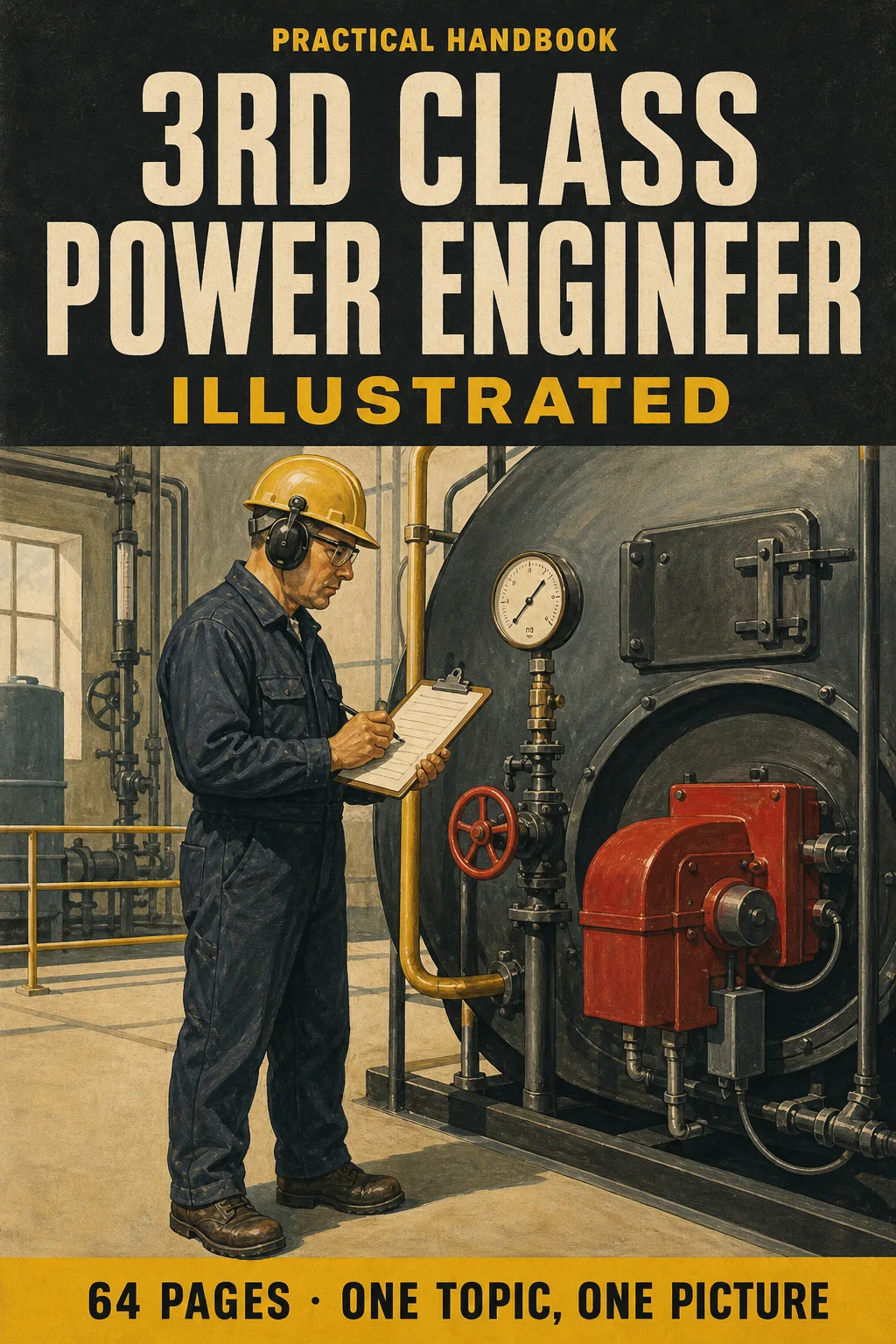
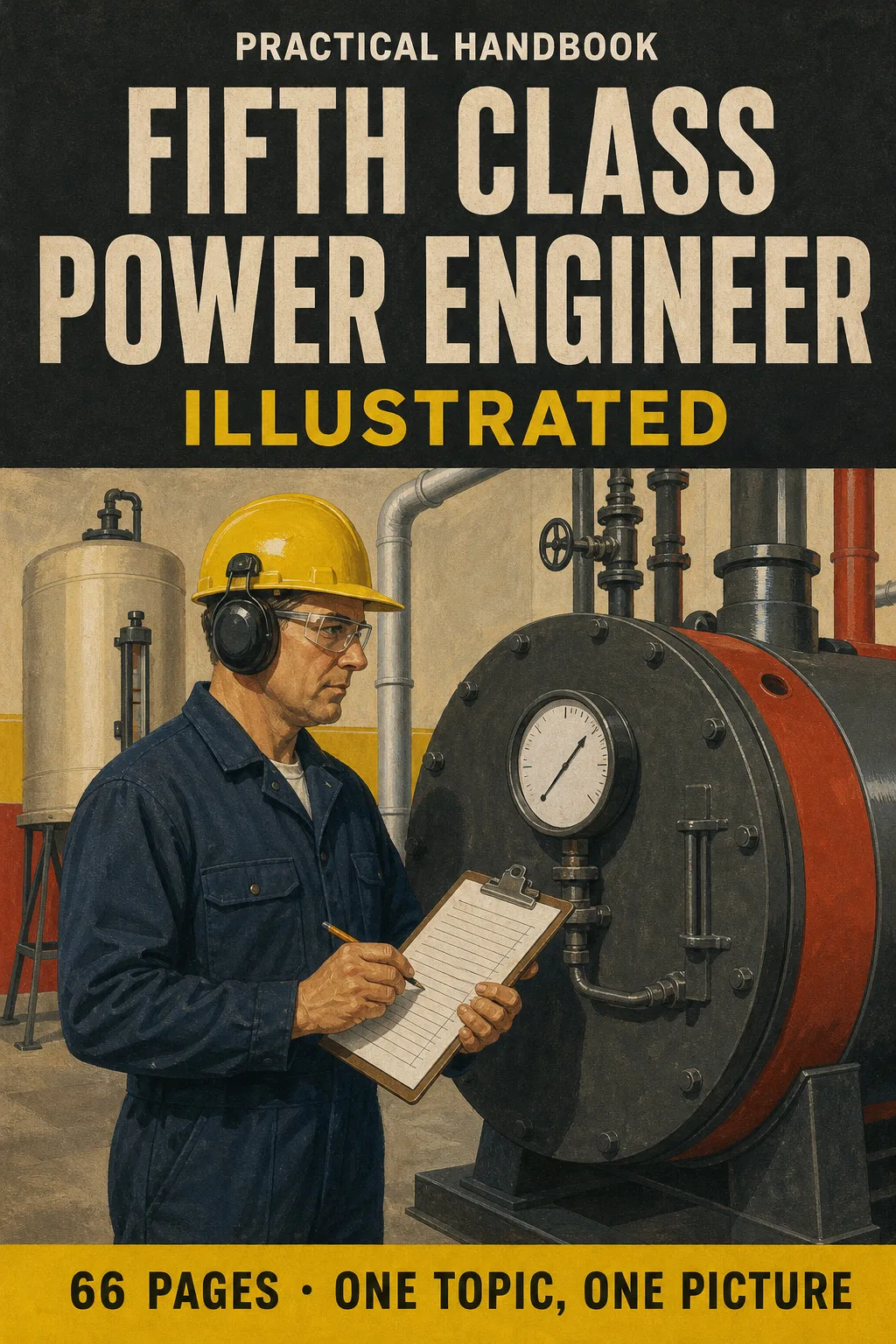
Study in Pictures🌐 English (Canada)
Fifth Class Power Engineer Illustrated

Digital book in PDF · read it on your phone or print it

Fifth Class Power Engineer Illustrated

Boilers in cross-section, gauge vs absolute pressure, safety valves, the gauge glass, feedwater, the gas burner train, purge and flame safeguard, lockout. Every topic gets its own page: first the drawing, then what you need to remember.

  • 66 illustrated pages
  • English
  • 30-day guarantee
CA$ 34.99CA$ 79.99
Get the book · CA$ 34.99

Price shown for: Canada. In other countries, the checkout shows the price that applies there.

About this book

What it is

Boilers in cross-section, gauge vs absolute pressure, safety valves, the gauge glass, feedwater, the gas burner train, purge and flame safeguard, lockout. Every topic gets its own page: first the drawing, then what you need to remember.

Who This Book Is For
  • You're studying for your Fifth Class
  • Your exam date is close
  • You already work in the plant
What it covers
  1. The Ticket and the Plant Map
  2. Pressure, Temperature and Heat
  3. Boilers Inside Out
  4. Fittings and Safety Devices
  5. Feedwater, Water Treatment and Steam Distribution
  6. Combustion and Burner Controls
  7. Plant Safety and Auxiliary Systems
  8. Operating Practice and Exam Review
Language
English (Canada)
Pages
66
Format
Digital book in PDF · read it on your phone or print it
Price
CA$ 34.99 (Canada)
Delivery
This is a digital PDF book sent to your email: nothing is printed or shipped.
30-Day Guarantee
30-day guarantee: if a file doesn't open, if the content isn't what the product page describes, if you were charged twice or the email never arrived, write to us and we'll refund you in full.

Look Inside the Book

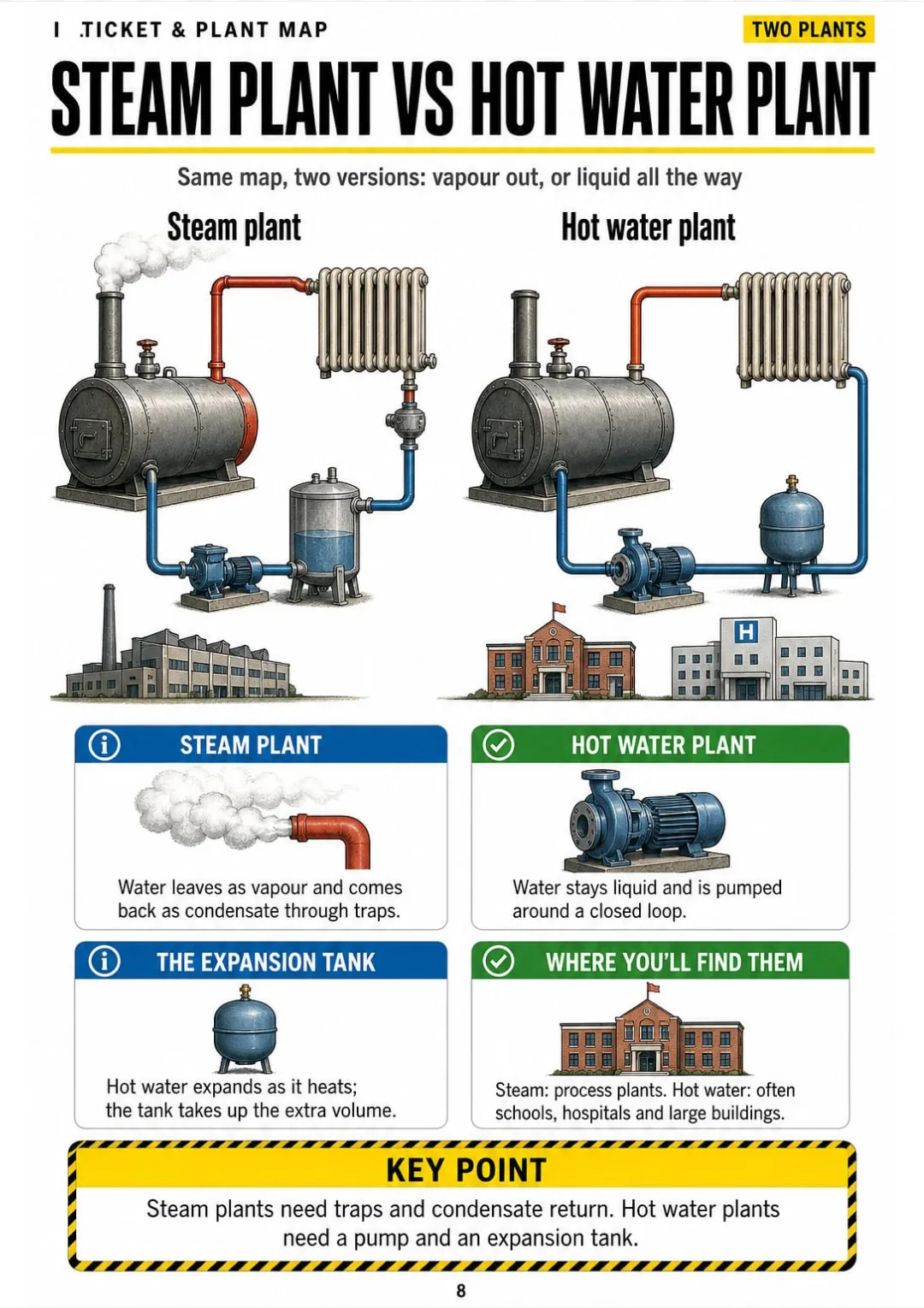
Steam: vapour out, condensate back. Hot water: closed loop with an expansion tank
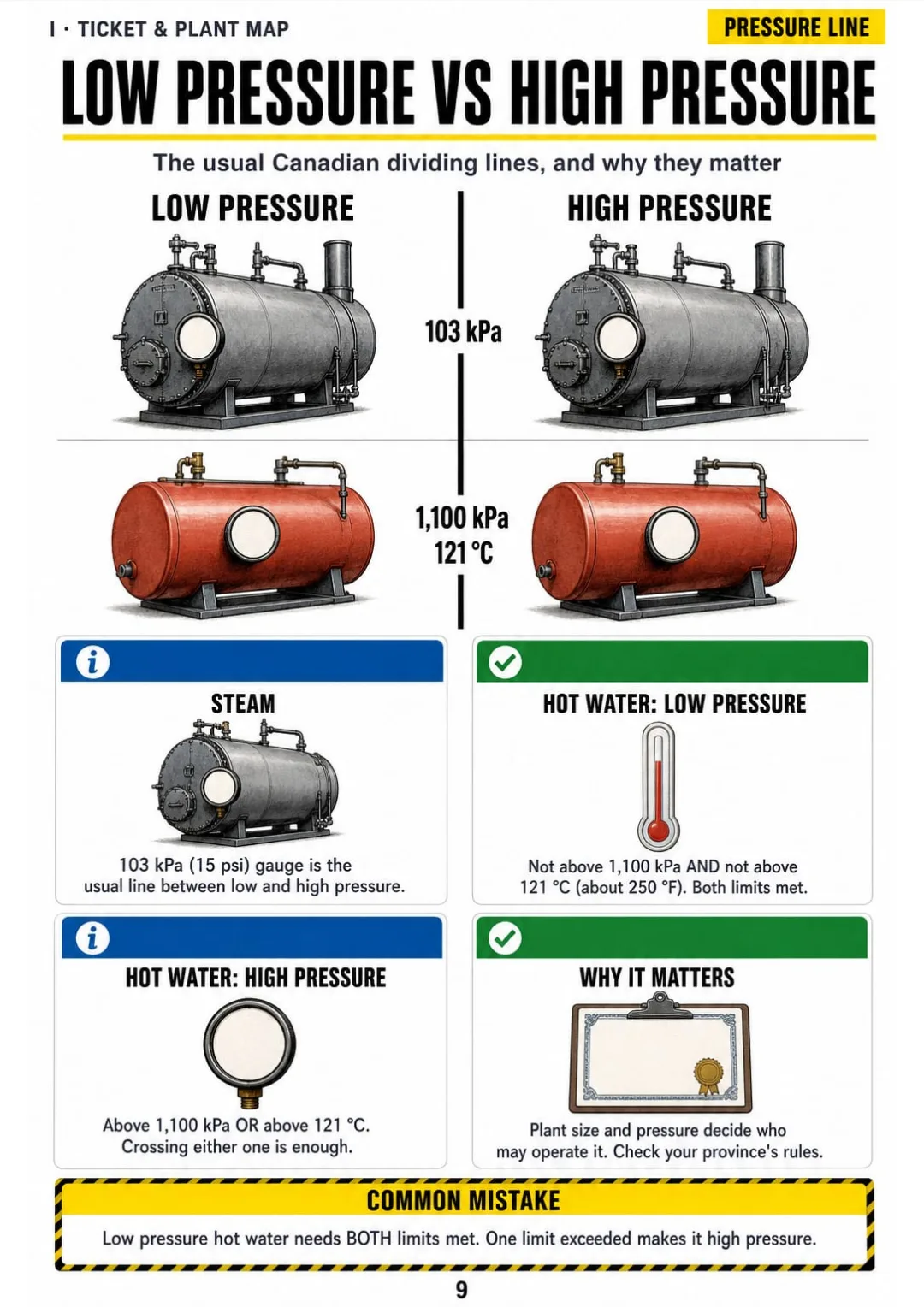
High pressure: steam above 103 kPa, hot water above 1,100 kPa or 121 °C
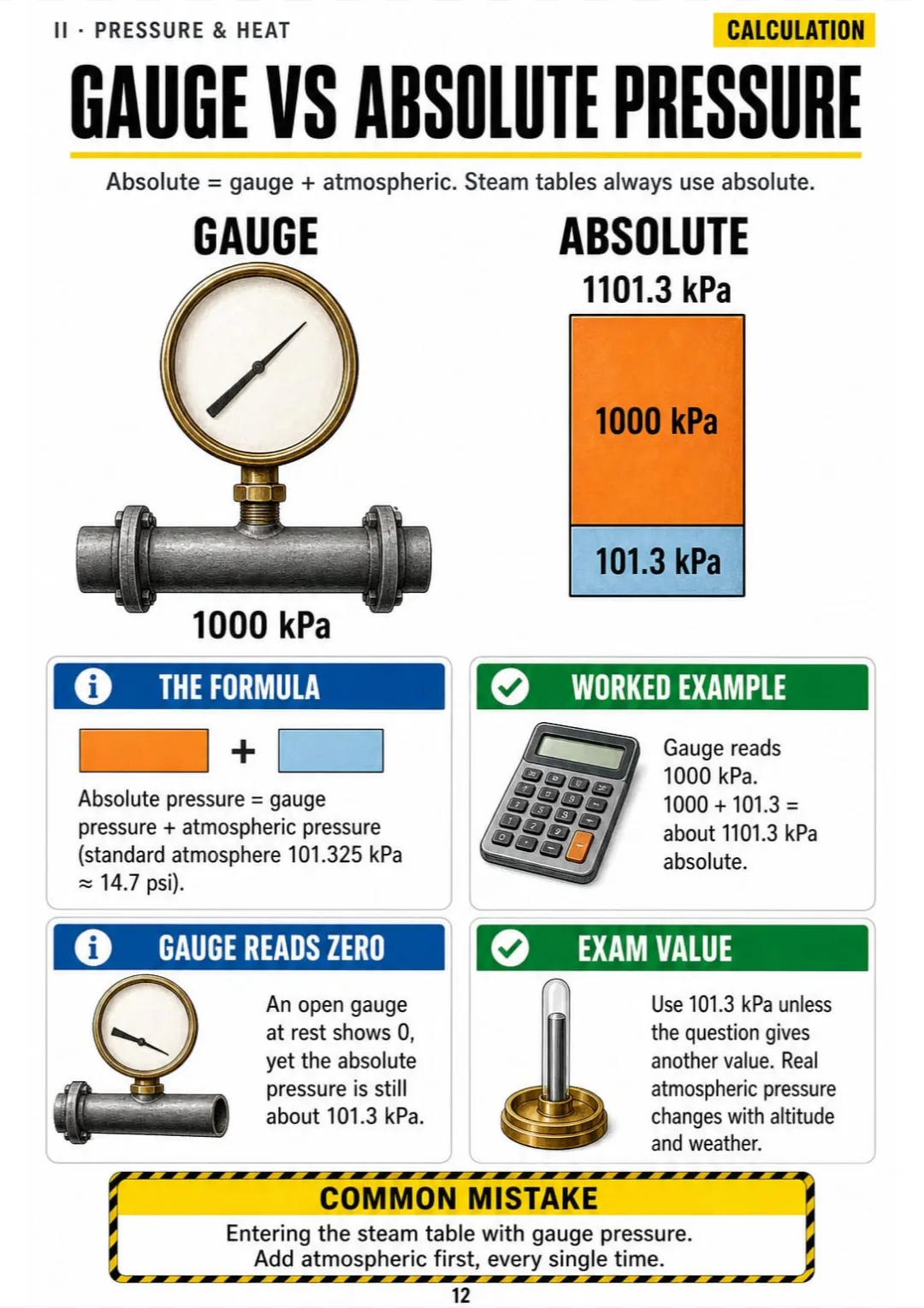
1000 kPa gauge = about 1101.3 kPa absolute
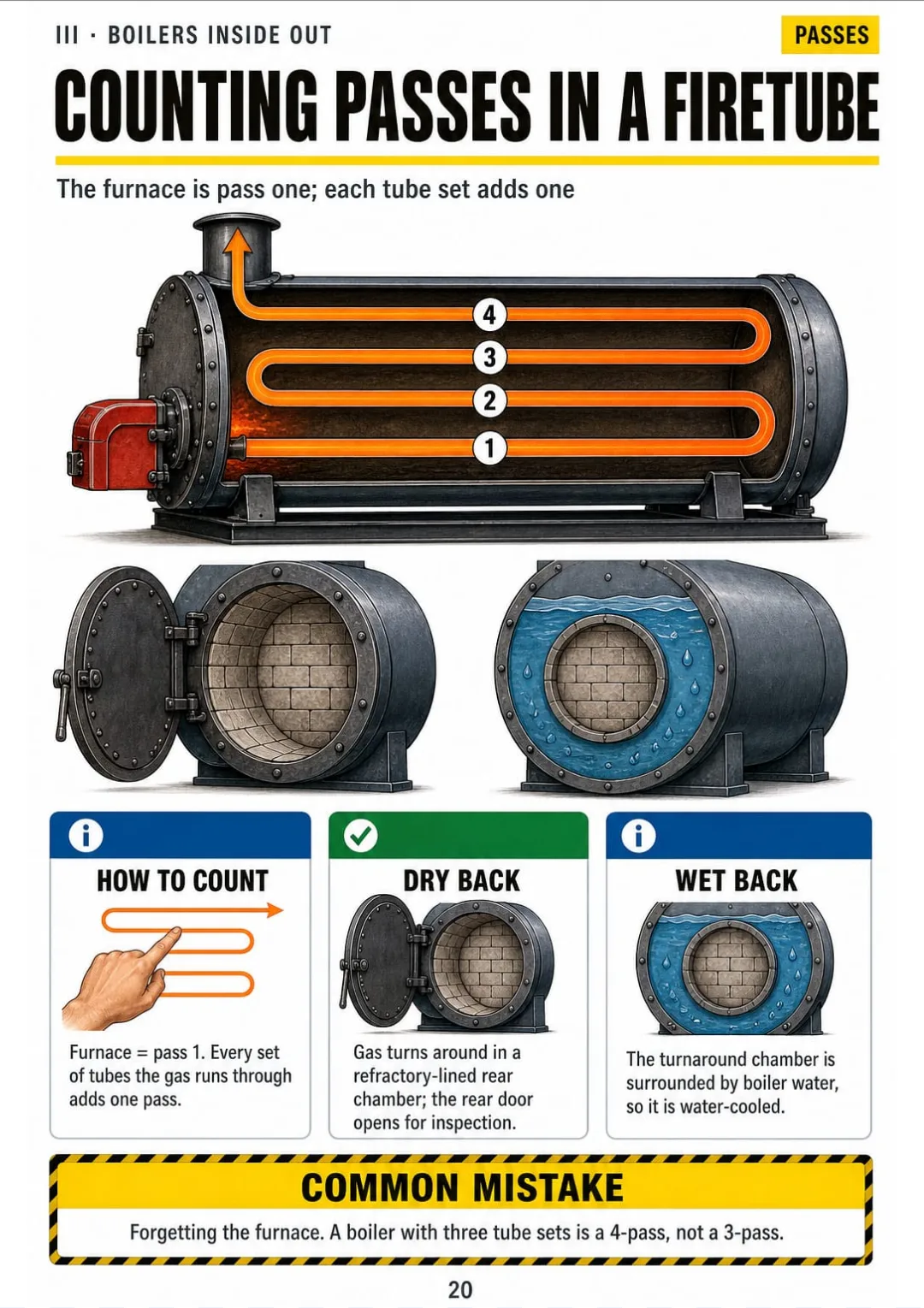
Furnace = pass 1, each tube set adds one; dry back vs wet back turnaround
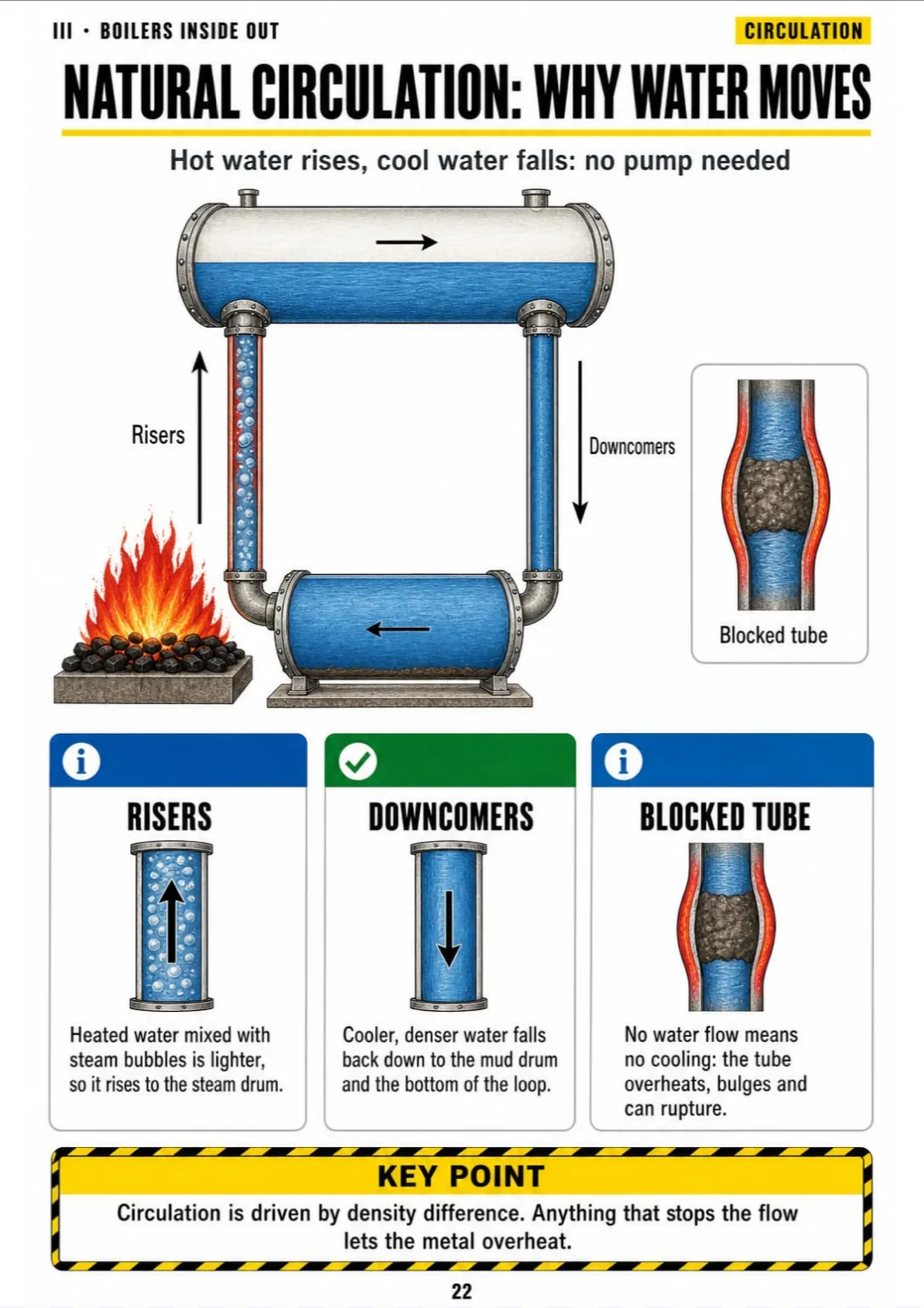
Risers carry lighter hot water up, downcomers bring denser water down; a blocked tube overheats
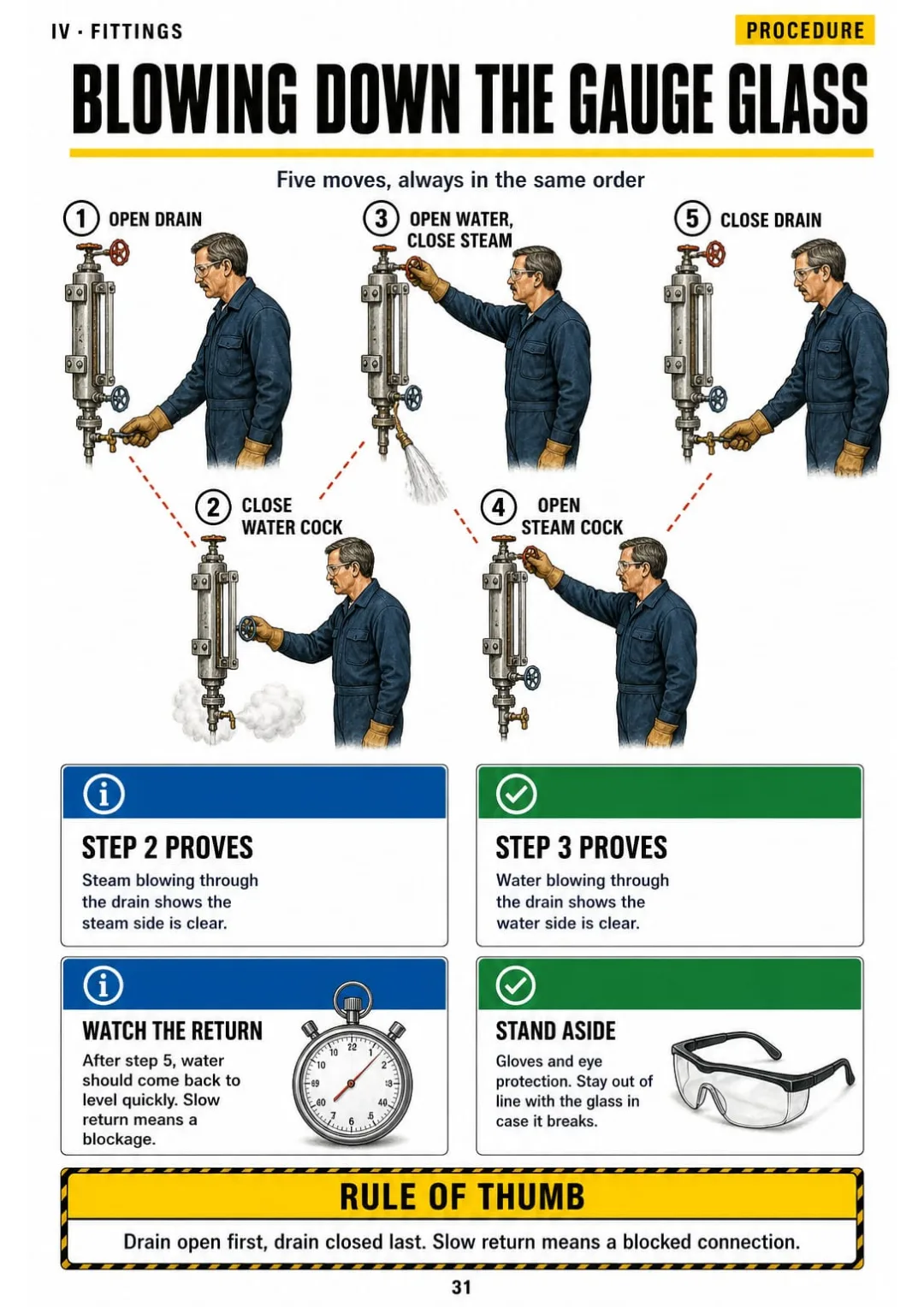
Open drain → close water → open water, close steam → open steam → close drain.
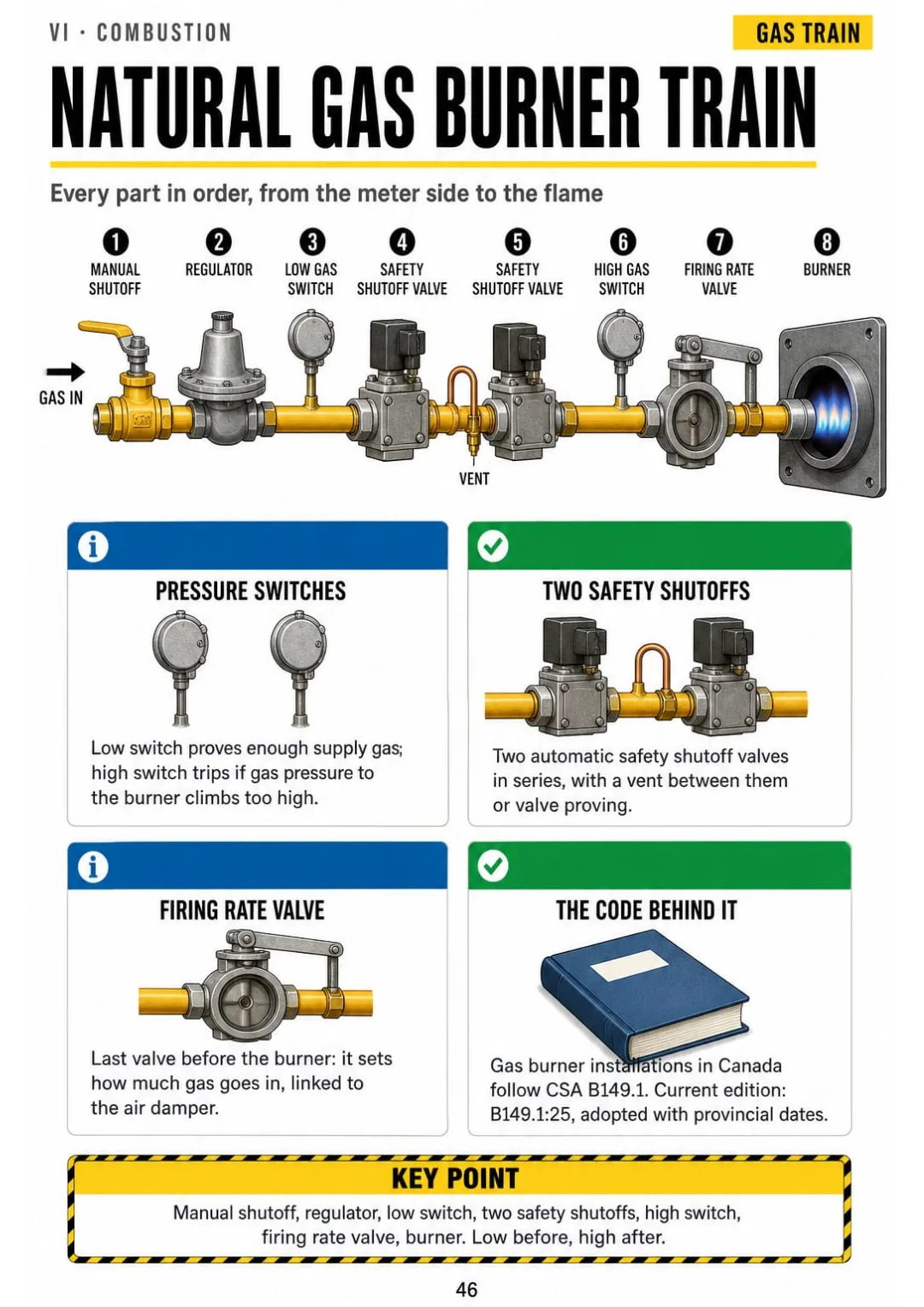
Manual shutoff → regulator → low gas switch → two safety shutoff valves → high gas switch → firing rate valve → burner.
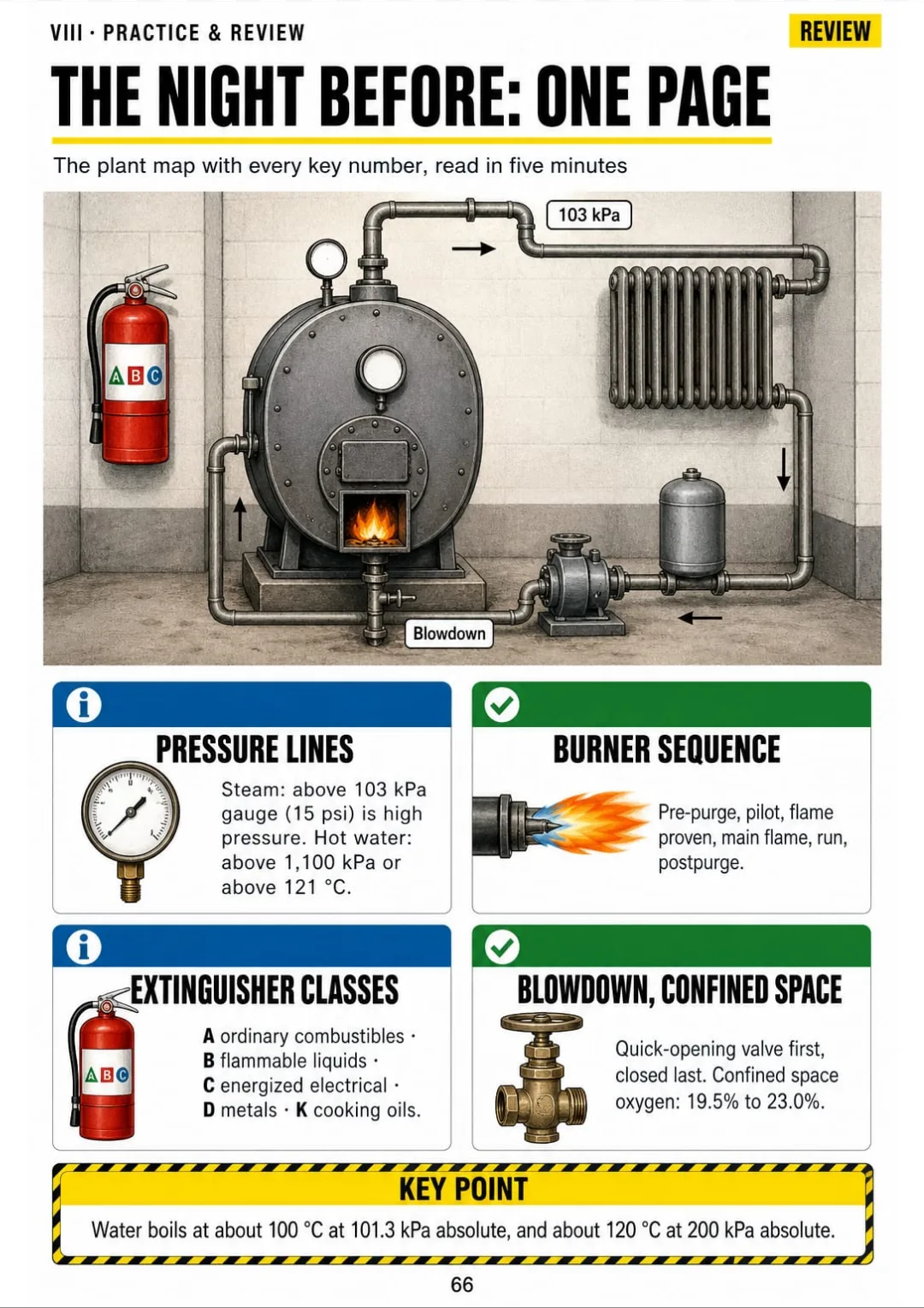
One-page review: 101.3 kPa, 103 kPa, 1,100 kPa, 121 °C, 4.19, 2,257, burner sequence, extinguisher classes.

Take a Look at the 8 Parts and 62 Topics

The Ticket and the Plant Map

pp. 5-10
  1. What a Fifth Class ticket lets you do
  2. How the exam works
  3. The plant map: one loop you will see on every page
  4. Steam plant vs hot water plant
  5. Low pressure vs high pressure boilers
  6. The boiler room in one picture

Pressure, Temperature and Heat

pp. 11-18
  1. Pressure is force on an area
  2. Gauge vs absolute pressure
  3. Vacuum and the condensate side
  4. Temperature scales and conversions
  5. Sensible heat vs latent heat
  6. Saturation: pressure sets the boiling point
  7. Wet, dry saturated and superheated steam
  8. Reading a steam table in four steps

Boilers Inside Out

pp. 19-26
  1. Firetube boiler in cross-section
  2. Counting passes in a firetube boiler
  3. Watertube boiler in cross-section
  4. Natural circulation: why the water moves
  5. Cast iron sectional and electric boilers
  6. Heating surface and boiler rating
  7. Boiler stays, tubes and how they fail
  8. The nameplate: what to read first

Fittings and Safety Devices

pp. 27-35
  1. Safety valve: pop open, blow down, reseat
  2. Safety valve vs relief valve
  3. The pressure gauge and its siphon
  4. Gauge glass and try cocks
  5. Blowing down the gauge glass, step by step
  6. Low water fuel cutoff
  7. Bottom blowdown valves: which first
  8. Main steam stop, non-return and feed check valves
  9. Hot water boiler fittings

Feedwater, Water Treatment and Steam Distribution

pp. 36-43
  1. The feedwater path, from tank to drum
  2. Why water must be treated
  3. Softeners and ion exchange
  4. Deaerator: removing the oxygen
  5. Boiler water testing on rounds
  6. Feed pumps and NPSH
  7. Steam traps: three families
  8. Water hammer and line drainage

Combustion and Burner Controls

pp. 44-51
  1. The combustion triangle and the three Ts
  2. Excess air: not too little, not too much
  3. Natural gas burner train
  4. Fuel oil firing basics
  5. Draft: forced, induced, natural, balanced
  6. Purge before every light-off
  7. Flame safeguard: the burner's sequence
  8. Operating controls vs limit controls

Plant Safety and Auxiliary Systems

pp. 52-58
  1. Lockout and isolation
  2. Confined space: boiler drum and furnace entry
  3. WHMIS and chemicals in the boiler room
  4. Fire extinguisher classes
  5. Electricity basics for operators
  6. Air compressors and receivers
  7. Heating systems and basic refrigeration

Operating Practice and Exam Review

pp. 59-66
  1. Boiler startup in the same order every time
  2. Normal operation and the daily round
  3. Taking a boiler off line and laying it up
  4. The logbook: what an inspector wants to see
  5. Emergencies: low water and flame failure
  6. Common mistakes in theory and on rounds
  7. How to read a multiple-choice question
  8. The night before: one-page review

Who This Book Is For

You're studying for your Fifth Class

Every syllabus topic on its own page, so after a shift you study one drawing, not a whole chapter.

Your exam date is close

The common mistakes, the one-page review and the exam-style questions show you your weak spots before you write the provincial exam.

You already work in the plant

Building operator, maintenance or oil and gas: the startup order, the daily round and the gauge glass blowdown drawn, printed and on hand during your shift.

Plus: 2 Free Books

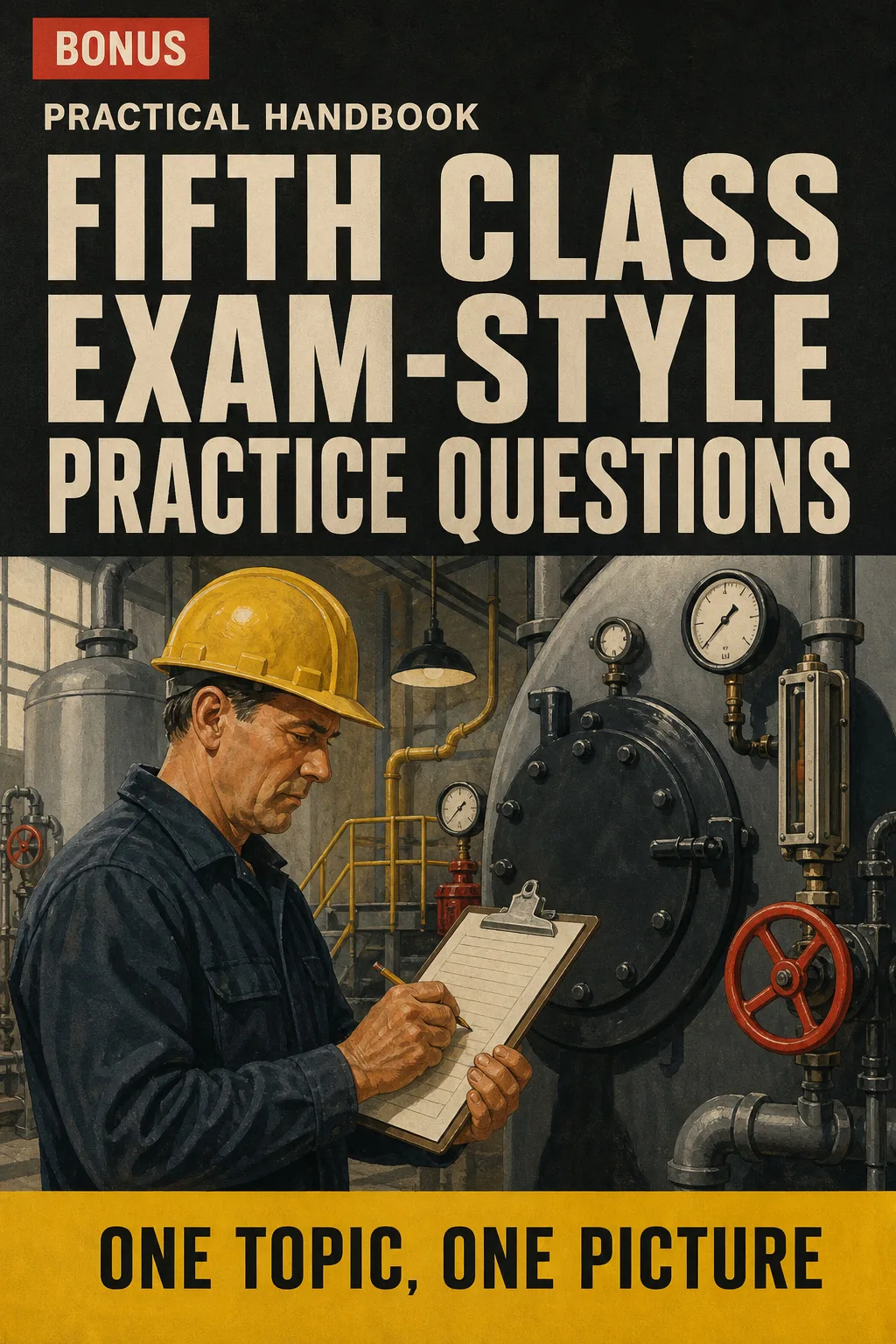
Fifth Class Exam-Style Practice Questions
BONUS 1

Fifth Class Exam-Style Practice Questions

Multiple-choice questions in the style of the certificate exam, each answer explained with a small drawing, so you find your weak spots before exam day.
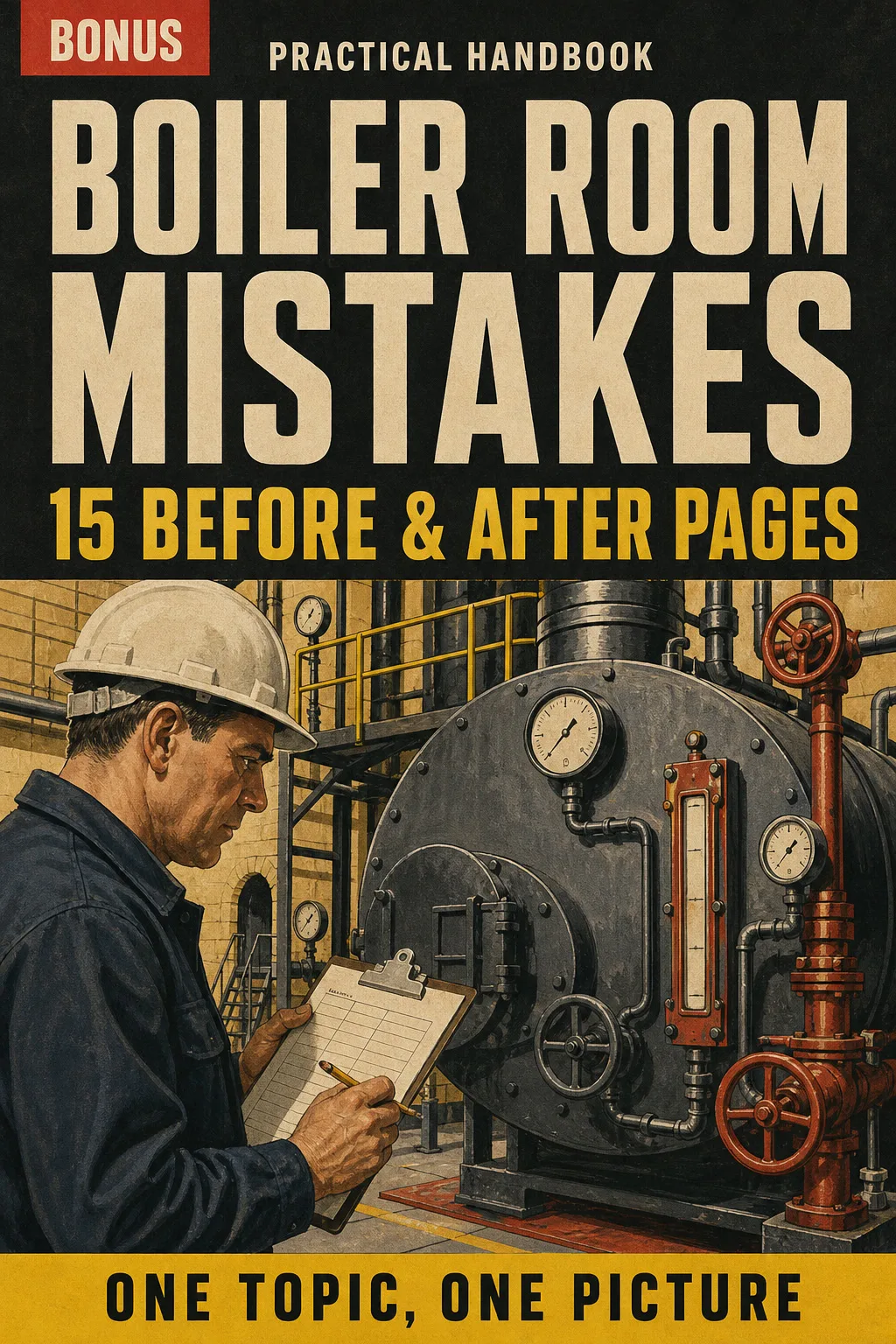
Boiler Room Mistakes: 15 Before & After Pages
BONUS 2

Boiler Room Mistakes: 15 Before & After Pages

The most common mistakes on rounds and in the theory, drawn wrong and then right, so the correct picture is the one you remember.

30-Day Guarantee

30-day guarantee: if a file doesn't open, if the content isn't what the product page describes, if you were charged twice or the email never arrived, write to us and we'll refund you in full. You pay once. No subscriptions.

Frequently Asked Questions

Is it for me if I've been out of school for 20 years?

Yes. It's written for working adults: one topic per page, the drawing first and the key numbers in a box. No academic padding.

Does it work for my province (Alberta, BC, Saskatchewan, Ontario)?

It's based on the interprovincial Fifth Class Power Engineer syllabus, CSA B51 and the rules of provinces that follow it, such as Alberta (ABSA), BC (Technical Safety BC) and Saskatchewan (TSASK). Not every province issues a Fifth Class certificate, so check with your regulator (in Ontario, TSSA) that your exam follows the interprovincial syllabus. Set pressures, intervals and exam format are flagged so you can confirm them for your province.

Is it official material?

No. It's an independent illustrated study book. It isn't published, approved or endorsed by any regulator, standards body or school, and it doesn't give you a ticket, a certificate or firing time: only your provincial regulator's exam and requirements do that.

Does it replace my course or textbook?

No. It's the drawn companion for reviewing and understanding. It doesn't replace your course, your site procedures or your chief engineer.

Are the practice questions the ones on the exam?

No. They're written for this book in multiple-choice style. They aren't official questions from any exam.

When and how do I get it?

The book and the 2 bonus books arrive as PDFs by email, at the address you enter at checkout.

Do I have to pay every month?

No. It's a one-time payment.

Can I have it on paper?

Yes. It's a printable PDF: print the whole book or just the pages you want on hand at work.

How does the refund work?

You have 30 days. We refund everything if the file won't open, if the book isn't what you see on this page, if you were charged twice or if the email doesn't arrive: just email us.

CA$ 34.99CA$ 79.99
Get the book · CA$ 34.99

This is a digital PDF book sent to your email: nothing is printed or shipped.

More books on this topic

Chimney & Wood Heat Illustrated

Wood stoves, inserts, clearances to combustibles, flue pipe, chimney height, draft, sweeping and Level 1, 2 and 3…

From CA$ 34.99 CA$ 79.99

Gas Technician 2 Illustrated

Prepare for the Ontario Gas Technician 2 exam one illustrated page at a time: pipe sizing in kPa, m³/h and kW, venting…

From CA$ 34.99 CA$ 79.99

2nd Class Power Engineer Illustrated

The 2nd Class Power Engineer syllabus explained one topic per page: boilers, fittings and safety valves, steam tables…

From CA$ 34.99 CA$ 79.99