Study in Pictures🌐 English (United States)
Security Alarm Installer Illustrated

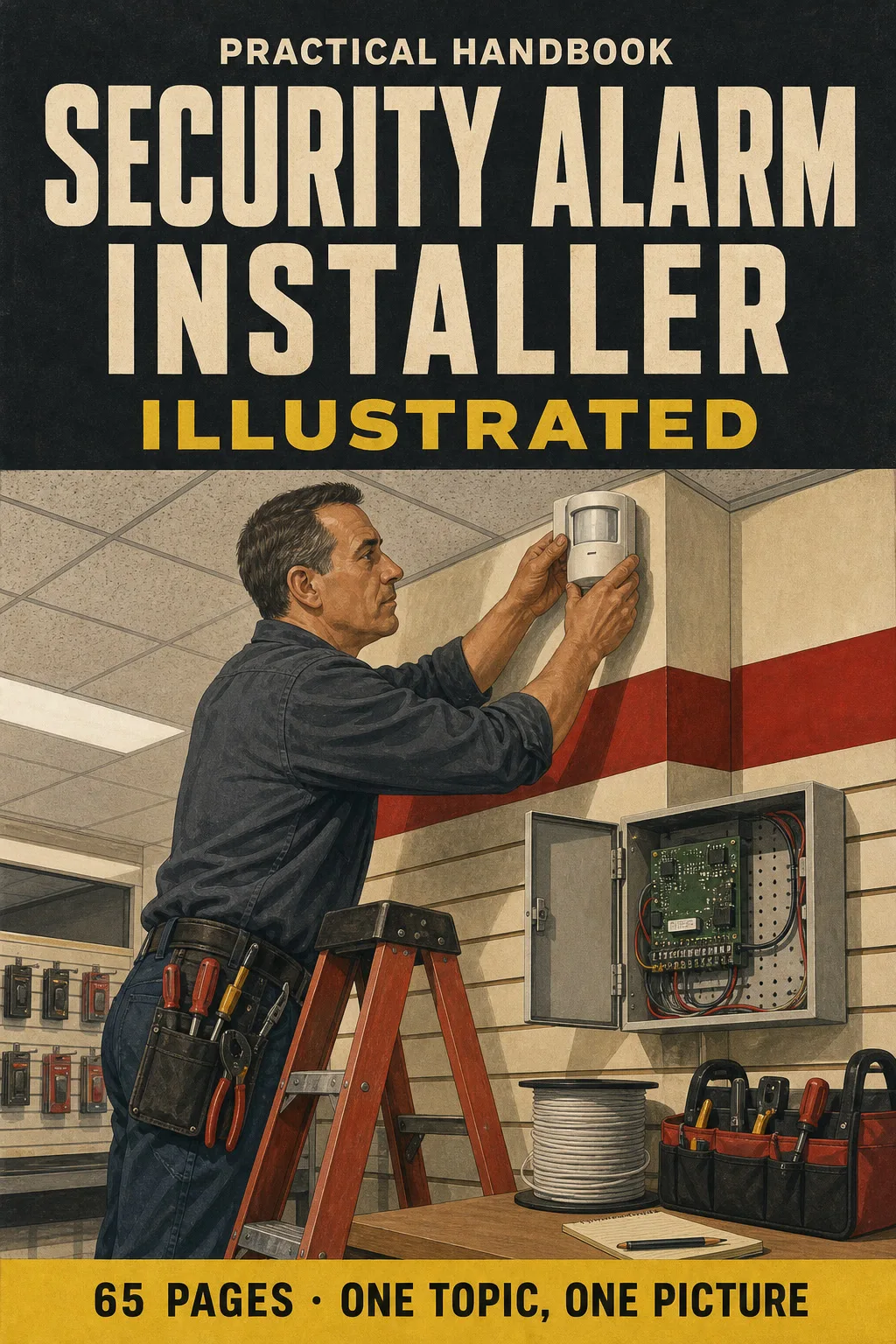
Digital book in PDF · read it on your phone or print it

Security Alarm Installer Illustrated

Control panels, standby batteries, EOL resistors, zone types, PIR placement, Ohm's law, communicators, maglocks and REX. Every topic has its own page: the drawing first, then what you need to remember.

  • 65 illustrated pages
  • English
  • 30-day guarantee
US$ 27US$ 63
Get the book · US$ 27

Price shown for: United States. In other countries, the checkout shows the price that applies there.

About this book

What it is

Control panels, standby batteries, EOL resistors, zone types, PIR placement, Ohm's law, communicators, maglocks and REX. Every topic has its own page: the drawing first, then what you need to remember.

Who This Book Is For
  • You're studying for the license
  • Your exam date is close
  • You already install alarms
What it covers
  1. The System and Your Exam
  2. Electricity for Low Voltage
  3. Panels, Power and Wiring
  4. Zones and Supervision
  5. Sensors and Placement
  6. Wireless, Communication and Monitoring
  7. Access Control and Locked Doors
  8. Review: Exam and Job Site
Language
English (United States)
Pages
65
Format
Digital book in PDF · read it on your phone or print it
Price
US$ 27 (United States)
Delivery
This is a digital PDF book sent to your email: nothing is printed or shipped.
30-Day Guarantee
30-day guarantee: if a file doesn't open, if the content isn't what the product page describes, if you were charged twice or the email never arrived, write to us and we'll refund you in full.

Look Inside the Book

No federal license: state board + training (e.g., ESA CAT Level 1) + local AHJ
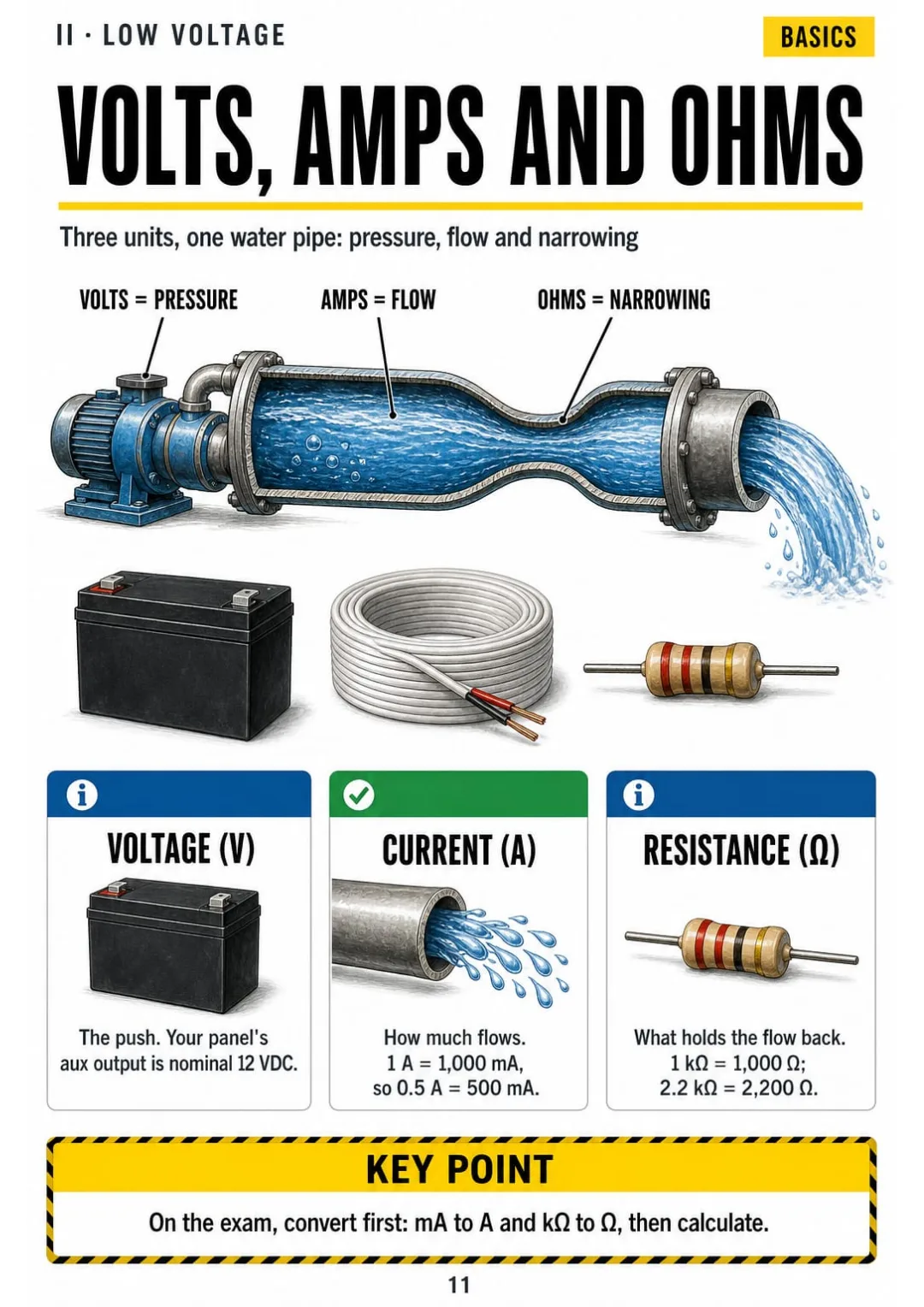
Volts = pressure, amps = flow, ohms = narrowing · 1 A = 1,000 mA · 2.2 kΩ = 2,200 Ω
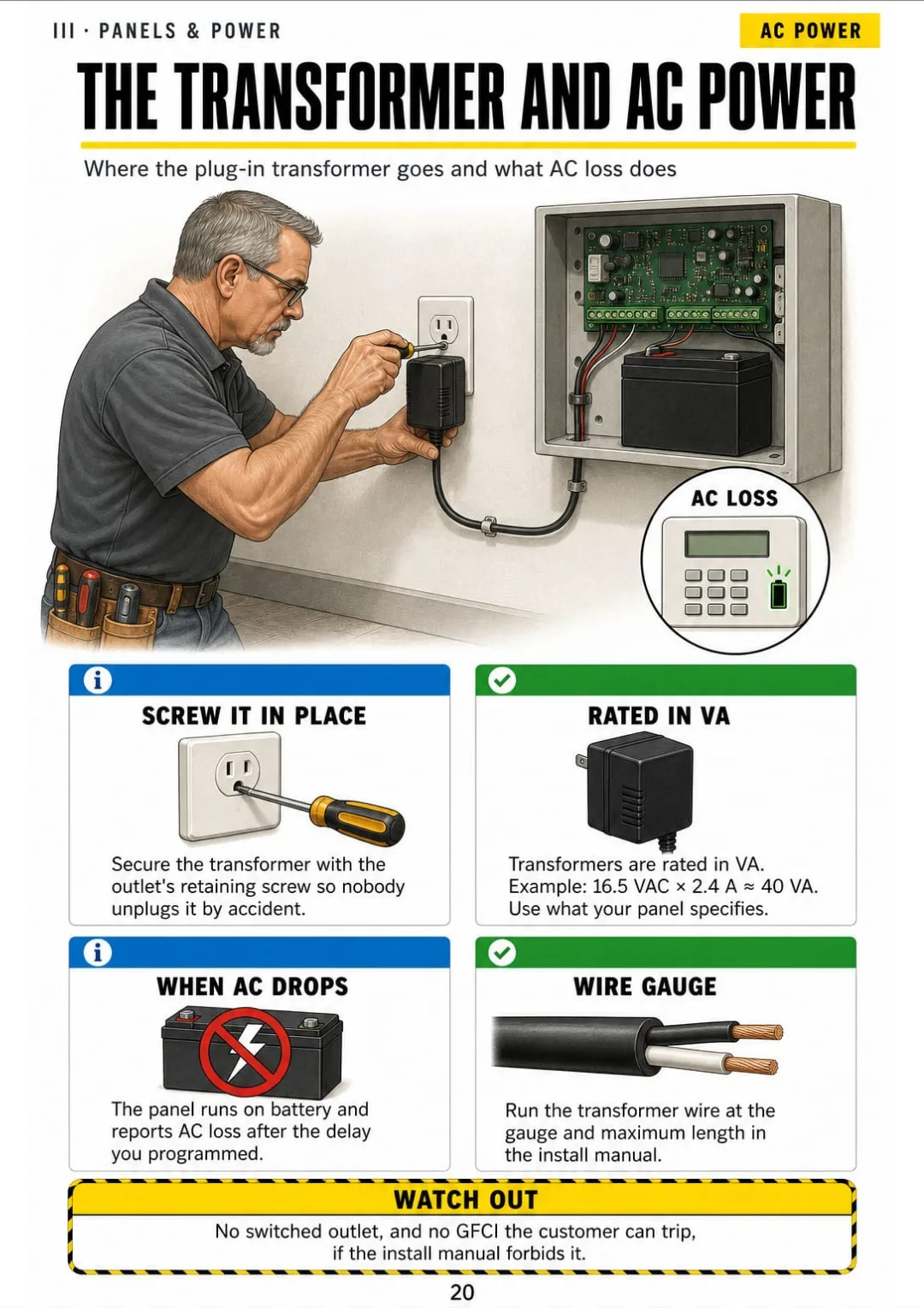
Non-switched outlet, retaining screw, VA rating: 16.5 VAC × 2.4 A ≈ 40 VA example.
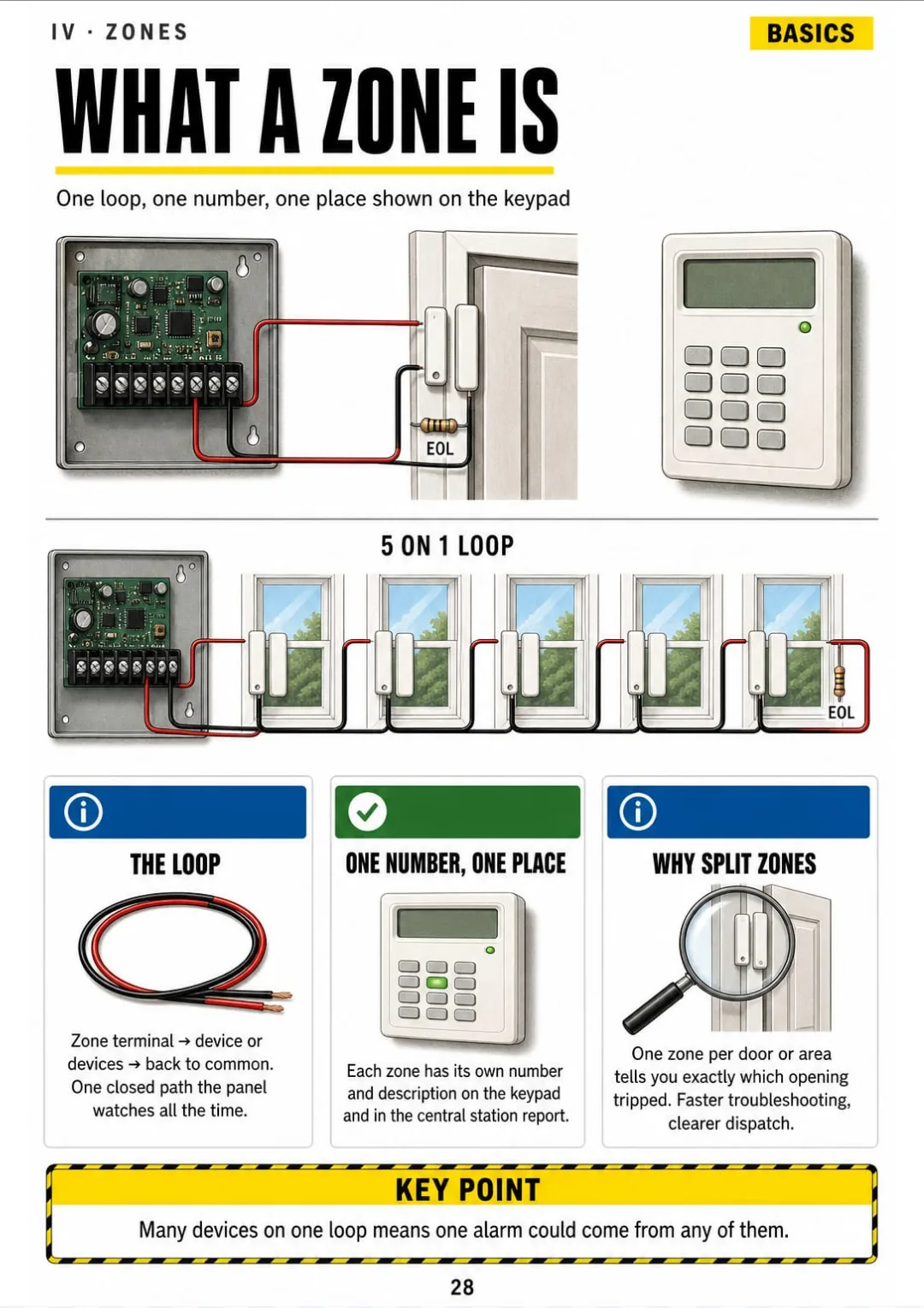
Zone terminal → device → back to common: one loop, one number on the keypad.
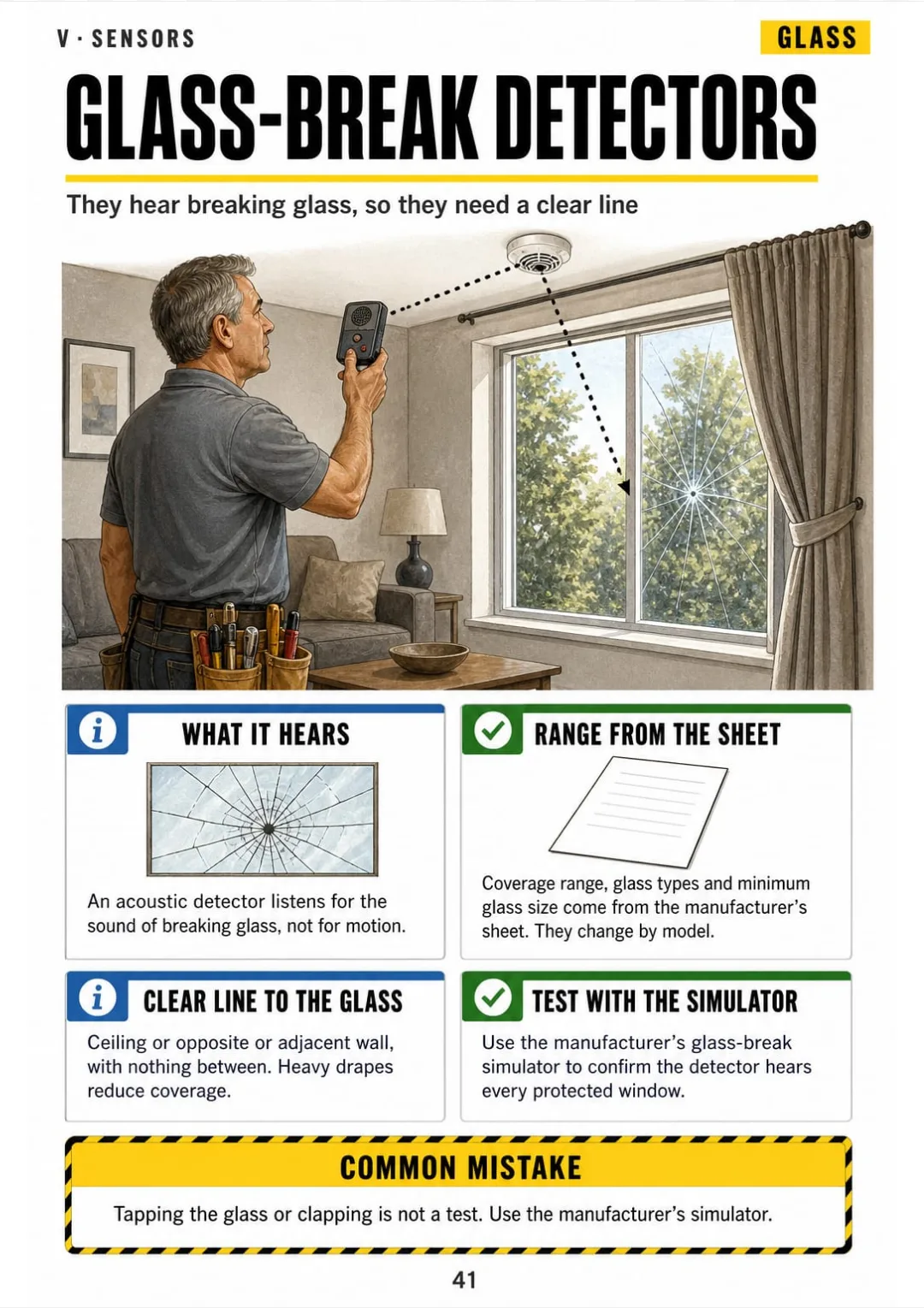
Acoustic glass-break: range per spec sheet, clear line to the glass, tested with the simulator.
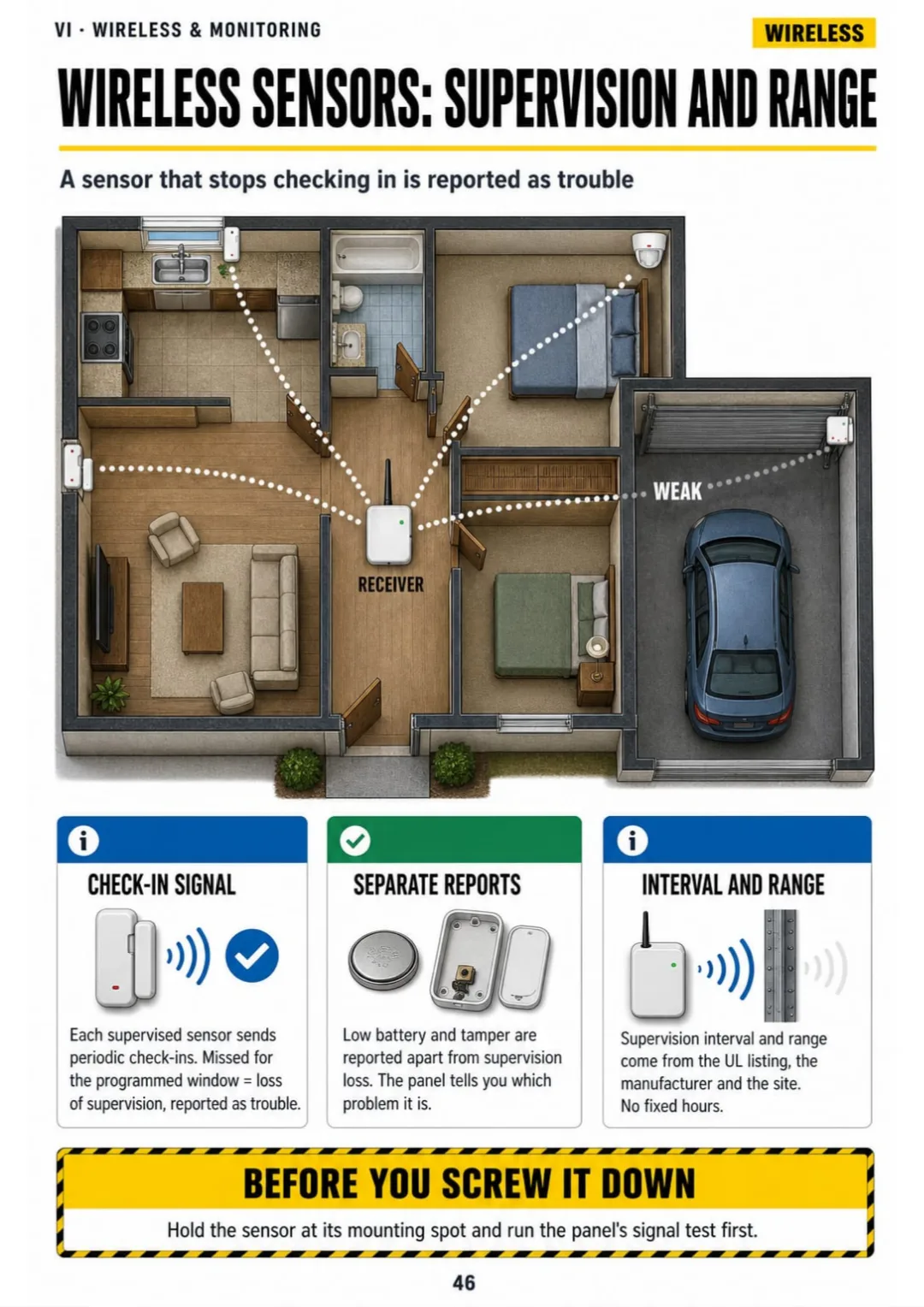
Missed check-in = loss of supervision; low battery and tamper reported separately.
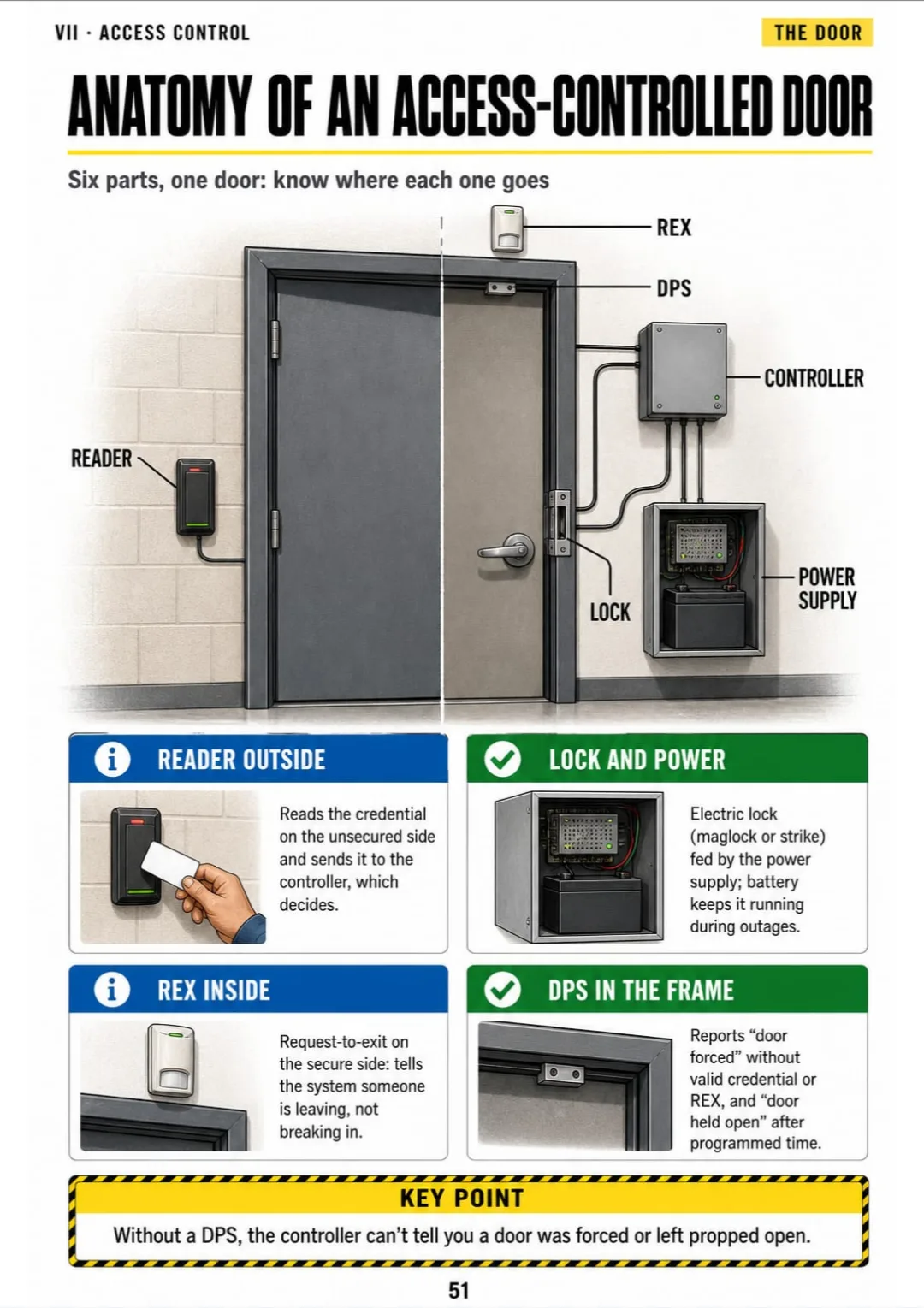
Reader, controller, power supply, lock, REX and DPS on one drawing of the door.
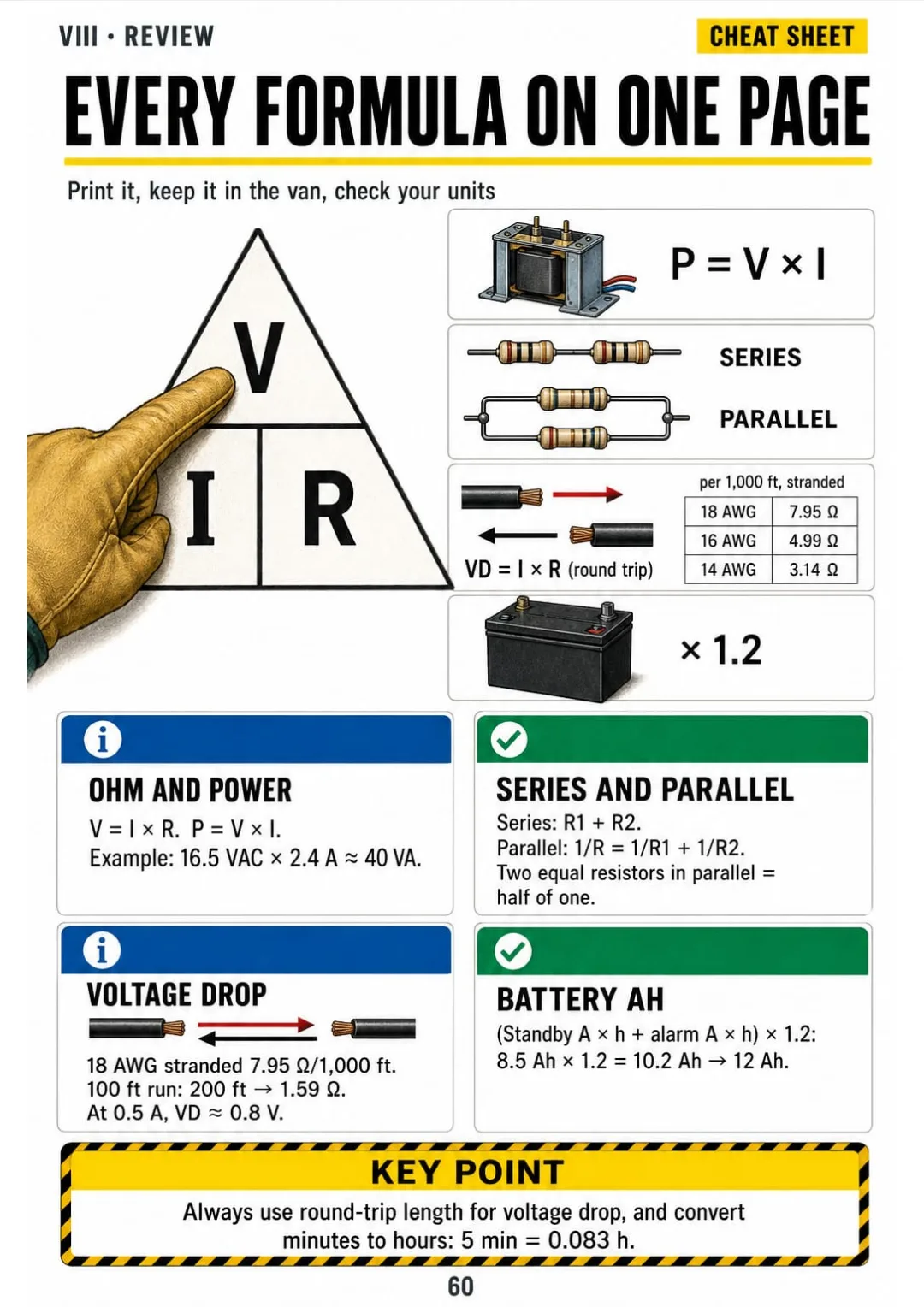
Ohm, power, series/parallel, voltage drop and battery Ah, each with a worked example

Take a Look at the 8 Parts and 61 Topics

The System and Your Exam

pp. 5-10
  1. Your Alarm License: Who Asks for It and What It Covers
  2. How to Use This Book
  3. The Alarm System at a Glance
  4. The Codes and Standards You'll Meet
  5. The AHJ, Alarm Permits and False Alarm Ordinances
  6. Normally Open vs. Normally Closed

Electricity for Low Voltage

pp. 11-18
  1. Volts, Amps and Ohms
  2. Ohm's Law: The Triangle
  3. Power: Watts and VA
  4. Series and Parallel Circuits
  5. AC In, DC Out
  6. Using the Multimeter
  7. Wire Gauge and Resistance
  8. Voltage Drop in 4 Steps

Panels, Power and Wiring

pp. 19-27
  1. Inside the Control Panel
  2. The Transformer and AC Power
  3. The Standby Battery
  4. Standby Battery Calculation: The Method
  5. Worked Example: Sizing the Battery
  6. Aux Power Budget and Add-On Power Supplies
  7. Class 2 Cable Types
  8. Routing and Separation from Power Wiring
  9. Earth Ground and Surge Protection

Zones and Supervision

pp. 28-35
  1. What a Zone Is
  2. The EOL Resistor: Where It Goes
  3. Single EOL: Reading the Loop
  4. Double EOL: Alarm vs. Tamper
  5. Measuring a Zone with the Meter
  6. Zone Types
  7. Entry/Exit Delays and CP-01 Defaults
  8. Cross-Zoning, Swinger Shutdown and Bypass

Sensors and Placement

pp. 36-45
  1. Door and Window Contacts
  2. Recessed, Surface and Overhead Door Contacts
  3. How a PIR Sees You
  4. PIR Mounting: Height and What to Avoid
  5. Pet-Immune and Dual-Technology Detectors
  6. Glass-Break Detectors
  7. Shock Sensors and Photoelectric Beams
  8. Panic, Hold-Up and Environmental Sensors
  9. Keypads and the Data Bus
  10. Sirens, Speakers and Strobes

Wireless, Communication and Monitoring

pp. 46-50
  1. Wireless Sensors: Supervision and Range
  2. Communicator Paths: Phone, Cellular, IP
  3. Contact ID: Reading the Event Code
  4. The Central Station and Verification
  5. Testing with the Central Station

Access Control and Locked Doors

pp. 51-59
  1. Anatomy of an Access-Controlled Door
  2. Credentials and Readers
  3. Wiegand vs. OSDP
  4. Fail-Safe vs. Fail-Secure
  5. Maglocks
  6. Electric Strikes
  7. REX Devices
  8. Sensor-Release Egress Doors (NFPA 101)
  9. Delayed Egress and Fire Alarm Release

Review: Exam and Job Site

pp. 60-65
  1. Every Formula on One Page
  2. Numbers to Have at Hand
  3. Zone Troubleshooting in Order
  4. Testing Before You Leave
  5. Customer Handover
  6. Most Frequent Mistakes at a Glance

Who This Book Is For

You're studying for the license

Each topic is one drawn page, so after a long day you can study one page a night and see how the whole system connects.

Your exam date is close

Every formula on one page and the battery math in the same steps every time, plus practice questions to check yourself before the test.

You already install alarms

Print the pages you need and keep them in the truck: the EOL loop, PIR mounting, the access door, the troubleshooting order.

Plus: 2 Free Books

Alarm Tech Exam-Style Practice Questions
BONUS 1

Alarm Tech Exam-Style Practice Questions

Test yourself on sensors, zones, wiring and battery math with exam-style questions, each answer explained with a reference to the page where the topic is drawn.
The 15 Most Common Alarm Install Mistakes: Before & After
BONUS 2

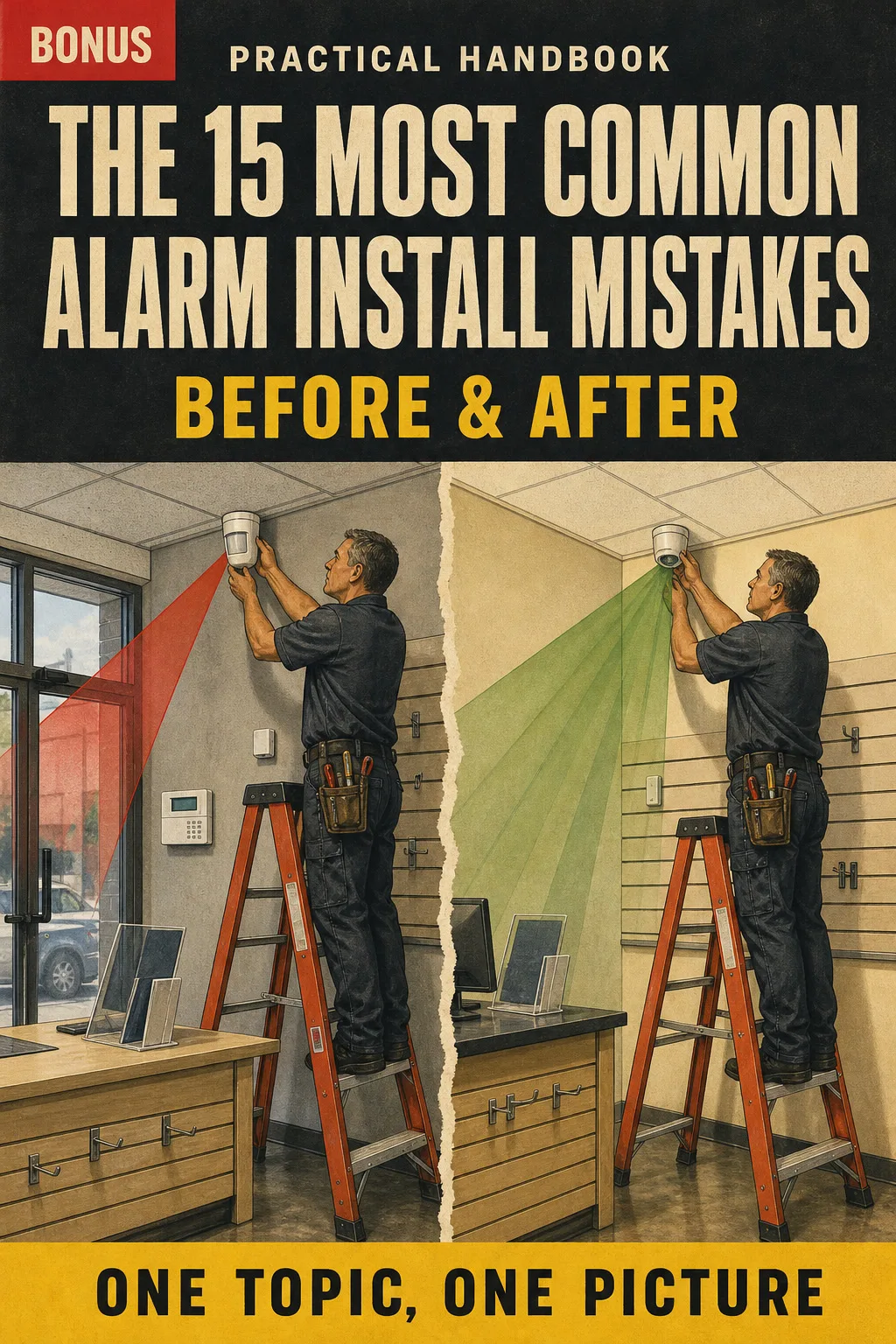
The 15 Most Common Alarm Install Mistakes: Before & After

Review the most frequent install errors side by side, wrong vs. right, so you spot them on the job and on the test.

30-Day Guarantee

30-day guarantee: if a file doesn't open, if the content isn't what the product page describes, if you were charged twice or the email never arrived, write to us and we'll refund you in full. You pay once. No subscriptions.

Frequently Asked Questions

Is it for me if I've been installing for years and now need the state license?

Yes. It isn't written for beginners: it goes straight to how each part connects and how to solve the calculations, with the basics drawn for quick review.

Will it work for my state's exam, and is it up to date with the codes?

It covers what alarm license exams have in common: Ohm's law with numbers, standby battery sizing, zones and EOL resistors, sensors, monitoring and access control. Code values are checked against the current editions of NFPA 70 (Class 2 and Class 3 circuits), NFPA 72, NFPA 101 for locked egress doors, ANSI/SIA CP-01 and UL 681, 2050 and 294. Each state has its own board and adopts code editions on its own schedule, so check your board's exam outline and the edition it enforces.

Is this official material?

No. It's independent study material, not affiliated with or endorsed by any state board, code body or certification association, and it doesn't give you a license or a certificate. It covers the topics that state license exams and Level I alarm tech certifications have in common, so you can use it to review for either.

Does it replace my course or training?

No. It helps you understand and review, but it doesn't replace the training hours, materials or exams your state requires, or the manufacturer's instructions.

Are the practice questions the ones on the exam?

No. They're written for this book, in the style of the exam, and each answer points to the page where the topic is drawn.

When and how do I get it?

As a PDF by email, sent to the address you enter at checkout.

Is this a subscription?

No. It's a one-time payment for the PDF. For state-specific rules, check your state board's candidate handbook.

Can I have it on paper?

Yes. It's a printable PDF: print the whole book or just the pages you want in the truck.

How does the refund work?

You have 30 days. We refund everything if the file won't open, if the book isn't what you see on this page, if you were charged twice or if the email doesn't arrive: just email us.

US$ 27US$ 63
Get the book · US$ 27

This is a digital PDF book sent to your email: nothing is printed or shipped.

More books on this topic

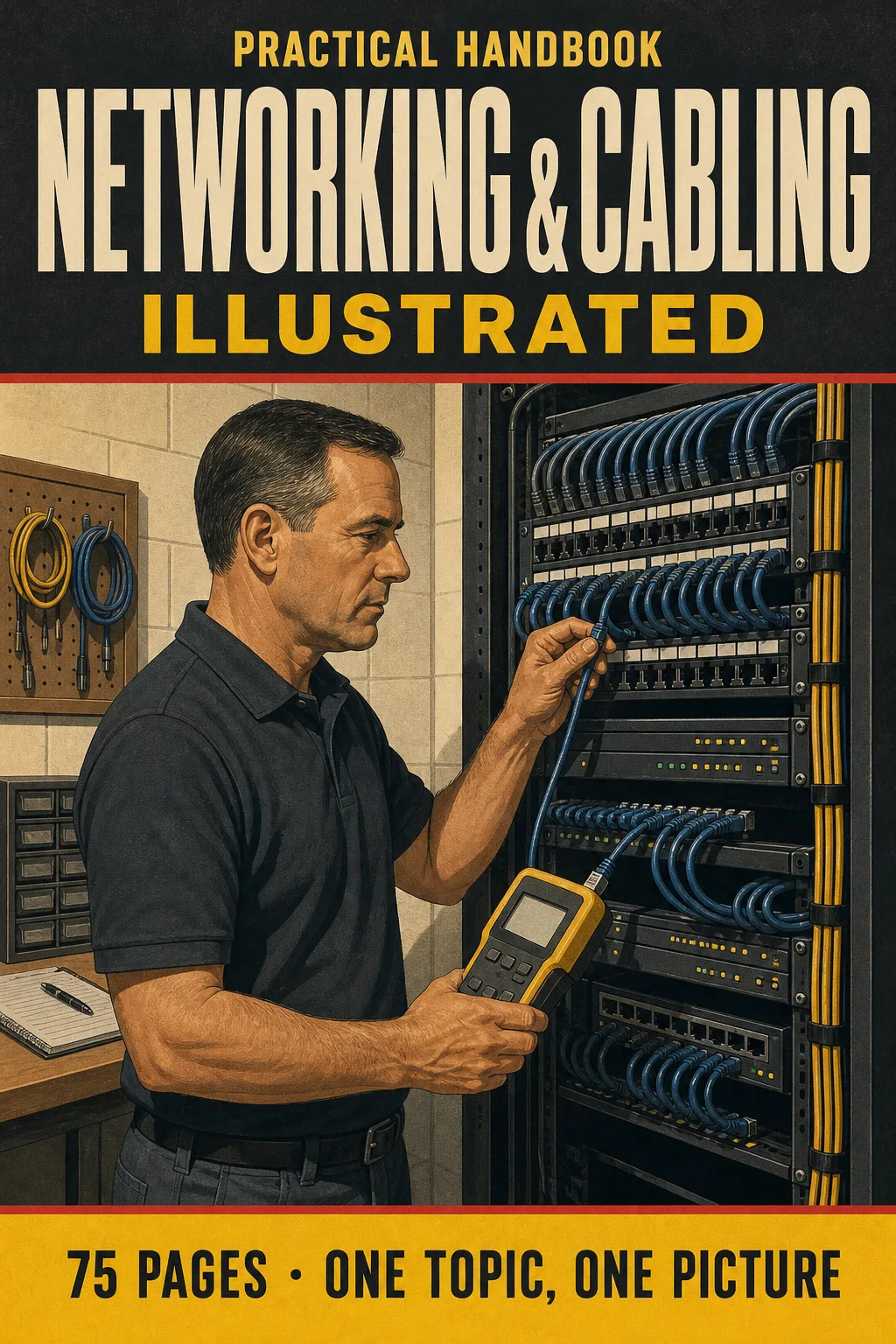
Networking & Cabling Illustrated

Networking and structured cabling explained one topic per page, each with a big, clear drawing: RJ45 pinouts T568A and…

From US$ 27 US$ 63

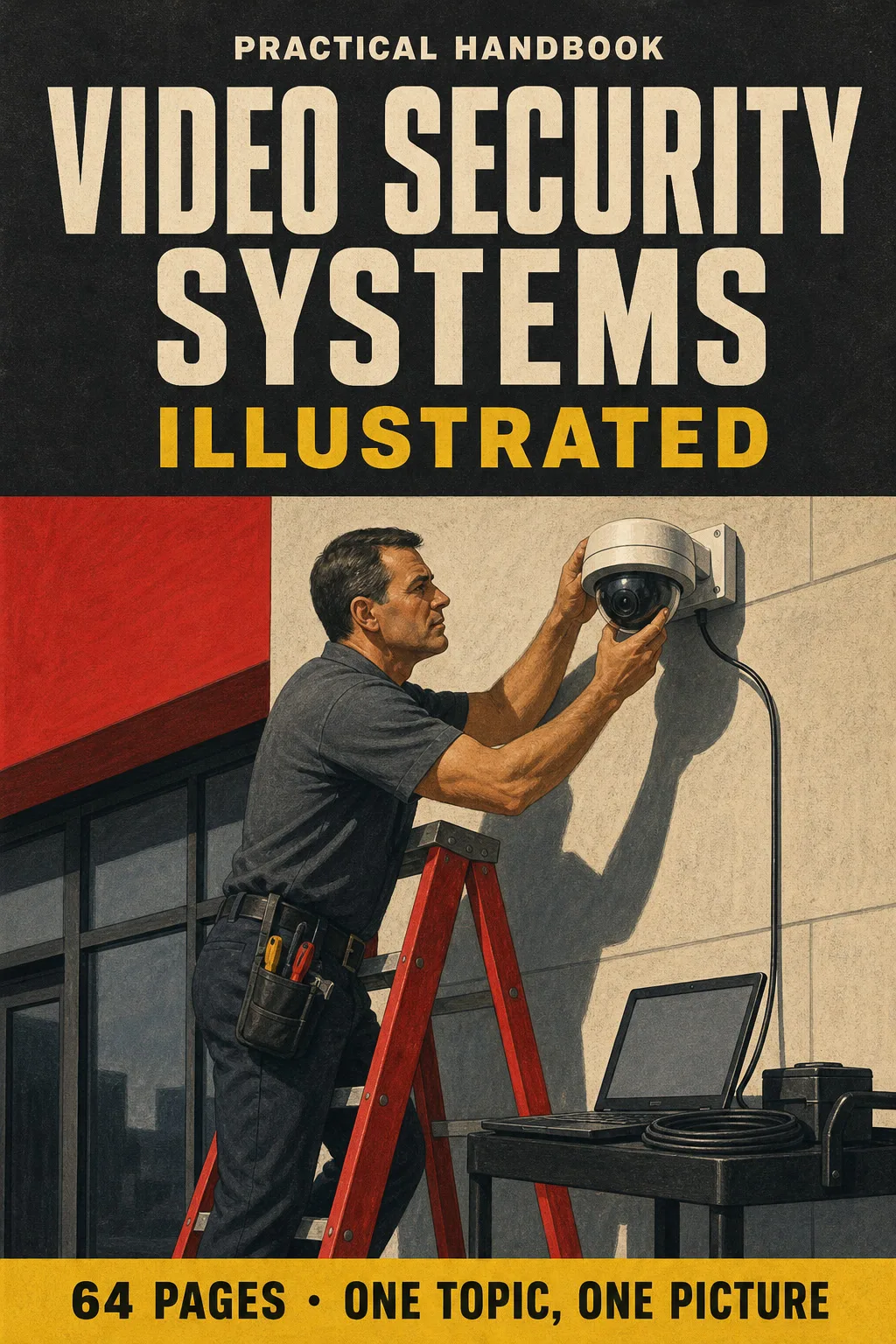
Video Security Systems Illustrated

Video surveillance explained one topic per page, every concept drawn: system architecture, camera types, lenses and…

From US$ 27 US$ 63

Locksmith Illustrated

An illustrated locksmith book for license and certification prep: pin tumbler cylinders, key blanks and bitting…

From US$ 27 US$ 63

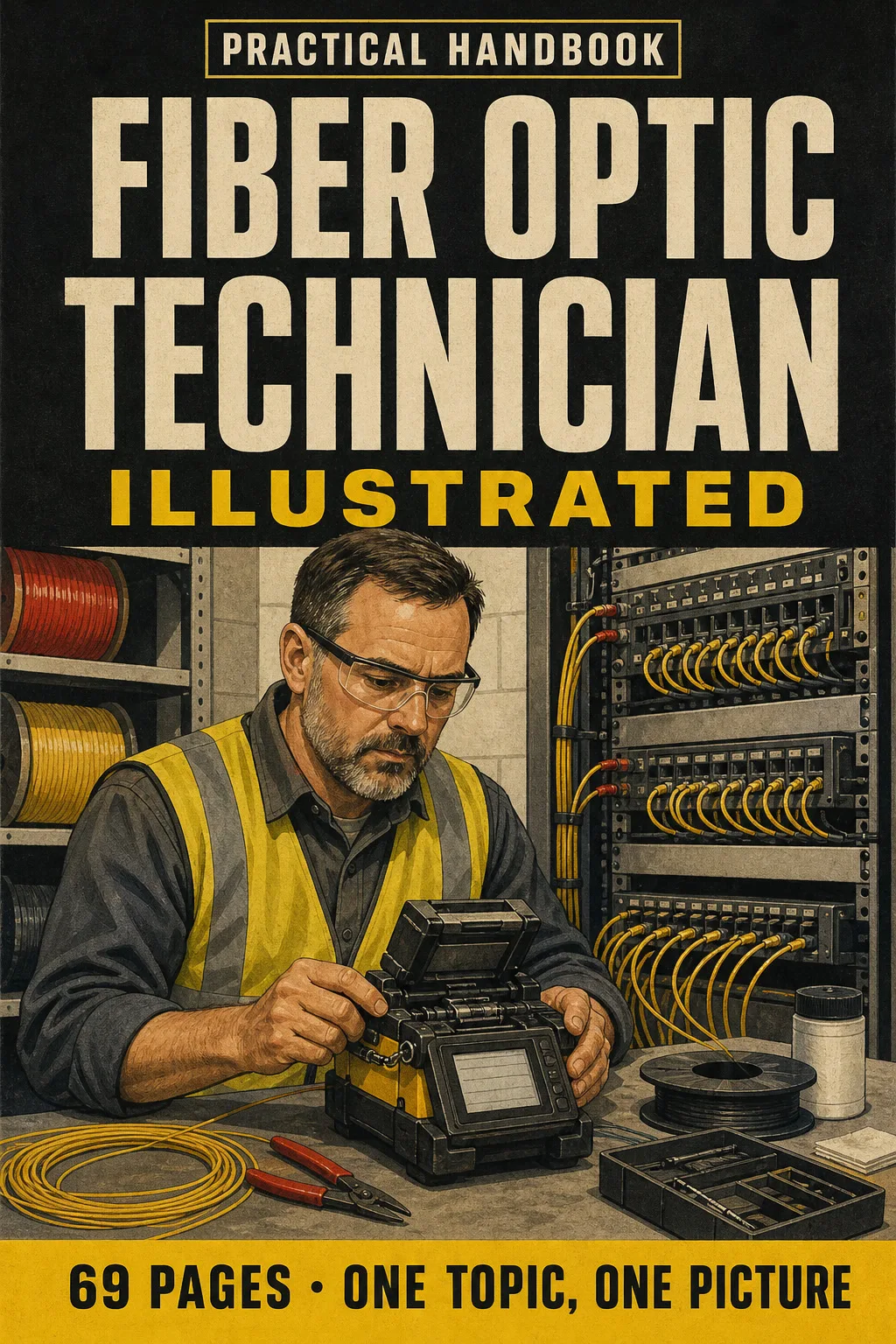
Fiber Optic Technician Illustrated

Fiber optics explained one topic per page, every concept drawn: singlemode vs. multimode, LC/SC/MPO and UPC vs. APC…

From US$ 27 US$ 63

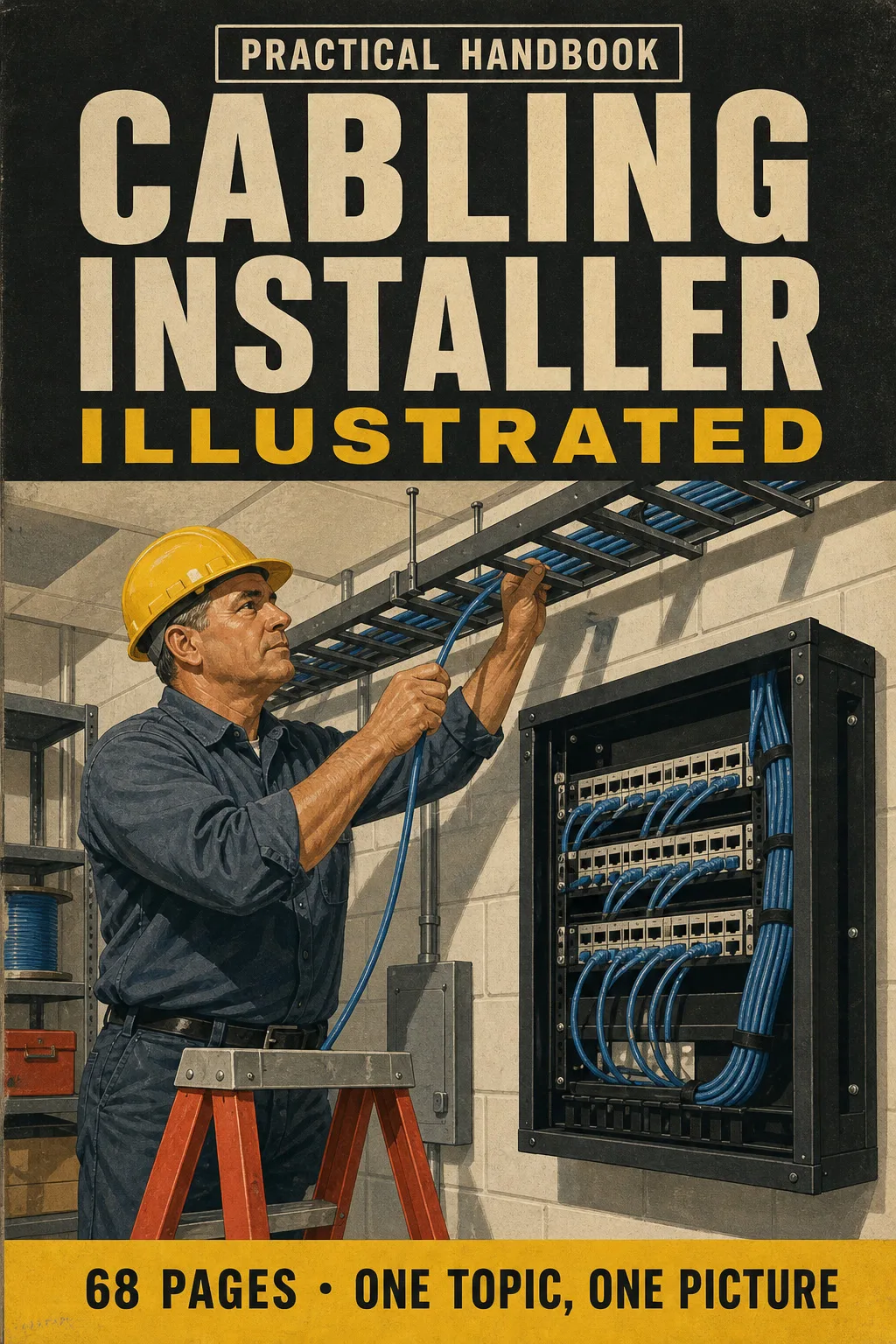
Cabling Installer Illustrated

Structured cabling explained one topic per page, every concept drawn: the 6 subsystems as one path, Cat 5e vs Cat 6 vs…

From US$ 27 US$ 63

Tower Technician Illustrated

Get ready for the TTT-1 written exam with a book you can actually picture: tower anatomy, fall protection, 100%…

From US$ 27 US$ 63