Study in Pictures🌐 English (United States)
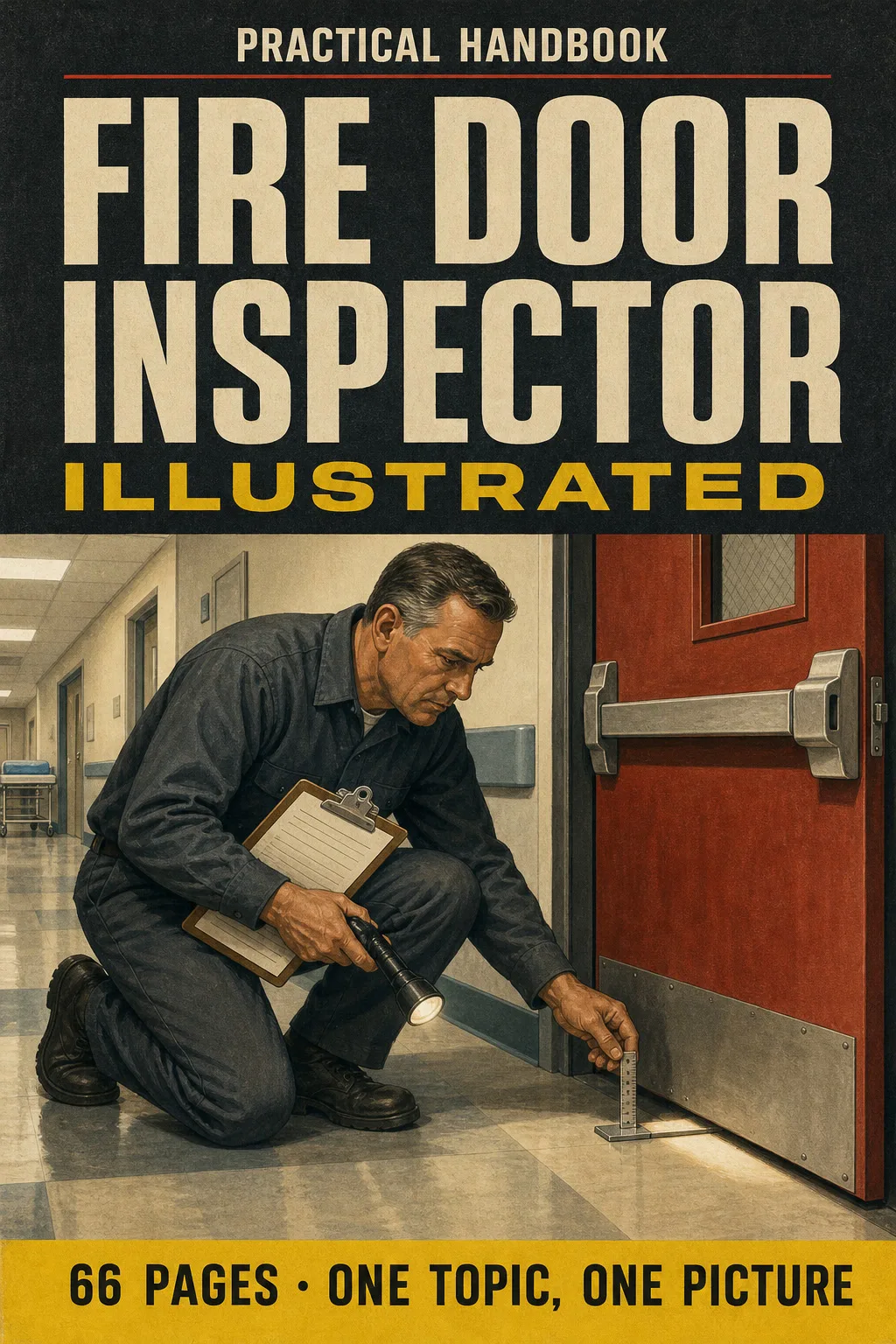
Fire Door Inspector Illustrated

Digital book in PDF · read it on your phone or print it

Fire Door Inspector Illustrated

Labels, clearances, hinges, closers, positive latching, astragals, vision lites, field modifications and egress rules. Every topic gets its own page: the drawing first, then what you need to remember.

  • 66 illustrated pages
  • English
  • 30-day guarantee
US$ 27US$ 63
Get the book · US$ 27

Price shown for: United States. In other countries, the checkout shows the price that applies there.

About this book

What it is

Labels, clearances, hinges, closers, positive latching, astragals, vision lites, field modifications and egress rules. Every topic gets its own page: the drawing first, then what you need to remember.

Who This Book Is For
  • You're learning fire door inspection
  • Your certification exam is coming up
  • You already inspect fire doors
What it covers
  1. The Basics Before the First Door
  2. Step 1: Labels and Ratings
  3. Step 2: Clearances with Worked Measurements
  4. Steps 3-4: Hinges, Closers and Hold-Opens
  5. Steps 5-6: Latching, Pairs and Astragals
  6. Steps 7-8: Glazing, Gaskets and Signage
  7. Step 9: Field Modifications and Repairs
  8. Step 10: Egress Rules (NFPA 101)
  9. Step 11: Documentation, Review and Practice
Language
English (United States)
Pages
66
Format
Digital book in PDF · read it on your phone or print it
Price
US$ 27 (United States)
Delivery
This is a digital PDF book sent to your email: nothing is printed or shipped.
30-Day Guarantee
30-day guarantee: if a file doesn't open, if the content isn't what the product page describes, if you were charged twice or the email never arrived, write to us and we'll refund you in full.

Look Inside the Book

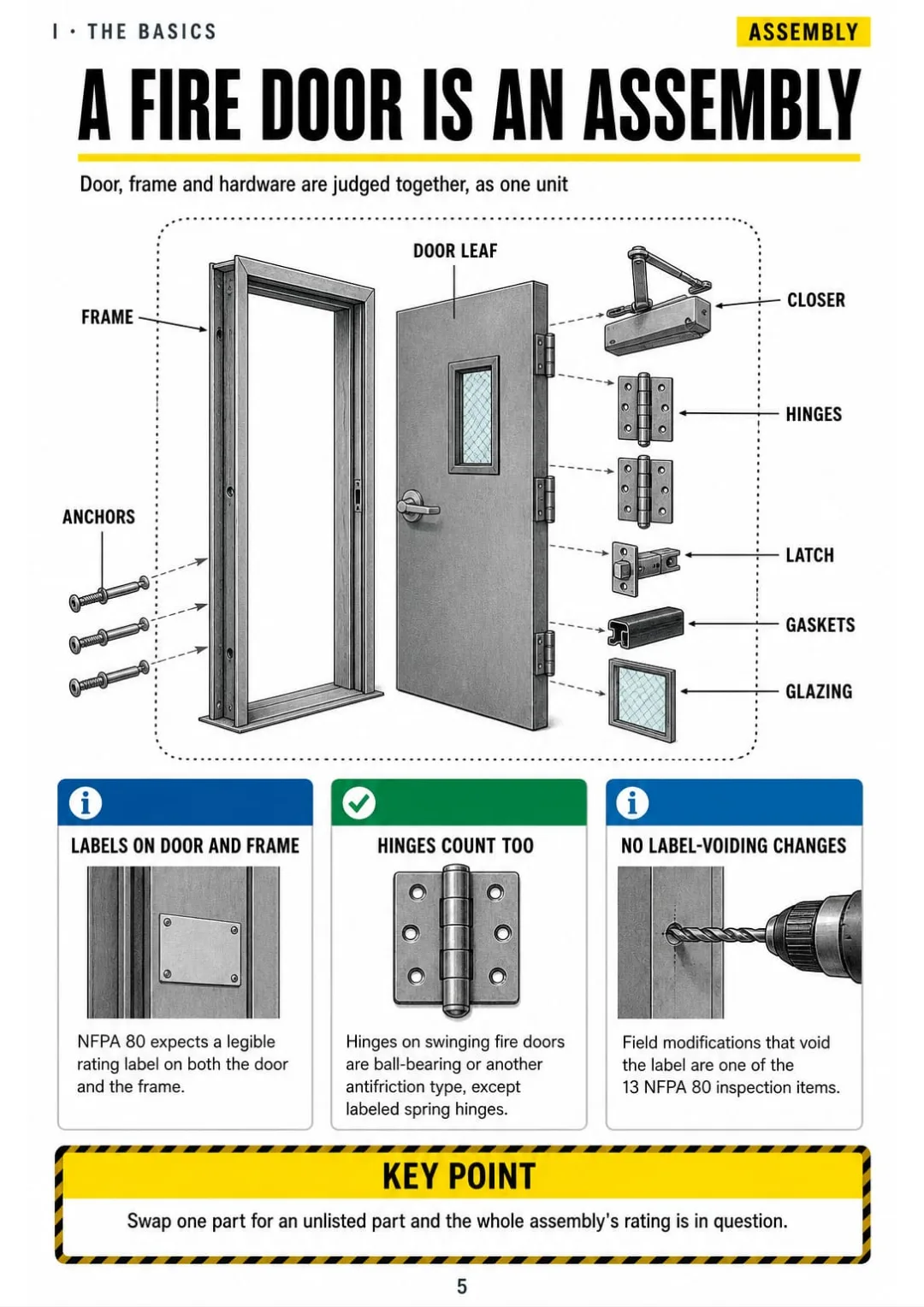
One rating for the whole opening: frame, leaf, hinges, closer, latch, anchors, plus any gaskets or glazing.
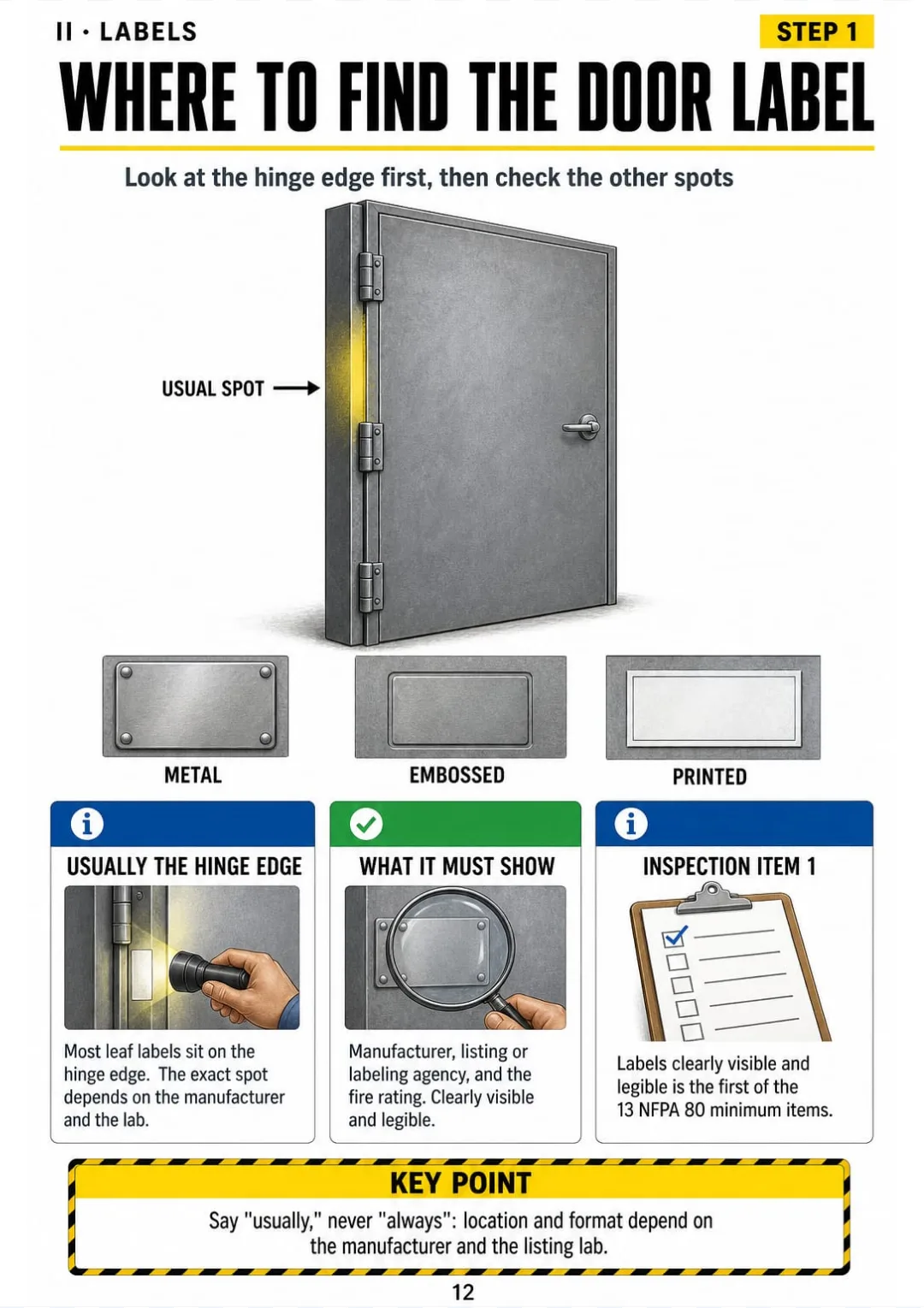
Door label: usually on the hinge edge, showing manufacturer, listing agency and rating.
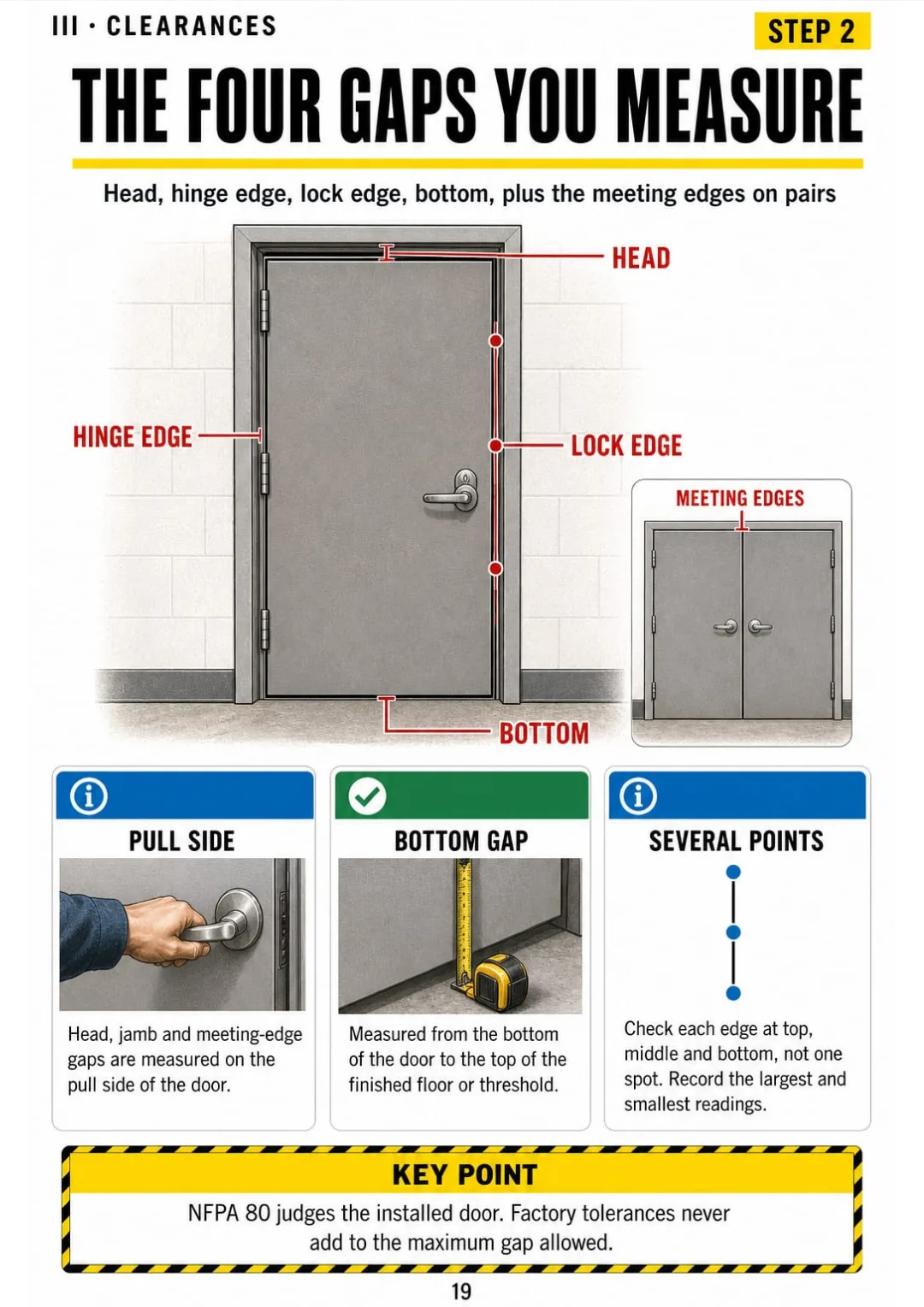
Head, hinge edge, lock edge and bottom: where and from which side you measure
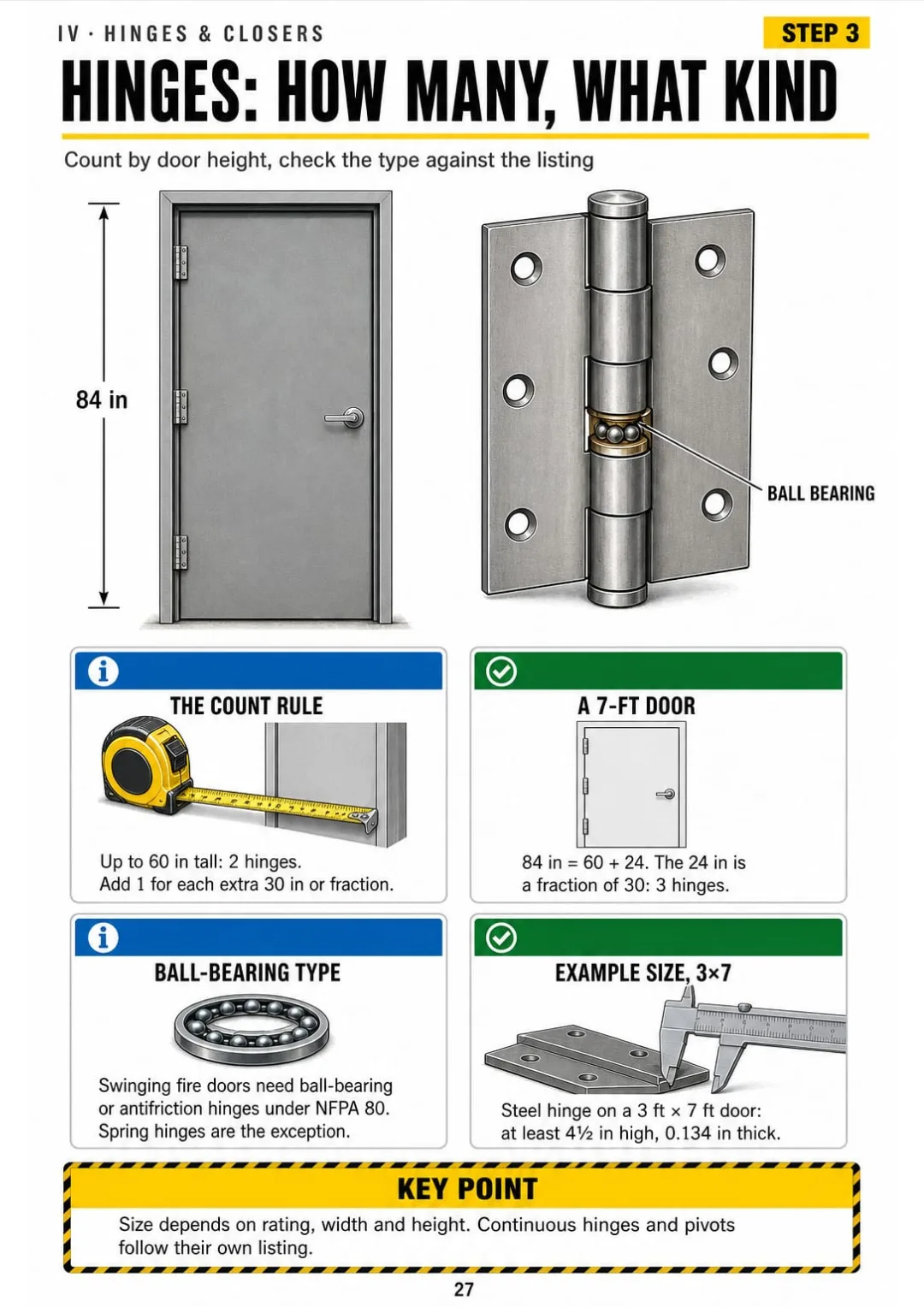
7-ft fire door = 3 ball-bearing hinges: 2 up to 60 in, +1 per extra 30 in
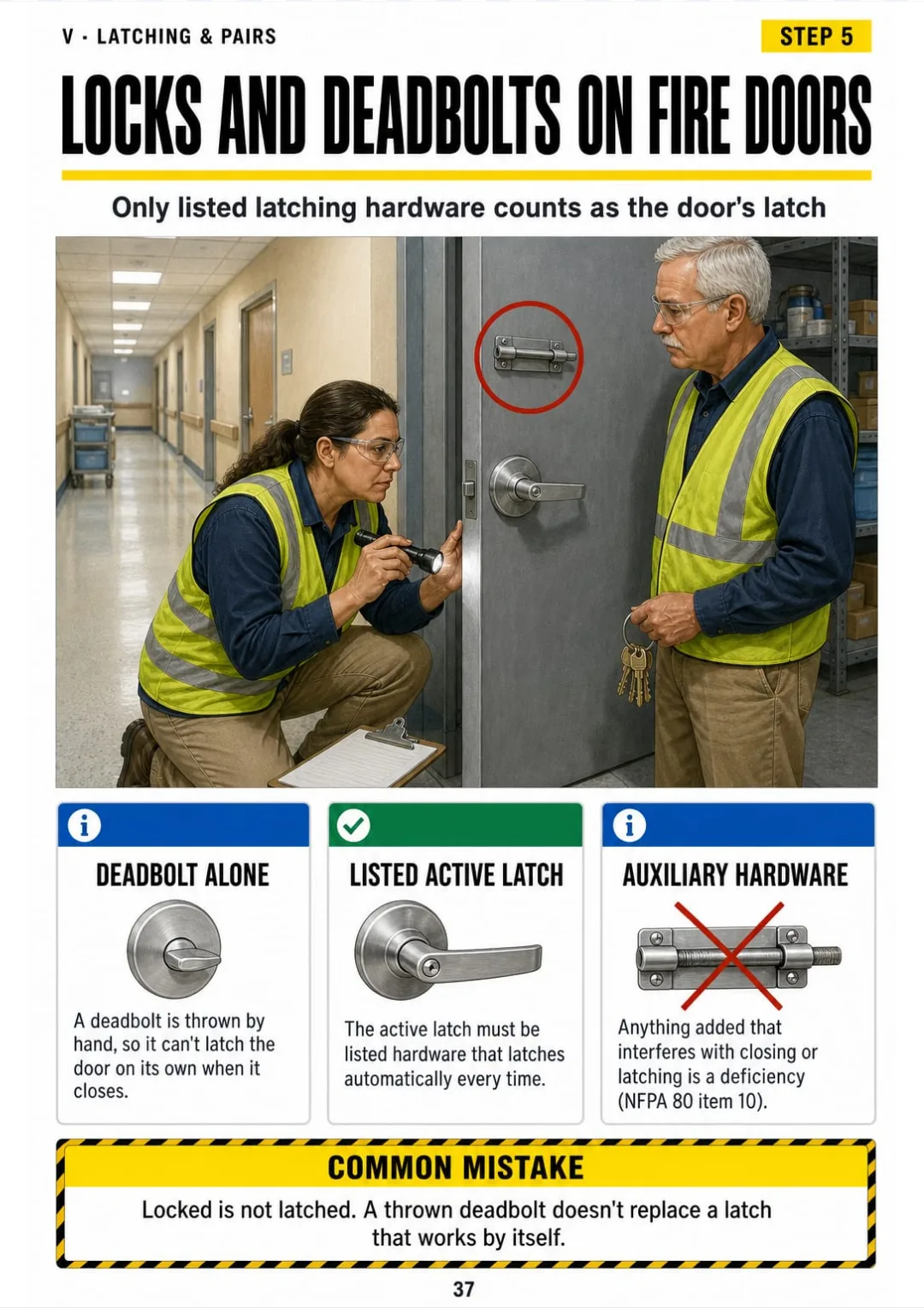
Deadbolt alone ≠ positive latching; added hardware that blocks closing is a deficiency.
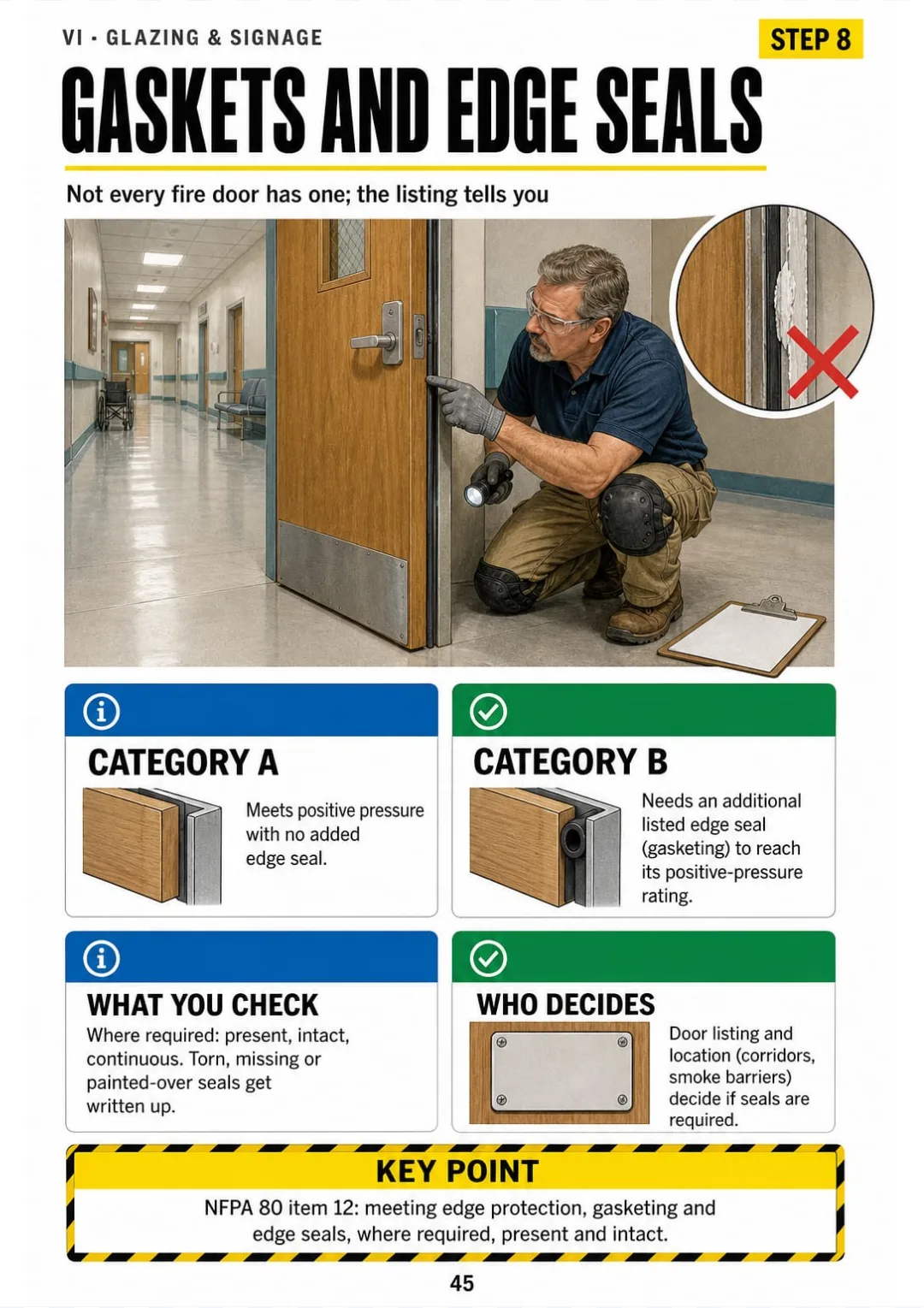
Category A needs no added seal; Category B needs a listed edge seal (NFPA 80, item 12).
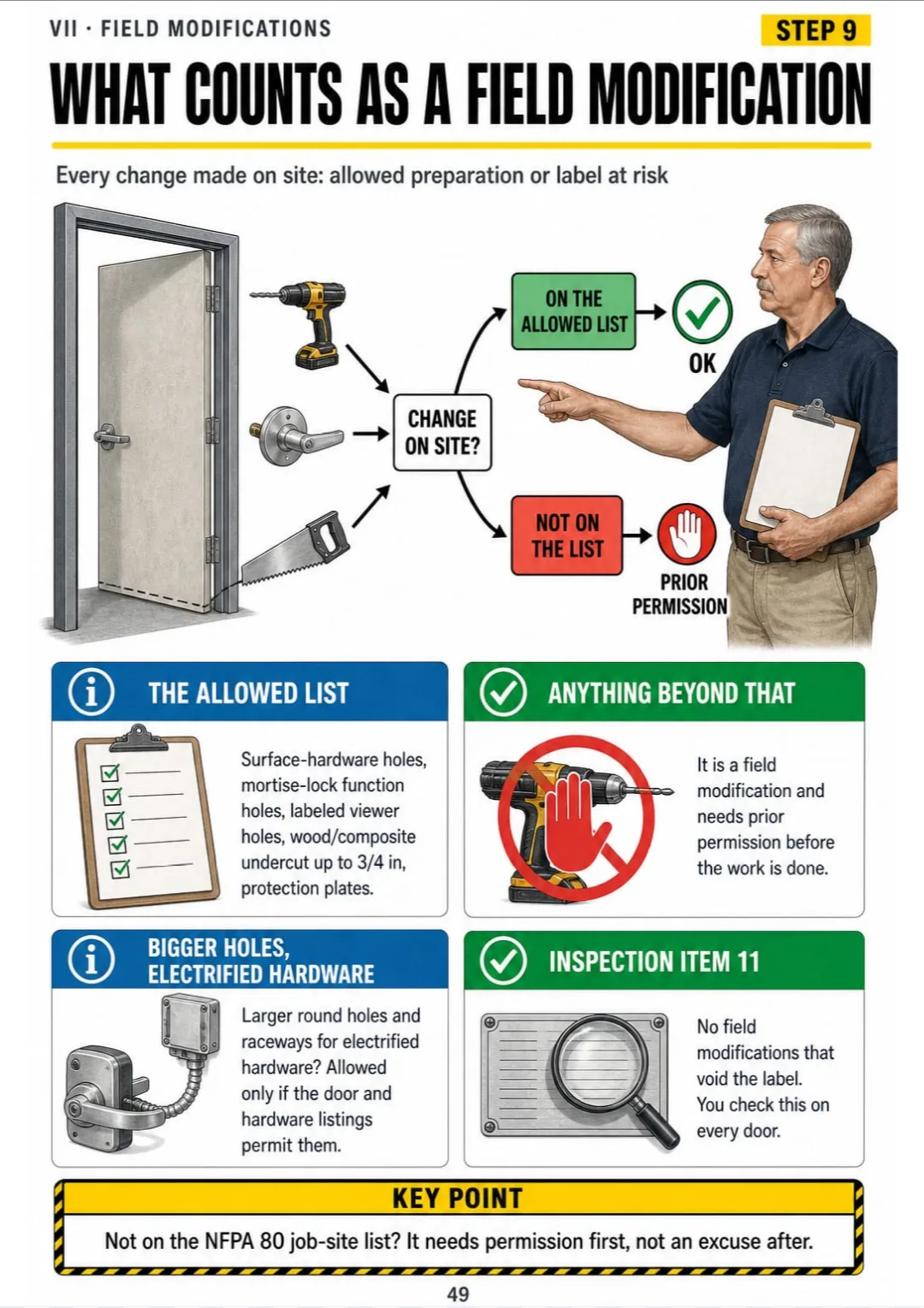
NFPA 80 2025, 5.1.4.2.2: five permitted job-site preparations; everything else is a field modification.
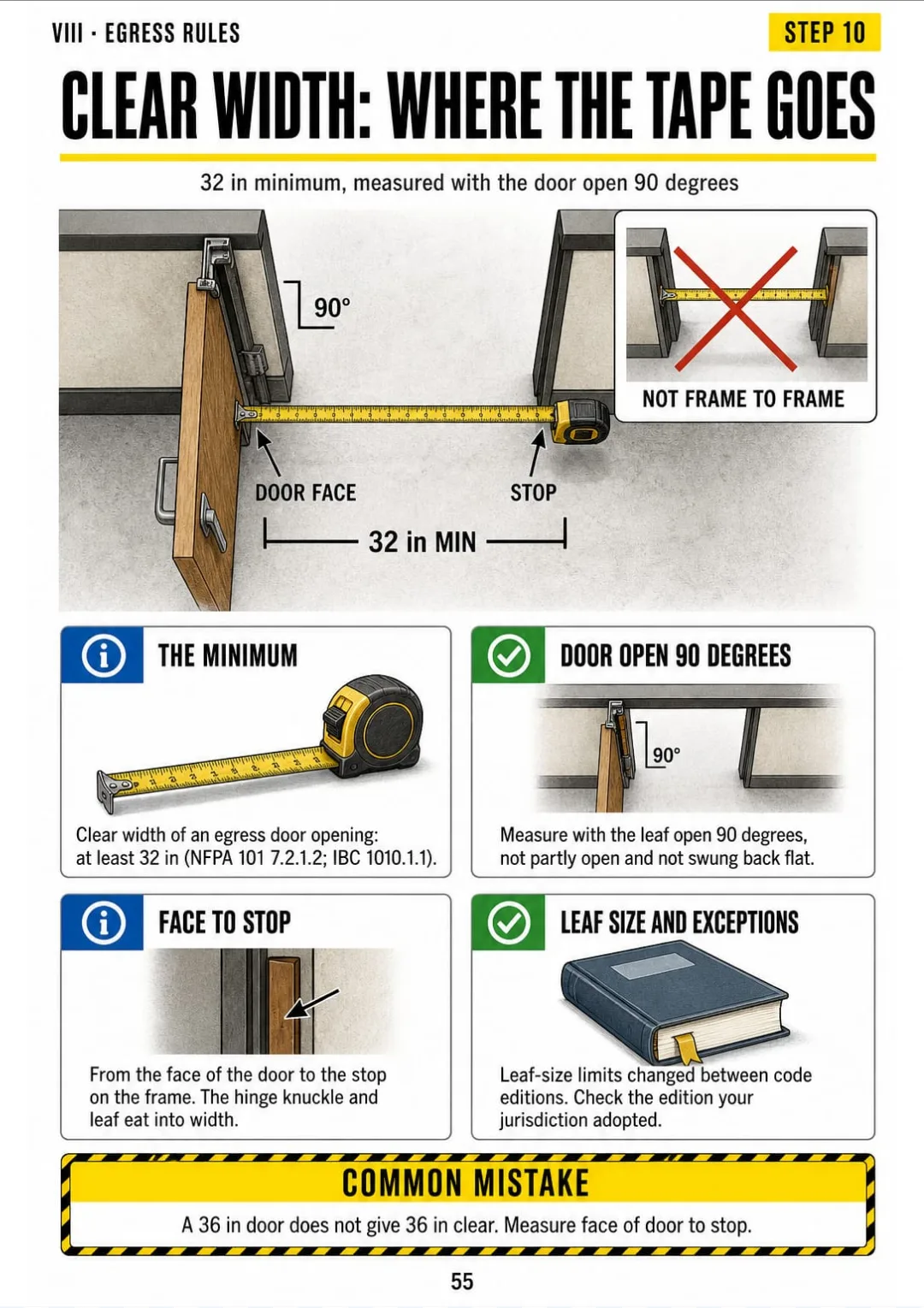
32 in clear minimum, measured from the open door's face to the frame stop.

Take a Look at the 9 Parts and 62 Topics

The Basics Before the First Door

pp. 5-11
  1. A Fire Door Is an Assembly, Not a Door
  2. Fire Door, Smoke Door, Egress Door: Three Jobs
  3. Door Ratings and the Walls They Go In
  4. NFPA 80, NFPA 101 and the Edition That Applies
  5. Who Inspects and How Often
  6. The 11-Step Method at a Glance
  7. What to Carry in the Truck

Step 1: Labels and Ratings

pp. 12-18
  1. Where to Find the Door Label
  2. Where to Find the Frame Label
  3. Reading a Label Line by Line
  4. Temperature-Rise Labels on Stair Doors
  5. Painted Over, Removed or Missing Label
  6. Labels on Hardware and Glazing
  7. Matching the Label to the Opening

Step 2: Clearances with Worked Measurements

pp. 19-26
  1. The Four Gaps You Measure
  2. Top and Edge Gaps on Steel Doors
  3. Top and Edge Gaps on Wood Doors
  4. Bottom Clearance: The Number Depends on the Floor
  5. Measure to the Top of the Floor Covering
  6. Worked Example: The Steel Door That Passes
  7. Worked Example: The Door That Fails
  8. Why Gaps Open Up and What Fixes Them

Steps 3-4: Hinges, Closers and Hold-Opens

pp. 27-34
  1. Hinges: How Many and What Kind
  2. Hinge Problems You See and Hear
  3. Self-Closing vs Automatic-Closing
  4. The Closer Test from Full Open
  5. Closer Adjustment: Sweep and Latch Speed
  6. Spring Hinges as the Closing Device
  7. Hold-Open Devices That Are Allowed
  8. Wedges, Kick-Down Holders and Other Hold-Opens

Steps 5-6: Latching, Pairs and Astragals

pp. 35-41
  1. Positive Latching: The Door Has to Stay Shut
  2. Latch Bolt Throw and Strike
  3. Locks and Deadbolts on Fire Doors
  4. Pairs of Doors: Active and Inactive Leaf
  5. The Coordinator: Who Closes First
  6. Astragals: Overlapping vs Meeting Edge
  7. Fire Exit Hardware on Fire Doors

Steps 7-8: Glazing, Gaskets and Signage

pp. 42-48
  1. Vision Lites: Glass, Frame and Beads
  2. Reading the Fire-Rated Glazing Mark
  3. Vision Panel Size by Door Rating
  4. Gaskets and Edge Seals: When They're Required
  5. Positive Pressure: What It Means at the Door
  6. Signs on Fire Doors: The 5% Rule
  7. No Holes, No Breaks in the Surface

Step 9: Field Modifications and Repairs

pp. 49-54
  1. What Counts as a Field Modification
  2. Modifications NFPA 80 Allows on Site
  3. Kick Plates and Protection Plates
  4. Cutting the Door Bottom After New Flooring
  5. Replacing Hardware with Listed Parts
  6. Repairs That Need Relabeling or Replacement

Step 10: Egress Rules (NFPA 101)

pp. 55-60
  1. Clear Width and Leaf Size
  2. Swing Direction
  3. Door Opening Force
  4. Hardware Height and One-Motion Release
  5. Doors Swinging into Corridors and Landings
  6. Delayed-Egress and Access-Controlled Locks

Step 11: Documentation, Review and Practice

pp. 61-66
  1. What the Inspection Record Has to Show
  2. Writing a Deficiency That Gets Fixed
  3. Labeling and Numbering Every Door
  4. The 11 Steps on One Page
  5. Most Frequent Deficiencies at a Glance
  6. Numbers to Know Before the Exam

Who This Book Is For

You're learning fire door inspection

The doors just landed on your desk. You get every step drawn in the order you'll actually walk it, from the label to the latch.

Your certification exam is coming up

You review one topic per page and finish with the numbers to know on a single page. The practice questions show you why each answer is right.

You already inspect fire doors

You've done doors for years. You get the code values checked against the current editions, printed and ready in the truck for when the inspector asks.

Plus: 2 Free Books

Fire Door Practice Questions: Exam-Style Questions with Explained Answers
BONUS 1

Fire Door Practice Questions: Exam-Style Questions with Explained Answers

Test yourself topic by topic and see why each answer is right, so the exam questions don't catch you off guard.
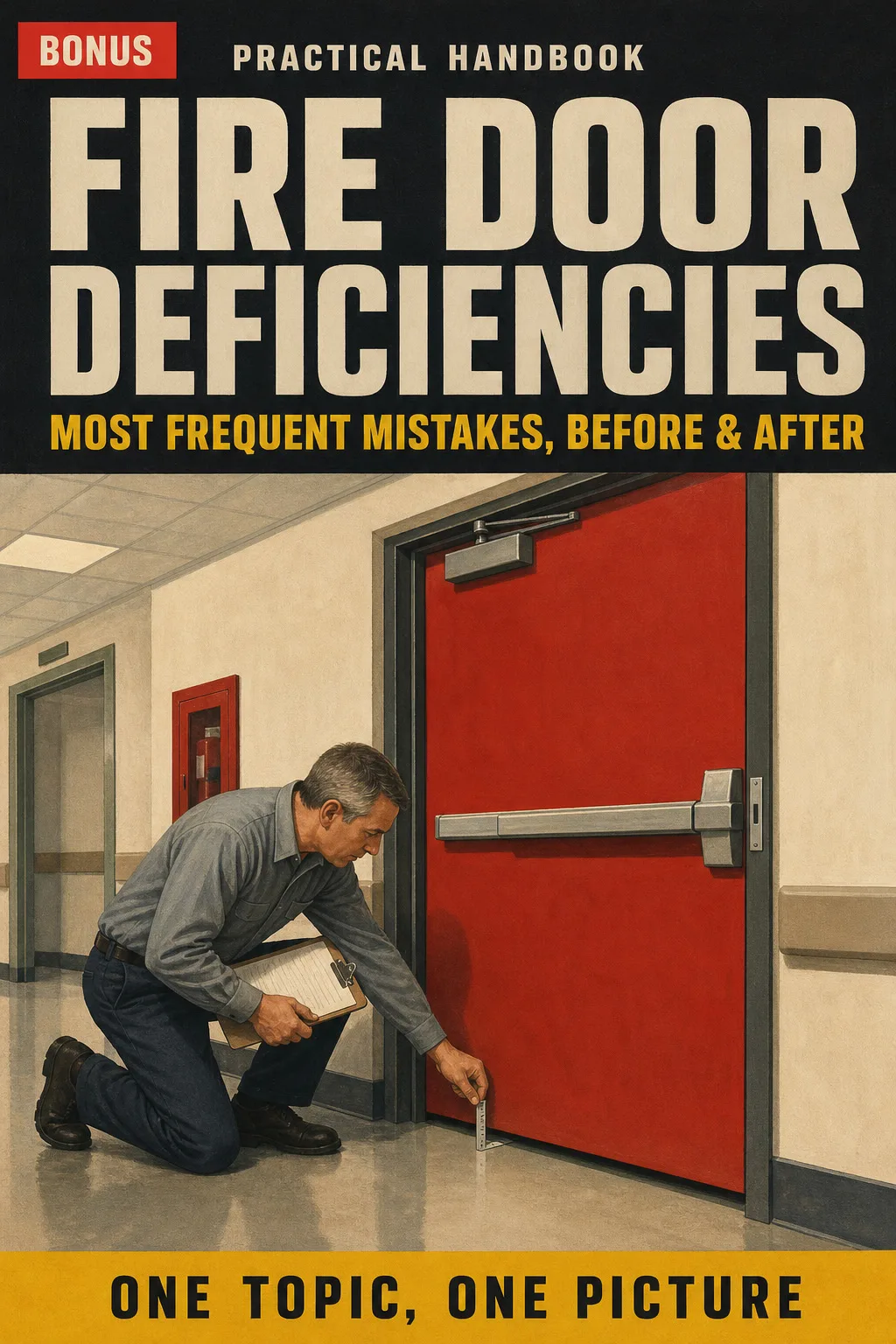
Fire Door Deficiencies: Most Frequent Mistakes, Before & After
BONUS 2

Fire Door Deficiencies: Most Frequent Mistakes, Before & After

See the most frequent deficiencies drawn side by side with the fix, so you spot them on the first walk-through.

30-Day Guarantee

30-day guarantee: if a file doesn't open, if the content isn't what the product page describes, if you were charged twice or the email never arrived, write to us and we'll refund you in full. You pay once. No subscriptions.

Frequently Asked Questions

Is it for me if I've been working on doors for 20 years?

Yes. It's not a beginner's course. It puts the whole inspection into 11 steps, always in the same order, with each code value on its own page so you can check it fast.

Where does the content come from?

From the current editions of NFPA 80 and NFPA 101, plus NFPA 105 for smoke door assemblies. Heads-up for hospitals: CMS-certified facilities are still inspected to the 2012 Life Safety Code, which references the 2010 edition of NFPA 80, so some values can differ from the latest edition. Always confirm which edition your authority having jurisdiction (AHJ) has adopted.

Is it official material?

No. It's an independent illustrated study guide. It isn't published, endorsed or approved by NFPA or by any certification program.

Does it replace a training course?

No. It's study and field reference material, and it doesn't come with a certificate. It doesn't replace formal training, the code itself or what your AHJ decides.

Are the practice questions the ones on the exam?

No. They're written for this book, exam-style, to test you topic by topic. They aren't official questions from any exam. What the book does cover is the content fire door inspector certifications are built on: NFPA 80, NFPA 101 and NFPA 105, inspection by inspection.

How do I get it?

The book and the 2 bonus books come as PDFs by email.

Do I have to pay every month?

No. It's a one-time payment.

Can I get it on paper?

It's a PDF you can print at home or at a print shop, and keep a copy in the truck.

How does the refund work?

You have 30 days. We refund everything if the file won't open, if the book isn't what you see on this page, if you were charged twice or if the email doesn't arrive: just email us.

US$ 27US$ 63
Get the book · US$ 27

This is a digital PDF book sent to your email: nothing is printed or shipped.

More books on this topic

Fire Alarm Systems Illustrated

A 58-page illustrated guide for the NICET Fire Alarm Systems Level I and II exams. Every device, circuit and…

From US$ 27 US$ 63

Fire Inspector Exam Illustrated

The Fire Inspector I material, one topic per illustrated page: occupancy groups, means of egress, fire protection…

From US$ 27 US$ 63

Fire Sprinkler Systems Illustrated

Fire sprinkler systems explained one topic per page, every part drawn: how a head operates, wet, dry, pre-action and…

From US$ 27 US$ 63

Fire Extinguisher Tech Illustrated

Portable fire extinguisher service, drawn one topic per page: fire classes A, B, C, D and K, extinguisher types, parts…

From US$ 27 US$ 63

Fire Plans Examiner Illustrated

Fire plans examiner prep, drawn one topic per page: occupancy classification, construction types, occupant load with…

From US$ 27 US$ 63