Study in Pictures🌐 English (United States)
Fire Inspector Exam Illustrated

Digital book in PDF · read it on your phone or print it

Fire Inspector Exam Illustrated

Occupancy groups, means of egress, occupant load, extinguishers, sprinklers, fire alarms, access roads, the NFPA 704 diamond and the inspection walk-through. Every topic gets its own page: first the drawing, then what you need to remember.

  • 66 illustrated pages
  • English
  • 30-day guarantee
US$ 27US$ 63
Get the book · US$ 27

Price shown for: United States. In other countries, the checkout shows the price that applies there.

About this book

What it is

Occupancy groups, means of egress, occupant load, extinguishers, sprinklers, fire alarms, access roads, the NFPA 704 diamond and the inspection walk-through. Every topic gets its own page: first the drawing, then what you need to remember.

Who This Book Is For
  • You're moving into fire prevention
  • Your Fire Inspector I exam is coming up
  • You already do inspections
What it covers
  1. The Inspector's Job and the Codes
  2. Fire Behavior and Construction
  3. Occupancy Classification
  4. Means of Egress
  5. Fire Protection Systems
  6. Access, Utilities and General Safety
  7. Hazardous Materials
  8. The Inspection, Start to Finish
Language
English (United States)
Pages
66
Format
Digital book in PDF · read it on your phone or print it
Price
US$ 27 (United States)
Delivery
This is a digital PDF book sent to your email: nothing is printed or shipped.
30-Day Guarantee
30-day guarantee: if a file doesn't open, if the content isn't what the product page describes, if you were charged twice or the email never arrived, write to us and we'll refund you in full.

Look Inside the Book

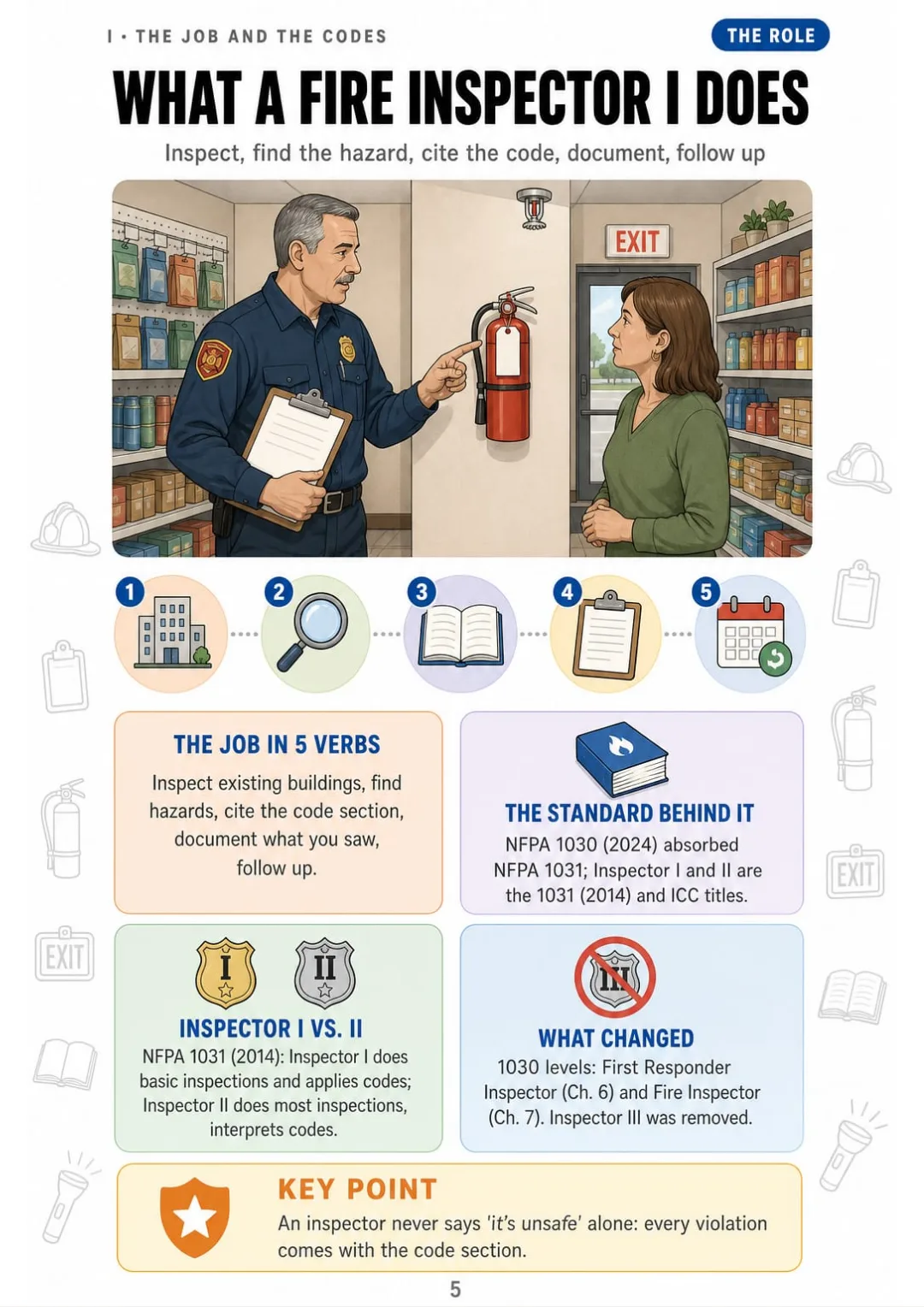
Inspect, find, cite, document, follow up: the Fire Inspector I job (ICC exam, NFPA 1031/1030).
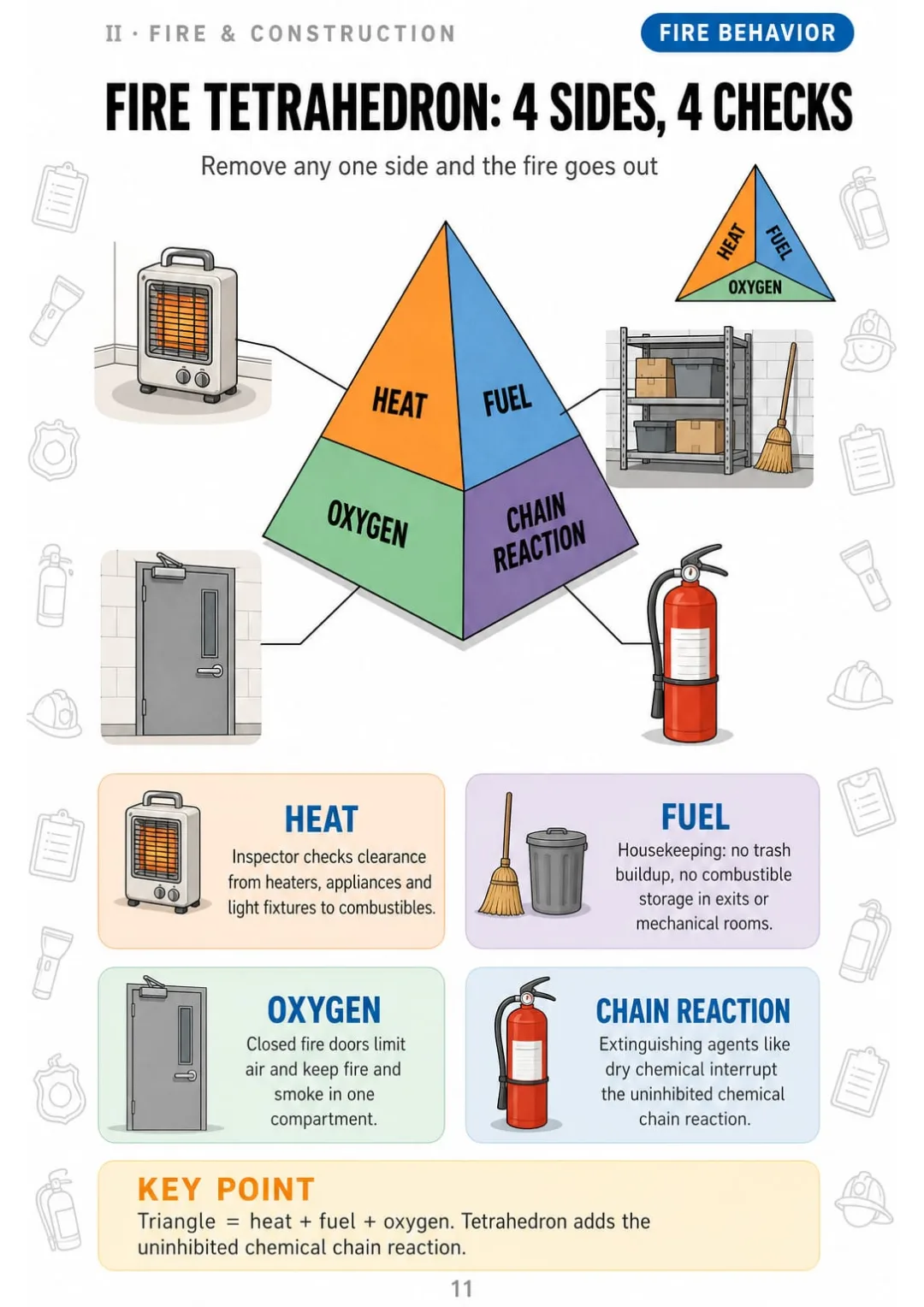
Heat, fuel, oxygen, chain reaction: each side linked to the inspection item that removes it.
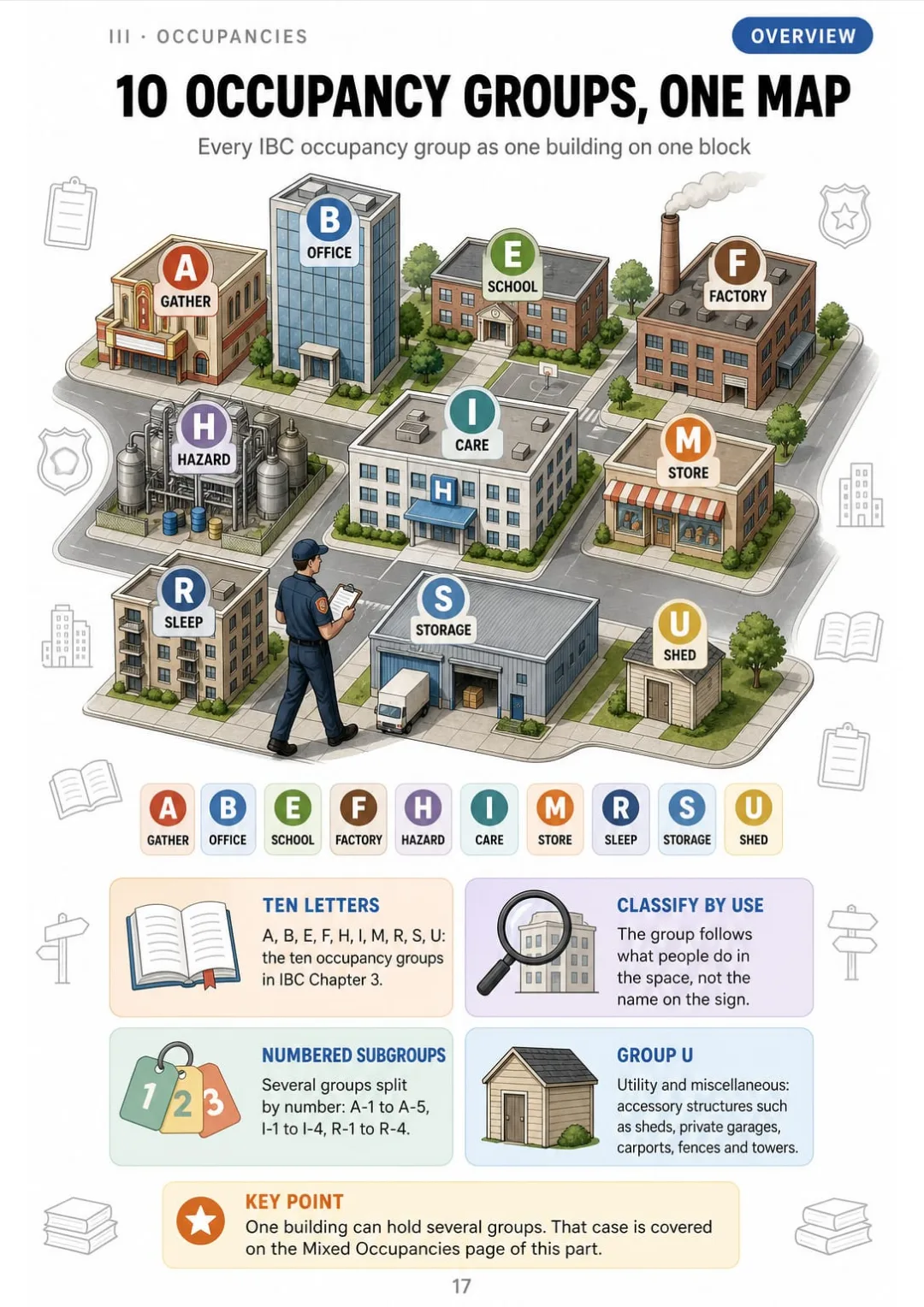
A, B, E, F, H, I, M, R, S, U: the 10 IBC occupancy groups drawn as one city block
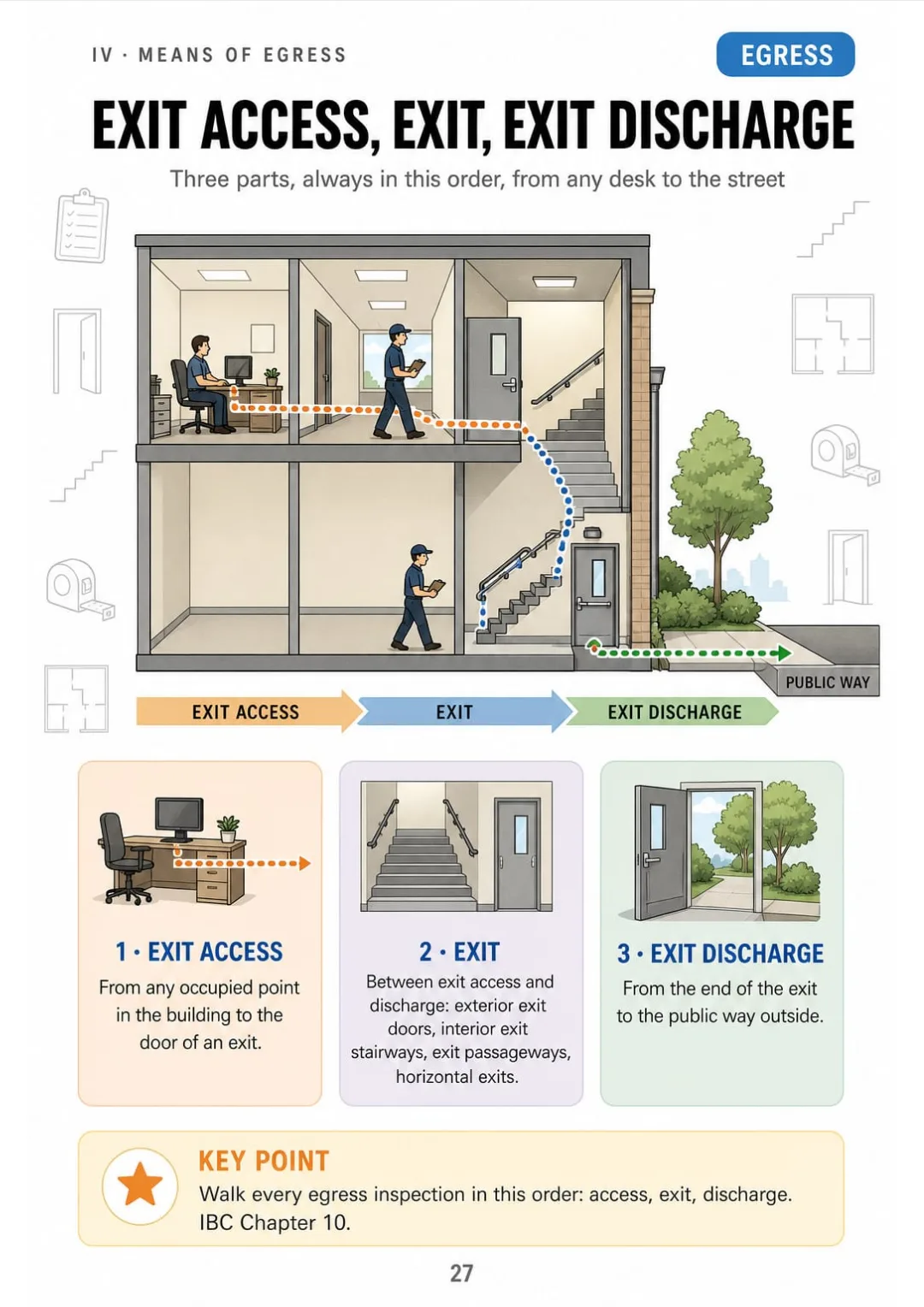
Exit access → exit → exit discharge → public way: one cutaway building, three bands.
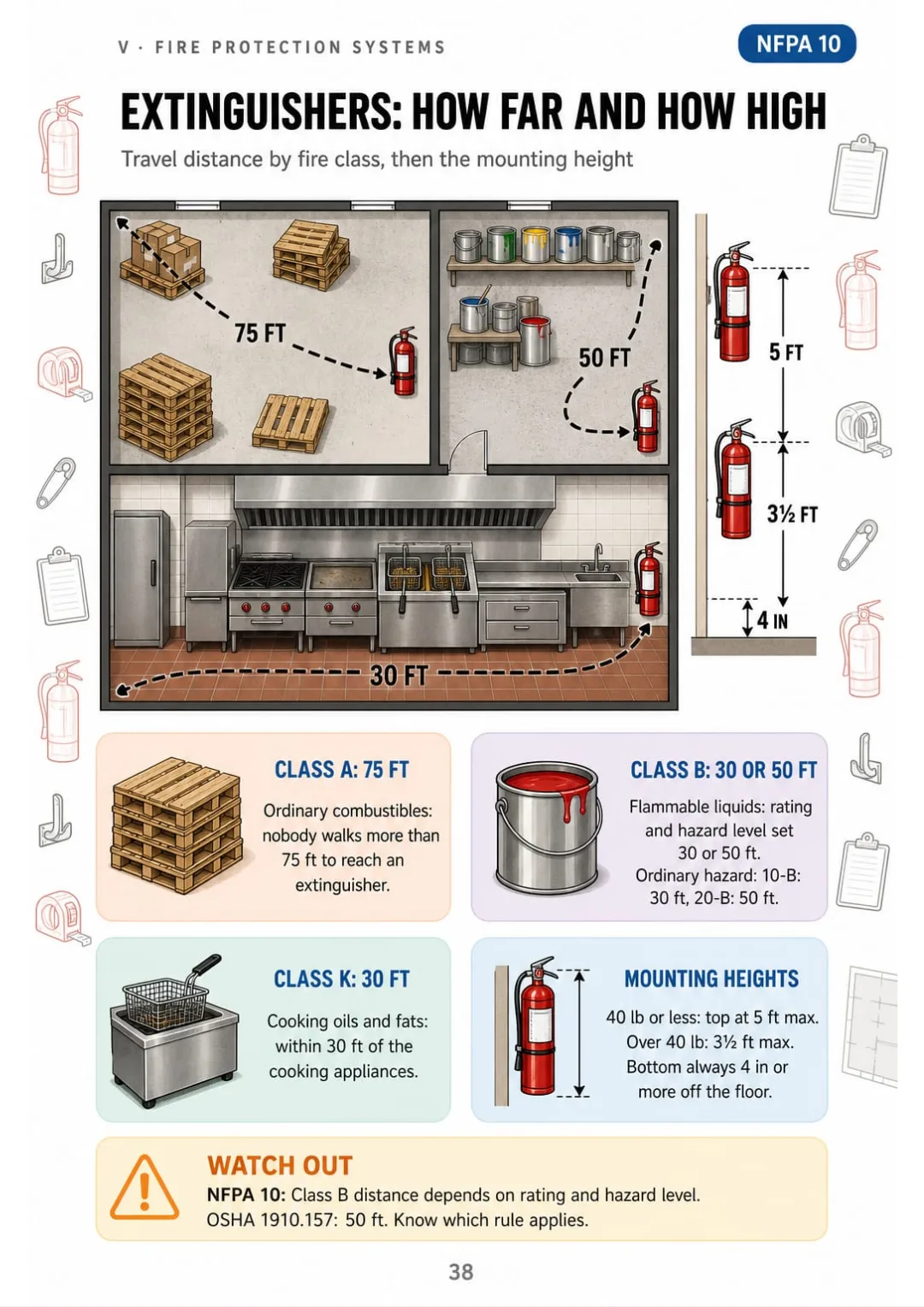
Class A 75 ft · Class B 30 or 50 ft · Class K 30 ft · top at 5 ft, bottom at 4 in
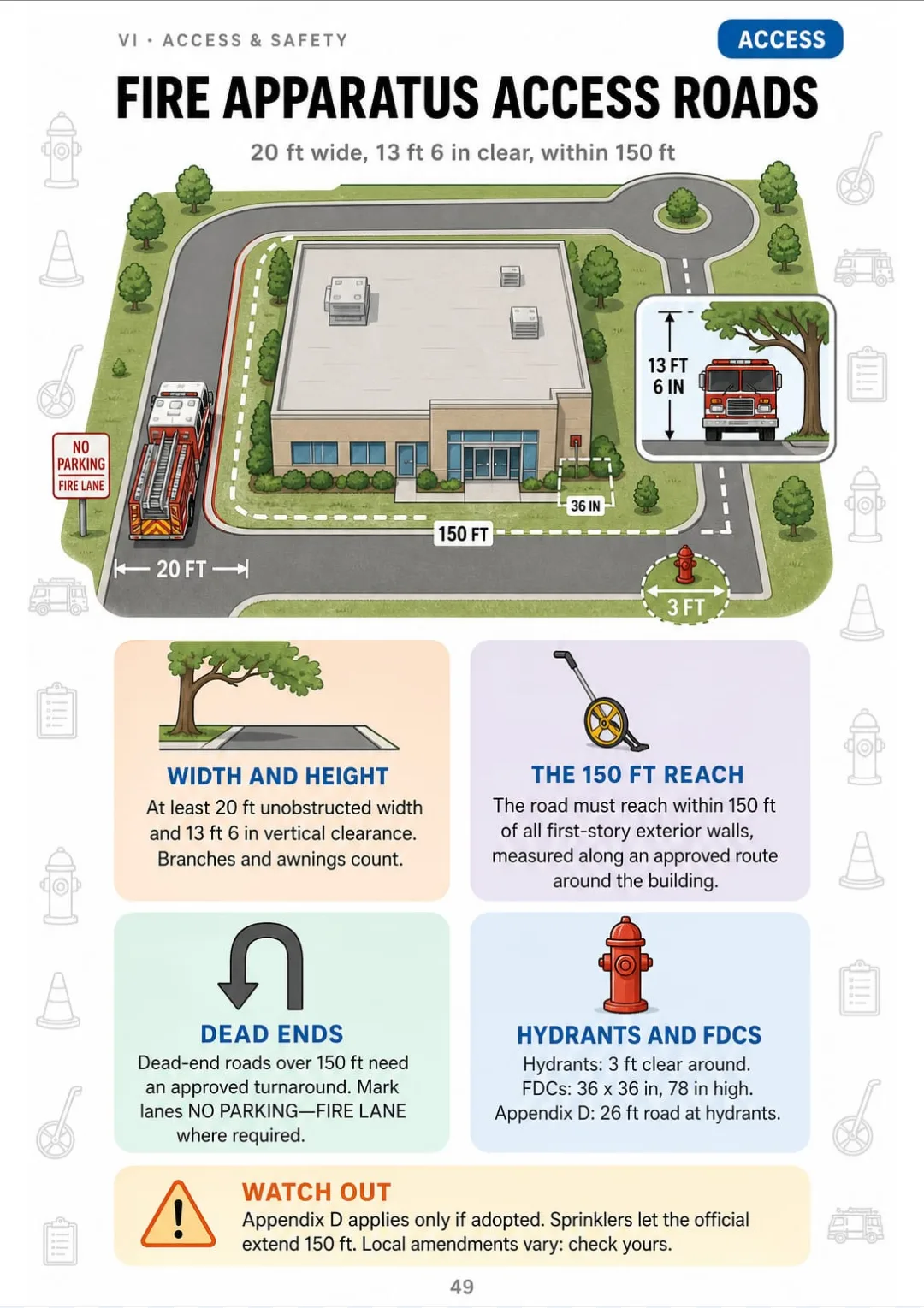
Access road: 20 ft wide, 13 ft 6 in clear, turnaround past 150 ft
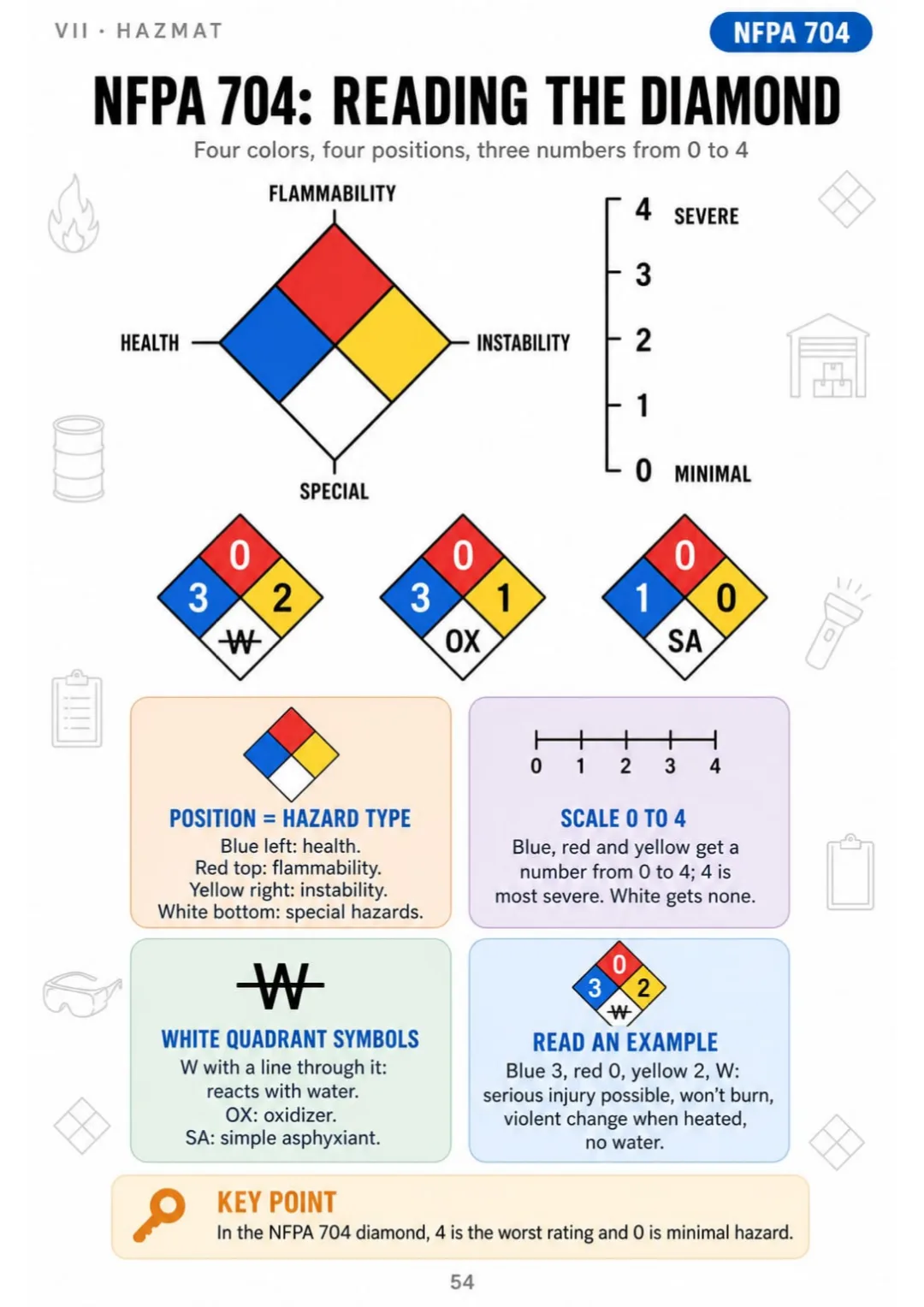
Blue health, red flammability, yellow instability rated 0 to 4 (4 is worst); white carries special-hazard symbols.
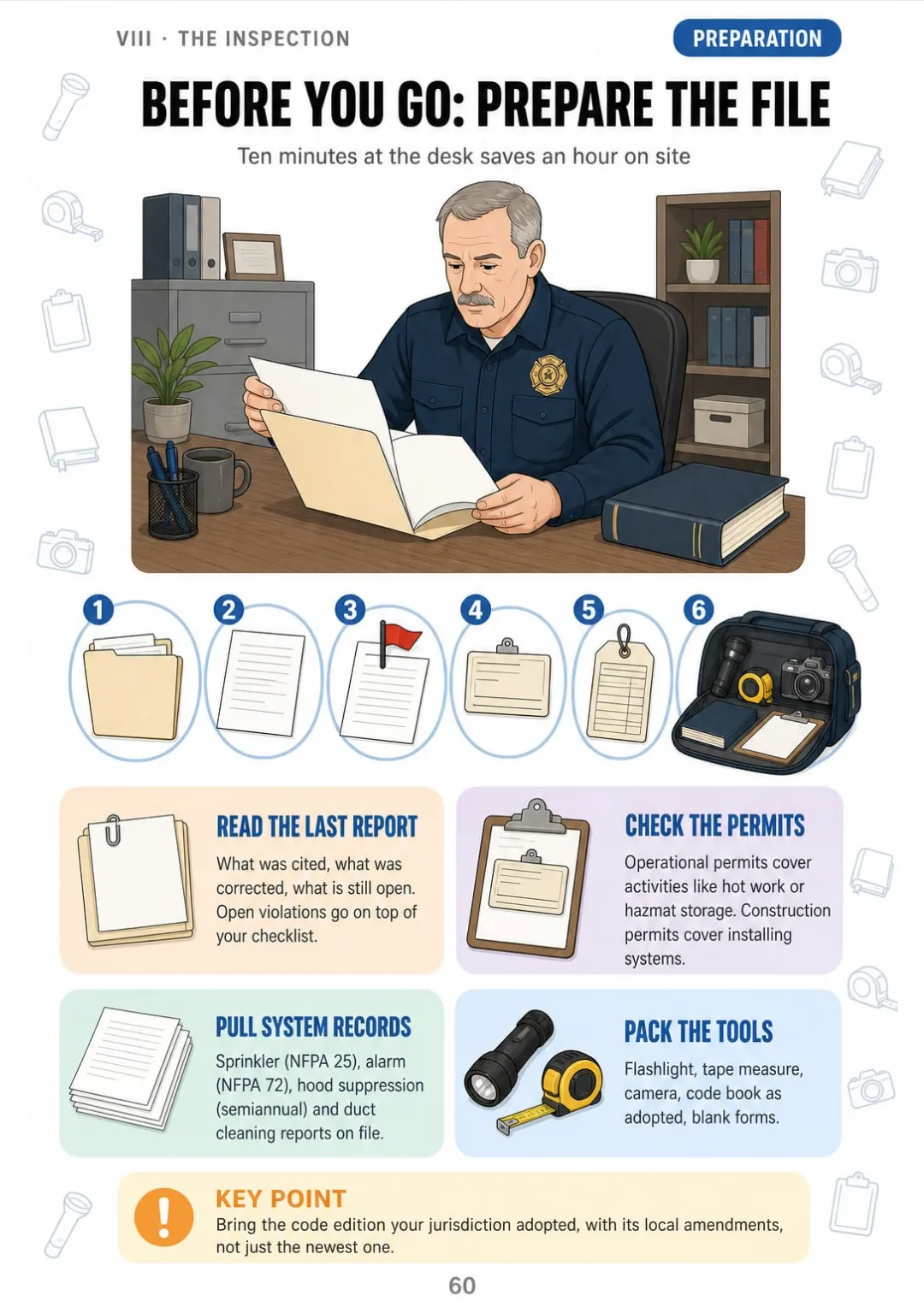
Last report, open violations, permits, system records and 5 tools: the prep in 6 steps.

Take a Look at the 8 Parts and 62 Topics

The Inspector's Job and the Codes

pp. 5-10
  1. From the Engine to Fire Prevention: What a Fire Inspector I Does
  2. ICC or Pro Board: Two Roads to the Same Badge
  3. Which Code Edition Does Your Jurisdiction Use?
  4. How the IFC Is Built: Finding Any Section in 3 Moves
  5. IFC, IBC and NFPA: Who Rules What
  6. Your Legal Authority: Right of Entry, Permits and Appeals

Fire Behavior and Construction

pp. 11-16
  1. Fire Triangle and Fire Tetrahedron
  2. Heat Transfer: Why 18 Inches and 24 Inches Matter
  3. Classes of Fire: A, B, C, D, K
  4. The 5 Construction Types at a Glance
  5. Fire-Resistance Ratings, Fire Walls and Fire Barriers
  6. Fire Doors: Labeled, Self-Closing, Never Wedged

Occupancy Classification

pp. 17-26
  1. The 10 Occupancy Groups on One Map
  2. Group A: A-1 to A-5 Without Mixing Them Up
  3. A-2 or B? The 50-Occupant Line
  4. Group B and Group M: Office vs. Store
  5. Group E and Day Care: The Age and Headcount Rules
  6. Group I: I-1 to I-4 by Who Can Self-Evacuate
  7. Group R: Hotels, Apartments, Homes, Assisted Living
  8. Groups F and S: Making Things vs. Storing Things
  9. Group H: When Quantity Changes the Occupancy
  10. Mixed Occupancies: Accessory, Nonseparated, Separated

Means of Egress

pp. 27-37
  1. Exit Access, Exit, Exit Discharge: Read It Left to Right
  2. Occupant Load: Area Divided by the Factor
  3. Gross vs. Net: The Trap in the Calculation
  4. How Many Exits: 1, 2, 3 or 4
  5. Exit Separation: Half or One-Third of the Diagonal
  6. Travel Distance, Common Path and Dead Ends
  7. Egress Width: 0.2 and 0.15 Inches per Occupant
  8. Doors in the Egress Path: Swing, Hardware, Locks
  9. Stairs, Handrails and Guards
  10. Exit Signs and Emergency Lighting
  11. Keeping Egress Clear: The Everyday Violations

Fire Protection Systems

pp. 38-48
  1. Portable Extinguishers: Type, Size, Placement
  2. Extinguisher Inspection: Monthly, Annual, Hydrostatic
  3. Sprinkler Systems: NFPA 13, 13R and 13D
  4. Reading a Sprinkler Head: Color and Temperature
  5. The Sprinkler Riser and the Spare Head Cabinet
  6. NFPA 25: What Gets Checked and How Often
  7. Fire Department Connection and Standpipes
  8. Fire Alarm Basics Under NFPA 72
  9. Smoke Alarms vs. Smoke Detectors
  10. Commercial Kitchen Hoods: NFPA 96 and UL 300
  11. Other Systems the Inspector Will Meet

Access, Utilities and General Safety

pp. 49-53
  1. Fire Apparatus Access Roads
  2. Address Numbers and Key Boxes
  3. Electrical Hazards You Can Cite
  4. Storage, Housekeeping and Combustibles
  5. Hot Work, Open Flames and Fire Watch

Hazardous Materials

pp. 54-59
  1. NFPA 704: Reading the Diamond
  2. DOT Placards vs. NFPA 704 vs. SDS
  3. Flammable and Combustible Liquid Classes
  4. Flammable Liquid Storage Cabinets
  5. Maximum Allowable Quantities and Control Areas
  6. Compressed Gases and LP-Gas Cylinders

The Inspection, Start to Finish

pp. 60-66
  1. Before You Go: Prepare the Inspection
  2. The Walk-Through, Always in the Same Order
  3. Talking to the Owner: 'Where Does It Say That?'
  4. Writing the Notice of Violation
  5. Records, Re-Inspection and Imminent Danger
  6. 10 Frequent Violations, Before and After
  7. Exam-Day Review: The Numbers Most Often Mixed Up

Who This Book Is For

You're moving into fire prevention

Years on the street, now the code side. The book lays it out the way an inspection actually runs, one drawn page per topic.

Your Fire Inspector I exam is coming up

Occupancy groups, egress numbers and extinguisher distances, each on its own page, plus practice questions that send you to the code section to look it up.

You already do inspections

Print it and keep it in the truck: the walk-through order, the numbers that get mixed up and how to write the violation citing the right section.

Plus: 2 Free Books

Fire Inspector I Practice Questions
BONUS 1

Fire Inspector I Practice Questions

Exam-style questions with every answer explained and the code section to look up, so you practice finding it, not just guessing.
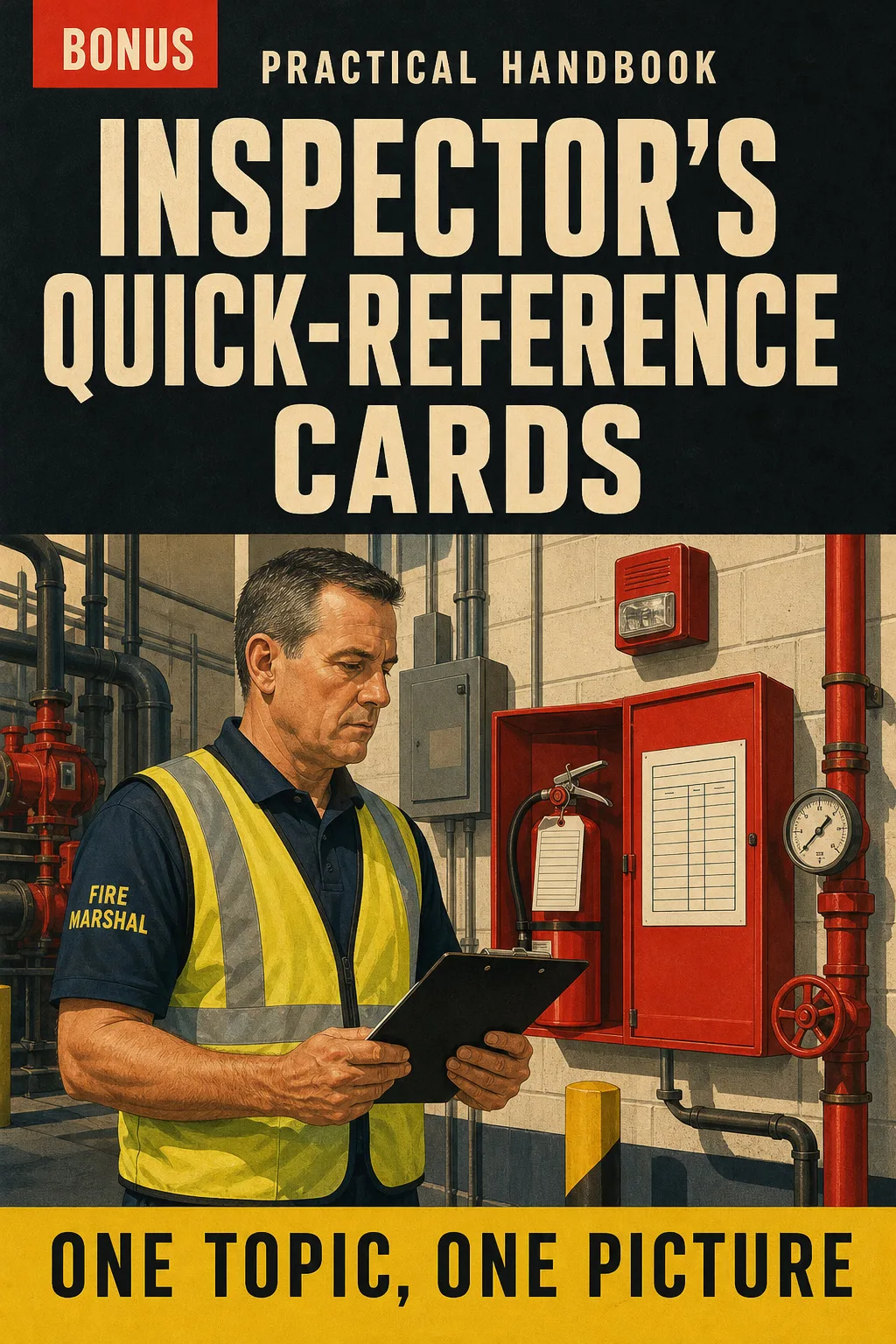
Inspector's Quick-Reference Cards
BONUS 2

Inspector's Quick-Reference Cards

The numbers and classes that are easiest to mix up (extinguisher classes, clearances, occupancy groups) on one-page cards to review before the exam or keep in the truck.

30-Day Guarantee

30-day guarantee: if a file doesn't open, if the content isn't what the product page describes, if you were charged twice or the email never arrived, write to us and we'll refund you in full. You pay once. No subscriptions.

Frequently Asked Questions

Is it for me if I've been a firefighter for 15 years and I'm moving into prevention?

Yes. Part 2 (fire behavior and construction types) is a short review you can skim. The rest is the code side you didn't need on the street: occupancy groups, occupant load, egress numbers, systems, hazmat quantities and writing the notice of violation citing the right section, organized like a real inspection.

Where does the content come from?

From the 2024 International Fire Code, the 2024 International Building Code and the referenced NFPA standards (10, 13, 25, 72, 96, 704 and NFPA 1030 for the Fire Inspector job performance requirements). Every number was checked against those editions, and each page names the code section. Many sections keep the same number across recent editions (503 for access roads, 906 for extinguishers), but your state or city may use an older edition or local amendments: check the edition your jurisdiction adopted. If your state uses NFPA 1 instead of the IFC (Florida, for example), the topics are the same but the section numbers are not.

Is this official ICC or NFPA material?

No. It's independent study material, not published or endorsed by ICC or NFPA. It explains the code in its own words and drawings and tells you which section to look up.

Does it replace my Fire Inspector I course or training?

No. It's a study and review companion for your course, your department's training and the code book your jurisdiction uses. It doesn't give a certificate or CEUs. It covers the topics of both paths: the ICC Fire Inspector I exam and state Fire Inspector I programs accredited by Pro Board or IFSAC under NFPA 1030. Part 1 explains the difference.

Are the practice questions the real exam questions?

No. They're written for this book, in the style of the exam, with every answer explained and the code section to look up.

When and how do I get it?

PDF by email, to the address you enter at checkout. The 2 bonus books come with it.

Do I have to pay every month?

No. It's a one-time payment.

Can I have it on paper?

Yes. It's a printable PDF: print it at home or at a print shop and keep it in the truck.

How does the refund work?

You have 30 days. We refund everything if the file won't open, if the book isn't what you see on this page, if you were charged twice or if the email doesn't arrive: just email us.

US$ 27US$ 63
Get the book · US$ 27

This is a digital PDF book sent to your email: nothing is printed or shipped.

More books on this topic

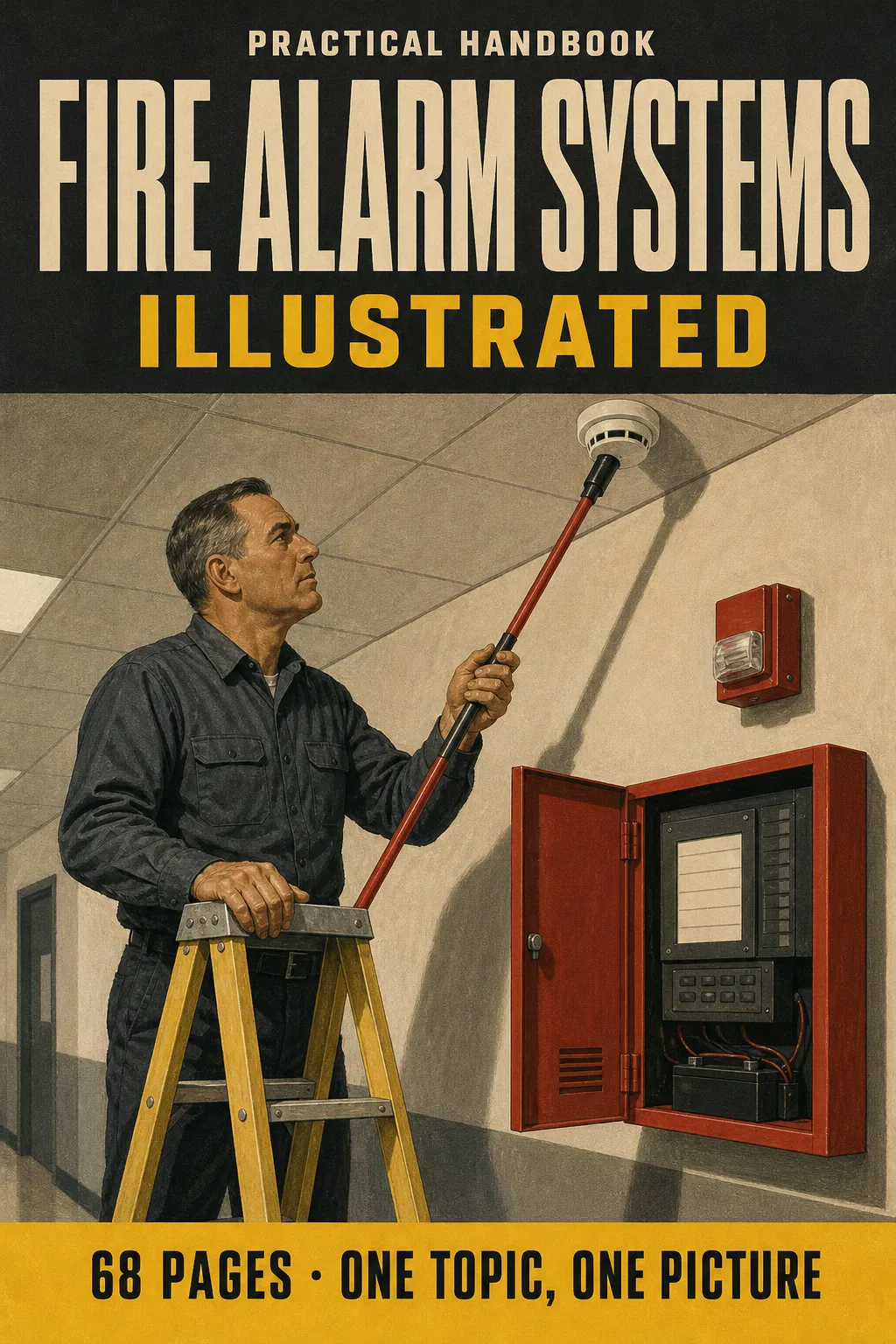
Fire Alarm Systems Illustrated

A 58-page illustrated guide for the NICET Fire Alarm Systems Level I and II exams. Every device, circuit and…

From US$ 27 US$ 63

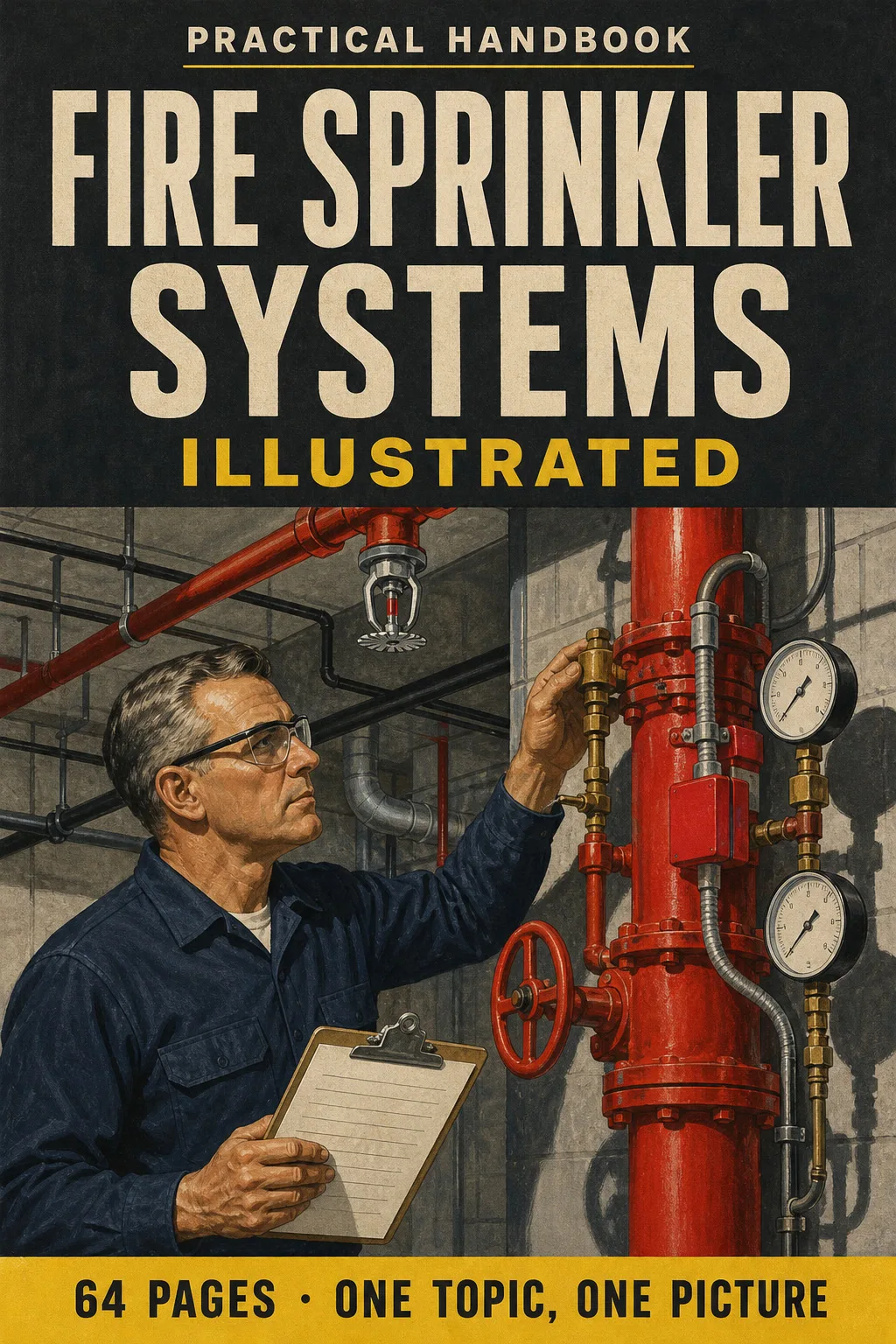
Fire Sprinkler Systems Illustrated

Fire sprinkler systems explained one topic per page, every part drawn: how a head operates, wet, dry, pre-action and…

From US$ 27 US$ 63

Fire Extinguisher Tech Illustrated

Portable fire extinguisher service, drawn one topic per page: fire classes A, B, C, D and K, extinguisher types, parts…

From US$ 27 US$ 63

Fire Plans Examiner Illustrated

Fire plans examiner prep, drawn one topic per page: occupancy classification, construction types, occupant load with…

From US$ 27 US$ 63