Study in Pictures🌐 English (United States)
Fire and Smoke Dampers Illustrated

Digital book in PDF · read it on your phone or print it

Fire and Smoke Dampers Illustrated

Identify, access, inspect, test, document: the same 5 steps for every fire, smoke and combination damper. One topic per page: first the drawing, then the numbers you need to remember.

  • 62 illustrated pages
  • English
  • 30-day guarantee
US$ 27US$ 63
Get the book · US$ 27

Price shown for: United States. In other countries, the checkout shows the price that applies there.

About this book

What it is

Identify, access, inspect, test, document: the same 5 steps for every fire, smoke and combination damper. One topic per page: first the drawing, then the numbers you need to remember.

Who This Book Is For
  • You're studying for the damper certification
  • Your exam date is set
  • You already inspect dampers
What it covers
  1. Why Dampers Exist
  2. Inside Each Damper
  3. How a Damper Is Installed
  4. Steps 1–2: Identify and Access
  5. Step 3: Inspect
  6. Step 4: Test
  7. Step 5: Document
  8. Review and Exam Prep
Language
English (United States)
Pages
62
Format
Digital book in PDF · read it on your phone or print it
Price
US$ 27 (United States)
Delivery
This is a digital PDF book sent to your email: nothing is printed or shipped.
30-Day Guarantee
30-day guarantee: if a file doesn't open, if the content isn't what the product page describes, if you were charged twice or the email never arrived, write to us and we'll refund you in full.

Look Inside the Book

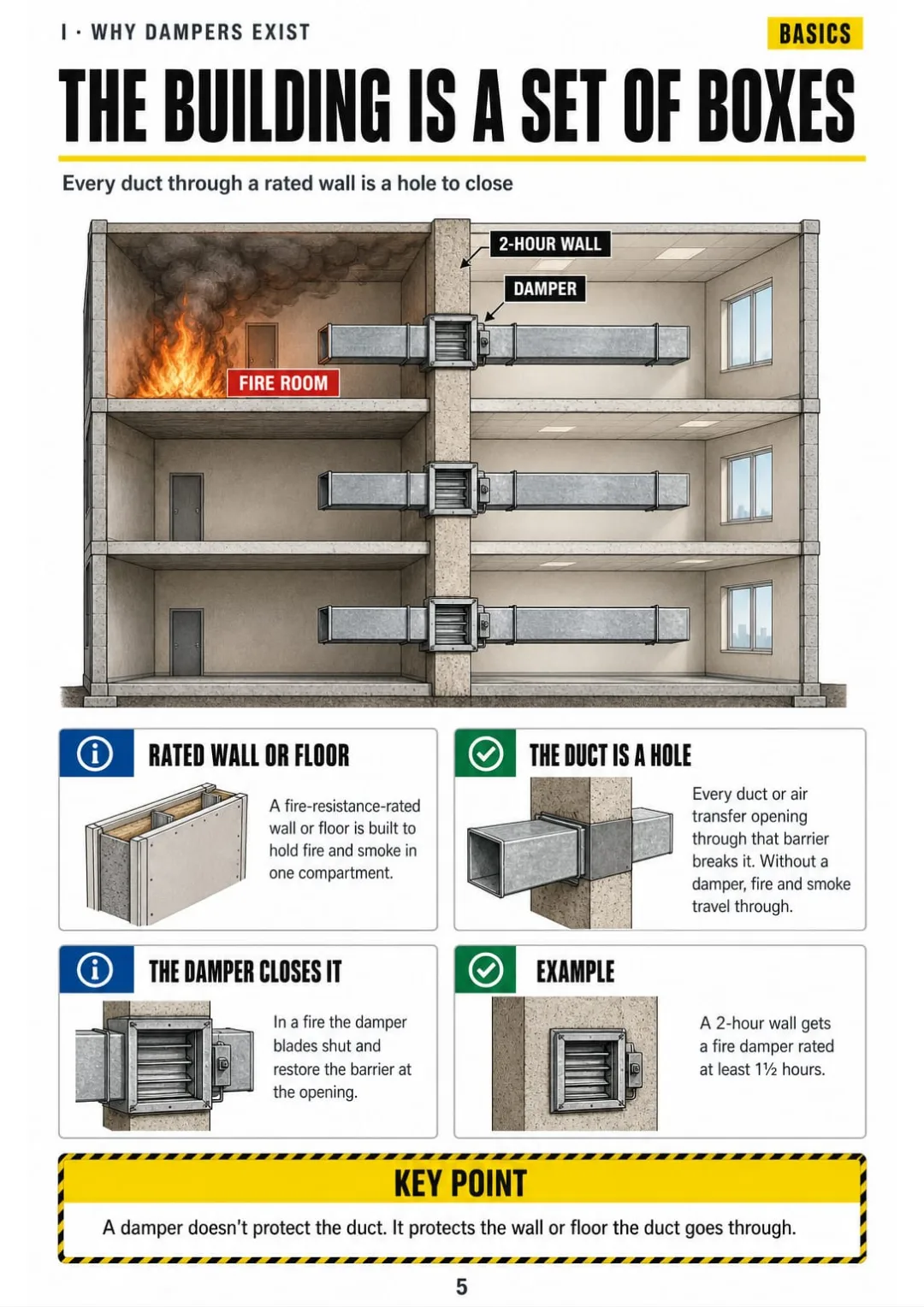
A rated wall holds fire in one compartment. Every duct through it is a hole, and the damper closes it.
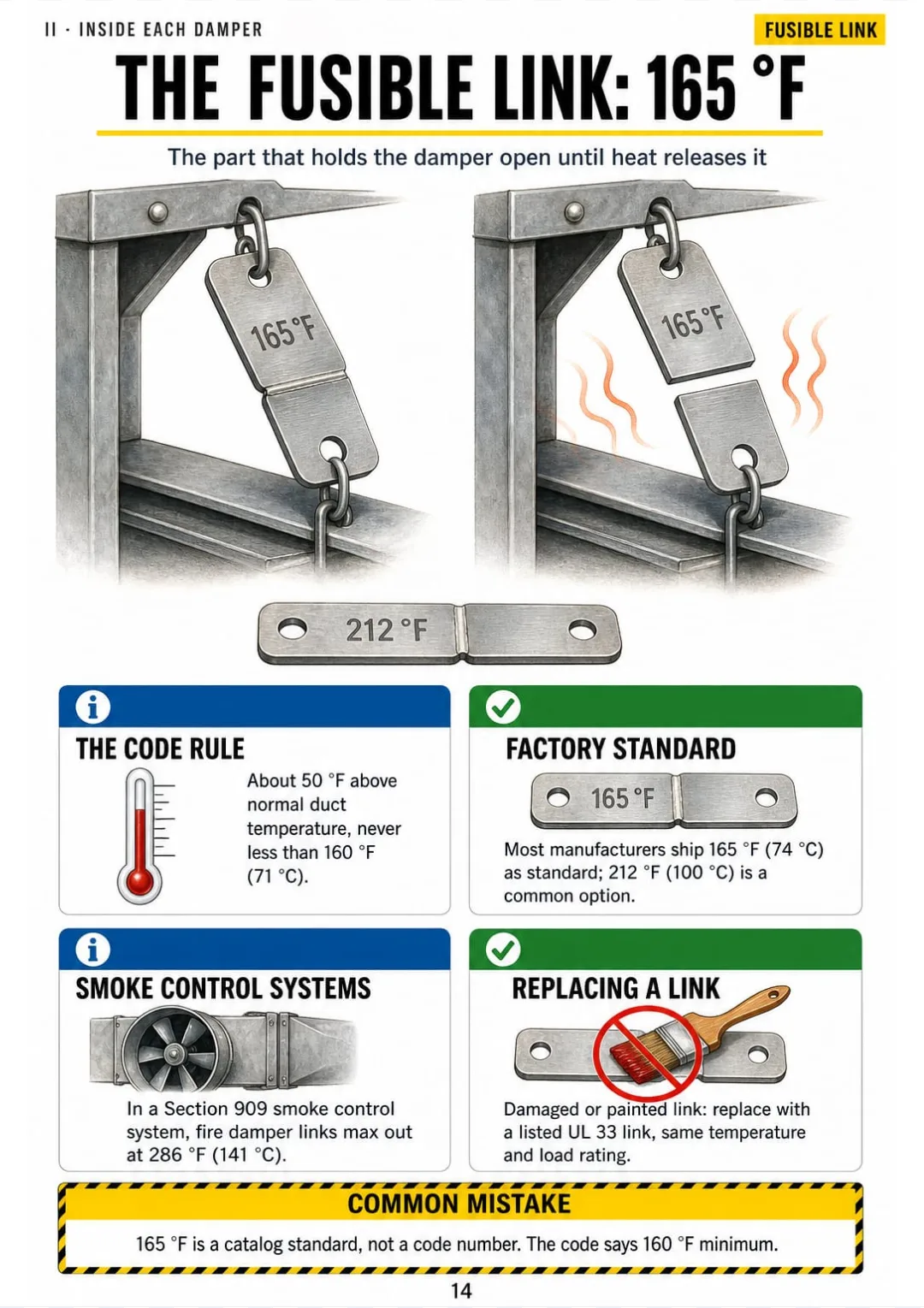
Fusible link: code minimum 160 °F, factory standard 165 °F, common option 212 °F.
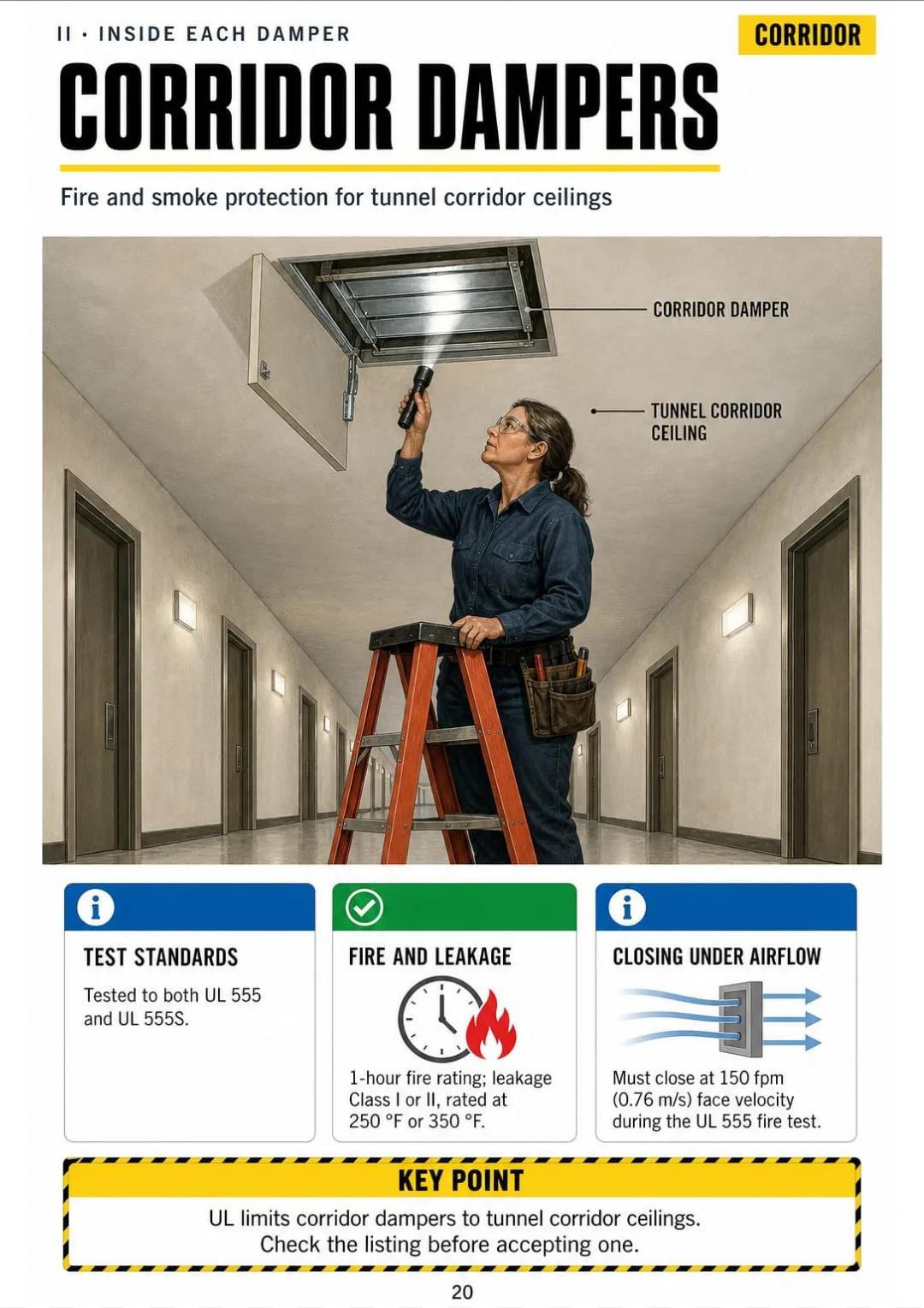
Corridor dampers: UL 555 + 555S, 1-hour rating, close at 150 fpm.
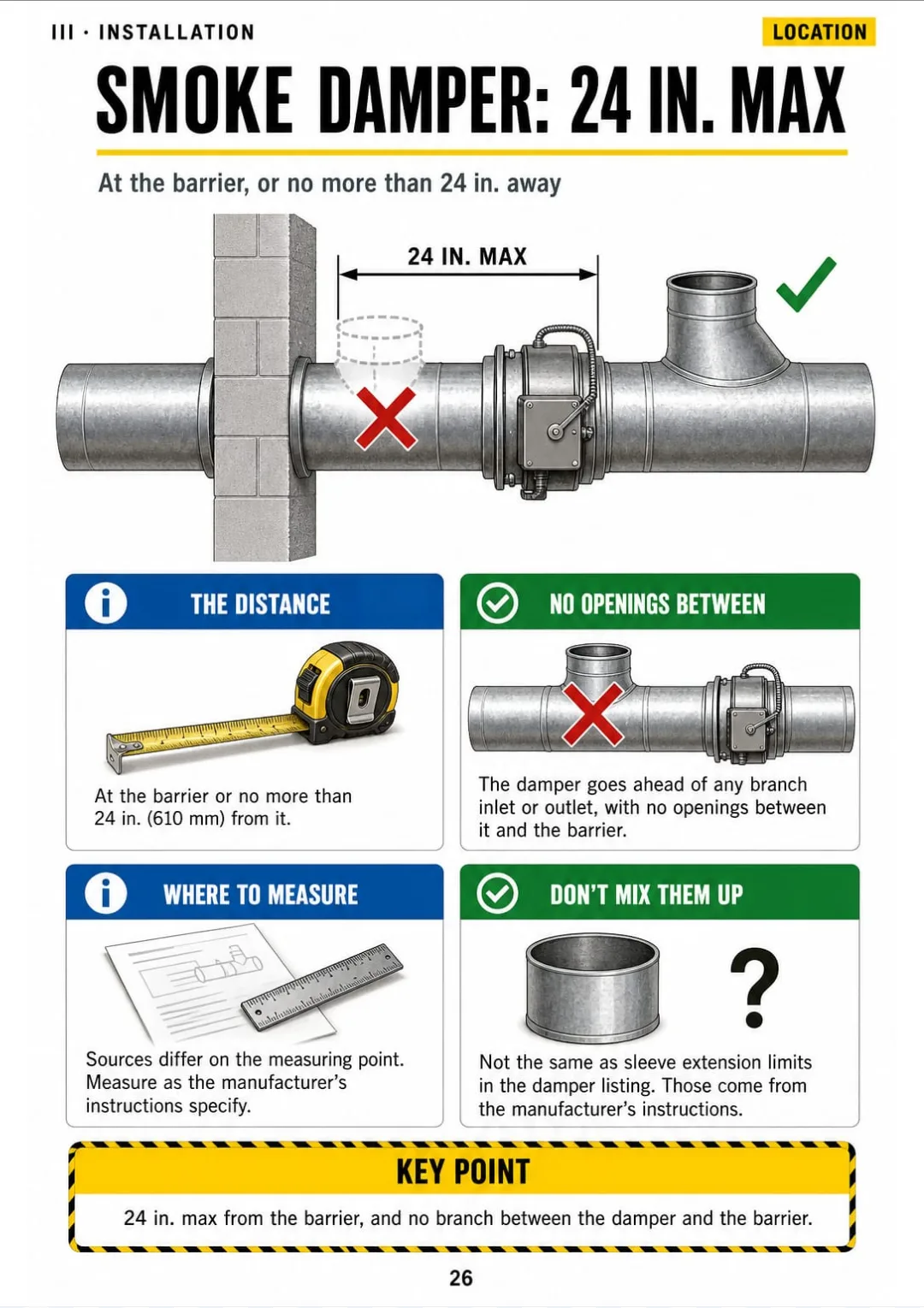
Smoke dampers: at the barrier or within 24 in. (610 mm), ahead of any branch.
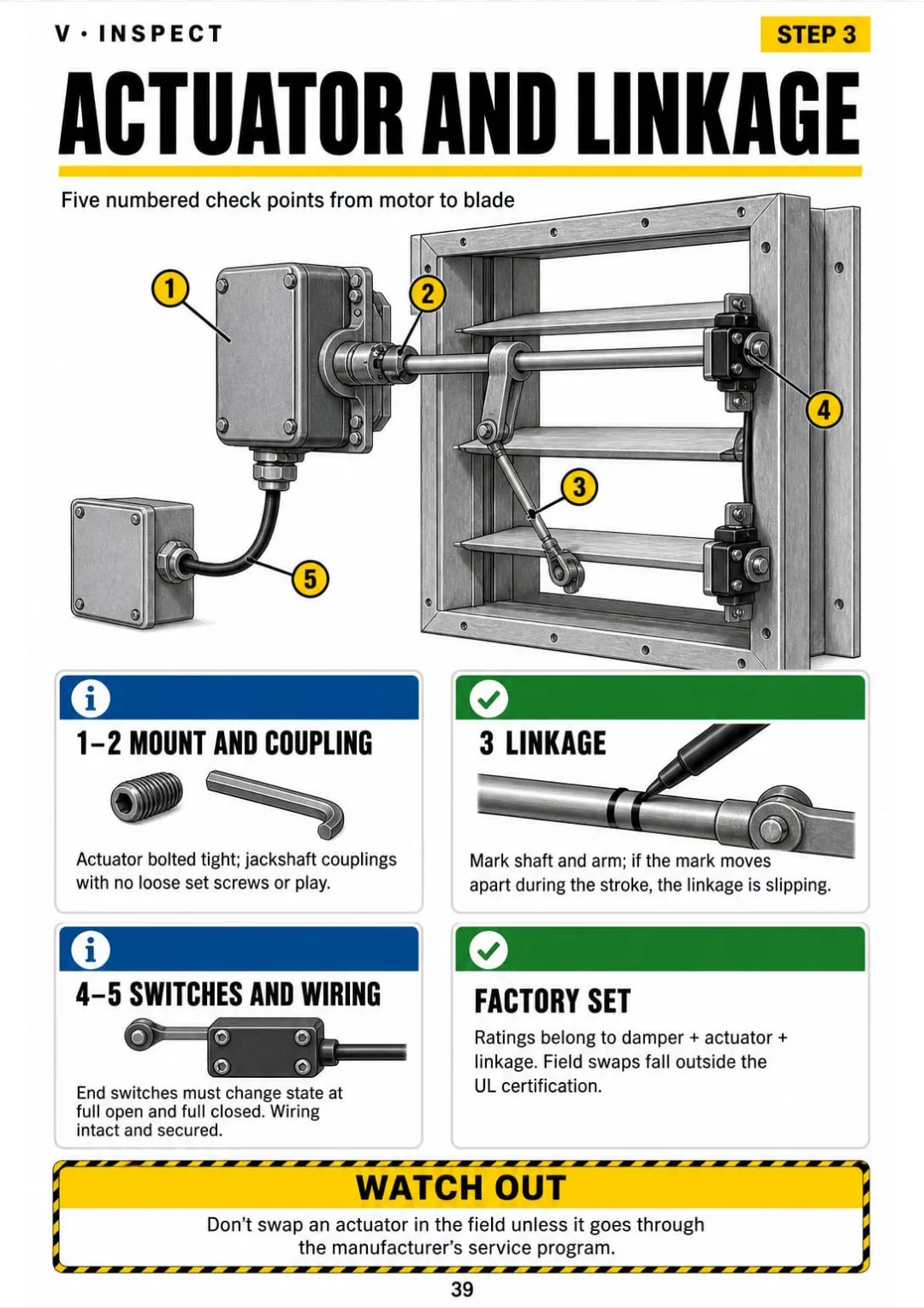
Five check points from actuator to blade, numbered in the order you inspect.
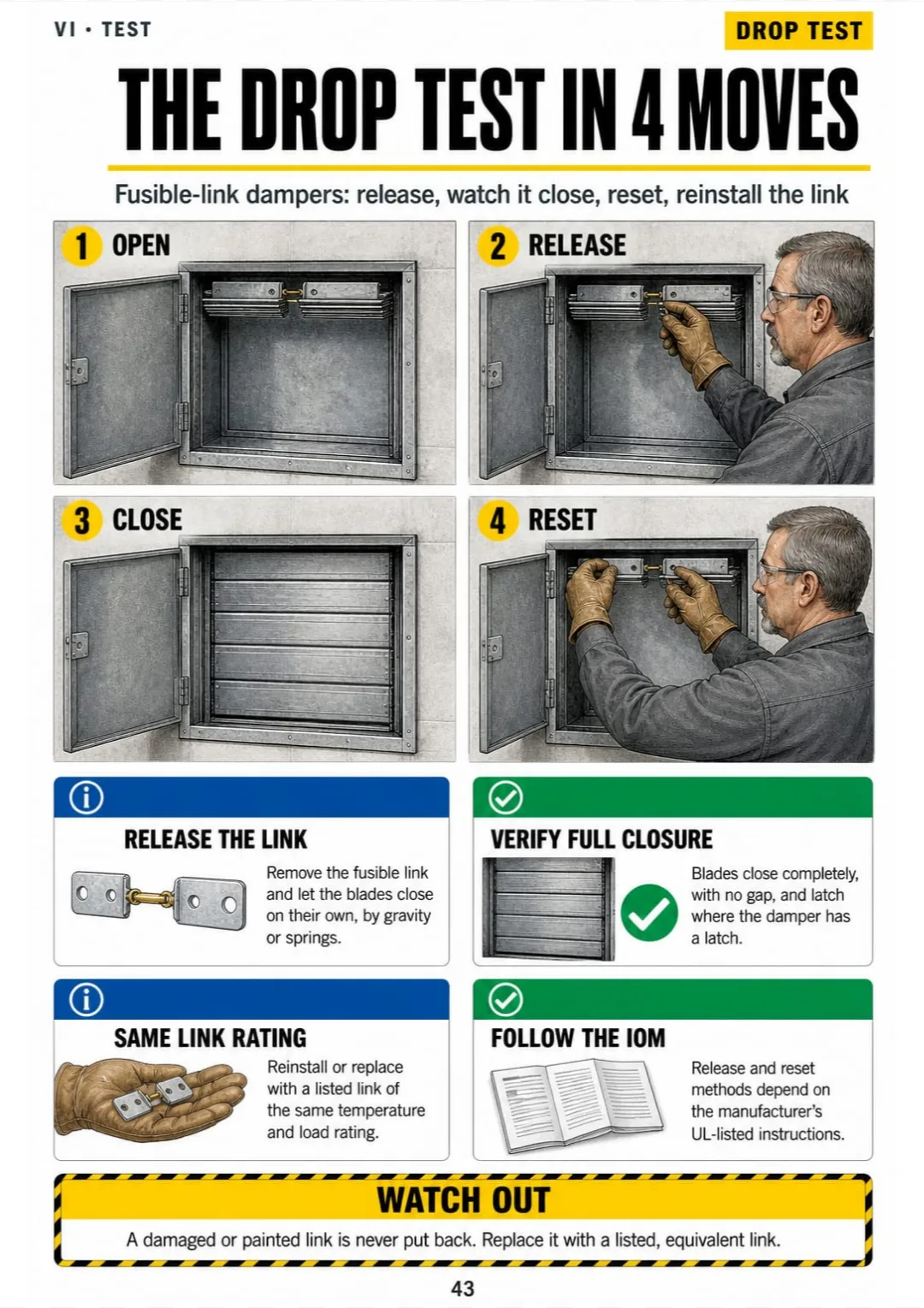
Drop test: remove the link, confirm full closure and latch, reset, reinstall a same-rated link.
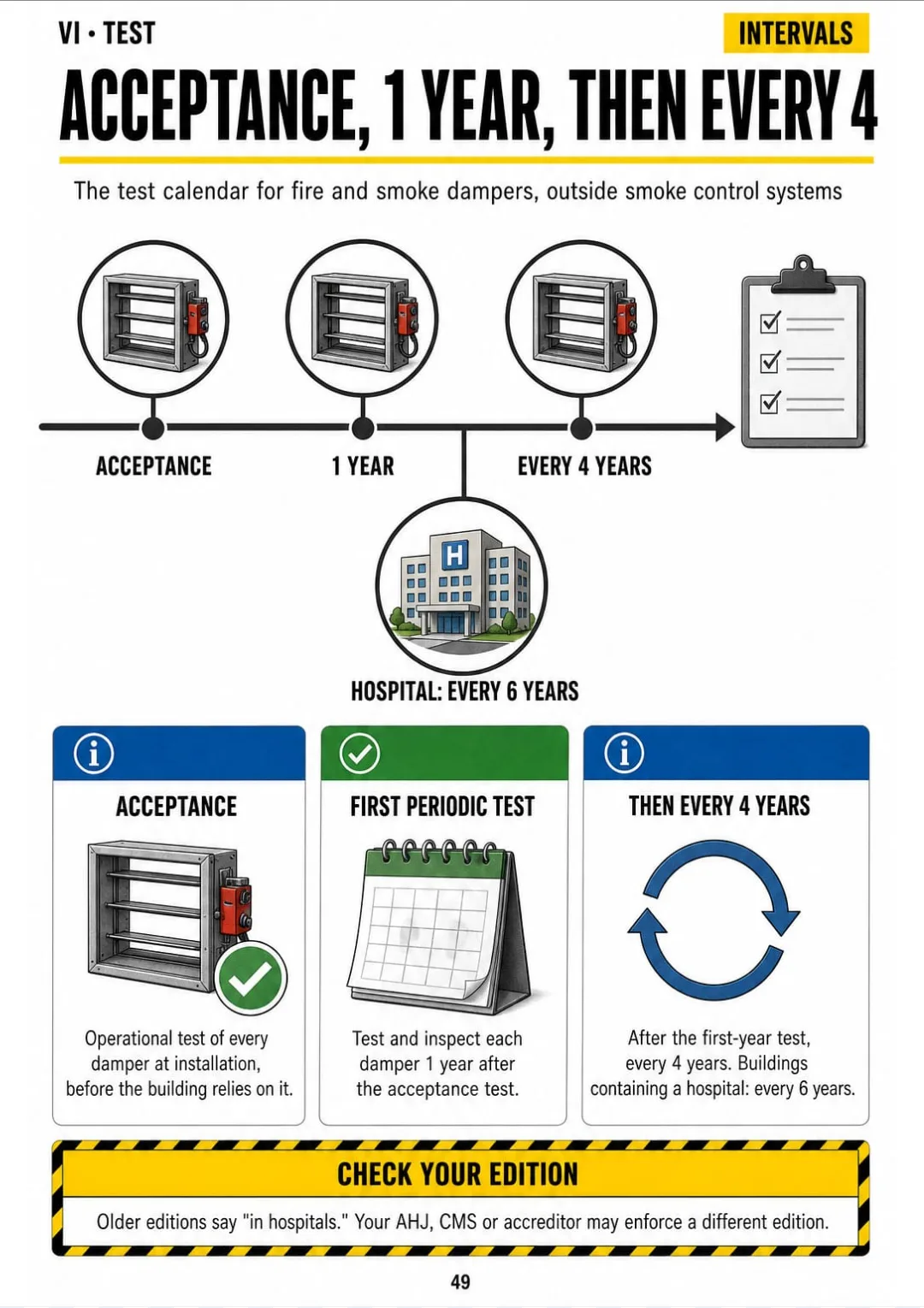
Damper tests: at acceptance, 1 year later, then every 4 years (6 in buildings containing a hospital).
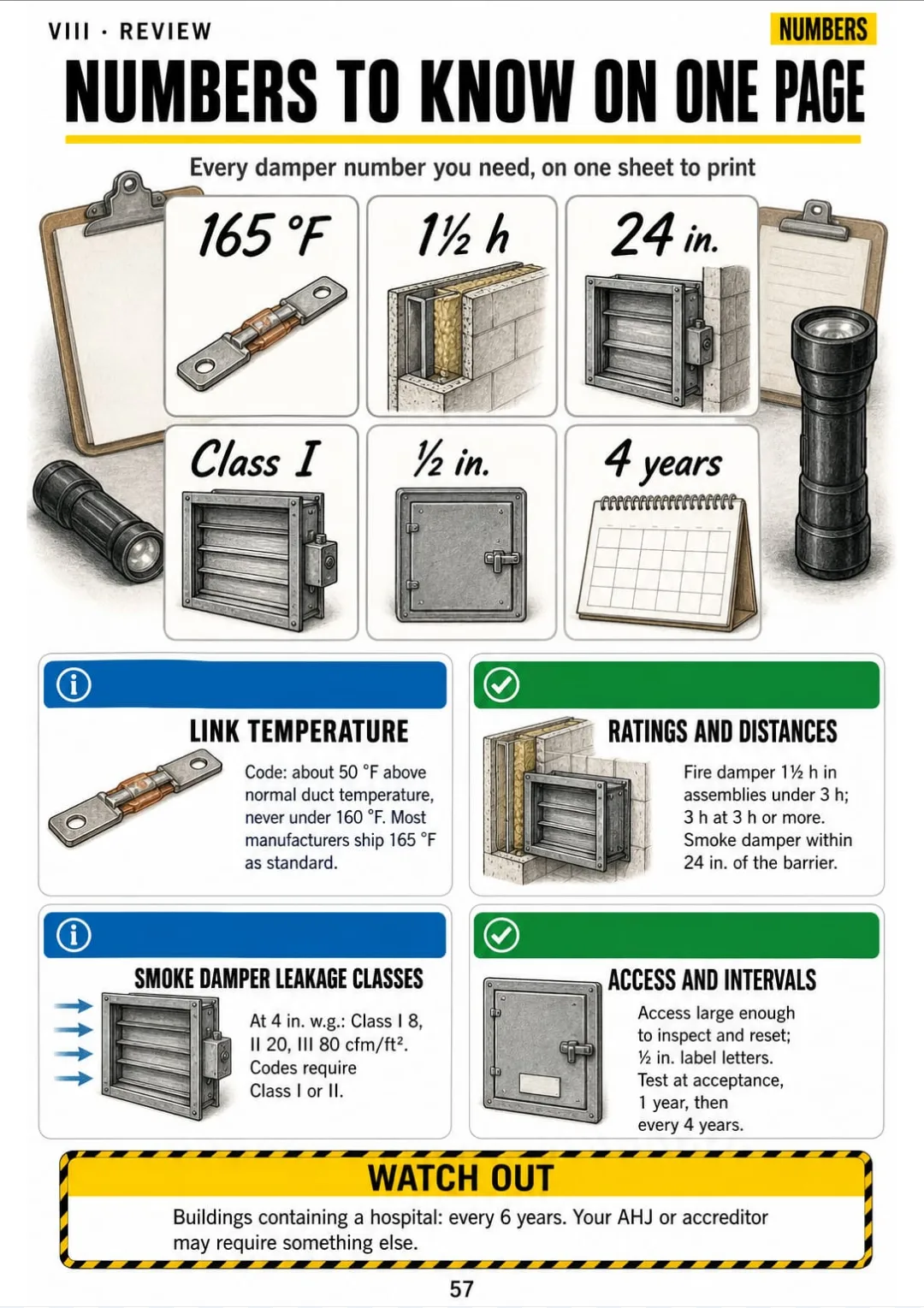
165 °F, 1½ and 3 hours, 24 in., ½ in., Class I-II-III and the 1-4-6 year rule

Take a Look at the 8 Parts and 58 Topics

Why Dampers Exist

pp. 5-11
  1. Compartments: The Building Is a Set of Boxes
  2. Fire Damper, Smoke Damper, Combination: Three Different Jobs
  3. Ratings: 1½ Hours and 3 Hours
  4. The Code Map: Who Says What
  5. The AHJ and the Edition That Applies
  6. Where Dampers Are Required
  7. The Label: What It Tells You at a Glance

Inside Each Damper

pp. 12-20
  1. Curtain Fire Damper: Folded Blades and Gravity or Springs
  2. Multi-Blade Fire Damper
  3. The Fusible Link: 165 °F as the Standard
  4. Static vs Dynamic Fire Dampers
  5. Smoke Damper: Blades, Seals and Leakage Class
  6. Actuators: Electric, Pneumatic and Spring Return
  7. Combination Damper: Heat Sensor and Reset
  8. Ceiling Radiation Dampers
  9. Corridor Dampers

How a Damper Is Installed

pp. 21-28
  1. The Sleeve: The Damper Lives in It
  2. Retaining Angles: Both Sides of the Wall
  3. Expansion Clearance Between Sleeve and Wall
  4. Breakaway Connections
  5. Vertical vs Horizontal Mounting
  6. Smoke Dampers Within 24 Inches of the Barrier
  7. Access Doors and the ½-Inch Label
  8. Controls: Duct Detectors, Fire Alarm and Wiring

Steps 1–2: Identify and Access

pp. 29-34
  1. The 5-Step Field Order
  2. Reading the Damper Schedule and Life Safety Plan
  3. Tags and Numbering
  4. Finding the Damper Above the Ceiling
  5. Before You Climb: Safety and Coordination
  6. Getting Through the Access Door

Step 3: Inspect

pp. 35-42
  1. Frame and Track
  2. Blades and Seals
  3. The Fusible Link Check
  4. Sleeve, Angles and the Wall Penetration
  5. Actuator and Linkage
  6. Obstructions in the Blade Path
  7. Latch and Closure Hardware
  8. What Counts as a Deficiency

Step 4: Test

pp. 43-50
  1. The Drop Test: Open, Release, Close, Reset
  2. Testing a Static Damper: Fans Off
  3. Testing a Dynamic Damper: Fans On
  4. Smoke Damper Operational Test
  5. Combination Damper: Testing Both Functions
  6. Smoke Control Systems: Timing and Position
  7. Testing Intervals: Acceptance, 1 Year, Then Every 4
  8. After Repairs: Retest Before You Leave

Step 5: Document

pp. 51-56
  1. What Every Damper Record Contains
  2. Photos That Prove the Test
  3. Writing a Deficiency So It Gets Fixed
  4. Inaccessible and Not Found Dampers
  5. Keeping Records for the Survey
  6. Signing the Report

Review and Exam Prep

pp. 57-62
  1. Numbers to Know on One Page
  2. Fire vs Smoke vs Combination: The Confusions
  3. Static vs Dynamic, Type A vs B vs C
  4. The 5 Steps in One Drawing
  5. Glossary of Damper Terms
  6. Pre-Exam and Pre-Job Checklist

Who This Book Is For

You're studying for the damper certification

You get the whole job in one order: type, how it closes, how it's installed, how it's tested, how it's documented. Each topic on one drawn page.

Your exam date is set

The review part puts every number on one page and the confusions side by side, so you go over it in the evenings and walk in knowing where everything is.

You already inspect dampers

Print the pages you need and keep them in the truck: the drop test, the intervals and how to write a deficiency, always in the same order.

Plus: 2 Free Books

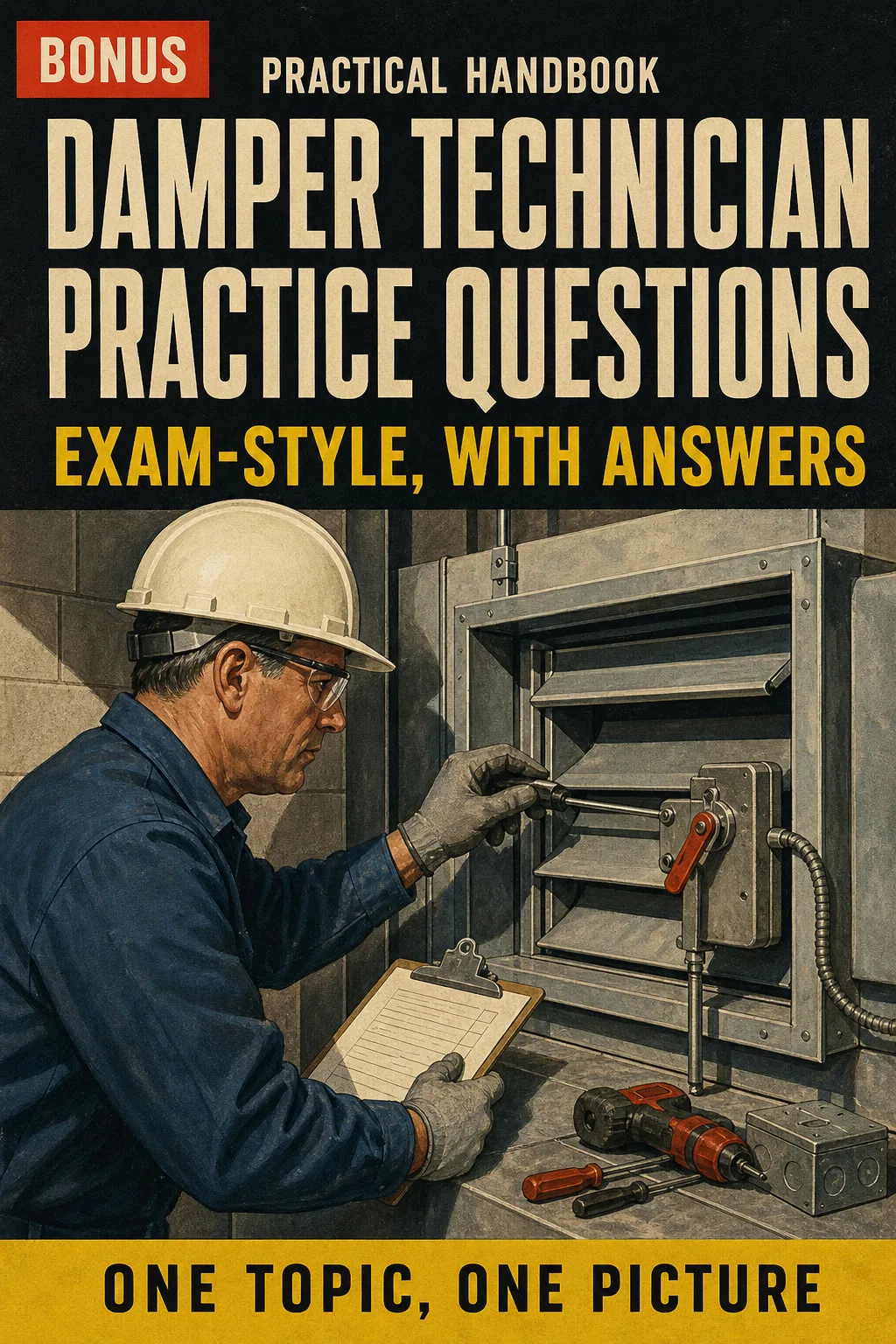
Damper Technician Practice Questions: Exam-Style, with Answers
BONUS 1

Damper Technician Practice Questions: Exam-Style, with Answers

Test yourself on damper types, installation, testing and reports, and see why each answer is right before the real exam.
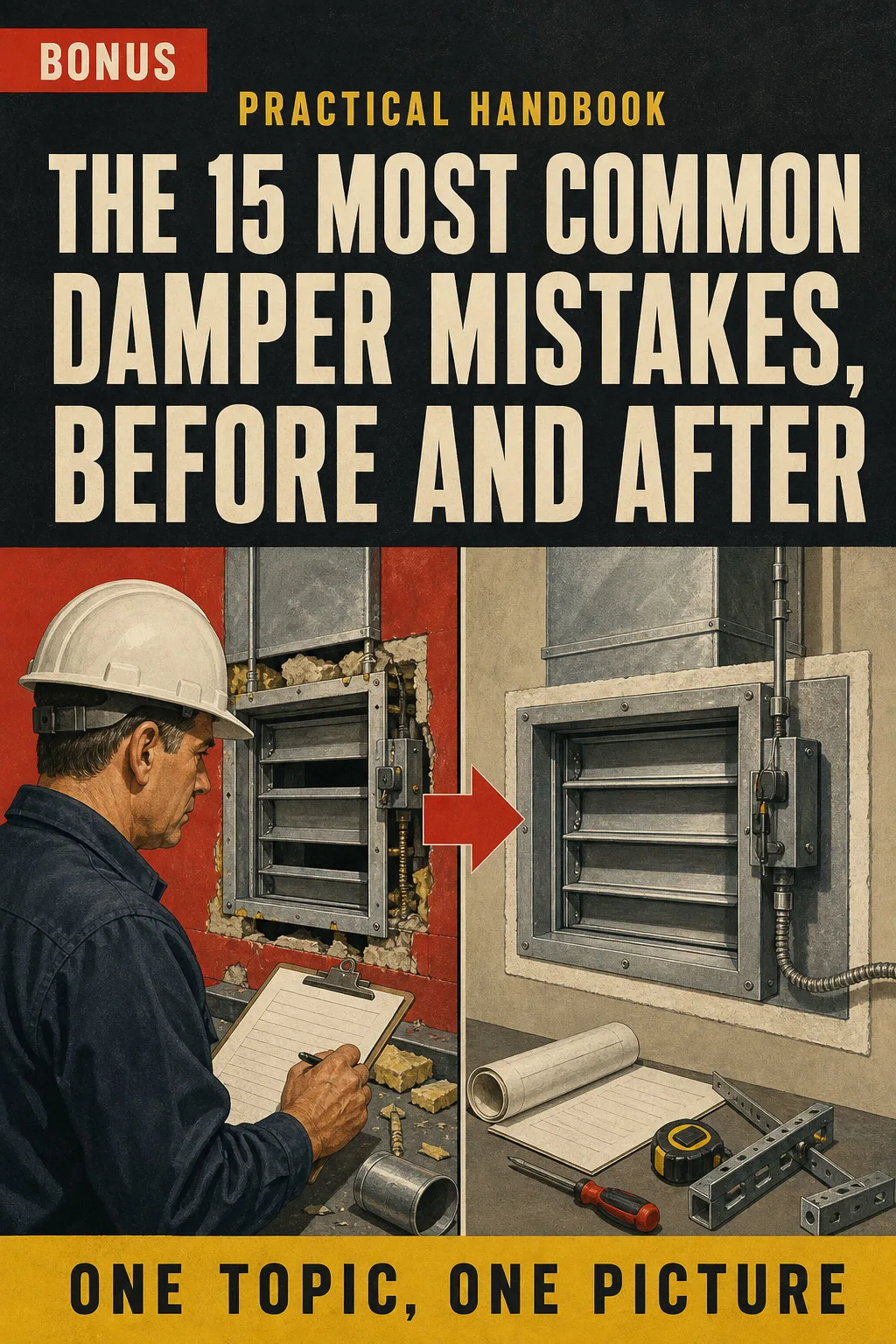
The 15 Most Common Damper Mistakes, Before and After
BONUS 2

The 15 Most Common Damper Mistakes, Before and After

See the errors that show up most often in the field and on reports, each drawn wrong and then right, so you can spot them at a glance.

30-Day Guarantee

30-day guarantee: if a file doesn't open, if the content isn't what the product page describes, if you were charged twice or the email never arrived, write to us and we'll refund you in full. You pay once. No subscriptions.

Frequently Asked Questions

Is it for my damper exam, and is it beginner level?

It covers what US fire and smoke damper inspection and testing exams ask about: damper types, installation, testing under NFPA 80 and NFPA 105, and documentation. Compare the open index on this page with your program's outline. It doesn't start you from zero: it puts what you already do in the field into one order and adds the why behind each step.

Is it for the US damper exam, and is it up to date with the code?

Yes, it's written for US practice, in inches, °F and in. w.g., from NFPA 80, NFPA 105, NFPA 90A, International Building Code Section 717, the International Mechanical Code, the UL 555 and UL 555S test standards and manufacturers' listed installation instructions. Your AHJ may enforce an edition other than the latest one, so every number and interval names the standard it comes from: check it against the edition adopted where you work.

Is it official material?

No. It's an independent illustrated study book. It is not affiliated with or endorsed by NFPA, ICC, UL, ICB, TABB or any certification body.

Does it give me the certification or replace the course?

No. It's a study and review book: the certification comes from the certifying body, after you pass their exam. It doesn't replace your course, field experience, the manufacturer's instructions or what your AHJ requires.

Are the practice questions the ones on the exam?

No. They're written for this book, in exam style, to help you check what you know. They aren't official questions from any exam.

When and how do I get it?

In PDF, by email, at the address you enter at checkout. The book and the 2 bonus books come together.

Do I have to pay every month?

No. It's a one-time payment. No subscription.

Can I have it on paper?

Yes. The PDF is made to print: print the whole book or just the pages you want to take to the job.

How does the refund work?

You have 30 days. We refund everything if the file won't open, if the book isn't what you see on this page, if you were charged twice or if the email doesn't arrive: just email us.

US$ 27US$ 63
Get the book · US$ 27

This is a digital PDF book sent to your email: nothing is printed or shipped.

More books on this topic

Fire Alarm Systems Illustrated

A 58-page illustrated guide for the NICET Fire Alarm Systems Level I and II exams. Every device, circuit and…

From US$ 27 US$ 63

Fire Inspector Exam Illustrated

The Fire Inspector I material, one topic per illustrated page: occupancy groups, means of egress, fire protection…

From US$ 27 US$ 63

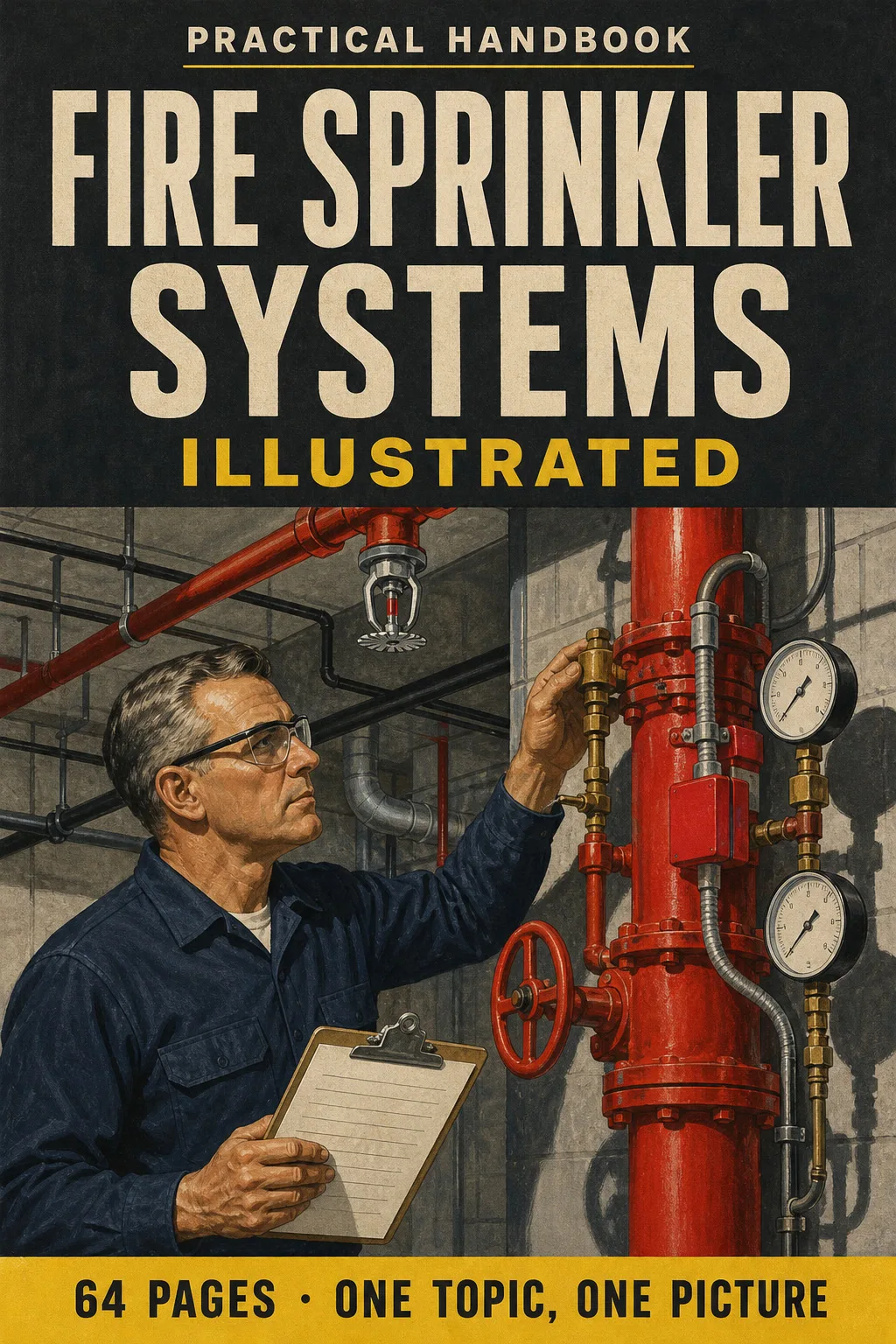
Fire Sprinkler Systems Illustrated

Fire sprinkler systems explained one topic per page, every part drawn: how a head operates, wet, dry, pre-action and…

From US$ 27 US$ 63

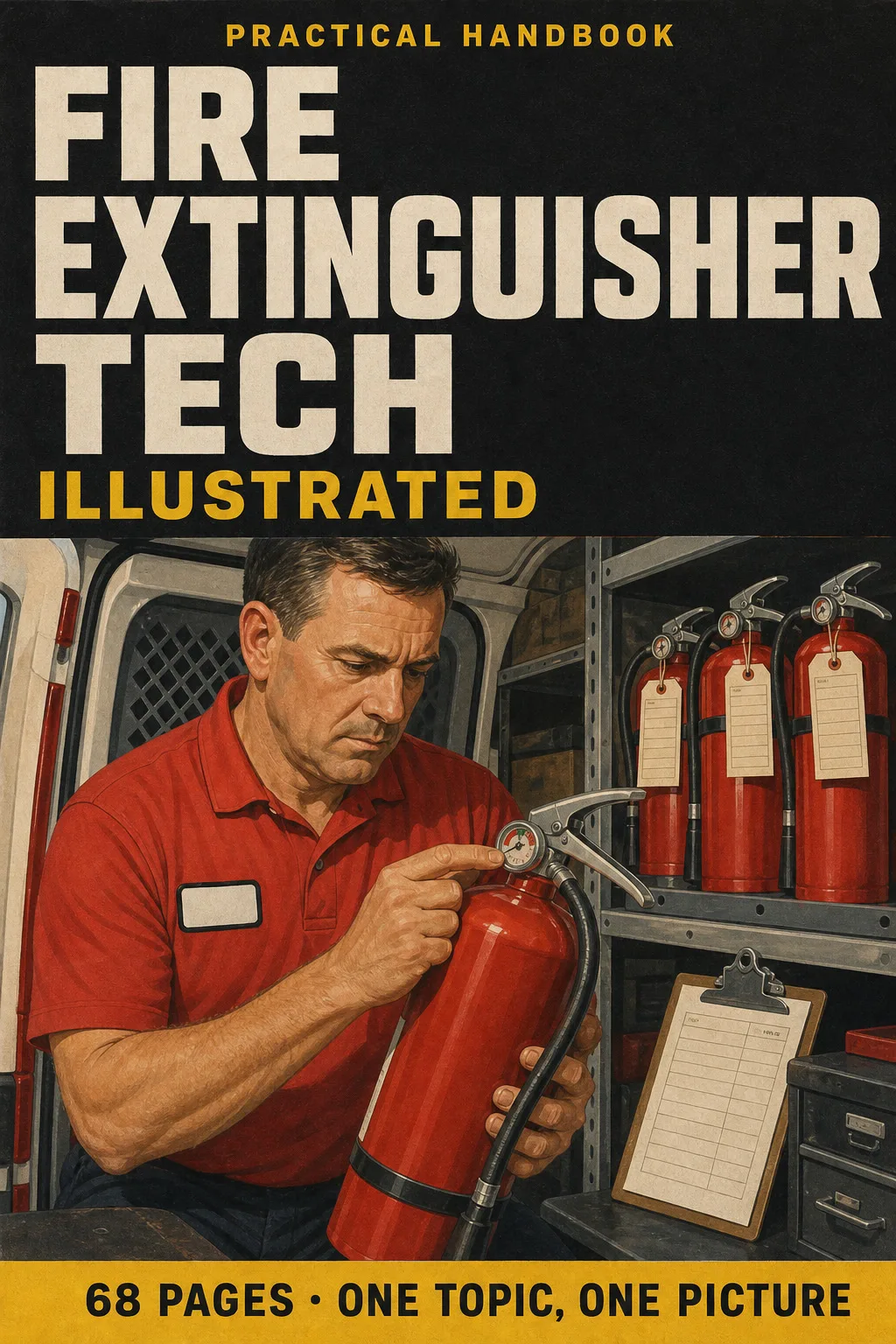
Fire Extinguisher Tech Illustrated

Portable fire extinguisher service, drawn one topic per page: fire classes A, B, C, D and K, extinguisher types, parts…

From US$ 27 US$ 63

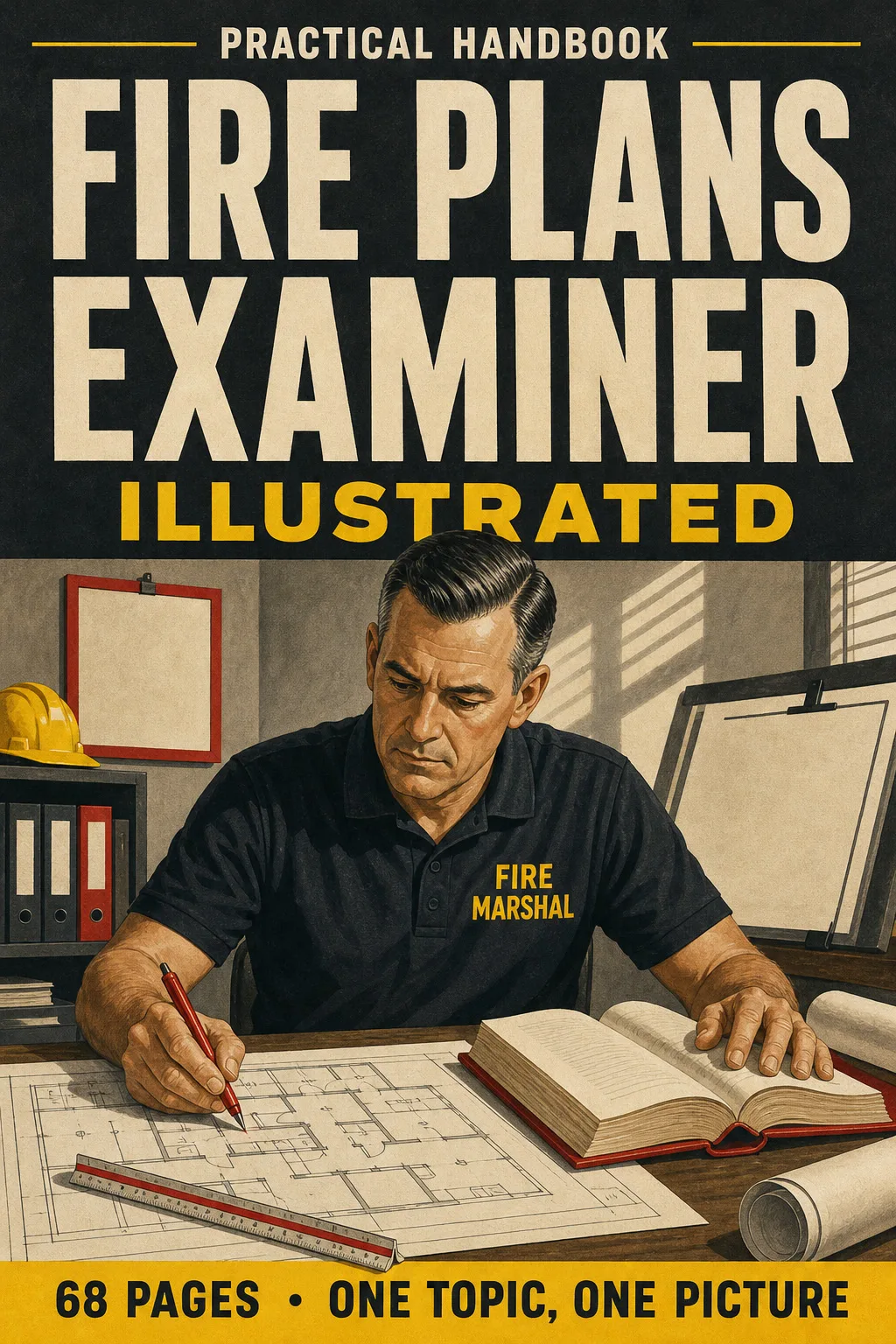
Fire Plans Examiner Illustrated

Fire plans examiner prep, drawn one topic per page: occupancy classification, construction types, occupant load with…

From US$ 27 US$ 63