Study in Pictures🌐 English (United Kingdom)
Fire Risk Assessment Illustrated

Digital book in PDF · read it on your phone or print it

Fire Risk Assessment Illustrated

The fire triangle, the five steps, people at risk, means of escape, fire doors, alarm categories, emergency lighting and rating the risk. Every topic has its own page: first the drawing, then what you need to remember.

  • 67 illustrated pages
  • English
  • 30-day guarantee
£19.99£57.99
Get the book · £19.99

Price shown for: United Kingdom. In other countries, the checkout shows the price that applies there.

About this book

What it is

The fire triangle, the five steps, people at risk, means of escape, fire doors, alarm categories, emergency lighting and rating the risk. Every topic has its own page: first the drawing, then what you need to remember.

Who This Book Is For
  • You're studying for an assessor qualification
  • Your exam is close
  • You're already the responsible person or an assessor
What it covers
  1. The law and your role
  2. How fire starts and spreads
  3. Step 1: Identify fire hazards
  4. Step 2: Identify people at risk
  5. Step 3: Means of escape
  6. Step 3: Fire doors and compartmentation
  7. Step 3: Detection, lighting and firefighting
  8. Steps 4 and 5: Record, plan, train, review
  9. Practice and review
Language
English (United Kingdom)
Pages
67
Format
Digital book in PDF · read it on your phone or print it
Price
£19.99 (United Kingdom)
Delivery
This is a digital PDF book sent to your email: nothing is printed or shipped.
30-Day Guarantee
30-day guarantee: if a file doesn't open, if the content isn't what the product page describes, if you were charged twice or the email never arrived, write to us and we'll refund you in full.

Look Inside the Book

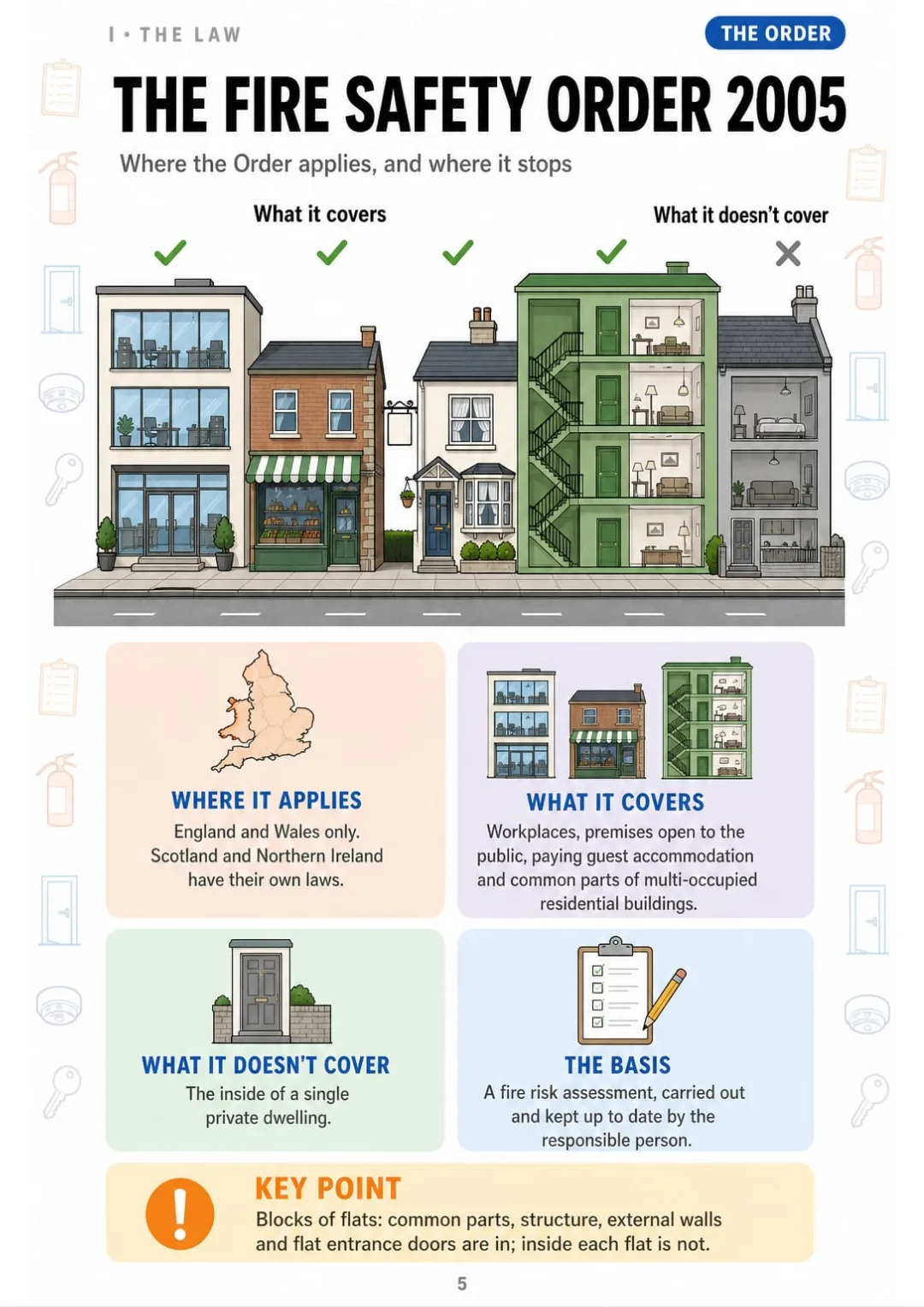
Fire Safety Order 2005: non-domestic premises and common parts of flats, England and Wales
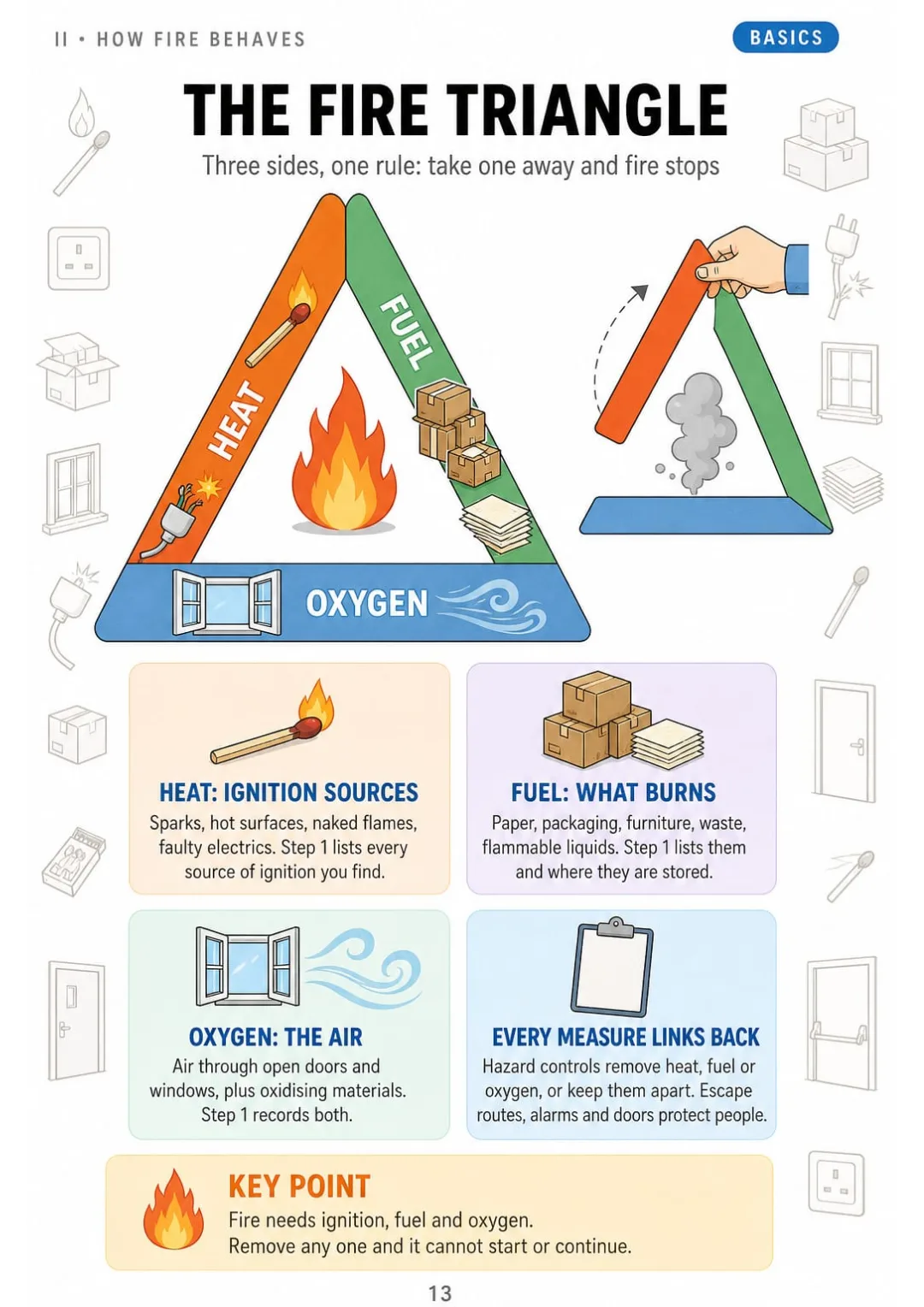
Ignition, fuel, oxygen: take one away and the fire cannot start or continue.
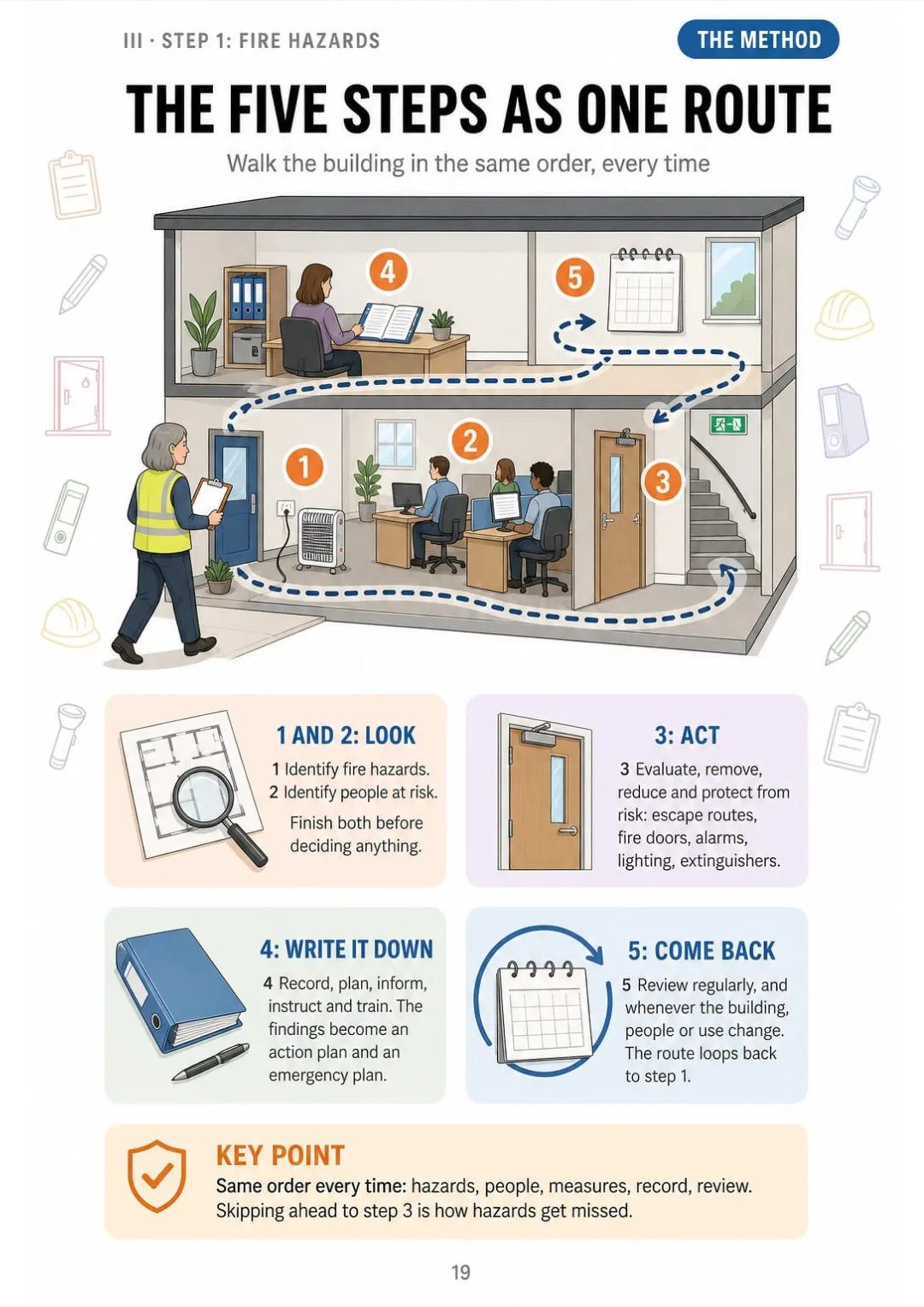
Hazards, people, measures, record, review: the five steps drawn as one walk.
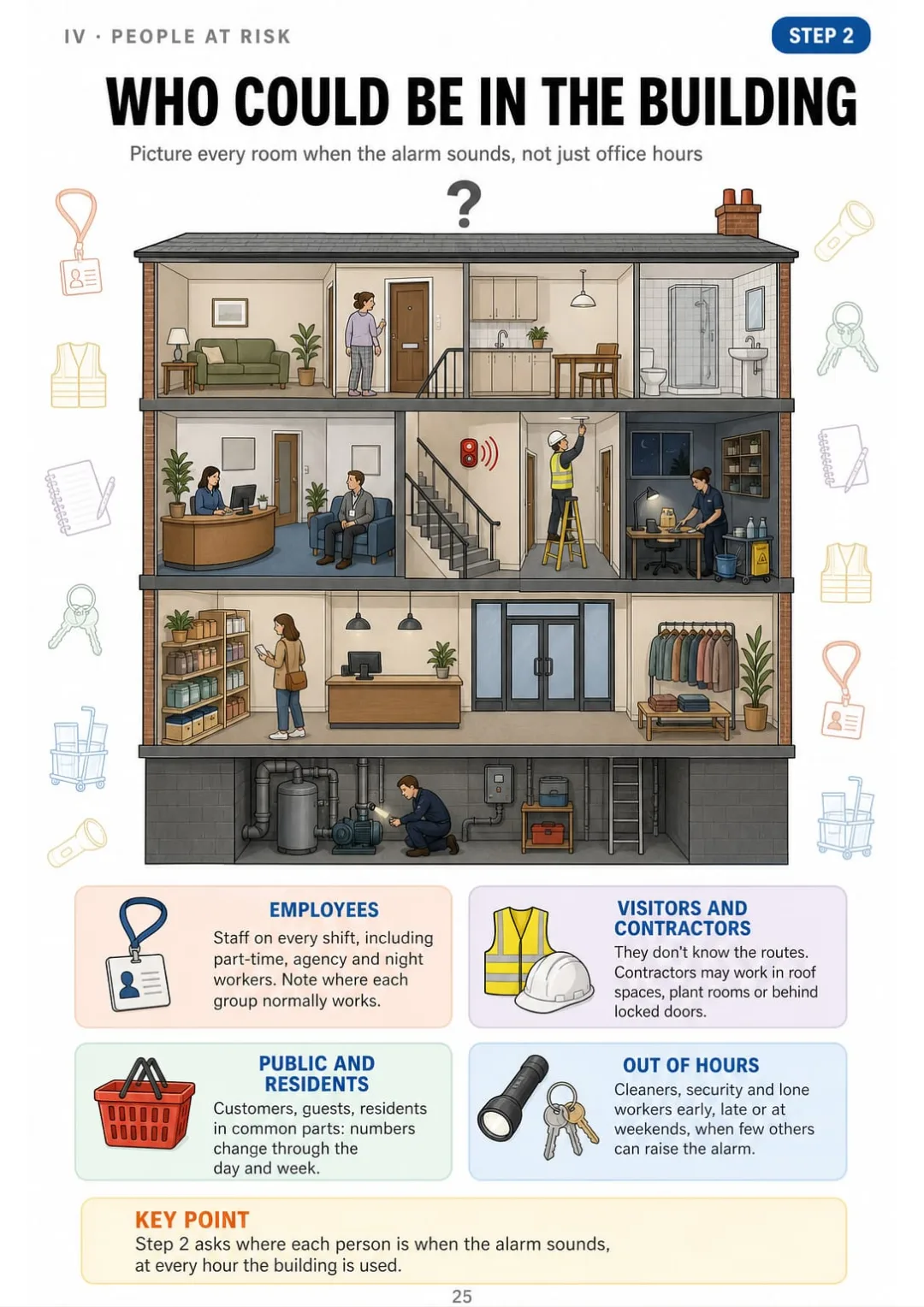
Employees, visitors, contractors, public, residents and lone workers: one figure in every room.
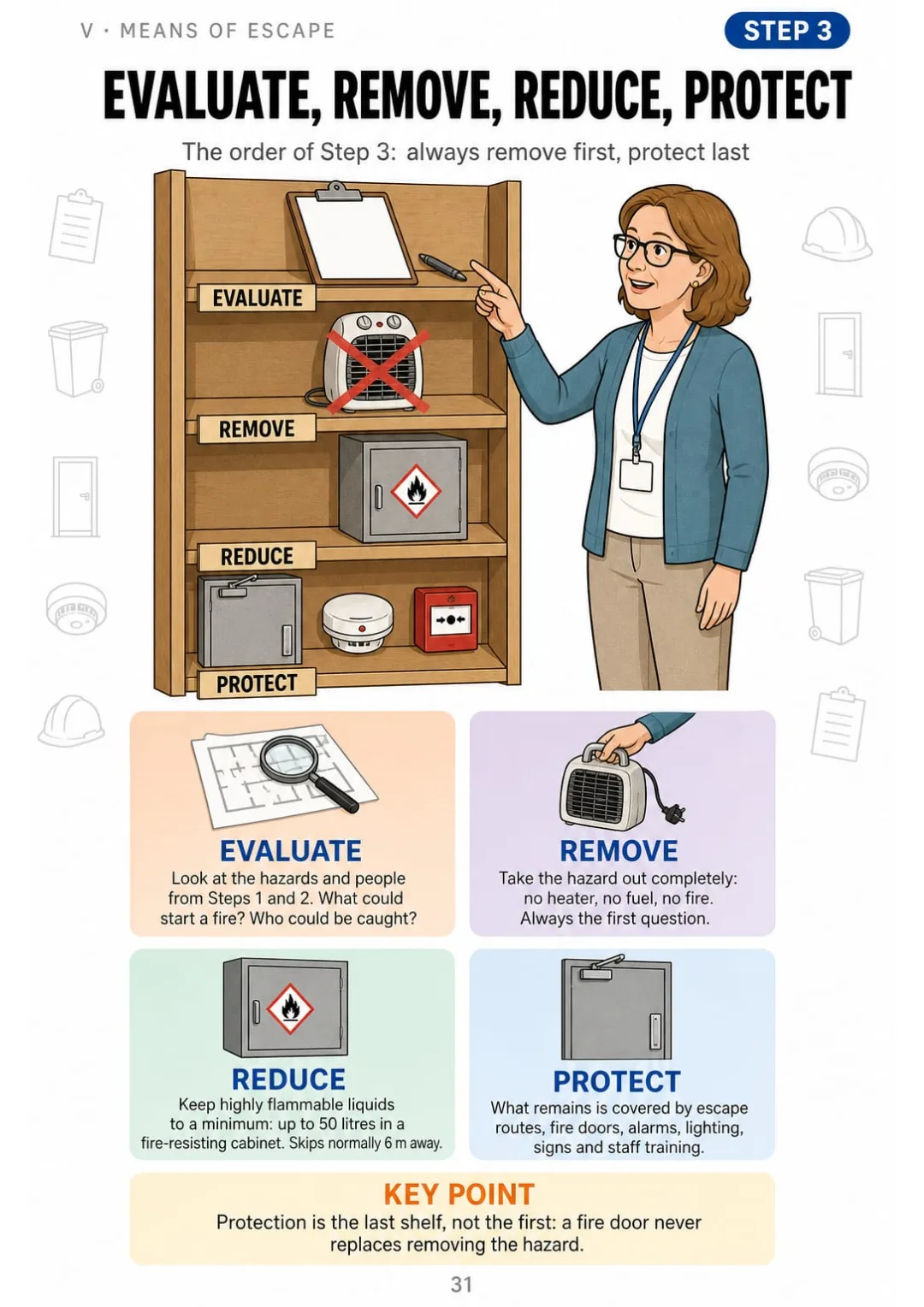
Step 3 on four shelves: evaluate, remove, reduce, protect – with a real example on each
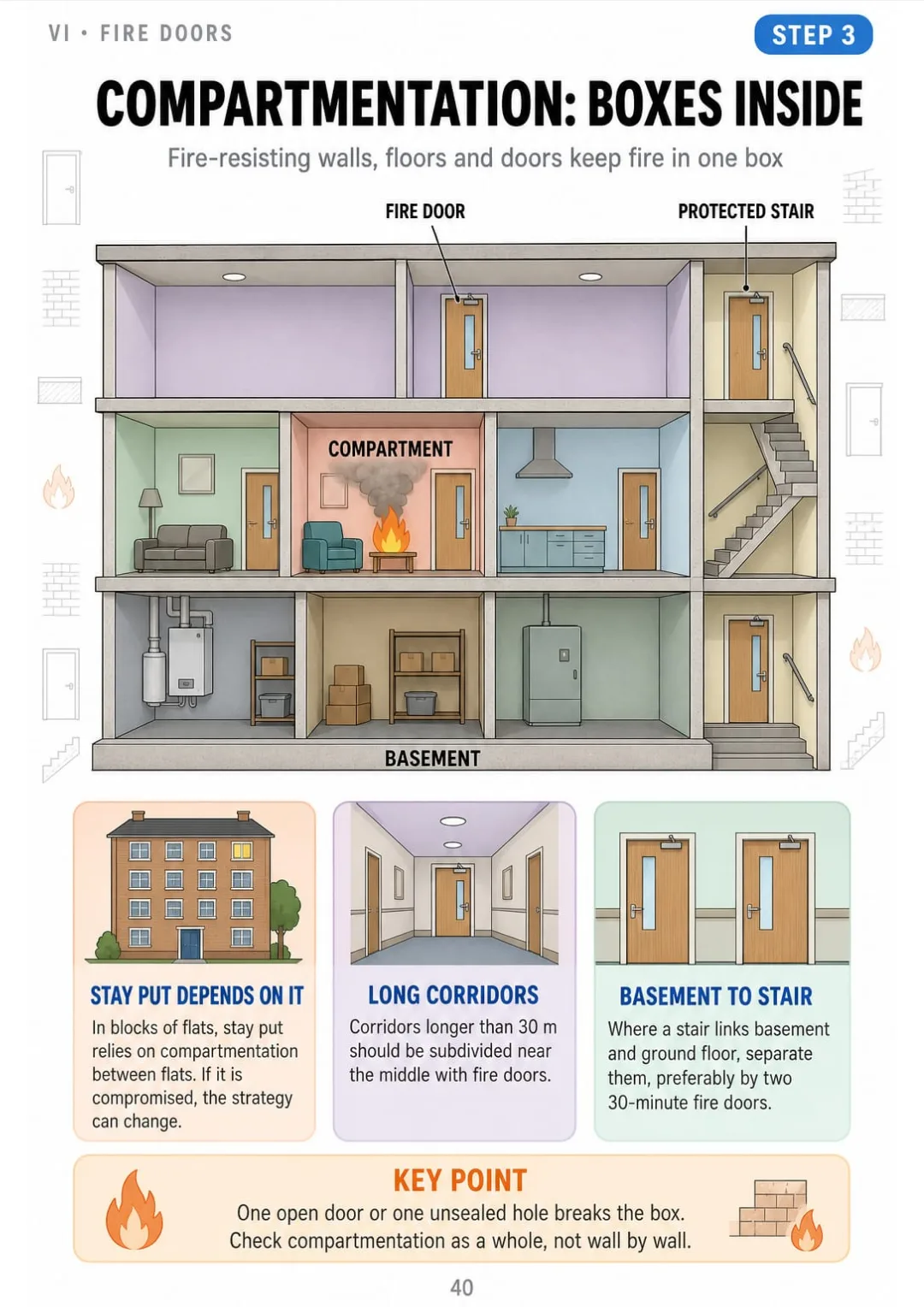
Corridors over 30 m split by fire doors; basement stair behind two 30-minute doors
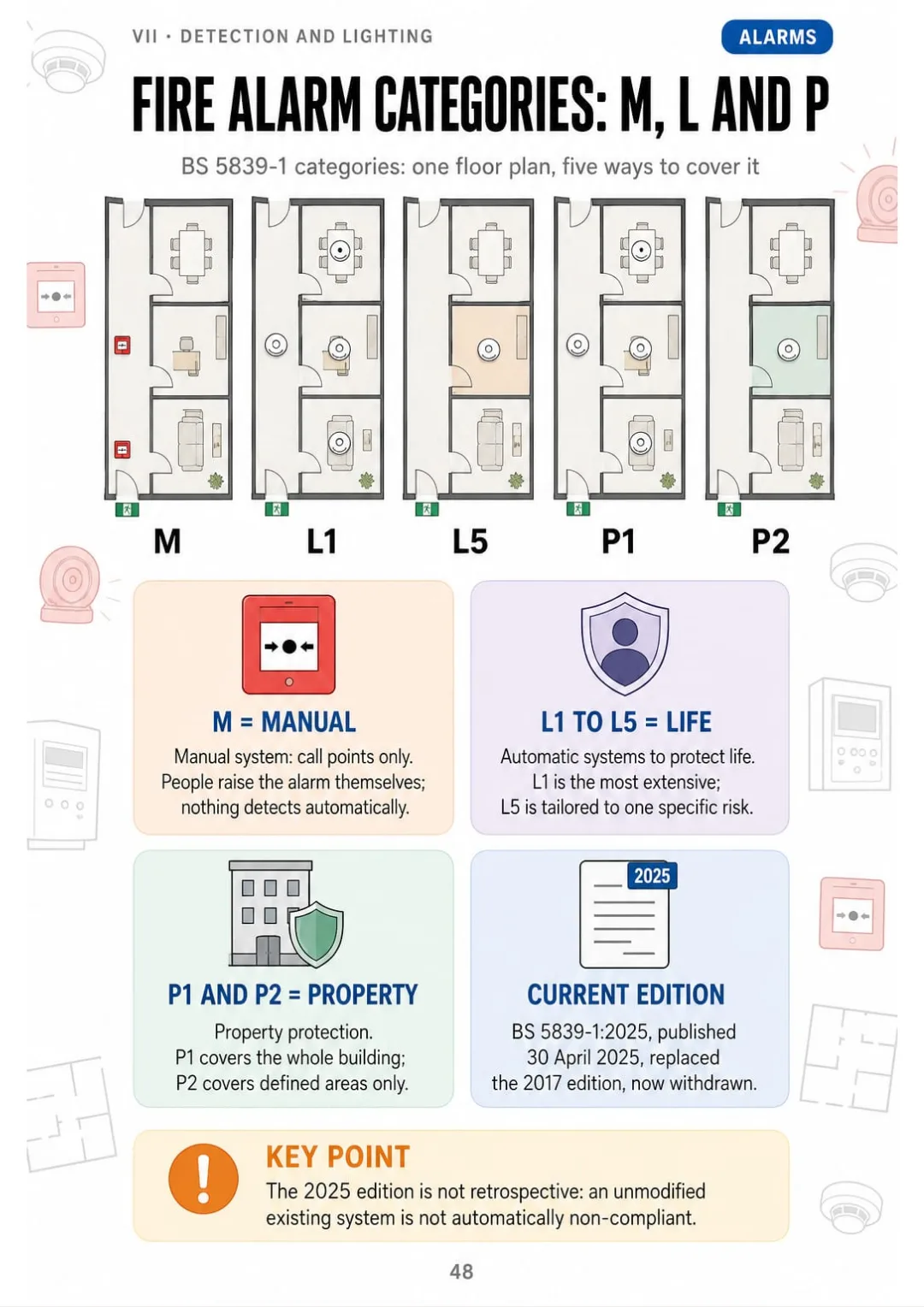
BS 5839-1: M = call points only, L1-L5 protect life, P1-P2 protect property
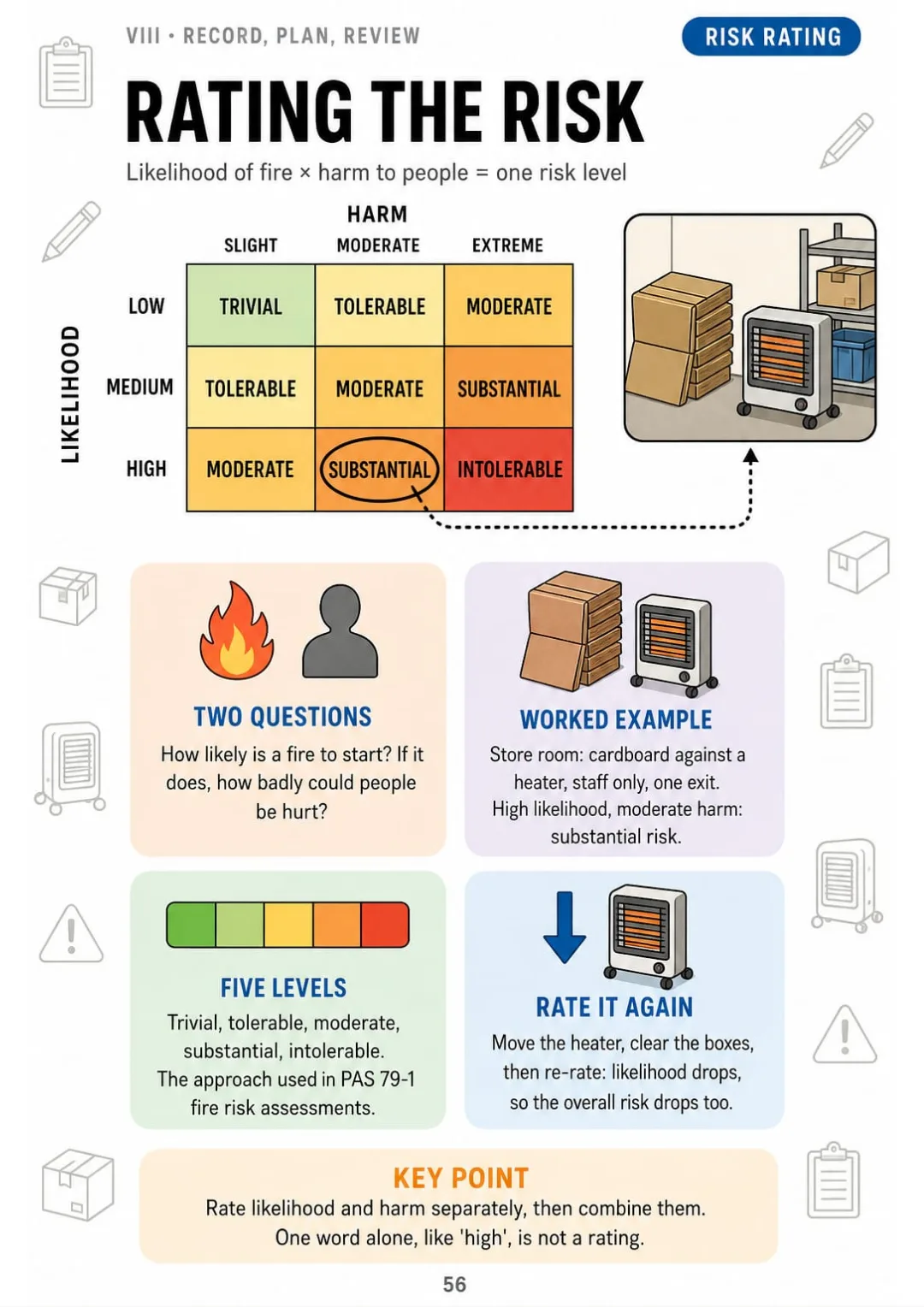
Likelihood × harm: a 3×3 matrix from trivial to intolerable, with a store room example

Take a Look at the 9 Parts and 63 Topics

The law and your role

pp. 5-12
  1. The Fire Safety Order in one page
  2. Who is the responsible person
  3. What changed in 2021, 2022 and 2023
  4. Recording the assessment: the 2023 rule
  5. Blocks of flats: the 2022 Regulations
  6. The fire inspector's visit
  7. Scotland and Northern Ireland: what is different
  8. What a competent assessor knows

How fire starts and spreads

pp. 13-18
  1. The fire triangle
  2. Four ways fire spreads
  3. Smoke kills before flames
  4. Fire growth: from ignition to flashover
  5. Classes of fire
  6. Arson: the deliberate fire

Step 1: Identify fire hazards

pp. 19-24
  1. The five steps as one route
  2. Sources of ignition
  3. Sources of fuel
  4. Sources of oxygen
  5. Hot work and contractors
  6. Dangerous substances and DSEAR

Step 2: Identify people at risk

pp. 25-30
  1. Who could be in the building
  2. People especially at risk
  3. Sleeping risk
  4. PEEPs: personal emergency evacuation plans
  5. Occupant numbers and floor space factors
  6. Evacuation strategies

Step 3: Means of escape

pp. 31-39
  1. Evaluate, remove, reduce, protect
  2. The escape route from start to finish
  3. Travel distance: one direction or two
  4. Alternative exits and the 45° rule
  5. Dead ends and inner rooms
  6. Exit widths
  7. Exit doors and fastenings
  8. Protected stairways
  9. Final exits and assembly points

Step 3: Fire doors and compartmentation

pp. 40-47
  1. Compartmentation: boxes inside the building
  2. Fire stopping and penetrations
  3. Anatomy of a fire door
  4. FD30, FD60 and the S
  5. Fire door gaps
  6. The self-closer test
  7. Hold-open devices and the alarm
  8. Flat entrance doors and external walls

Step 3: Detection, lighting and firefighting

pp. 48-55
  1. Fire alarm categories
  2. Detectors and call points
  3. Testing the fire alarm
  4. Domestic alarms in flats: BS 5839-6
  5. Emergency lighting
  6. Testing emergency lighting
  7. Fire safety signs
  8. Fire extinguishers by colour

Steps 4 and 5: Record, plan, train, review

pp. 56-62
  1. Rating the risk
  2. Significant findings
  3. The action plan
  4. The emergency plan
  5. Inform, instruct and train
  6. Maintenance and the logbook
  7. Step 5: When to review

Practice and review

pp. 63-67
  1. Walk-through: a small office
  2. Walk-through: a block of flats
  3. The numbers to have at hand
  4. Five steps at a glance
  5. Frequent mistakes when assessing

Who This Book Is For

You're studying for an assessor qualification

Each evening you open one topic, see it drawn and know where it fits in the five steps, even after years away from exams.

Your exam is close

You revise the numbers to have at hand and the five steps at a glance, then test yourself with the practice questions and their answers.

You're already the responsible person or an assessor

You print the pages you need and take them round the building, so the fire doors, alarms and escape routes are checked in the same order every time.

Plus: 2 Free Books

Fire Risk Assessment Practice Questions, with Answers Explained
BONUS 1

Fire Risk Assessment Practice Questions, with Answers Explained

Exam-style questions on every chapter, each with the answer and the reason behind it, so you find your gaps before the exam does.
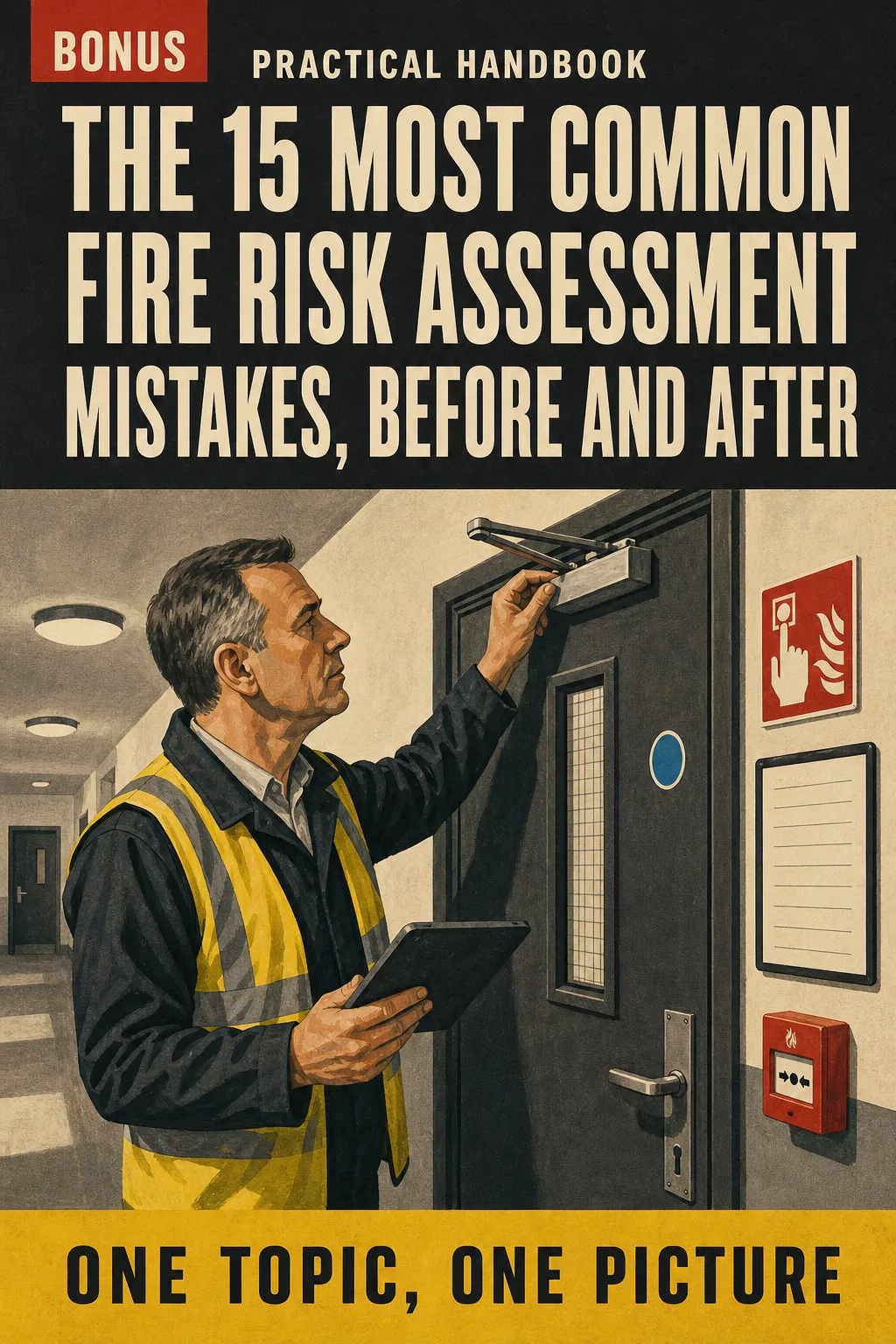
The 15 Most Common Fire Risk Assessment Mistakes, Before and After
BONUS 2

The 15 Most Common Fire Risk Assessment Mistakes, Before and After

Fifteen frequent mistakes drawn side by side with the right version, from wedged fire doors to vague action plans, to review in an evening.

30-Day Guarantee

30-day guarantee: if a file doesn't open, if the content isn't what the product page describes, if you were charged twice or the email never arrived, write to us and we'll refund you in full. You pay once. No subscriptions.

Frequently Asked Questions

Is it for me if I already work in facilities or used to be a firefighter?

Yes. It is written for people preparing a Level 3 or Level 4 fire risk assessment qualification and for those already on site. It starts from the law but goes into compartmentation, fire door gaps, BS 5839-1 alarm categories and rating the risk, so it works as structured revision, not a beginner's leaflet. Check your course syllabus against the contents list above.

Where does the content come from?

From the Regulatory Reform (Fire Safety) Order 2005 as amended by the Fire Safety Act 2021 and the Building Safety Act 2022, the Fire Safety (England) Regulations 2022 and the HM Government fire safety guides, with reference to Approved Document B and the relevant British Standards. It is written for England and Wales; note that the 2022 Regulations apply in England only. Scotland (Fire (Scotland) Act 2005) and Northern Ireland have their own law, and one page explains what is different.

Is it official material?

No. It is an independent illustrated study book, not published or endorsed by any government department, awarding body, register or fire and rescue service.

Does it replace the course or the qualification?

No. It helps you study and revise, but it doesn't replace accredited training. It doesn't give you a certificate, a qualification or a place on a professional register, and reading it doesn't make you a competent assessor.

Are the practice questions the ones in the exam?

No. They are written for this book, in exam style, with the answer and the reason behind it.

When and how do I get it?

As a PDF by email, at the address you give when you pay.

Do I have to pay every month?

No. It's a one-off payment, with no subscription.

Can I have it on paper?

Yes. The PDF is ready to print, at home or at a print shop, so you can take the pages round the building.

How does the refund work?

You have 30 days. We refund everything if the file won't open, if the book isn't what you see on this page, if you were charged twice or if the email doesn't arrive: just email us.

£19.99£57.99
Get the book · £19.99

This is a digital PDF book sent to your email: nothing is printed or shipped.

More books on this topic

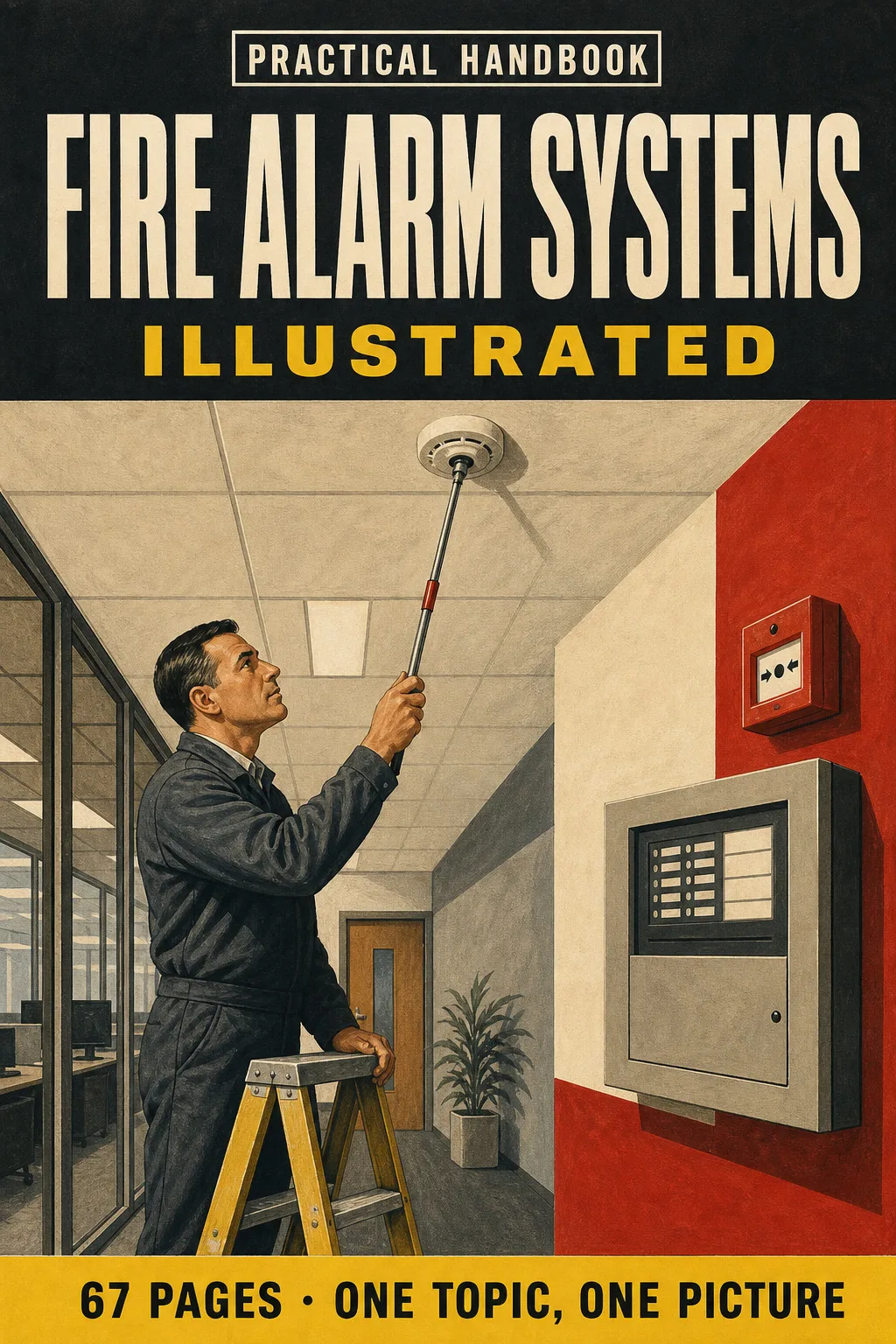
Fire Alarm Systems Illustrated

Fire detection and alarm systems explained one topic per page, each with a clear drawing: categories L1 to L5, M and P…

From £19.99 £57.99

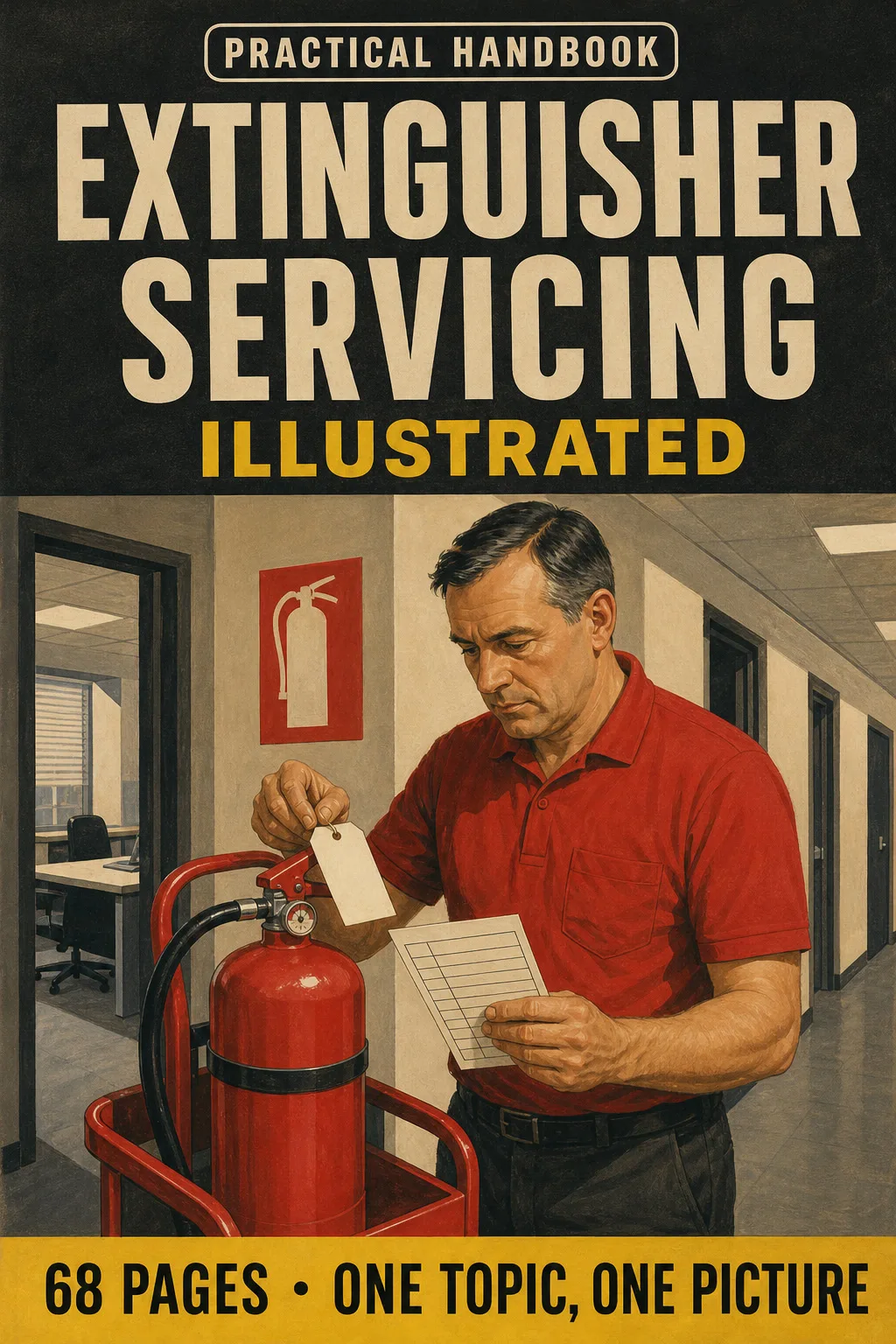
Extinguisher Servicing Illustrated

Portable fire extinguisher servicing for UK technicians, one drawing per page: fire classes and colour bands, parts…

From £19.99 £57.99

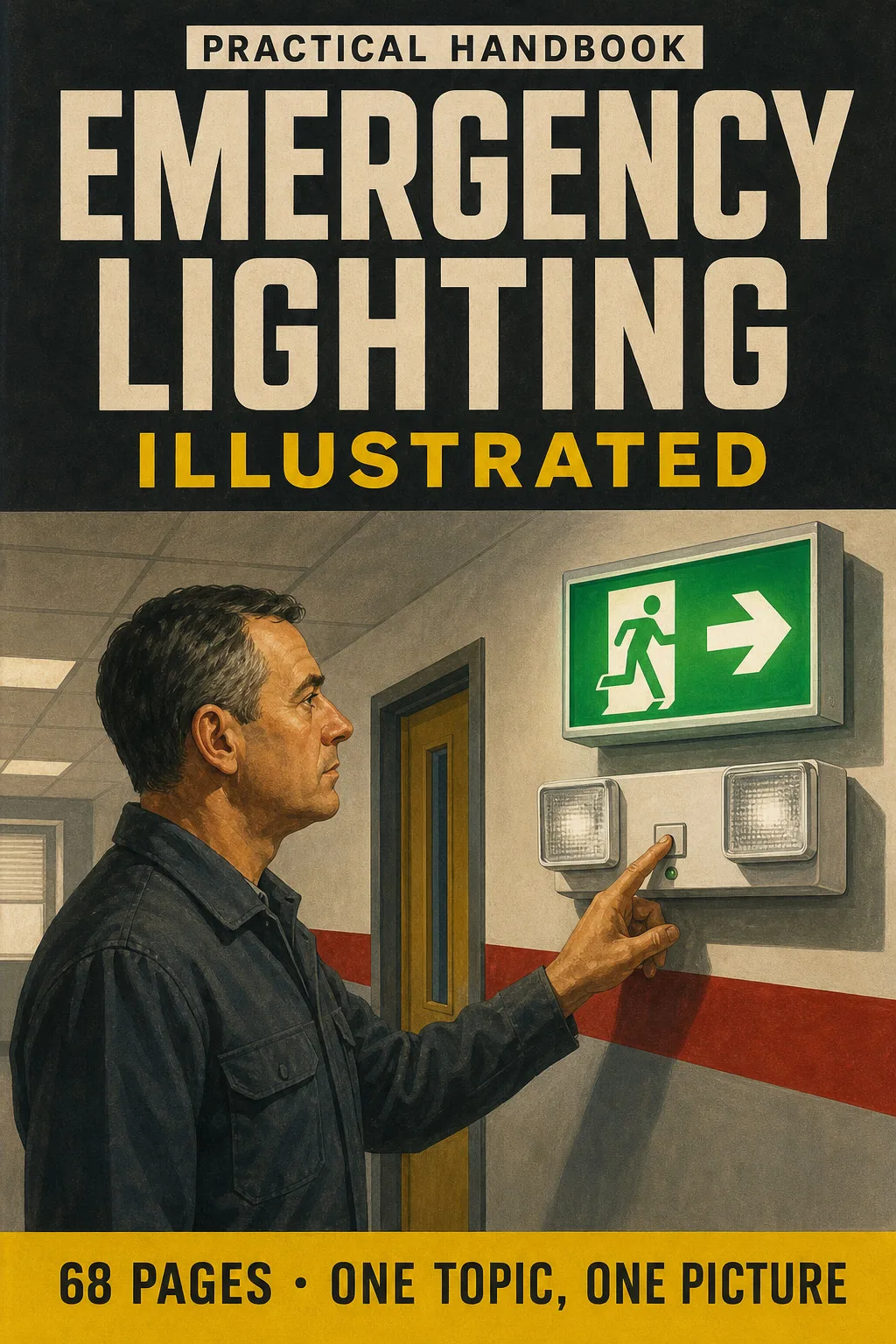
Emergency Lighting Illustrated

Emergency lighting to BS 5266-1, one topic per page and every concept drawn: escape route, open area and high-risk task…

From £19.99 £57.99

Fire Door Inspection Illustrated

Fire door inspection explained one topic per page, every point drawn: doorset anatomy, FD30 and FD60 ratings and…

From £19.99 £57.99

Fire Sprinklers Illustrated

An illustrated book for sprinkler fitters: wet, dry, alternate and pre-action systems, glass bulb colours, hazard…

From £19.99 £57.99