Study in Pictures🌐 English (United Kingdom)
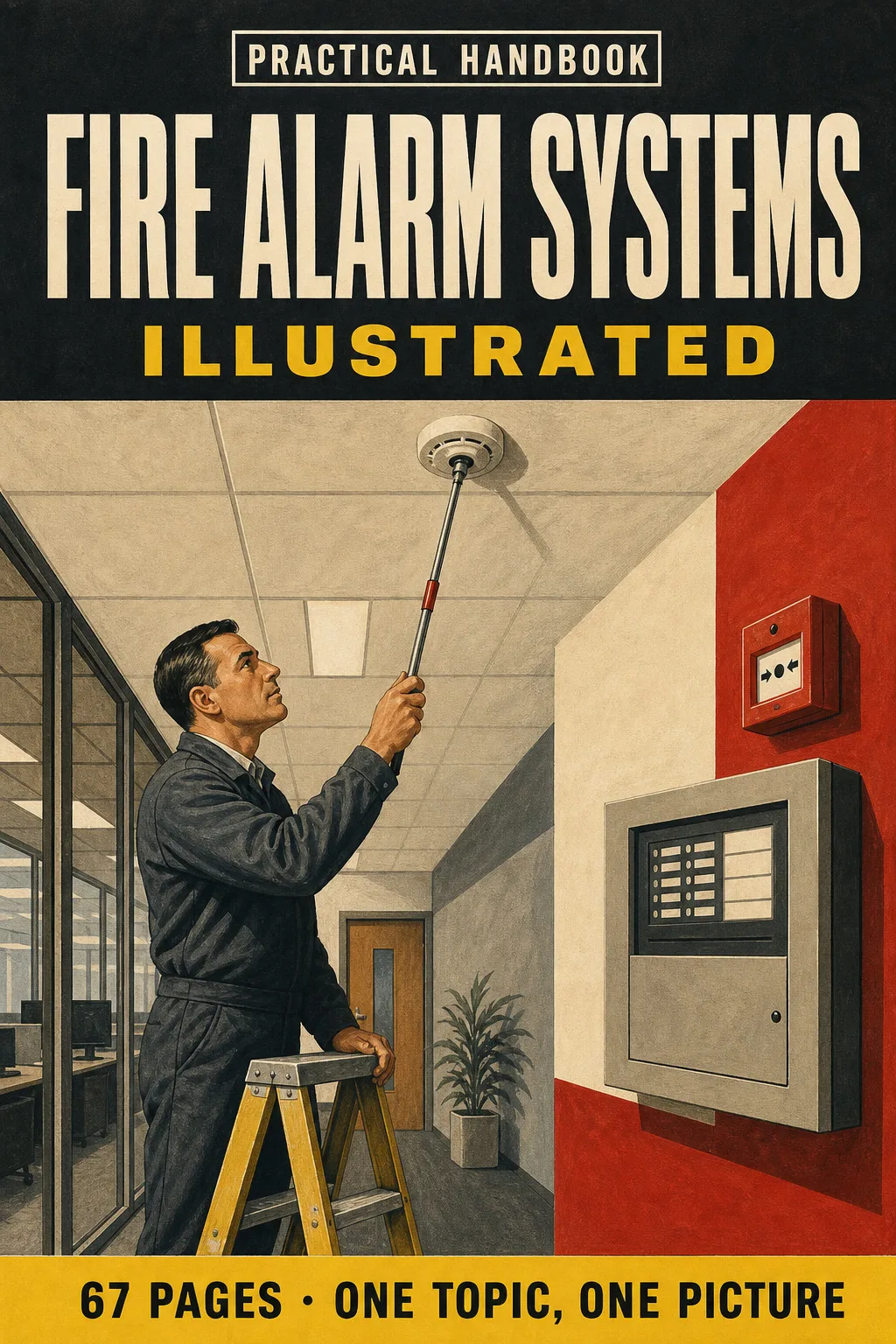
Fire Alarm Systems Illustrated

Digital book in PDF · read it on your phone or print it

Fire Alarm Systems Illustrated

Choose the category, site the detector, check the spacing: in the same order every time. From L1 to P2 to the six-monthly service visit, each topic on its own page, drawing first.

  • 67 illustrated pages
  • English
  • 30-day guarantee
£19.99£57.99
Get the book · £19.99

Price shown for: United Kingdom. In other countries, the checkout shows the price that applies there.

About this book

What it is

Choose the category, site the detector, check the spacing: in the same order every time. From L1 to P2 to the six-monthly service visit, each topic on its own page, drawing first.

Who This Book Is For
  • You're studying for your fire alarm unit
  • Your exam or audit is close
  • You already install or service systems
What it covers
  1. The System and Who Does What
  2. Categories on a Floor Plan
  3. Detectors and Where They Go
  4. Call Points, Sounders and VADs
  5. Panels, Zones and Power
  6. Cabling and Installation
  7. False Alarms and Cause and Effect
  8. Commissioning and Handover
  9. Service Visits, Log Book and Final Review
Language
English (United Kingdom)
Pages
67
Format
Digital book in PDF · read it on your phone or print it
Price
£19.99 (United Kingdom)
Delivery
This is a digital PDF book sent to your email: nothing is printed or shipped.
30-Day Guarantee
30-day guarantee: if a file doesn't open, if the content isn't what the product page describes, if you were charged twice or the email never arrived, write to us and we'll refund you in full.

Look Inside the Book

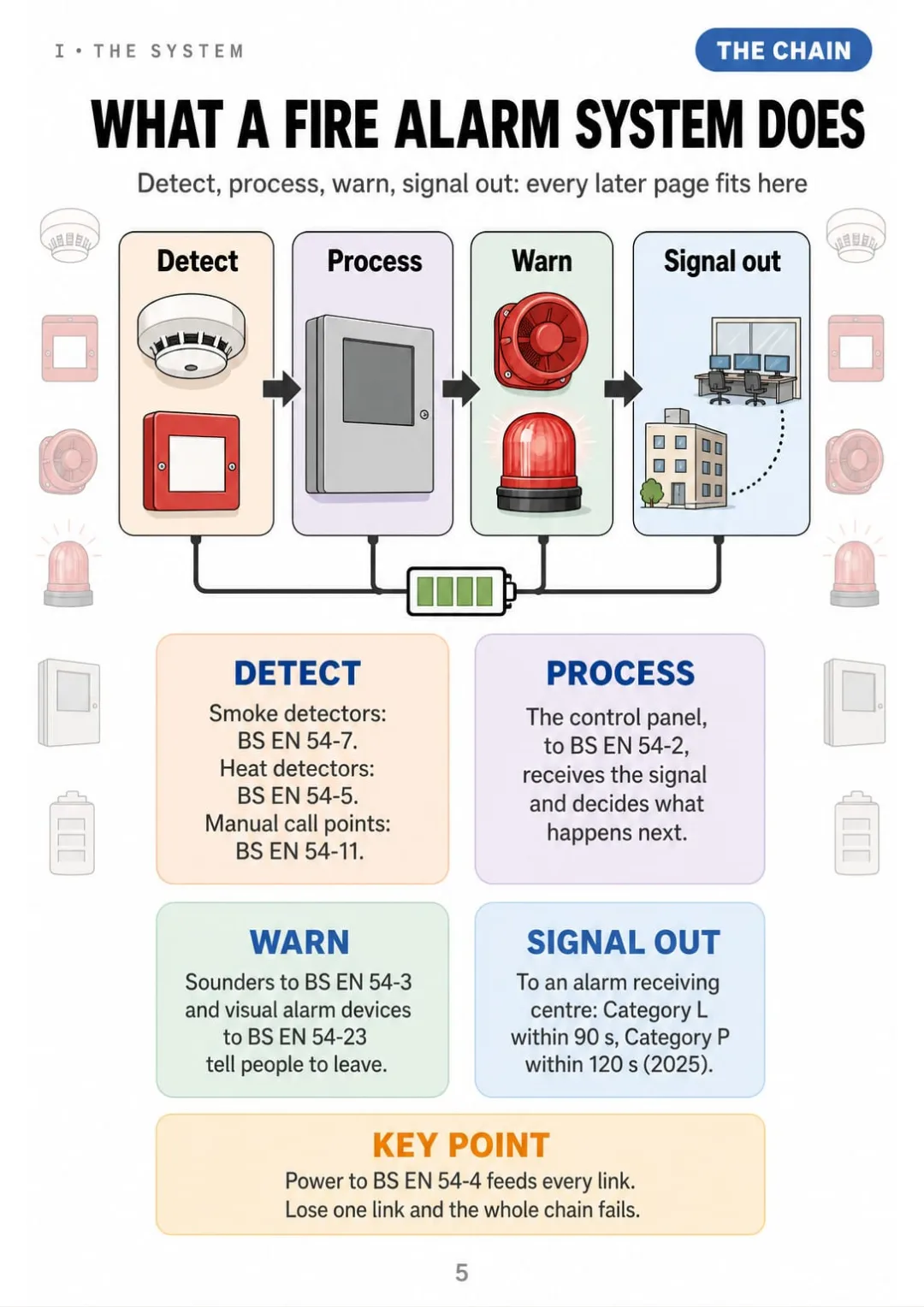
Detect → panel → warn → signal out, with the BS EN 54 part for each link
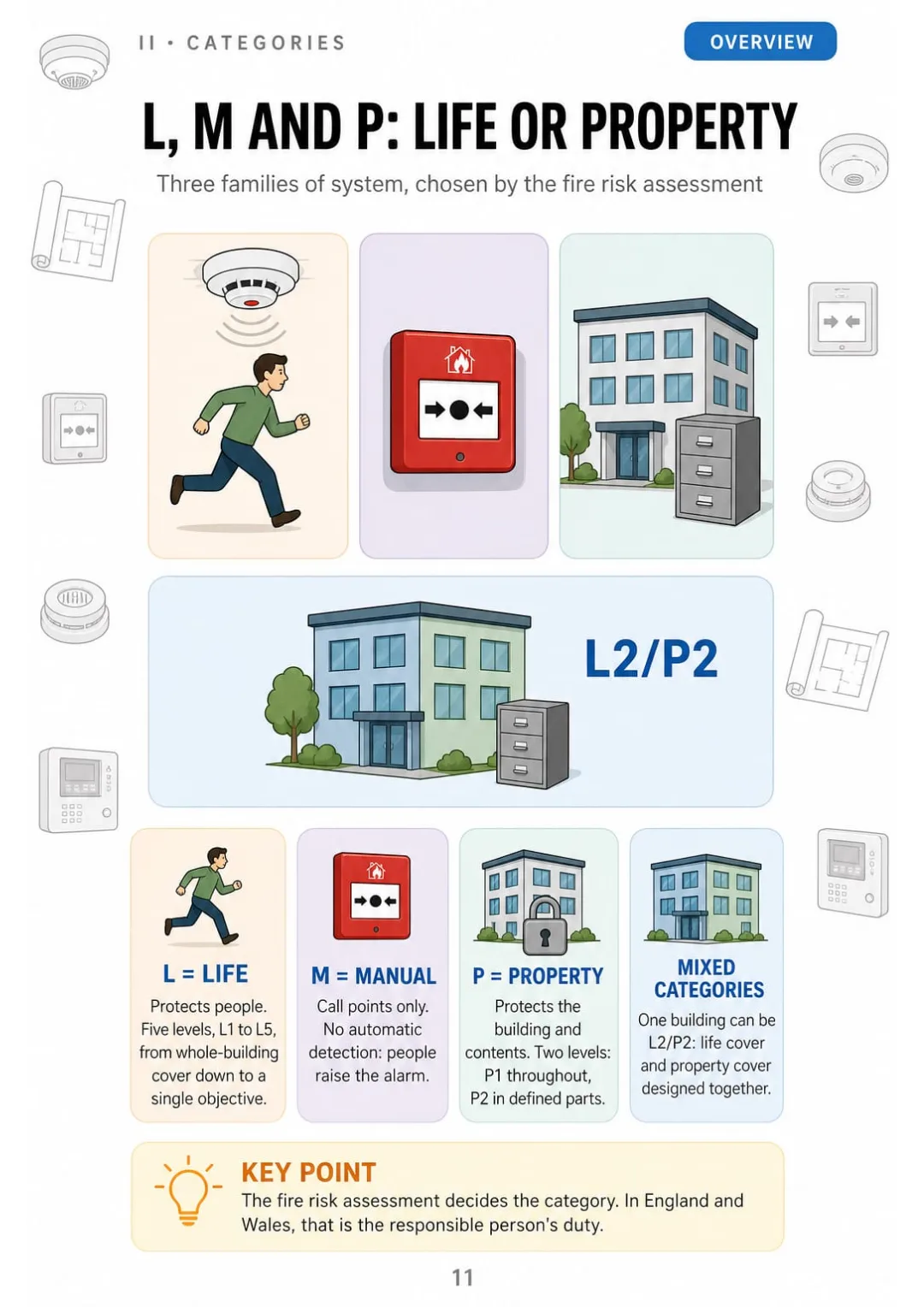
L1–L5 for life, P1–P2 for property, M for call points only
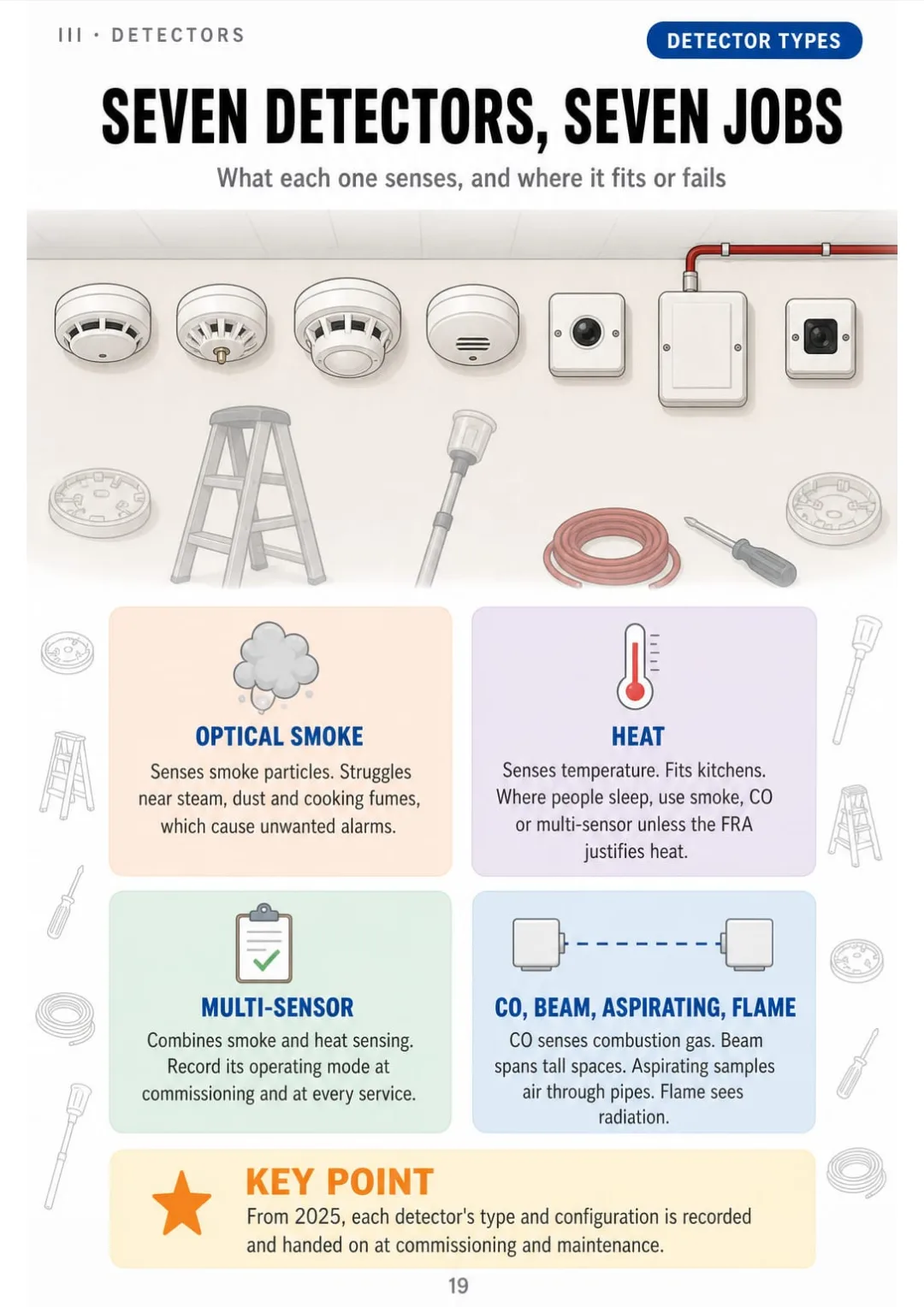
Optical, heat, multi-sensor, CO, beam, aspirating and flame: what each one senses
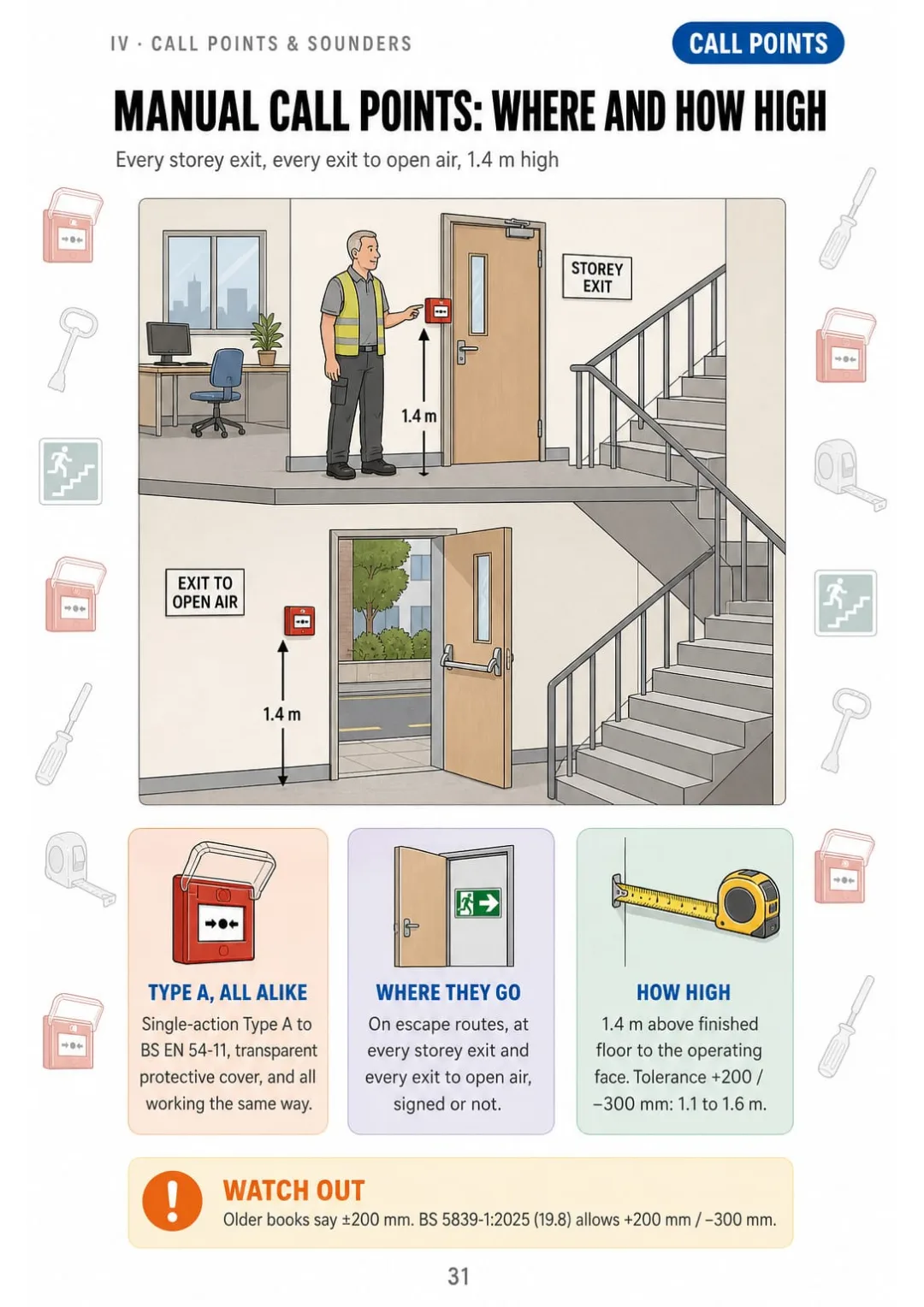
Call points: every storey exit and exit to open air, 1.4 m (1.1–1.6 m) to the operating face
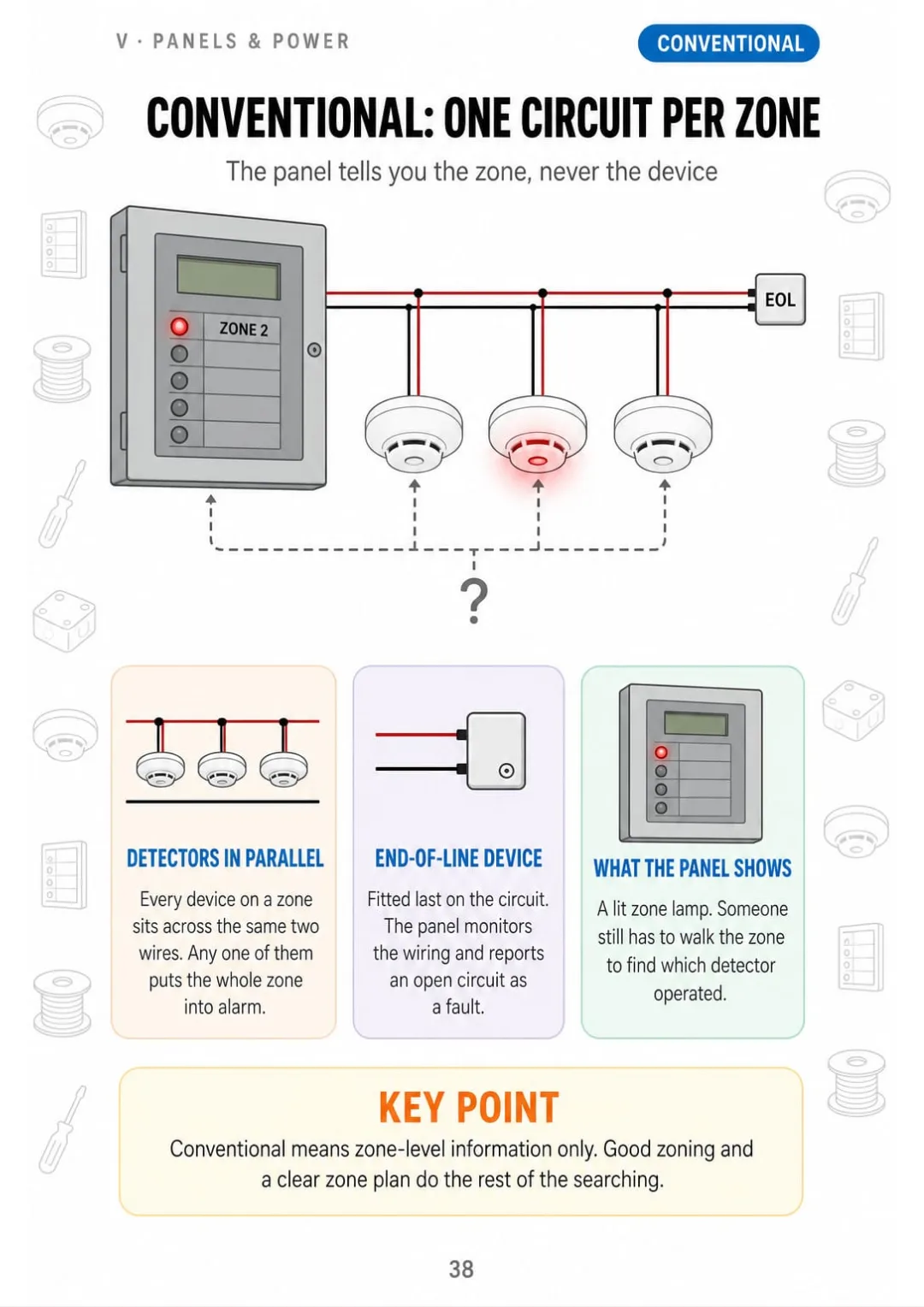
Conventional zone circuit: detectors in parallel, end-of-line device, zone lamp only
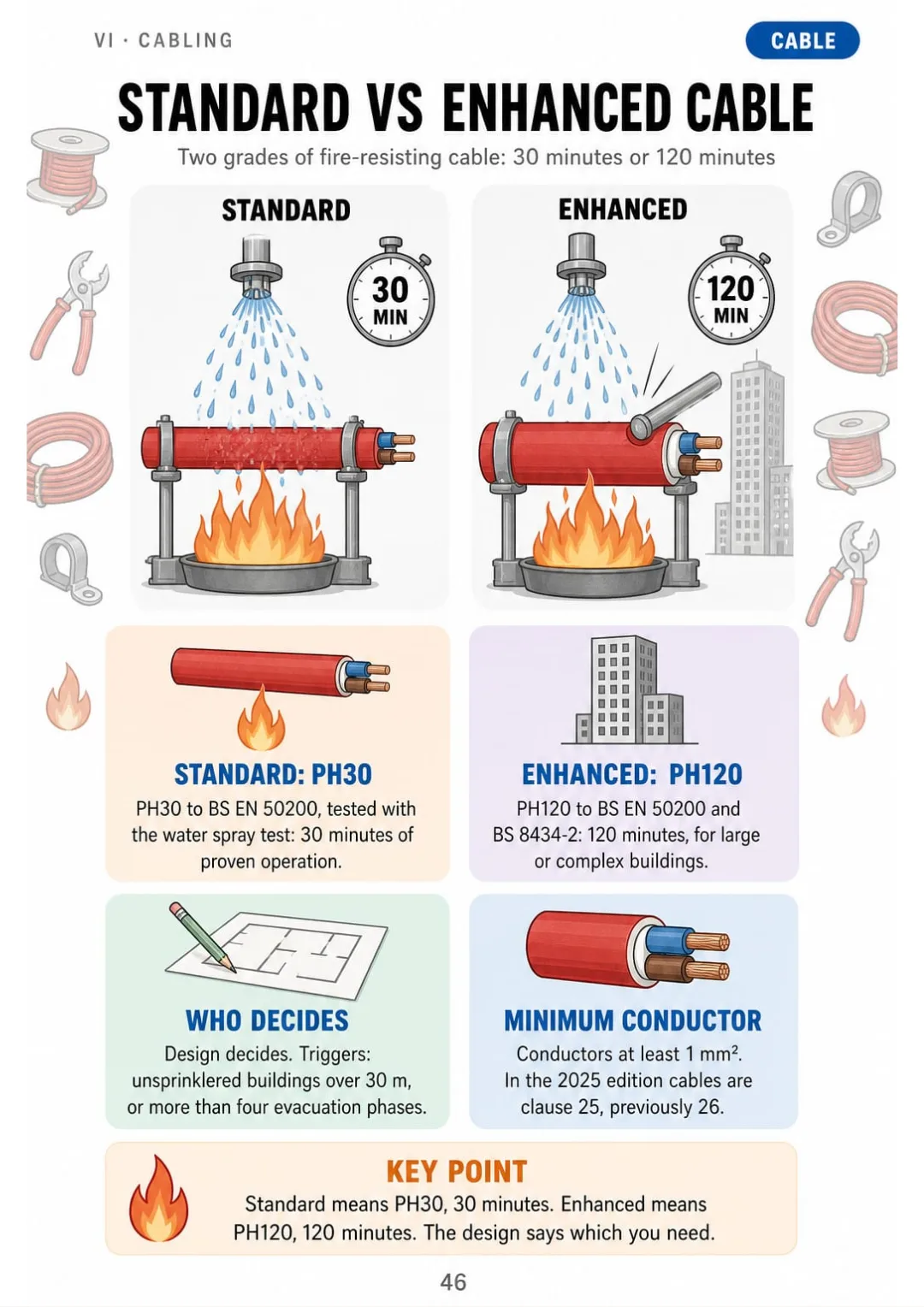
PH30 standard (30 min) vs PH120 enhanced (120 min) fire-resisting cable, BS 5839-1:2025 clause 25
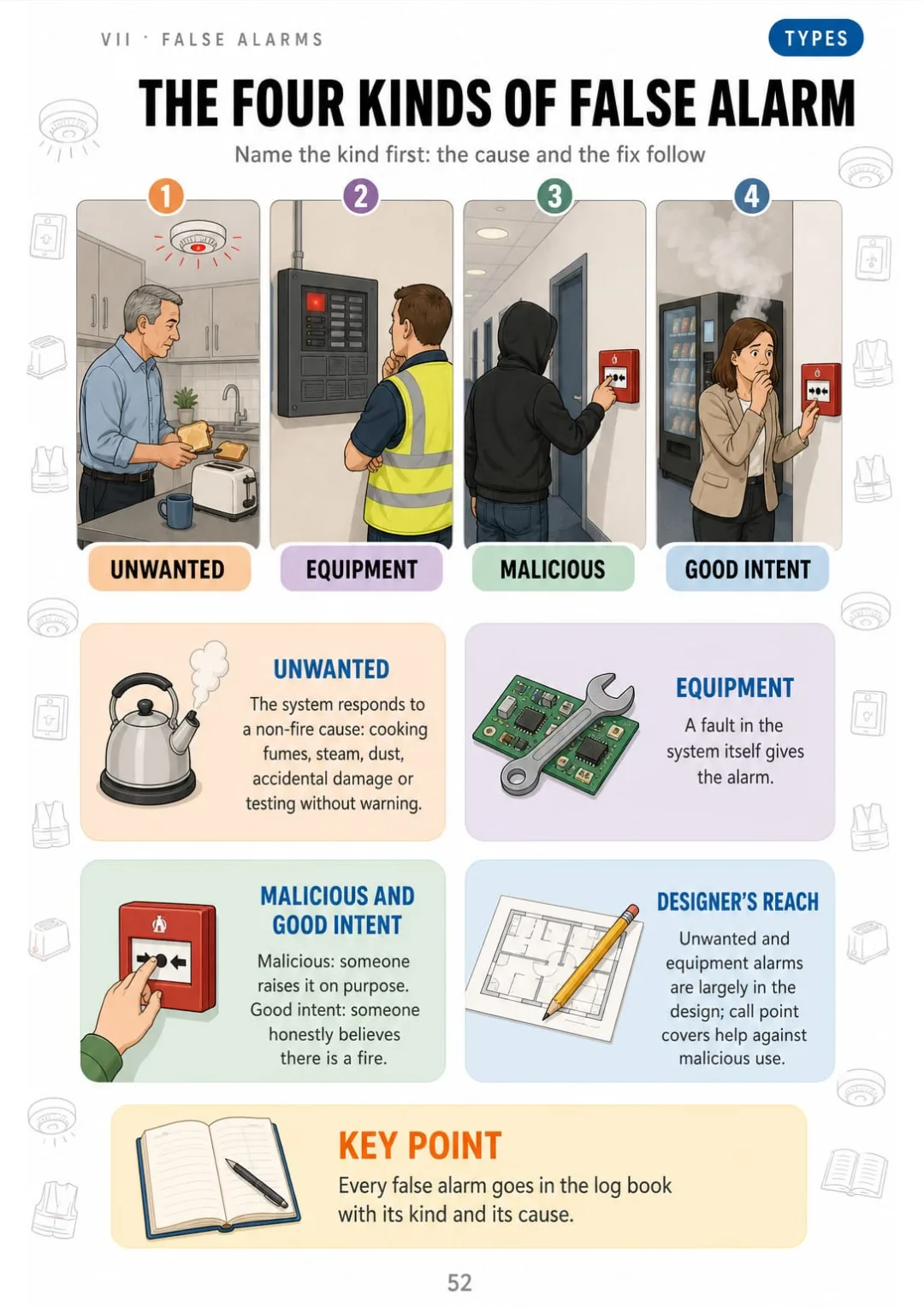
Unwanted, equipment, malicious, good intent: the four kinds in BS 5839-1
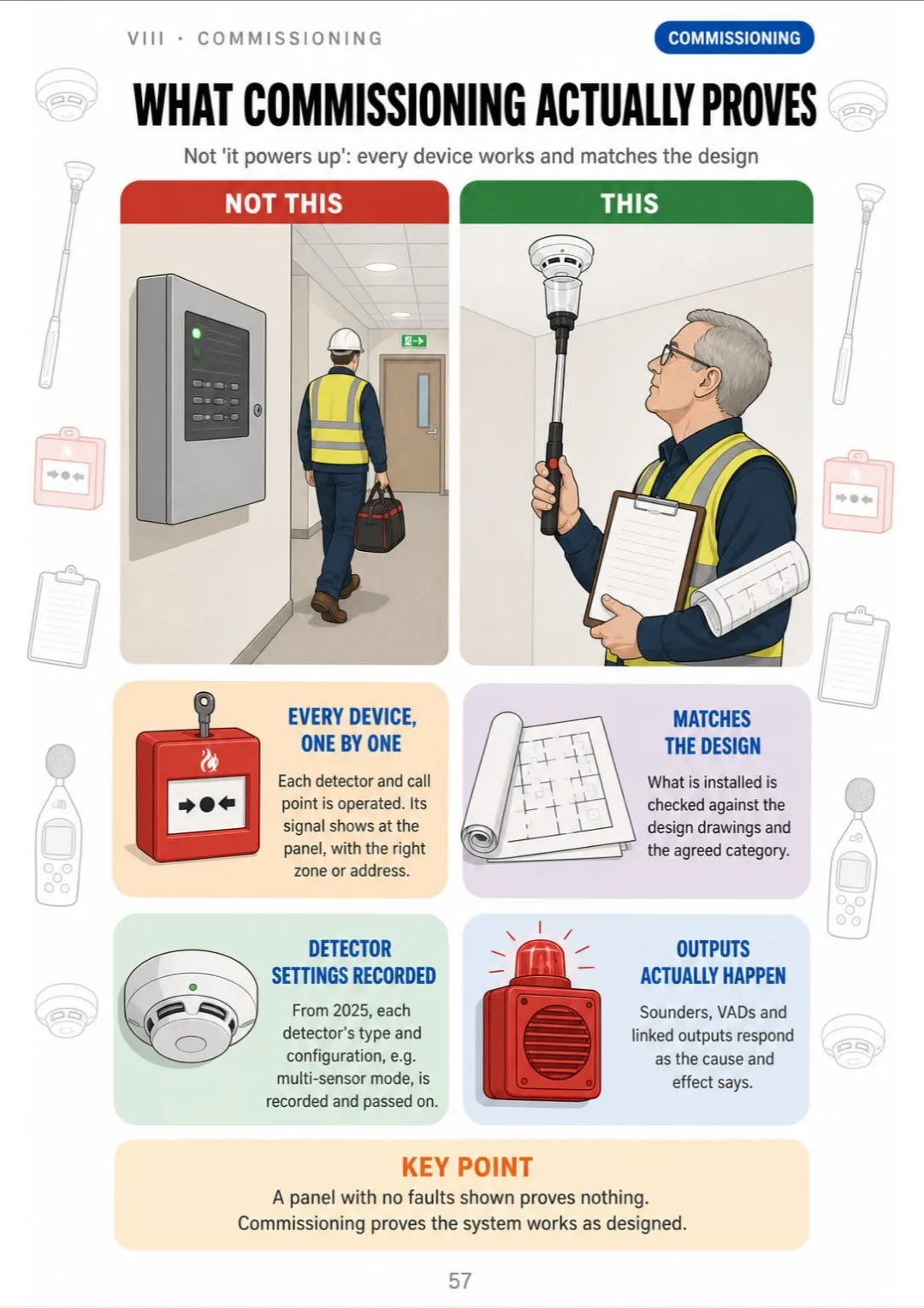
Commissioning proves every device works and the system matches the design, not just that it powers up.

Take a Look at the 9 Parts and 63 Topics

The System and Who Does What

pp. 5-10
  1. What a fire alarm system has to do
  2. BS 5839-1 vs BS 5839-6 vs BS EN 54
  3. The four jobs: design, install, commission, maintain
  4. The responsible person and the fire risk assessment
  5. Variations: agreed, recorded, signed
  6. Competence and third-party certification

Categories on a Floor Plan

pp. 11-18
  1. L, M and P: life or property
  2. Category M: call points only
  3. Category L4: escape routes only
  4. Category L3: routes plus the rooms that open onto them
  5. Category L2: L3 plus high-risk rooms
  6. Category L1: everywhere
  7. Category L5: designed for one specific problem
  8. P1 and P2: protecting the building

Detectors and Where They Go

pp. 19-30
  1. Choosing the detector type
  2. Heat detector classes: A1, A2, B and the R and S suffixes
  3. Smoke detectors: 7.5 metres from any point
  4. Heat detectors: 5.3 metres from any point
  5. Corridors under 2 metres wide
  6. Distance from the ceiling
  7. 500 mm from walls and partitions
  8. Beams and downstand obstructions
  9. Ceiling height limits
  10. Pitched ceilings and the apex
  11. Air movement and ventilation
  12. Voids above and below

Call Points, Sounders and VADs

pp. 31-37
  1. Manual call points: where and how high
  2. Call point travel distance: 45 m or 25 m
  3. Sounder levels: 65 dB(A) or 5 dB above background
  4. Sleeping areas: 75 dB(A) at the bedhead
  5. Sounder tones and two-stage alarms
  6. Visual alarm devices to BS EN 54-23
  7. Other warning methods

Panels, Zones and Power

pp. 38-45
  1. Conventional panels: one circuit per zone
  2. Addressable panels: every device has a number
  3. Conventional vs addressable: side by side
  4. Loops and short-circuit isolators
  5. Zoning rules: 2,000 m² and 60 m search distance
  6. Zone plans and location text
  7. Power supplies: mains and standby
  8. Battery standby calculation

Cabling and Installation

pp. 46-51
  1. Standard vs enhanced fire-resisting cable
  2. Cable support that won't collapse in a fire
  3. Segregation and colour
  4. Cable testing before connection
  5. Mounting and protecting devices
  6. Interfaces with other systems

False Alarms and Cause and Effect

pp. 52-56
  1. The four kinds of false alarm
  2. Designing false alarms out
  3. When the false alarm rate needs investigating
  4. Remote signalling to an alarm receiving centre
  5. Reading a cause and effect matrix

Commissioning and Handover

pp. 57-61
  1. What commissioning actually proves
  2. Commissioning in the same order every time
  3. Sound level readings that count
  4. The certificates: design, installation, commissioning, acceptance
  5. Handover documentation

Service Visits, Log Book and Final Review

pp. 62-67
  1. User checks: the weekly call point test
  2. Service visits at six-monthly intervals
  3. The service visit step by step
  4. The log book: what goes in it
  5. Disablements, faults and modifications
  6. One-page review: the numbers to know

Who This Book Is For

You're studying for your fire alarm unit

Every topic of design, installation, commissioning or maintenance on its own page, drawn, so an evening's study actually stays with you.

Your exam or audit is close

The categories, distances, dB(A) levels and service steps in one place, with a one-page review of the numbers and exam-style questions to test yourself.

You already install or service systems

A printable reference for the van: check a spacing, a call point height or the order of a service visit in seconds, in front of the client.

Plus: 2 Free Books

Fire Alarm Exam-Style Questions with Worked Answers
BONUS 1

Fire Alarm Exam-Style Questions with Worked Answers

Test yourself on categories, siting, panels and servicing, and see exactly why each answer is right, so nothing feels new on the day.
The 15 Common Fire Alarm Mistakes, Before and After
BONUS 2

The 15 Common Fire Alarm Mistakes, Before and After

Each frequent mistake drawn wrong, then drawn right, so you spot it on site before the client or the inspector does.

30-Day Guarantee

30-day guarantee: if a file doesn't open, if the content isn't what the product page describes, if you were charged twice or the email never arrived, write to us and we'll refund you in full. You pay once. No subscriptions.

Frequently Asked Questions

Is it for me if I already do the job and just need to pass my unit?

Yes. It doesn't explain what a detector is: it goes straight to the BS 5839-1 rules, distances and sequences. Design: parts 2 to 5 and 7. Installation: parts 3 to 6. Commissioning: part 8. Maintenance: part 9. Part 1 and the one-page review of the numbers cover all four.

Where does the content come from?

It's written to BS 5839-1:2025, the current edition, together with the BS EN 54 product series and BS 7671 for wiring. Every rule was checked against the 2025 text and explained in our own words and drawings.

Is it official material?

No. It's an independent study book. It isn't published or endorsed by BSI or by any certification or training body, and it doesn't give you a certificate, CPD points or a qualification.

Does it replace the course or training?

No. It's a study and revision aid to use alongside your training, your site experience and the standard itself.

Are the practice questions the ones from the exam?

No. They're written for this book, in the style of the topics that are asked about most, with worked answers.

When and how does it arrive?

As a PDF by email, to the address you enter at checkout. The 2 free books come the same way.

Do I have to pay every month?

No. It's a one-off payment. No subscription.

Can I have it on paper?

Yes. The PDF prints well on A4, so you can keep a copy in the van.

How does the refund work?

You have 30 days. We refund everything if the file won't open, if the book isn't what you see on this page, if you were charged twice or if the email doesn't arrive: just email us.

£19.99£57.99
Get the book · £19.99

This is a digital PDF book sent to your email: nothing is printed or shipped.

More books on this topic

Fire Risk Assessment Illustrated

Fire risk assessment explained one topic per page, every page drawn: the fire triangle, the five steps, people at risk…

From £19.99 £57.99

Extinguisher Servicing Illustrated

Portable fire extinguisher servicing for UK technicians, one drawing per page: fire classes and colour bands, parts…

From £19.99 £57.99

Emergency Lighting Illustrated

Emergency lighting to BS 5266-1, one topic per page and every concept drawn: escape route, open area and high-risk task…

From £19.99 £57.99

Fire Door Inspection Illustrated

Fire door inspection explained one topic per page, every point drawn: doorset anatomy, FD30 and FD60 ratings and…

From £19.99 £57.99

Fire Sprinklers Illustrated

An illustrated book for sprinkler fitters: wet, dry, alternate and pre-action systems, glass bulb colours, hazard…

From £19.99 £57.99