Study in Pictures🌐 English (United Kingdom)
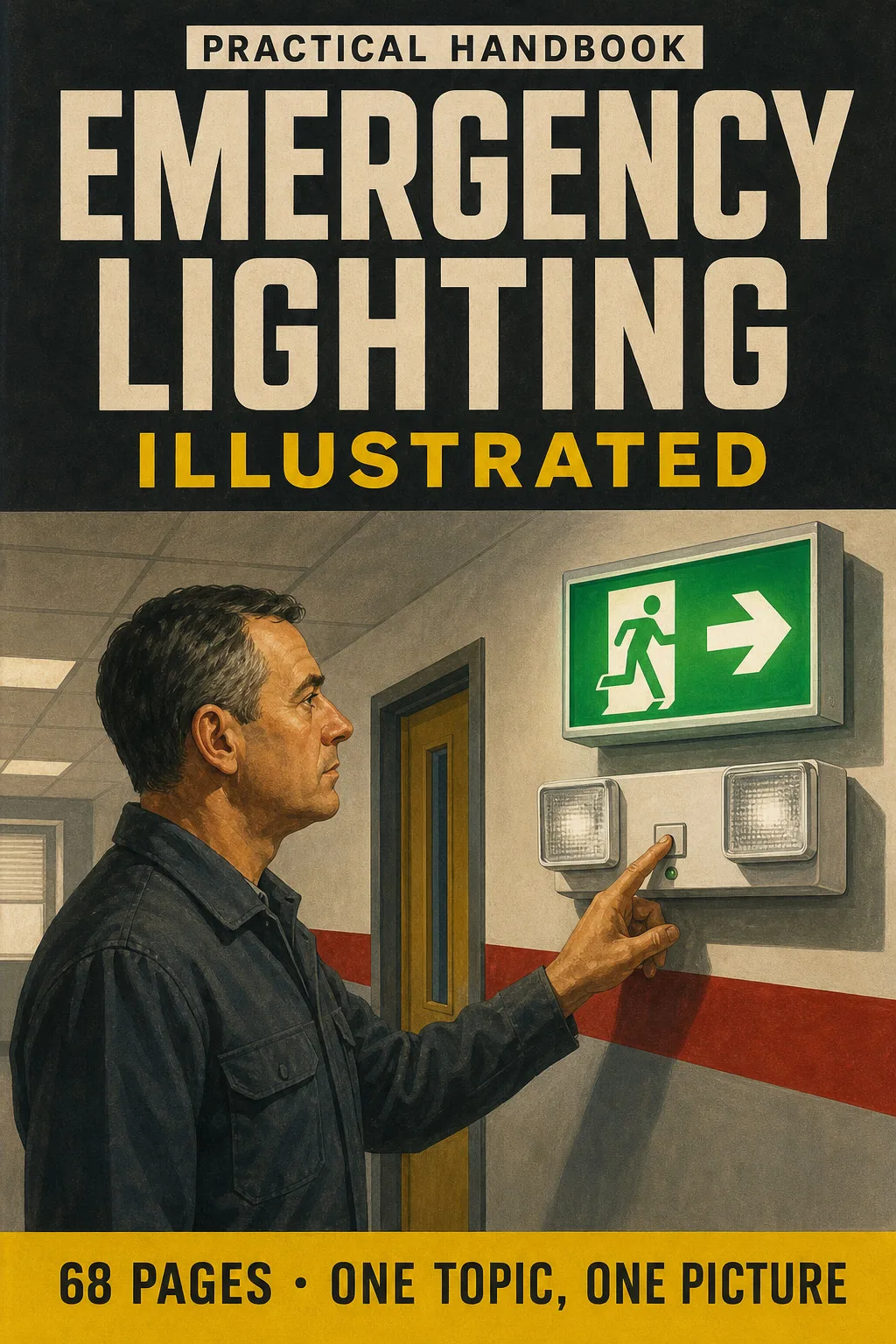
Emergency Lighting Illustrated

Digital book in PDF · read it on your phone or print it

Emergency Lighting Illustrated

Escape routes, open areas, the 2-metre rule, maintained and non-maintained, exit sign viewing distances, design in 8 steps and the monthly and annual tests. Every topic has its own page: the drawing first, then what you need to remember.

  • 68 illustrated pages
  • English
  • 30-day guarantee
£19.99£57.99
Get the book · £19.99

Price shown for: United Kingdom. In other countries, the checkout shows the price that applies there.

About this book

What it is

Escape routes, open areas, the 2-metre rule, maintained and non-maintained, exit sign viewing distances, design in 8 steps and the monthly and annual tests. Every topic has its own page: the drawing first, then what you need to remember.

Who This Book Is For
  • You're adding emergency lighting to your work
  • Your emergency lighting exam is close
  • You already install, test or sign the log book
What it covers
  1. The basics
  2. Luminaires and systems
  3. Lux levels and timings
  4. Points of emphasis on the floor plan
  5. Open areas and additional areas
  6. Exit signs
  7. Design in fixed steps
  8. Testing, log book and certificates
  9. Revision and checklists
Language
English (United Kingdom)
Pages
68
Format
Digital book in PDF · read it on your phone or print it
Price
£19.99 (United Kingdom)
Delivery
This is a digital PDF book sent to your email: nothing is printed or shipped.
30-Day Guarantee
30-day guarantee: if a file doesn't open, if the content isn't what the product page describes, if you were charged twice or the email never arrived, write to us and we'll refund you in full.

Look Inside the Book

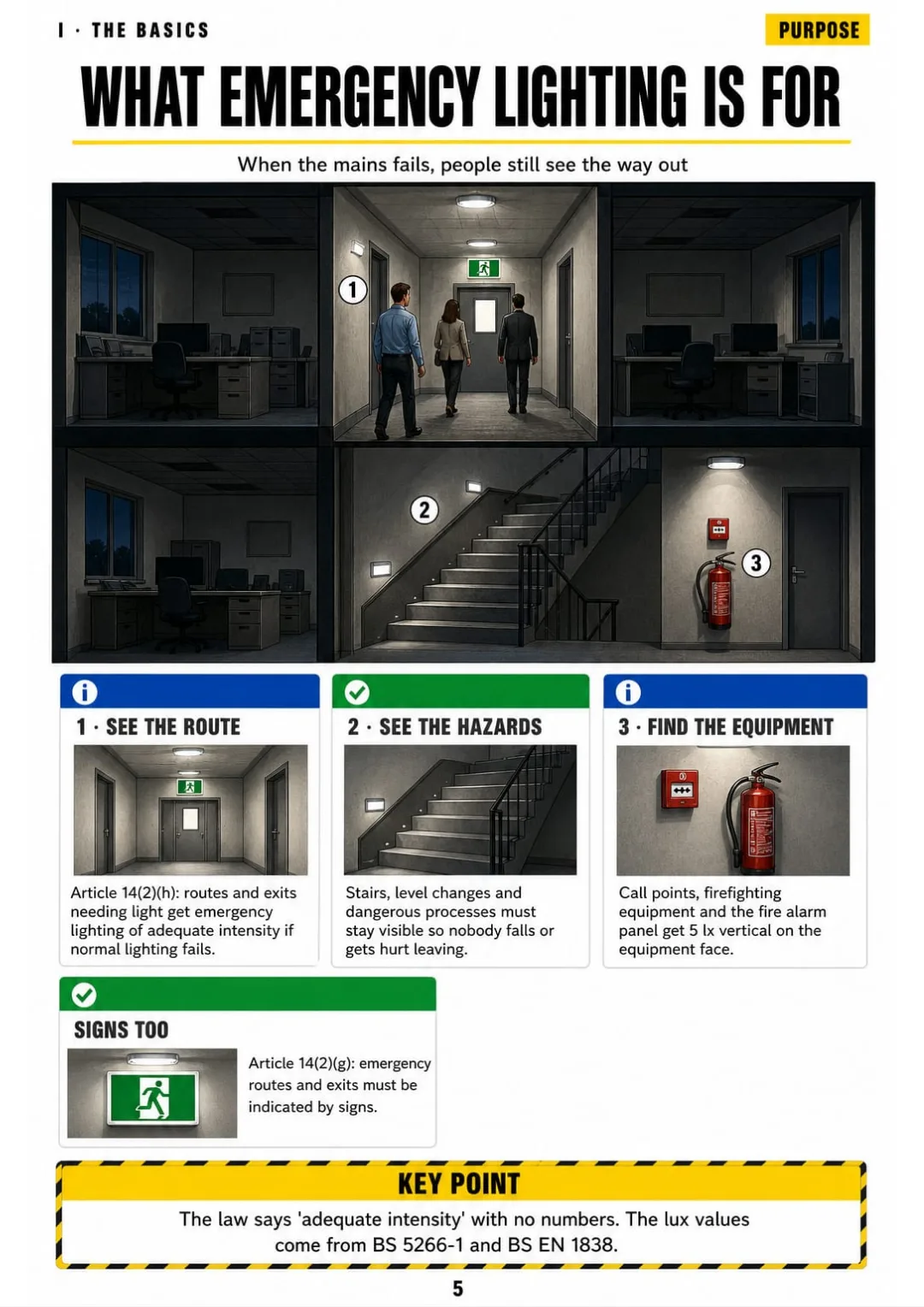
Fire Safety Order article 14: routes and exits lit and signed when normal lighting fails
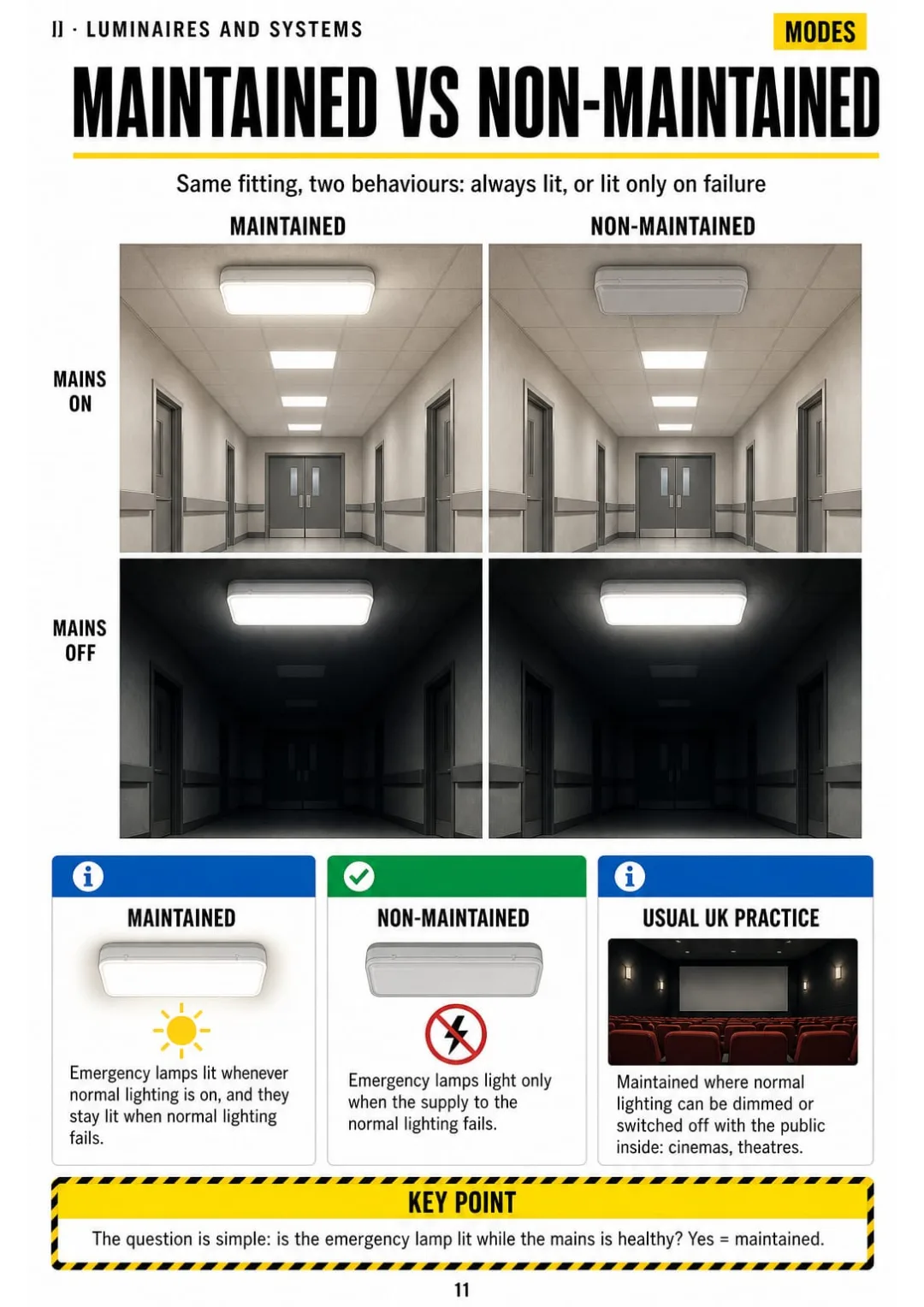
Maintained: lit with mains on and off · Non-maintained: lit only on mains failure
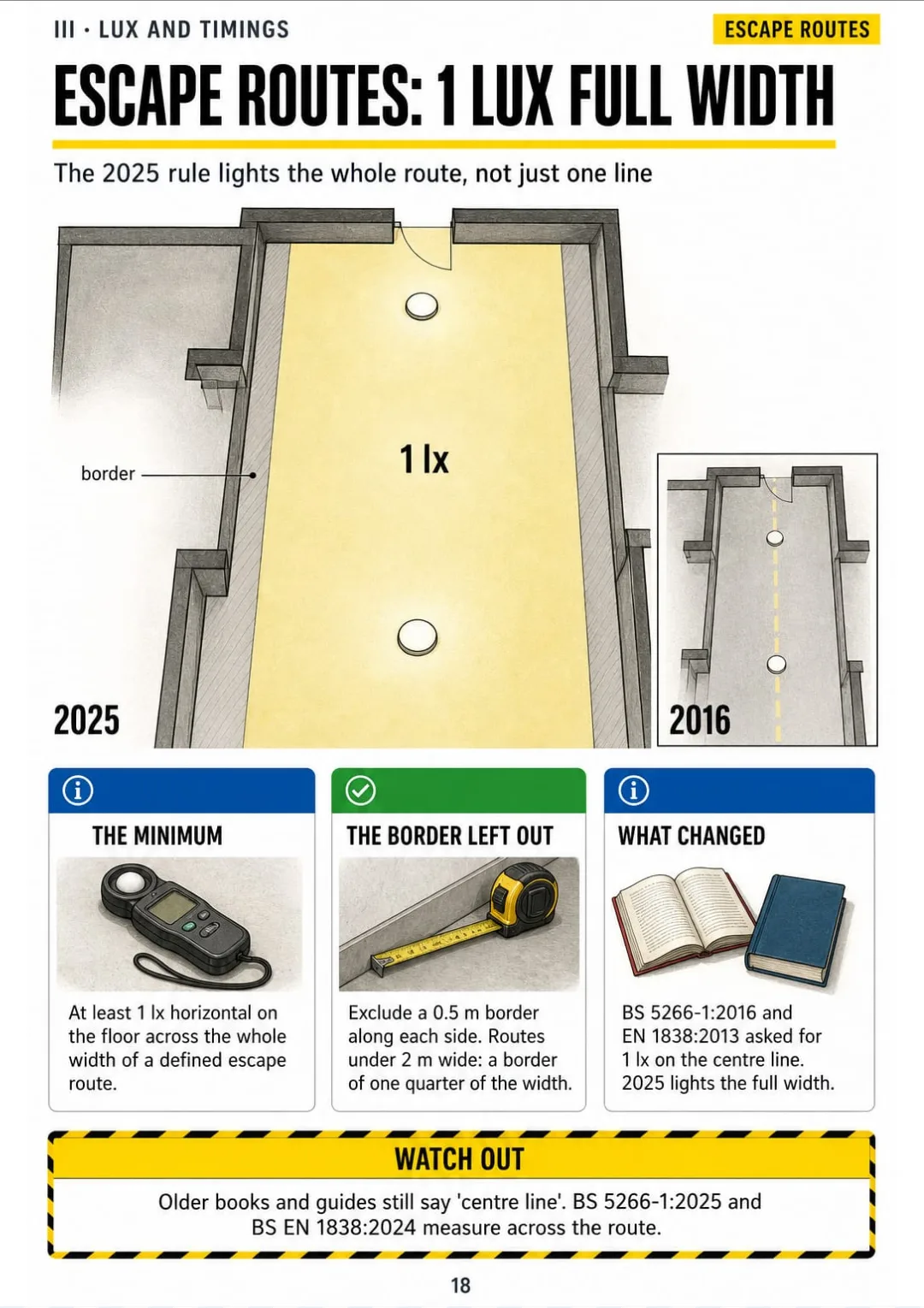
Escape routes: at least 1 lx across the route width, borders excluded: 0.5 m, or ¼ width up to 2 m (BS 5266-1:2025).
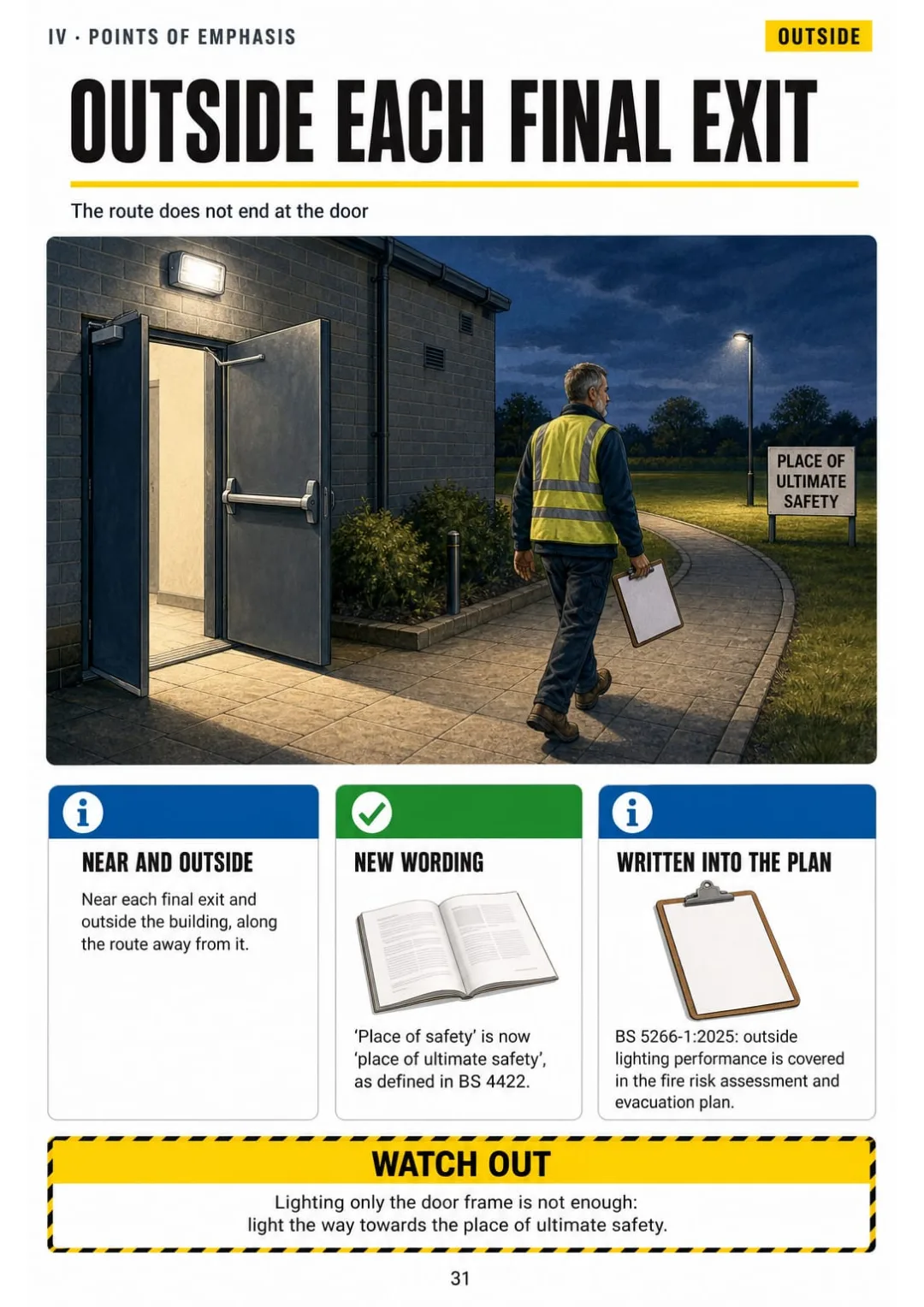
Outside each final exit: light the route to the place of ultimate safety (BS 4422)
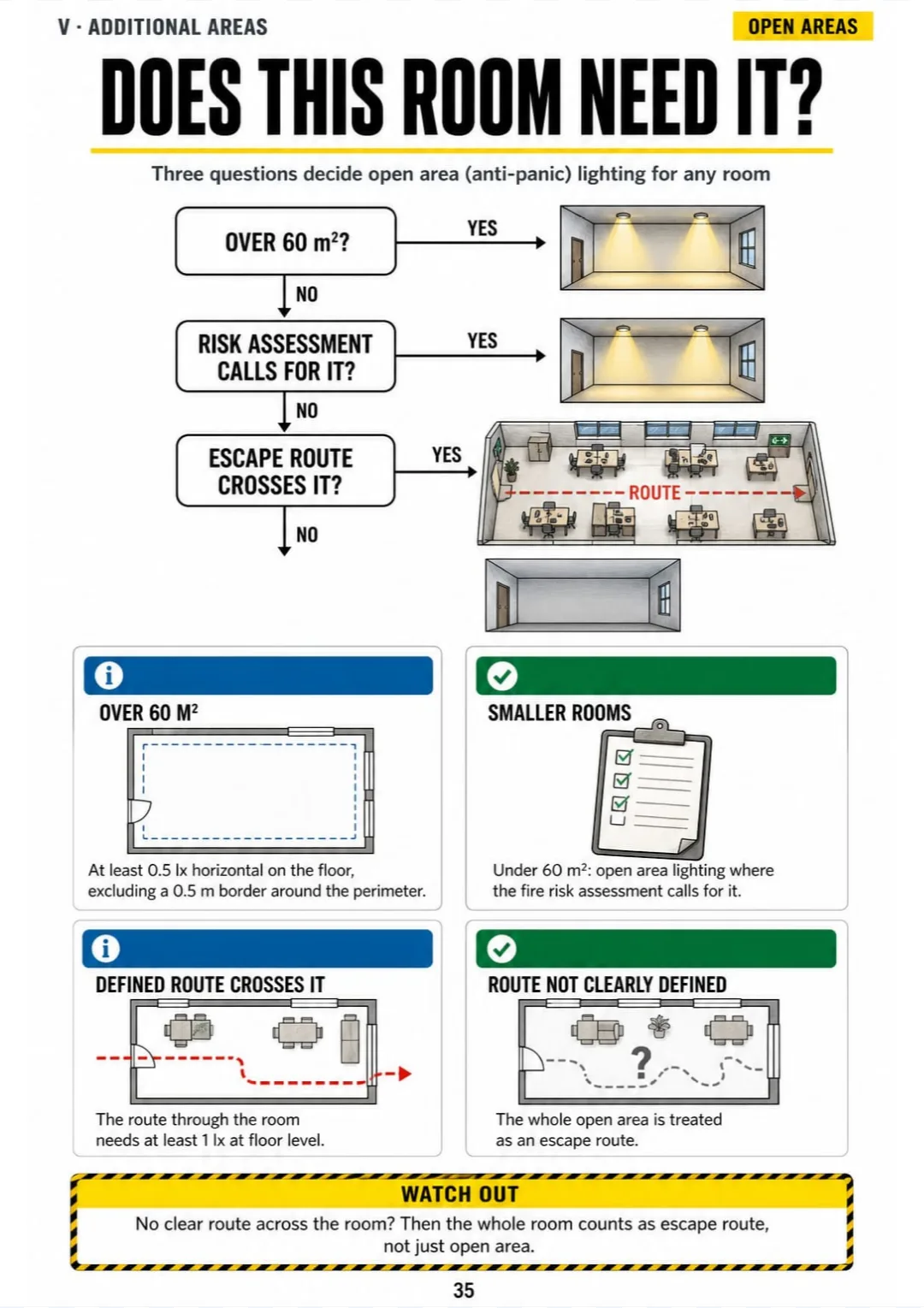
Over 60 m²: 0.5 lx on the floor · route through it: 1 lx · undefined route: whole room is escape route
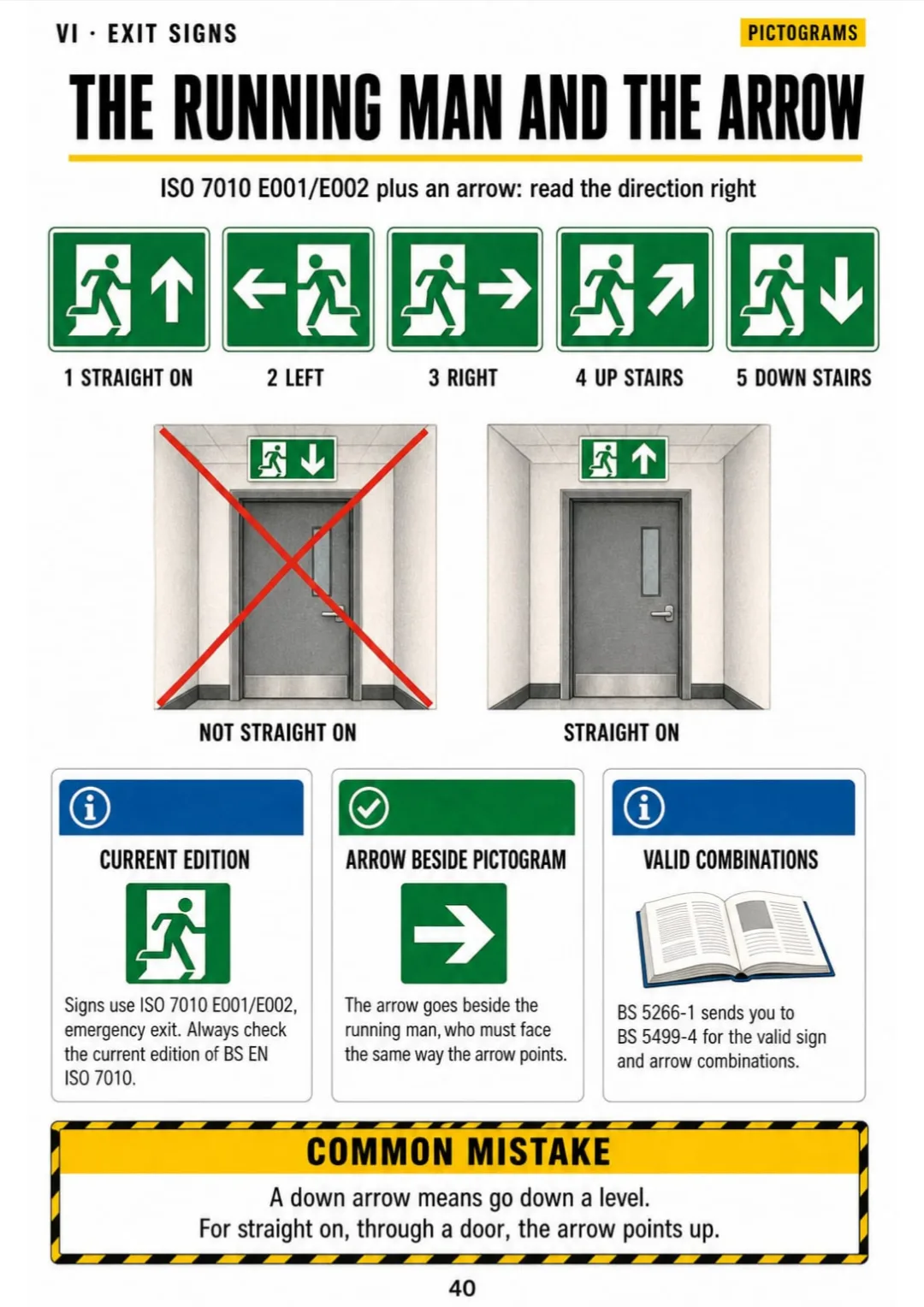
ISO 7010 E001/E002 running man, with the arrow combinations from BS 5499-4 Tables 2 and 3
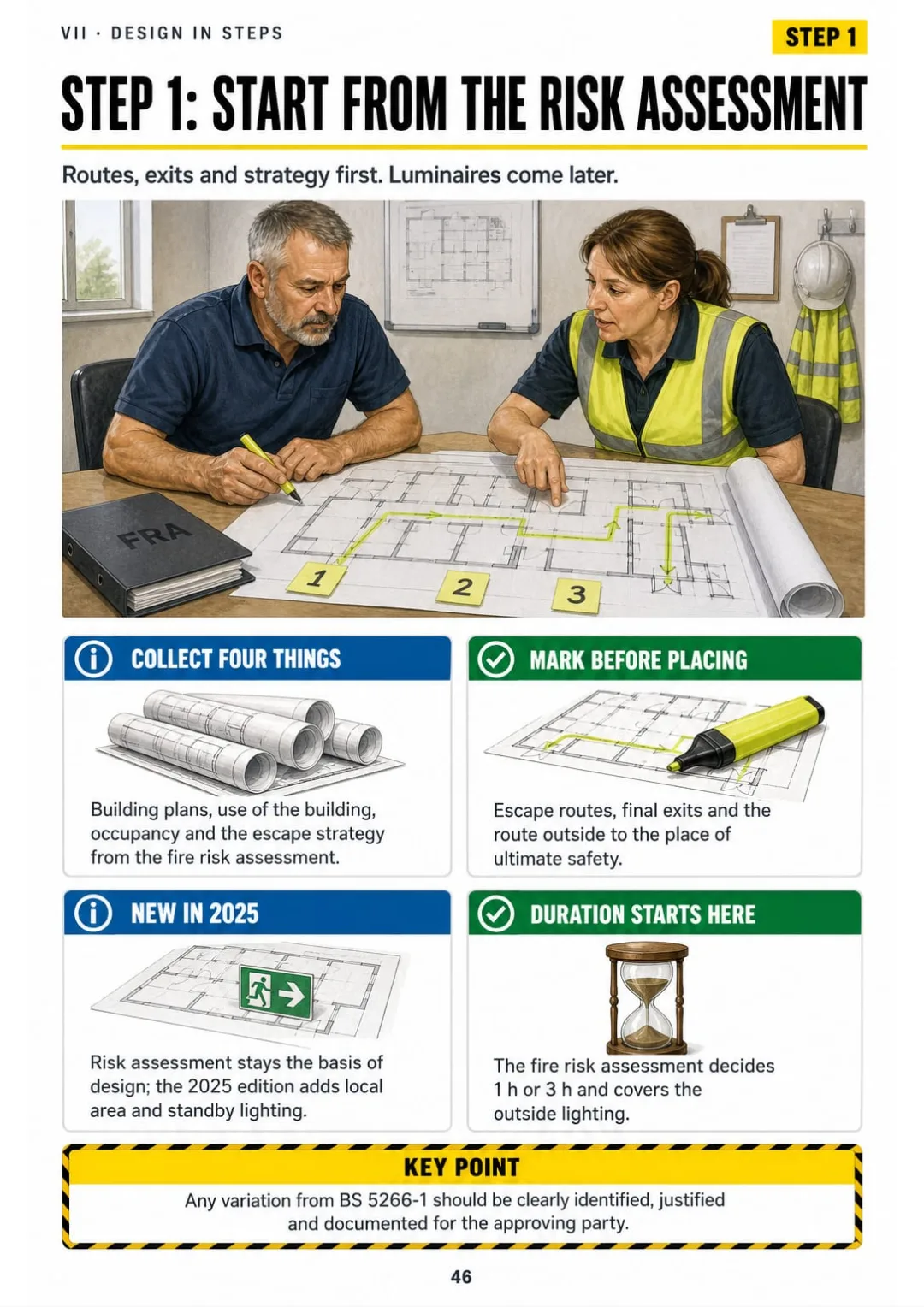
Step 1: plans, use, occupancy and escape strategy first, then routes and final exits marked.
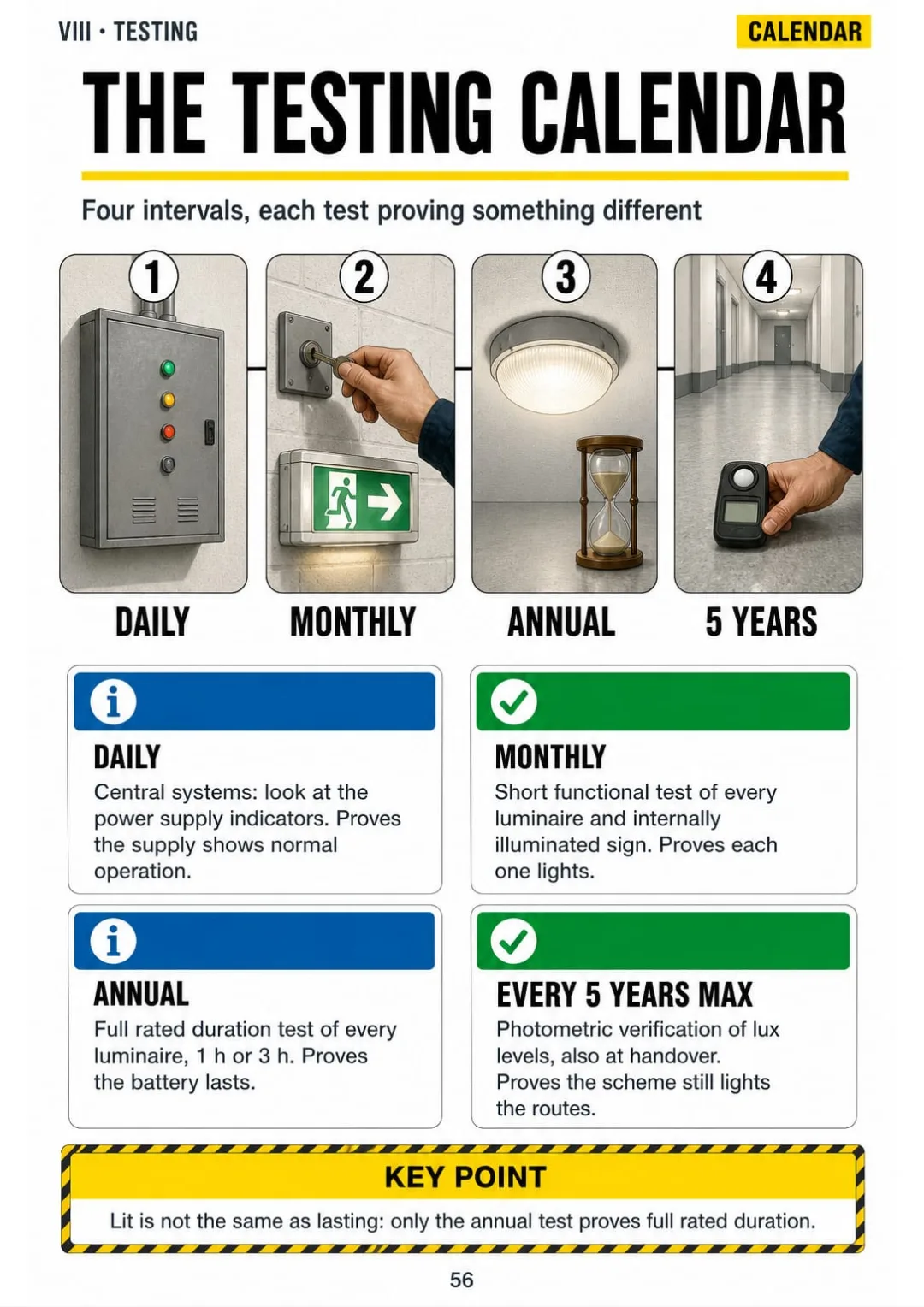
Daily indicators, monthly functional test, annual full duration, lux check every 5 years at most.

Take a Look at the 9 Parts and 64 Topics

The basics

pp. 5-10
  1. What emergency lighting is for
  2. Emergency escape lighting vs standby lighting
  3. The three types of escape lighting
  4. Who is responsible: the responsible person
  5. The family of standards on one page
  6. The words you need to know

Luminaires and systems

pp. 11-17
  1. Maintained vs non-maintained
  2. Combined (sustained) luminaires
  3. Reading the category code: M3, NM3, NM1
  4. Self-contained luminaires
  5. Central battery systems
  6. Batteries and recharge time
  7. Automatic test systems

Lux levels and timings

pp. 18-24
  1. Escape routes: 1 lux across the full width
  2. Open areas: 0.5 lux on the floor
  3. High-risk task areas: 10% or 15 lux
  4. Uniformity: 40:1 and 10:1
  5. Response times: 5 seconds and 60 seconds
  6. Duration: 1 hour or 3 hours
  7. Mounting height, glare and colour

Points of emphasis on the floor plan

pp. 25-34
  1. The 2-metre rule
  2. Every exit door intended for emergency use
  3. Stairs: every tread gets direct light
  4. Any other change of floor level
  5. Changes of direction
  6. Corridor intersections
  7. Outside each final exit
  8. Fire alarm call points and firefighting equipment
  9. First aid posts and safety signs
  10. Refuges and equipment for disabled people

Open areas and additional areas

pp. 35-39
  1. When a room needs open area lighting
  2. Lift cars and escalators
  3. Toilets
  4. Plant rooms, control rooms and covered car parks
  5. Local area failure

Exit signs

pp. 40-45
  1. The running man and the arrow
  2. Never mix sign formats
  3. Viewing distance: Z × h
  4. Worked example: how far can it be seen
  5. Internally vs externally illuminated
  6. Where signs go

Design in fixed steps

pp. 46-55
  1. Step 1: start from the fire risk assessment
  2. Step 2: mark every point of emphasis
  3. Step 3: place the exit signs
  4. Step 4: fill the escape routes
  5. Step 5: open areas
  6. Step 6: high-risk areas and additional areas
  7. Step 7: choose mode, duration and system
  8. Step 8: wiring for safety services
  9. Worked plan: a small office
  10. Worked plan: premises where people sleep

Testing, log book and certificates

pp. 56-63
  1. The testing calendar
  2. Daily: check the indicators
  3. Monthly: the functional test
  4. Annual: the full rated duration test
  5. The risk window after a full test
  6. Filling in the log book
  7. Certificates on completion
  8. Periodic inspection and handover

Revision and checklists

pp. 64-68
  1. All the numbers on one page
  2. Points of emphasis checklist
  3. Design checklist in 8 steps
  4. Testing and log book checklist
  5. Numbers people often mix up

Who This Book Is For

You're adding emergency lighting to your work

You already know BS 7671. The book gives you BS 5266-1 on floor plans, so you can quote and lay out commercial jobs with confidence.

Your emergency lighting exam is close

Lux levels, durations, luminaire types and tests, always in the same order, with exam-style questions to check yourself before the day.

You already install, test or sign the log book

A page to open on site when the client or the fire risk assessor asks why a luminaire goes there, or which test is due.

Plus: 2 Free Books

Emergency Lighting Exam-Style Questions
BONUS 1

Emergency Lighting Exam-Style Questions

Practise with exam-style questions on lux levels, luminaire types, siting and testing, each with the answer and the page that explains it.
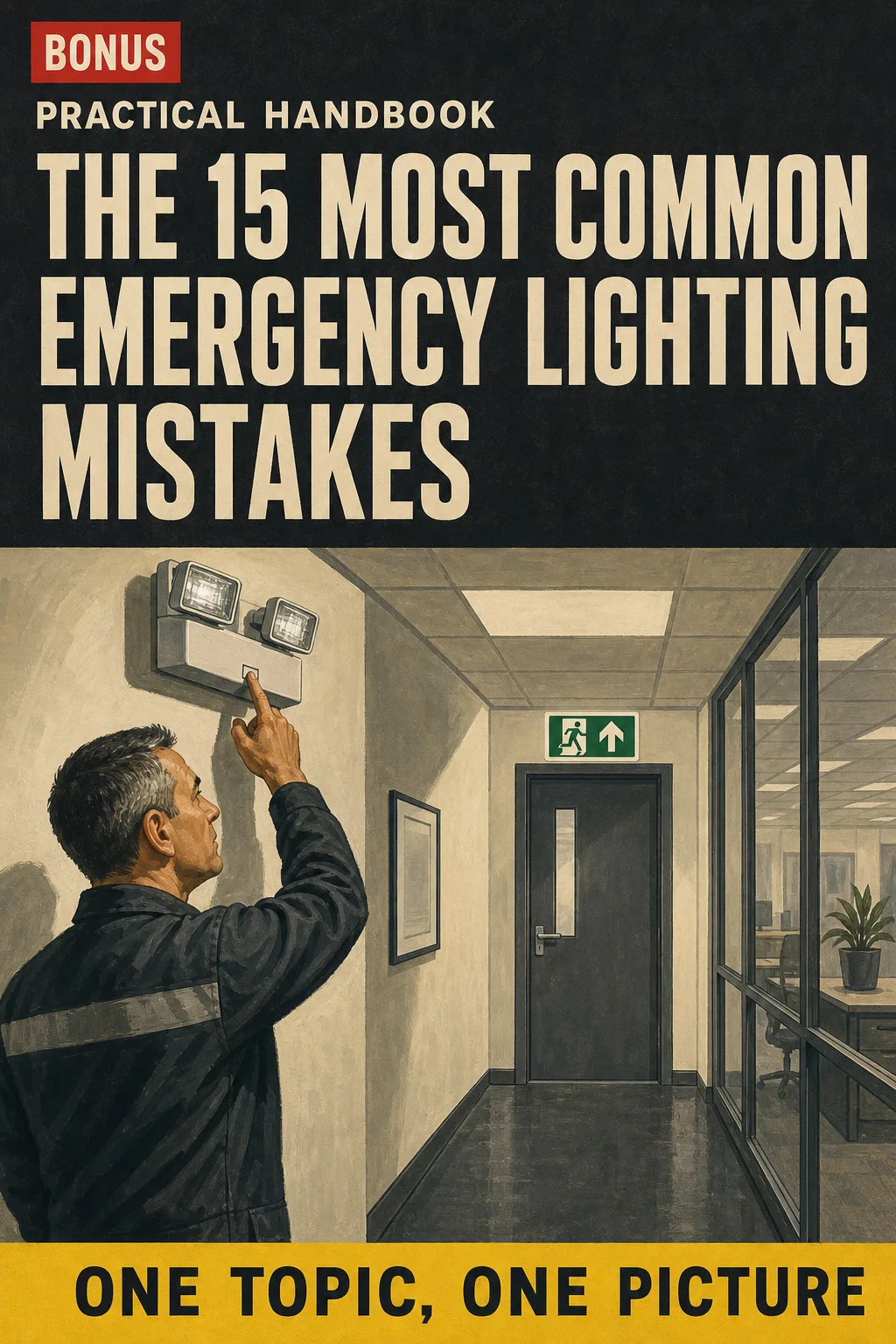
The 15 Most Common Emergency Lighting Mistakes
BONUS 2

The 15 Most Common Emergency Lighting Mistakes

See the most frequent siting, design and testing mistakes drawn before and after, so you spot them on site and on the exam paper.

30-Day Guarantee

30-day guarantee: if a file doesn't open, if the content isn't what the product page describes, if you were charged twice or the email never arrived, write to us and we'll refund you in full. You pay once. No subscriptions.

Frequently Asked Questions

Is it for me if I'm already an electrician with my 18th Edition?

Yes. It isn't a beginner's book on electrics: it assumes you know the trade and BS 7671, and focuses on BS 5266-1, from siting and lux levels to testing and the log book. It follows the BS 5266-1 topics that Level 3 emergency lighting courses work through, but it isn't tied to one awarding body's syllabus: check your course outline against the contents.

Where does the content come from?

Every number is checked against BS 5266-1:2016 (the edition in force when the book was written), BS EN 1838, BS EN 50172 / BS 5266-8, BS EN ISO 7010, BS 5499-4, BS 7671 Chapter 56 and the Regulatory Reform (Fire Safety) Order 2005. Each page names the clause it comes from.

Is it official material?

No. It's an illustrated study book, not published or endorsed by BSI or any awarding body. Always keep the standard itself to hand for the full text.

Does it replace the course or training?

No. It's there to help you understand and revise what you learn on the course and on site. It doesn't give you a certificate, a qualification or CPD, and it doesn't replace accredited training or a competent person's judgement.

Are the practice questions the ones from the exam?

No. They're written for this book, in exam style, and each one points to the page that explains it. They aren't official exam questions.

When and how does it arrive?

As a PDF by email, at the address you enter at checkout, together with the 2 free books.

Do I have to pay every month?

No. It's a one-off payment. No subscription.

Can I have it on paper?

Yes. It's a PDF you can print at home or at a print shop and keep in the van.

How does the refund work?

You have 30 days. We refund everything if the file won't open, if the book isn't what you see on this page, if you were charged twice or if the email doesn't arrive: just email us.

£19.99£57.99
Get the book · £19.99

This is a digital PDF book sent to your email: nothing is printed or shipped.

More books on this topic

Fire Alarm Systems Illustrated

Fire detection and alarm systems explained one topic per page, each with a clear drawing: categories L1 to L5, M and P…

From £19.99 £57.99

Fire Risk Assessment Illustrated

Fire risk assessment explained one topic per page, every page drawn: the fire triangle, the five steps, people at risk…

From £19.99 £57.99

Extinguisher Servicing Illustrated

Portable fire extinguisher servicing for UK technicians, one drawing per page: fire classes and colour bands, parts…

From £19.99 £57.99

Fire Door Inspection Illustrated

Fire door inspection explained one topic per page, every point drawn: doorset anatomy, FD30 and FD60 ratings and…

From £19.99 £57.99

Fire Sprinklers Illustrated

An illustrated book for sprinkler fitters: wet, dry, alternate and pre-action systems, glass bulb colours, hazard…

From £19.99 £57.99