Study in Pictures🌐 English (Australia)
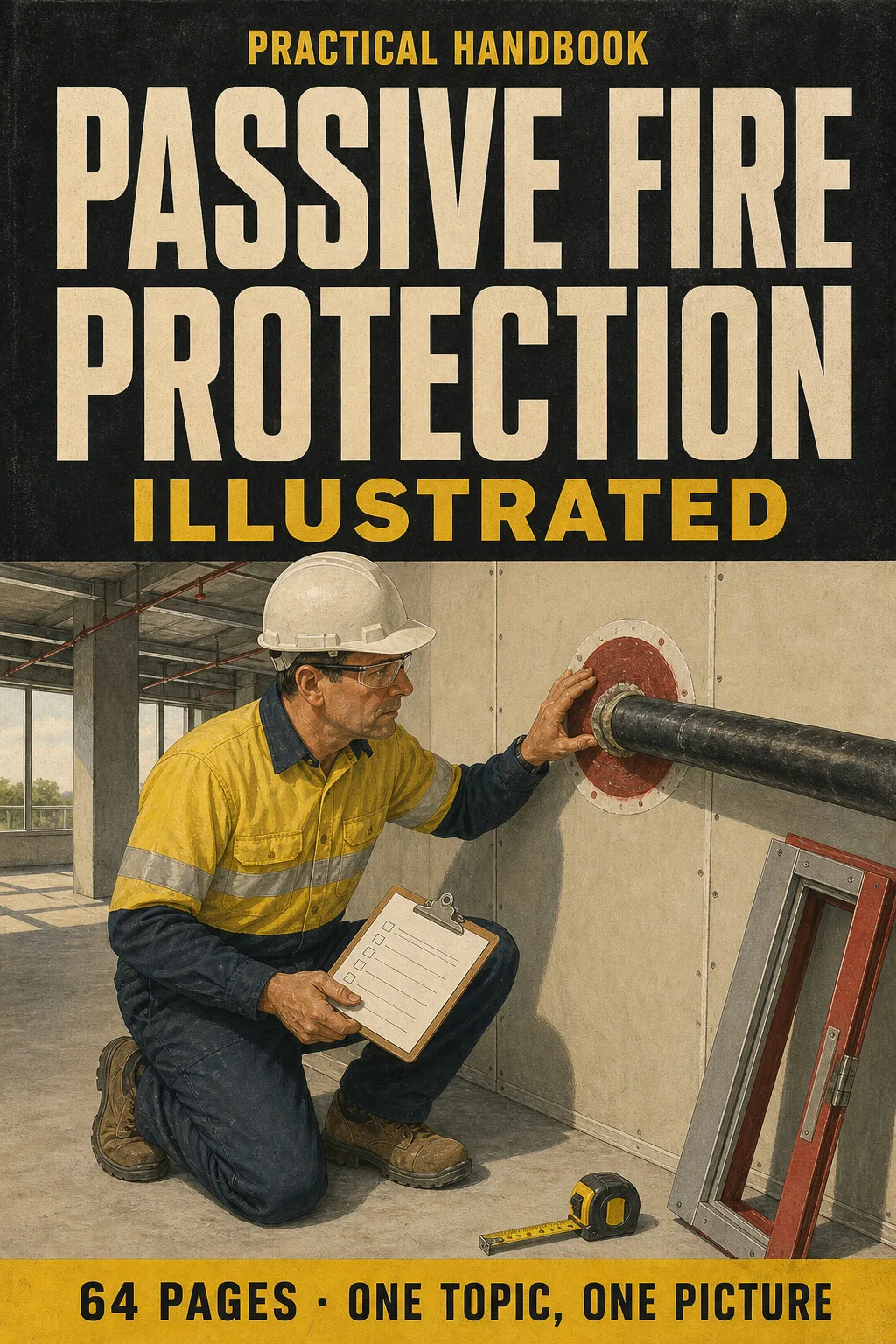
Passive Fire Protection Illustrated

Digital book in PDF · read it on your phone or print it

Passive Fire Protection Illustrated

For passive fire work in Australia, with the Queensland and NSW licensing side covered: FRLs, fire-rated walls and ceilings, fire doors part by part, collars and wraps, sealants and batts, fire dampers, inspection and records. Every topic has its own page: the drawing first, then the numbers you need to remember.

  • 64 illustrated pages
  • English
  • 30-day guarantee
A$ 39A$ 89
Get the book · A$ 39

Price shown for: Australia. In other countries, the checkout shows the price that applies there.

About this book

What it is

For passive fire work in Australia, with the Queensland and NSW licensing side covered: FRLs, fire-rated walls and ceilings, fire doors part by part, collars and wraps, sealants and batts, fire dampers, inspection and records. Every topic has its own page: the drawing first, then the numbers you need to remember.

Who This Book Is For
  • You're studying for your licence or accreditation
  • Your assessment is coming up
  • You already work in passive fire
What it covers
  1. How passive fire works
  2. FRLs and the NCC
  3. Walls, floors and ceilings
  4. Fire doors part by part
  5. Service penetrations: the 6-step method
  6. Ducts, dampers and other openings
  7. Inspection, maintenance and records
  8. Review and site checklist
Language
English (Australia)
Pages
64
Format
Digital book in PDF · read it on your phone or print it
Price
A$ 39 (Australia)
Delivery
This is a digital PDF book sent to your email: nothing is printed or shipped.
30-Day Guarantee
30-day guarantee: if a file doesn't open, if the content isn't what the product page describes, if you were charged twice or the email never arrived, write to us and we'll refund you in full.

Look Inside the Book

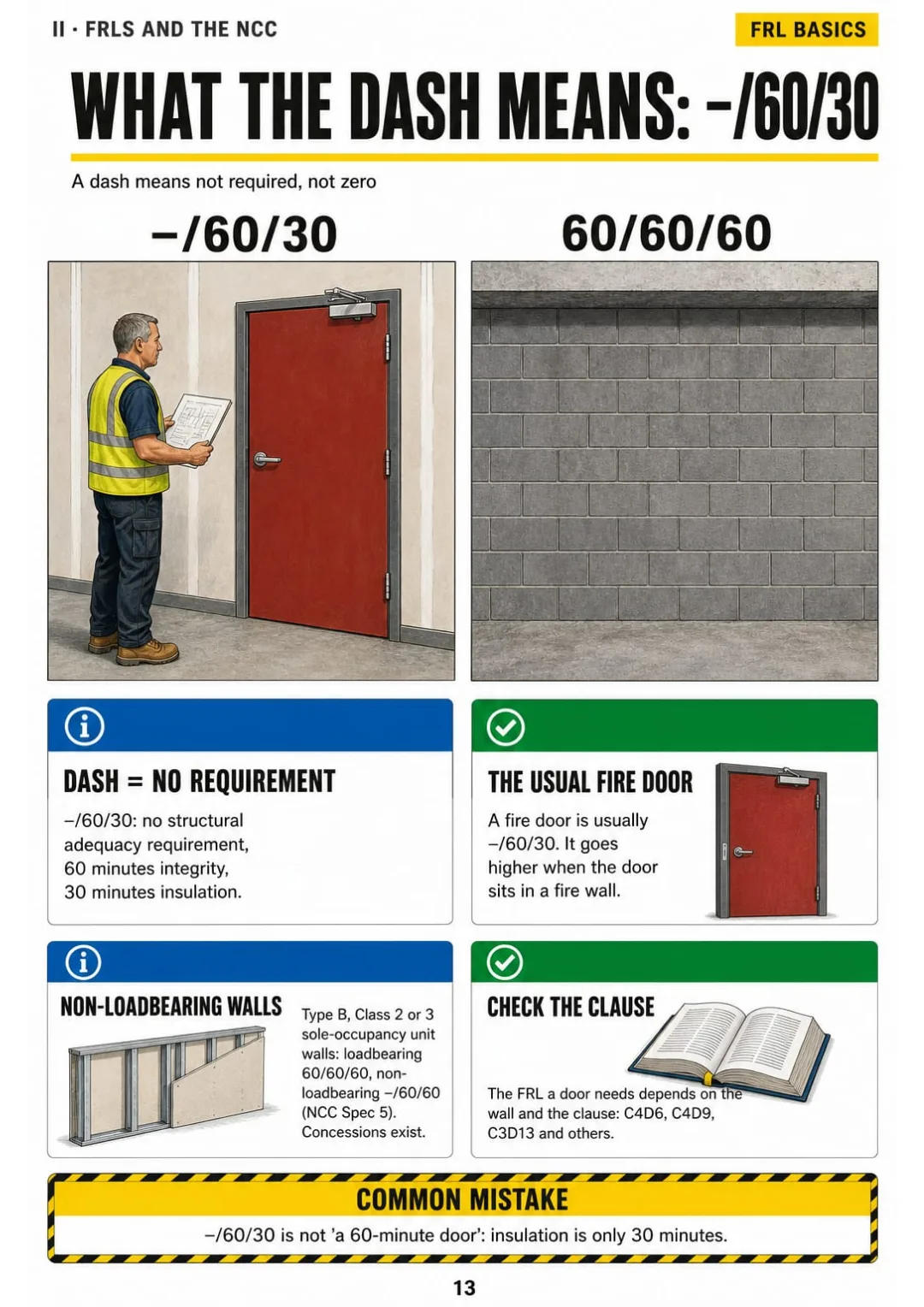
–/60/30 = no structural adequacy needed, 60 min integrity, 30 min insulation
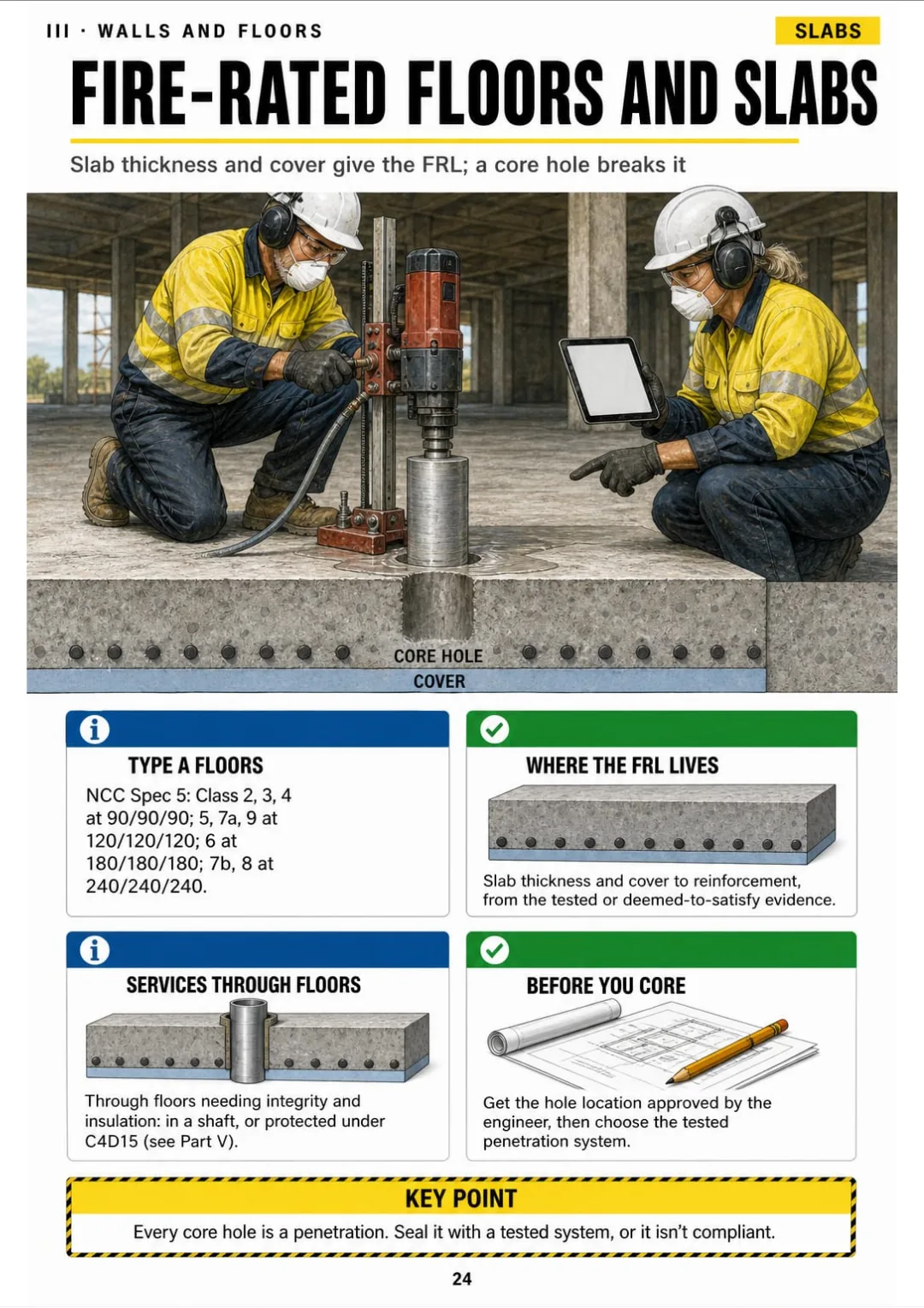
Type A floors run from 90/90/90 to 240/240/240 by class; every core hole needs a tested seal.
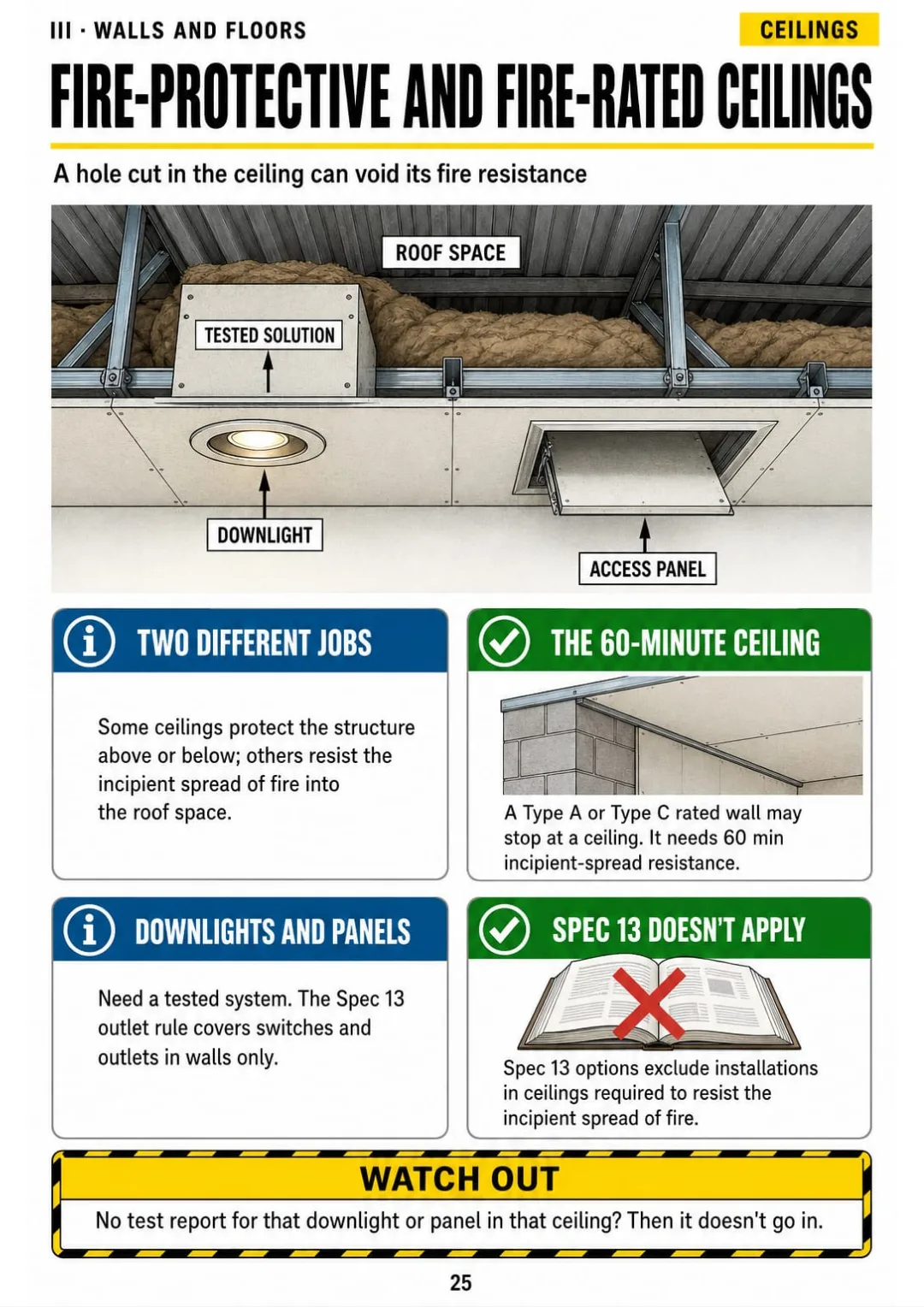
Downlights and access panels in fire-resisting ceilings need a tested system; Spec 13 doesn't cover them.
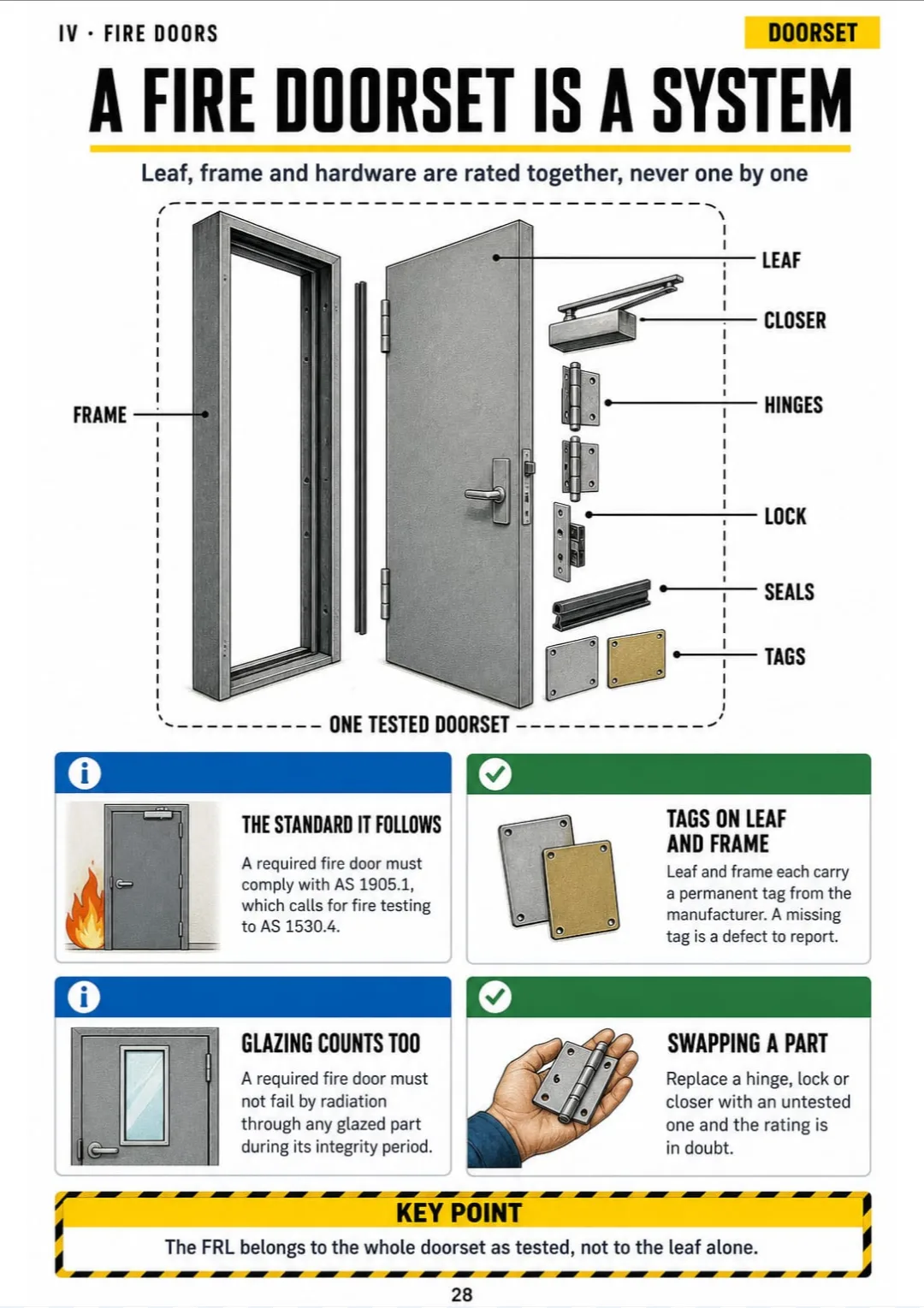
Leaf, frame, hinges, lock, closer, seals and tags: one doorset tested to AS 1905.1 and AS 1530.4
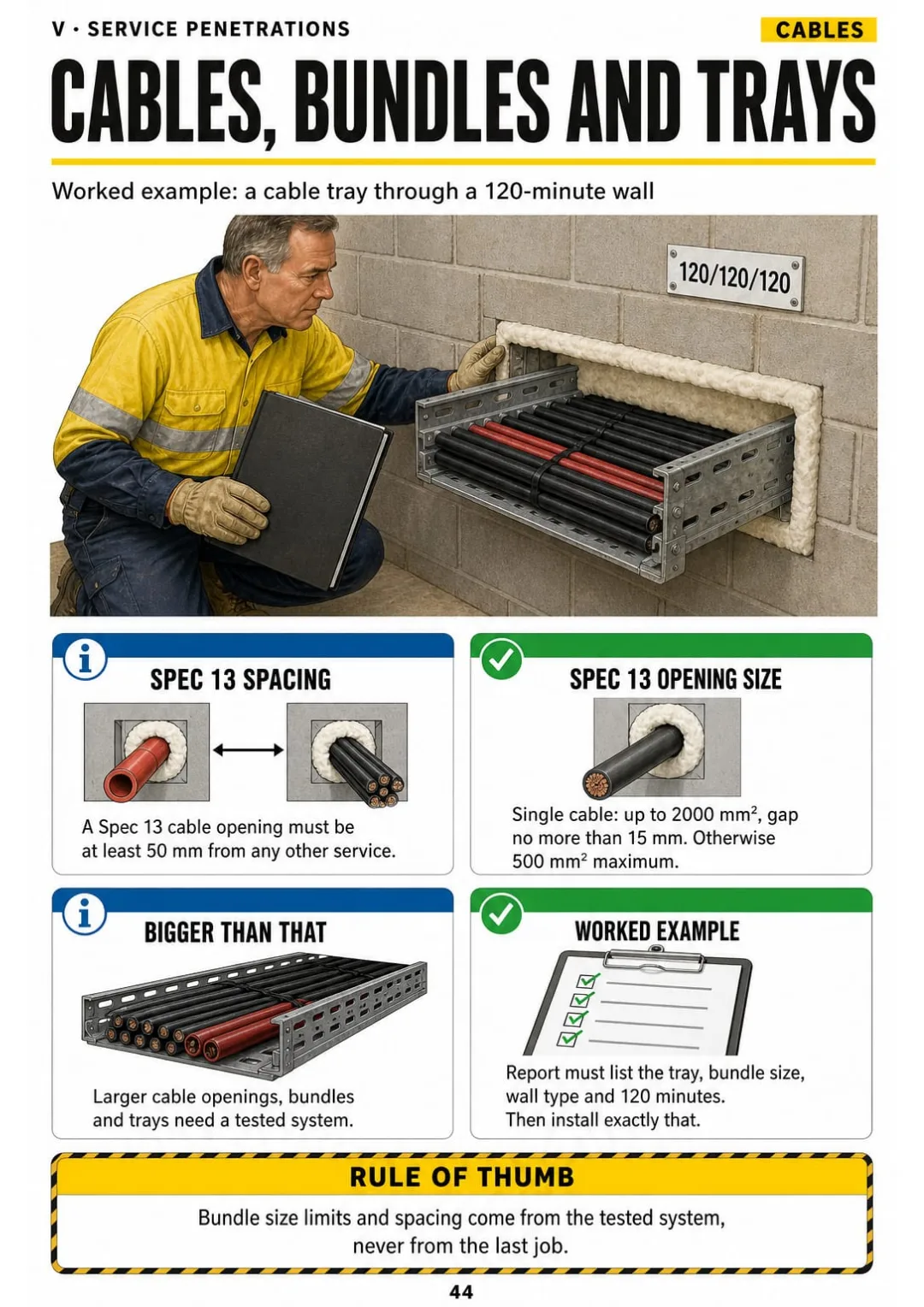
Tray through a 120-minute wall: tray, bundle size, wall and FRL must match the report.
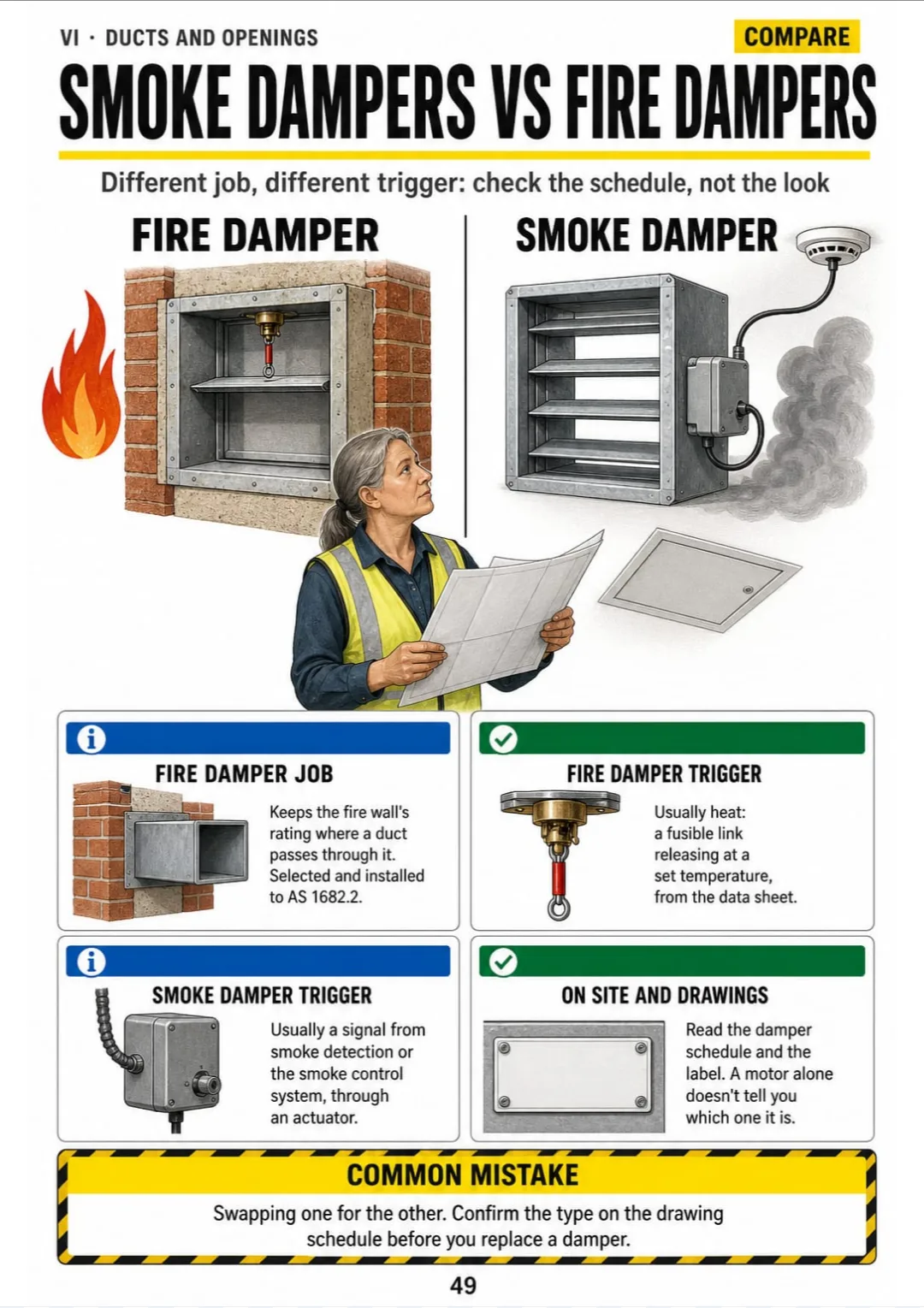
Fire damper vs smoke damper: what each one does, what triggers it, how to tell them apart
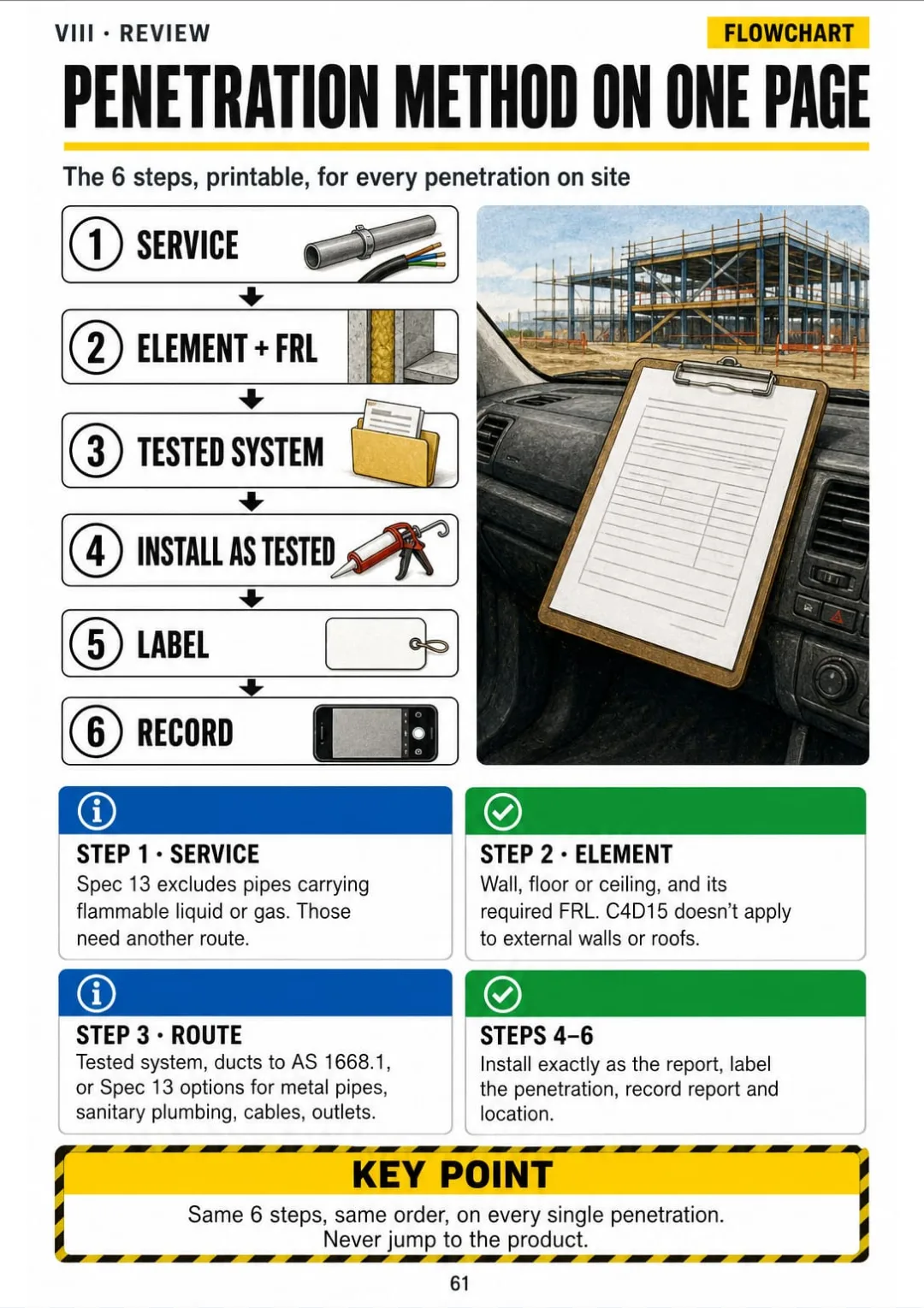
Service → element + FRL → tested system → install → label → record
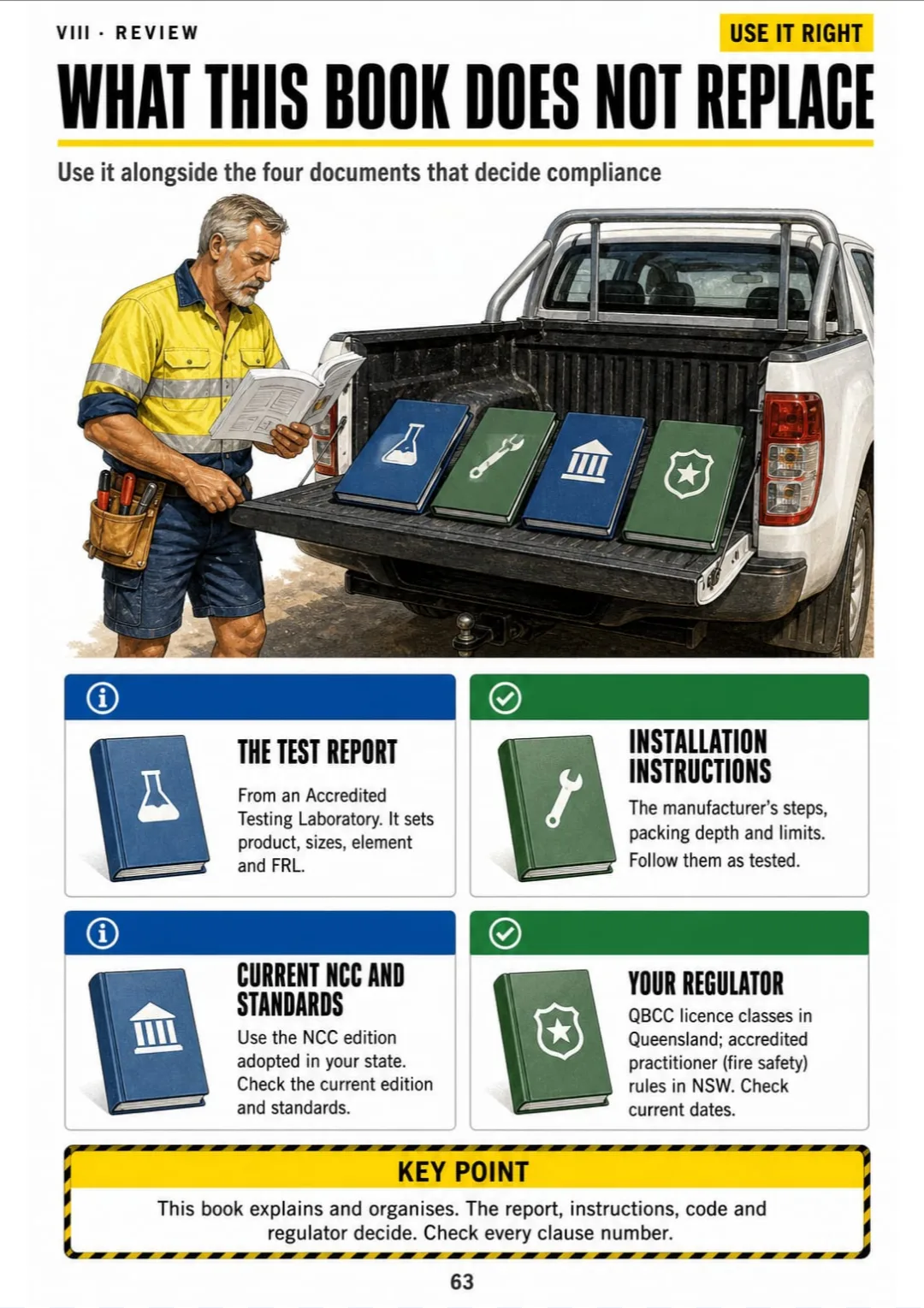
Test report, manufacturer instructions, current NCC, your regulator: use the book with them

Take a Look at the 8 Parts and 60 Topics

How passive fire works

pp. 5-11
  1. Active vs passive fire protection
  2. Compartmentation: boxes inside the building
  3. How fire and smoke travel
  4. The tested system rule
  5. Who's who on a passive fire job
  6. Licensing in Queensland and NSW
  7. Words you must use correctly

FRLs and the NCC

pp. 12-19
  1. Reading an FRL: 120/120/120
  2. What the dash means: -/60/30
  3. Structural adequacy
  4. Integrity
  5. Insulation
  6. How fire tests are run
  7. Building class and type of construction
  8. Where the NCC sets the FRLs

Walls, floors and ceilings

pp. 20-27
  1. A fire-rated plasterboard wall, layer by layer
  2. How high the wall must go
  3. Deflection head and top-of-wall joint
  4. Masonry and concrete walls
  5. Fire-rated floors and slabs
  6. Fire-protective and fire-rated ceilings
  7. Control joints and linear gaps
  8. Smoke walls vs fire walls

Fire doors part by part

pp. 28-36
  1. A fire doorset is a system
  2. The door leaf
  3. The frame and how it's fixed
  4. Door gaps in millimetres
  5. Hinges, locks and latching
  6. Self-closing and door closers
  7. Seals: intumescent and smoke
  8. Hold-open devices and automatic release
  9. Tags, labels and signage

Service penetrations: the 6-step method

pp. 37-46
  1. The 6 steps, always in the same order
  2. Step 1: identify the service
  3. Step 2: the element and its FRL
  4. Step 3: match a tested system
  5. Fire collars on plastic pipes
  6. Wraps on metal and insulated pipes
  7. Sealants, mortars and batts
  8. Cables, bundles and trays
  9. Step 5: labelling the penetration
  10. Step 6: what you record

Ducts, dampers and other openings

pp. 47-51
  1. Fire dampers: how they close
  2. Installing a fire damper
  3. Smoke dampers vs fire dampers
  4. Access panels, downlights and boxes
  5. Fire windows, shutters and curtains

Inspection, maintenance and records

pp. 52-58
  1. How to inspect in the same order every time
  2. Routine service of passive fire
  3. Inspecting a fire door
  4. Inspecting penetrations
  5. Writing a defect clearly
  6. NSW fire safety statements and Queensland occupier's statements
  7. Records that hold up

Review and site checklist

pp. 59-64
  1. The most common installation errors
  2. Five questions the assessor often asks
  3. Penetration method on one page
  4. Fire door check on one page
  5. What this book does not replace
  6. Final review map

Who This Book Is For

You're studying for your licence or accreditation

Every topic you've been reading as clauses is now a drawing with the key numbers next to it, so it makes sense after a day on site.

Your assessment is coming up

The review section and the practice questions let you check what you can really explain: FRLs, fire doors, penetrations and inspection.

You already work in passive fire

Print the one-page checks and keep them in the ute: the penetration method and the fire door gaps, in the same order on every job.

Plus: 2 Free Books

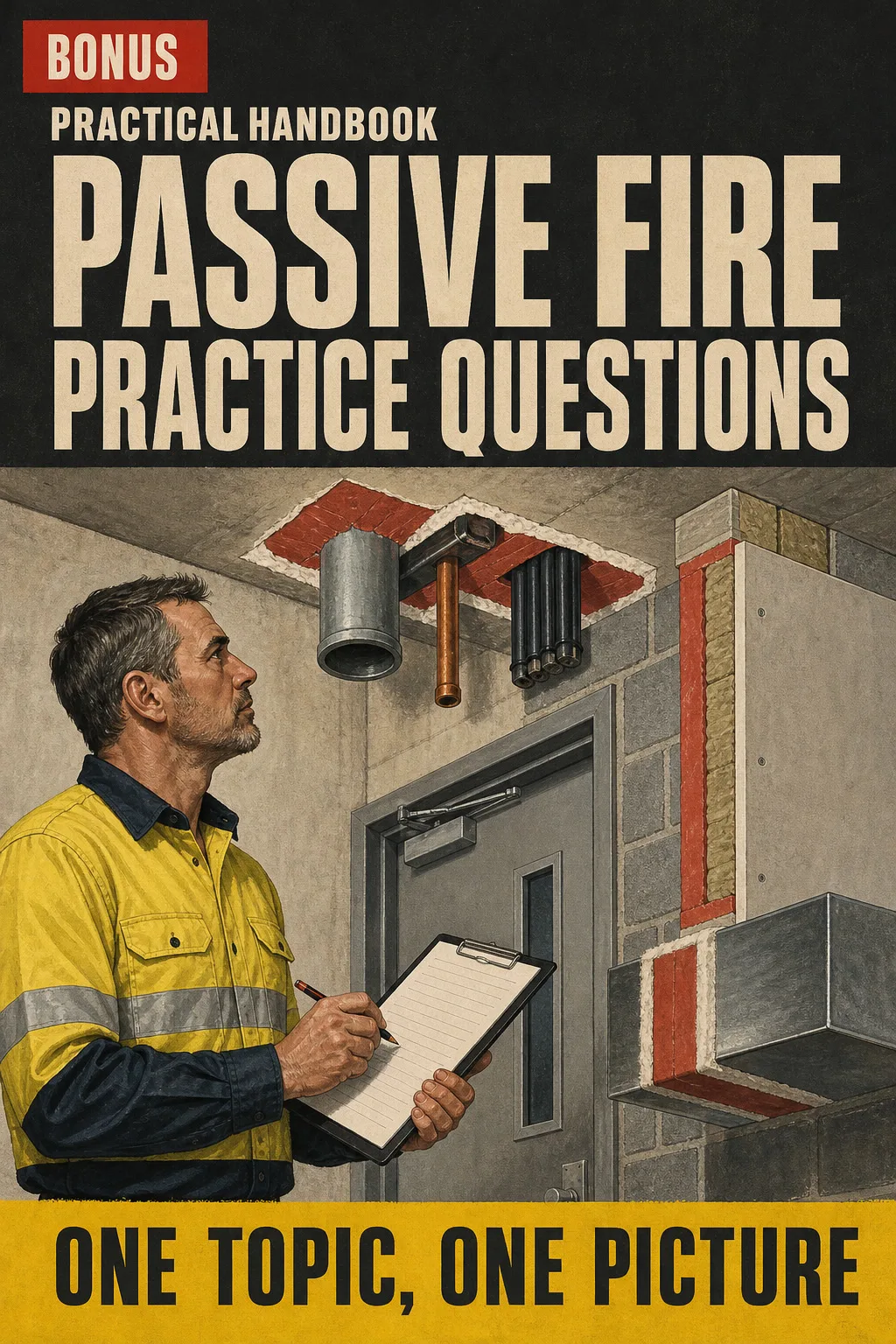
Passive Fire Practice Questions
BONUS 1

Passive Fire Practice Questions

Exam-style questions with worked answers on FRLs, fire doors, penetrations and inspection, so you can check what you really know before your assessment.
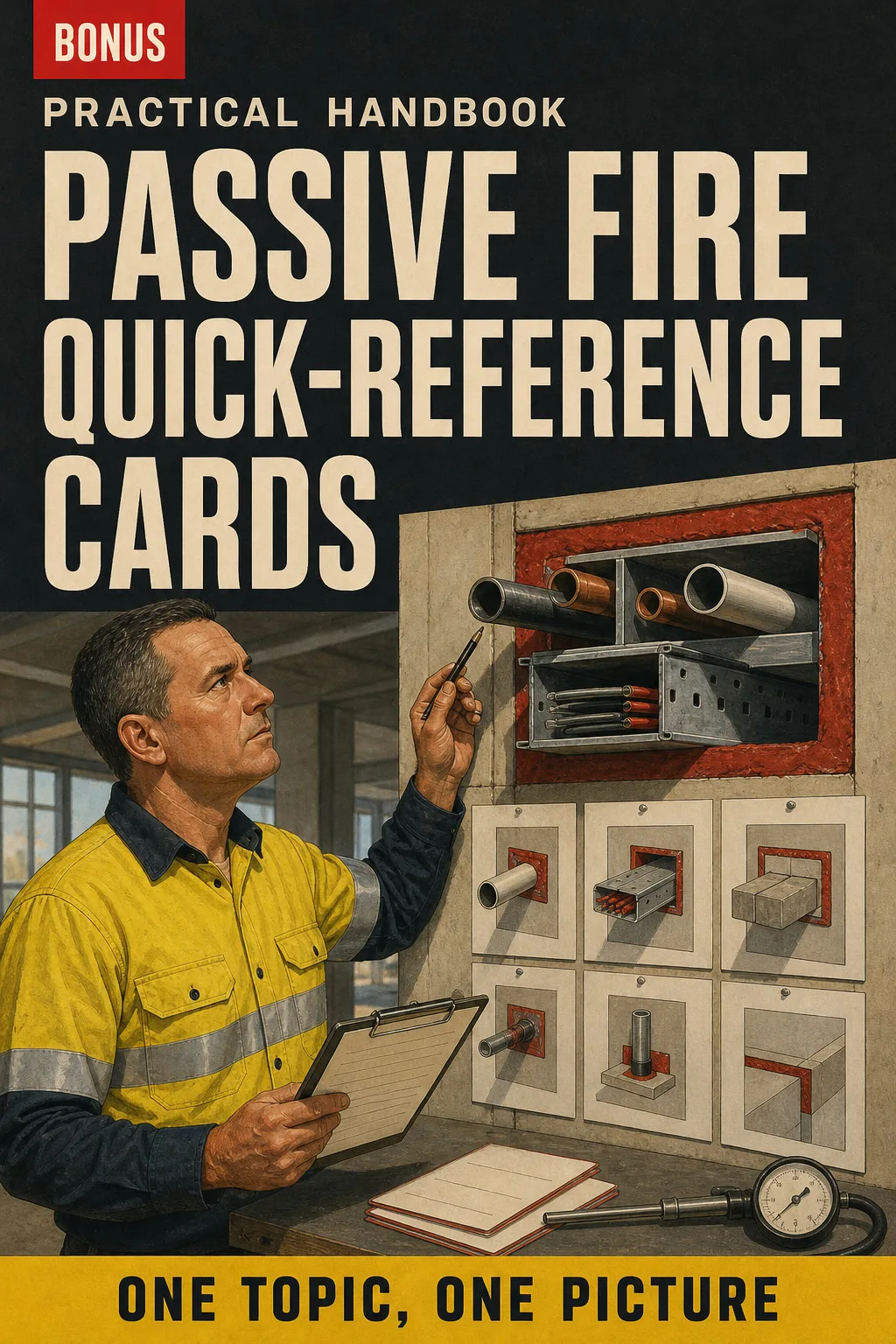
Passive Fire Quick-Reference Cards
BONUS 2

Passive Fire Quick-Reference Cards

The key ideas of every chapter on printable cards, so you can revise in ten minutes or keep them in the ute for site.

30-Day Guarantee

30-day guarantee: if a file doesn't open, if the content isn't what the product page describes, if you were charged twice or the email never arrived, write to us and we'll refund you in full. You pay once. No subscriptions.

Frequently Asked Questions

Is it for me if I already do passive fire work and need the licence?

Yes. It's written for people who already do the job and need to explain it in the language of the code: FRLs, tested systems, fire doors, penetrations and inspection. The NCC and Australian Standards pages apply across Australia; the licensing and fire safety statement pages cover Queensland and NSW. It starts from the basics but moves on fast.

Where does the content come from?

From the current NCC Volume One (Section C and its Specifications), AS 1530.4, AS 1905.1, AS 4072.1, AS 1682 and AS 1851, plus the Queensland and NSW licensing and accreditation requirements. Every clause number and interval is flagged so you can check it against the current official version.

Is it official material?

No. It's an independent study guide. It's not affiliated with or endorsed by the QBCC, NSW Fair Trading, FPA Australia, the ABCB, Standards Australia or any regulator.

Does it replace the course or the required training?

No. It's study material and a site reference. It doesn't give you a licence, an accreditation, a certificate or CPD points, and it doesn't replace the training your licence requires. On every job, the tested system documentation and the manufacturer's installation instructions come first: the book shows you how to read them and what to check.

Are the practice questions the ones in the assessment?

No. They're written for this book to help you check what you know. They aren't official questions from any assessment.

When and how do I get it?

The book and the 2 bonus books come as PDFs by email, to the address you enter at checkout.

Do I have to pay every month?

No. It's a one-off payment. No subscription.

Can I have it on paper?

Yes. It's a PDF, so you can print it at home or at a print shop and take it to site.

How does the refund work?

You have 30 days. We refund everything if the file won't open, if the book isn't what you see on this page, if you were charged twice or if the email doesn't arrive: just email us.

A$ 39A$ 89
Get the book · A$ 39

This is a digital PDF book sent to your email: nothing is printed or shipped.

More books on this topic

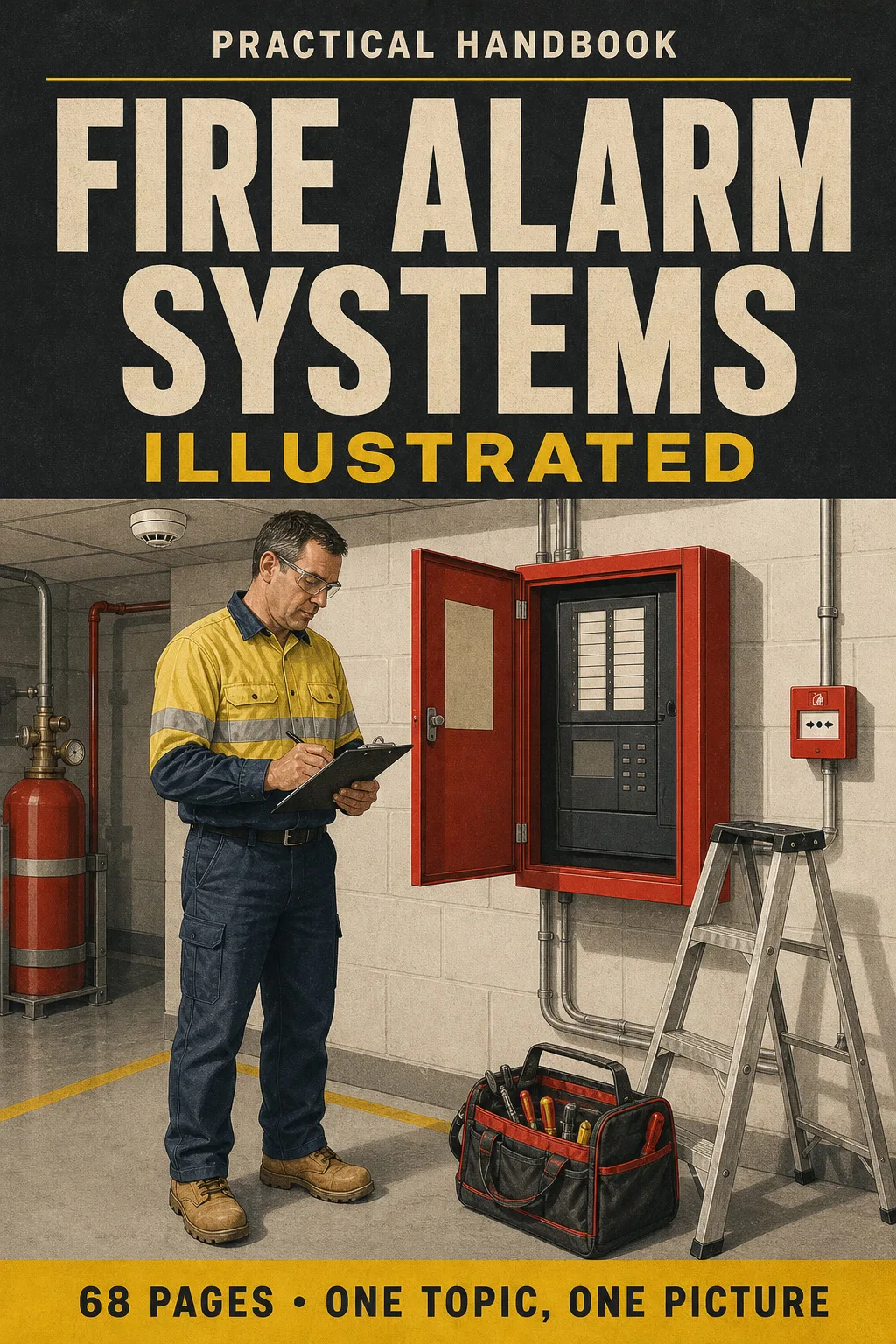
Fire Alarm Systems Illustrated

Fire detection and alarm systems explained one topic per page, every concept drawn: detector types, spacing and…

From A$ 39 A$ 89