Study in Pictures🌐 English (Australia)
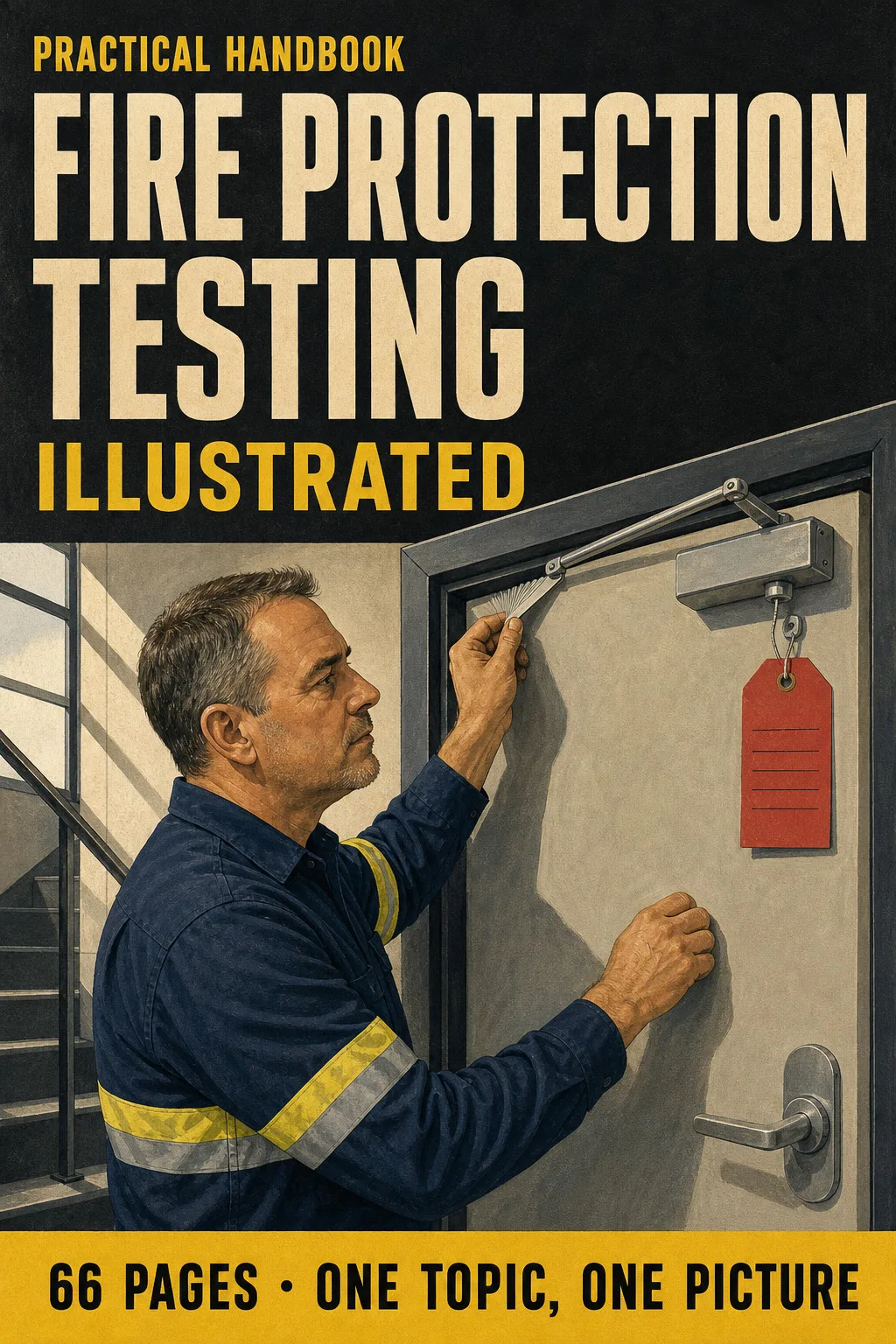
Fire Protection Testing Illustrated

Digital book in PDF · read it on your phone or print it

Fire Protection Testing Illustrated

Fire doors, detection and alarm, sprinklers, fire pumps, hydrants, hose reels, extinguishers, exit lighting and passive fire. Every topic has its own page: the drawing first, then what you need to remember.

  • 66 illustrated pages
  • English
  • 30-day guarantee
A$ 39A$ 89
Get the book · A$ 39

Price shown for: Australia. In other countries, the checkout shows the price that applies there.

About this book

What it is

Fire doors, detection and alarm, sprinklers, fire pumps, hydrants, hose reels, extinguishers, exit lighting and passive fire. Every topic has its own page: the drawing first, then what you need to remember.

Who This Book Is For
  • You're doing your Cert III
  • Your FPAS or QBCC assessment is close
  • You already work in fire
What it covers
  1. How AS 1851 Works
  2. Fire and Smoke Doors
  3. Detection and Alarm
  4. Sprinklers and Fire Pumps
  5. Hydrants and Hose Reels
  6. Extinguishers and Fire Blankets
  7. Exit and Emergency Lighting
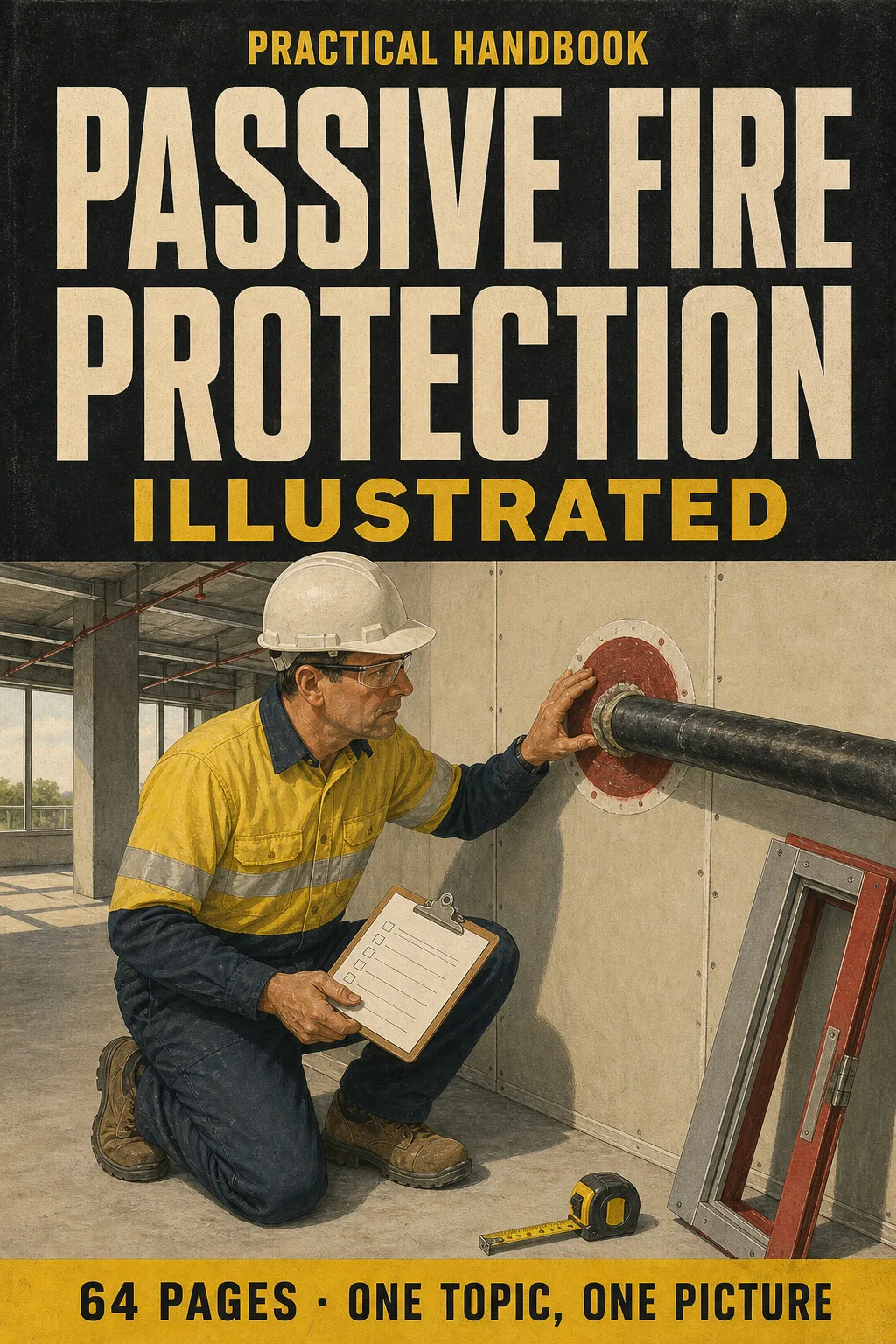
  8. Passive Fire
  9. Logbook, State Rules and Review
Language
English (Australia)
Pages
66
Format
Digital book in PDF · read it on your phone or print it
Price
A$ 39 (Australia)
Delivery
This is a digital PDF book sent to your email: nothing is printed or shipped.
30-Day Guarantee
30-day guarantee: if a file doesn't open, if the content isn't what the product page describes, if you were charged twice or the email never arrived, write to us and we'll refund you in full.

Look Inside the Book

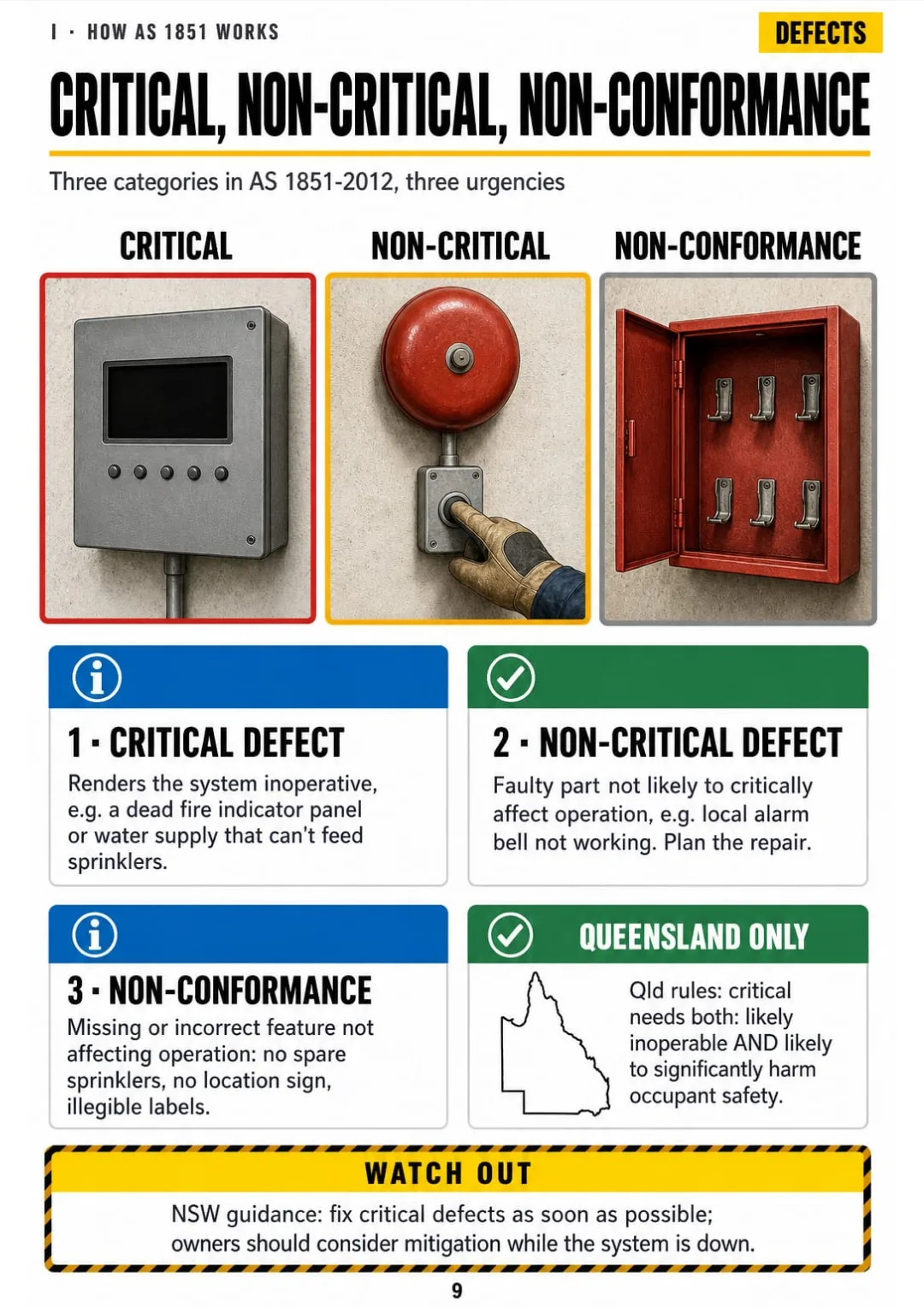
Critical, non-critical, non-conformance: AS 1851-2012 cl. 1.5.6 with real examples
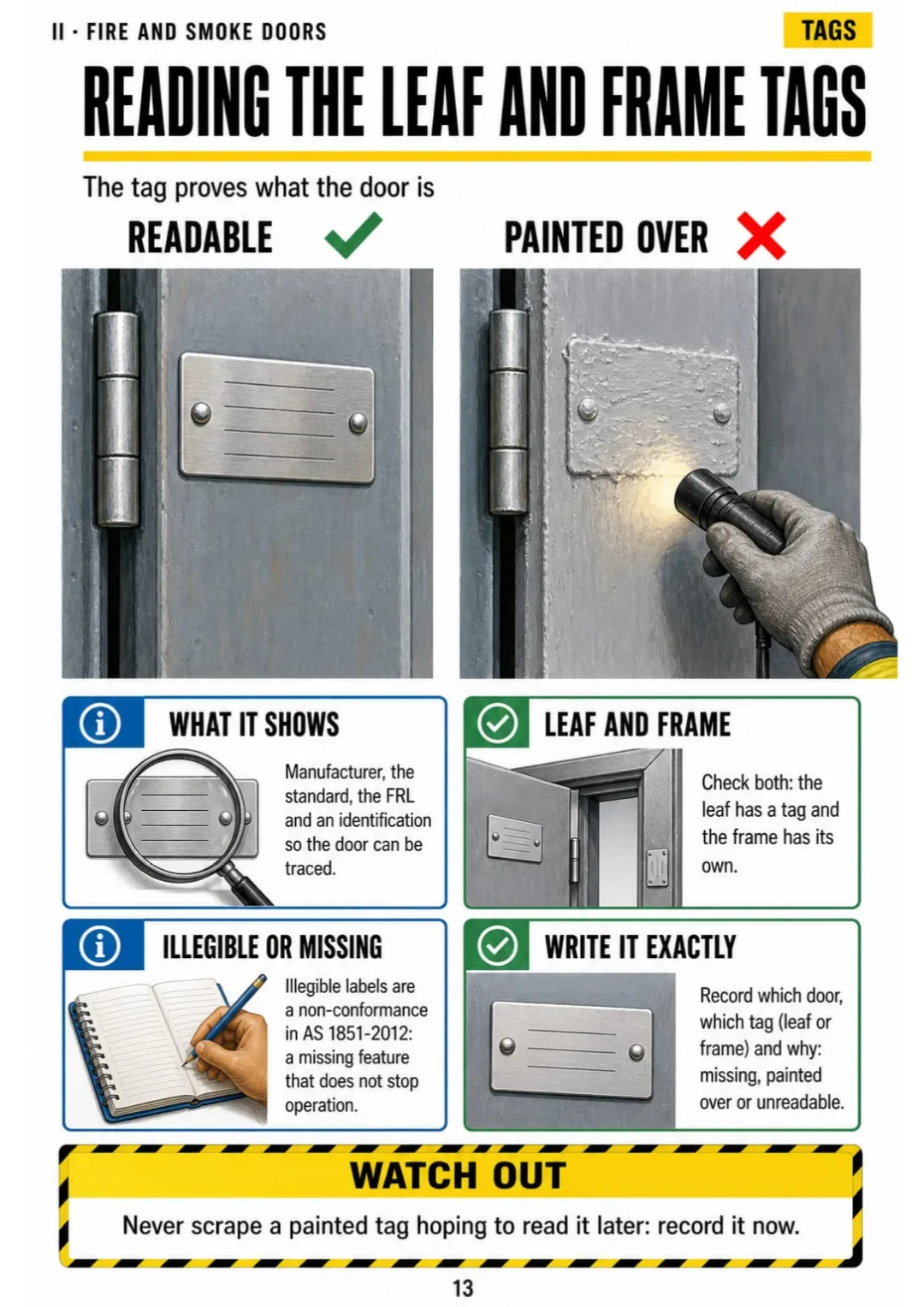
Manufacturer, standard, FRL, ID: what the leaf and frame tags must show
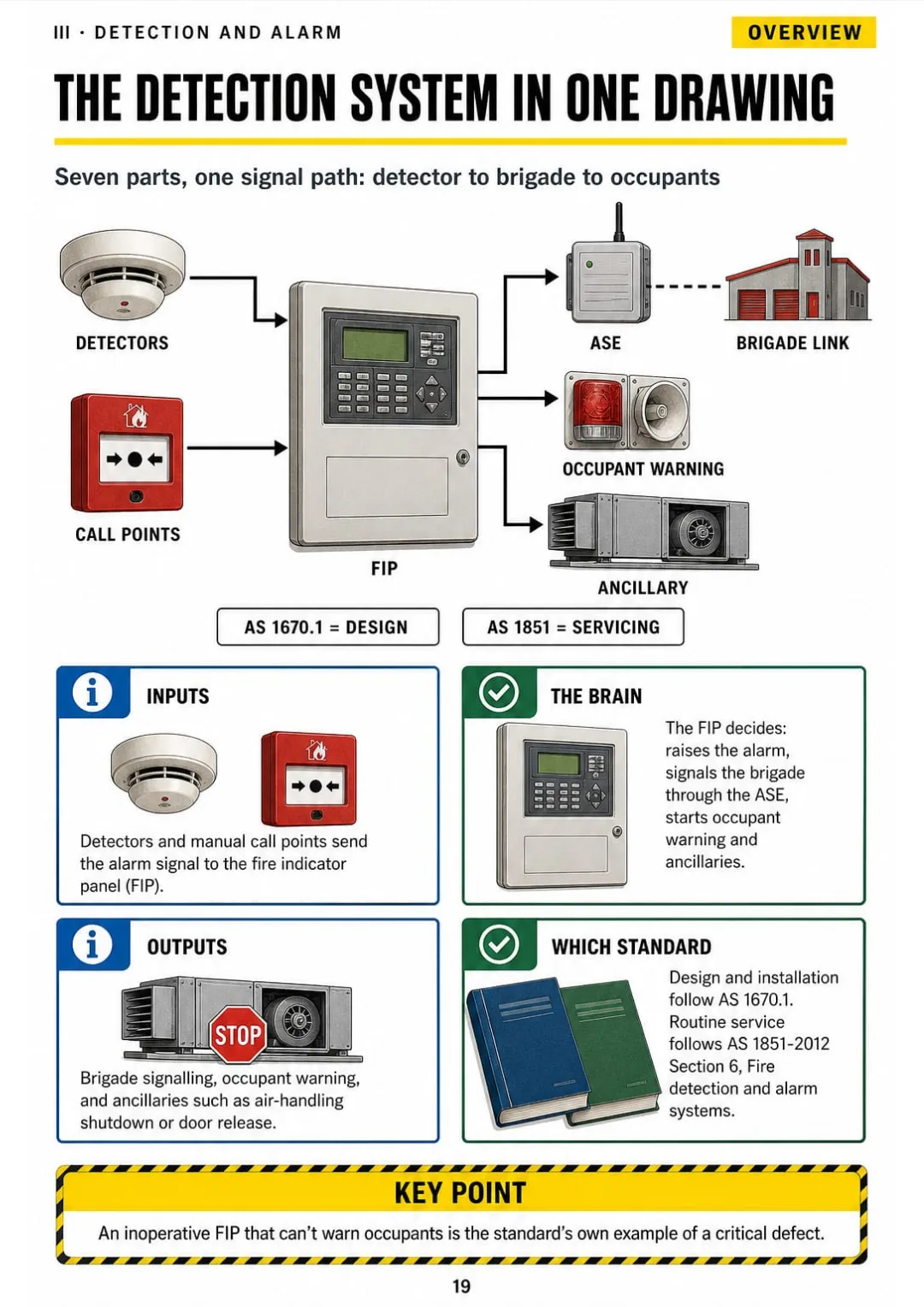
Detectors → FIP → brigade link → occupant warning → ancillaries: designed to AS 1670.1, serviced to AS 1851.
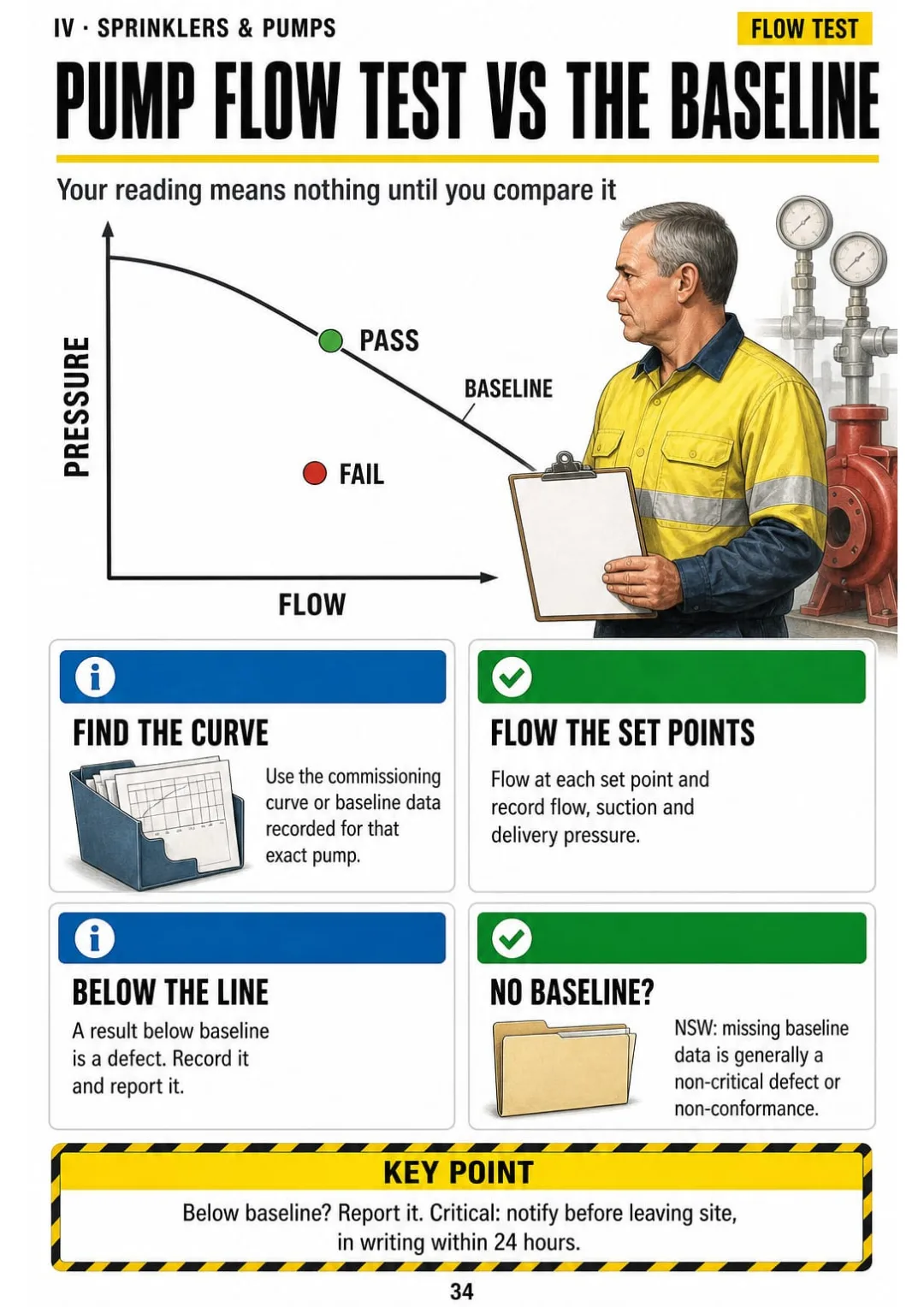
Flow at the set points, compare with the commissioning curve; below baseline = defect to report.
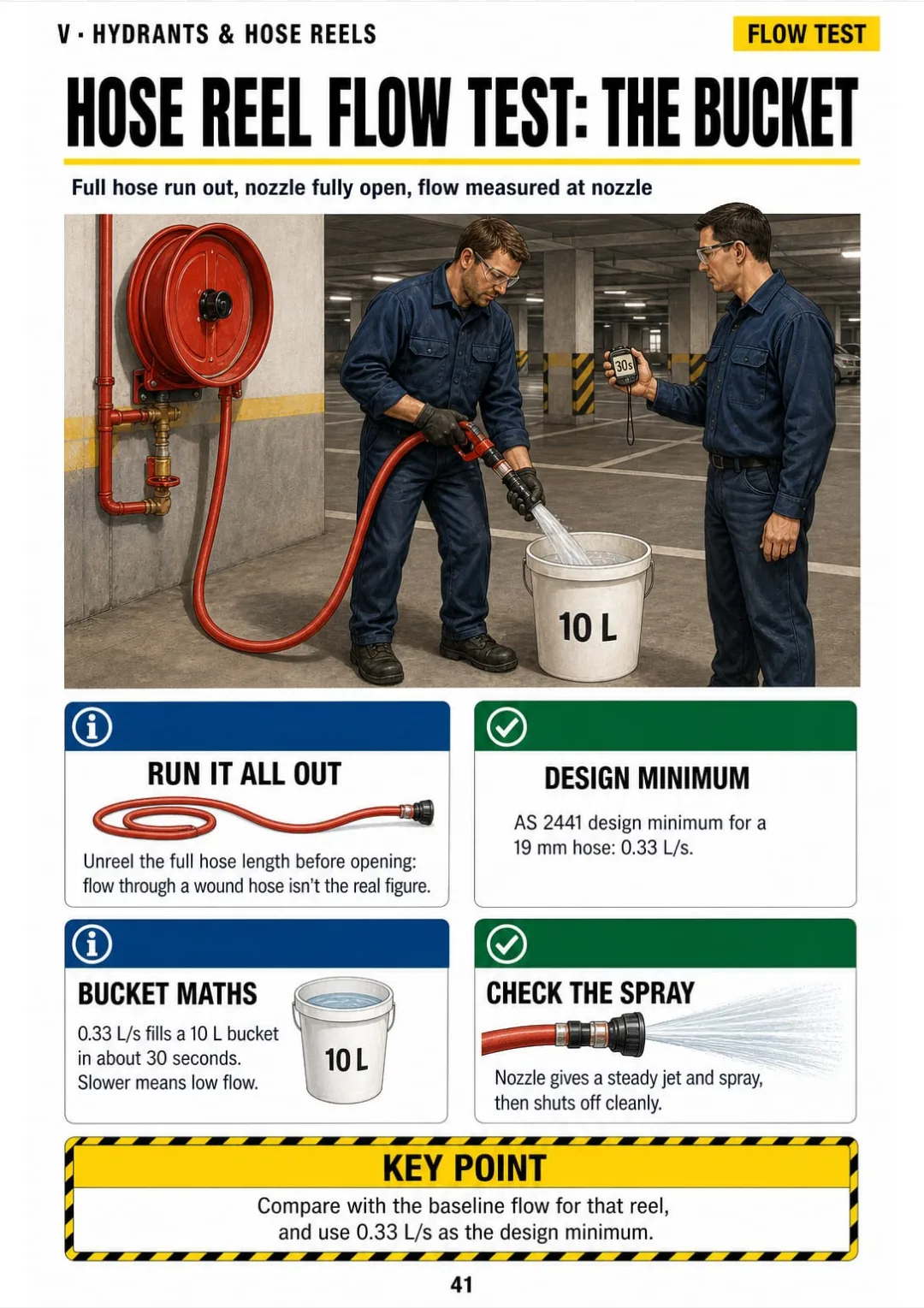
0.33 L/s (19 mm hose, AS 2441) fills a 10 L bucket in about 30 seconds.
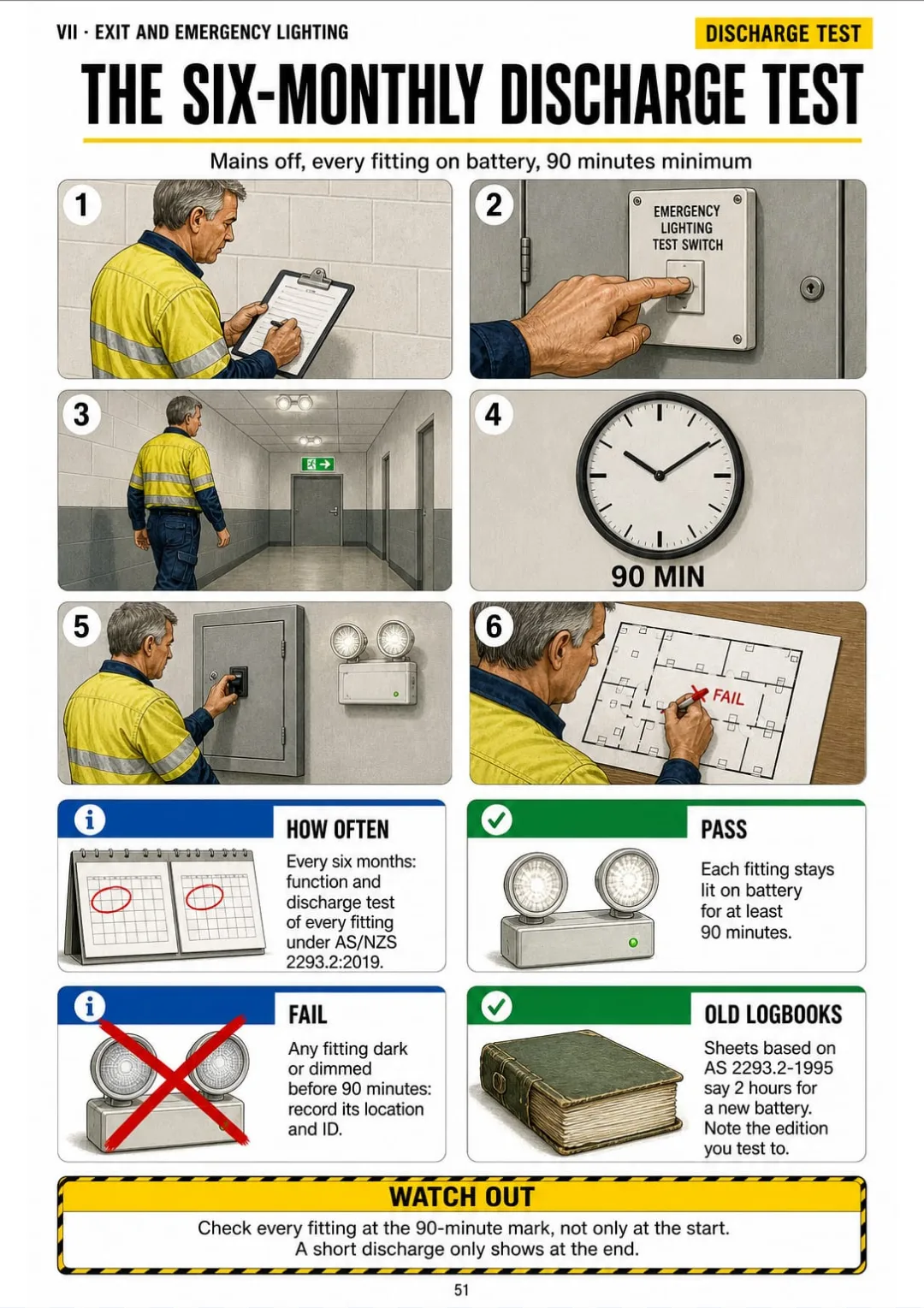
Six-monthly discharge test: every fitting on battery for at least 90 minutes (AS/NZS 2293.2:2019).
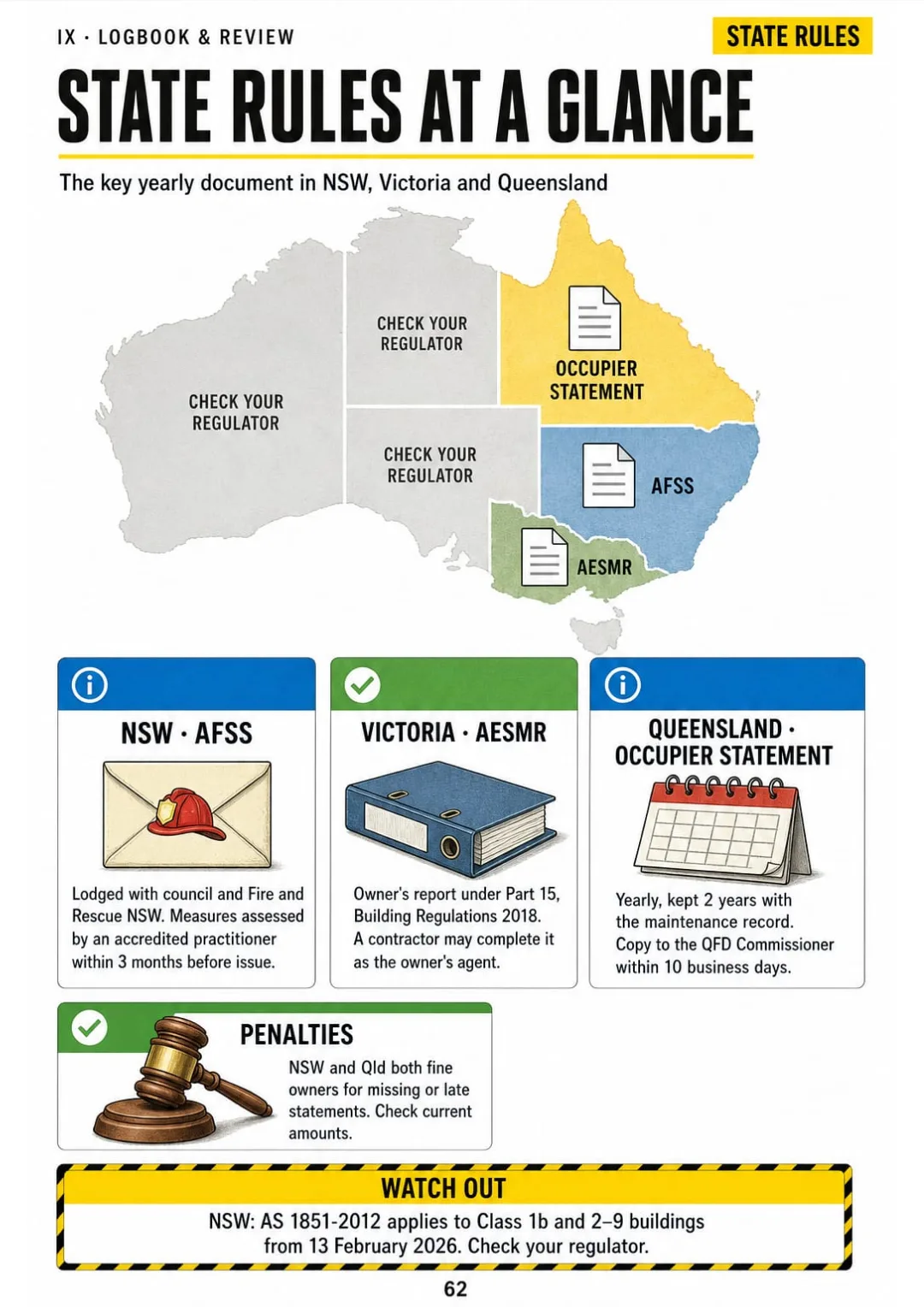
NSW AFSS, Victoria AESMR, Queensland occupier statement: one map, check your regulator.
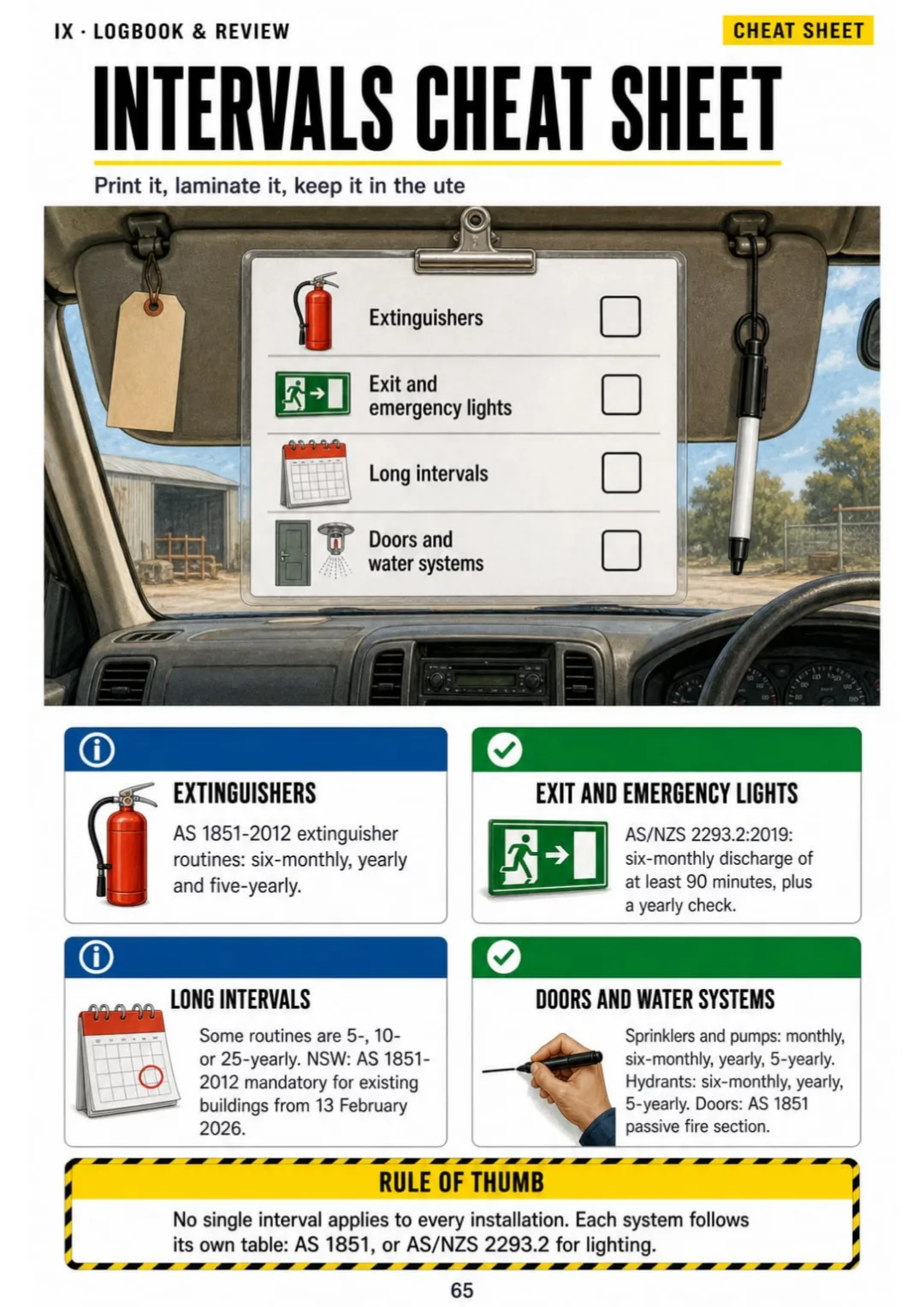
Extinguishers 6-monthly to 5-yearly, emergency lights monthly to yearly, on one page.

Take a Look at the 9 Parts and 62 Topics

How AS 1851 Works

pp. 5-11
  1. What AS 1851 Covers, and What It Doesn't
  2. The Routine Ladder: Monthly to Five-Yearly and Beyond
  3. Inspect, Test, Survey: Three Different Jobs
  4. Baseline Data: The Number You Test Against
  5. Critical Defect, Non-Critical Defect, Non-Conformance
  6. Reporting a Critical Defect the Same Day
  7. Essential Safety Measures and the Building's Fire Safety Schedule

Fire and Smoke Doors

pp. 12-18
  1. Anatomy of a Fire Door Set
  2. Reading the Tag on the Leaf and the Frame
  3. The Clearances: Measured, Not Guessed
  4. Closer and Latch: The Self-Closing Test
  5. Hold-Open Devices and Door Release
  6. Smoke Doors vs Fire Doors
  7. Door Defects: Which Category?

Detection and Alarm

pp. 19-26
  1. The Fire Detection System in One Drawing
  2. The Fire Indicator Panel: What to Read First
  3. Isolating Before You Test
  4. Smoke Detectors: Testing With Aerosol or Smoke
  5. Heat Detectors and Other Detector Types
  6. Manual Call Points and Break-Glass Alarms
  7. Batteries and Standby Power
  8. Occupant Warning and EWIS

Sprinklers and Fire Pumps

pp. 27-34
  1. The Sprinkler System From Valve Set to Head
  2. The Valve Set: Checks in Order
  3. Alarm Test: Gong, Flow Switch and Brigade Signal
  4. Sprinkler Head Colours and Temperatures
  5. Clearance Under the Heads
  6. The Spare Heads Cabinet
  7. Fire Pumps: The Run Test
  8. Pump Flow Test Against the Baseline

Hydrants and Hose Reels

pp. 35-42
  1. Hydrant Systems: Feed, Attack and Booster
  2. The Booster Assembly and Block Plan
  3. Hydrant Landing Valves
  4. Hydrant Flow Test: Setting Up
  5. Hydrant Flow Test: Reading the Result
  6. Hose Reels: Inspection Points
  7. Hose Reel Flow Test
  8. Hydrant and Hose Reel Defects

Extinguishers and Fire Blankets

pp. 43-49
  1. Extinguisher Types and Their Colour Bands
  2. Which Extinguisher for Which Fire Class
  3. Location, Height and Signage
  4. The Six-Monthly Extinguisher Check
  5. The Maintenance Tag: How to Punch It
  6. Five-Yearly Work: Pressure Test and Refurbishment
  7. Fire Blankets

Exit and Emergency Lighting

pp. 50-54
  1. Exit Signs and Emergency Lights: What's Required
  2. The Six-Monthly Discharge Test
  3. Visual Checks Between Tests
  4. Central Systems and Self-Test Fittings
  5. Emergency Lighting Faults and How to Record Them

Passive Fire

pp. 55-59
  1. Reading an FRL
  2. Fire-Rated Walls and Compartments
  3. Service Penetrations: Collars, Sealants and Wraps
  4. Spotting a Breached Penetration
  5. Evacuation Diagrams and Signage

Logbook, State Rules and Review

pp. 60-66
  1. Filling In the Logbook Line by Line
  2. Writing a Defect So Anyone Understands It
  3. State Rules at a Glance
  4. Cert III, FPAS and QBCC: Which Pathway Is Yours
  5. One Building, Every Routine: A Yearly Visit in Order
  6. Intervals Cheat Sheet
  7. Most Frequent Mistakes on Site

Who This Book Is For

You're doing your Cert III

Every routine drawn in the same order, so what you study at night matches what you test during the day.

Your FPAS or QBCC assessment is close

Intervals, defect categories and flow tests on one page each, plus exam-style questions to check yourself.

You already work in fire

A printable reference for the van: the checks in order and the numbers in a box, ready when the building manager asks.

Plus: 2 Free Books

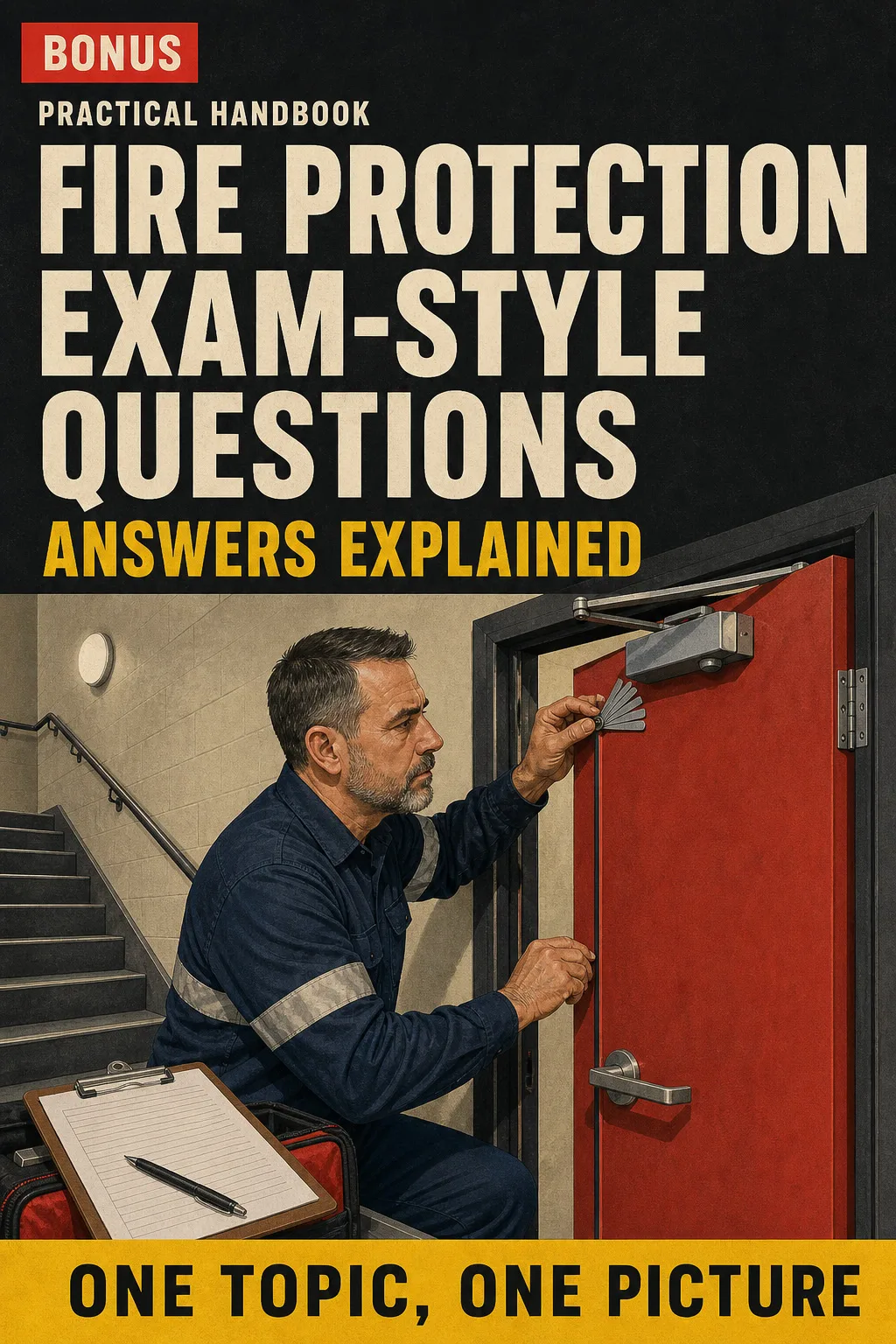
Fire Protection Exam-Style Questions: Answers Explained
BONUS 1

Fire Protection Exam-Style Questions: Answers Explained

Test yourself on routines, defects and flow tests, and see why each answer is right before your assessment.
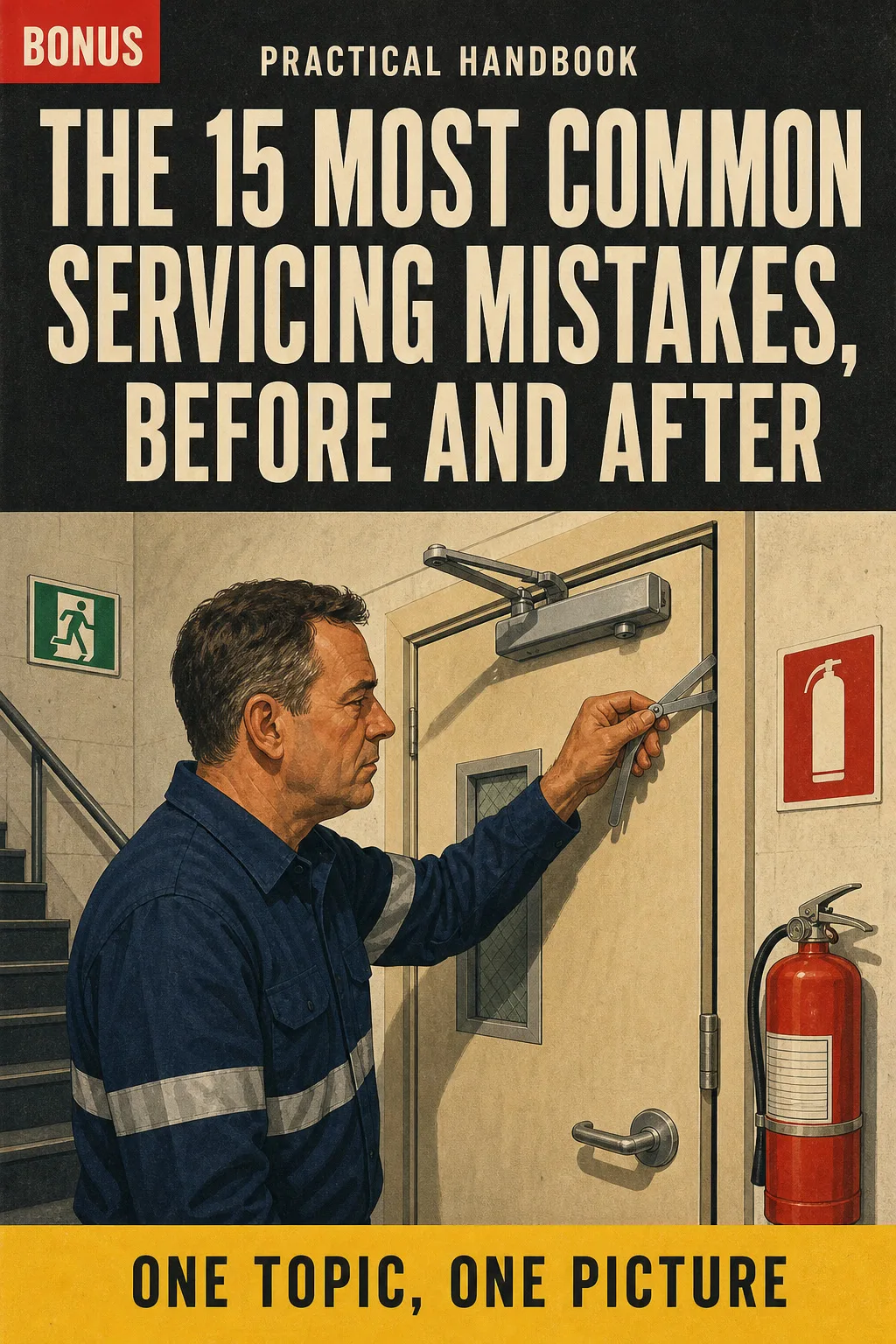
The 15 Most Common Servicing Mistakes, Before and After
BONUS 2

The 15 Most Common Servicing Mistakes, Before and After

See the errors techs make most often on doors, detectors, hydrants and logbooks, each one drawn wrong and then drawn right.

30-Day Guarantee

30-day guarantee: if a file doesn't open, if the content isn't what the product page describes, if you were charged twice or the email never arrived, write to us and we'll refund you in full. You pay once. No subscriptions.

Frequently Asked Questions

Is it for me if I already work in fire protection?

Yes. It's written for techs who already test on site and want AS 1851 in one clear order for Cert III, FPAS or a QBCC licence, and for tradies moving into fire from plumbing or electrical. It skips the obvious and goes to what gets asked: intervals, baseline data, defect categories and flow tests, with the numbers in a box on each page.

Where does the content come from?

It's written for Australia, not adapted from a US book: no NFPA, metric units, Australian Standards and Australian terms (FIP, booster, logbook). The content comes from AS 1851 (current edition) and the related Australian Standards (AS 1905.1, AS 1670.1, AS 2419.1, AS 2441, AS/NZS 2293.2 and others), the National Construction Code and state building regulations. The standards are cited for reference; nothing is copied, every figure is redrawn.

Is it official material?

No. It's an independent study book, not published or endorsed by Standards Australia, FPA Australia, the QBCC or any regulator. It doesn't give you a certificate and doesn't count toward Cert III, FPAS or any licence.

Does it replace my RTO course or training?

No, and it isn't meant to. It sits next to your RTO notes: the same systems, drawn one topic per page, in the order you test them on site, with the intervals and numbers in a box. It doesn't replace your Cert III training, supervised work on site or an accredited assessment.

Are the practice questions the ones in the exam?

No. They're written for this book so you can check what you know. They're not official questions from any exam or assessment.

When and how do I get it?

The book and the 2 bonus books arrive as PDFs by email, at the address you enter at checkout.

Do I have to pay every month?

No. It's a one-off payment.

Can I have it on paper?

Yes. The PDF is made to print, at home on A4 or at a print shop, so you can keep it in the van.

How does the refund work?

You have 30 days. We refund everything if the file won't open, if the book isn't what you see on this page, if you were charged twice or if the email doesn't arrive: just email us.

A$ 39A$ 89
Get the book · A$ 39

This is a digital PDF book sent to your email: nothing is printed or shipped.

More books on this topic

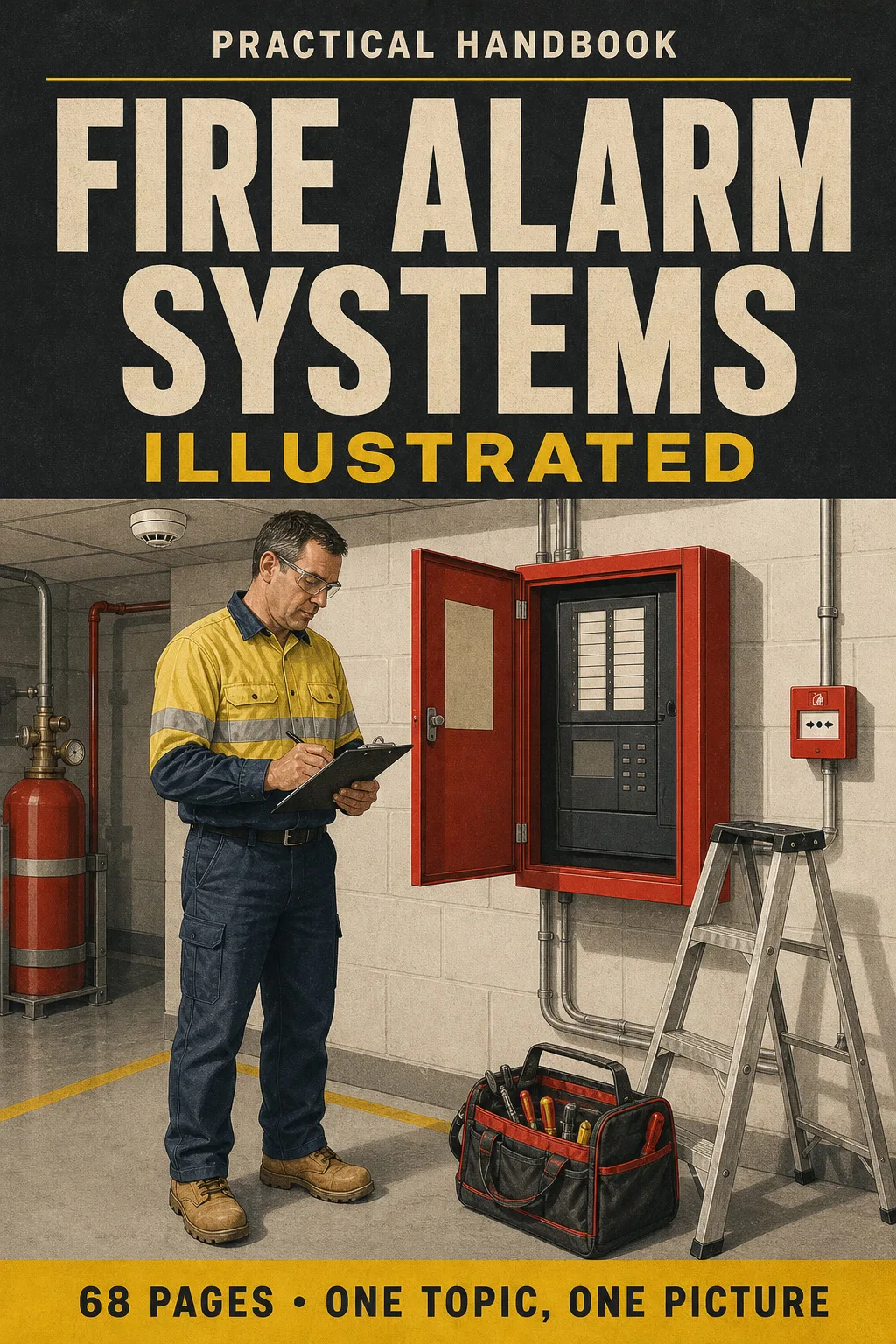
Fire Alarm Systems Illustrated

Fire detection and alarm systems explained one topic per page, every concept drawn: detector types, spacing and…

From A$ 39 A$ 89