Study in Pictures🌐 English (South Africa)
Home Generator Illustrated

Digital book in PDF · read it on your phone or print it

Home Generator Illustrated

How many kVA your house needs, why it trips when the fridge and the kettle start together, how many litres a four-hour outage takes, how far from the window it must stand, and why it never goes into a wall socket. One topic per page: the drawing first, then the numbers to remember.

  • 72 illustrated pages
  • English
  • 30-day guarantee
R399R999
Get the book · R399

Price shown for: South Africa. In other countries, the checkout shows the price that applies there.

About this book

What it is

How many kVA your house needs, why it trips when the fridge and the kettle start together, how many litres a four-hour outage takes, how far from the window it must stand, and why it never goes into a wall socket. One topic per page: the drawing first, then the numbers to remember.

Who This Book Is For
  • You're about to buy one
  • It's already in your garden
  • Your parents run one
What it covers
  1. Know Your Machine
  2. Choosing the Right Type
  3. Sizing in 5 Steps
  4. Fuel and Running Time
  5. Where to Place It: Carbon Monoxide
  6. Connecting Safely: Leads, Changeover and Backfeed
  7. Start, Run and Shut Down
  8. Maintenance and Storage
  9. Review: Checklists and Frequent Mistakes
Language
English (South Africa)
Pages
72
Format
Digital book in PDF · read it on your phone or print it
Price
R399 (South Africa)
Delivery
This is a digital PDF book sent to your email: nothing is printed or shipped.
30-Day Guarantee
30-day guarantee: if a file doesn't open, if the content isn't what the product page describes, if you were charged twice or the email never arrived, write to us and we'll refund you in full.

Look Inside the Book

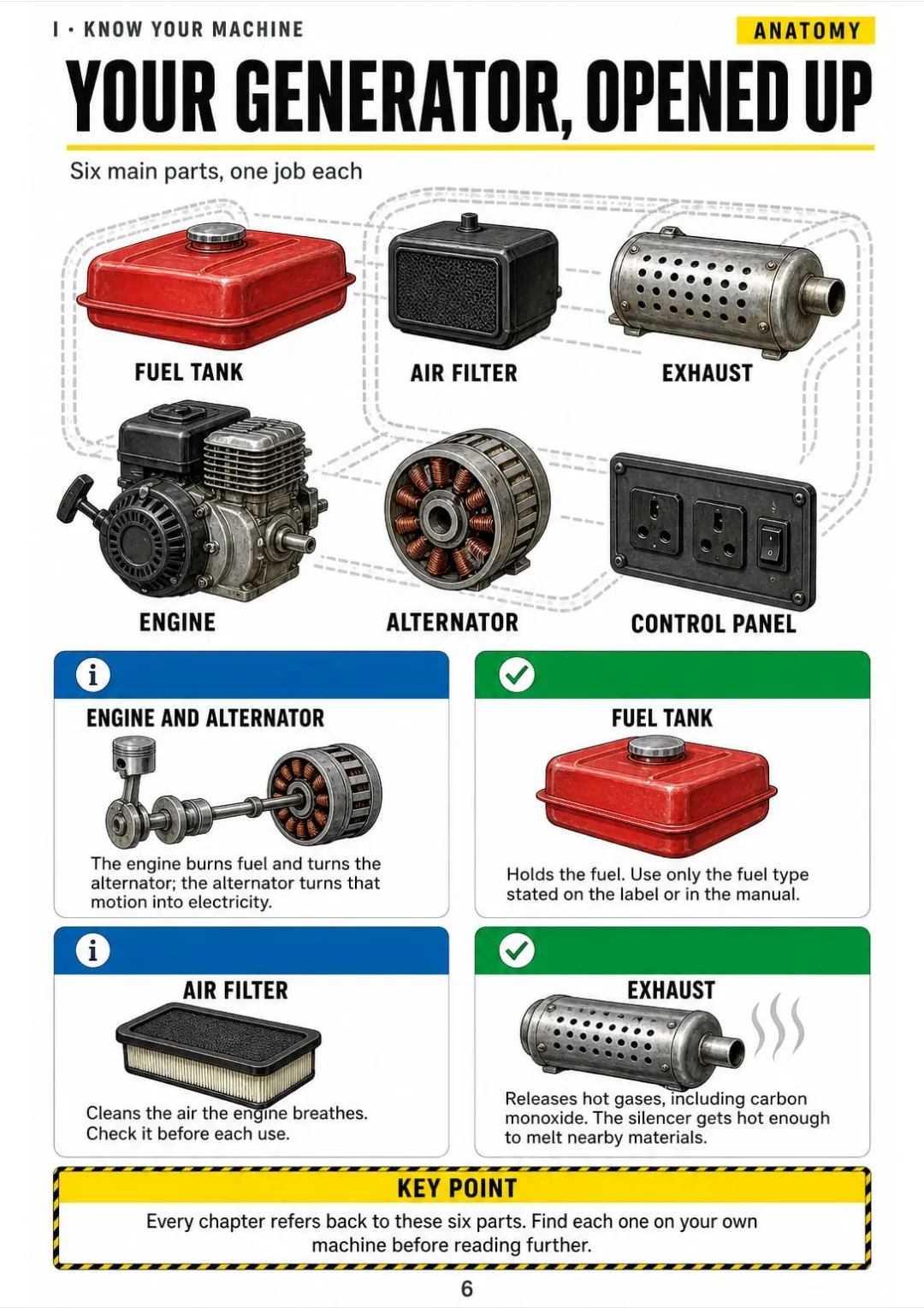
Engine, alternator, tank, air filter, exhaust and control panel, each labelled with its job
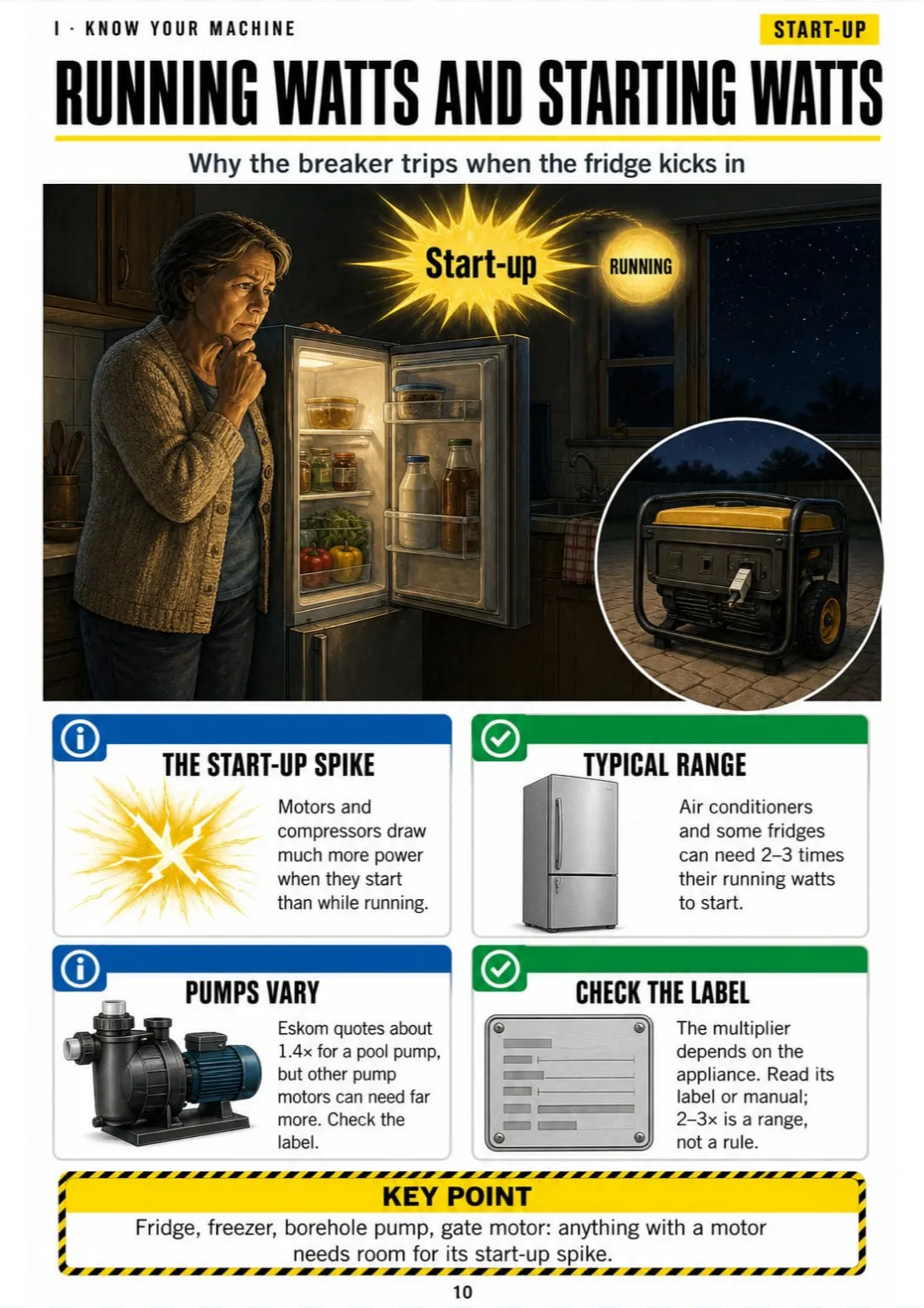
Motor loads can need 2–3× their running watts to start; a pool pump about 1.4×
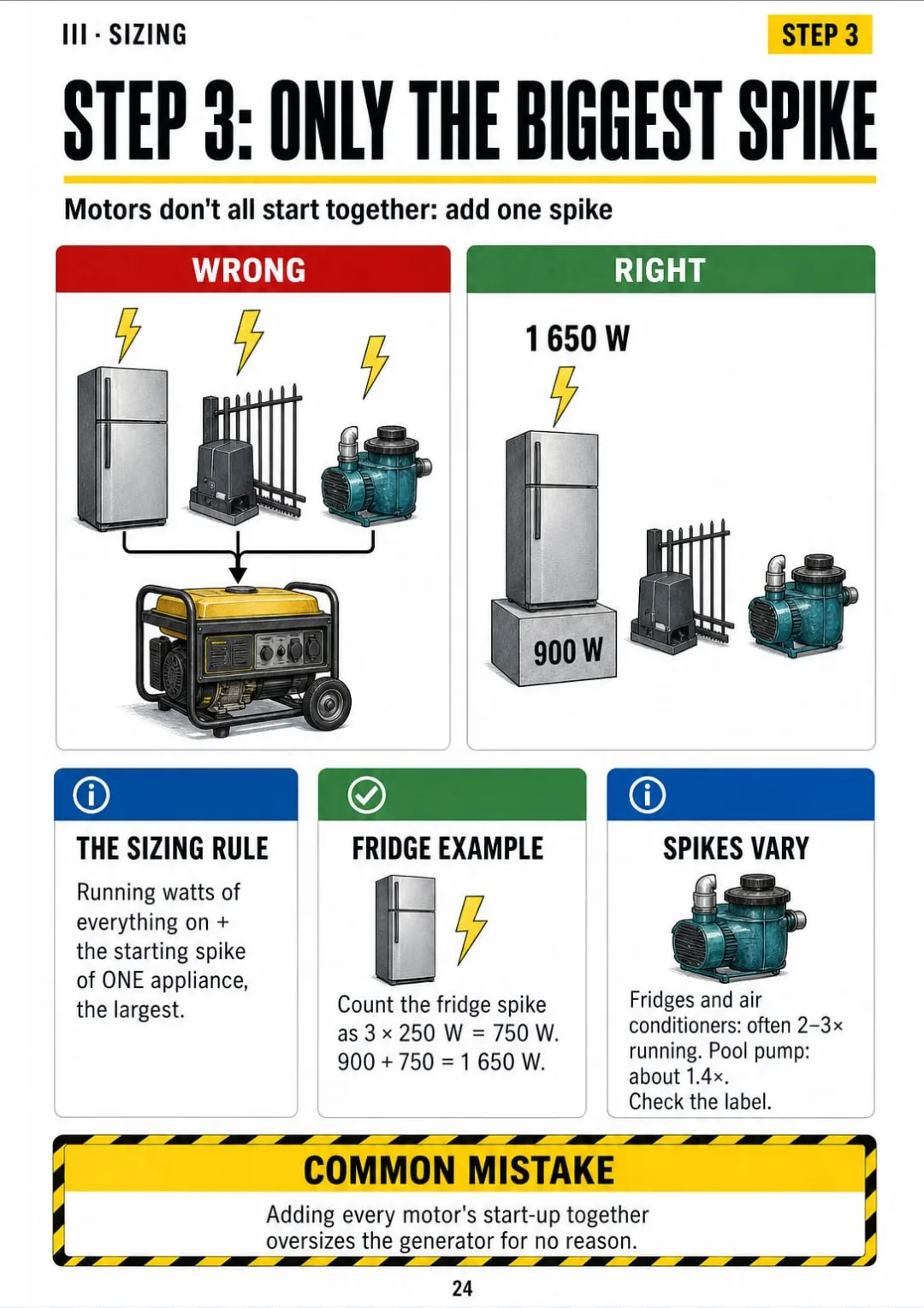
900 W running + one fridge spike of 750 W = 1 650 W peak
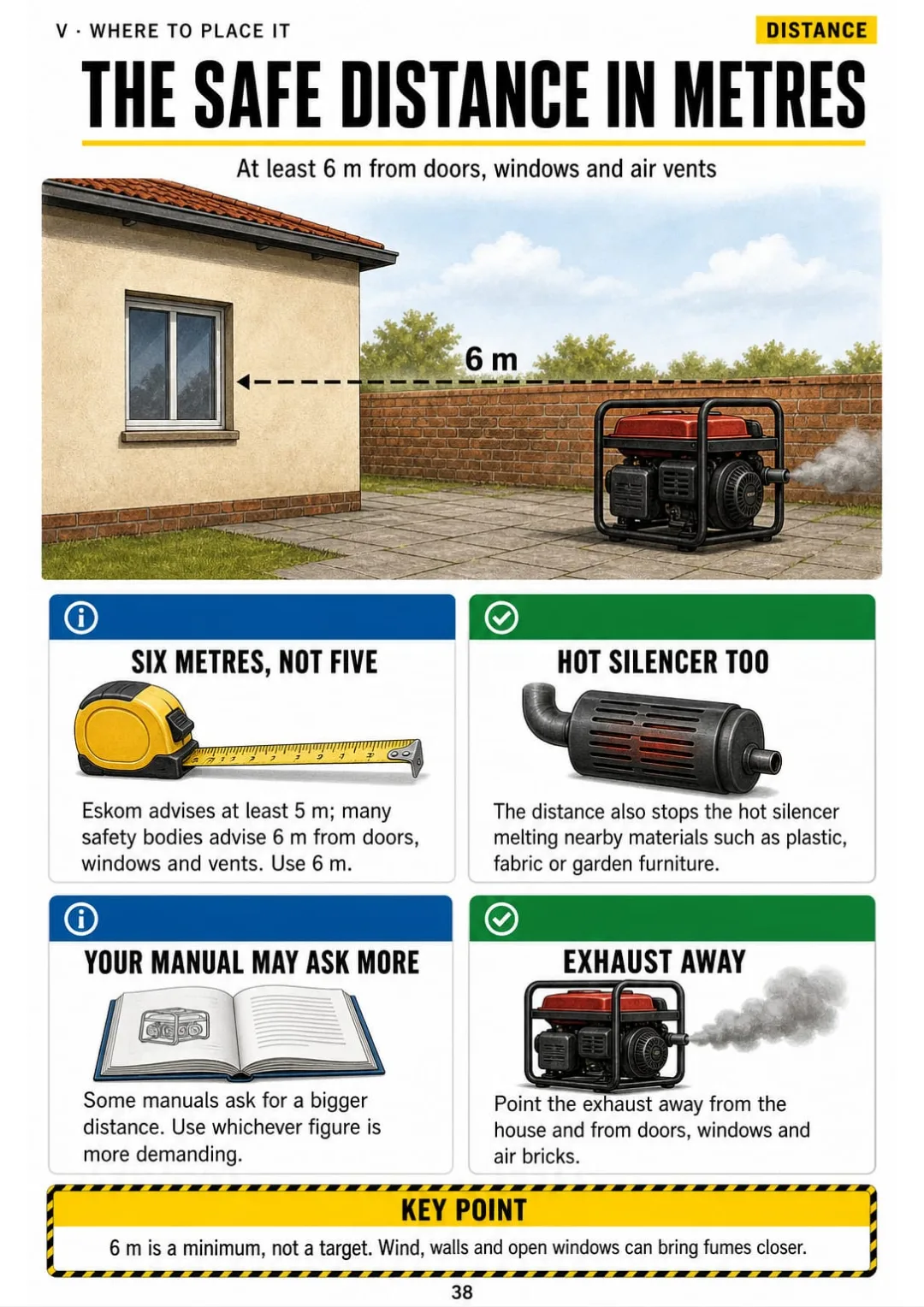
At least 6 m from doors, windows and vents, exhaust facing away; follow your manual if it asks more.
CoC: issued by a registered person, renewed after new work, kept with the generator documents
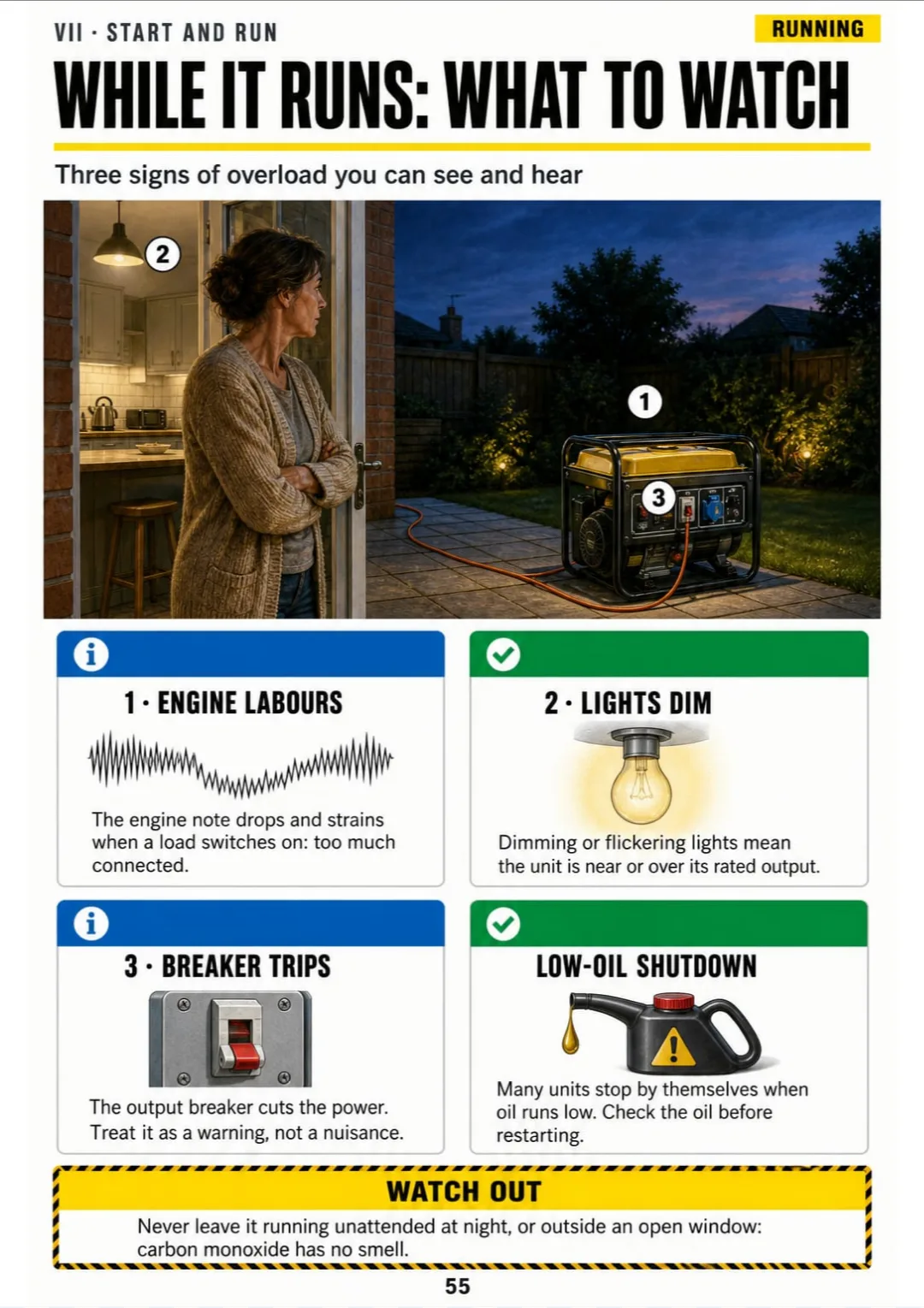
Overload signs: engine labours, lights dim, breaker trips. Low oil can shut it down.
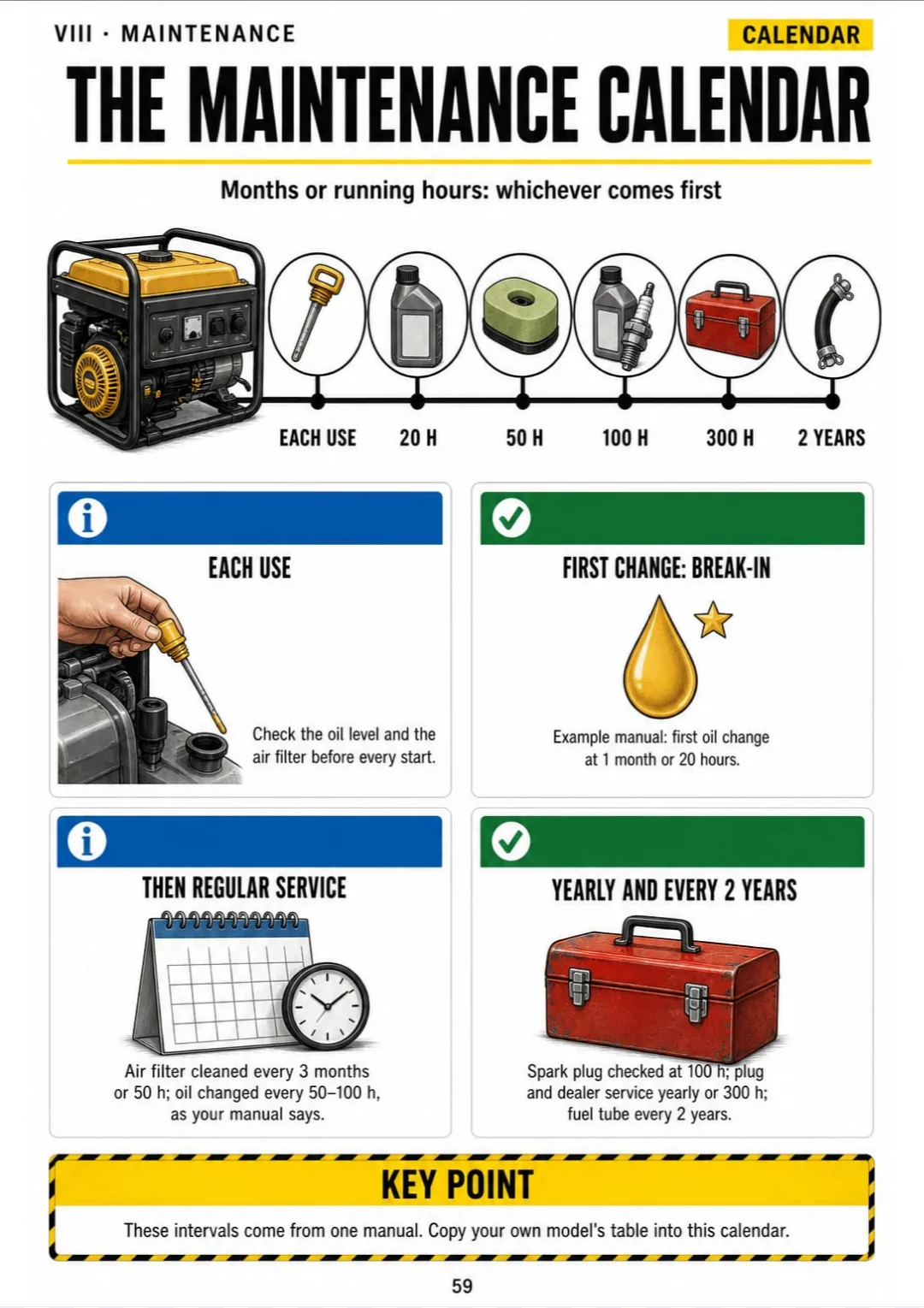
Each use · 20 h · 50 h · 100 h · 300 h · 2 years: whichever comes first
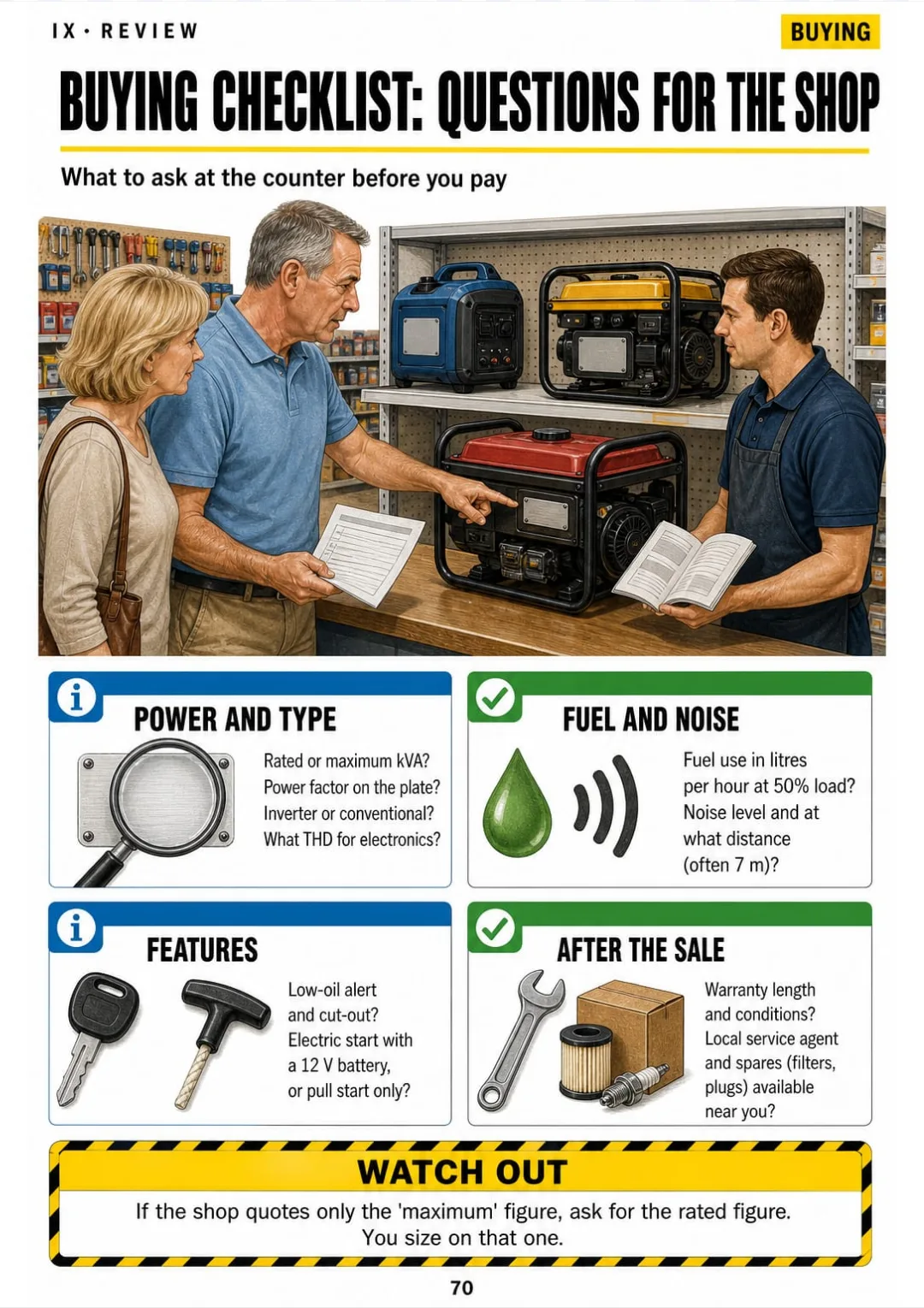
Questions for the shop: rated kVA, THD, fuel at 50% load, noise, oil-alert, spares

Take a Look at the 9 Parts and 67 Topics

Know Your Machine

pp. 6-12
  1. Your generator, opened up
  2. The control panel, button by button
  3. Watts, volts, amps and kVA on one page
  4. Rated power vs maximum power
  5. Running watts and starting watts
  6. Resistive vs motor vs electronic loads
  7. The two rules that repeat on every page

Choosing the Right Type

pp. 13-19
  1. Conventional portable vs inverter generator
  2. Clean power and sensitive electronics
  3. Petrol, diesel or LPG
  4. Dual-fuel generators and LPG cylinders
  5. Pull start, electric start and remote start
  6. Altitude and heat: why Gauteng gets less power
  7. Generator, inverter-battery or solar: what each covers

Sizing in 5 Steps

pp. 20-29
  1. The 5-step sizing method
  2. Step 1: your load list
  3. Where to find the watts on a label
  4. Step 2: add up the running watts
  5. Step 3: add only the biggest starting spike
  6. Step 4: the margin
  7. Step 5: convert to kVA and correct for altitude
  8. The heavy hitters: kettle, geyser, oven, borehole
  9. Worked example: a small home on a 3 kVA unit
  10. Worked example: a family home on a 6-8 kVA unit

Fuel and Running Time

pp. 30-36
  1. Litres per hour: read it at real load
  2. Fuel for one outage, worked out
  3. Fuel for a week of load shedding
  4. Tank size and refuelling mid-outage
  5. Storing fuel safely at home
  6. Stale fuel and fuel stabiliser
  7. Inverter eco mode and running at partial load

Where to Place It: Carbon Monoxide

pp. 37-44
  1. Carbon monoxide: why you cannot smell it
  2. The safe distance, drawn in metres
  3. Wind, walls and enclosed corners
  4. Carports, lean-tos and rain covers
  5. CO alarms inside the house
  6. Neighbours, flats and complexes
  7. Noise: decibels you can live with
  8. Theft, rain and a level surface

Connecting Safely: Leads, Changeover and Backfeed

pp. 45-52
  1. Backfeed: the danger you cannot see
  2. Option 1: extension leads straight to the appliances
  3. Choosing the right extension lead
  4. Option 2: a changeover switch, fitted by an electrician
  5. Inlet socket and dedicated circuits
  6. Earthing and the earth leakage unit
  7. The CoC, your insurance and selling the house
  8. Load order: what you switch on first

Start, Run and Shut Down

pp. 53-58
  1. Pre-start check in 6 points
  2. Starting it: choke, pull and warm-up
  3. While it runs: what to watch
  4. When the breaker trips
  5. Shutting down when the power returns
  6. Children, pets and the hot exhaust

Maintenance and Storage

pp. 59-66
  1. The maintenance calendar on one page
  2. Changing the oil
  3. Air filter: foam and paper
  4. Spark plug: check, gap and replace
  5. Exercise run: once a month
  6. The 12 V starter battery
  7. Long-term storage
  8. Diesel and LPG units: what changes

Review: Checklists and Frequent Mistakes

pp. 67-72
  1. The 10 most frequent mistakes
  2. Will it start? Troubleshooting chart
  3. Outage checklist: before, during, after
  4. Buying checklist: questions for the shop
  5. Quick reference: formulas and numbers
  6. When to call a professional

Who This Book Is For

You're about to buy one

Work out the kVA your house needs before you walk into the shop, so you don't pay for a machine that's too small or far too big.

It's already in your garden

See what it can run, how many litres each outage takes and where it must stand, then keep it serviced so it starts when the power goes.

Your parents run one

Print the carbon monoxide, refuelling and start-up pages for their house: big drawings anyone at home can follow.

Plus: 2 Free Books

Generator Sizing Workbook: 20 Homes to Work Out
BONUS 1

Generator Sizing Workbook: 20 Homes to Work Out

Practise the 5-step sizing method on 20 real household load lists, with the answers worked out, until you can size any generator yourself.
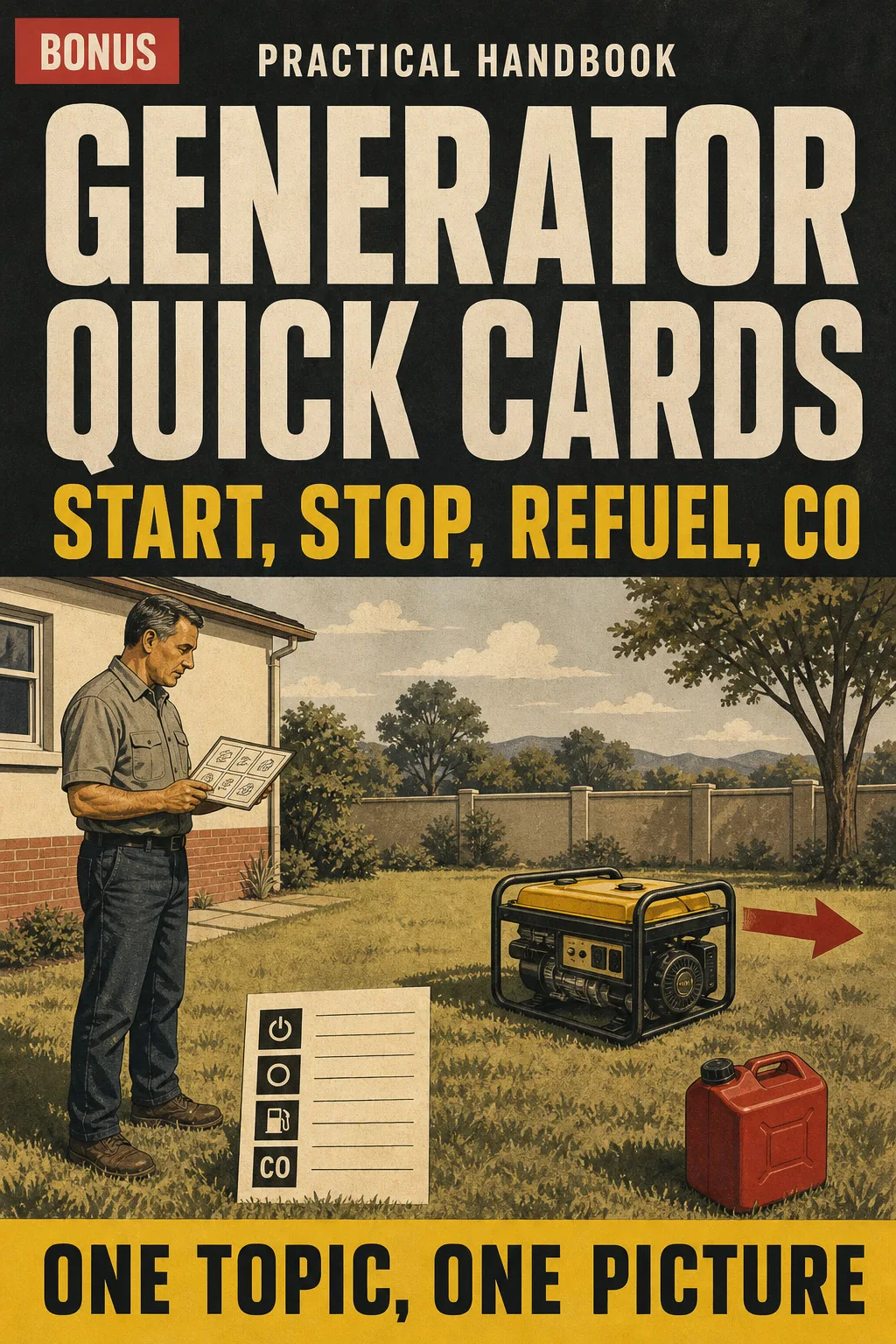
Generator Quick Cards: Start, Stop, Refuel, CO
BONUS 2

Generator Quick Cards: Start, Stop, Refuel, CO

Print the start-up, shut-down, refuelling and carbon monoxide rules on cards and keep them next to the generator, so anyone at home follows the same steps.

30-Day Guarantee

30-day guarantee: if a file doesn't open, if the content isn't what the product page describes, if you were charged twice or the email never arrived, write to us and we'll refund you in full. You pay once. No subscriptions.

Frequently Asked Questions

Is it for me if I'm not an electrician or a mechanic?

Yes. It's written for homeowners who run a portable or inverter generator, on petrol, diesel or LPG. Every topic starts with a drawing, in metric units.

Where does the content come from?

It's cross-checked against SANS 10142-1, the Electrical Installation Regulations under the Occupational Health and Safety Act 85 of 1993, SANS 10087-1 for LPG and generator manufacturers' manuals. For your model's ratings and service intervals, your own manual always comes first.

Is it official material?

No. It's an independent illustrated book. It isn't affiliated with, approved by or endorsed by the SABS, the Department of Employment and Labour or any manufacturer, and it reproduces no text from the standards.

Does it replace an electrician or my generator's manual?

No. It never teaches you to wire the house or connect to the distribution board: a changeover switch is fitted by a registered electrical contractor, who issues a CoC. The book explains why and what to ask.

Isn't this the same as the manual that came with my generator?

No. Your manual gives your model's ratings and service intervals, and you still need it. This book shows what the manual doesn't: how to turn your appliance labels into kVA, the order to switch things on, the litres for one outage and where the generator must stand. One drawing per page. The 20 homes in the workbook are written for this book.

When and how does it arrive?

The book and the 2 gifts arrive as PDFs by email, at the address you enter at checkout.

Do I have to pay every month?

No. It's a one-off payment, with no subscription.

Can I have it on paper?

Yes. The PDF is made to print at home or at a print shop, in A4. The quick cards are made to keep next to the generator.

How does the refund work?

You have 30 days. We refund everything if the file won't open, if the book isn't what you see on this page, if you were charged twice or if the email doesn't arrive: just email us.

R399R999
Get the book · R399

This is a digital PDF book sent to your email: nothing is printed or shipped.

More books on this topic

Wireman's Licence Illustrated

The SANS 10142-1 Installation Rules and the CoC inspection and test sequence explained one topic per page, each with a…

From R399 R999