Study in Pictures🌐 English (United States)
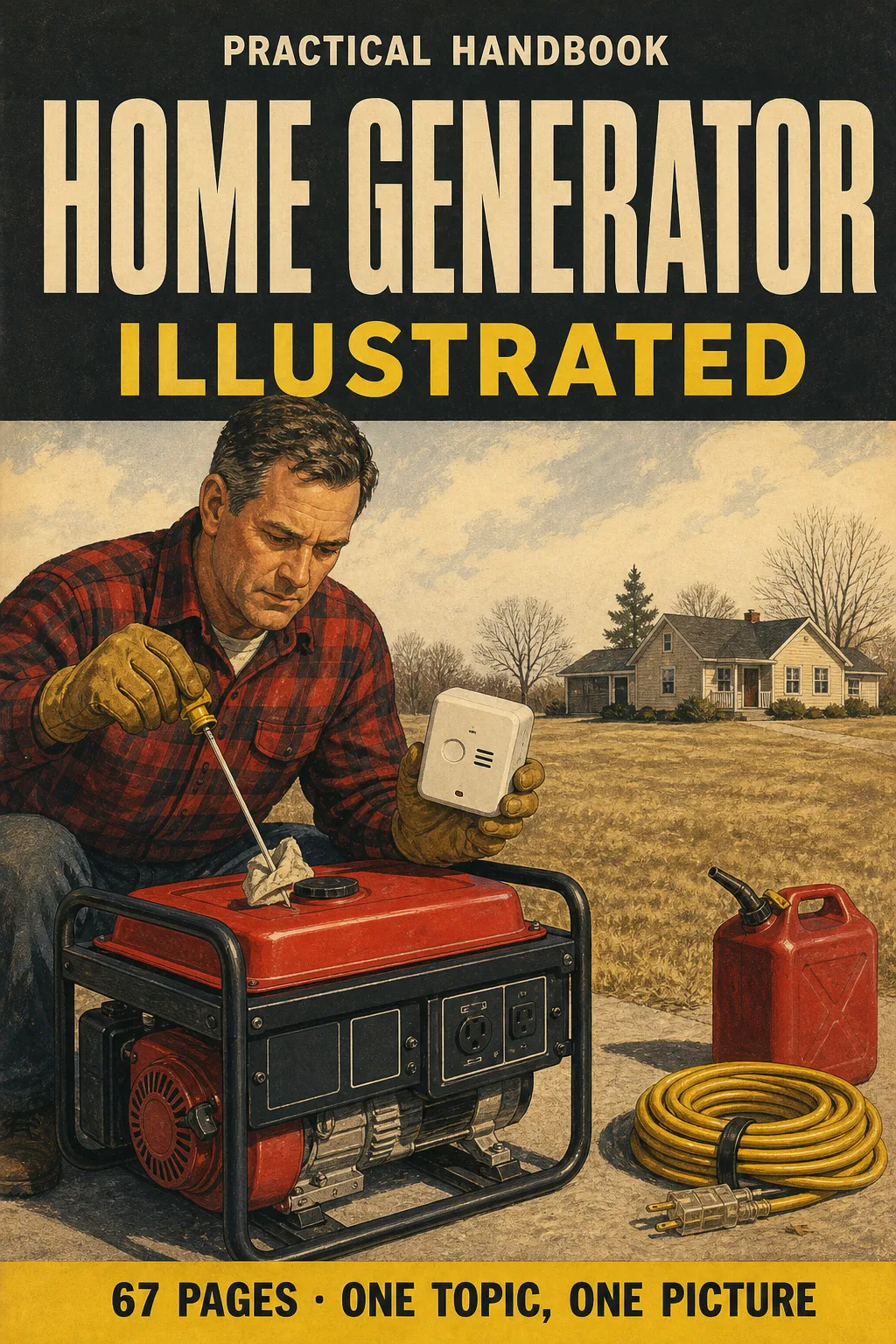
Home Generator Illustrated

Digital book in PDF · read it on your phone or print it

Home Generator Illustrated

Portable vs standby, starting watts, the well pump, 20 feet from the house, CO alarms, why you never plug into a wall outlet, refueling, start-up and shutdown. Every topic has its own page: the drawing first, then what you need to remember.

  • 67 illustrated pages
  • English
  • 30-day guarantee
US$ 27US$ 63
Get the book · US$ 27

Price shown for: United States. In other countries, the checkout shows the price that applies there.

About this book

What it is

Portable vs standby, starting watts, the well pump, 20 feet from the house, CO alarms, why you never plug into a wall outlet, refueling, start-up and shutdown. Every topic has its own page: the drawing first, then what you need to remember.

Who This Book Is For
  • Your generator is still in the box
  • Storm season is on the way
  • You've already run it through an outage
What it covers
  1. Know Your Generator
  2. Size It: What Can It Run?
  3. Place It: Carbon Monoxide Rules
  4. Connect It Safely
  5. Fuel It
  6. Run It: Same Steps, Same Order
  7. Keep It Ready
  8. Outage Night: Review and Checklists
Language
English (United States)
Pages
67
Format
Digital book in PDF · read it on your phone or print it
Price
US$ 27 (United States)
Delivery
This is a digital PDF book sent to your email: nothing is printed or shipped.
30-Day Guarantee
30-day guarantee: if a file doesn't open, if the content isn't what the product page describes, if you were charged twice or the email never arrived, write to us and we'll refund you in full.

Look Inside the Book

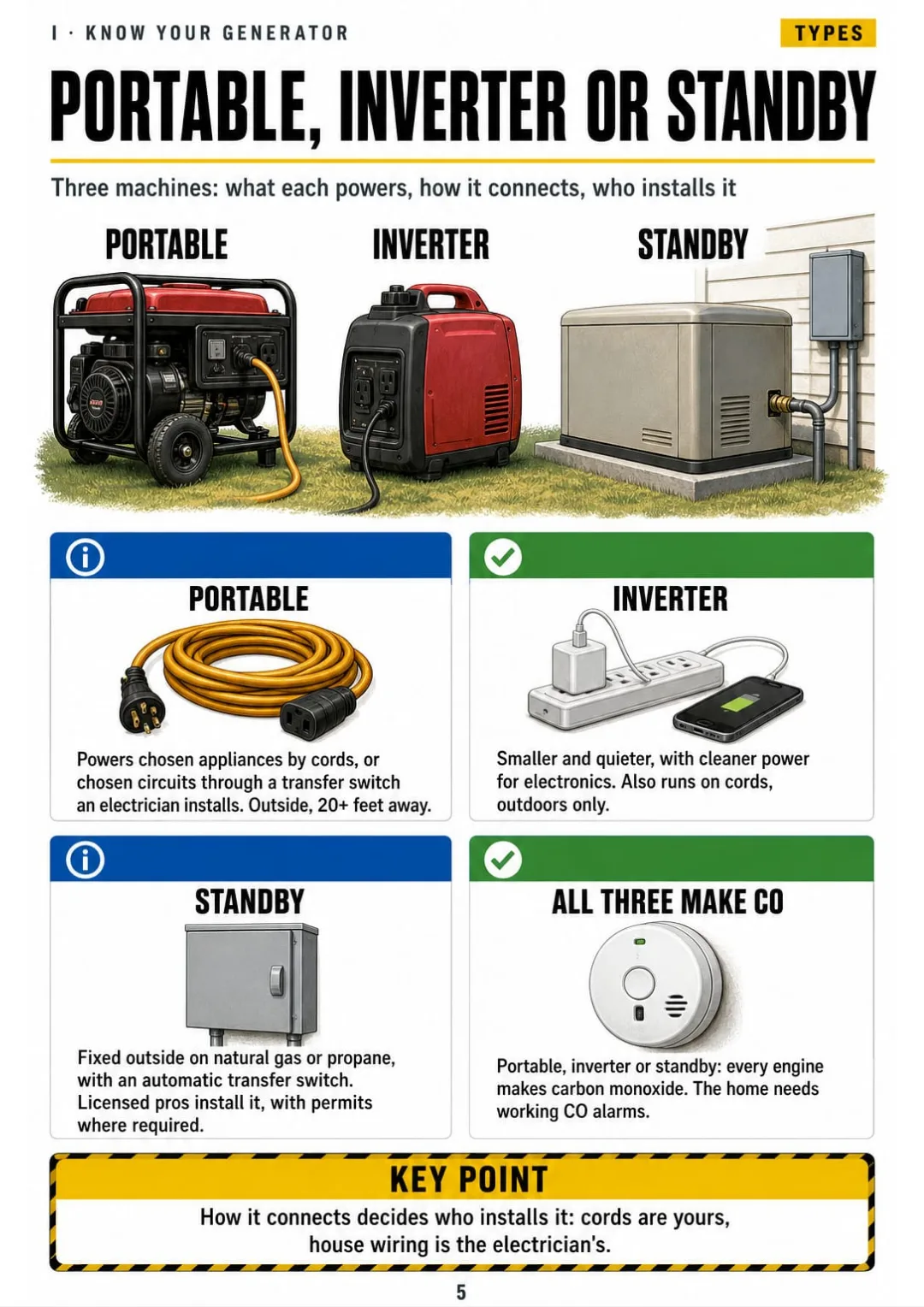
Three generators side by side: what each powers, how it connects and who installs it.
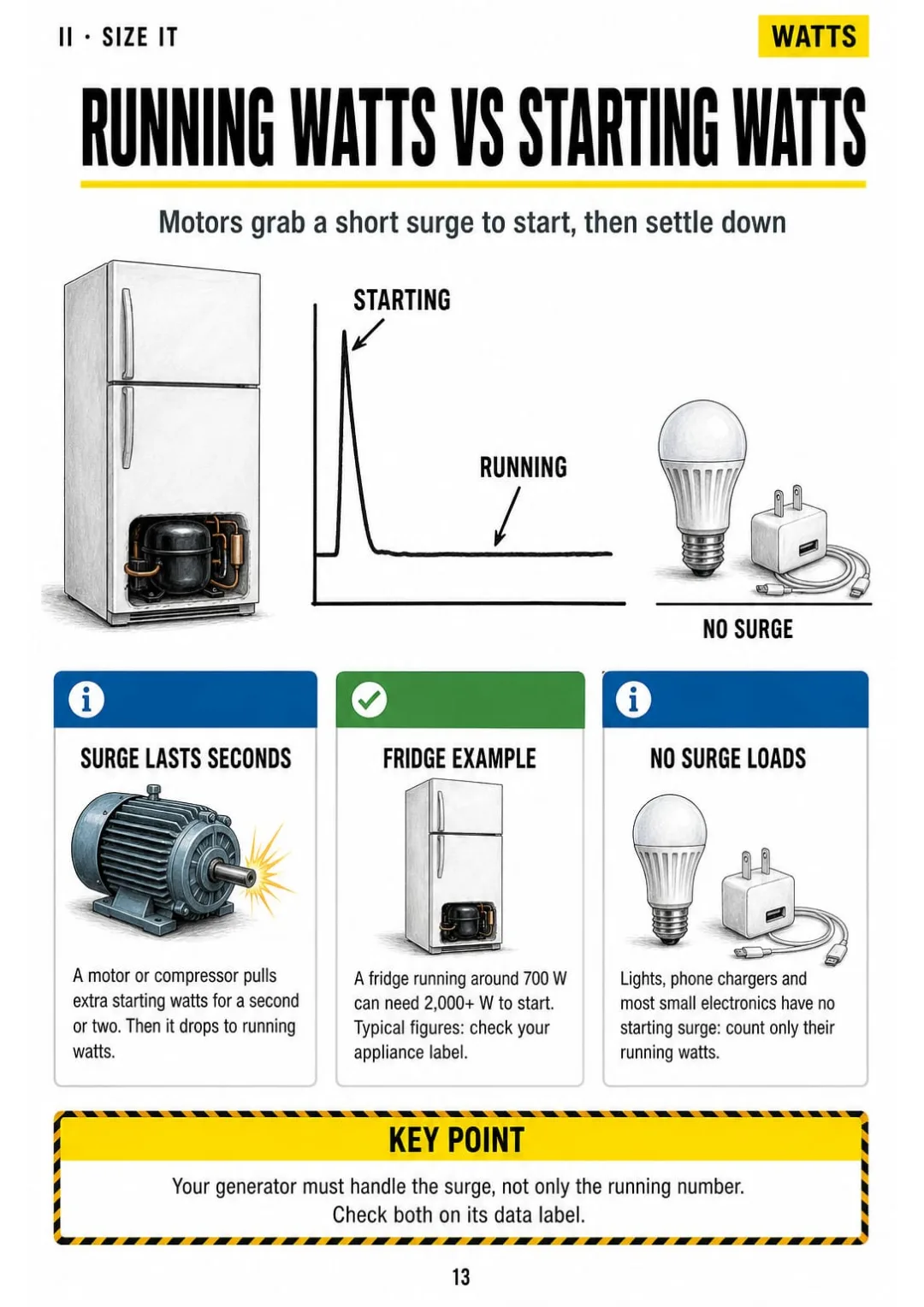
Motors need a short starting surge; lights and chargers don't.
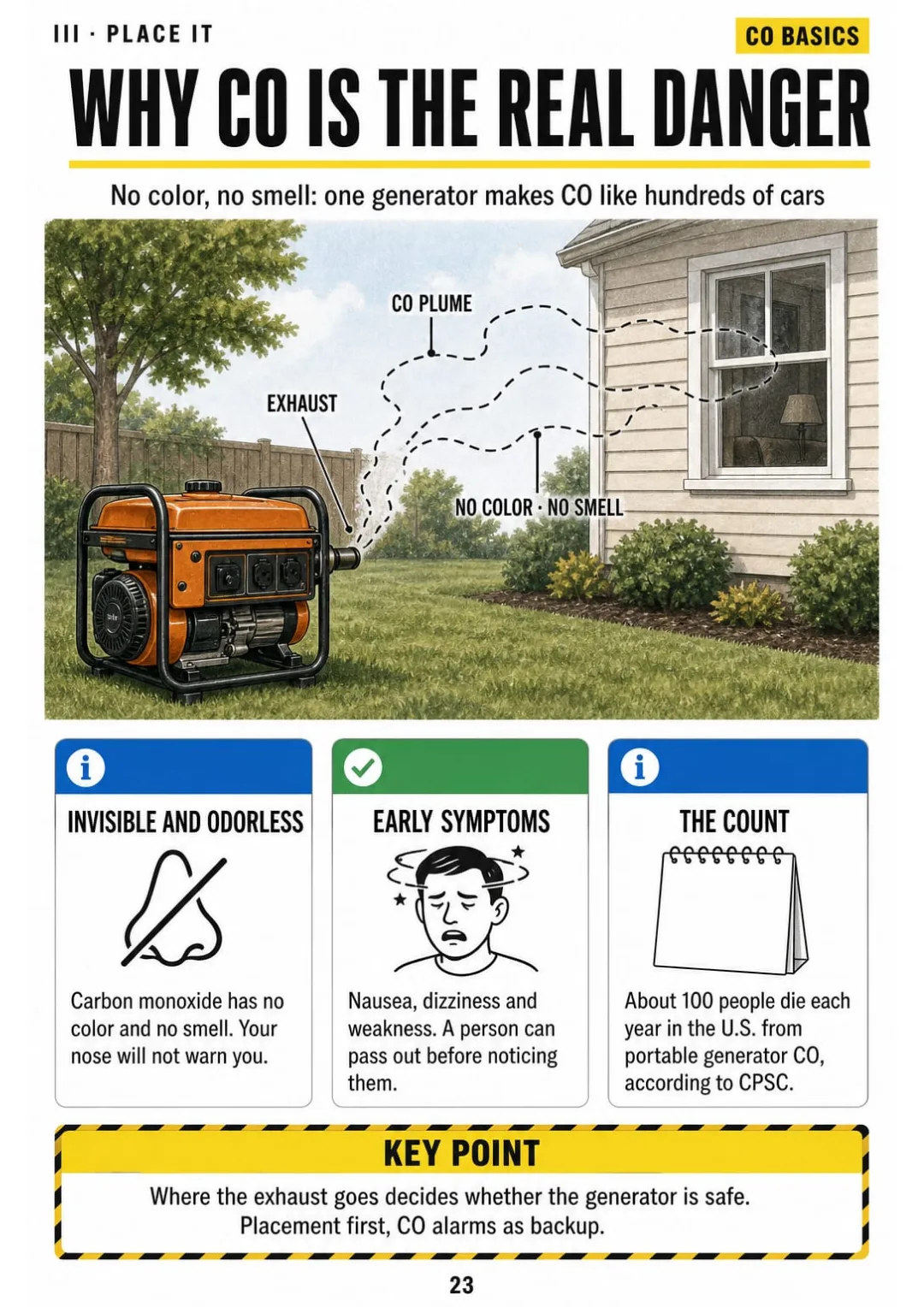
CO has no color and no smell: about 100 U.S. deaths a year from portable generators (CPSC).
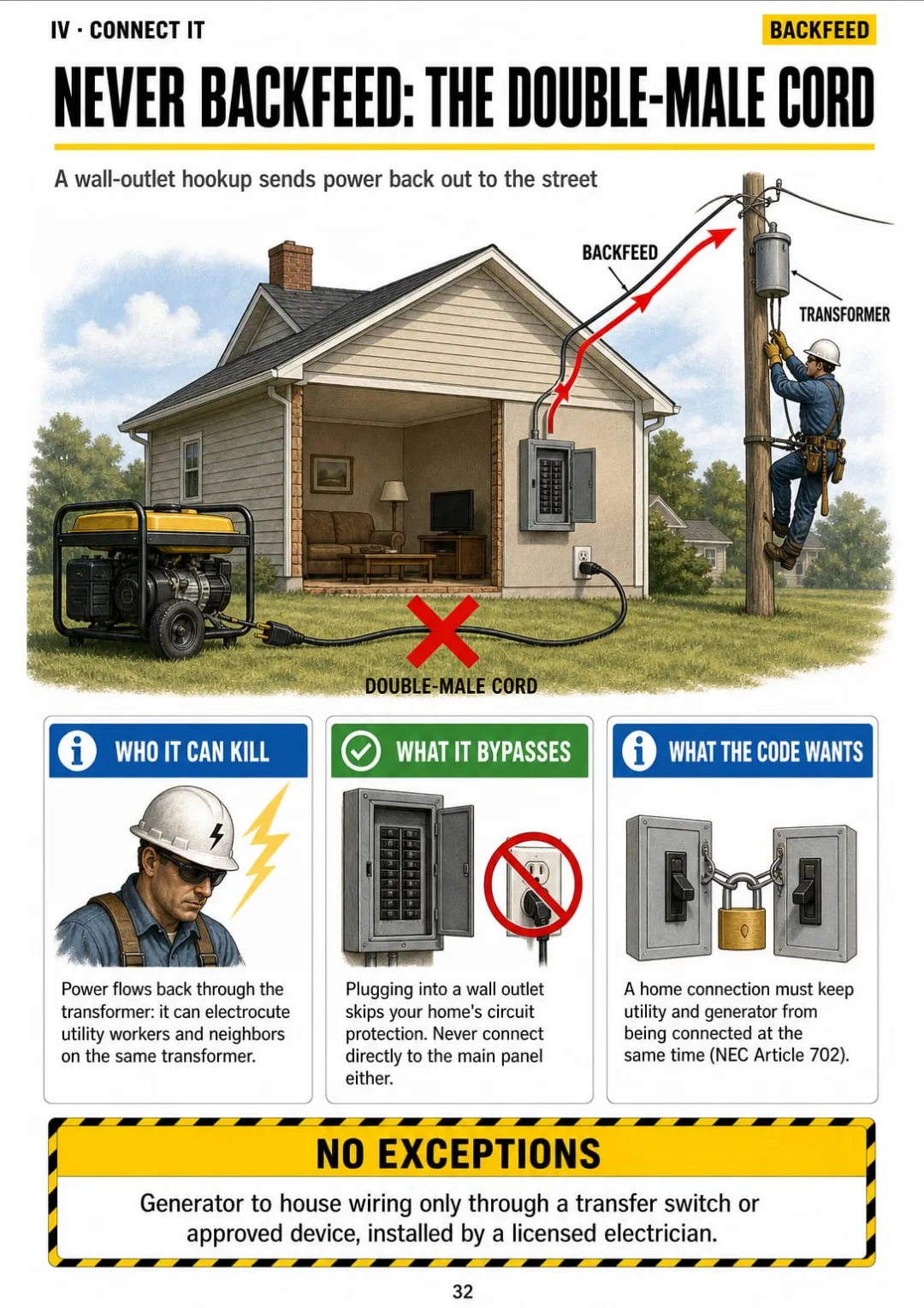
Backfeeding through a wall outlet can kill utility workers and neighbors on your transformer.
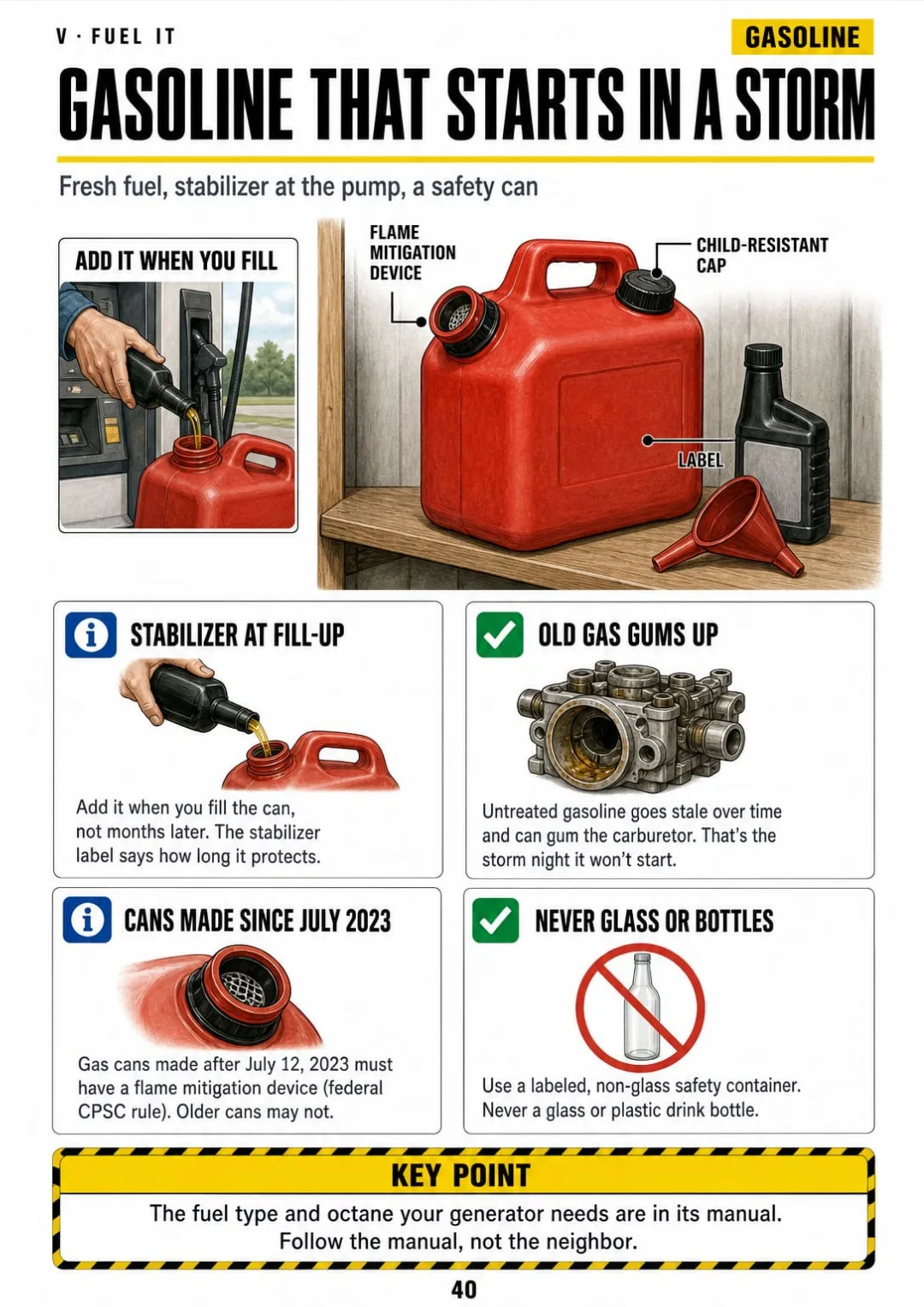
Stabilizer goes in at fill-up; new gas cans must have flame mitigation devices.
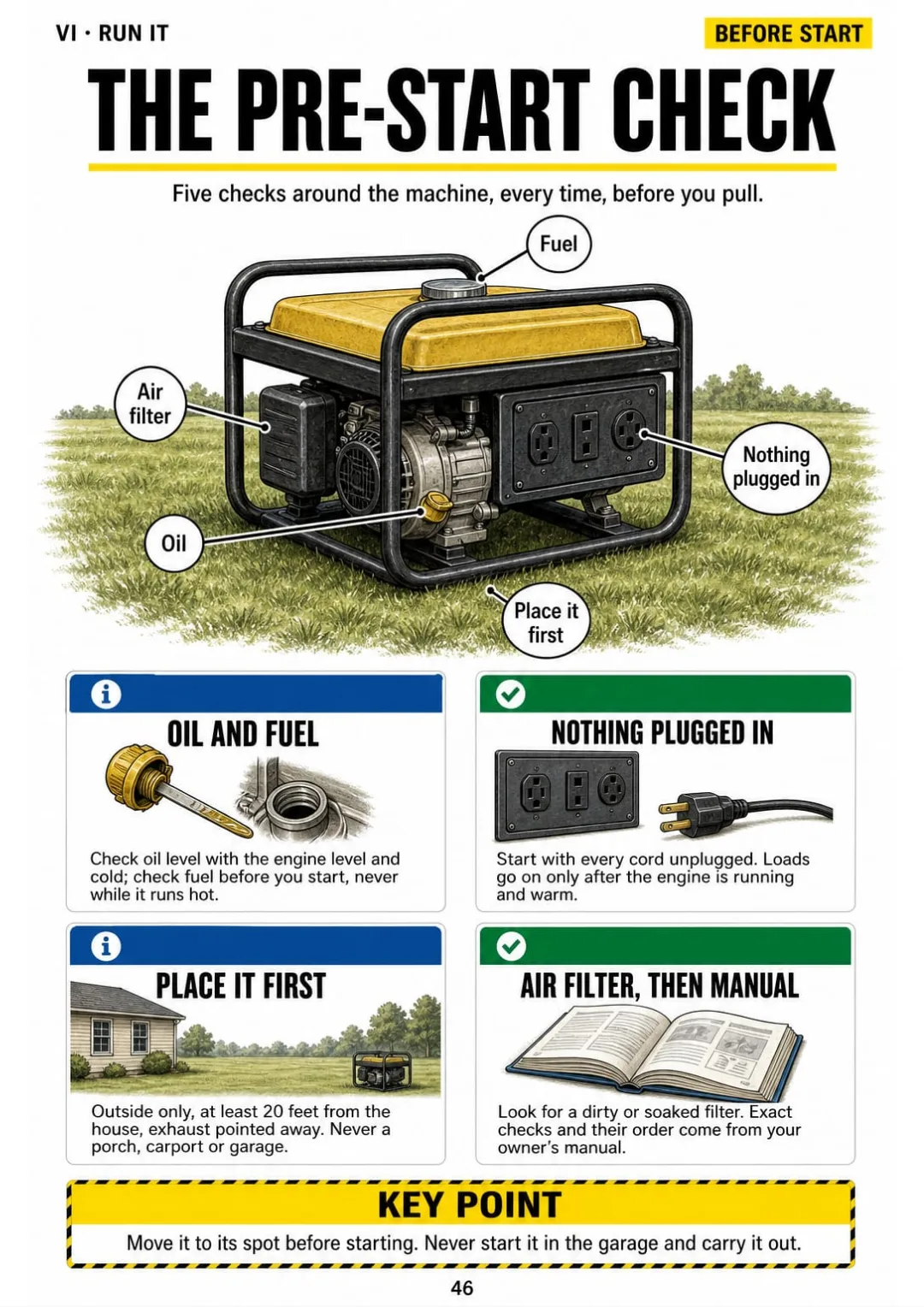
Oil, fuel, air filter, nothing plugged in, 20 feet out with exhaust away
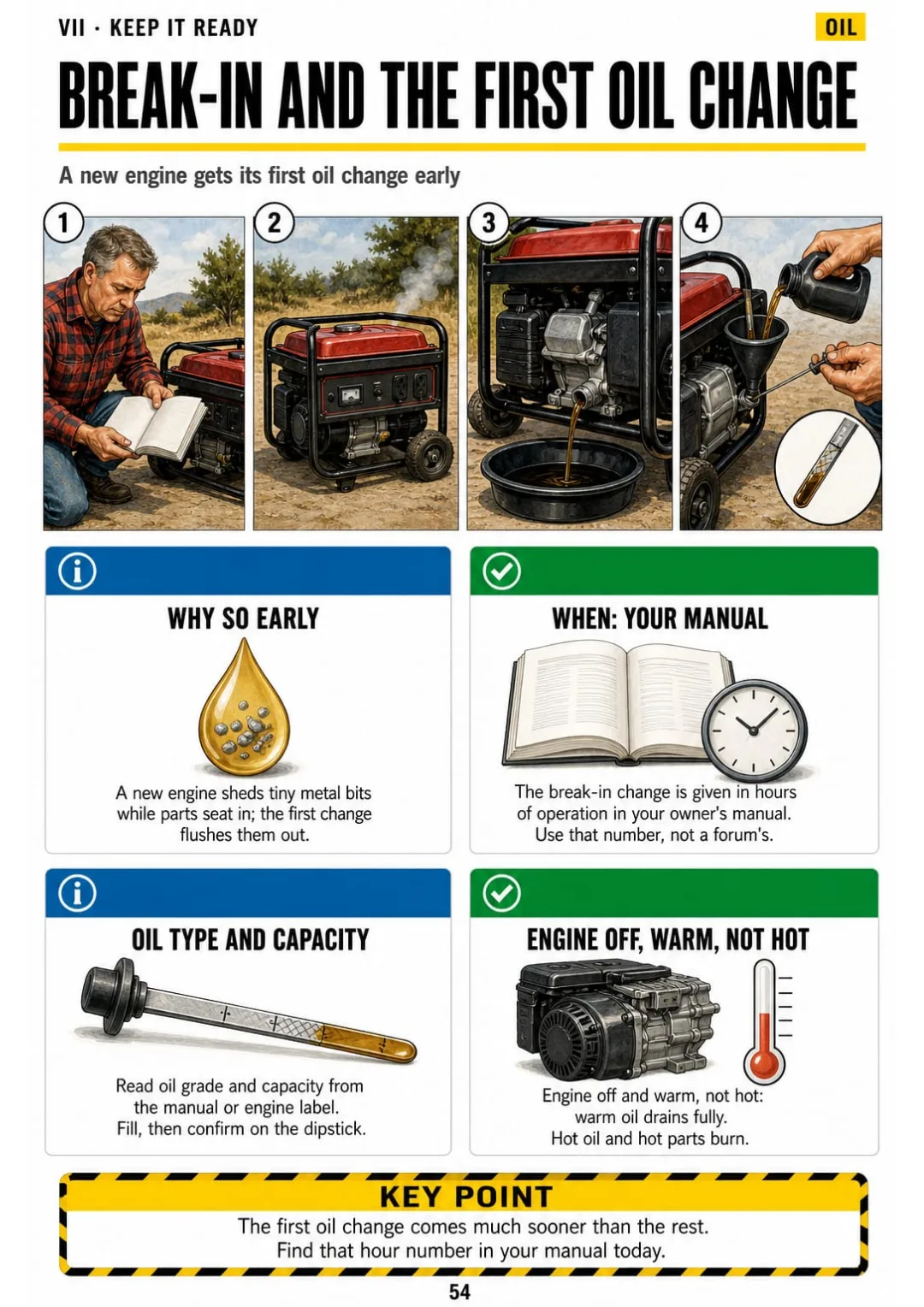
Break-in oil change: the hour number is in your manual, not in a forum
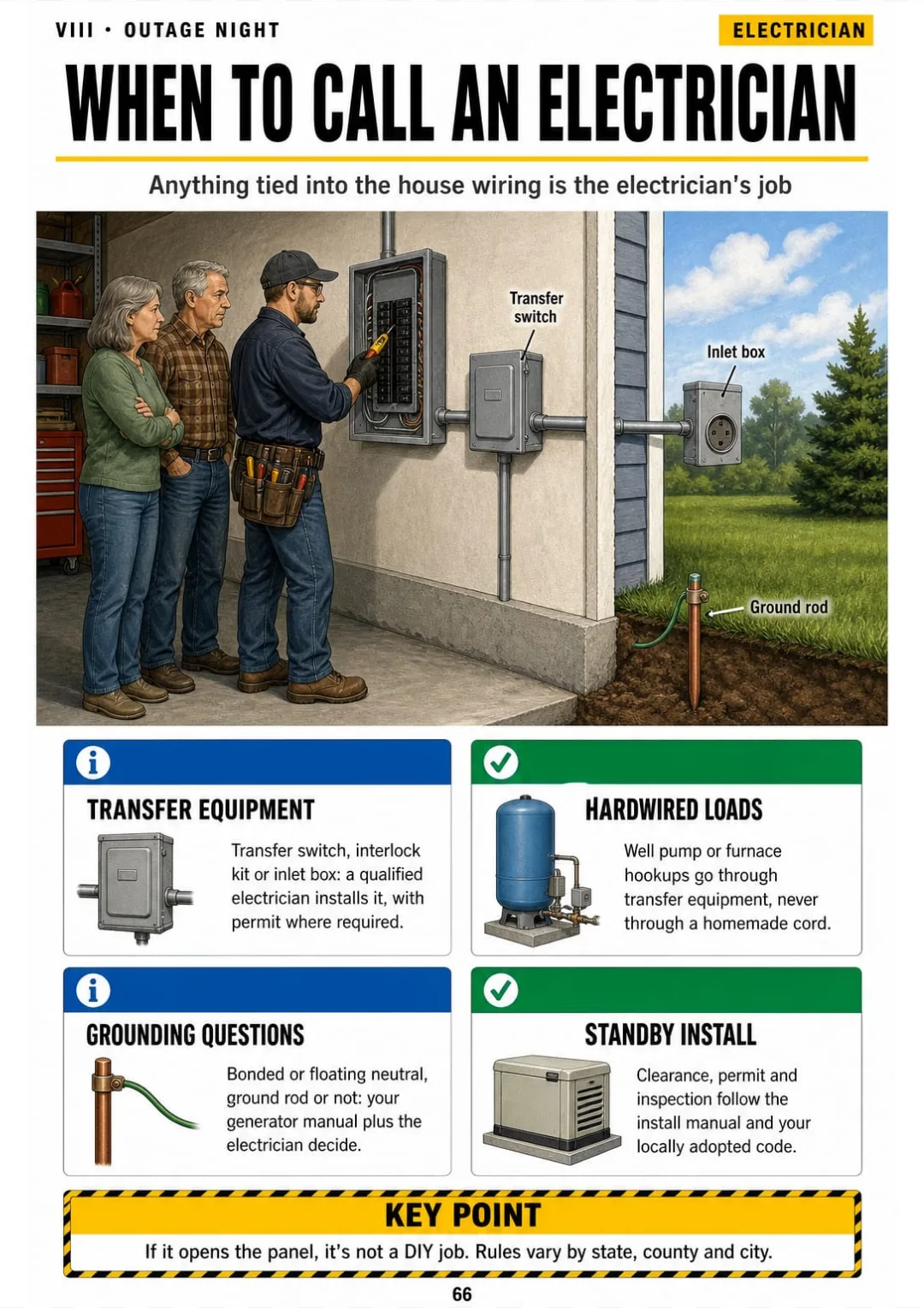
Call an electrician for: transfer switch, interlock, inlet box, well pump, grounding, standby, the panel.

Take a Look at the 8 Parts and 63 Topics

Know Your Generator

pp. 5-12
  1. Portable, Inverter or Standby: Side by Side
  2. Read the Data Label in 30 Seconds
  3. Watts, Volts and Amps in One Drawing
  4. The Outlets on the Panel
  5. 120 V Loads vs 240 V Loads
  6. Gasoline, Propane or Natural Gas
  7. The CO Shutoff Feature on Newer Models
  8. Run Time on the Spec Sheet

Size It: What Can It Run?

pp. 13-22
  1. Running Watts vs Starting Watts
  2. The Sizing Rule: Biggest Surge + Everything Running
  3. Find the Real Wattage of an Appliance
  4. The Well Pump Page
  5. Sump Pump, Fridge and Freezer
  6. The Furnace Blower and Electronics
  7. What a Portable Usually Can't Run
  8. Build Your Load Table Step by Step
  9. Essentials First, Comfort Second
  10. Signs You Are Overloading It

Place It: Carbon Monoxide Rules

pp. 23-31
  1. Why CO Is the Real Danger
  2. Never Inside: Not Even the Garage
  3. Twenty Feet From the House, Exhaust Away
  4. Doors, Windows, Vents and the Wind
  5. CO Alarms: Where They Go
  6. Test, Replace, Check the Date
  7. If the Alarm Sounds
  8. Rain, Snow and a Dry Spot
  9. Clearance, Fire and Stability

Connect It Safely

pp. 32-39
  1. Never Backfeed: The Double-Male Cord
  2. Extension Cords: Gauge vs Length
  3. Inspect the Cord Before Every Outage
  4. GFCI Protection Outdoors
  5. Manual Transfer Switch: What It Is
  6. Interlock Kit and Inlet Box: What They Are
  7. Automatic Transfer Switch on a Standby
  8. Grounding and Neutral: Follow the Manual

Fuel It

pp. 40-45
  1. Gasoline That Will Start in a Storm
  2. Storing Fuel Away From the House
  3. Refueling Without a Fire
  4. Propane Tanks: Hookup and Cold Weather
  5. Natural Gas for a Standby
  6. How Much Fuel for a Three-Day Outage

Run It: Same Steps, Same Order

pp. 46-53
  1. Pre-Start Check
  2. The Start-Up Sequence
  3. Adding Loads in the Right Order
  4. While It Runs: The Hourly Look
  5. Low-Oil Shutdown and Other Stops
  6. The Shutdown Sequence
  7. When the Power Comes Back
  8. Eco Mode and Quiet Running

Keep It Ready

pp. 54-61
  1. Break-In and the First Oil Change
  2. Oil Change Intervals
  3. The Monthly Test Run Under Load
  4. Spark Plug and Air Filter
  5. Stop the Carburetor From Gumming
  6. Electric Start Battery
  7. Standby Exercise and Annual Service
  8. Storing It Between Seasons

Outage Night: Review and Checklists

pp. 62-67
  1. 24 Hours Before the Storm
  2. The First Hour of an Outage
  3. Running Through Several Days
  4. The Most Frequent Mistakes
  5. When to Call a Licensed Electrician
  6. The Whole Book on One Page

Who This Book Is For

Your generator is still in the box

You learn what it can run and where it goes before the first storm, one page at a time.

Storm season is on the way

The day-before checklist, your load table and the 20-foot spot, ready to print and tape inside the garage.

You've already run it through an outage

You put the steps in order: start-up, refueling, shutdown, and the maintenance that keeps it starting.

Plus: 2 Free Books

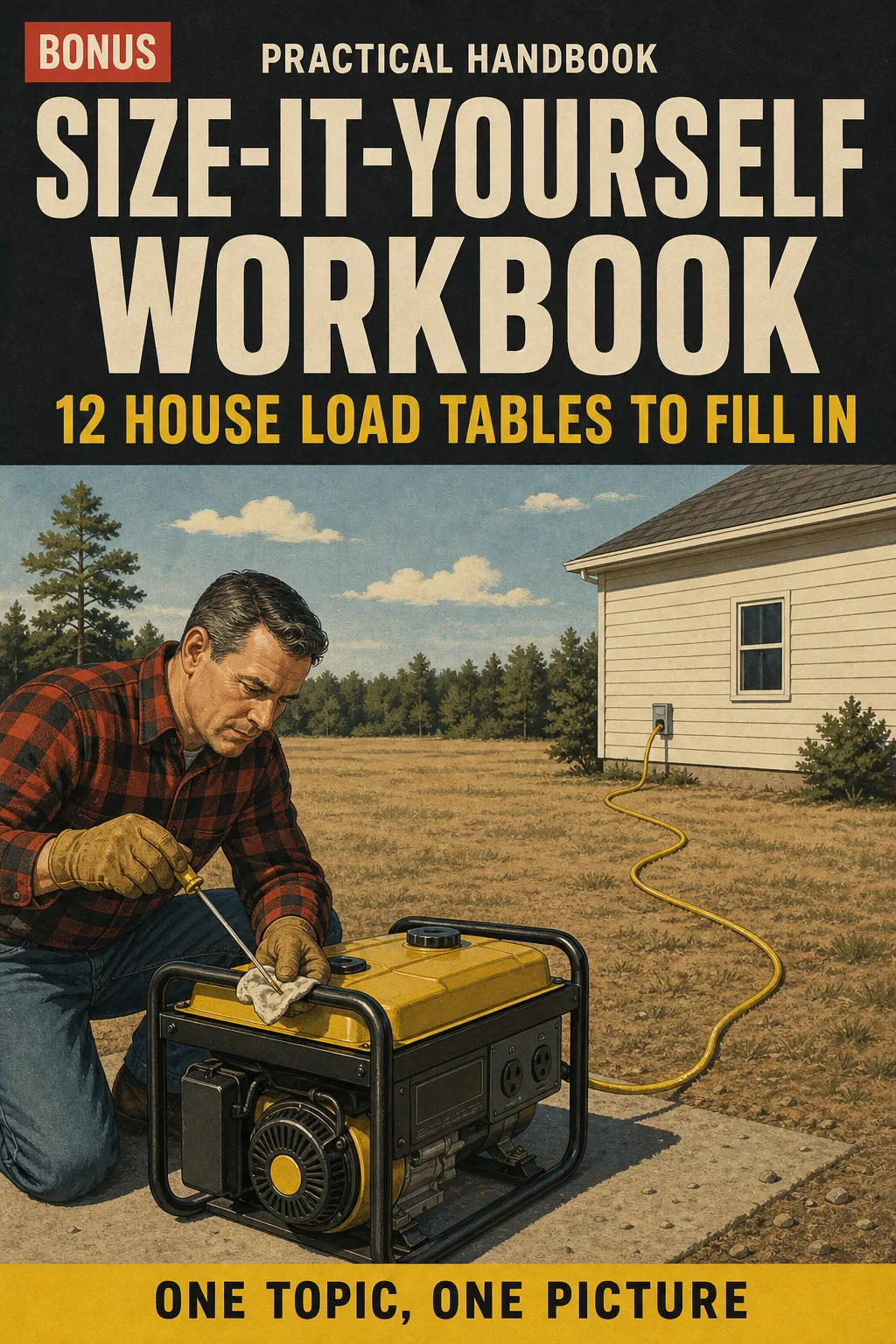
Size-It-Yourself Workbook: 12 House Load Tables to Fill In
BONUS 1

Size-It-Yourself Workbook: 12 House Load Tables to Fill In

Practice sizing on 12 real-life houses (well pump, sump pump, furnace fan, fridge) and check your answers, so you can do your own load table with confidence.
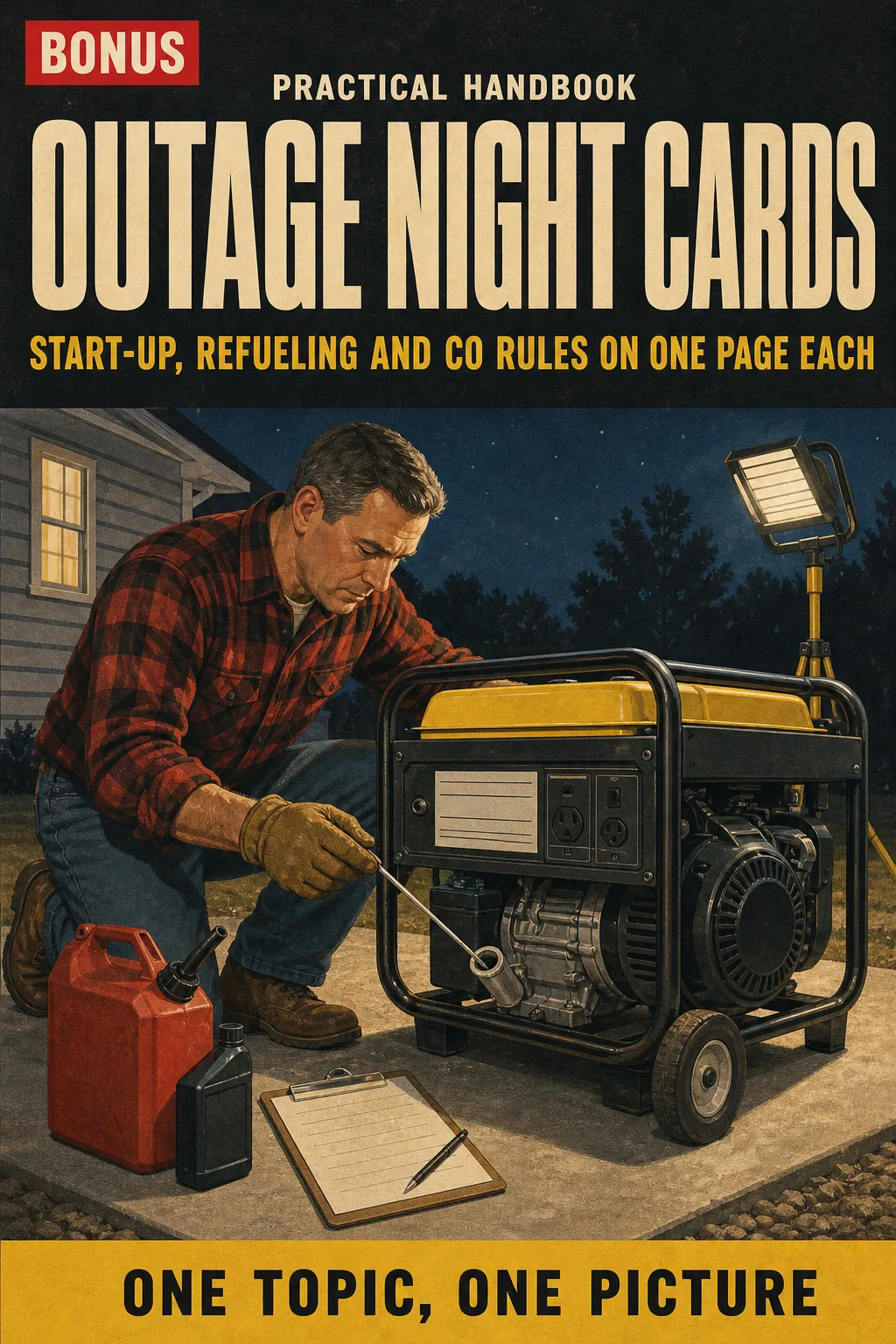
Outage Night Cards: Start-Up, Refueling and CO Rules on One Page Each
BONUS 2

Outage Night Cards: Start-Up, Refueling and CO Rules on One Page Each

Print them, tape them inside the garage, and follow the same steps in the dark without opening the book.

30-Day Guarantee

30-day guarantee: if a file doesn't open, if the content isn't what the product page describes, if you were charged twice or the email never arrived, write to us and we'll refund you in full. You pay once. No subscriptions.

Frequently Asked Questions

Is it for me if my generator is still in the box?

Yes. It starts from the data label and builds up one page at a time. It's written for homeowners, not electricians.

Where does the content come from?

From U.S. CPSC portable generator and carbon monoxide guidance, the National Electrical Code (NFPA 70), the fire alarm code (NFPA 72) and FEMA/Ready.gov outage guidance. Every distance, interval and label value is marked so you can check it against your generator's manual and your local code.

Is it official material?

No. It's an independent illustrated guide. It isn't affiliated with or endorsed by any agency or any generator brand.

I already have the manual. What does this add?

Your manual covers your model's parts and specs. The book draws the decisions around it: what you can run, where it sits, the CO alarms, refueling, and the start-up and shutdown order. Your manual and local code still have the final word. It never shows how to wire anything into your panel: a transfer switch or interlock is installed only by a licensed electrician, with a permit and an inspection.

Will it work for my generator's brand and model?

Yes. It's general: it works for portable, inverter and standby units of any brand. Each page shows you where to find the number on your own data label and manual, so you check every value against your machine. The 12 practice load tables in the workbook are written for this book.

When and how do I get it?

The book and the 2 bonus books arrive as PDFs by email, at the address you enter at checkout.

Do I have to pay every month?

No. It's a one-time payment.

Can I have it on paper?

Yes. Print it at home or at a print shop and keep it in the garage for when the power is out.

How does the refund work?

You have 30 days. We refund everything if the file won't open, if the book isn't what you see on this page, if you were charged twice or if the email doesn't arrive: just email us.

US$ 27US$ 63
Get the book · US$ 27

This is a digital PDF book sent to your email: nothing is printed or shipped.

More books on this topic

Marine Electrical Illustrated

An illustrated PDF book on boat electrical systems for marine techs: Ohm's law with worked examples, battery banks…

From US$ 27 US$ 63

Lightning Protection Illustrated

Lightning protection explained one topic per page, every concept drawn: air terminals, conductors, grounding, bonding…

From US$ 27 US$ 63

EV Charger Installer Illustrated

EV charger installation explained one topic per page: charging levels, J1772, CCS and NACS connectors, the 125%…

From US$ 27 US$ 63

Traffic Signal Tech Illustrated

An illustrated study book for traffic signal technicians in the USA: the whole intersection, the controller cabinet…

From US$ 27 US$ 63

Generator Technician Illustrated

Understand standby and prime power generators as one path from fuel to the load: engine, alternator, wye and delta…

From US$ 27 US$ 63

Sign Electrician Illustrated

Sign Electrician Illustrated is a one-topic-per-page illustrated PDF for sign shop technicians and electricians…

From US$ 27 US$ 63

Journeyman Lineman Illustrated

Overhead and underground line work for the journeyman lineman exam, one topic per page with a big drawing: transformer…

From US$ 27 US$ 63