Study in Pictures🌐 English (South Africa)
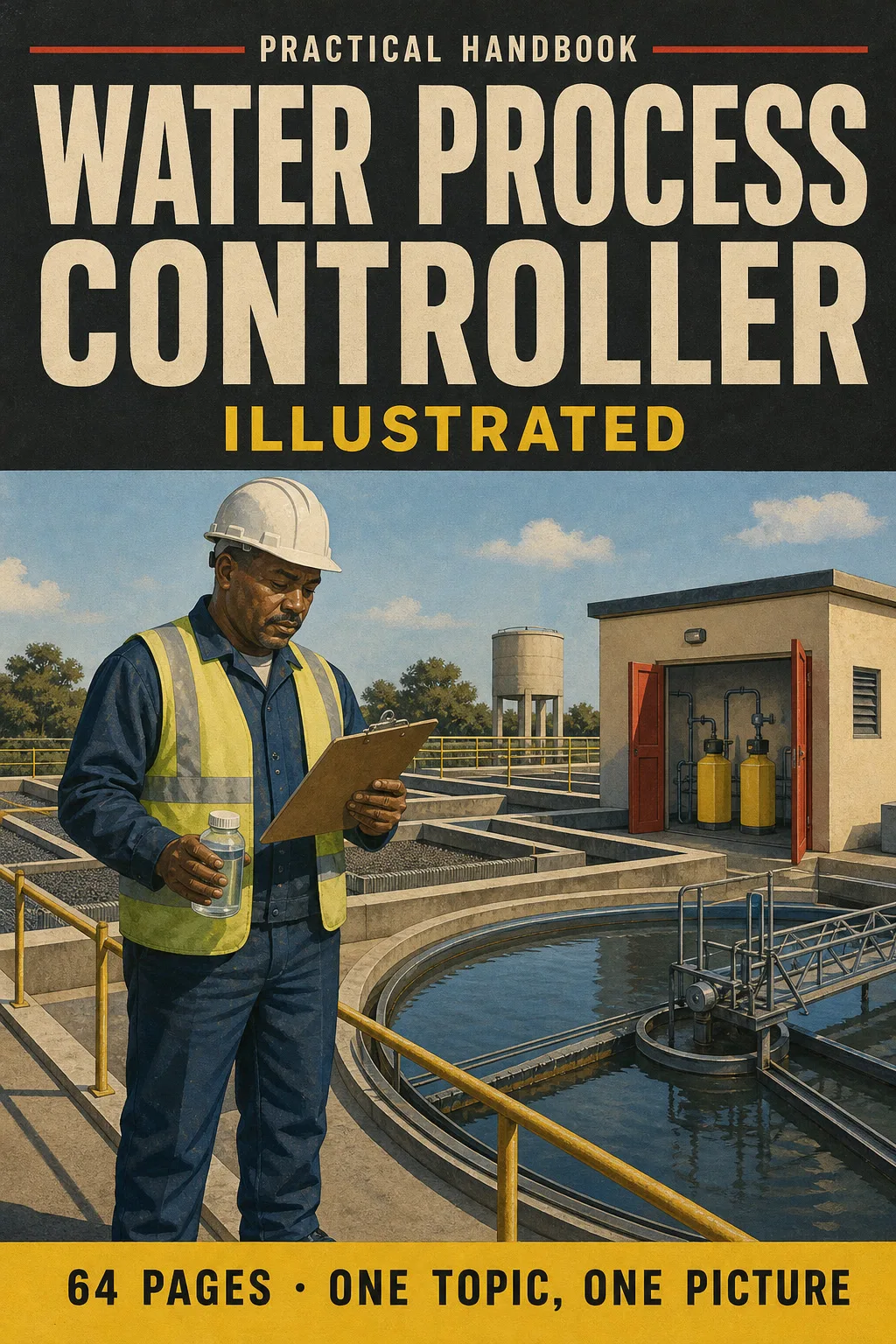
Water Process Controller Illustrated

Digital book in PDF · read it on your phone or print it

Water Process Controller Illustrated

Classes I to VI, works maths, coagulation and the jar test, filters and backwashing, the breakpoint curve, activated sludge and sludge age, digesters and chlorine safety. Every topic has its own page: the drawing first, then what you need to remember.

  • 64 illustrated pages
  • English
  • 30-day guarantee
R399R999
Get the book · R399

Price shown for: South Africa. In other countries, the checkout shows the price that applies there.

About this book

What it is

Classes I to VI, works maths, coagulation and the jar test, filters and backwashing, the breakpoint curve, activated sludge and sludge age, digesters and chlorine safety. Every topic has its own page: the drawing first, then what you need to remember.

Who This Book Is For
  • You're studying for registration
  • Your registration or class upgrade is close
  • You already run shifts at the works
What it covers
  1. The Works and the Rules
  2. Works Maths Without Freezing
  3. Drinking Water Treatment
  4. Chlorine and Disinfection
  5. Wastewater: Inlet to Primary
  6. Activated Sludge
  7. Sludge, Lab and Safety
  8. Revision and Exam Prep
Language
English (South Africa)
Pages
64
Format
Digital book in PDF · read it on your phone or print it
Price
R399 (South Africa)
Delivery
This is a digital PDF book sent to your email: nothing is printed or shipped.
30-Day Guarantee
30-day guarantee: if a file doesn't open, if the content isn't what the product page describes, if you were charged twice or the email never arrived, write to us and we'll refund you in full.

Look Inside the Book

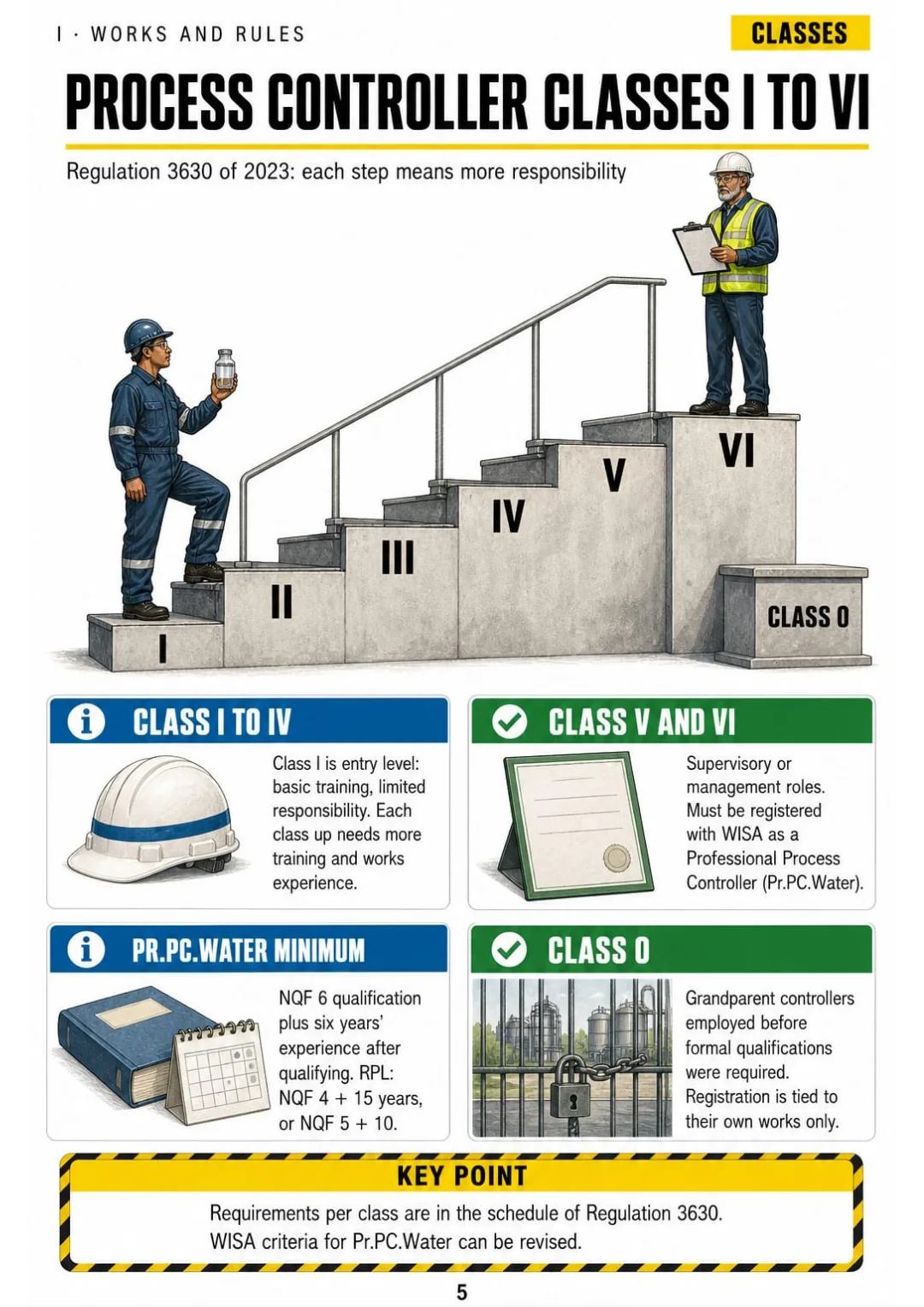
Class I to VI under Regulation 3630 of 2023: Class V and VI need Pr.PC.Water registration.
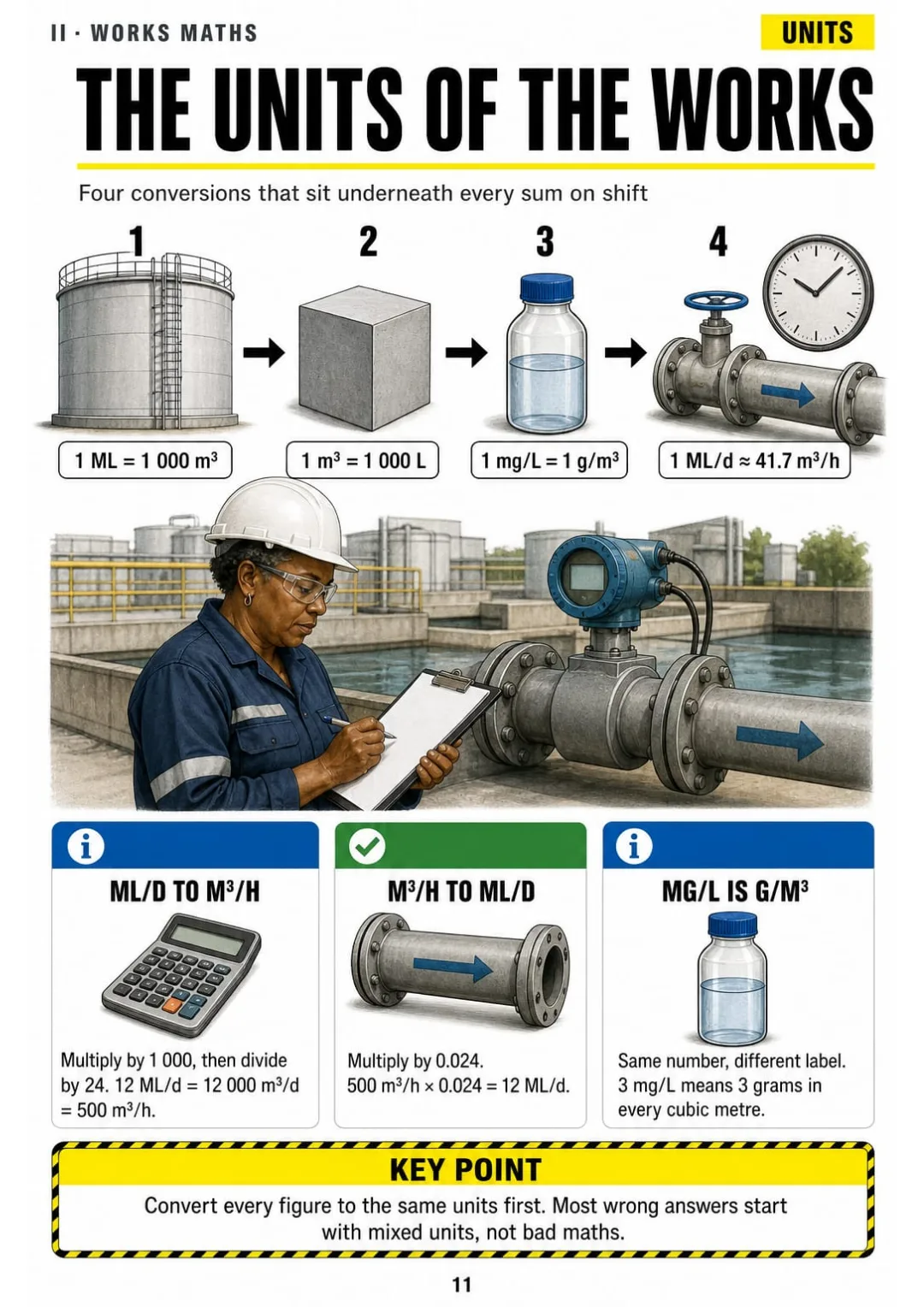
1 ML = 1 000 m³ · 1 m³ = 1 000 L · 1 ML/d ≈ 41.7 m³/h
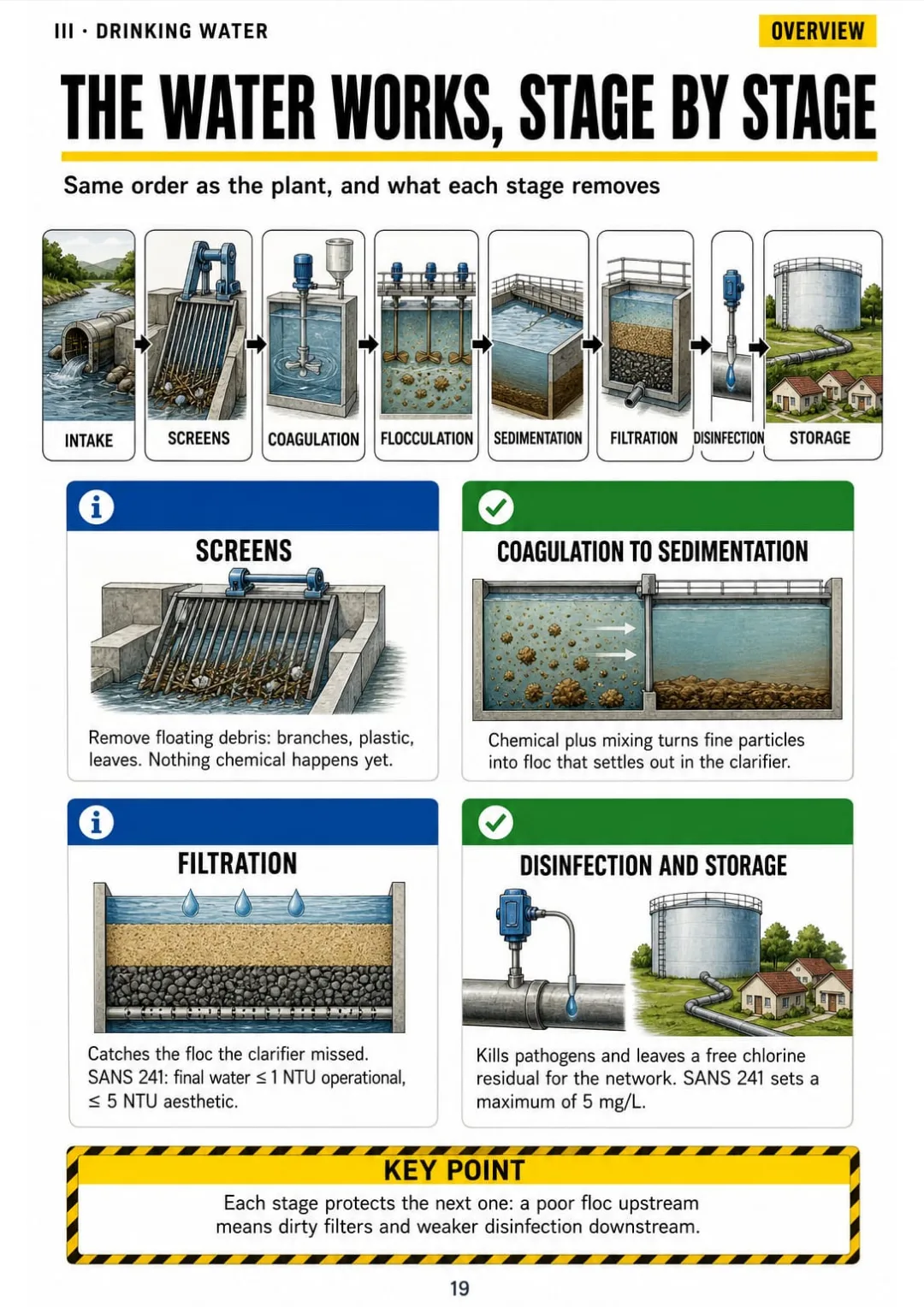
Intake to reservoir in eight boxes, with what each stage removes
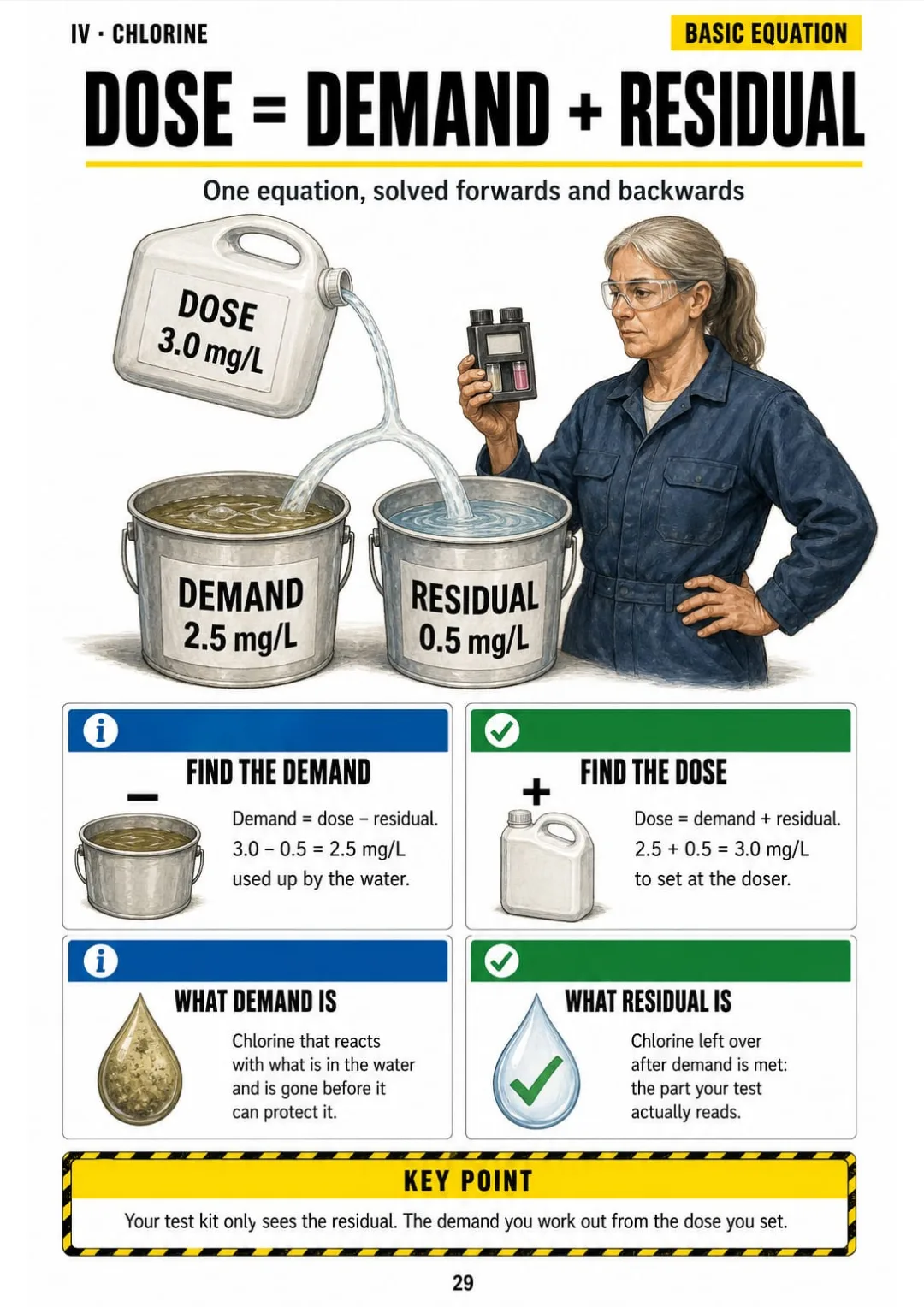
Dose 3.0 mg/L − residual 0.5 mg/L = demand 2.5 mg/L, solved both ways.
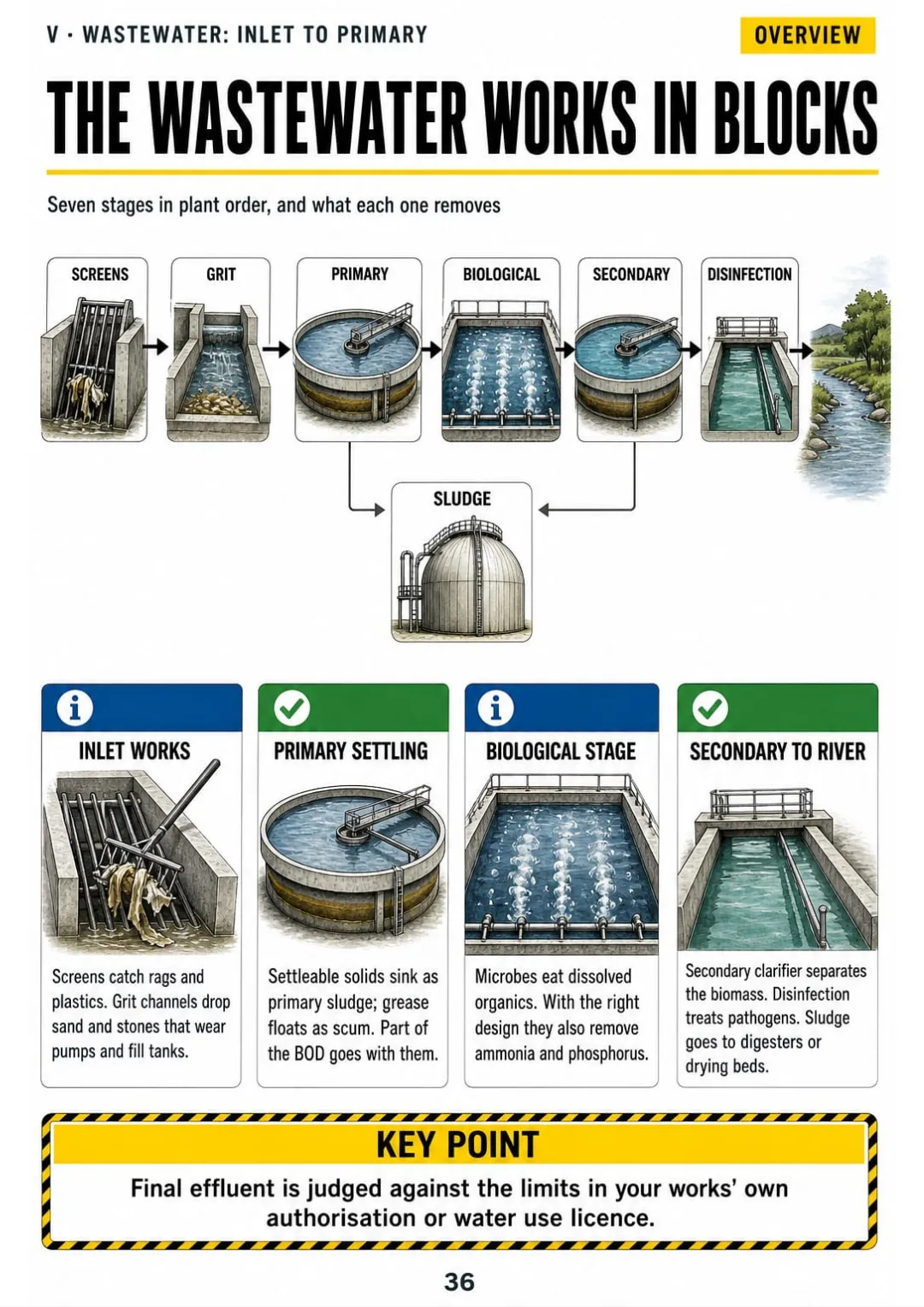
Screens → grit → primary → biological → secondary → disinfection, with sludge handled on the side
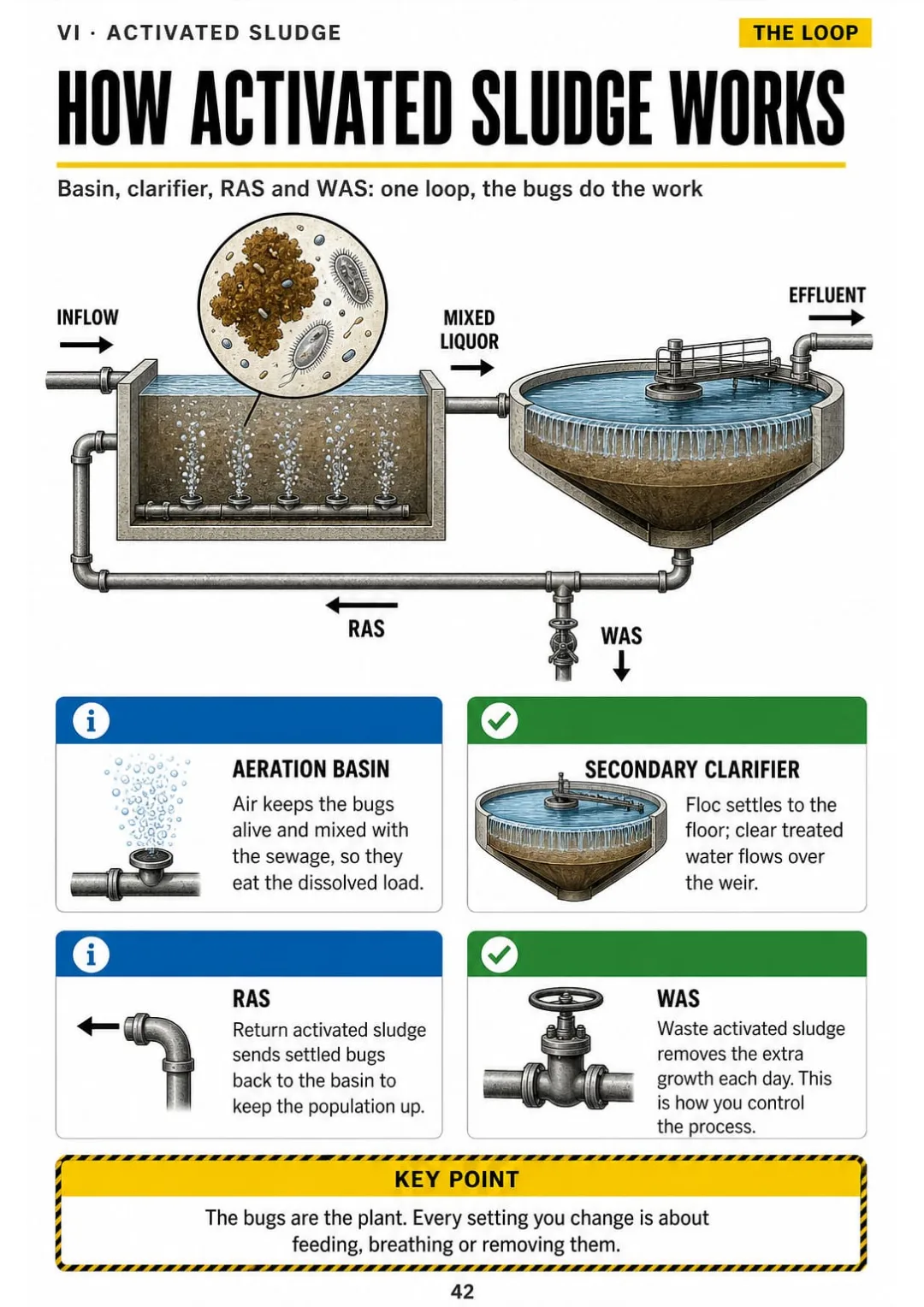
Aeration basin, clarifier, RAS and WAS drawn as one loop.
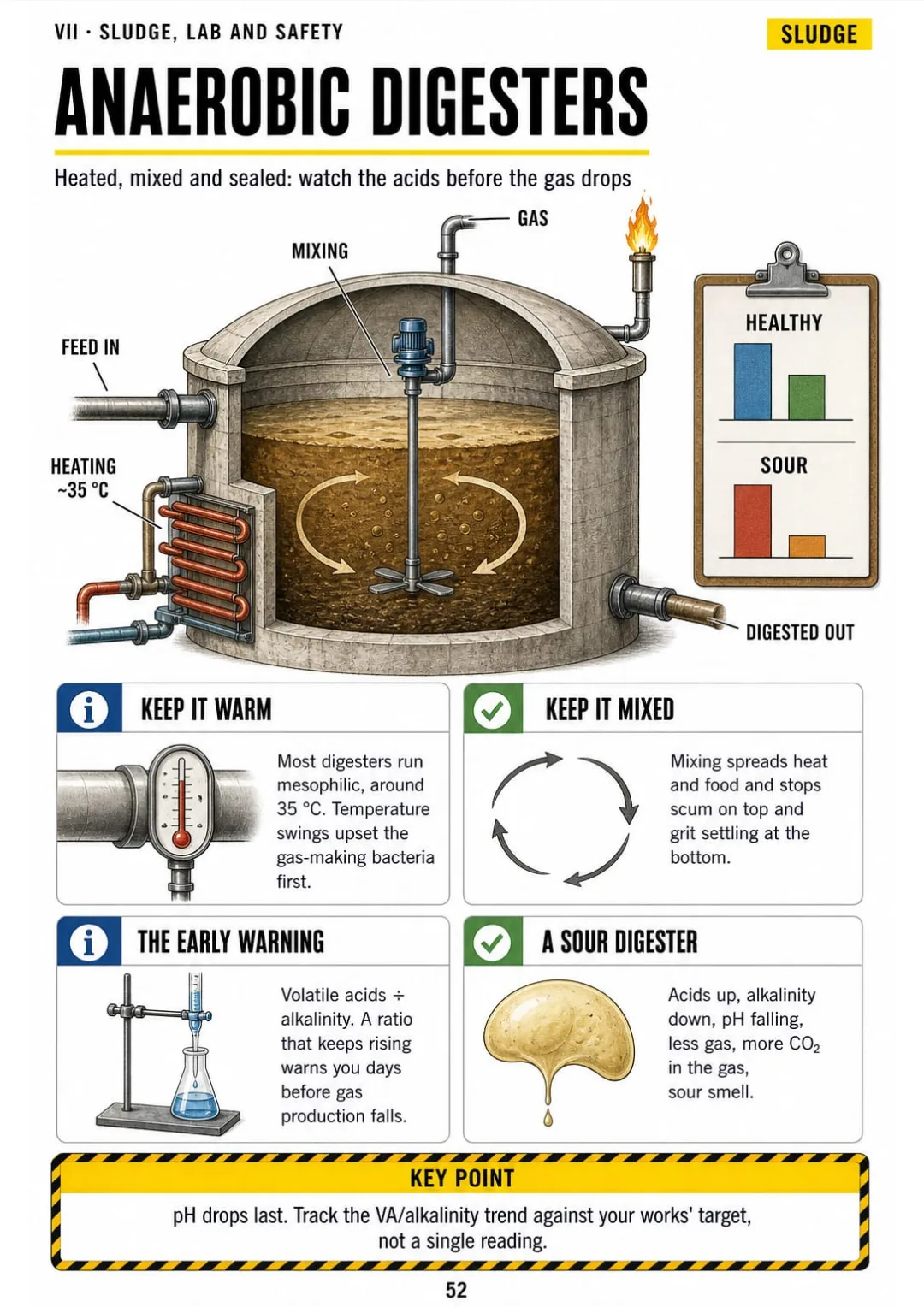
Digester at around 35 °C: rising volatile acids to alkalinity ratio is the early warning.
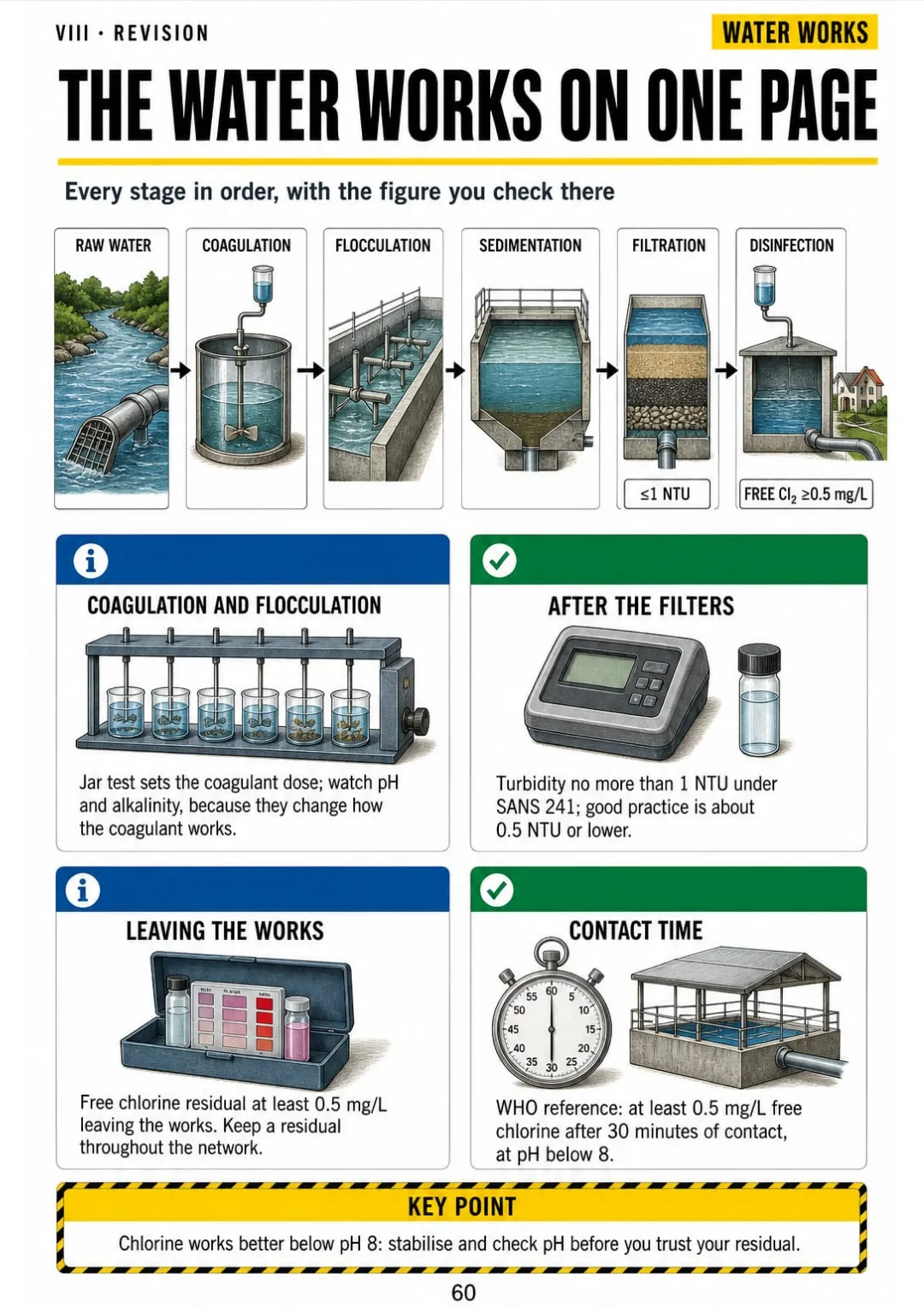
Raw water to tap in six blocks: ≤1 NTU after filters, 0.5 mg/L free chlorine leaving the works.

Take a Look at the 8 Parts and 60 Topics

The Works and the Rules

pp. 5-10
  1. Process controller classes I to VI
  2. How a works is classified: A to E
  3. What a process controller is responsible for
  4. The logbook: what to write and when
  5. SANS 241 at a glance
  6. Wastewater effluent limits: why they exist

Works Maths Without Freezing

pp. 11-18
  1. mg/L, ML/d and m³/h: the units of the works
  2. The kg per day rule
  3. Dosing with a chemical that is not 100%
  4. Retention time
  5. Surface overflow rate
  6. Areas and volumes of works tanks
  7. Dosing pump settings from a dose
  8. Percent removal

Drinking Water Treatment

pp. 19-28
  1. The water works as a block diagram
  2. Raw water: what comes in
  3. Coagulation: neutralising the charge
  4. The jar test step by step
  5. Flocculation: building the floc
  6. pH and alkalinity in coagulation
  7. Sedimentation: the clarifier cross-section
  8. Rapid gravity filters inside
  9. When to backwash
  10. Stabilisation and final pH

Chlorine and Disinfection

pp. 29-35
  1. Dose = demand + residual
  2. The breakpoint curve
  3. Free and combined chlorine
  4. pH changes how chlorine works
  5. Contact time: the CT idea
  6. Chlorine gas, HTH and sodium hypochlorite
  7. Keeping a residual in the network

Wastewater: Inlet to Primary

pp. 36-41
  1. The wastewater works as a block diagram
  2. What is in raw sewage
  3. Screens and grit channels
  4. Measuring flow: Parshall flume and weirs
  5. Primary settling tanks
  6. Trickling filters (biofilters)

Activated Sludge

pp. 42-51
  1. How activated sludge works
  2. MLSS and MLVSS
  3. Sludge age, calculated
  4. F/M ratio
  5. Dissolved oxygen in the aeration basin
  6. The 30-minute settling test and SVI
  7. Bulking, foaming and rising sludge
  8. Nitrification and denitrification
  9. Biological phosphorus removal
  10. Secondary clarifier and RAS rate

Sludge, Lab and Safety

pp. 52-59
  1. Anaerobic digesters
  2. Sludge drying beds and dewatering
  3. Taking a representative sample
  4. Turbidity, pH and chlorine tests at the works
  5. Chlorine safety
  6. Confined spaces and H₂S
  7. Pumps at the works
  8. Reporting a non-compliance

Revision and Exam Prep

pp. 60-64
  1. The whole water works on one page
  2. The whole wastewater works on one page
  3. Formula sheet
  4. Frequent calculation mistakes
  5. Shift checklist

Who This Book Is For

You're studying for registration

Every stage of the works and every calculation is drawn on its own page, so you study the plant in the order it really runs.

Your registration or class upgrade is close

The revision part puts both works on one page each, with a formula sheet, so you can go over everything calmly in an evening.

You already run shifts at the works

Print the pages you use most, like the chlorine dose or the units of the works, and keep them next to the logbook.

Plus: 2 Free Books

Process Controller Practice Questions
BONUS 1

Process Controller Practice Questions

Exam-style questions with worked answers on treatment, calculations and safety, so you can test yourself before registration.
15 Common Works Mistakes: Before and After
BONUS 2

15 Common Works Mistakes: Before and After

The most frequent mistakes at the works, from wrong chlorine dosing to late backwashing, each drawn next to the right way.

30-Day Guarantee

30-day guarantee: if a file doesn't open, if the content isn't what the product page describes, if you were charged twice or the email never arrived, write to us and we'll refund you in full. You pay once. No subscriptions.

Frequently Asked Questions

Is it for me if I've worked at the works for years but I'm still registered at a low class?

Yes. It isn't a beginner's book: it shows why the works does what it does and solves every calculation step by step, to help you prepare to register or move up a class.

Where does the content come from?

It's written for South African works: metric units (ML/d, m³/h, mg/L, kg/d), process controller classes I to VI, works classes A to E, and the limits you report against. It isn't an American book adapted. The content is checked against Regulation 3630, the Water Services Act, the National Water Act, SANS 241, the General Authorisation effluent limits and the Occupational Health and Safety Act 85 of 1993, cited for reference.

Is it official material?

No. It's an independent study book. It isn't issued, approved or endorsed by the Department of Water and Sanitation, the SABS or any other body.

Does it replace a course or training?

No. It doesn't replace accredited training, experience on the job or your works' operating procedures, and it doesn't give you a certificate or count as credits towards registration. It's a study book to help you understand and revise before you register or move up a class.

Are the practice questions the ones in the exam?

No. They're written for this book, in exam style, so you can test yourself. They aren't official questions from any exam or assessment.

When and how do I receive it?

The book and the 2 gifts arrive as a PDF by email, at the address you enter when you pay.

Do I have to pay every month?

No. It's a once-off payment.

Can I have it on paper?

Yes. The PDF prints on A4, so you can keep the pages you use most at the works.

How does the refund work?

You have 30 days. We refund everything if the file won't open, if the book isn't what you see on this page, if you were charged twice or if the email doesn't arrive: just email us.

R399R999
Get the book · R399

This is a digital PDF book sent to your email: nothing is printed or shipped.