Study in Pictures🌐 English (South Africa)
Close Protection Illustrated

Digital book in PDF · read it on your phone or print it

Close Protection Illustrated

Risk, the principal, the advance, routes, venues, formations on foot, embus and debus, convoys and the incident report. One topic per page: the drawing first, then what you need to remember. No weapons or fighting techniques: planning, positioning and prevention.

  • 70 illustrated pages
  • English
  • 30-day guarantee
R399R999
Get the book · R399

Price shown for: South Africa. In other countries, the checkout shows the price that applies there.

About this book

What it is

Risk, the principal, the advance, routes, venues, formations on foot, embus and debus, convoys and the incident report. One topic per page: the drawing first, then what you need to remember. No weapons or fighting techniques: planning, positioning and prevention.

Who This Book Is For
  • You're moving into close protection
  • Your first detail is coming up
  • You already work as a protector
What it covers
  1. The Role and Its Limits
  2. Threat and Risk
  3. The Principal
  4. Advance Work and Routes
  5. Venues, Hotels and Homes
  6. On Foot: Formations
  7. Vehicles: Embus, Debus and Convoys
  8. Comms, Searches and Reporting
  9. Practice and Review
Language
English (South Africa)
Pages
70
Format
Digital book in PDF · read it on your phone or print it
Price
R399 (South Africa)
Delivery
This is a digital PDF book sent to your email: nothing is printed or shipped.
30-Day Guarantee
30-day guarantee: if a file doesn't open, if the content isn't what the product page describes, if you were charged twice or the email never arrived, write to us and we'll refund you in full.

Look Inside the Book

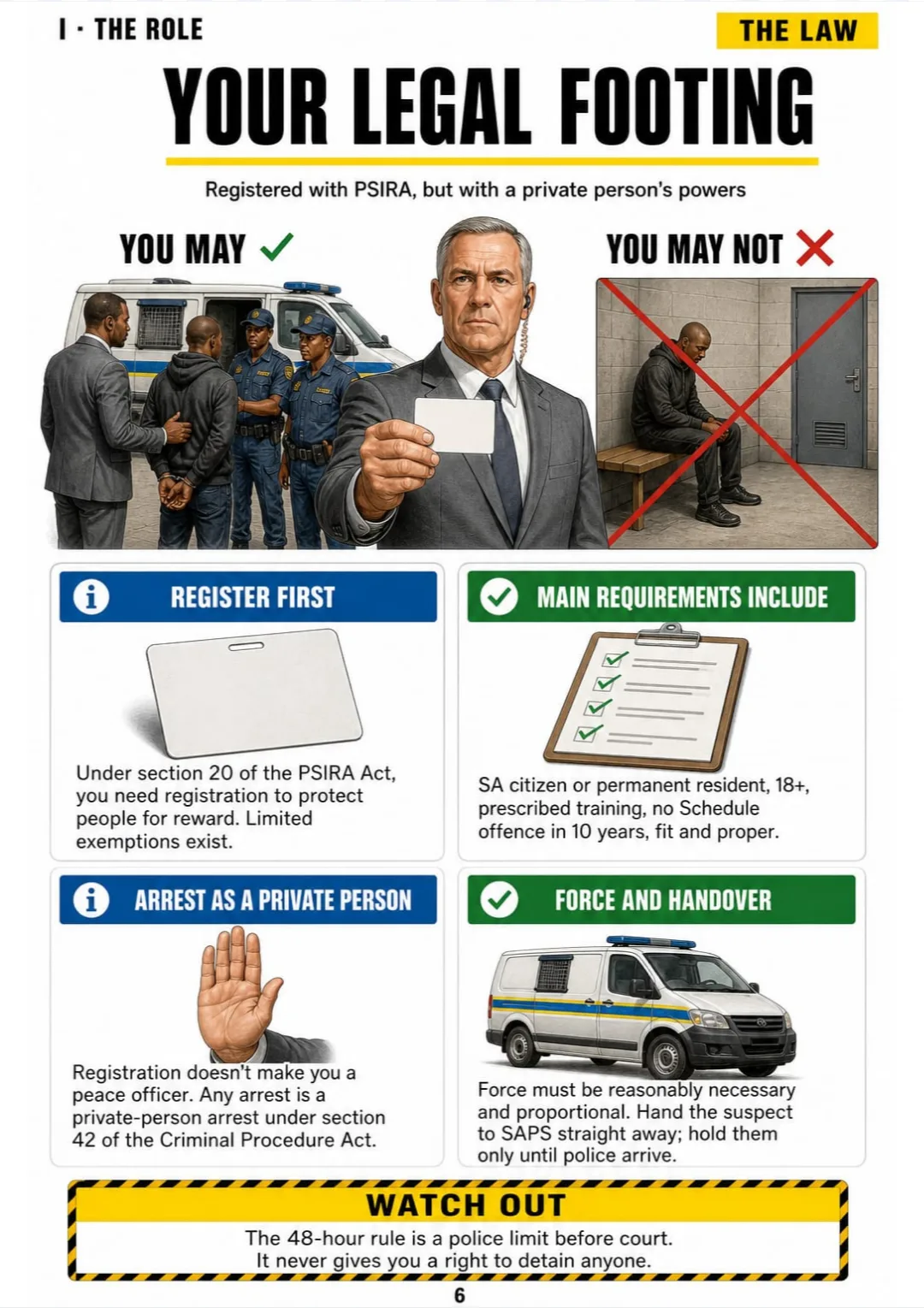
Arrest only as a private person, use proportional force, and hand the suspect to SAPS straight away
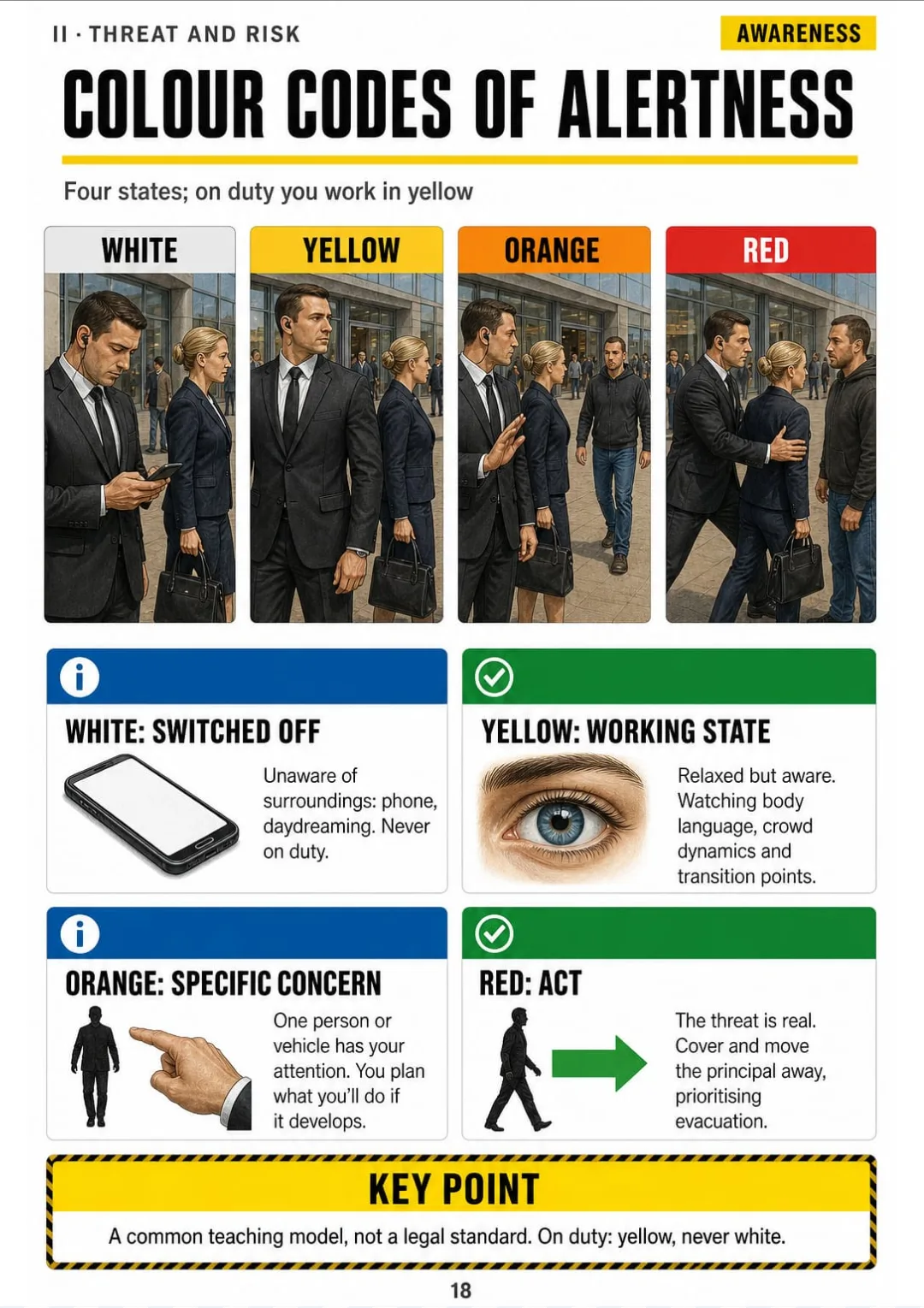
White, yellow, orange, red: what each alertness state looks like on a detail
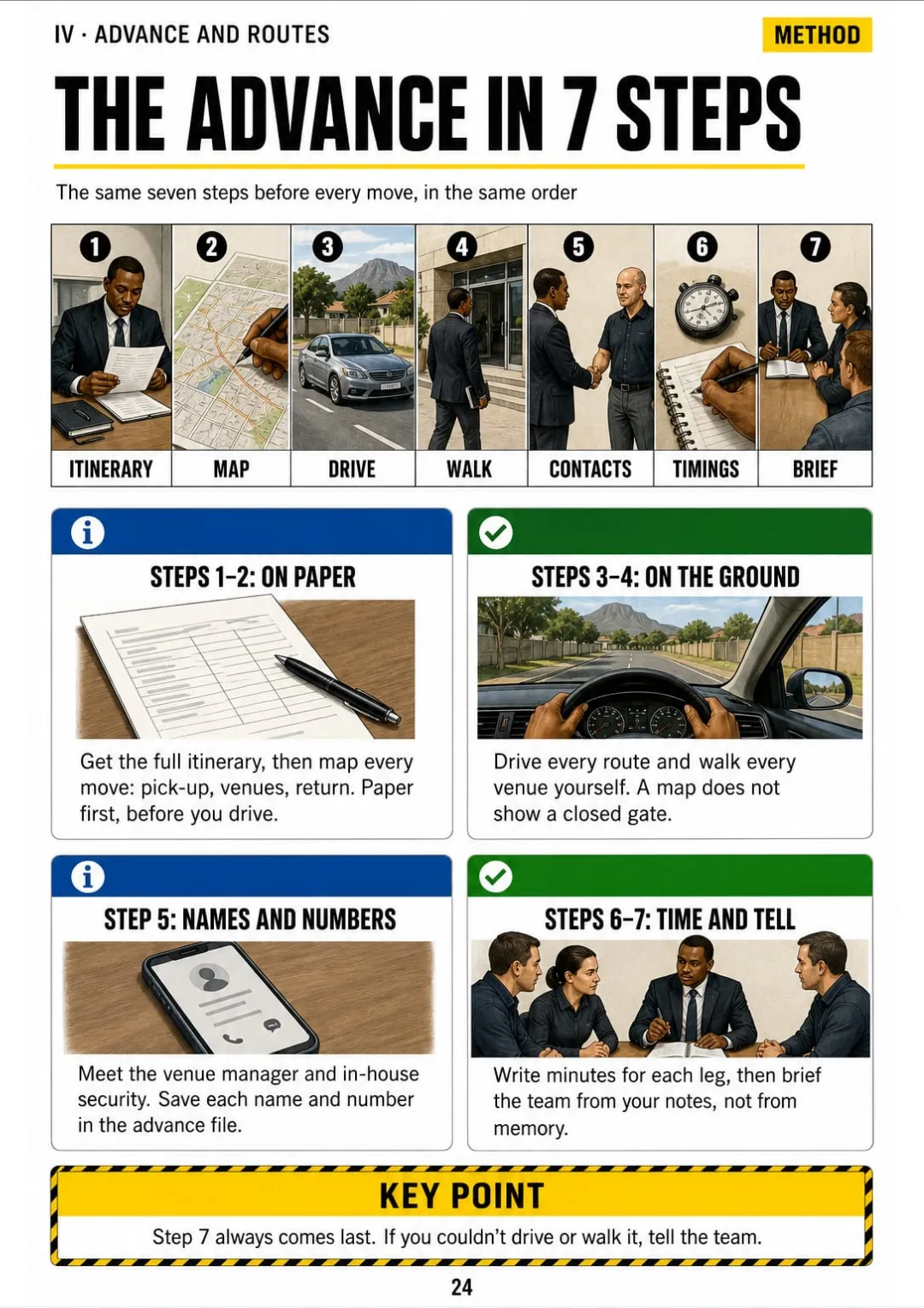
Itinerary, map, drive, walk, contacts, timings, brief: the advance in 7 numbered steps.
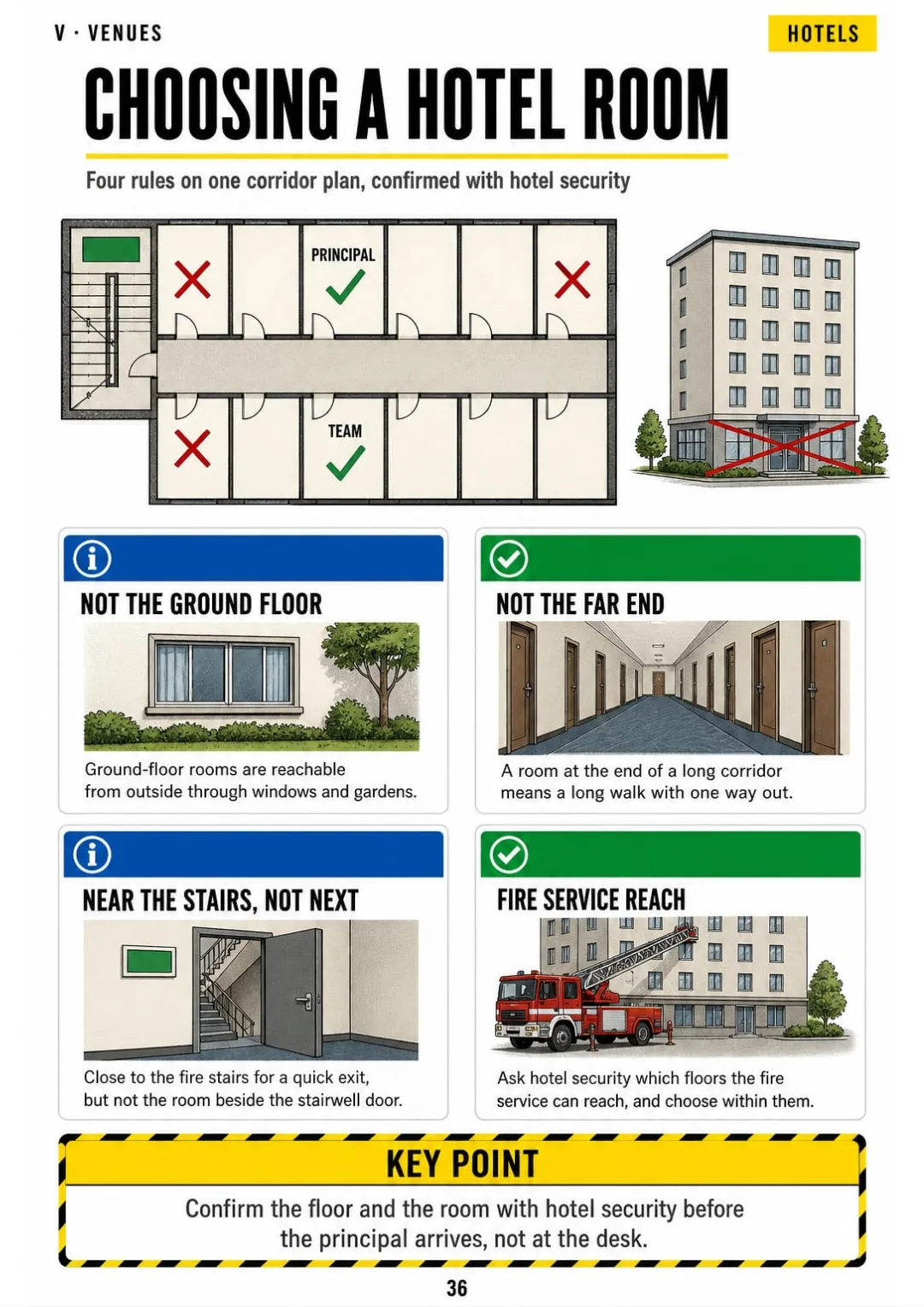
A corridor plan showing the principal's room, the team room and the rooms to avoid.
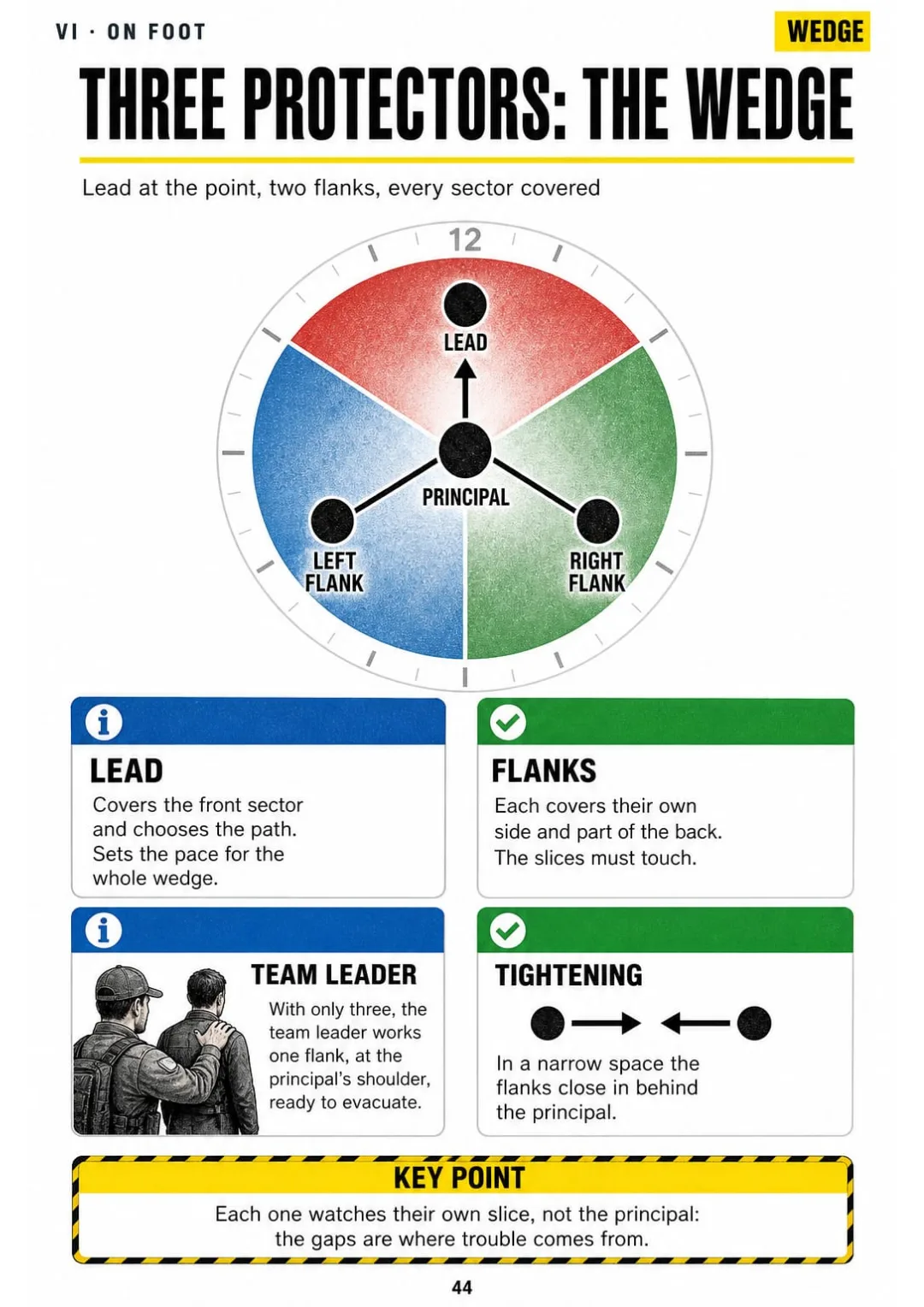
The wedge: one lead and two flanks, each with a sector that touches the next.
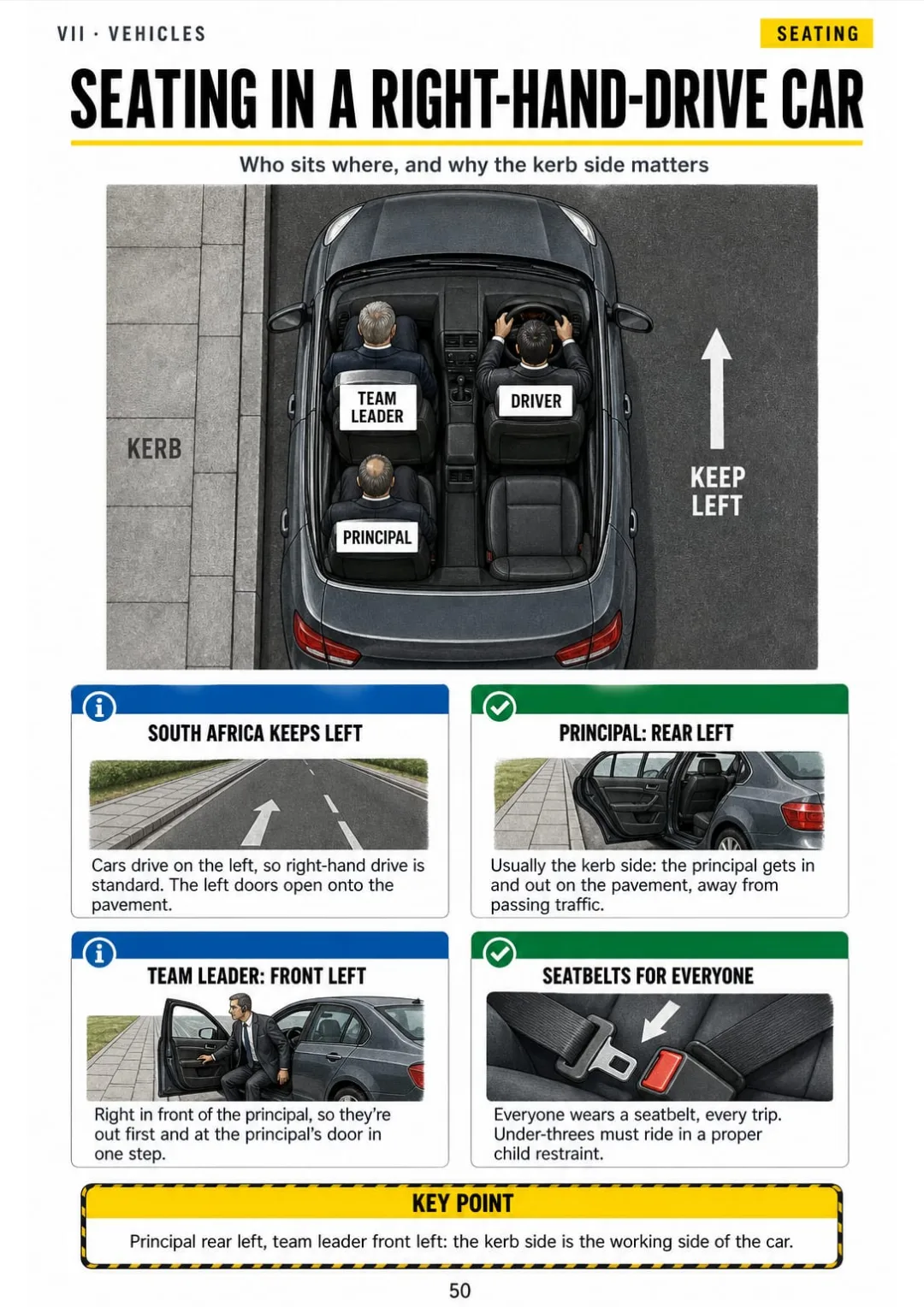
Principal rear left on the kerb side, team leader front left: seating drawn from above.
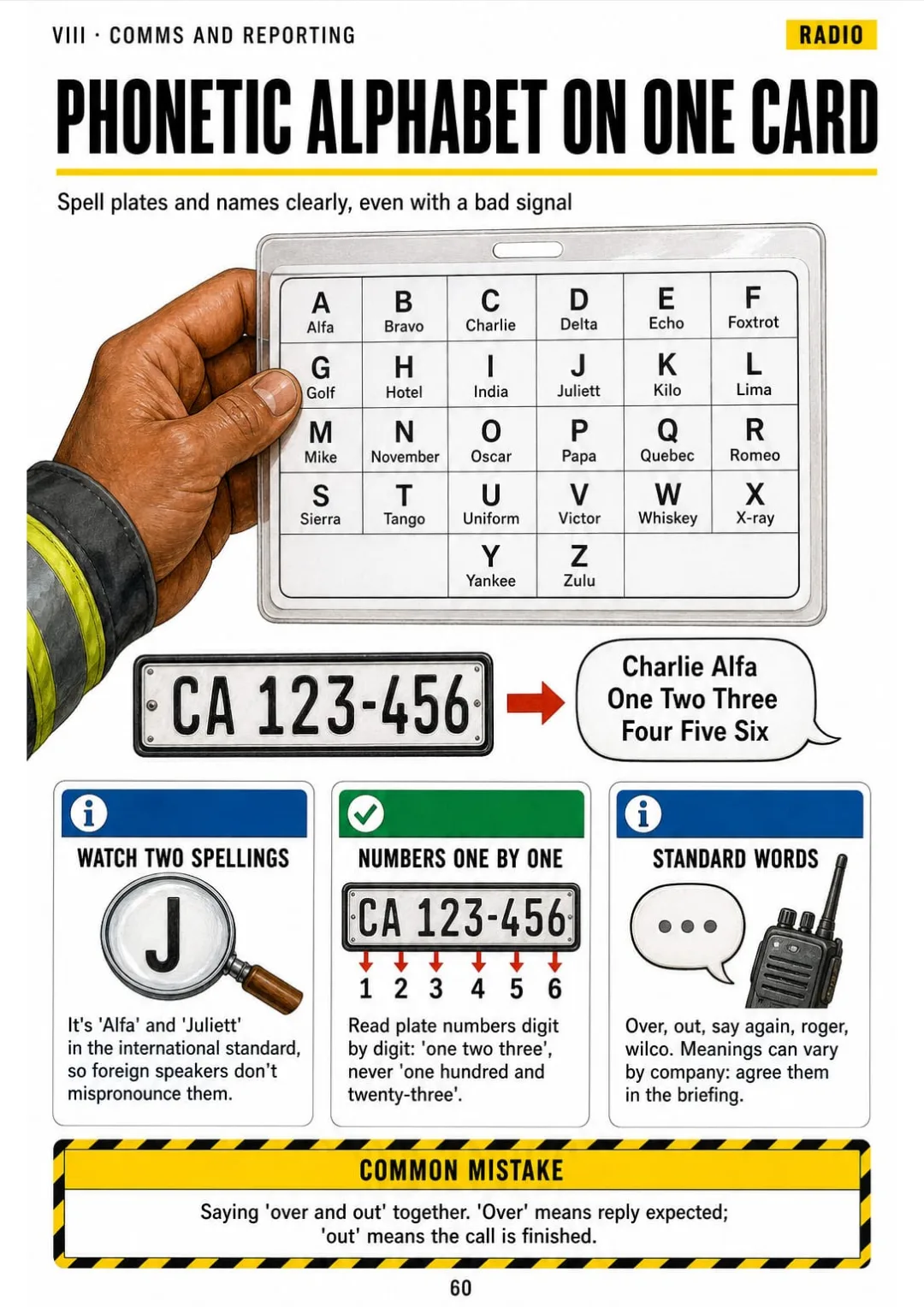
Alfa to Zulu on one card, plus how to read a plate on the radio
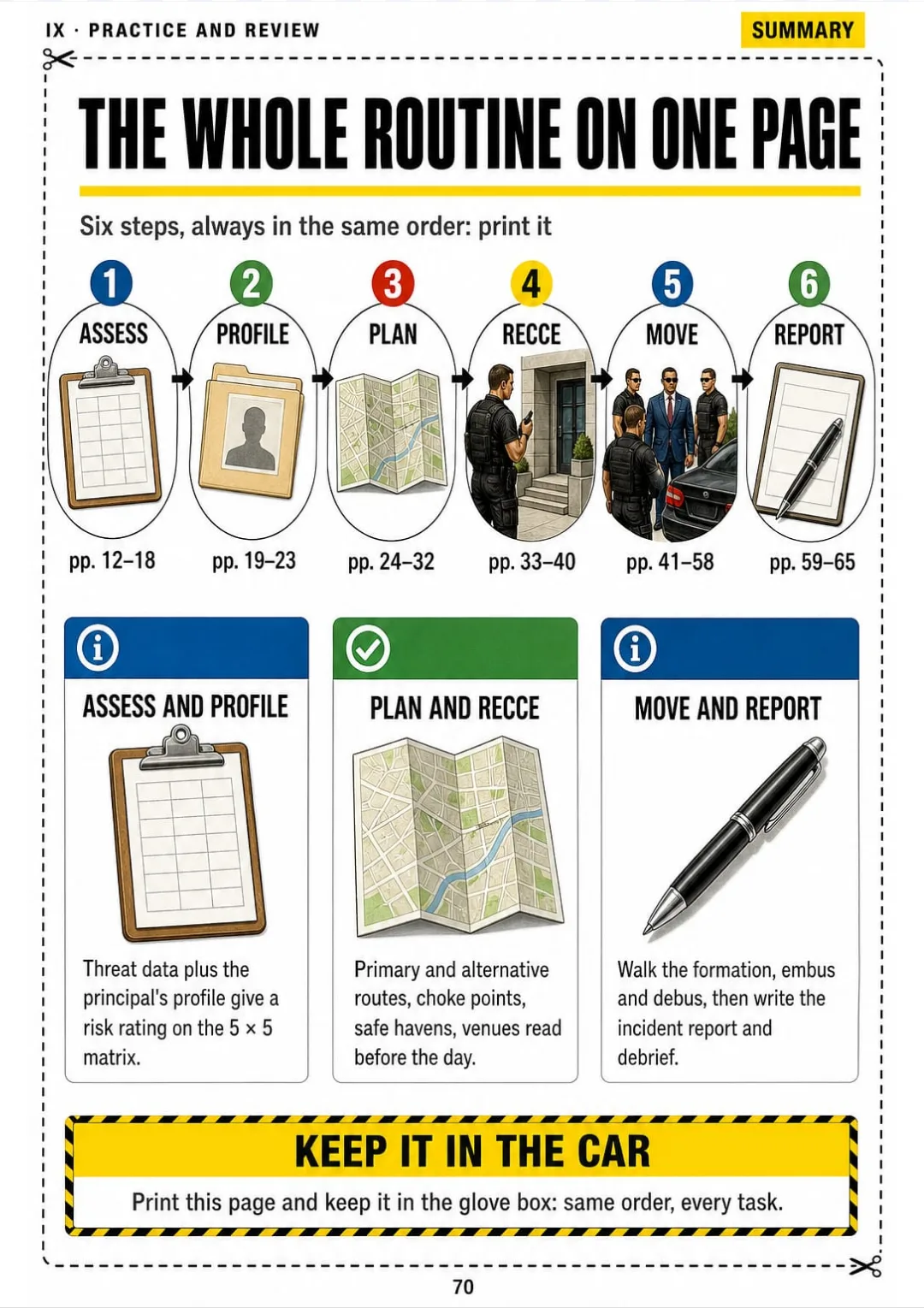
Assess, profile, plan, recce, move, report: the whole routine on one page.

Take a Look at the 9 Parts and 66 Topics

The Role and Its Limits

pp. 5-11
  1. What close protection is (and what it isn't)
  2. Your legal footing in South Africa
  3. Who's who on a detail
  4. The 4 phases of every task
  5. Low profile vs high profile
  6. Professional conduct around the principal
  7. Your personal kit list

Threat and Risk

pp. 12-18
  1. Threat, vulnerability, risk: three different words
  2. The risk matrix in 5 × 5
  3. Common threats on South African details
  4. Follow-home: how it works and how you spot it
  5. The attack cycle
  6. Writing the threat assessment
  7. Colour codes of alertness

The Principal

pp. 19-23
  1. The principal profile form
  2. Routine is the enemy
  3. Families and children
  4. Briefing the principal without scaring them
  5. Digital footprint

Advance Work and Routes

pp. 24-32
  1. The advance in 7 steps
  2. When you get the itinerary at 21:00
  3. Primary and alternative routes
  4. Choke points and danger areas
  5. Safe havens along the route
  6. Timing a route properly
  7. Recce notes that someone else can read
  8. Airport arrivals
  9. Liaison: who you call before the day

Venues, Hotels and Homes

pp. 33-40
  1. Reading a venue in 6 points
  2. The restaurant table
  3. Standing at the door
  4. Choosing a hotel room
  5. Hotel arrival and check-in
  6. The residence: perimeter, entry, safe room
  7. The gate: most exposed 60 seconds
  8. Events and crowds

On Foot: Formations

pp. 41-49
  1. The body cover principle
  2. One protector
  3. Two protectors
  4. Three protectors: the wedge
  5. Four protectors: the box and the diamond
  6. Doorways
  7. Stairs and escalators
  8. Lifts
  9. Clock code and 'move' commands

Vehicles: Embus, Debus and Convoys

pp. 50-58
  1. Seating in a right-hand-drive car
  2. Choosing and checking the vehicle
  3. Embus in 5 steps
  4. Debus in 5 steps
  5. Parking for a fast exit
  6. The two-car convoy
  7. Intersections and robots
  8. Lane changes and turns as a team
  9. Vehicle breakdown or blocked road

Comms, Searches and Reporting

pp. 59-65
  1. Radio discipline
  2. Phonetic alphabet and standard words
  3. Vehicle search in a fixed order
  4. Room search
  5. Medical emergencies on a detail
  6. The incident report
  7. The handover

Practice and Review

pp. 66-70
  1. Day-before checklist
  2. Day-of checklist
  3. Practice: plan a dinner out
  4. Common mistakes at a glance
  5. The whole routine on one page

Who This Book Is For

You're moving into close protection

You start from the role and its limits and learn the routine in order: assess, profile, plan, recce, move, report.

Your first detail is coming up

The night before, you go through the advance in 7 steps and the formations drawn from above, and print the checklists for the car.

You already work as a protector

You review the basics in a few minutes and give your team the same pages, so everyone works in the same order.

Plus: 2 Free Books

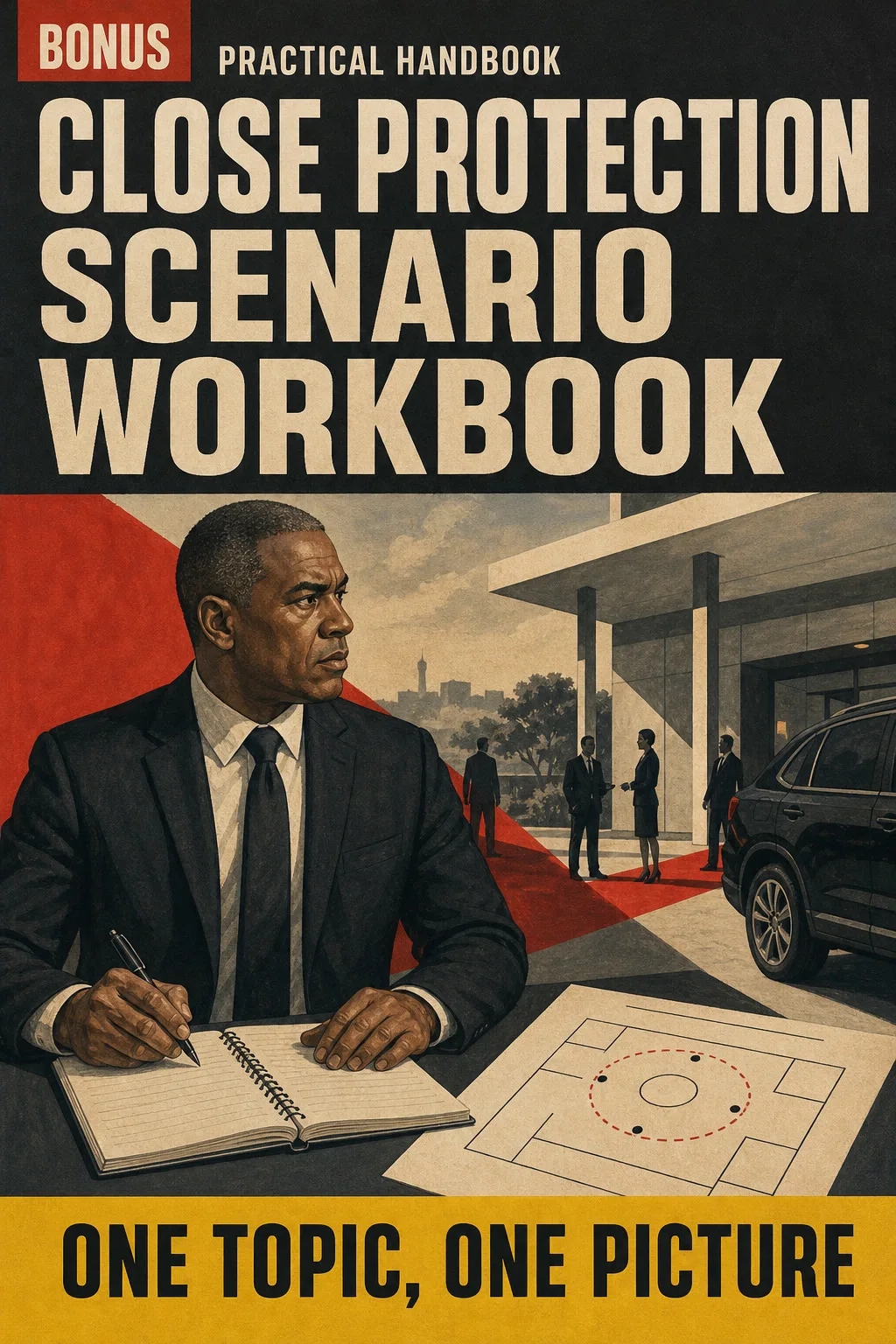
Close Protection Scenario Workbook
BONUS 1

Close Protection Scenario Workbook

Worked scenarios to practise on paper (an airport arrival, a dinner out, a hotel stay, a school run): you pick the route, the formation and the vehicle positions, then check your plan against the drawn answer.

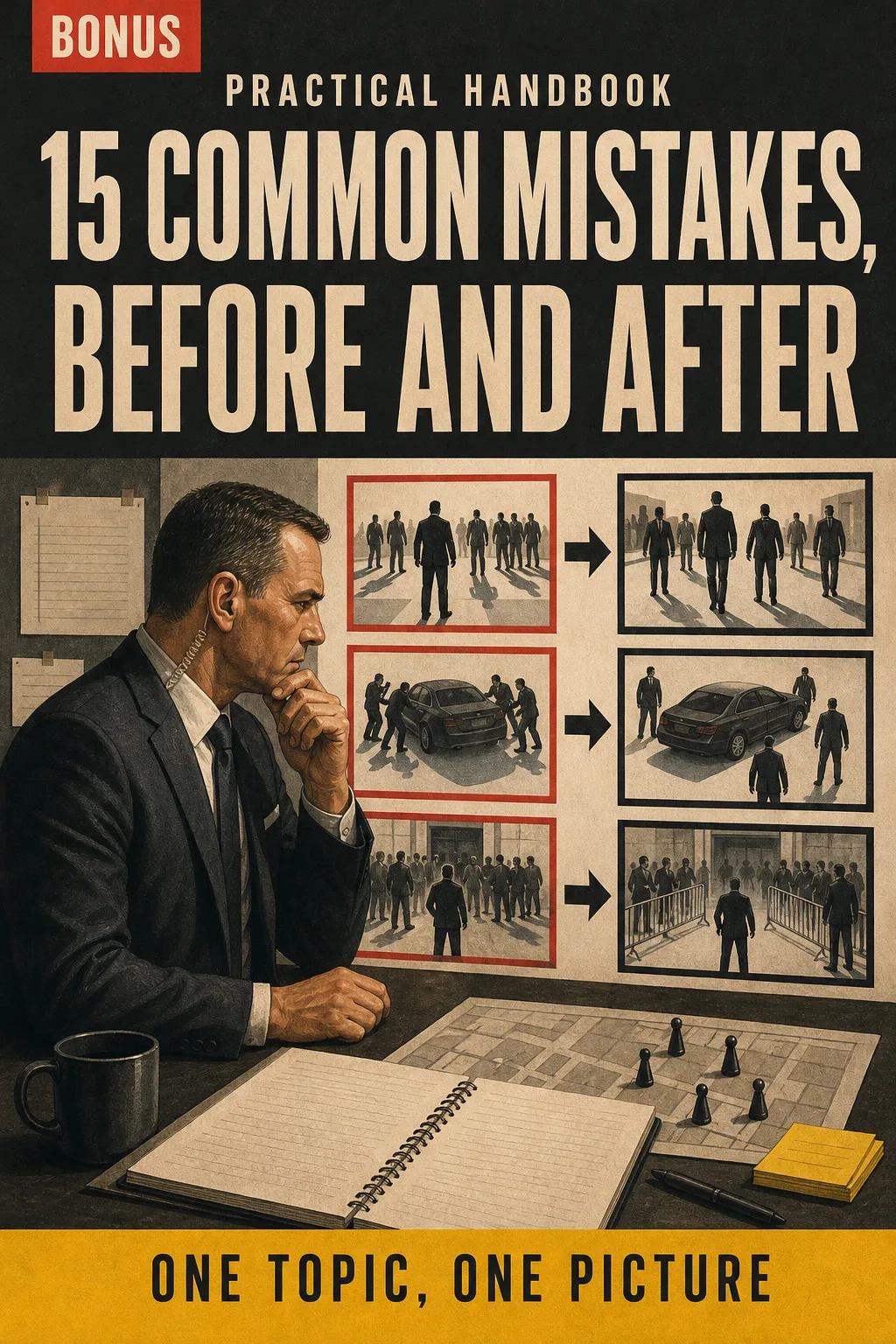
15 Common Mistakes, Before and After
BONUS 2

15 Common Mistakes, Before and After

The most frequent close protection mistakes drawn side by side with the right way, on quick cards you can review in a few minutes before a detail.

30-Day Guarantee

30-day guarantee: if a file doesn't open, if the content isn't what the product page describes, if you were charged twice or the email never arrived, write to us and we'll refund you in full. You pay once. No subscriptions.

Frequently Asked Questions

Is it for me if I'm moving from guarding or armed response into close protection?

Yes. It starts with the role and its limits and builds the routine step by step. If you already work as a protector or team leader, it works as a review and a shared reference for your team.

Where does the content come from?

It's checked against South African legislation, such as the Private Security Industry Regulation Act 56 of 2001, the Criminal Procedure Act 51 of 1977 and the National Road Traffic Act 93 of 1996, and against standard close protection practice. It's written for left-hand traffic, right-hand-drive vehicles and metric distances.

Is this official material?

No. It's an independent illustrated book. It isn't affiliated with, endorsed by or approved by any government department, regulator, training provider or association.

Does it replace a close protection course or training?

No. It's a study and review book for planning, positioning and prevention. It doesn't teach weapons, shooting or fighting techniques, it doesn't give you a certificate and it doesn't count towards PSIRA registration or grades. It doesn't replace accredited training, first aid training or your team leader's instructions.

Are the practice scenarios taken from a course or assessment?

No. The scenarios and the practice plan are written for this book. They aren't taken from any course, assessment or official material.

How do I get it?

As a PDF by email: the book and the 2 gifts, sent to the address you enter at checkout.

Do I have to pay every month?

No. It's a one-off payment, with no subscription.

Can I have it on paper?

Yes. The PDF is ready to print, so you can keep the pages and the checklists in the vehicle.

How does the refund work?

You have 30 days. We refund everything if the file won't open, if the book isn't what you see on this page, if you were charged twice or if the email doesn't arrive: just email us.
R399R999
Get the book · R399

This is a digital PDF book sent to your email: nothing is printed or shipped.