Study in Pictures🌐 English (United States)
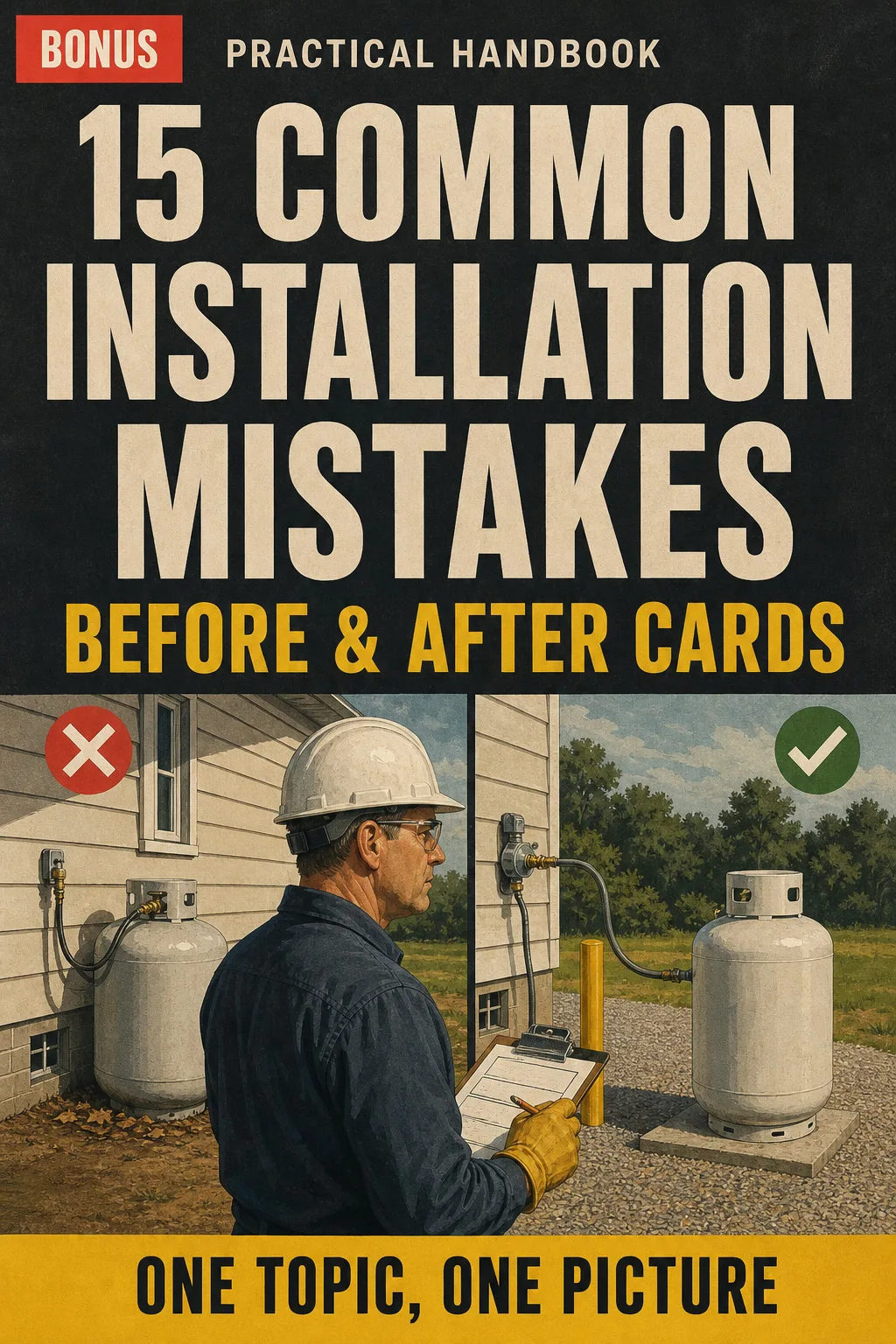
Propane Tank Installation Illustrated

Digital book in PDF · read it on your phone or print it

Propane Tank Installation Illustrated

Tank siting distances in feet, aboveground and underground setting, anodes, first- and second-stage regulators, line sizing, leak testing and placing the system in service. Each topic has its own page: the drawing first, then what you need to remember.

  • 67 illustrated pages
  • English
  • 30-day guarantee
US$ 27US$ 63
Get the book · US$ 27

Price shown for: United States. In other countries, the checkout shows the price that applies there.

About this book

What it is

Tank siting distances in feet, aboveground and underground setting, anodes, first- and second-stage regulators, line sizing, leak testing and placing the system in service. Each topic has its own page: the drawing first, then what you need to remember.

Who This Book Is For
  • You just started at a propane company
  • Your state LP-gas exam is coming up
  • You already set tanks
What it covers
  1. The Whole System at a Glance
  2. Propane and the Tank
  3. Siting the Tank: Distances in Feet
  4. Setting the Tank: Aboveground and Underground
  5. Regulators
  6. Piping and Line Sizing
  7. Leak Testing and Placing in Service
  8. Review: Checklists and Common Mistakes
Language
English (United States)
Pages
67
Format
Digital book in PDF · read it on your phone or print it
Price
US$ 27 (United States)
Delivery
This is a digital PDF book sent to your email: nothing is printed or shipped.
30-Day Guarantee
30-day guarantee: if a file doesn't open, if the content isn't what the product page describes, if you were charged twice or the email never arrived, write to us and we'll refund you in full.

Look Inside the Book

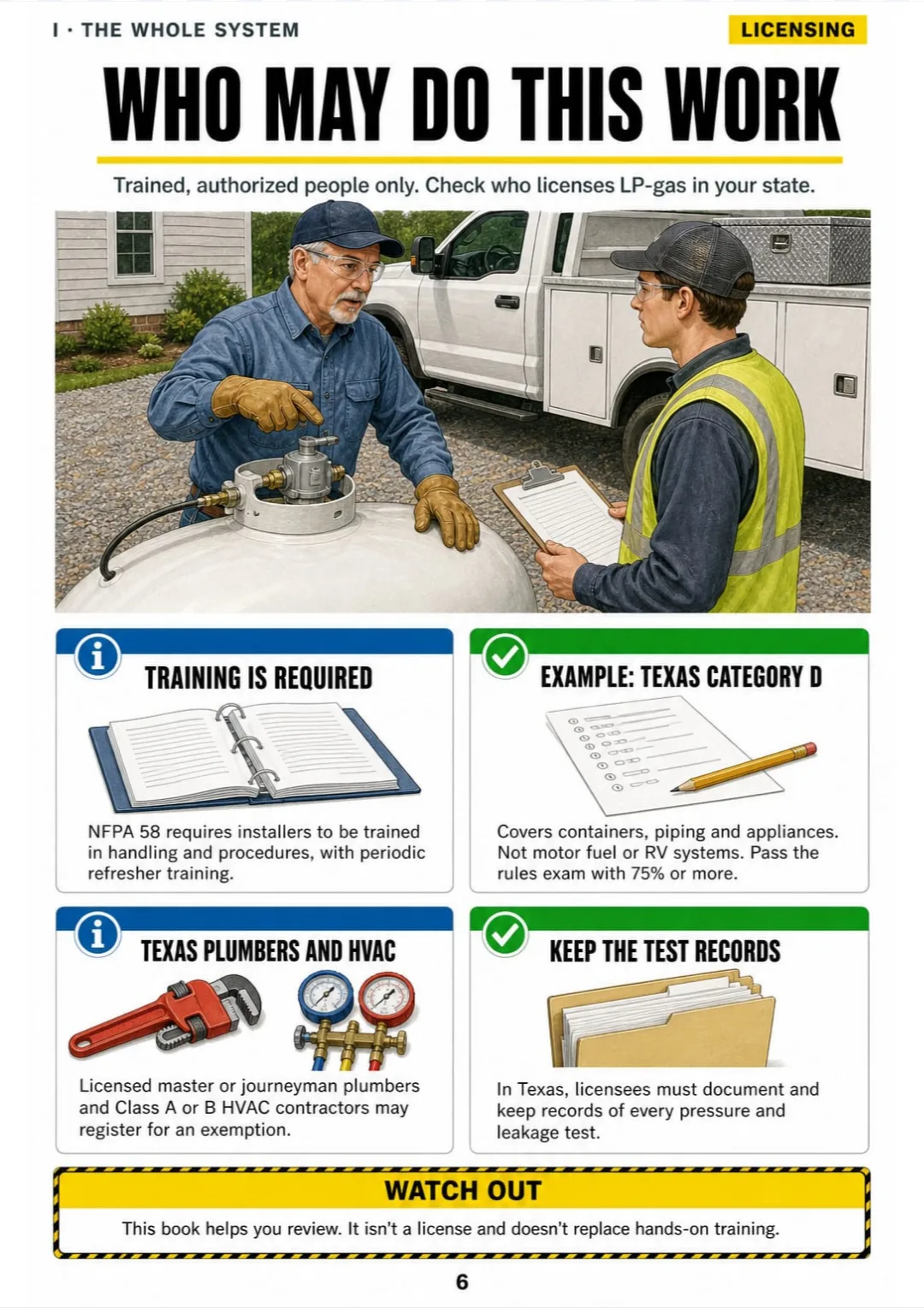
Texas example: Category D license, rules exam passed at 75% or more
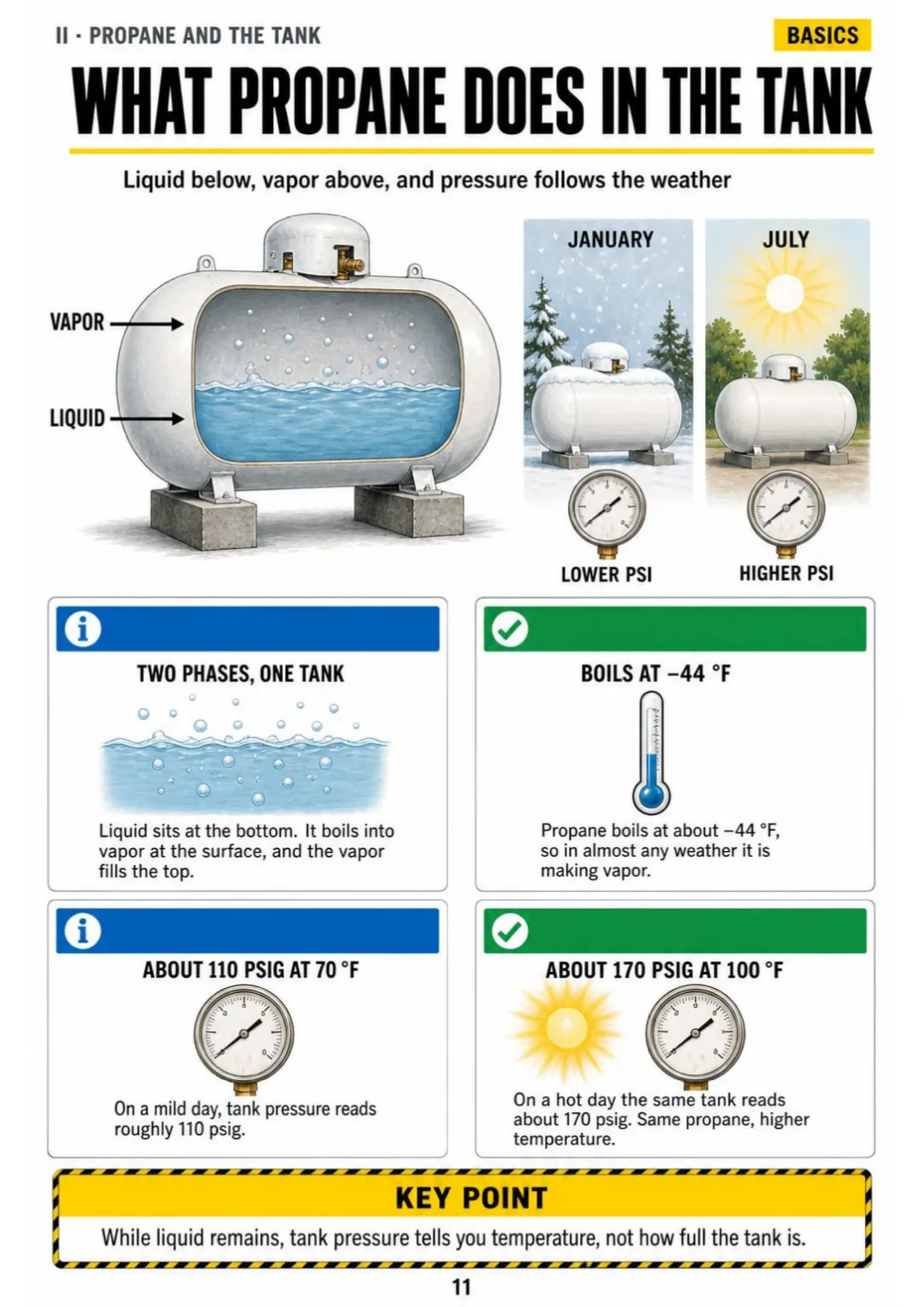
Propane boils at −44 °F: about 110 psig at 70 °F, about 170 psig at 100 °F.
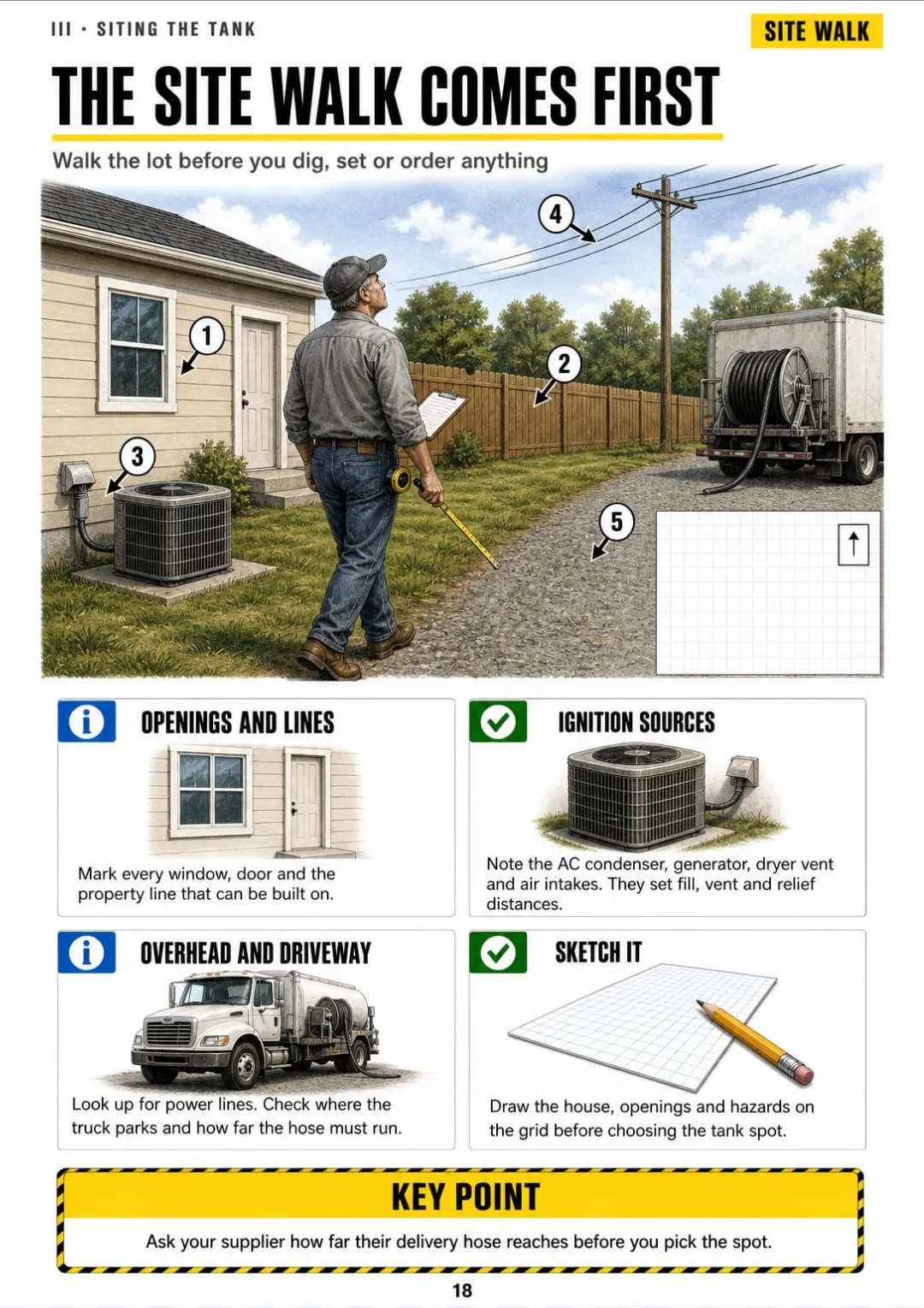
The site walk: openings, property lines, ignition sources, overhead lines and hose reach.
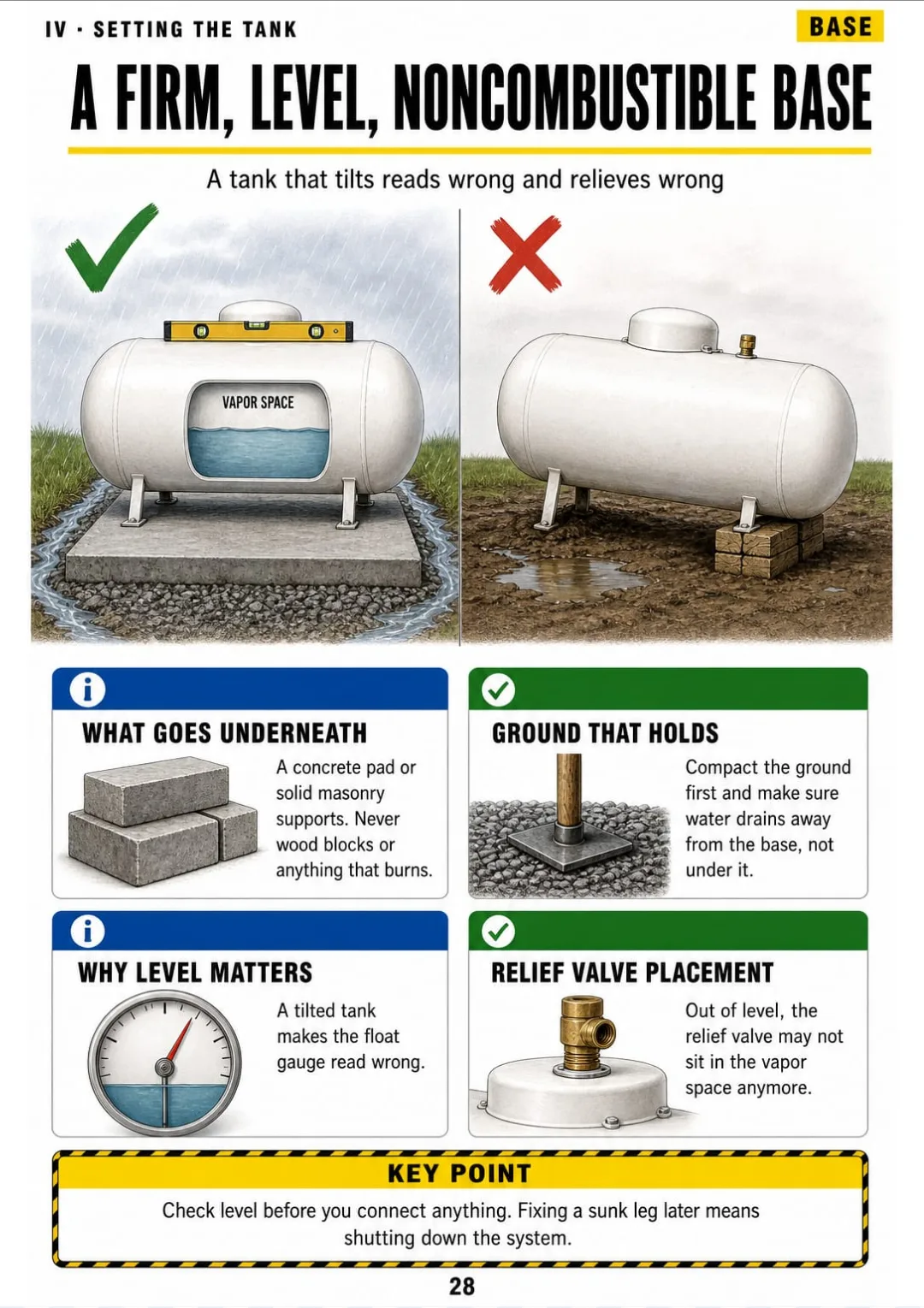
Concrete or masonry on compacted, draining ground, and level so the gauge and relief valve work.
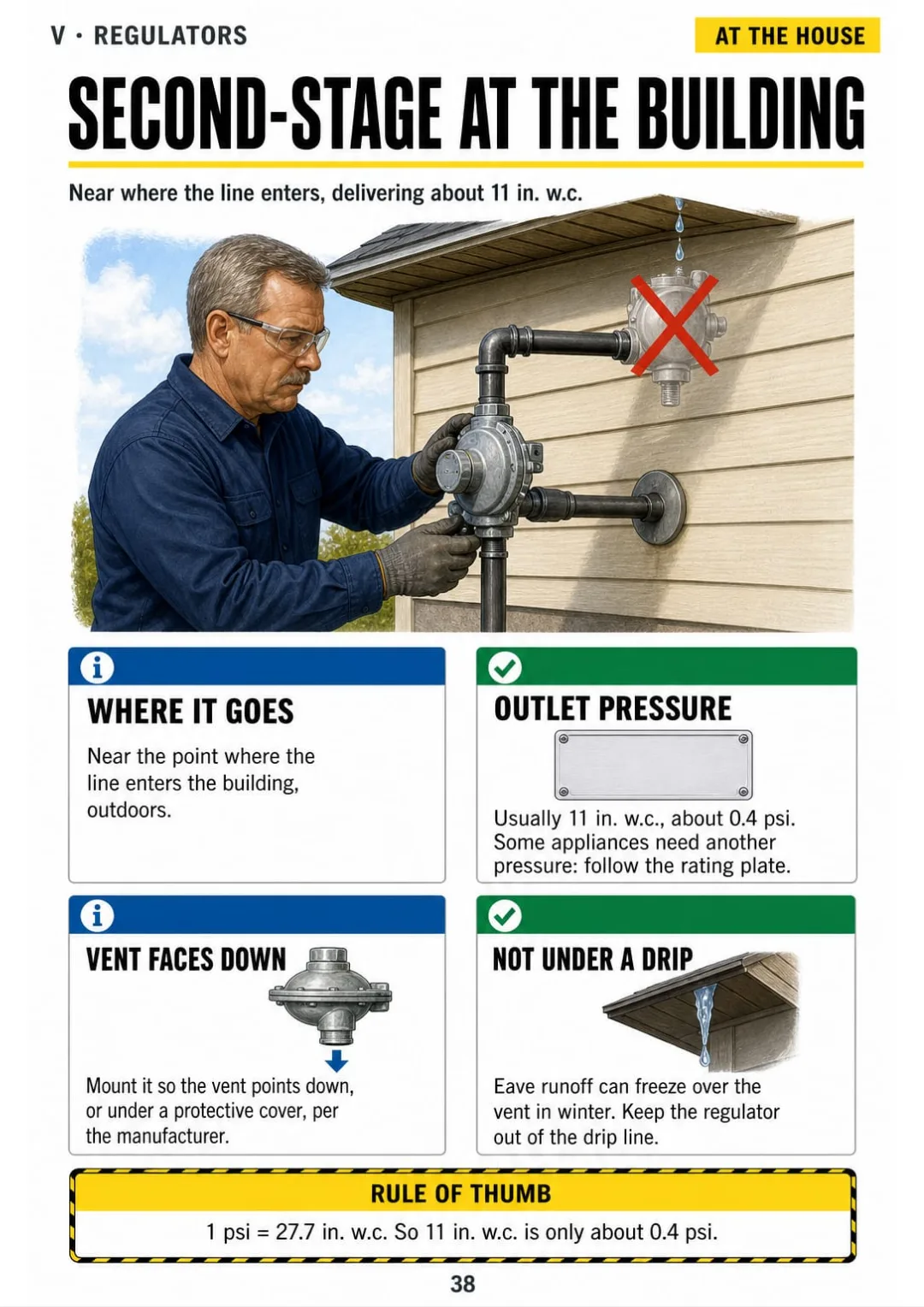
Second stage at the wall: about 11 in. w.c., vent down, away from eave drips.
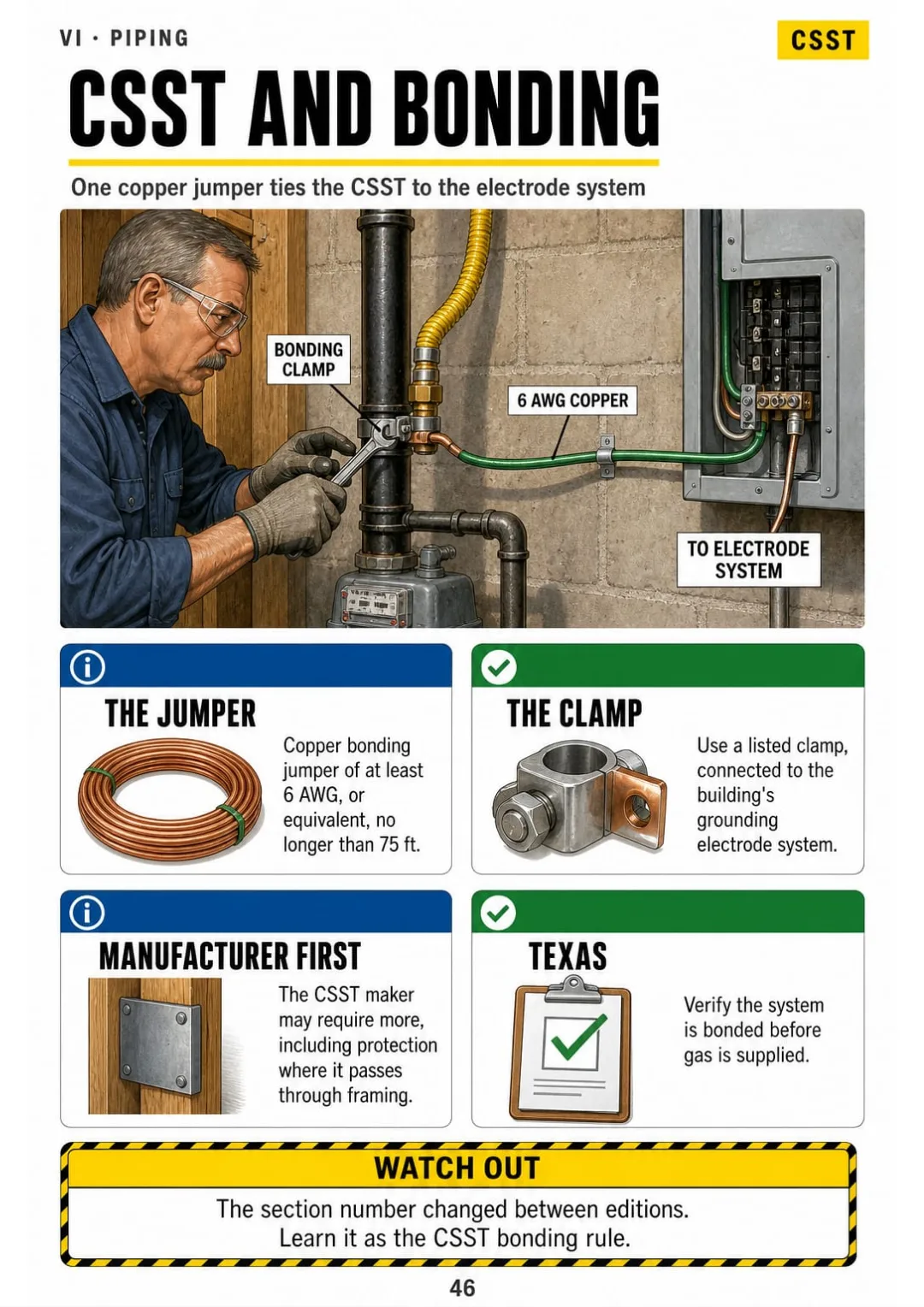
CSST bonding: at least 6 AWG copper, 75 ft maximum, listed clamp, to the grounding electrode system.
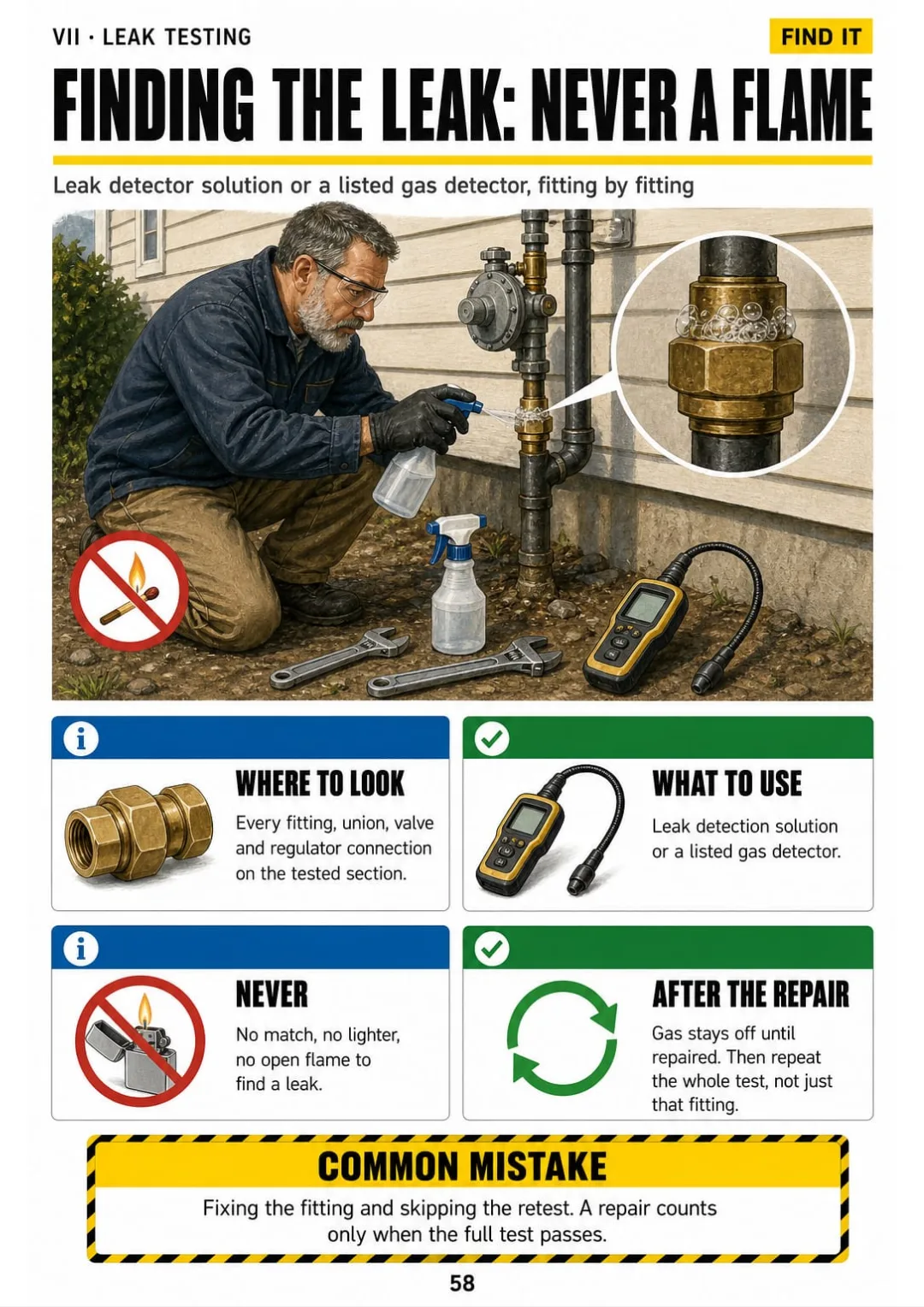
Bubbles at a flare fitting: solution or detector, never an open flame
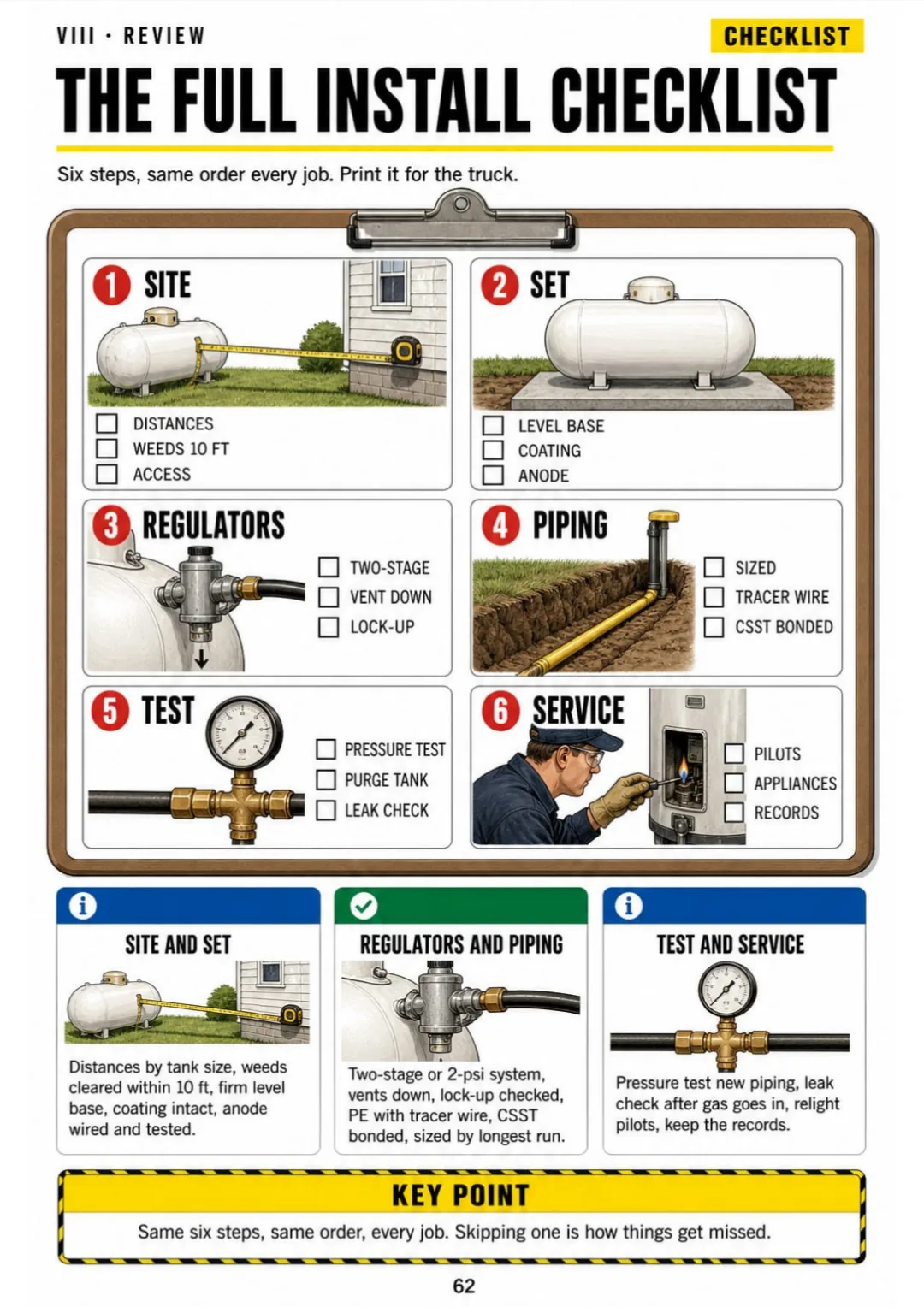
Site, Set, Regulators, Piping, Test, Service: one checklist for the whole job

Take a Look at the 8 Parts and 63 Topics

The Whole System at a Glance

pp. 5-10
  1. The propane vapor system, start to finish
  2. Who may do this work
  3. The two codes and your state
  4. Words you'll hear on day one
  5. DOT cylinders vs. ASME tanks
  6. The install route: six steps in the same order

Propane and the Tank

pp. 11-17
  1. What propane does inside the tank
  2. Heavier than air, and it smells on purpose
  3. Why a tank is filled to about 80%
  4. Vaporization: why a small tank freezes up
  5. Map of the tank fittings
  6. The nameplate: read it before you set the tank
  7. Cylinders on site: setting and clearances

Siting the Tank: Distances in Feet

pp. 18-27
  1. The site walk comes first
  2. How distances are measured
  3. Under 125 gallons
  4. 125 to 500 gallons aboveground: 10 ft
  5. 501 to 2,000 gallons aboveground: 25 ft, and the 10-ft exception
  6. Underground and mounded tanks: 10 ft
  7. Relief valve discharge and building openings
  8. Fill connection and gauge vent: 10 ft
  9. Combustibles, other tanks and what can't go nearby
  10. Worked site plan: putting it all together

Setting the Tank: Aboveground and Underground

pp. 28-35
  1. Aboveground: a firm, level, noncombustible base
  2. Vehicle protection and delivery access
  3. Underground: the excavation in cross-section
  4. Coating and handling an underground tank
  5. Anodes: how cathodic protection works
  6. Testing the anode: the −0.85 V reading
  7. Isolating the tank from the house piping
  8. High water table: flotation and backfill

Regulators

pp. 36-43
  1. Why two stages
  2. First-stage regulator at the tank
  3. Second-stage regulator at the building
  4. Integral two-stage and 2-psi systems
  5. The regulator vent points down
  6. Regulator vent clearances
  7. Lock-up: what the manometer tells you
  8. Regulator trouble by symptom

Piping and Line Sizing

pp. 44-52
  1. Pipe materials and where each one goes
  2. Underground PE pipe, risers and tracer wire
  3. CSST and bonding
  4. Sizing step 1: add up the BTU load
  5. Sizing step 2: measure the longest run
  6. Sizing step 3: read your code's sizing table
  7. Worked example: a ranch house at 11 in. w.c.
  8. Worked example: the 10 psig line from tank to house
  9. Sediment traps and appliance shutoffs

Leak Testing and Placing in Service

pp. 53-61
  1. Pressure test vs. leak check: two different jobs
  2. The pressure test, step by step
  3. The manometer: reading inches of water column
  4. Low-pressure leak check with a manometer
  5. High-pressure side leak check
  6. Finding the leak: solution, never flame
  7. A new tank: purging air before the first fill
  8. Placing the system in service
  9. Out of gas and interruption of service

Review: Checklists and Common Mistakes

pp. 62-67
  1. The full install checklist
  2. Every distance on one page
  3. Every pressure on one page
  4. Common siting and setting mistakes
  5. Common regulator, piping and test mistakes
  6. How to review the night before

Who This Book Is For

You just started at a propane company

You see the whole system at a glance before your first install, and you learn the job in the same order you'll do it: site, set, regulators, piping, test, service.

Your state LP-gas exam is coming up

Distances, regulator pressures and test pressures each have their own page, so you can review them at night without everything blurring together.

You already set tanks

You know the work with your hands. The book gives you the why behind each step, drawn, so you can explain it to a supervisor or an inspector.

Plus: 2 Free Books

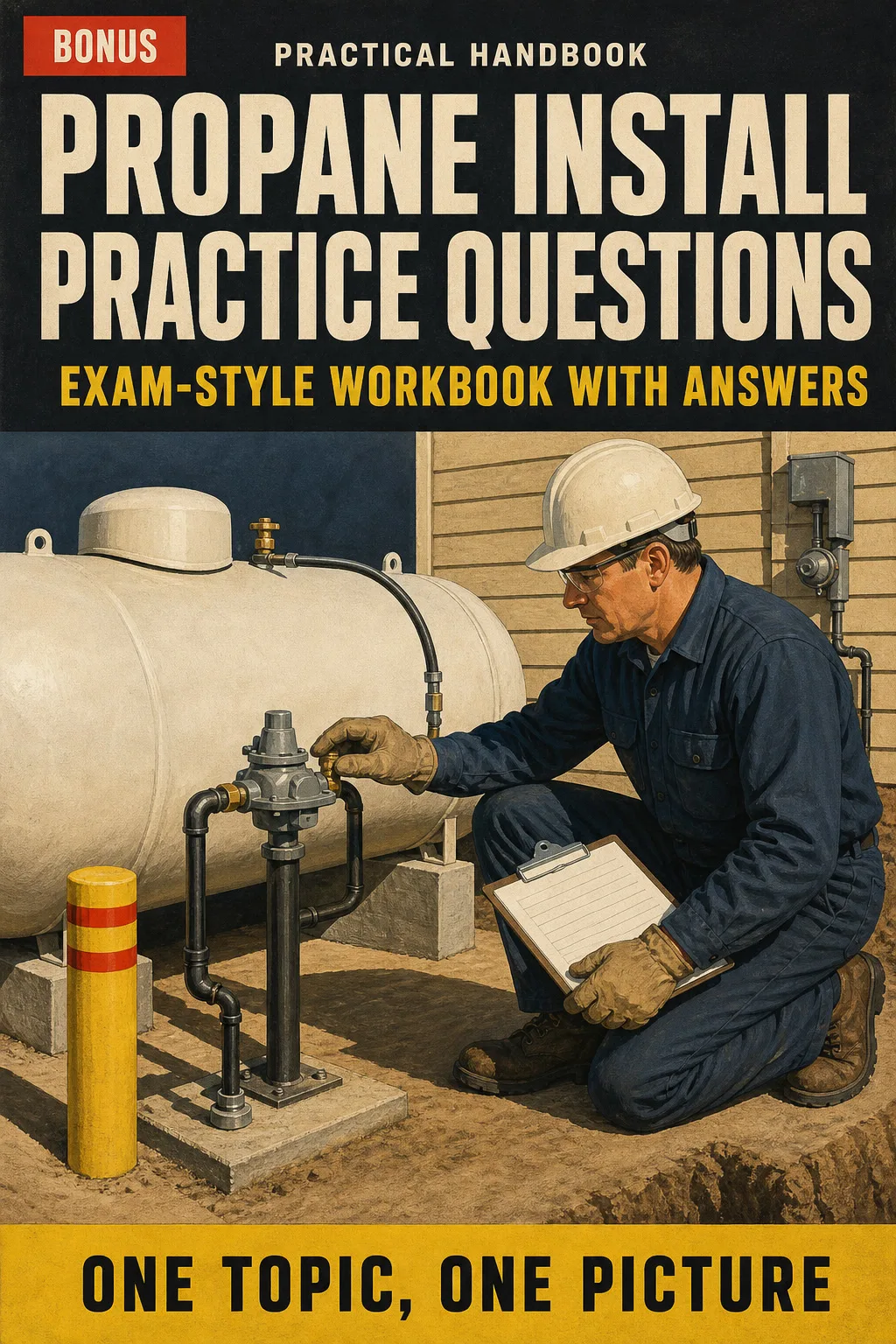
Propane Install Practice Questions: Exam-Style Workbook with Answers
BONUS 1

Propane Install Practice Questions: Exam-Style Workbook with Answers

Test yourself on distances, regulators, line sizing and leak testing, then check every answer with a short explanation and the page to review.
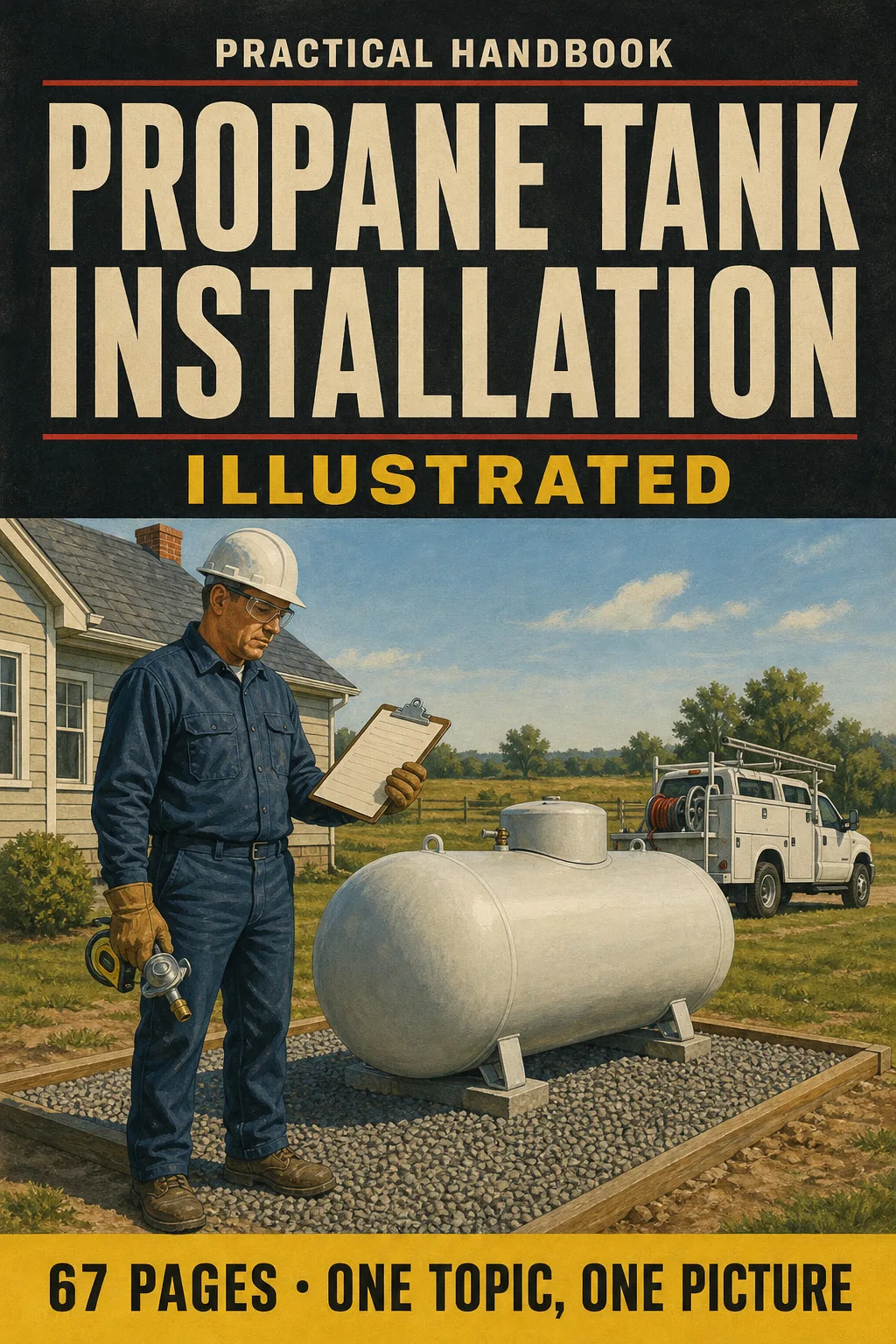
15 Common Installation Mistakes: Before & After Cards
BONUS 2

15 Common Installation Mistakes: Before & After Cards

See the most frequent installation mistakes drawn next to the right way, so you can spot them on the job before your supervisor does.

30-Day Guarantee

30-day guarantee: if a file doesn't open, if the content isn't what the product page describes, if you were charged twice or the email never arrived, write to us and we'll refund you in full. You pay once. No subscriptions.

Frequently Asked Questions

Is it for me if I came to propane from the bobtail, HVAC or plumbing?

Yes. It's written for adults who already work in the trade or just joined a propane company. It starts with the whole system at a glance, so you don't need to have set a tank before, and it doesn't talk down to you if you have.

Does it work for my state's LP-gas exam?

It's built on the current editions of NFPA 58 and NFPA 54 / ANSI Z223.1, the codes state LP-gas rules are based on, and it points out where your state can add its own rules. Always check the edition your state has adopted and your local authority having jurisdiction. Everything is redrawn and explained in plain words; no code text or tables are reproduced.

Is this official material?

No. It's an independent illustrated study book. It isn't issued, approved or endorsed by NFPA, the industry training program or any state agency, and it doesn't give you a certificate, a license or training credit. It's for studying and reviewing.

Does it replace my company's training or the industry course?

No. It helps you review what you learn in training and on the job. Work on gas systems is for trained, authorized personnel, and the current code and your local authority always have the final word.

Are the practice questions the ones on the exam?

No. The practice questions are written for this book to help you review distances, regulators, line sizing and leak testing. They are not official exam questions.

When and how do I get it?

The book and the 2 bonus books arrive as PDFs by email, at the address you enter at checkout.

Do I have to pay every month?

No. It's a one-time payment. There's no subscription.

Can I print it?

Yes. The PDFs are made to print, so you can keep a copy in the truck.

How does the refund work?

You have 30 days. We refund everything if the file won't open, if the book isn't what you see on this page, if you were charged twice or if the email doesn't arrive: just email us.

US$ 27US$ 63
Get the book · US$ 27

This is a digital PDF book sent to your email: nothing is printed or shipped.