Study in Pictures🌐 English (United States)
Manual Machining Illustrated

Digital book in PDF · read it on your phone or print it

Manual Machining Illustrated

Read the micrometer, set your RPM and cut to size on the lathe and the mill. 65 pages, one topic per page: the setup drawn first, then a box with the numbers and steps. Same order on a bench lathe in your garage or a lathe at the shop.

  • 65 illustrated pages
  • English
  • 30-day guarantee
US$ 27US$ 63
Get the book · US$ 27

Price shown for: United States. In other countries, the checkout shows the price that applies there.

About this book

What it is

Read the micrometer, set your RPM and cut to size on the lathe and the mill. 65 pages, one topic per page: the setup drawn first, then a box with the numbers and steps. Same order on a bench lathe in your garage or a lathe at the shop.

Who This Book Is For
  • You're taking a shop class
  • You just started at a machine shop
  • You run a lathe in your garage
What it covers
  1. Safe at the Machine
  2. Measuring Tools
  3. Speeds and Feeds
  4. The Lathe and Its Setup
  5. Turning Operations
  6. Threading on the Lathe
  7. The Milling Machine
  8. Drilling, Tapping and Tool Grinding
  9. Review and Checklists
Language
English (United States)
Pages
65
Format
Digital book in PDF · read it on your phone or print it
Price
US$ 27 (United States)
Delivery
This is a digital PDF book sent to your email: nothing is printed or shipped.
30-Day Guarantee
30-day guarantee: if a file doesn't open, if the content isn't what the product page describes, if you were charged twice or the email never arrived, write to us and we'll refund you in full.

Look Inside the Book

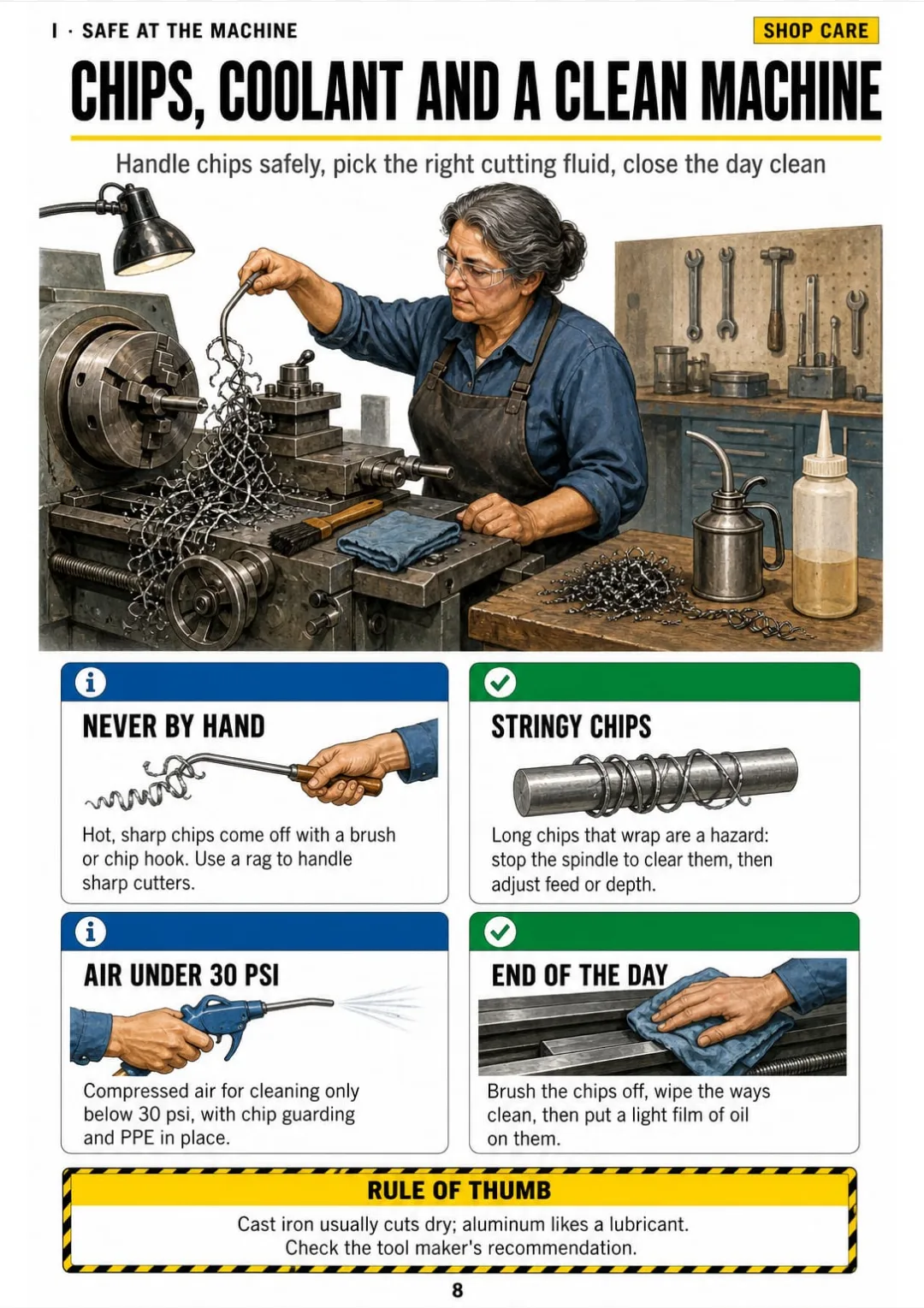
Brush or chip hook, never hands; air only under 30 psi; wipe and oil the ways.
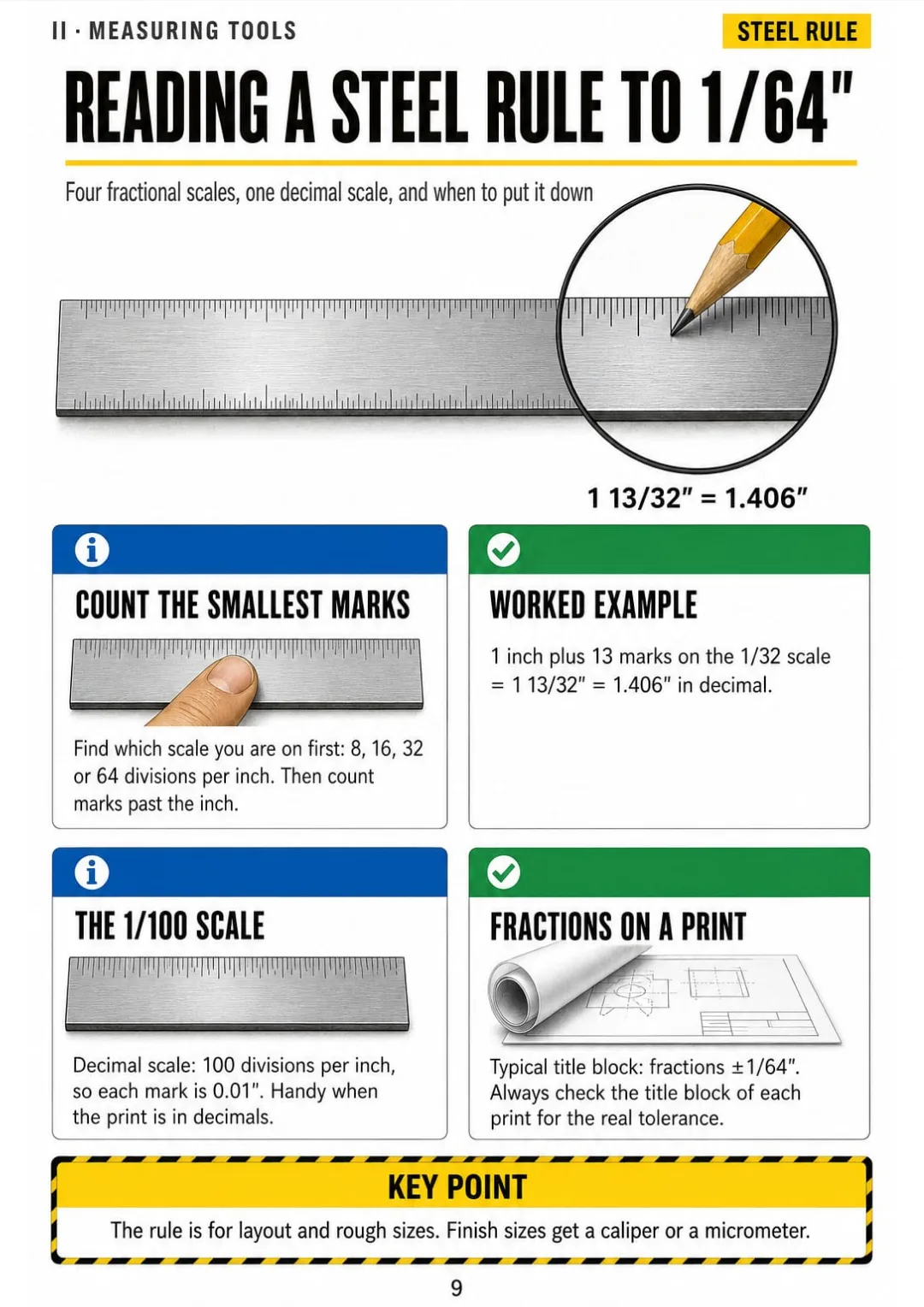
Four fractional scales and one decimal scale: 1 13/32" = 1.406".
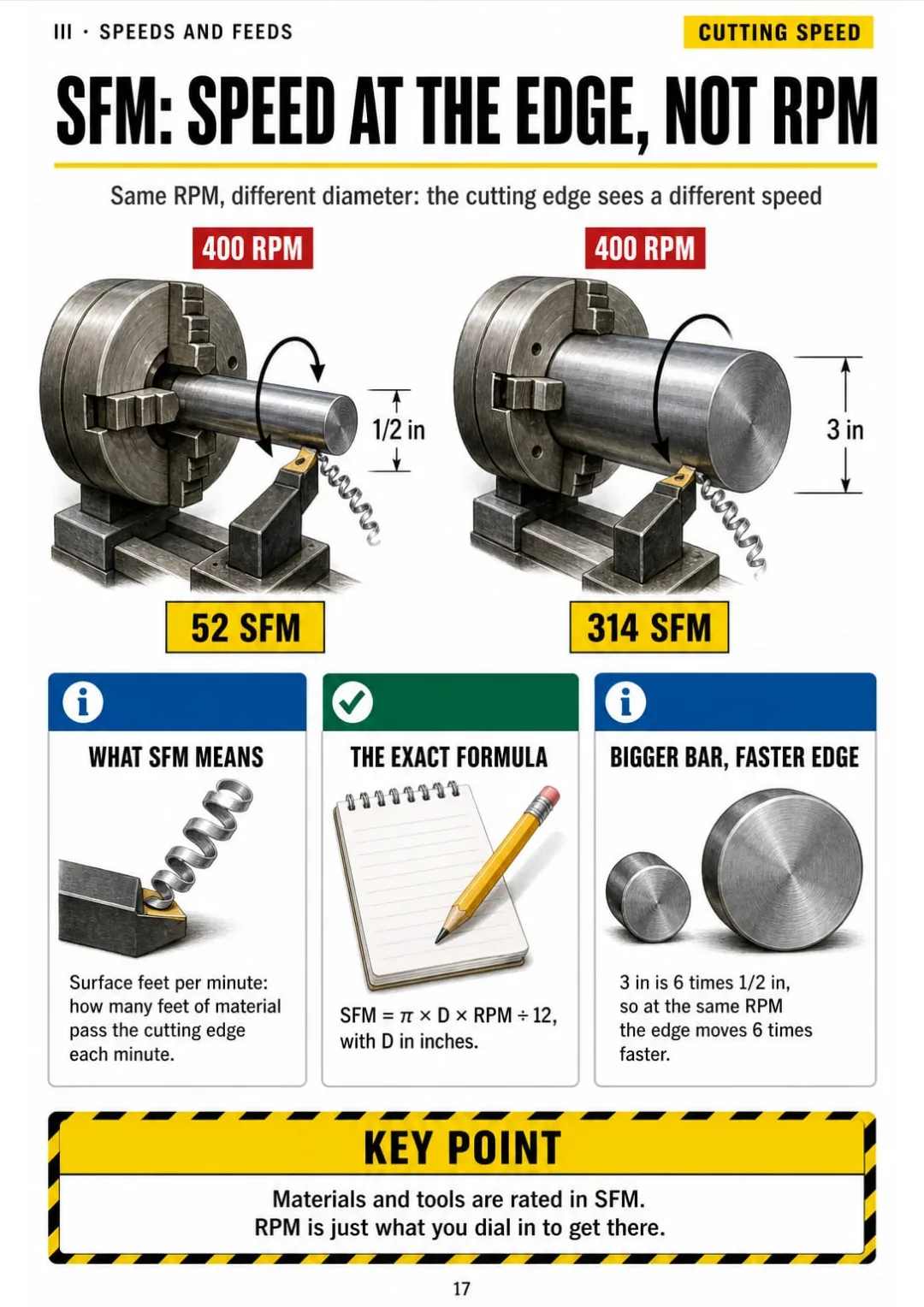
400 RPM: 52 SFM on a 1/2" bar, 314 SFM on a 3" bar
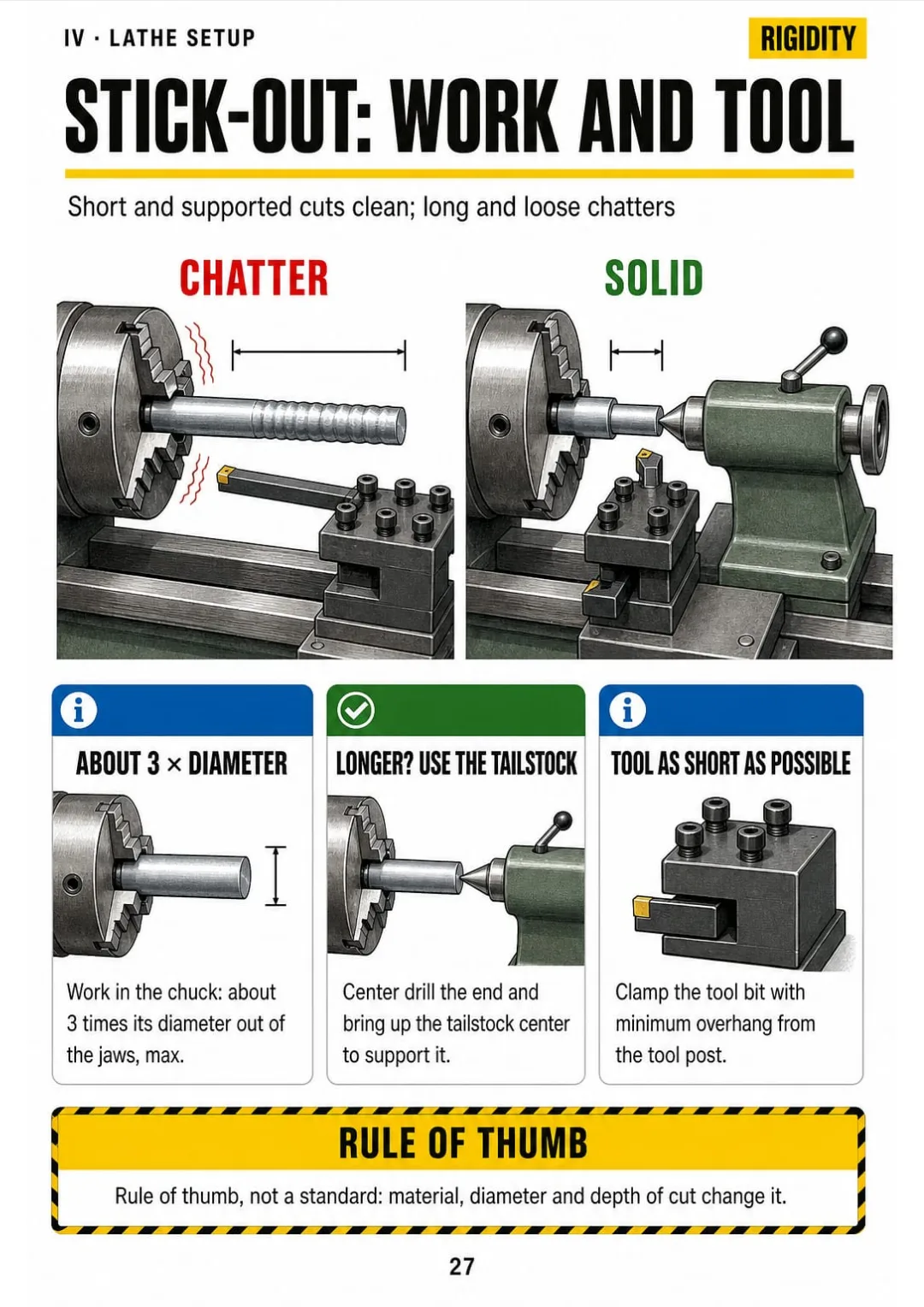
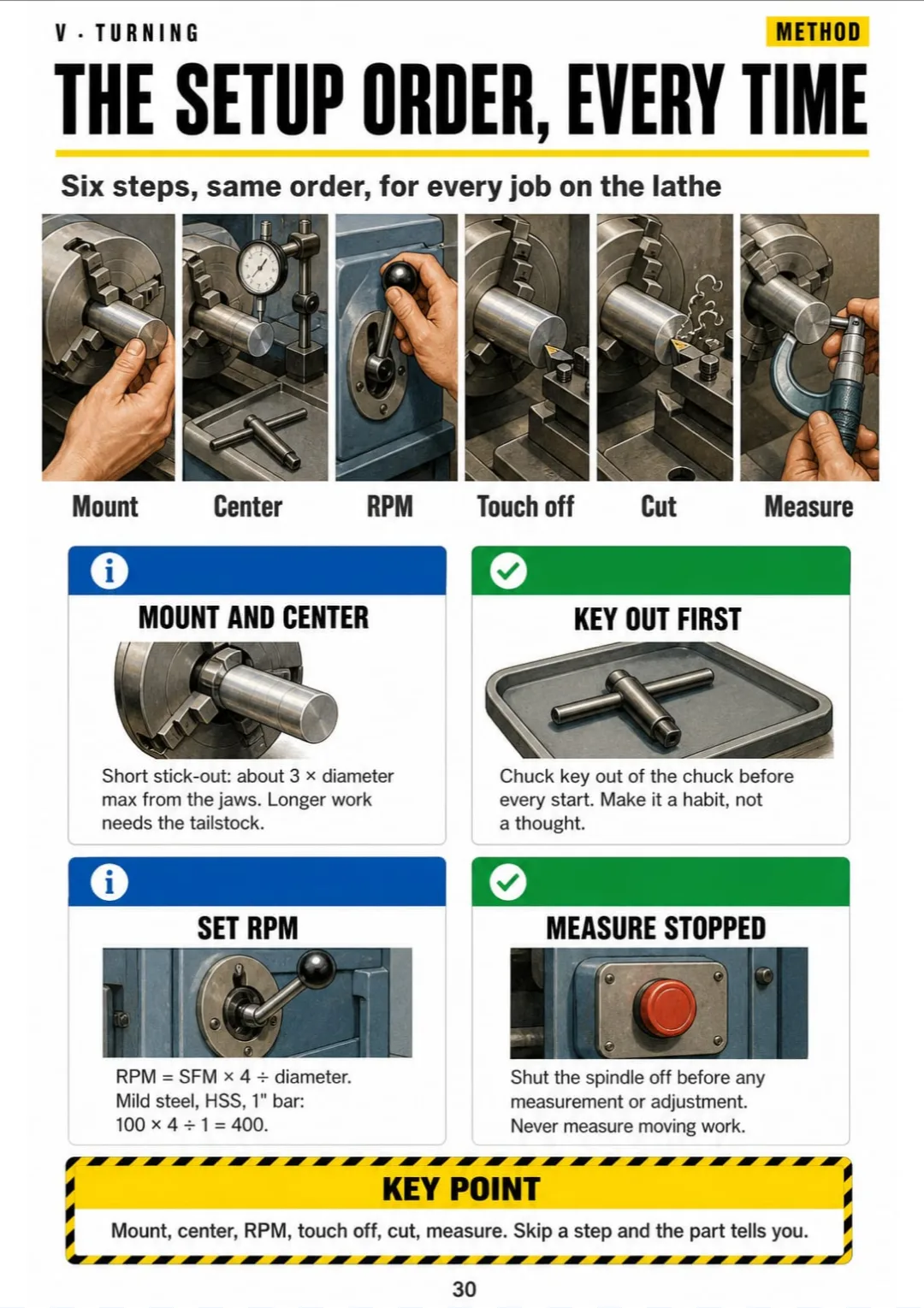
Work out of the chuck about 3 × diameter max; longer needs the tailstock.
Mount → center → RPM → touch off → cut → measure: the strip you'll see on every page.
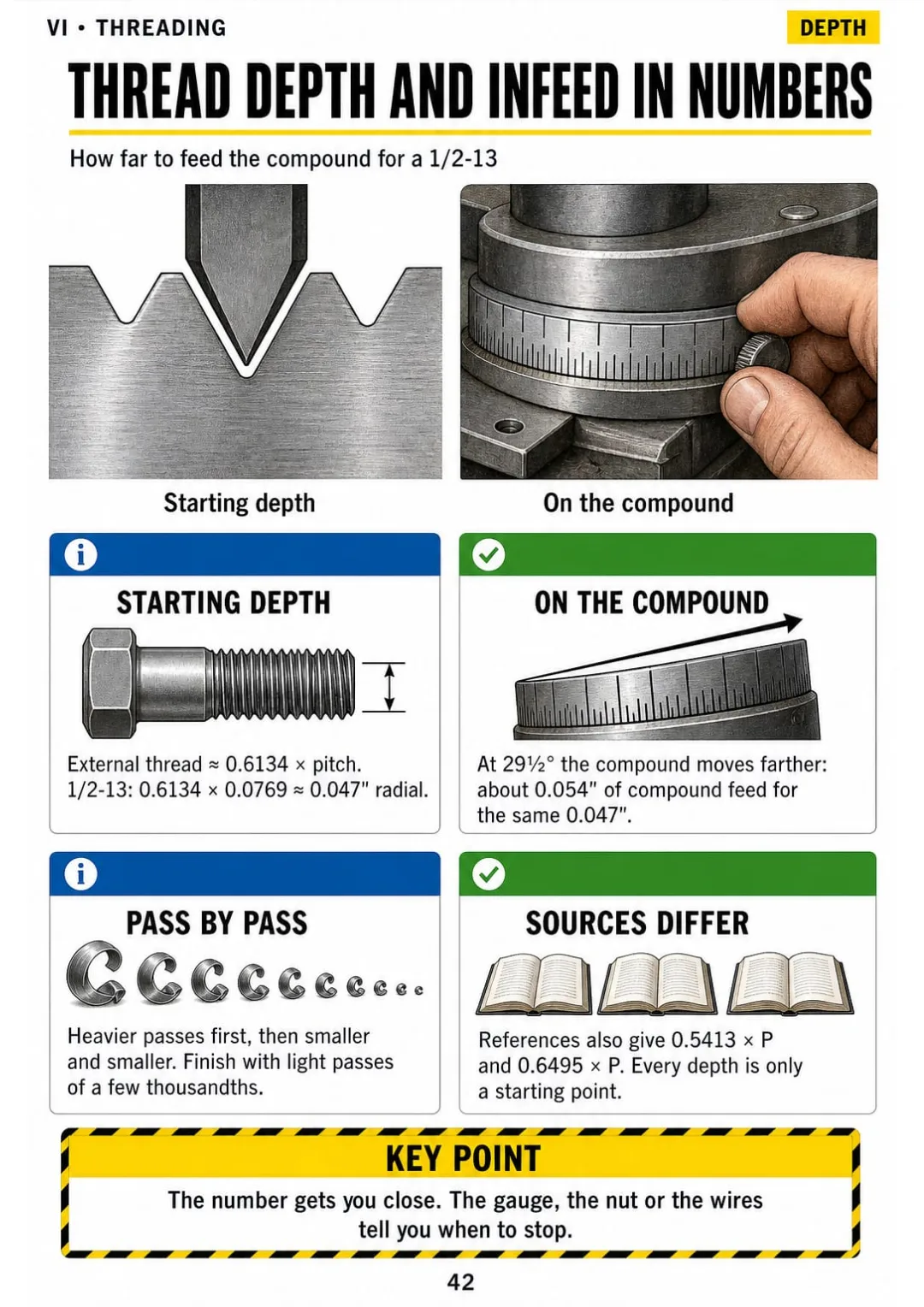
1/2-13 external: ≈ 0.047" depth, ≈ 0.054" on the compound at 29½°, then check
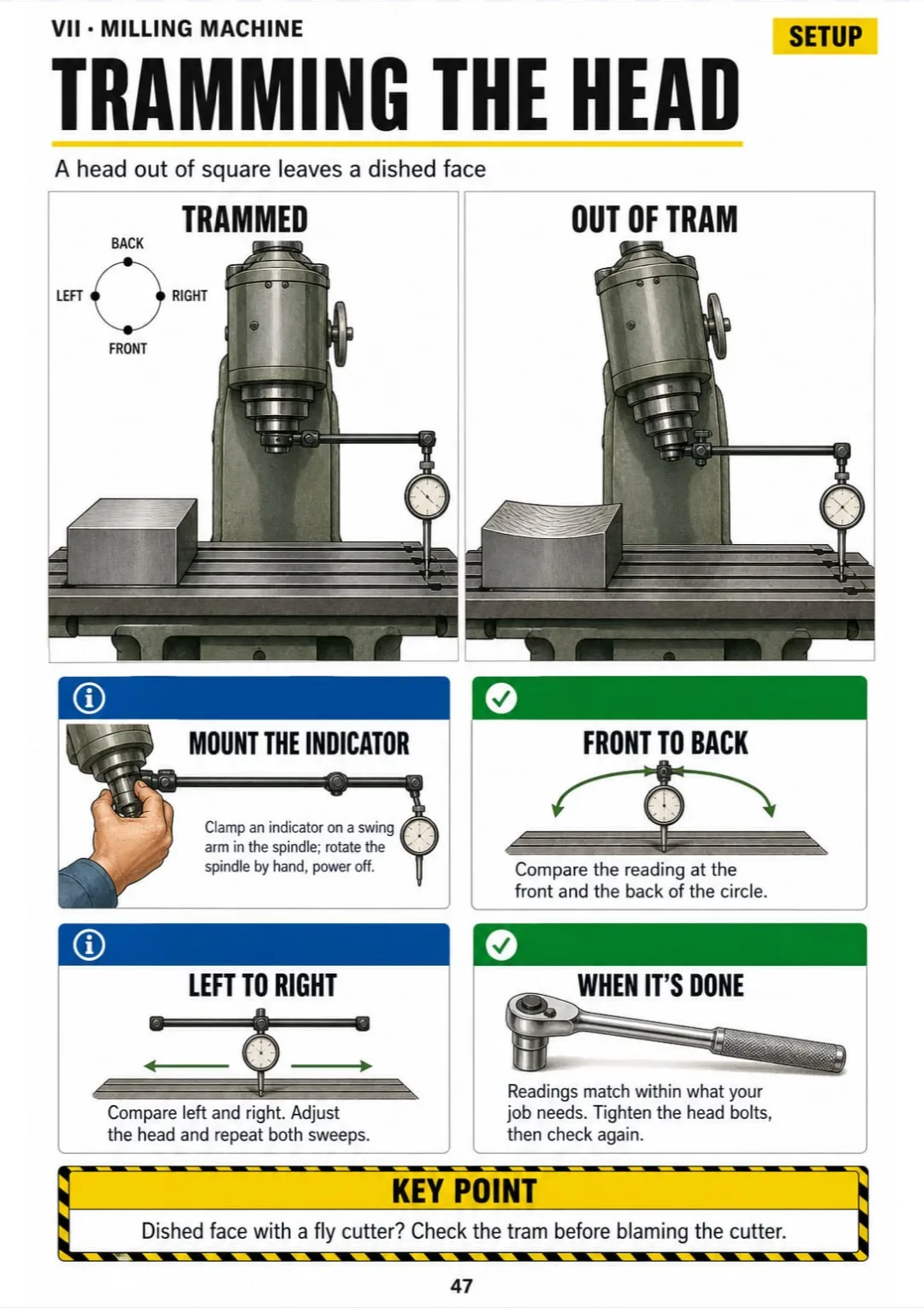
Front-back, left-right: tram the head so the face comes out flat.
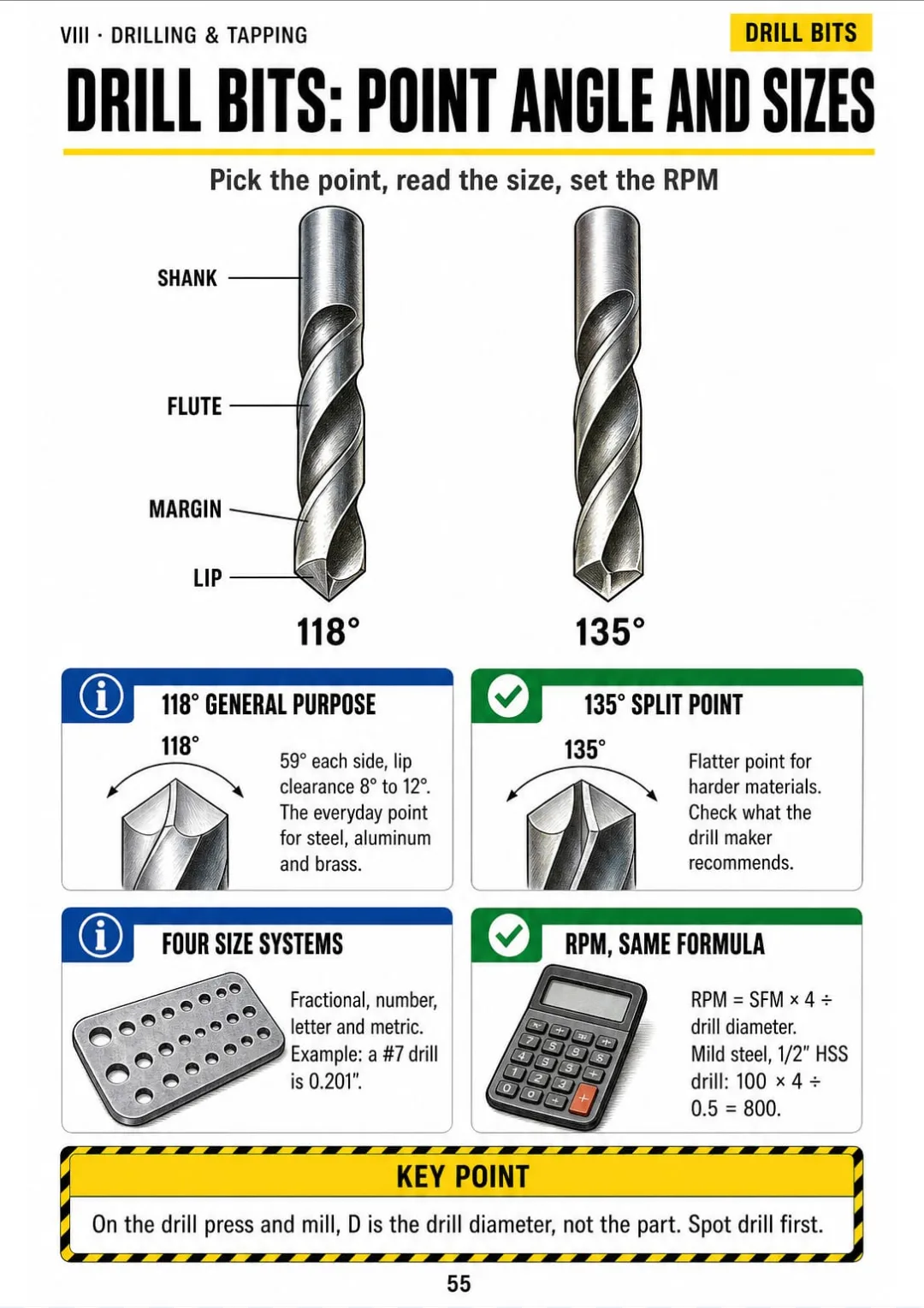
118° general point, 135° split point, #7 = 0.201", RPM = SFM × 4 ÷ D

Take a Look at the 9 Parts and 61 Topics

Safe at the Machine

pp. 5-8
  1. The 5 Rules Before You Hit the Switch
  2. The Chuck Key Never Stays in the Chuck
  3. Guards, E-Stop and Where Your Hands Go
  4. Chips, Coolant and a Clean Machine

Measuring Tools

pp. 9-16
  1. Reading a Steel Rule to 1/64"
  2. Dial and Digital Calipers in 4 Moves
  3. The Outside Micrometer: Sleeve and Thimble
  4. The Vernier Line: Reading to 0.0001"
  5. Using the Mic Without Fooling Yourself
  6. Telescoping Gauges and Small Hole Gauges
  7. The Dial Test Indicator and Dial Indicator
  8. Tolerances on a Print

Speeds and Feeds

pp. 17-22
  1. SFM: Speed at the Edge, Not RPM
  2. The RPM Formula: SFM × 4 ÷ Diameter
  3. Starting SFM by Material and Tool
  4. Feed on the Lathe: Inches per Revolution
  5. Feed on the Mill: Inches per Minute
  6. Small Bench Machines: Dial It Back

The Lathe and Its Setup

pp. 23-29
  1. Parts of the Lathe
  2. 3-Jaw, 4-Jaw and Collets
  3. Dialing In a 4-Jaw Chuck
  4. Tool on Center Height
  5. Stick-Out: Work and Tool
  6. The Cross-Slide Dial: Radius or Diameter?
  7. Backlash: Always Approach from the Same Side

Turning Operations

pp. 30-38
  1. The Setup Order, Every Time
  2. Facing to a Clean Face
  3. Center Drilling for the Tailstock
  4. Turning to Diameter in 4 Passes
  5. Turning to a Shoulder Length
  6. Boring a Hole to Size
  7. Short Tapers with the Compound
  8. Parting Off Without Jamming
  9. Knurling in One Steady Pass

Threading on the Lathe

pp. 39-44
  1. Thread Anatomy: Major, Minor, Pitch
  2. Setting Up: Gearbox, Compound at 29.5°
  3. The Thread Dial: Which Line to Engage
  4. Thread Depth and Infeed in Numbers
  5. The Threading Cycle Step by Step
  6. Checking the Thread

The Milling Machine

pp. 45-54
  1. Parts of the Knee Mill
  2. End Mills, Face Mills and Collets
  3. Tramming the Head
  4. Squaring the Vise to the Table
  5. Holding the Work in the Vise
  6. Finding an Edge with an Edge Finder
  7. Conventional vs Climb Milling
  8. Squaring a Block: The 6-Side Order
  9. Pockets and Slots
  10. Drilling a Hole Pattern on the Mill

Drilling, Tapping and Tool Grinding

pp. 55-60
  1. Drill Bits: Point Angle and Sizes
  2. Tap Drills: The Chart and the 75% Rule
  3. Tapping Without Breaking the Tap
  4. Reaming for a Precise Hole
  5. Grinding an HSS Lathe Tool
  6. Carbide Inserts in 5 Minutes

Review and Checklists

pp. 61-65
  1. Part Undersize? The 6 Usual Suspects
  2. Chatter and Bad Finish: Fix in Order
  3. Lathe Setup Checklist
  4. Mill Setup Checklist
  5. Numbers to Keep by the Machine

Who This Book Is For

You're taking a shop class

Every lesson from the shop floor has a page you can go back to that night, with the setup drawn in the same order your instructor uses at the machine.

You just started at a machine shop

You check the page before you ask the old-timer a third time: the mic reading, the RPM, the dial move, all worked out in inches.

You run a lathe in your garage

Ten videos, ten ways? Here every setup follows one order, and you can print the page and tape it next to the machine.

Plus: 2 Free Books

Machinist Practice Workbook: Reading, RPM & Depth of Cut
BONUS 1

Machinist Practice Workbook: Reading, RPM & Depth of Cut

Drill yourself on micrometer and caliper readings, RPM calculations and cross-slide dial moves, with answers, before you cut real stock.
Lathe & Mill Quick-Reference Cards
BONUS 2

Lathe & Mill Quick-Reference Cards

Print the key steps, angles and setup orders on cards to keep at the machine, so you check instead of guessing.

30-Day Guarantee

30-day guarantee: if a file doesn't open, if the content isn't what the product page describes, if you were charged twice or the email never arrived, write to us and we'll refund you in full. You pay once. No subscriptions.

Frequently Asked Questions

Is it for beginners, or for someone who already runs a lathe? And on a small bench lathe?

Both. It starts from the steel rule and the parts of the lathe, and goes up to threading and squaring a block, so it works as a first book or as a reference at the machine. Everything works the same way on a bench lathe, and one page covers small bench machines specifically: how to dial back speed and depth of cut.

Where does the content come from?

Safety follows OSHA general machine guarding (29 CFR 1910.212), threads follow ASME B1.1 Unified Inch Screw Threads, and print conventions follow ASME Y14.5. Cutting speeds are rounded starting points with worked examples in inches. Always check them against your tool maker's data.

Is it official material?

No. It's an independent illustrated book. It isn't affiliated with or endorsed by OSHA, ASME or any machine or tool manufacturer.

Does it replace a shop class or training?

No. It's study material to keep next to the machine. It doesn't replace hands-on training, supervision or your machine's manual.

I already know how to face a part. Is it too basic for me?

It starts with safety and the steel rule, but most of the book goes past that: the cross-slide dial and backlash, dialing in a 4-jaw, thread depth and infeed, tramming the head, tap drills and the 75% rule, and the 6 usual suspects when a part comes out undersize. The workbook problems were written for this book, with answers included.

When and how do I get it?

The book and the 2 bonus books arrive as a PDF by email, at the address you enter at checkout.

Do I have to pay every month?

No. It's a one-time payment.

Can I have it on paper?

We don't ship a printed copy. You get a PDF by email, laid out to print at home or at a print shop, so you can keep the pages and the quick-reference cards at the machine.

How does the refund work?

You have 30 days. We refund everything if the file won't open, if the book isn't what you see on this page, if you were charged twice or if the email doesn't arrive: just email us.

US$ 27US$ 63
Get the book · US$ 27

This is a digital PDF book sent to your email: nothing is printed or shipped.