Study in Pictures🌐 English (United States)
Machine Troubleshooting Illustrated

Digital book in PDF · read it on your phone or print it

Machine Troubleshooting Illustrated

Lockout/tagout, the 5-step method, noise and vibration, voltage unbalance, failed bearings, pump cavitation, hydraulic schematics and ladder diagrams. Every topic gets its own page: the drawing first, then what you need to remember.

  • 70 illustrated pages
  • English
  • 30-day guarantee
US$ 27US$ 63
Get the book · US$ 27

Price shown for: United States. In other countries, the checkout shows the price that applies there.

About this book

What it is

Lockout/tagout, the 5-step method, noise and vibration, voltage unbalance, failed bearings, pump cavitation, hydraulic schematics and ladder diagrams. Every topic gets its own page: the drawing first, then what you need to remember.

Who This Book Is For
  • You just moved into maintenance
  • You've been fixing machines for years
  • You lead the maintenance crew
What it covers
  1. Before You Touch Anything
  2. The 5-Step Method
  3. Reading the Evidence
  4. Electric Motors
  5. Bearings, Couplings and Drives
  6. Pumps
  7. Hydraulics and Pneumatics
  8. Conveyors and Simple Control Circuits
  9. Practice and Quick Review
Language
English (United States)
Pages
70
Format
Digital book in PDF · read it on your phone or print it
Price
US$ 27 (United States)
Delivery
This is a digital PDF book sent to your email: nothing is printed or shipped.
30-Day Guarantee
30-day guarantee: if a file doesn't open, if the content isn't what the product page describes, if you were charged twice or the email never arrived, write to us and we'll refund you in full.

Look Inside the Book

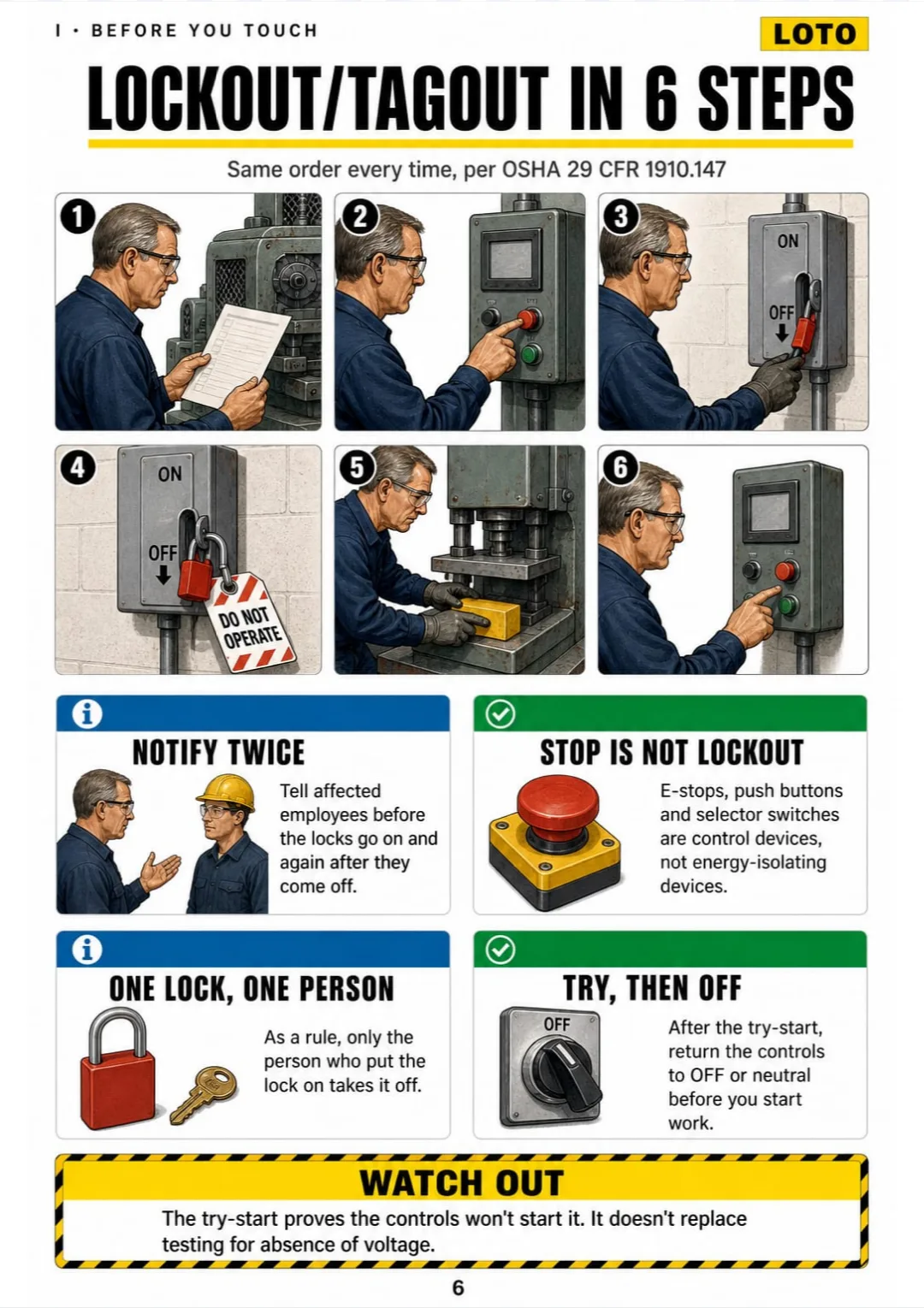
Prepare, shut down, isolate, lock and tag, release stored energy, verify: the 6 OSHA steps in order.
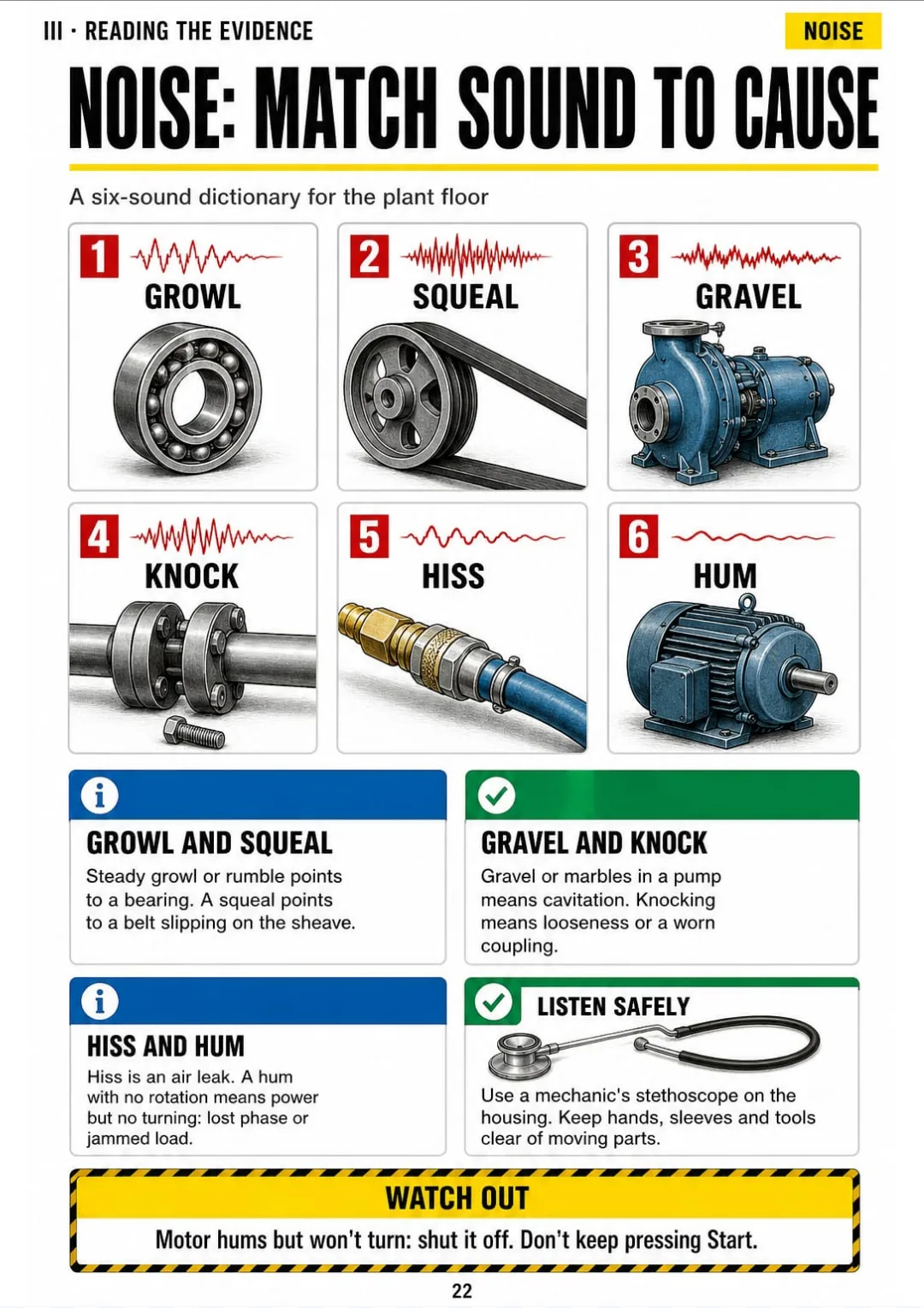
Growl = bearing, squeal = belt, gravel = cavitation, knock = looseness, hiss = air, hum = powered but stuck.
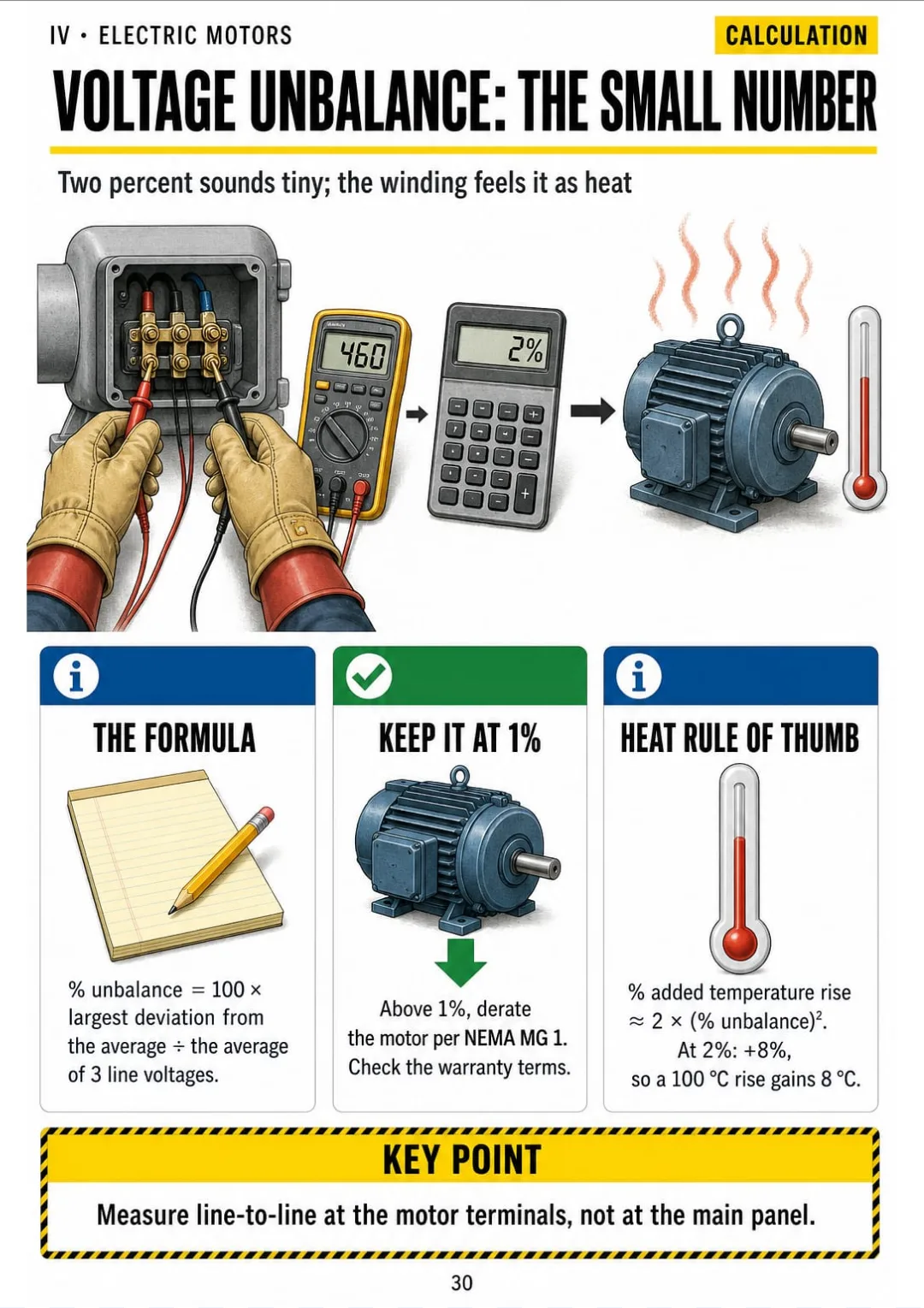
460, 467, 450 V → about 2% unbalance → keep it at 1% or less
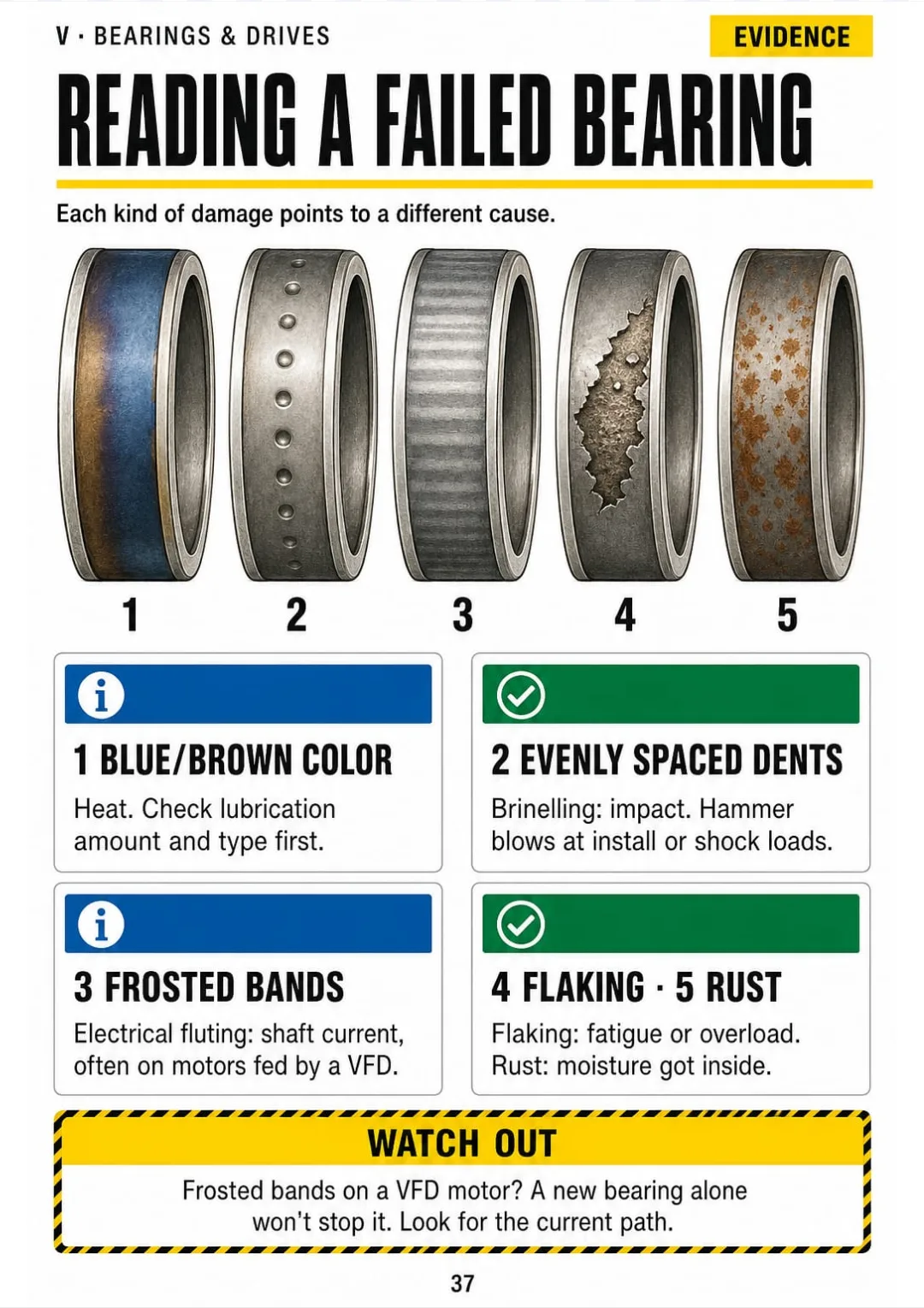
Discoloration, dents, frosted bands, flaking, rust: what each one says.
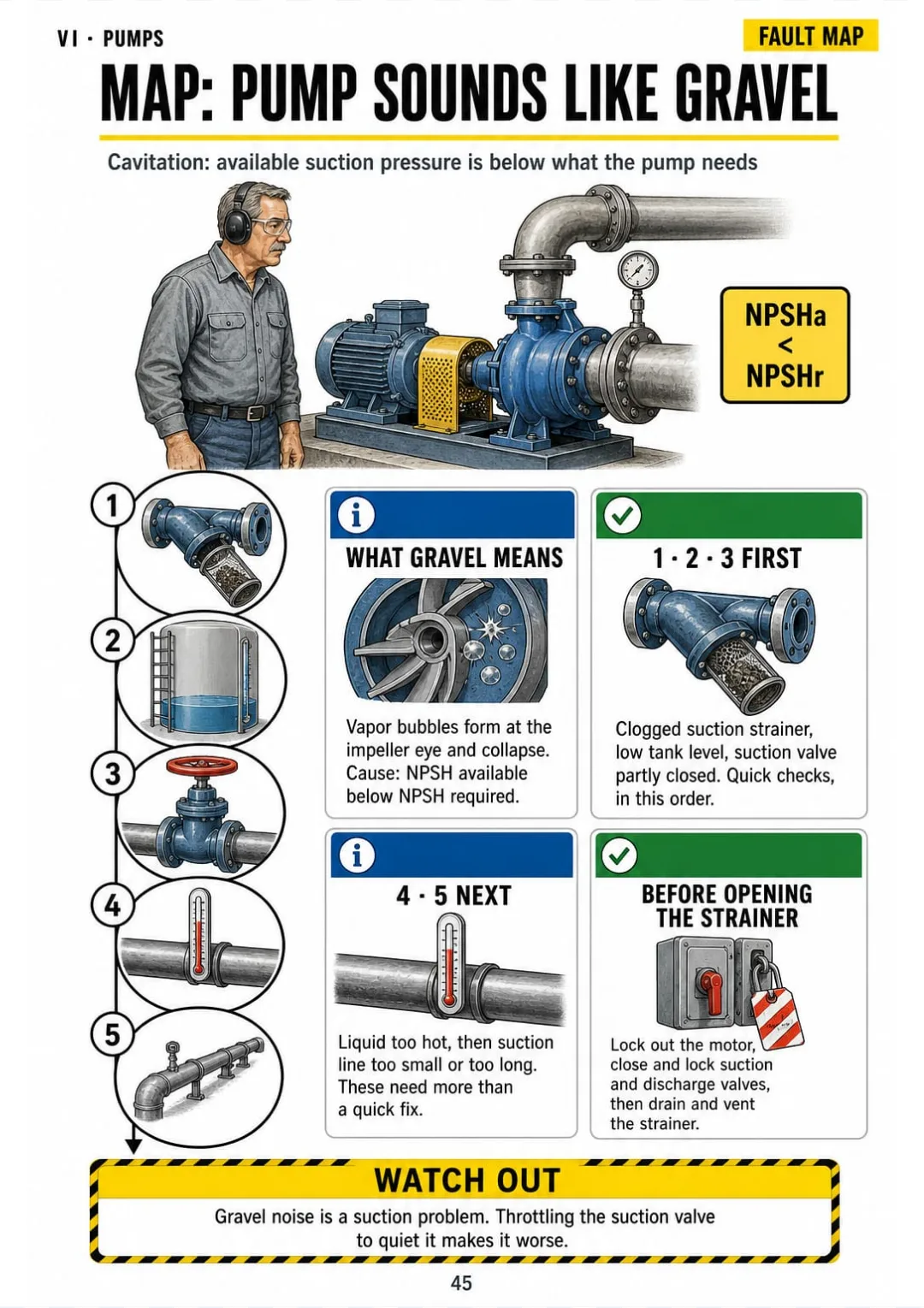
Cavitation map: strainer → tank level → suction valve → liquid temperature → suction line.
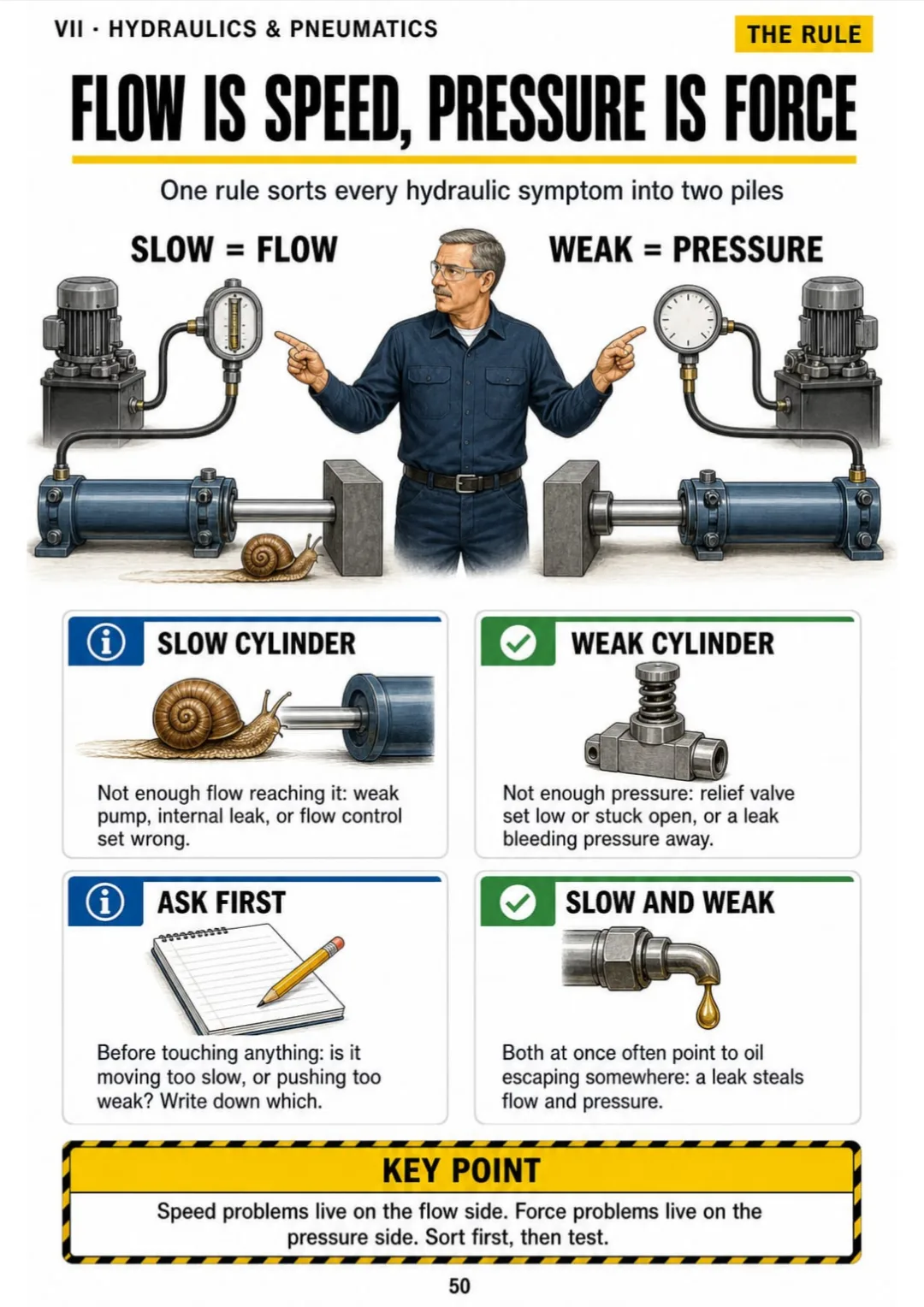
Slow = flow problem. Weak = pressure problem. One cylinder, two gauges.
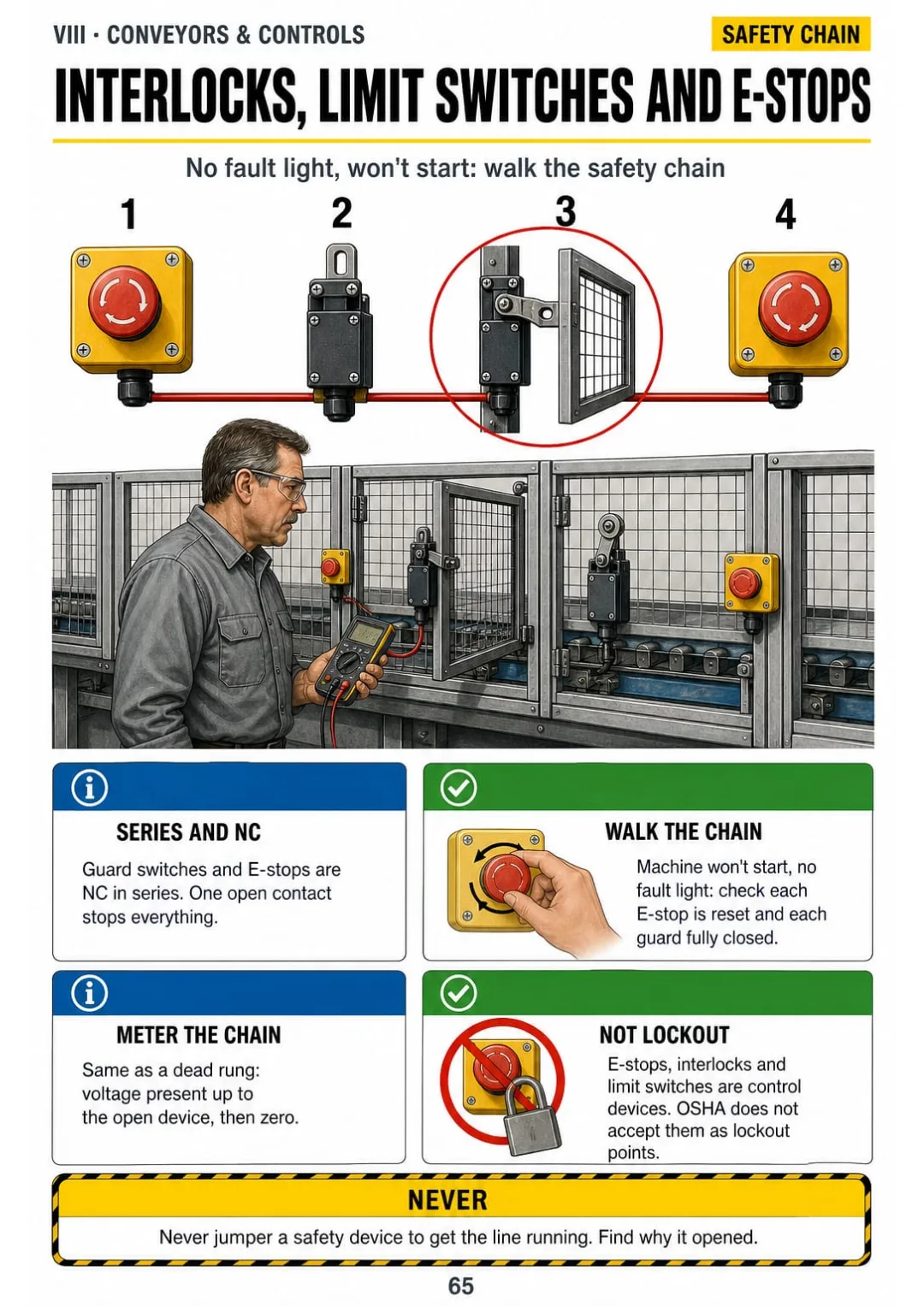
Safety chain: NC devices in series; one open contact stops the whole machine.
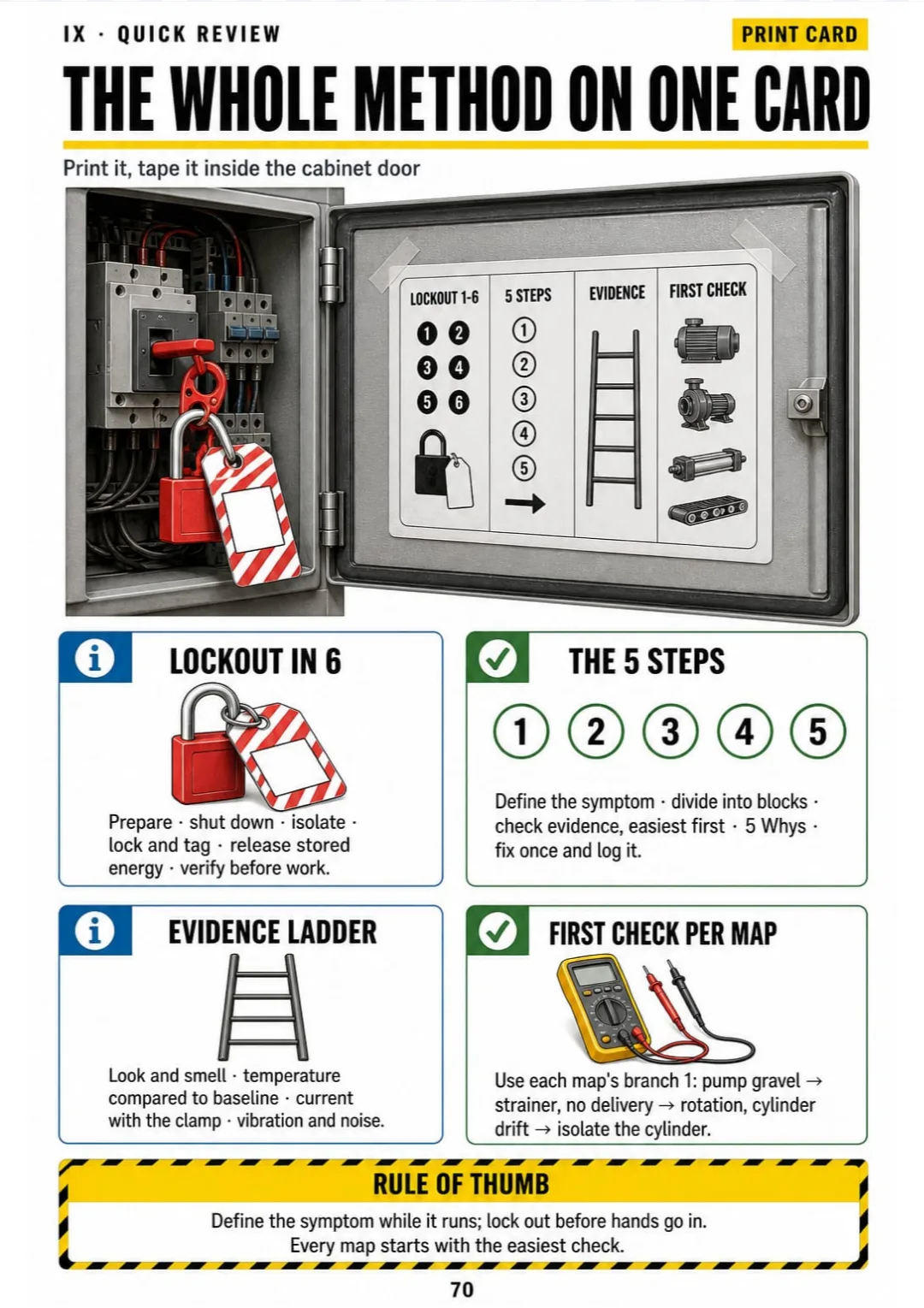
Lockout in 6, the 5 steps, the evidence ladder and each map's first check on one printable card.

Take a Look at the 9 Parts and 66 Topics

Before You Touch Anything

pp. 5-10
  1. Why Swapping Parts Doesn't Fix the Machine
  2. Lockout/Tagout in 6 Steps
  3. Stored Energy: The Machine Is Off but Not Dead
  4. Live-Dead-Live: Testing for Absence of Voltage
  5. Troubleshooting Live: When It's Allowed and What You Wear
  6. Your Basic Kit and What Each Tool Tells You

The 5-Step Method

pp. 11-18
  1. The 5 Steps on One Page
  2. Step 1: Define the Symptom in One Sentence
  3. Step 1 Bonus: Ask the Operator the Right Way
  4. Step 2: Divide the System into Blocks
  5. Step 2: Half-Splitting
  6. Step 3: Check the Evidence, Easiest First
  7. Step 4: Confirm the Root Cause with 5 Whys
  8. Step 5: Fix It Once and Write It Down

Reading the Evidence

pp. 19-26
  1. Baselines: You Can't Spot 'Abnormal' Without 'Normal'
  2. Temperature: Compare, Don't Guess
  3. Vibration: What 1x and 2x Tell You
  4. Noise: Matching the Sound to the Cause
  5. Pressure Gauges: Where You Put Them Decides What You See
  6. Current: The Clamp Meter Tells the Motor's Story
  7. Look and Smell: The Free Evidence
  8. Intermittent Faults: Catch the Moment

Electric Motors

pp. 27-35
  1. Reading the Motor Nameplate
  2. Map: Motor Hums but Won't Start
  3. Map: Motor Trips the Overload
  4. Voltage Unbalance: The Small Number That Burns Motors
  5. Map: Motor Runs Hot
  6. Insulation Testing: The Megger Without Fear
  7. Map: Motor Runs Backward or Speed Is Wrong
  8. VFD Faults Without Panic
  9. Contactors and Overload Relays

Bearings, Couplings and Drives

pp. 36-43
  1. Why Bearings Really Fail
  2. Reading a Failed Bearing
  3. Greasing: More Is Not Better
  4. Map: Bearing Runs Hot
  5. Shaft Alignment Basics
  6. Soft Foot: The Check Before Alignment
  7. V-Belts: Tension and Wear
  8. Map: Gearbox Noisy or Hot

Pumps

pp. 44-49
  1. A Centrifugal Pump in One Drawing
  2. Map: Pump Sounds Like Gravel
  3. Map: Pump Runs but Doesn't Deliver
  4. Pump Curves Without Math
  5. Map: Mechanical Seal Leaks
  6. Positive Displacement Pumps: Different Rules

Hydraulics and Pneumatics

pp. 50-57
  1. Hydraulics: Flow Is Speed, Pressure Is Force
  2. Reading a Hydraulic Schematic
  3. Map: Cylinder Drifts or Won't Hold
  4. Map: Hydraulic System Runs Hot
  5. Contamination: The Silent Cause
  6. Pneumatics: The FRL and Plant Air
  7. Map: Air Cylinder Slow, Weak or Erratic
  8. Solenoid Valves: Electrical or Mechanical?

Conveyors and Simple Control Circuits

pp. 58-65
  1. Conveyor Belt Tracking Rule
  2. Map: Conveyor Belt Slips or Stalls
  3. Chain Drives and Roller Conveyors
  4. Reading a Ladder Diagram
  5. The Start-Stop Circuit with Seal-In
  6. Tracing a Dead Rung with Your Meter
  7. Sensors: PNP, NPN and the LED
  8. Interlocks, Limit Switches and E-Stops

Practice and Quick Review

pp. 66-70
  1. Worked Case: Pump Seal Every Three Weeks
  2. Worked Case: Motor Trips Every Afternoon
  3. Most Frequent Troubleshooting Mistakes
  4. Explaining the Failure to Your Supervisor
  5. The 5-Step Method on One Card

Who This Book Is For

You just moved into maintenance

You get one sequence to follow on every breakdown, so you know where to start instead of watching someone else and guessing.

You've been fixing machines for years

You already know the machines. The book puts your experience in a fixed sequence, one map per symptom, so the same failure stops coming back.

You lead the maintenance crew

You hand your new techs the same 5 steps you use, drawn and printable, so everyone on every shift troubleshoots the same way.

Plus: 2 Free Books

Shop-Floor Case Drills
BONUS 1

Shop-Floor Case Drills

Real-style breakdown scenarios to work through with the 5-step method, with the answer path drawn on the next page, so the order sticks before the next call.
Symptom Quick Cards
BONUS 2

Symptom Quick Cards

One printable card per common symptom with the first checks in order, small enough to keep in your toolbox or tape inside the cabinet door.

30-Day Guarantee

30-day guarantee: if a file doesn't open, if the content isn't what the product page describes, if you were charged twice or the email never arrived, write to us and we'll refund you in full. You pay once. No subscriptions.

Frequently Asked Questions

Is it for me if I've been in maintenance for years?

Yes. It's not a beginner course: it's one fixed sequence to go from symptom to root cause, with a drawn map per symptom. It doesn't depend on your brand of motor, pump or valve: it shows what to measure and in what order. For brand-specific settings and fault codes, you still use the manufacturer's manual.

Where does the content come from?

Safety steps follow the OSHA lockout/tagout rule (29 CFR 1910.147) and NFPA 70E; motor checks follow NEMA MG 1 criteria. The book explains them in its own words and drawings and doesn't reproduce any standard.

Is it official material?

No. It's an independent illustrated reference. It isn't issued, approved or endorsed by OSHA, NFPA, NEMA or any manufacturer.

Does it replace my training?

No. It doesn't replace your employer's training, your plant's lockout/tagout procedure or the equipment manufacturer's instructions. It helps you put what you know in order.

Do I get a certificate?

No. It's a reference book, not a course: there's no certificate or credential. The case drills are written for this book to practice the 5-step method on shop-floor breakdowns.

When and how do I get it?

As a PDF by email, sent to the address you enter at checkout. The 2 bonus books come the same way.

Do I have to pay every month?

No. It's a one-time payment. No subscription.

Can I get it on paper?

It's a PDF, so you can print the whole book or just the pages you need and keep them in the shop or your toolbox.

How does the refund work?

You have 30 days. We refund everything if the file won't open, if the book isn't what you see on this page, if you were charged twice or if the email doesn't arrive: just email us.

US$ 27US$ 63
Get the book · US$ 27

This is a digital PDF book sent to your email: nothing is printed or shipped.