Study in Pictures🌐 English (Ireland)
PPL Theory Illustrated

Digital book in PDF · read it on your phone or print it

PPL Theory Illustrated

Air law, airspace, hypoxia, fronts, METARs, the pitot-static instruments, mass and balance, the wind triangle and squawk codes. Each topic has its own page: the drawing first, then what you need to remember.

  • 65 illustrated pages
  • English
  • 30-day guarantee
€19.90€58.20
Get the book · €19.90

Price shown for: Ireland. In other countries, the checkout shows the price that applies there.

About this book

What it is

Air law, airspace, hypoxia, fronts, METARs, the pitot-static instruments, mass and balance, the wind triangle and squawk codes. Each topic has its own page: the drawing first, then what you need to remember.

Who This Book Is For
  • You're starting ground school
  • Your exam sitting is close
  • You're already flying with an instructor
What it covers
  1. Before You Start
  2. Air Law and Airspace
  3. Human Performance
  4. Meteorology
  5. Principles of Flight and the Aircraft
  6. Performance, Planning and Mass and Balance
  7. Navigation
  8. Communications and Operational Procedures
  9. Final Review
Language
English (Ireland)
Pages
65
Format
Digital book in PDF · read it on your phone or print it
Price
€19.90 (Ireland)
Delivery
This is a digital PDF book sent to your email: nothing is printed or shipped.
30-Day Guarantee
30-day guarantee: if a file doesn't open, if the content isn't what the product page describes, if you were charged twice or the email never arrived, write to us and we'll refund you in full.

Look Inside the Book

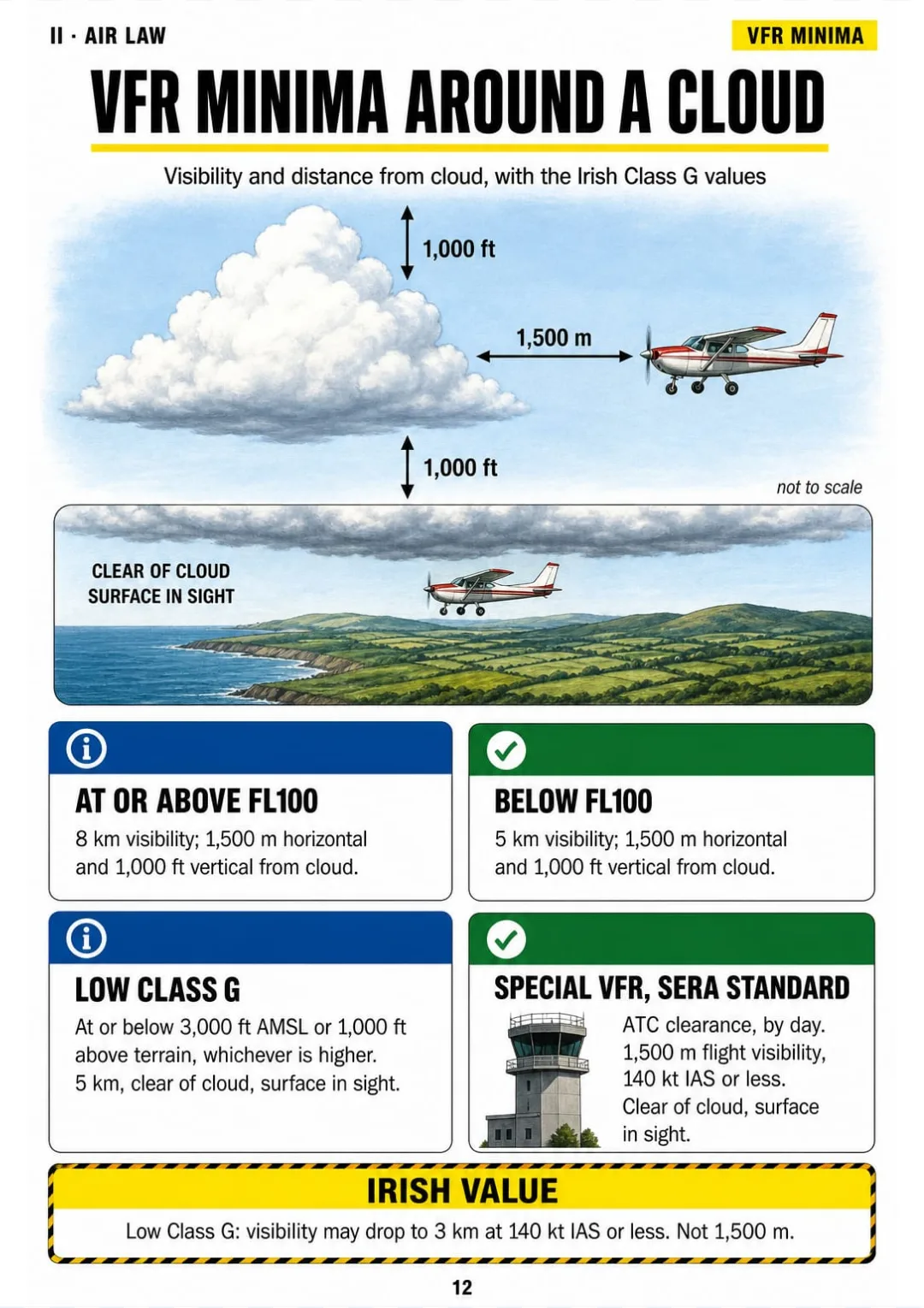
Below FL100: 5 km, 1,500 m and 1,000 ft · low Class G: 3 km at 140 kt or less.
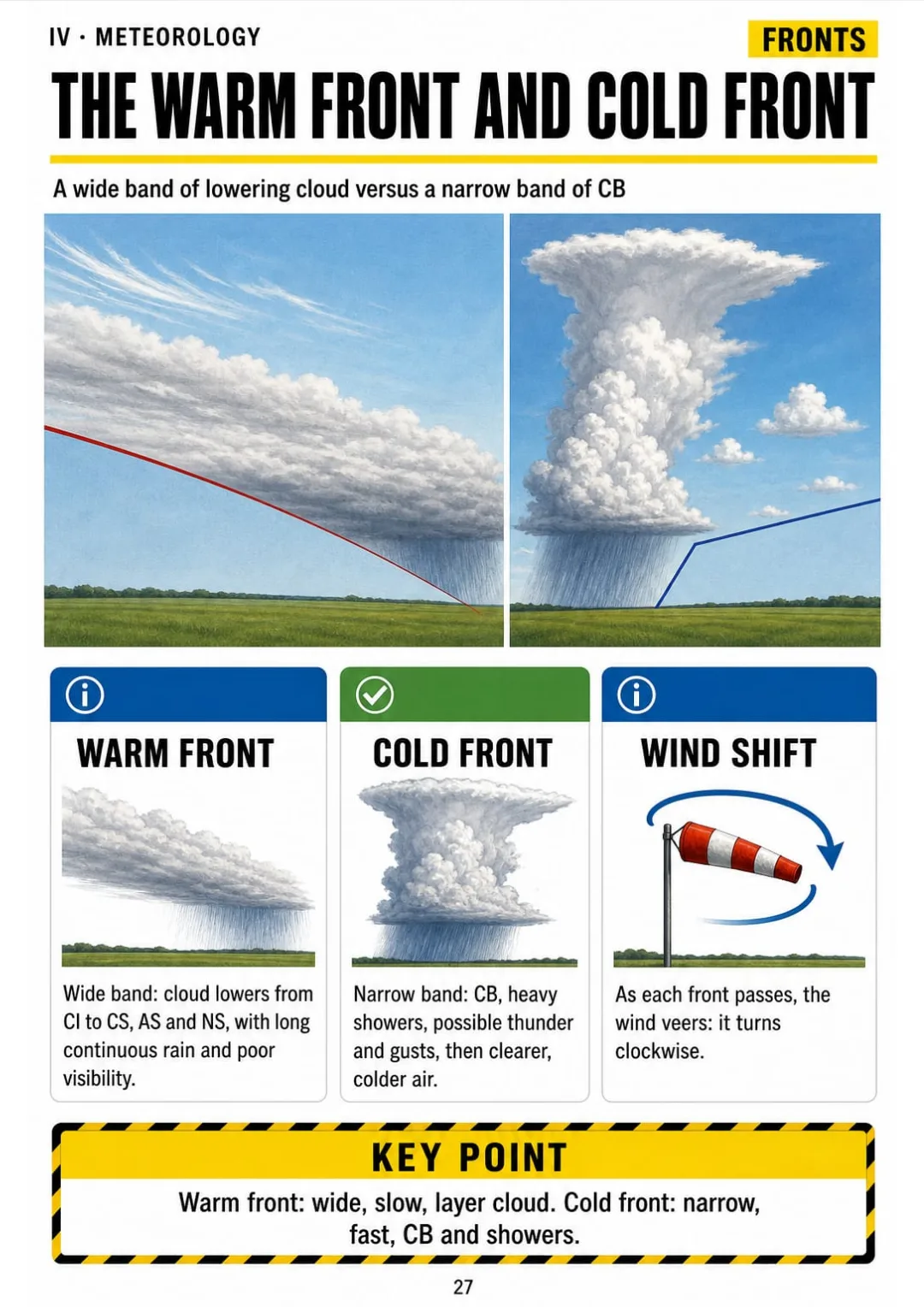
Warm front: CI, CS, AS to NS over a wide band · Cold front: CB in a narrow band
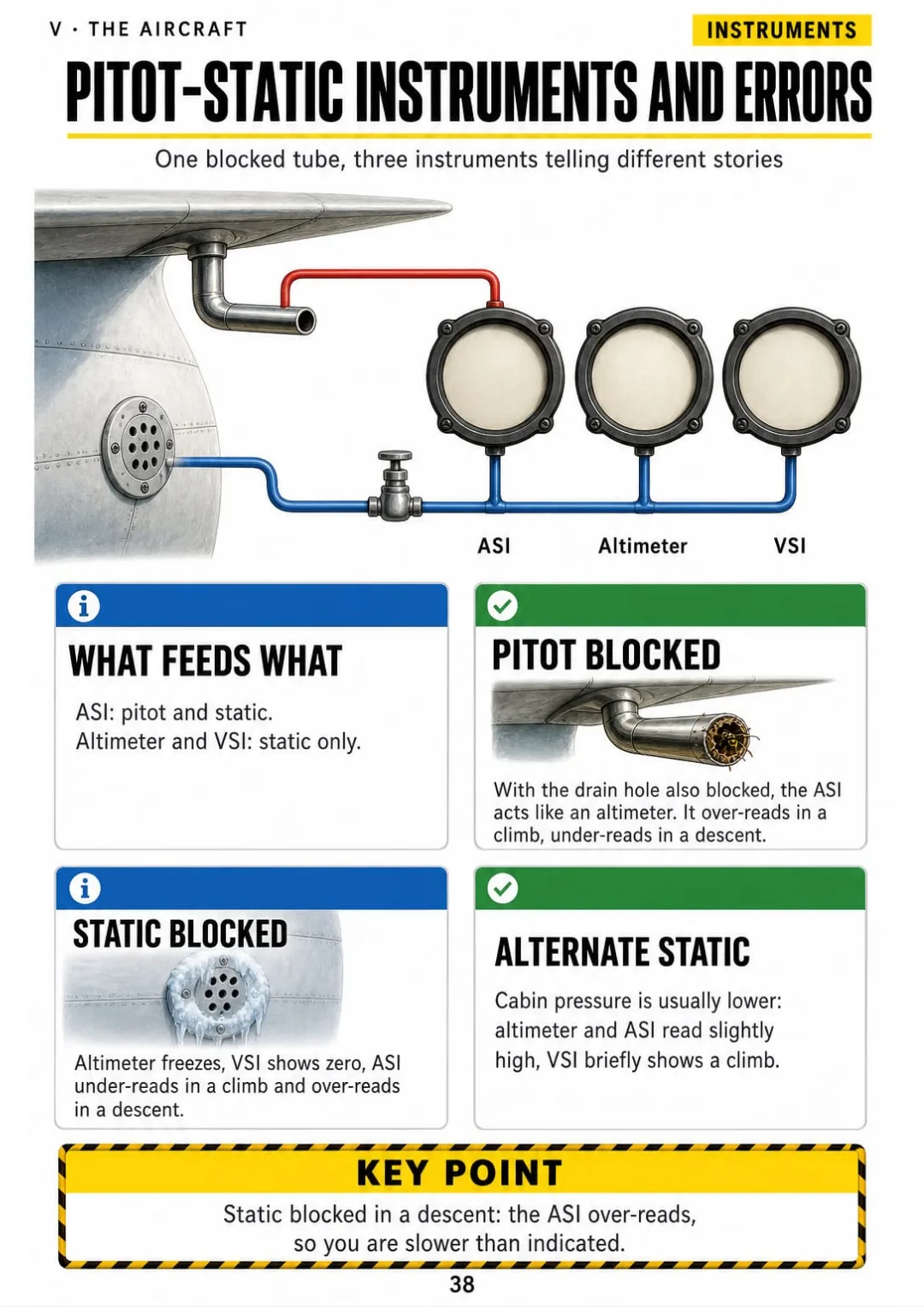
Pitot or static blocked: what the ASI, altimeter and VSI show, plus the alternate static source.
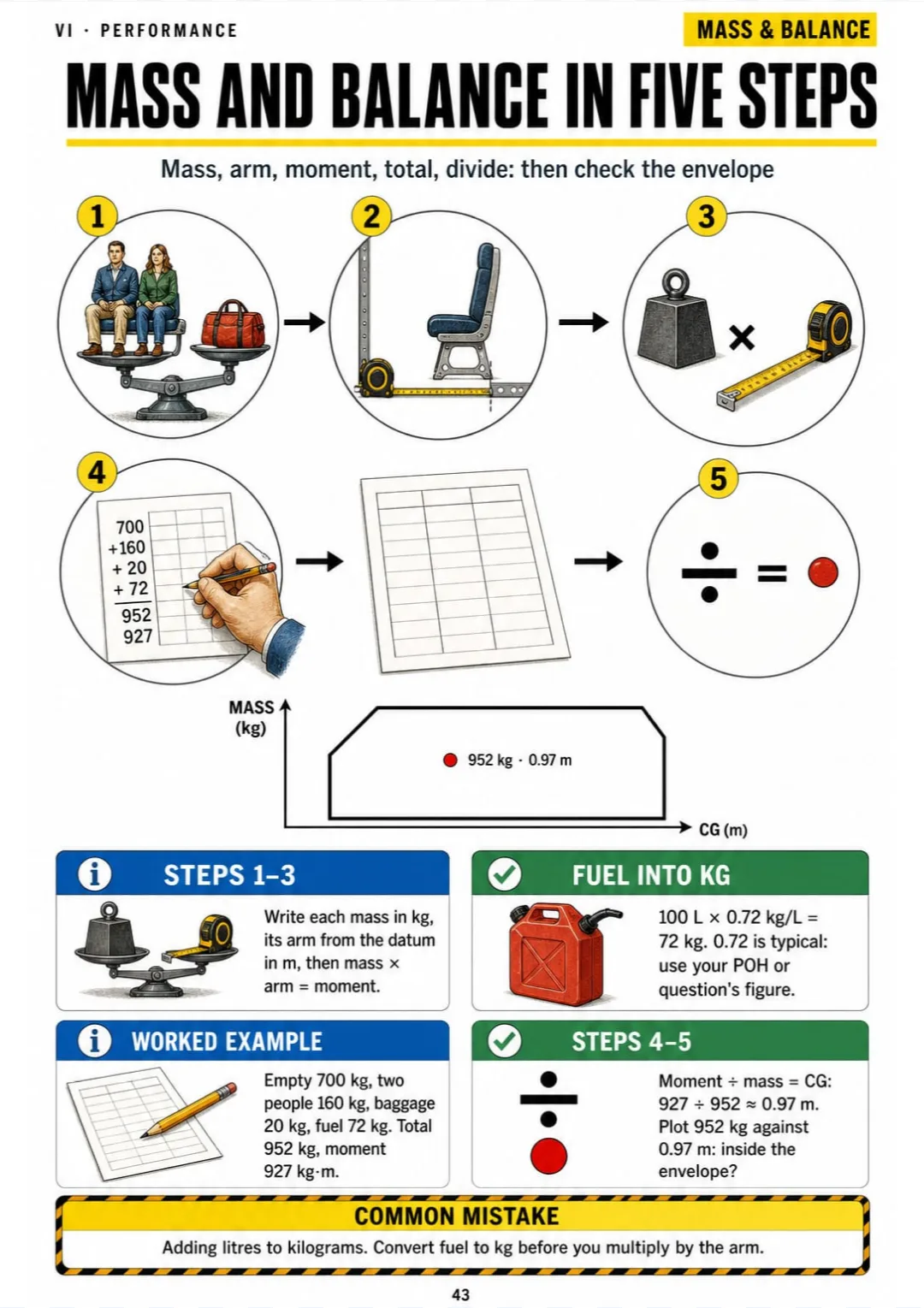
Mass × arm = moment; total moment ÷ total mass = CG, then check it against the envelope.
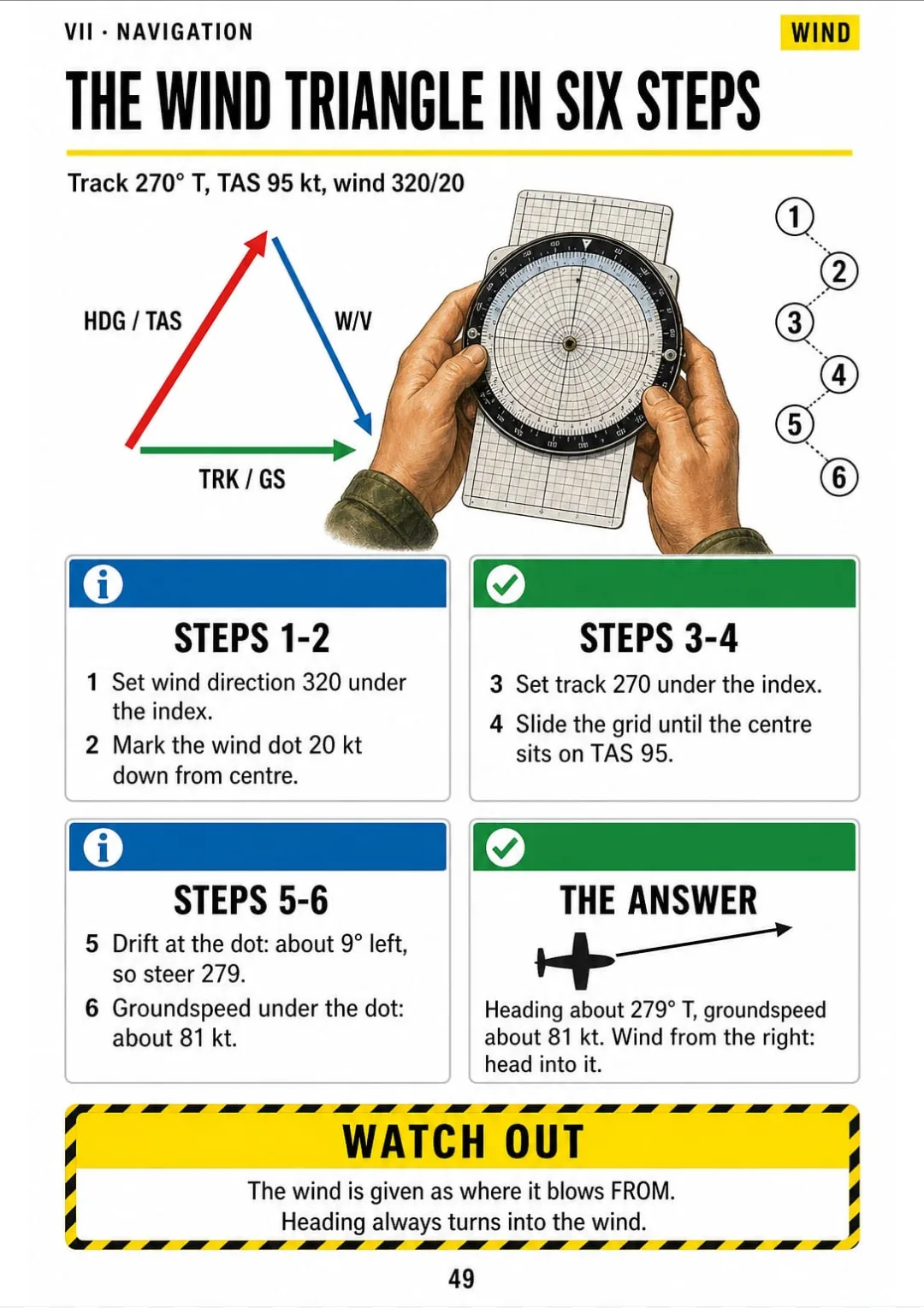
270° T, 95 kt, wind 320/20: heading about 279° T, GS about 81 kt
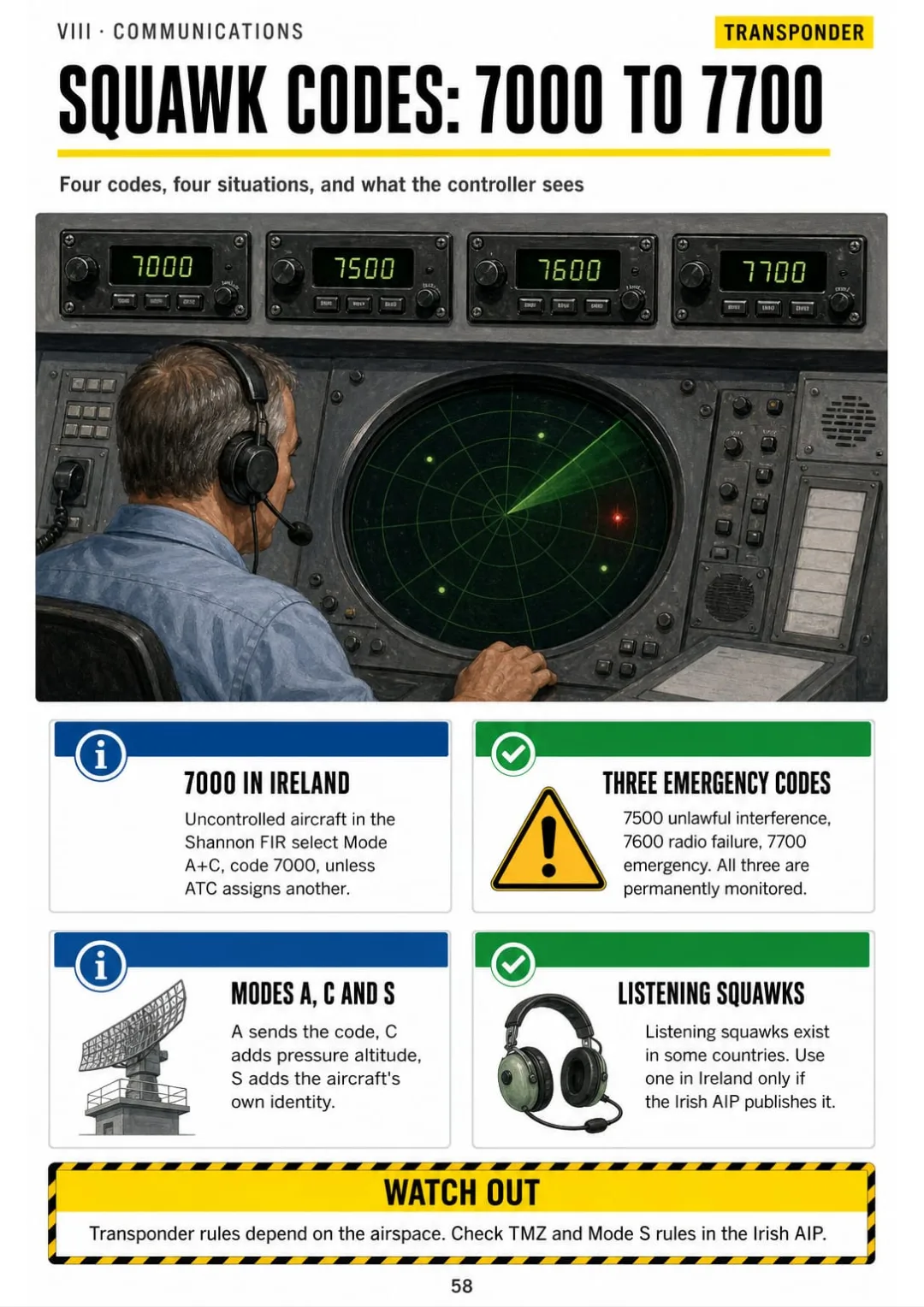
7000 VFR, 7500 hijack, 7600 radio failure, 7700 emergency, as in AIP Ireland ENR 1.6
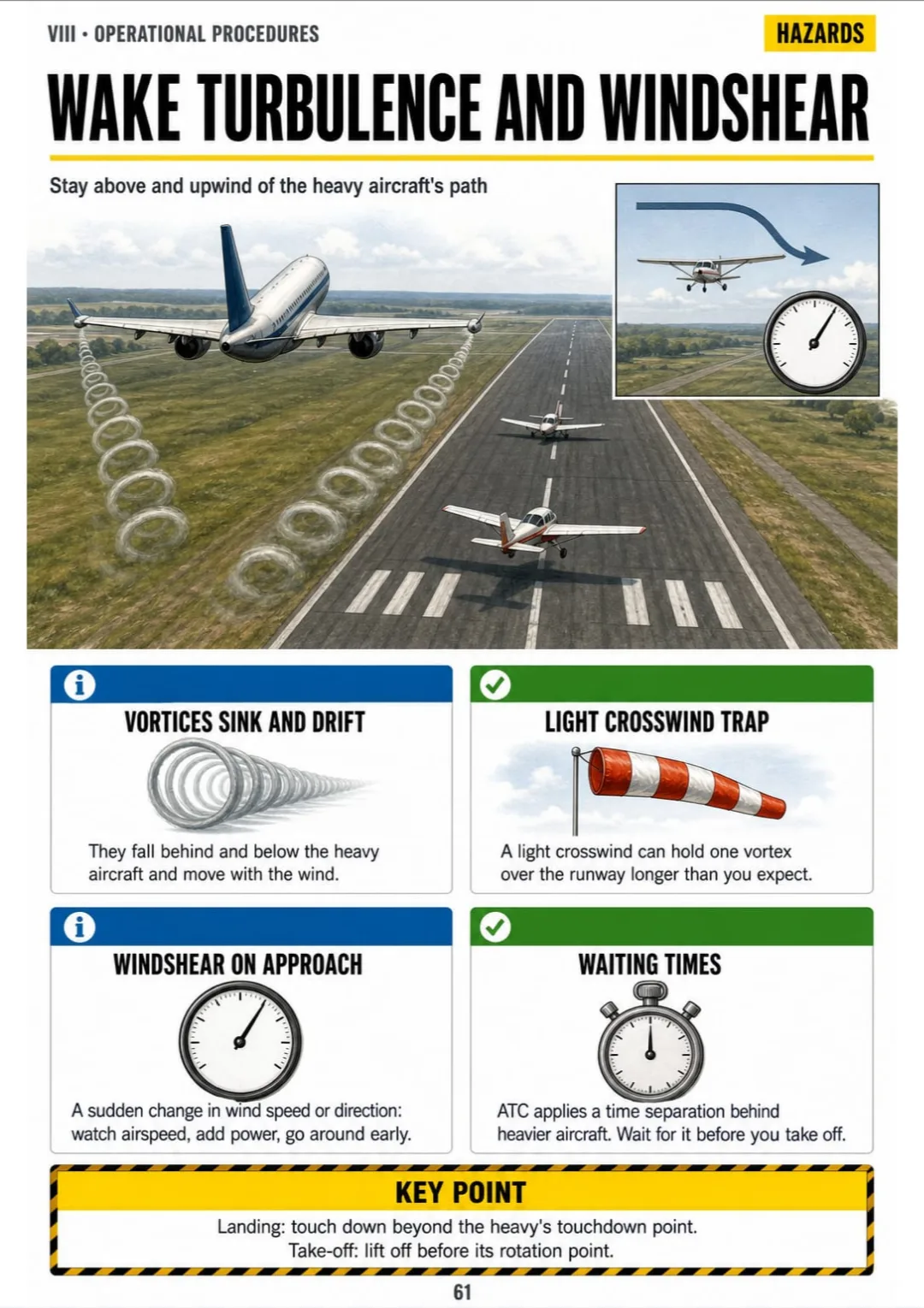
Wingtip vortices drawn falling behind a heavy aircraft, and where to land and lift off
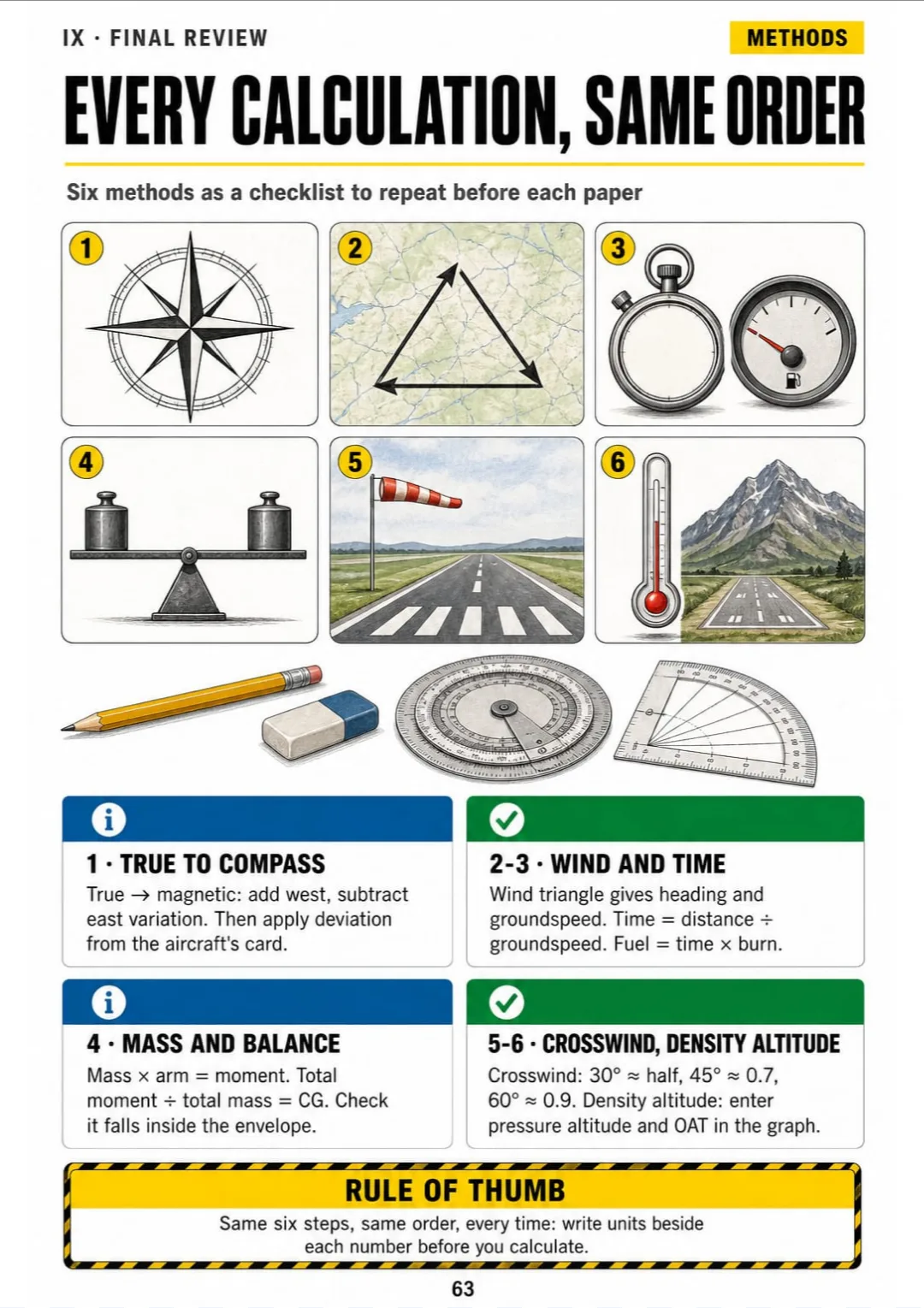
Variation, wind triangle, time-speed-distance-fuel, mass and balance, crosswind, density altitude: six steps.

Take a Look at the 9 Parts and 61 Topics

Before You Start

pp. 5-7
  1. The nine PPL(A) theory papers on one page
  2. The exam rules: 18 months, 6 sittings, 4 attempts
  3. How to use this book: read, draw, repeat in the same order

Air Law and Airspace

pp. 8-16
  1. Who makes the rules: ICAO, EASA, the IAA
  2. Your licence, your medical, your privileges
  3. Right of way: who gives way to whom
  4. Airspace classes A to G drawn as a stack
  5. VFR minima: visibility and distance from cloud
  6. Danger, restricted and prohibited areas on the Irish chart
  7. Minimum heights: 500 ft and 1,000 ft
  8. Altimeter settings: QNH, QFE, standard and transition altitude
  9. Aerodrome signals and markings

Human Performance

pp. 17-21
  1. Hypoxia: the problem you don't notice
  2. The inner ear and spatial disorientation
  3. Visual illusions on approach
  4. Alcohol, medication, blood donation and diving
  5. Decision-making, threat and error management and the IMSAFE check

Meteorology

pp. 22-30
  1. The ISA: the standard atmosphere in four numbers
  2. Pressure and the altimeter: high to low, look out below
  3. Stability and lapse rates: why cloud forms
  4. Cloud types drawn by height
  5. Air masses over Ireland
  6. The warm front and the cold front
  7. Fog, icing and thunderstorms
  8. Reading a METAR line by line
  9. Reading a TAF: BECMG, TEMPO and PROB

Principles of Flight and the Aircraft

pp. 31-39
  1. The four forces side by side
  2. Lift and angle of attack
  3. Drag: induced, parasite and the speed for best glide
  4. Stability and the three axes
  5. Flaps, trim and adverse yaw
  6. The piston engine: four strokes and the magnetos
  7. Mixture, carb heat and detonation
  8. The pitot-static instruments and their errors
  9. The compass and the gyro instruments

Performance, Planning and Mass and Balance

pp. 40-45
  1. Density altitude: when the aircraft performs worse
  2. Take-off and landing distances from the graph
  3. Crosswind and headwind components
  4. Mass and balance in five steps
  5. Fuel planning in litres
  6. Flight planning and the flight plan

Navigation

pp. 46-54
  1. Latitude, longitude and the nautical mile
  2. The 1:500,000 chart of Ireland
  3. True, magnetic, compass: variation and deviation
  4. The wind triangle in six steps
  5. Time, speed, distance and fuel
  6. The 1 in 60 rule: correcting off track
  7. The navigation log, step by step
  8. VOR and DME: where you are from a beacon
  9. GNSS and getting lost

Communications and Operational Procedures

pp. 55-61
  1. The phonetic alphabet and the numbers
  2. What you must read back
  3. The position report and joining the circuit
  4. Squawk codes: 7000, 7500, 7600, 7700
  5. Mayday and Pan-Pan
  6. Emergencies: engine failure, fire and the forced landing
  7. Wake turbulence and windshear

Final Review

pp. 62-65
  1. The numbers to know, on one page
  2. Every calculation method, in the same order
  3. The most common mistakes, before and after
  4. The night before the exam: checklist

Who This Book Is For

You're starting ground school

You get the nine papers in order and drawn from day one, so you know where each topic sits before you open the thick manuals.

Your exam sitting is close

You revise each paper at a glance, and the calculations come out in the same order every time: wind, fuel, mass and balance, variation and deviation.

You're already flying with an instructor

Before a lesson you open the page for that briefing, from the forced landing to the squawk codes, and walk in knowing what you need to know.

Plus: 2 Free Books

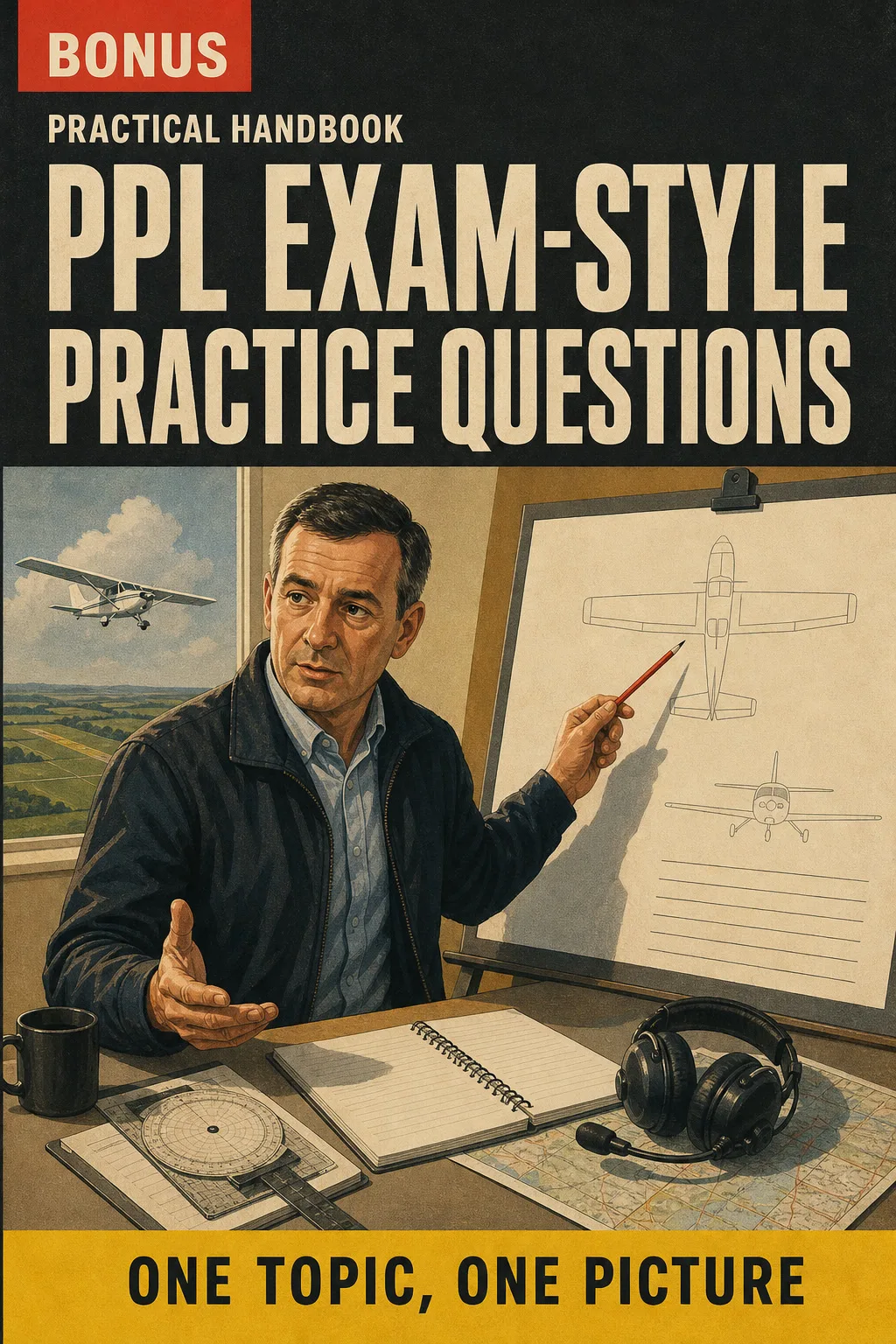
PPL Exam-Style Practice Questions
BONUS 1

PPL Exam-Style Practice Questions

Exam-style questions for every paper, each with the answer explained, so you can check what you really know before the sitting.
The 15 Most Common PPL Theory Mistakes
BONUS 2

The 15 Most Common PPL Theory Mistakes

The mistakes students make most often, from METAR codes to compass errors, each shown before and after so you stop repeating them.

30-Day Guarantee

30-day guarantee: if a file doesn't open, if the content isn't what the product page describes, if you were charged twice or the email never arrived, write to us and we'll refund you in full. You pay once. No subscriptions.

Frequently Asked Questions

Is it for me if I'm studying for the PPL(A) in Ireland while working full time?

Yes. It follows the PPL(A) theory for the IAA exams under EASA Part-FCL, one topic per page, so you can revise a page in the evening without starting a whole chapter. It starts from the basics and goes up to the full calculations, with worked examples in knots, nautical miles and litres.

Where does the content come from?

From EASA Part-FCL and its PPL(A) learning objectives, SERA, Part-NCO, AIP Ireland and published IAA guidance. The chart, the procedures and the examples are for Ireland, not the UK.

Is it official material?

No. It's an independent study book. It isn't affiliated with or endorsed by the IAA, EASA, AirNav Ireland or any flight school.

Does it replace ground school or my instructor?

No. It sits next to your school's theory manuals. They explain every subject at length; this book puts each topic on one drawn page, with the numbers and the steps in a box, so you can revise in ten minutes what took a chapter to read. Flying, checks and emergencies are learned with your instructor and the aircraft's POH.

Are the practice questions the ones from the exam?

No. They're exam-style questions written for this book, each with the answer explained. They aren't official questions from any exam.

When and how does it arrive?

The book and the 2 free books arrive as PDFs by email, at the address you enter at checkout.

Do I have to pay every month?

No. It's a single payment, with no subscription.

Can I have it on paper?

Yes. The PDF is ready to print: print the whole book or just the pages you want in your flight bag.

How does the refund work?

You have 30 days. We refund everything if the file won't open, if the book isn't what you see on this page, if you were charged twice or if the email doesn't arrive: just email us.

€19.90€58.20
Get the book · €19.90

This is a digital PDF book sent to your email: nothing is printed or shipped.