Study in Pictures🌐 English (United Kingdom)
UK PPL Theory Illustrated

Digital book in PDF · read it on your phone or print it

UK PPL Theory Illustrated

Air law and UK airspace, radio calls, METARs and TAFs, fronts, pitot-static instruments, the wind triangle, weight and balance and flight planning. Every topic has its own page: the drawing first, then what you need to remember.

  • 64 illustrated pages
  • English
  • 30-day guarantee
£19.99£57.99
Get the book · £19.99

Price shown for: United Kingdom. In other countries, the checkout shows the price that applies there.

About this book

What it is

Air law and UK airspace, radio calls, METARs and TAFs, fronts, pitot-static instruments, the wind triangle, weight and balance and flight planning. Every topic has its own page: the drawing first, then what you need to remember.

Who This Book Is For
  • You're starting the theory
  • Your next paper is close
  • You're already flying
What it covers
  1. The Map of the Nine Papers
  2. Air Law and UK Airspace
  3. Radio and Operational Procedures
  4. Human Performance
  5. Meteorology
  6. How the Aeroplane Flies and Works
  7. Navigation
  8. Flight Performance and Planning
  9. Final Review
Language
English (United Kingdom)
Pages
64
Format
Digital book in PDF · read it on your phone or print it
Price
£19.99 (United Kingdom)
Delivery
This is a digital PDF book sent to your email: nothing is printed or shipped.
30-Day Guarantee
30-day guarantee: if a file doesn't open, if the content isn't what the product page describes, if you were charged twice or the email never arrived, write to us and we'll refund you in full.

Look Inside the Book

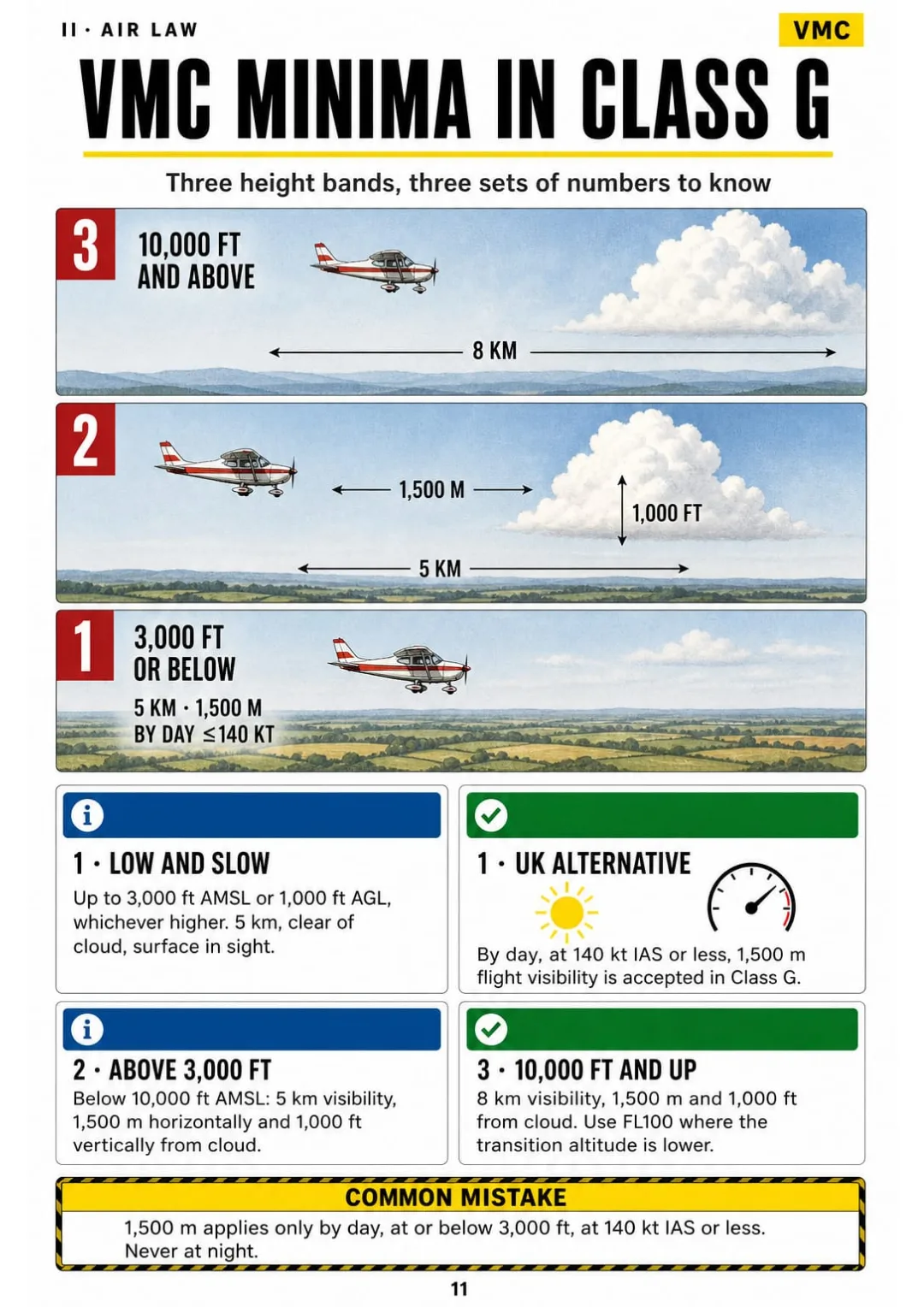
Class G low: 5 km, or 1,500 m by day at ≤140 kt; above 3,000 ft: 5 km, 1,500 m, 1,000 ft
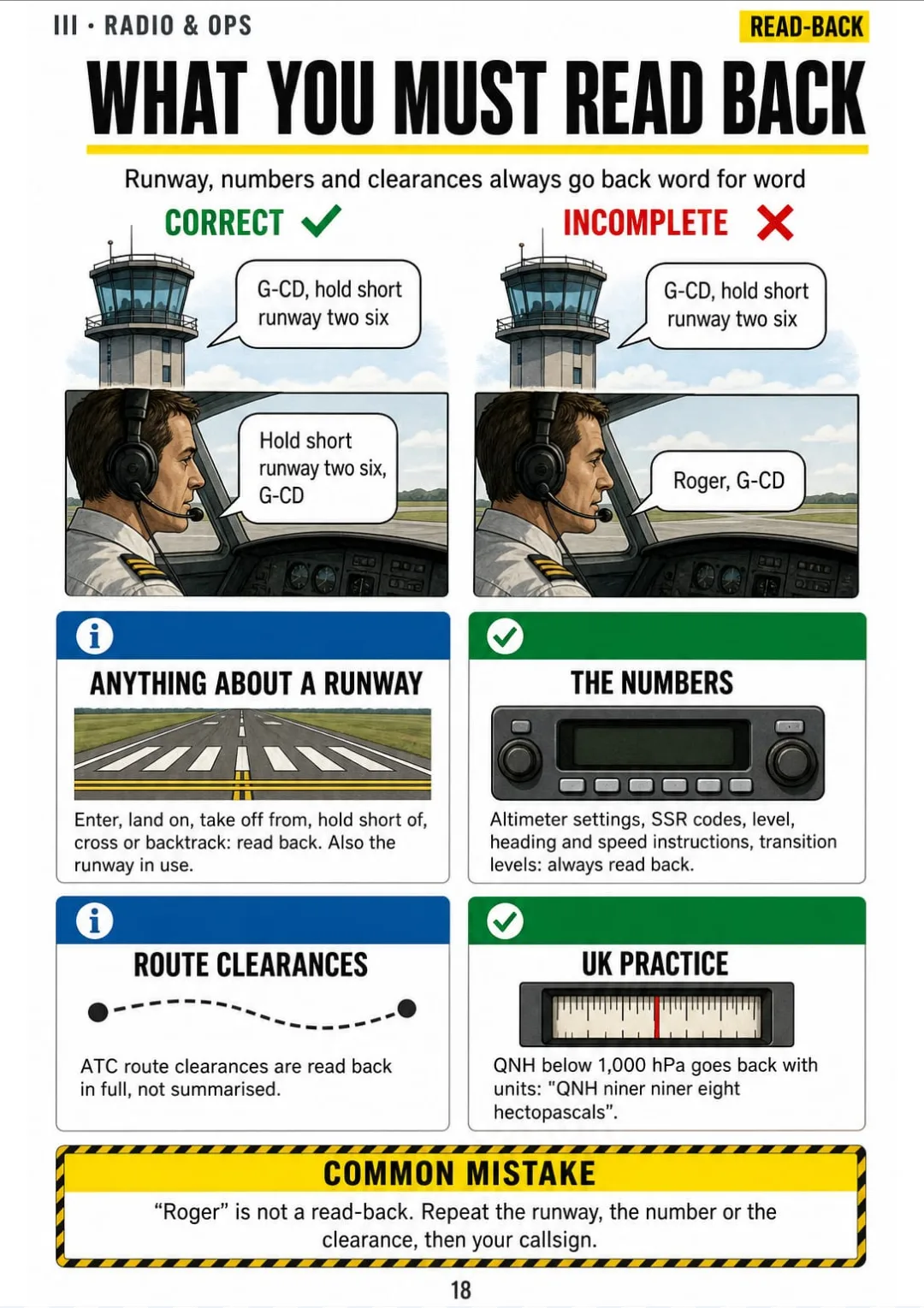
Runway instructions, QNH, squawk, level, heading, speed: the read-back list, with a correct and an incomplete example
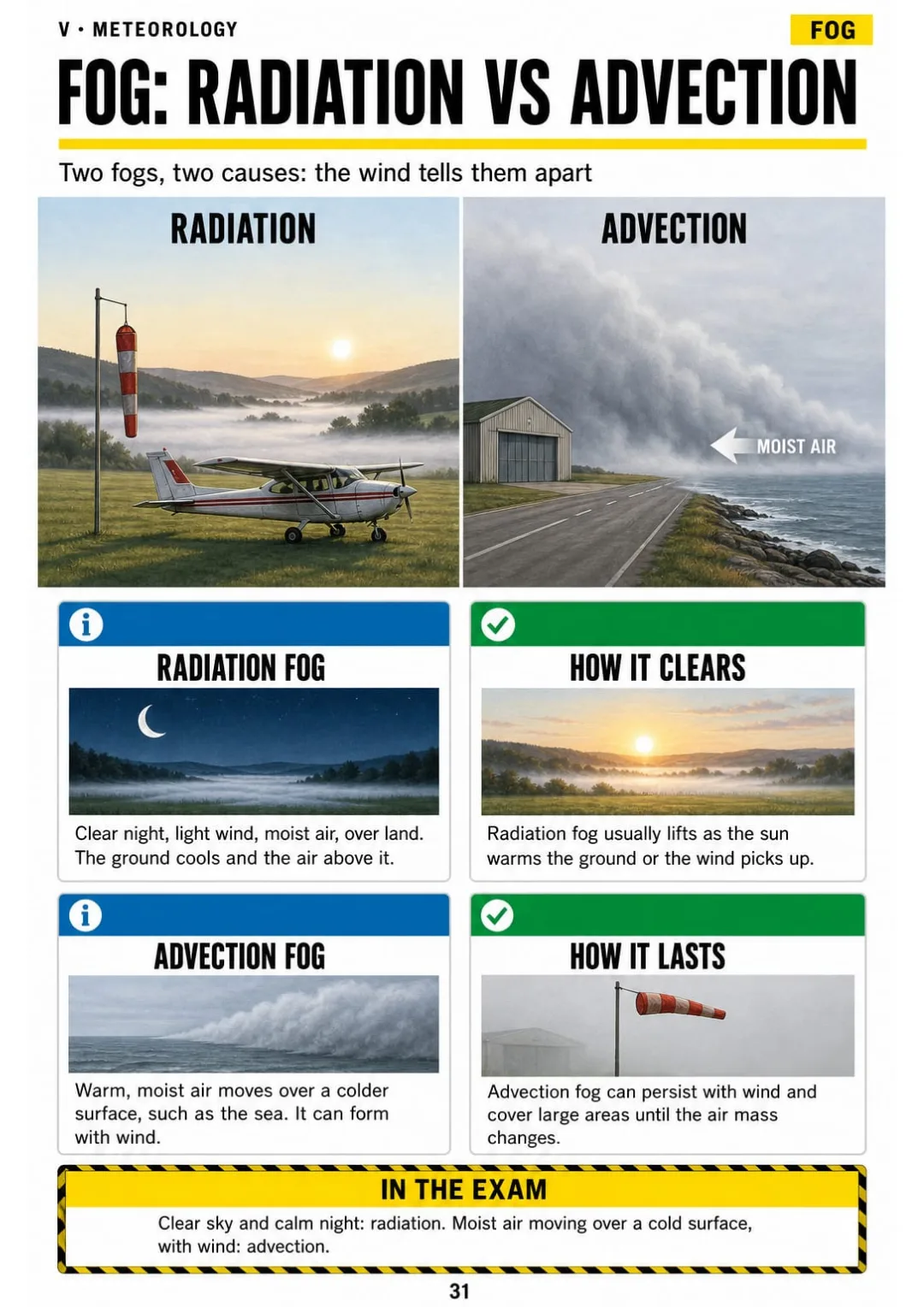
Radiation fog needs a clear, calm night; advection fog can form and last with wind.
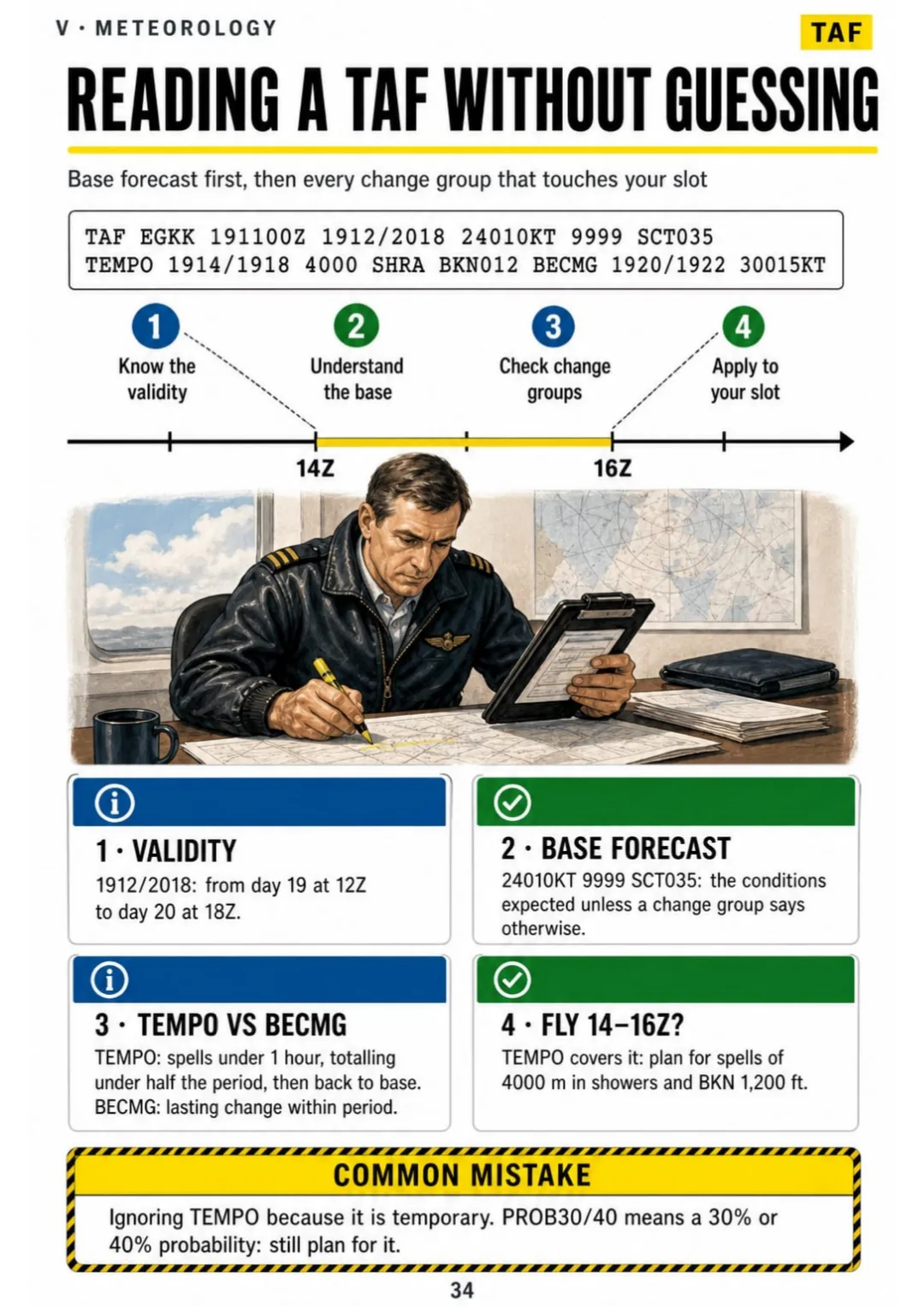
TAF worked example: can you fly between 14Z and 16Z with a TEMPO in force?
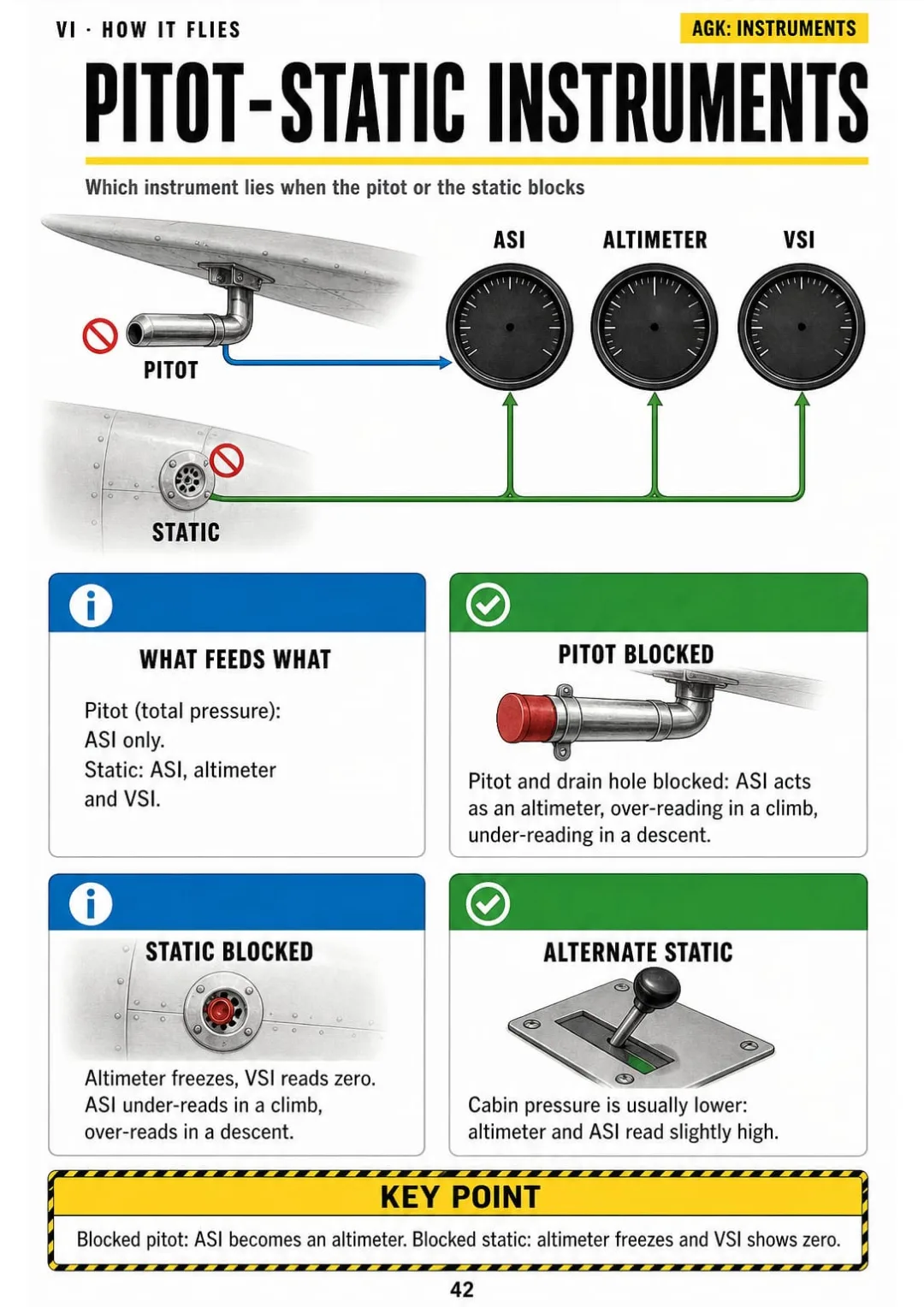
Blocked pitot: the ASI behaves like an altimeter.
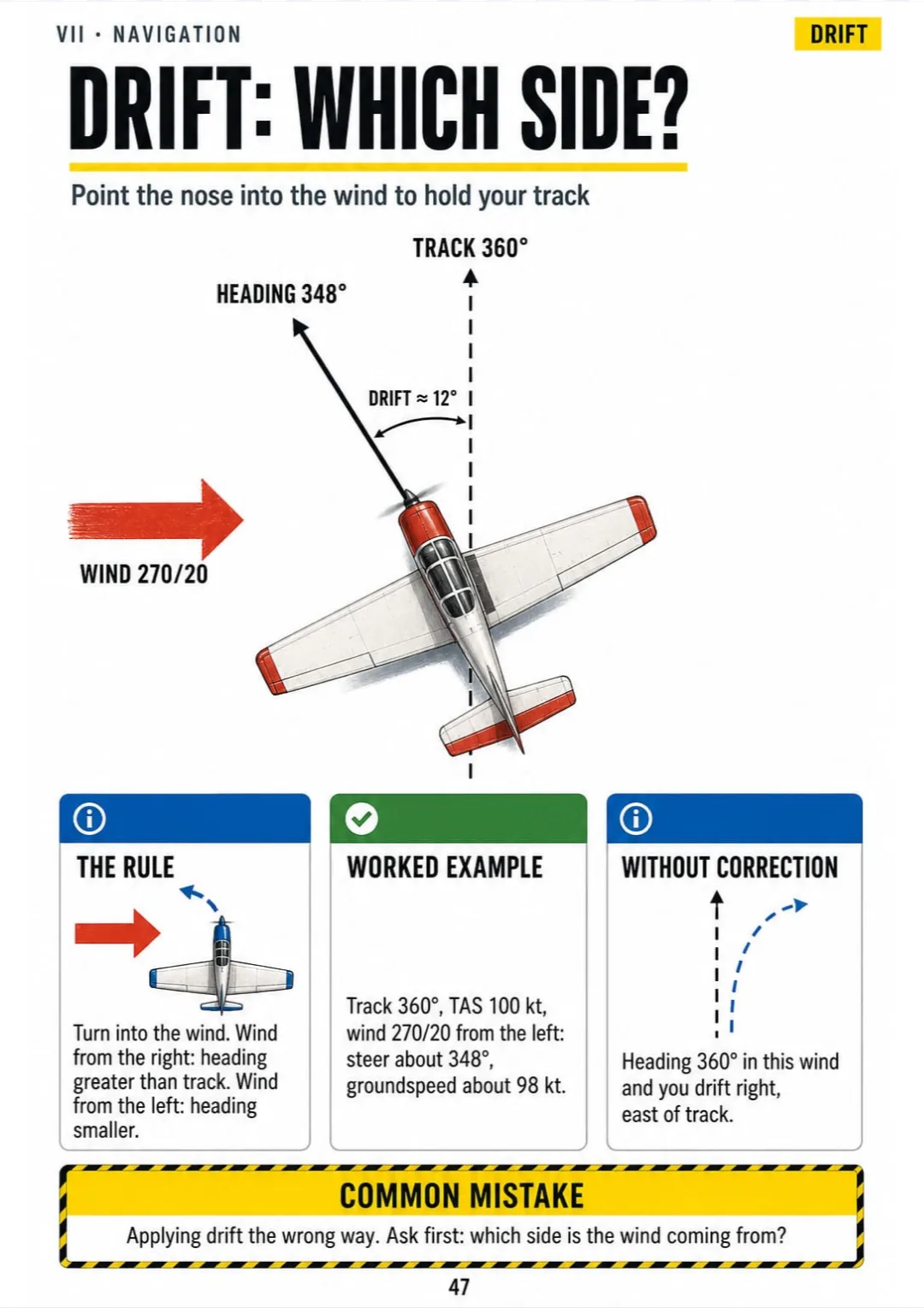
Wind 270/20, track 360°: correct left, heading about 348°
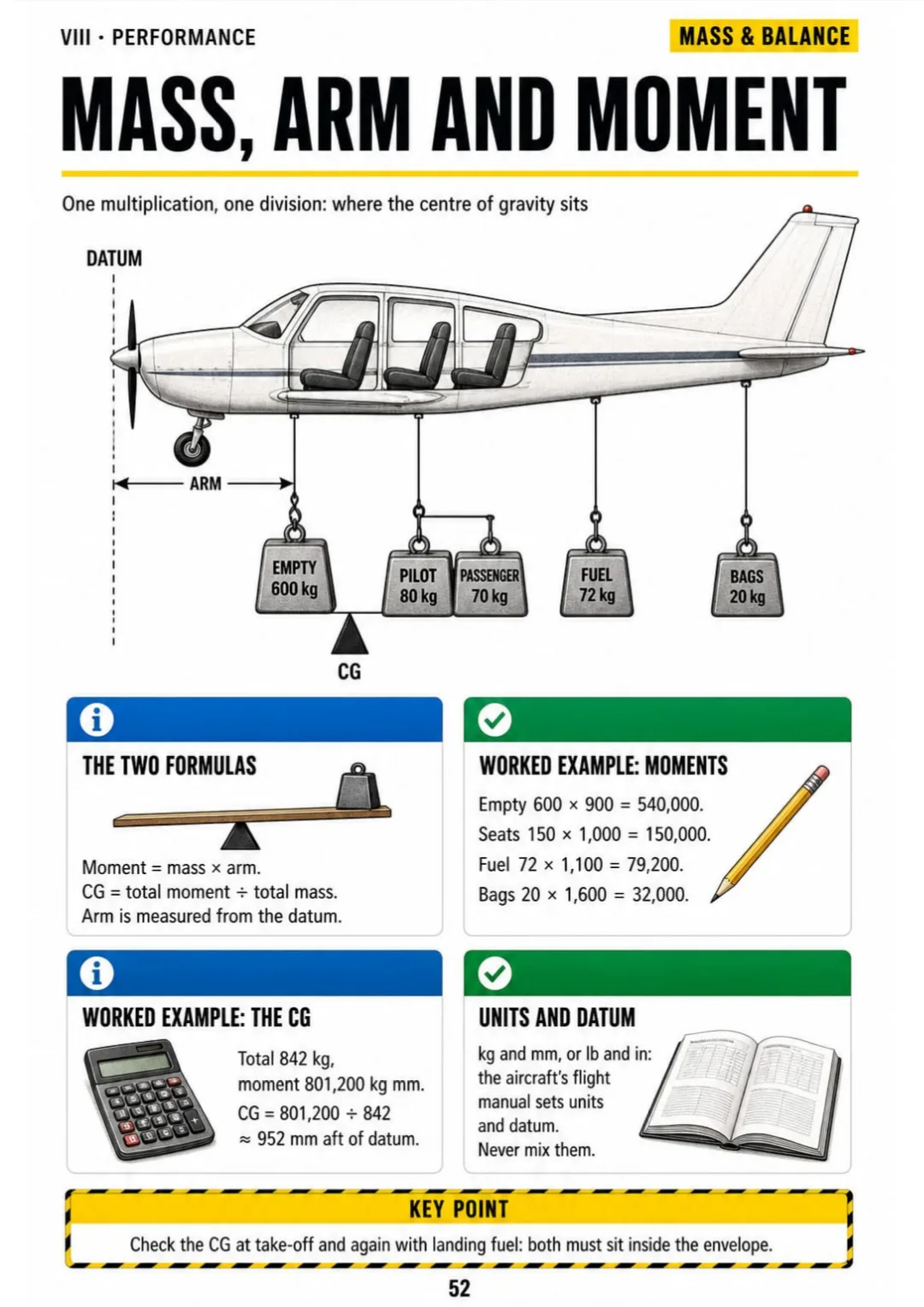
Moment = mass × arm; CG = total moment ÷ total mass, worked out in kg and mm
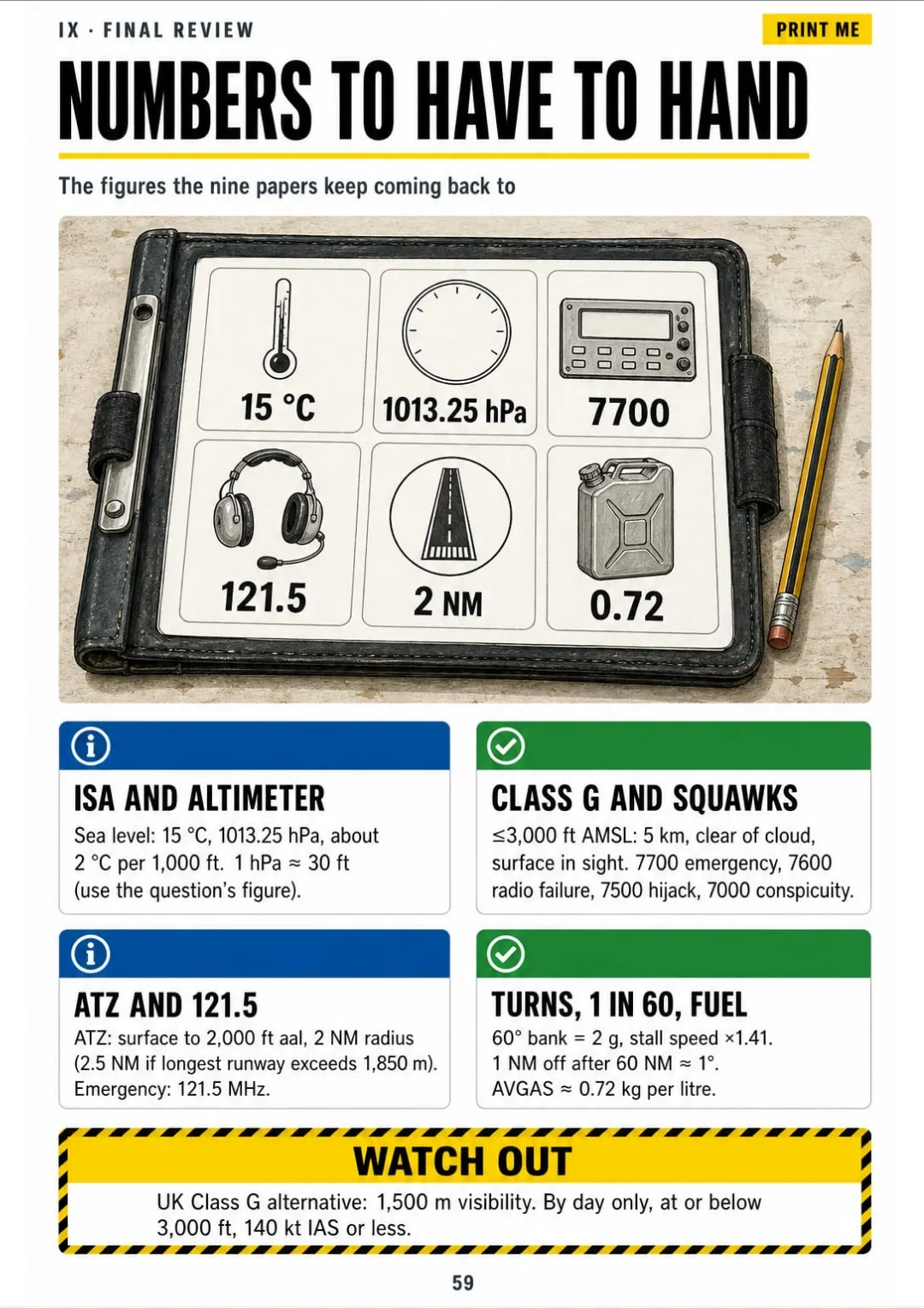
ISA, 30 ft per hPa, Class G minima, squawks, 121.5, ATZ, 1 in 60, 2 g and 0.72 kg/l on one sheet

Take a Look at the 9 Parts and 60 Topics

The Map of the Nine Papers

pp. 5-8
  1. Nine exams on one page
  2. The time window, without surprises
  3. A study order that builds on itself
  4. Your revision planner

Air Law and UK Airspace

pp. 9-16
  1. Licences: LAPL, PPL and what each lets you do
  2. The UK airspace classes
  3. VMC minima in Class G
  4. Controlled airspace, zones and danger areas
  5. Rules of the air: who gives way
  6. Minimum heights: the 500 ft rule
  7. Altimeter settings: QNH, QFE and 1013
  8. Ground signals and light signals

Radio and Operational Procedures

pp. 17-22
  1. The order of every radio call
  2. What you must read back
  3. UK Flight Information Services
  4. Transponder codes and emergencies
  5. Wake turbulence and windshear
  6. Forced landing and fire drills

Human Performance

pp. 23-26
  1. Hypoxia and altitude
  2. Your inner ear can lie
  3. Eyes: scanning and blind spots
  4. Fit to fly: the IMSAFE check

Meteorology

pp. 27-34
  1. The ISA in four numbers
  2. High to low, look out below
  3. UK air masses
  4. Fronts drawn in section
  5. Fog: radiation vs advection
  6. Carburettor icing
  7. Reading a METAR line by line
  8. Reading a TAF without guessing

How the Aeroplane Flies and Works

pp. 35-43
  1. Four forces in balance
  2. Angle of attack and the stall
  3. Load factor in a turn
  4. Drag: induced vs parasite
  5. Stability and the three axes
  6. The four-stroke piston engine
  7. Mixture and carb heat
  8. Pitot-static instruments
  9. Compass errors: ANDS and UNOS

Navigation

pp. 44-51
  1. The 1:500 000 chart
  2. True, magnetic, compass
  3. The wind triangle, always in the same order
  4. Drift: which side?
  5. The flight computer, step by step
  6. The 1 in 60 rule
  7. VOR and DME
  8. Lost procedure and GNSS

Flight Performance and Planning

pp. 52-58
  1. Mass, arm and moment
  2. Fuel in litres, kilos and gallons
  3. Is the CG inside the envelope?
  4. Take-off distance factors
  5. Density altitude
  6. Fuel planning: time, fuel, distance
  7. Building a flight log (plog)

Final Review

pp. 59-64
  1. Numbers to have to hand
  2. Frequent mistakes: drift and variation
  3. Frequent mistakes: weather reports
  4. Frequent mistakes: air law and radio
  5. The night before each paper
  6. From theory to the aerodrome

Who This Book Is For

You're starting the theory

You see the nine papers as one map and study them in an order that builds on itself. Each topic is a page you can actually picture the next day.

Your next paper is close

You revise the whole subject at a glance, page by page, and go back to the numbers sheet the night before. The practice questions send you back to the page whenever you're unsure.

You're already flying

You keep it to hand for the club: Class G minima, squawks, a TAF or the CG on the loading sheet, drawn and quick to find. You can print the pages you use most.

Plus: 2 Free Books

Nine Papers Practice Questions
BONUS 1

Nine Papers Practice Questions

Exam-style questions for every paper, each answer explained with the page to go back to, so you practise understanding instead of memorising.
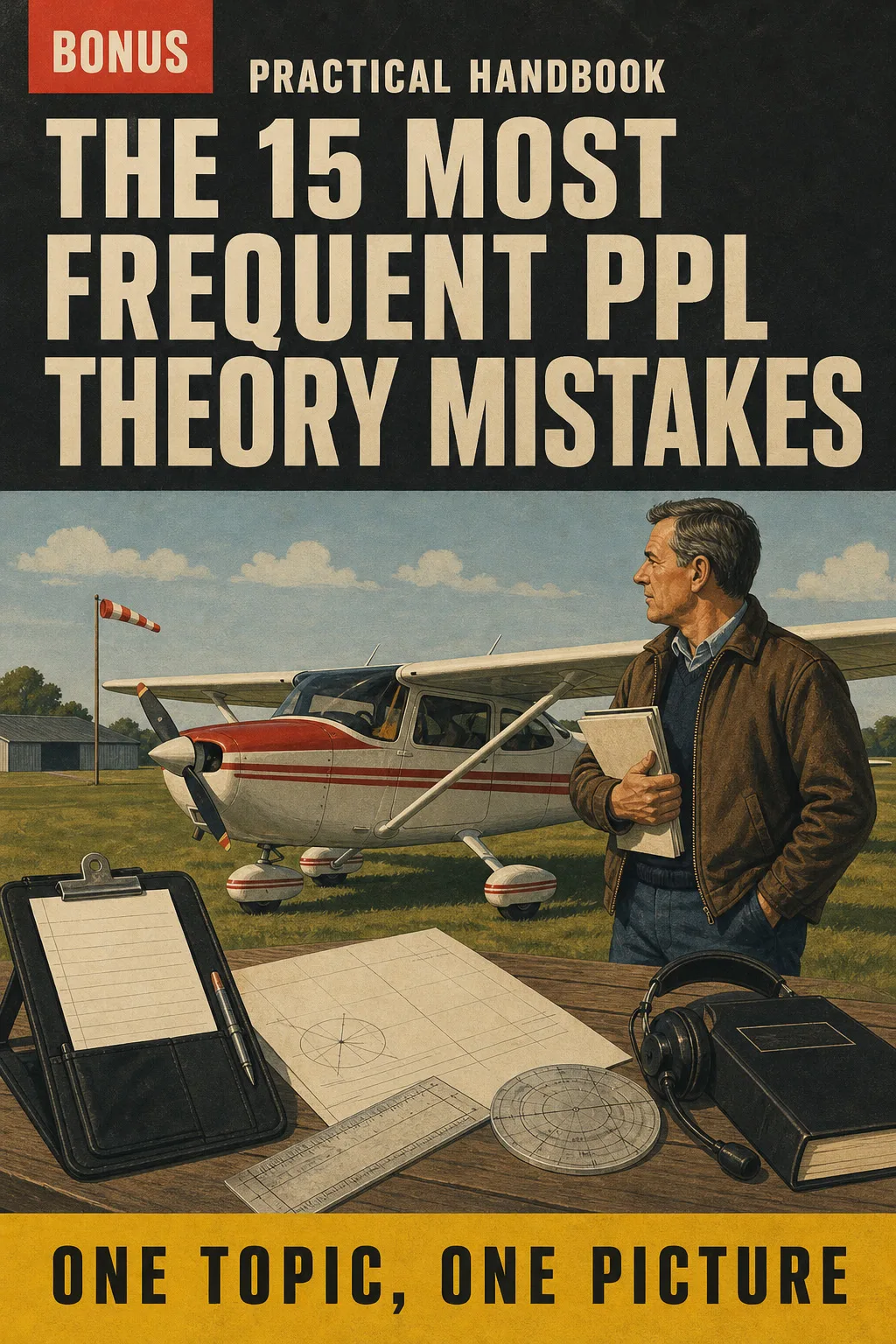
The 15 Most Frequent PPL Theory Mistakes
BONUS 2

The 15 Most Frequent PPL Theory Mistakes

Each frequent mistake drawn before and after – from drift on the wrong side to misreading a TAF – so you spot it before the exam does.

30-Day Guarantee

30-day guarantee: if a file doesn't open, if the content isn't what the product page describes, if you were charged twice or the email never arrived, write to us and we'll refund you in full. You pay once. No subscriptions.

Frequently Asked Questions

I already have my school's manual and a question app. What does this add?

The manual explains in paragraphs and the app tests you. This book shows each topic as one drawing with its numbers, so you see why an answer is right and can still picture it the next day. It isn't a beginner's overview: it covers all nine UK PPL(A) papers, with the calculations worked step by step, in feet, knots, hPa, kg and litres. One topic per page also fits a short session after work.

Where does the content come from?

From the UK PPL(A) theoretical knowledge syllabus (UK Part-FCL), UK SERA and the Rules of the Air Regulations 2015, the UK AIP, the Skyway Code (CAP 1535), the Radiotelephony Manual (CAP 413) and the CAA Safety Sense Leaflets. Each page is checked against them. It's written for the UK exams, not adapted from a US or EASA book. Rules do change, so always confirm the current version with your school.

Is it official material?

No. It's an independent illustrated study guide. It isn't published, approved or endorsed by the UK CAA or by any flight school.

Does it replace ground school or my flight school's course?

No. It doesn't replace your training, your instructor or your school's material, and it doesn't give you a certificate or count towards any exam. It helps you understand and revise what you're studying there.

Are the practice questions the ones in the exam?

No. They're exam-style questions written for this book, not official exam questions. Each answer is explained and tells you which page to go back to.

When and how does it arrive?

The book and the 2 gifts arrive as a PDF by email, to the address you enter at checkout.

Do I have to pay every month?

No. It's a one-off payment. No subscription.

Can I have it on paper?

Yes. The PDF is ready to print, whole or just the pages you want to keep to hand.

How does the refund work?

You have 30 days. We refund everything if the file won't open, if the book isn't what you see on this page, if you were charged twice or if the email doesn't arrive: just email us.

£19.99£57.99
Get the book · £19.99

This is a digital PDF book sent to your email: nothing is printed or shipped.

More books on this topic

Drone Pilot in Pictures

The UK drone rules finally make sense: Flyer ID and Operator ID, the Drone Code, the 120 m (400 ft) limit, A1/A2/A3…

From £19.99 £57.99

IR(R) Instrument Flying Illustrated

The theory behind the UK Restricted Instrument Rating, one topic per page: the six-pack, the instrument scan, VOR, NDB…

From £19.99 £57.99

ATPL(A) Theory Illustrated

An illustrated PDF book for UK ATPL(A) theory students: every subject explained one topic per page, with a clear…

From £19.99 £57.99