Study in Pictures🌐 English (United Kingdom)
Septic Tanks Illustrated

Digital book in PDF · read it on your phone or print it

Septic Tanks Illustrated

The three layers in the tank, a treatment plant step by step, drainage fields and soakaways, tanks draining to a ditch or stream, the rules for England, Wales, Scotland and Northern Ireland, desludging, fault-finding and buying a house with a tank. Every topic has its own page: the drawing first, then what you need to remember.

  • 69 illustrated pages
  • English
  • 30-day guarantee
£19.99£57.99
Get the book · £19.99

Price shown for: United Kingdom. In other countries, the checkout shows the price that applies there.

About this book

What it is

The three layers in the tank, a treatment plant step by step, drainage fields and soakaways, tanks draining to a ditch or stream, the rules for England, Wales, Scotland and Northern Ireland, desludging, fault-finding and buying a house with a tank. Every topic has its own page: the drawing first, then what you need to remember.

Who This Book Is For
  • You've got a tank you never chose
  • You're buying or selling the house
  • You already do groundworks or drainage
What it covers
  1. What's Under Your Garden
  2. Inside a Septic Tank
  3. Sewage Treatment Plants
  4. Drainage Fields and Soakaways
  5. The Rules by Nation
  6. Looking After Your System
  7. Tracing a Fault in the Same Order
  8. Buying, Selling and Building Work
  9. Review and Checklists
Language
English (United Kingdom)
Pages
69
Format
Digital book in PDF · read it on your phone or print it
Price
£19.99 (United Kingdom)
Delivery
This is a digital PDF book sent to your email: nothing is printed or shipped.
30-Day Guarantee
30-day guarantee: if a file doesn't open, if the content isn't what the product page describes, if you were charged twice or the email never arrived, write to us and we'll refund you in full.

Look Inside the Book

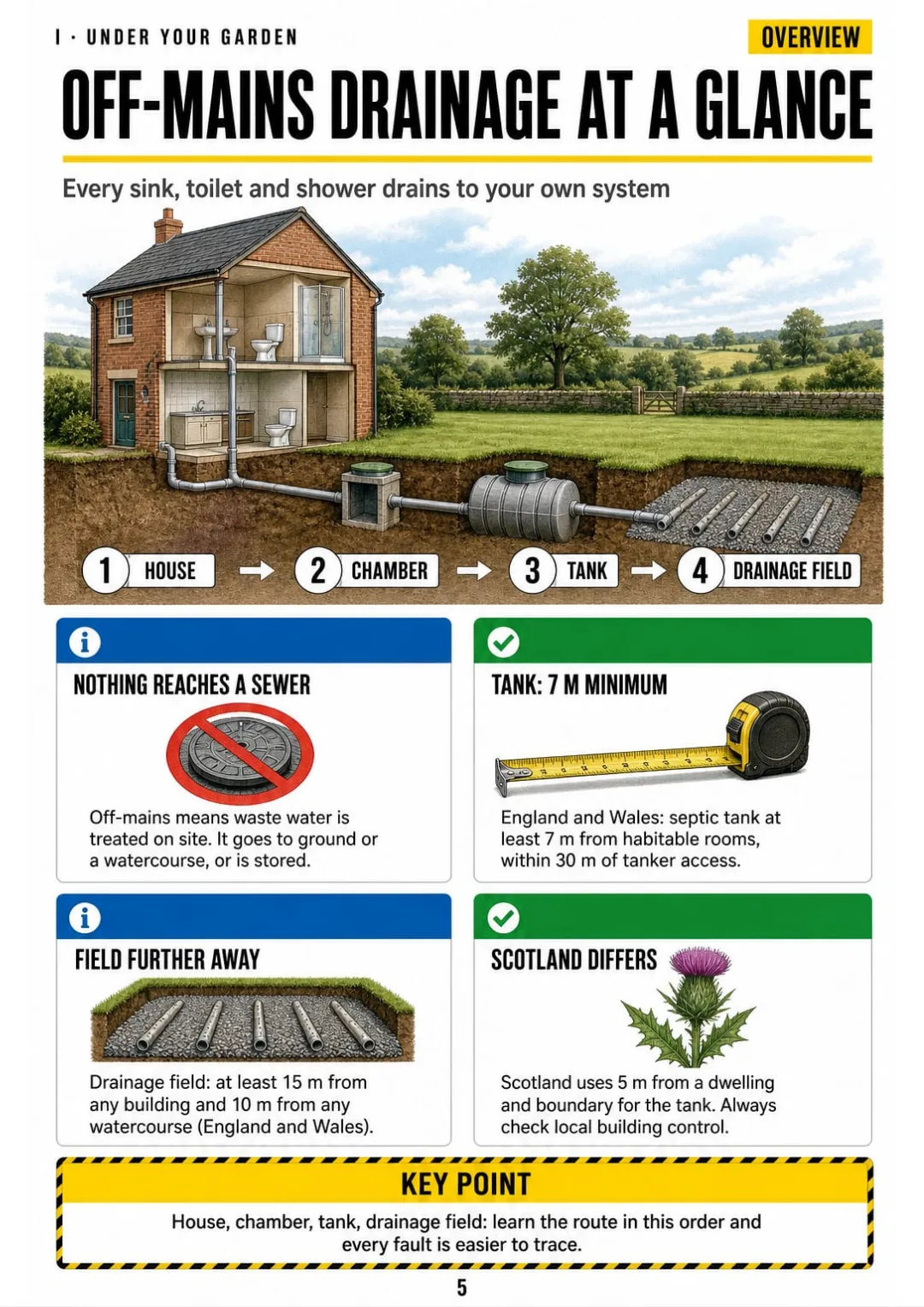
House → chamber → tank → drainage field: tank at least 7 m from the house, field at least 15 m
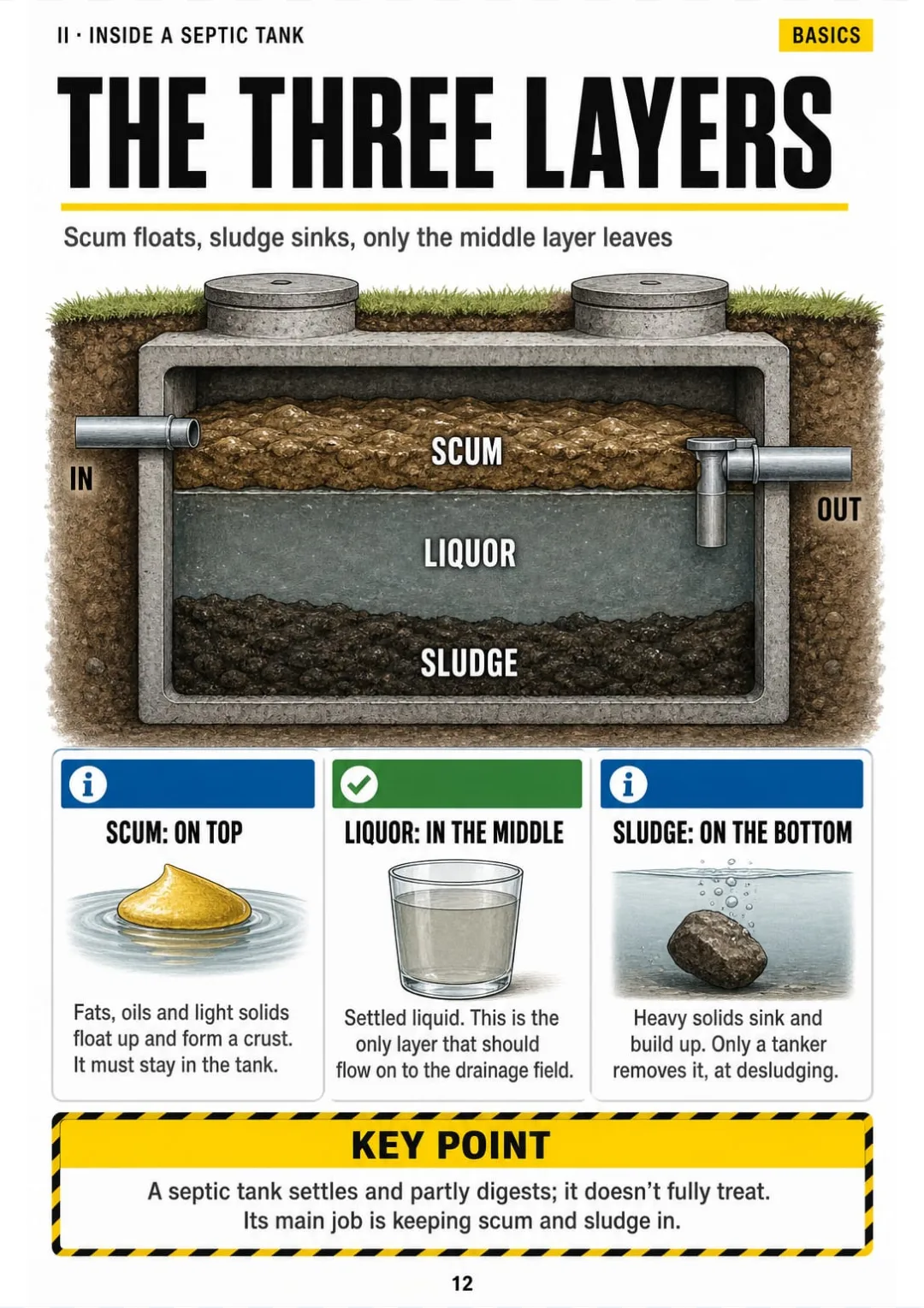
Scum on top, sludge on the bottom, liquor in the middle: only the liquor goes out
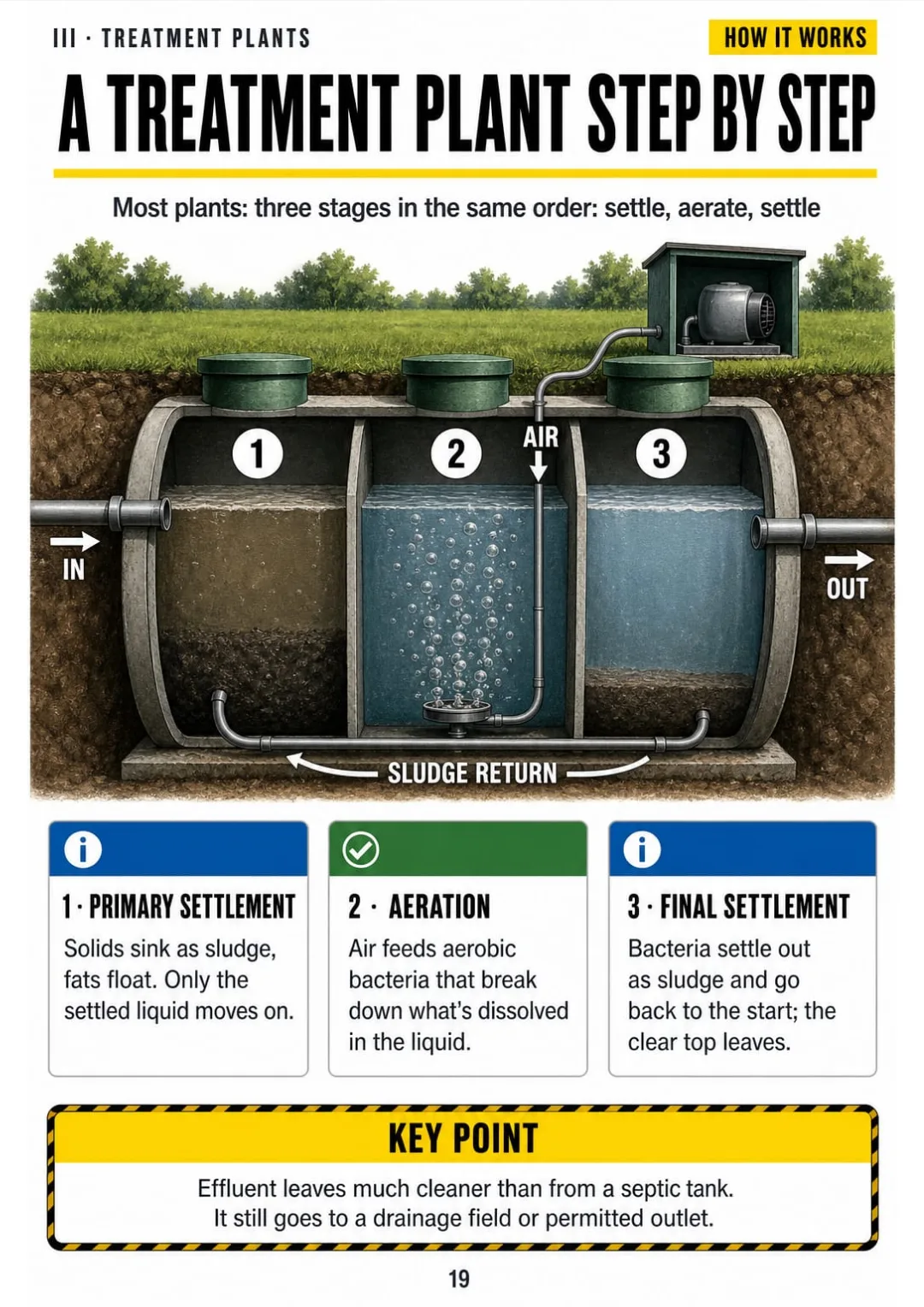
Three chambers: primary settlement → aeration → final settlement, with sludge return.
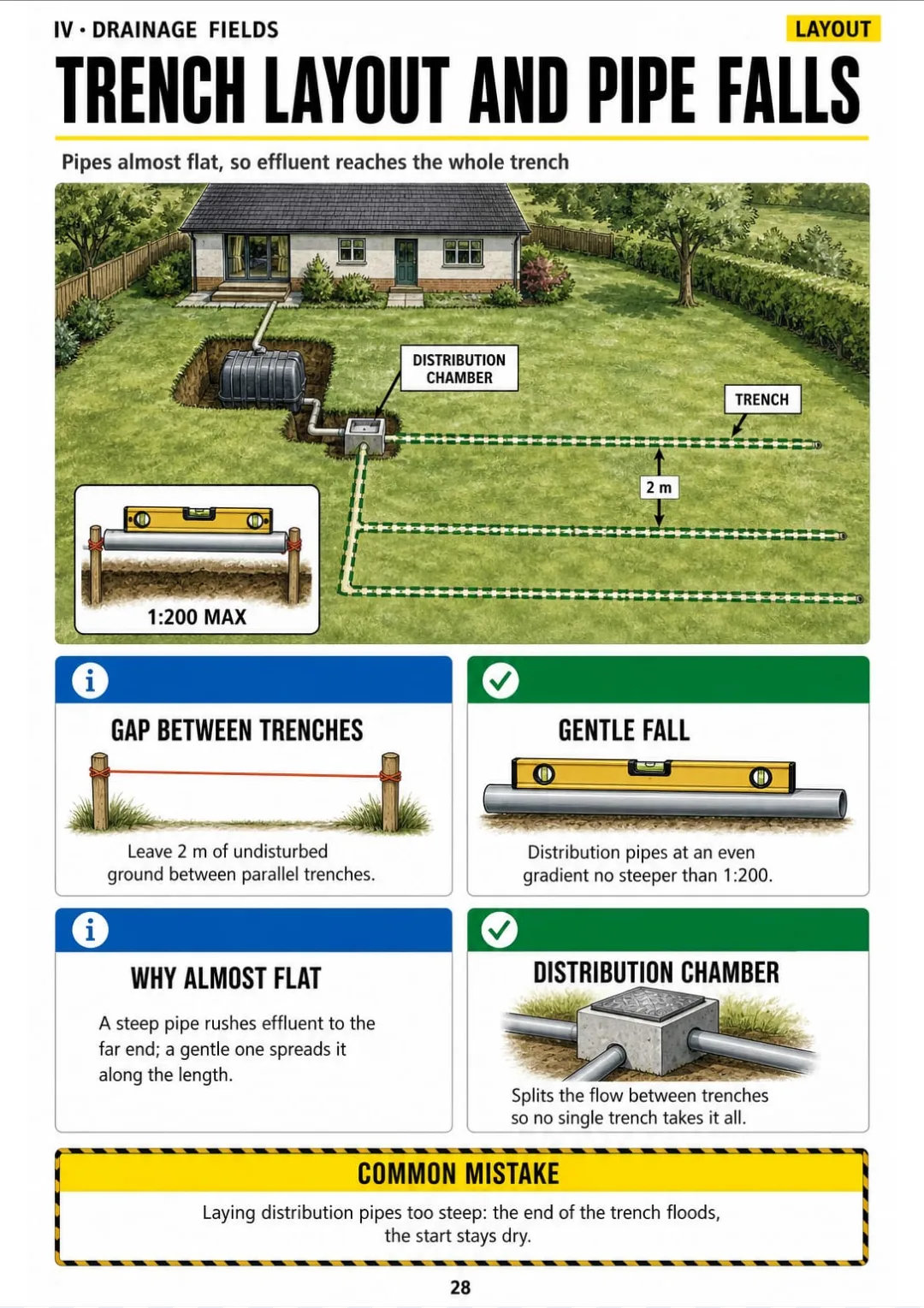
Trenches 2 m apart, pipes no steeper than 1:200.
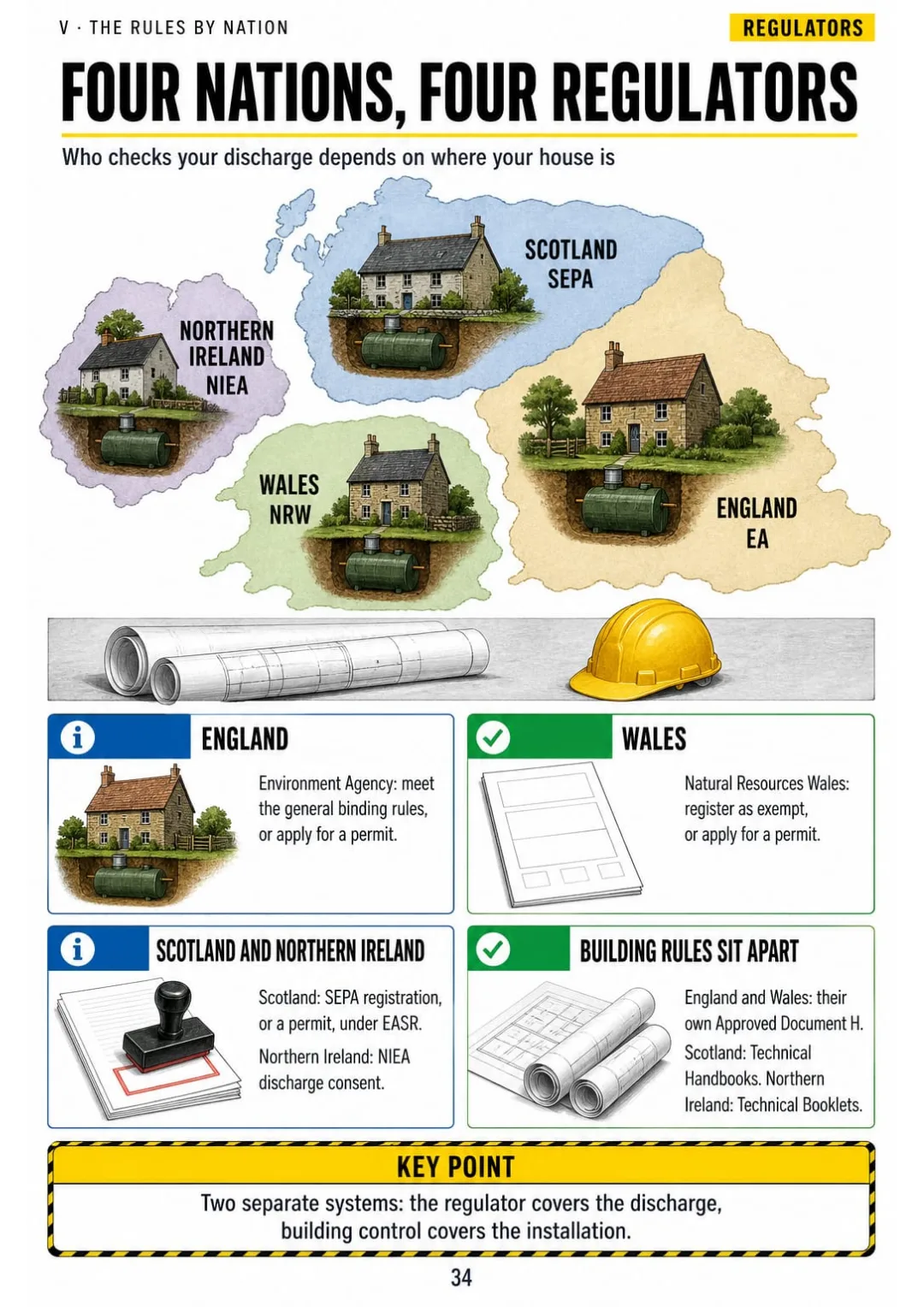
EA, NRW, SEPA and NIEA on one map, with building regulations kept apart
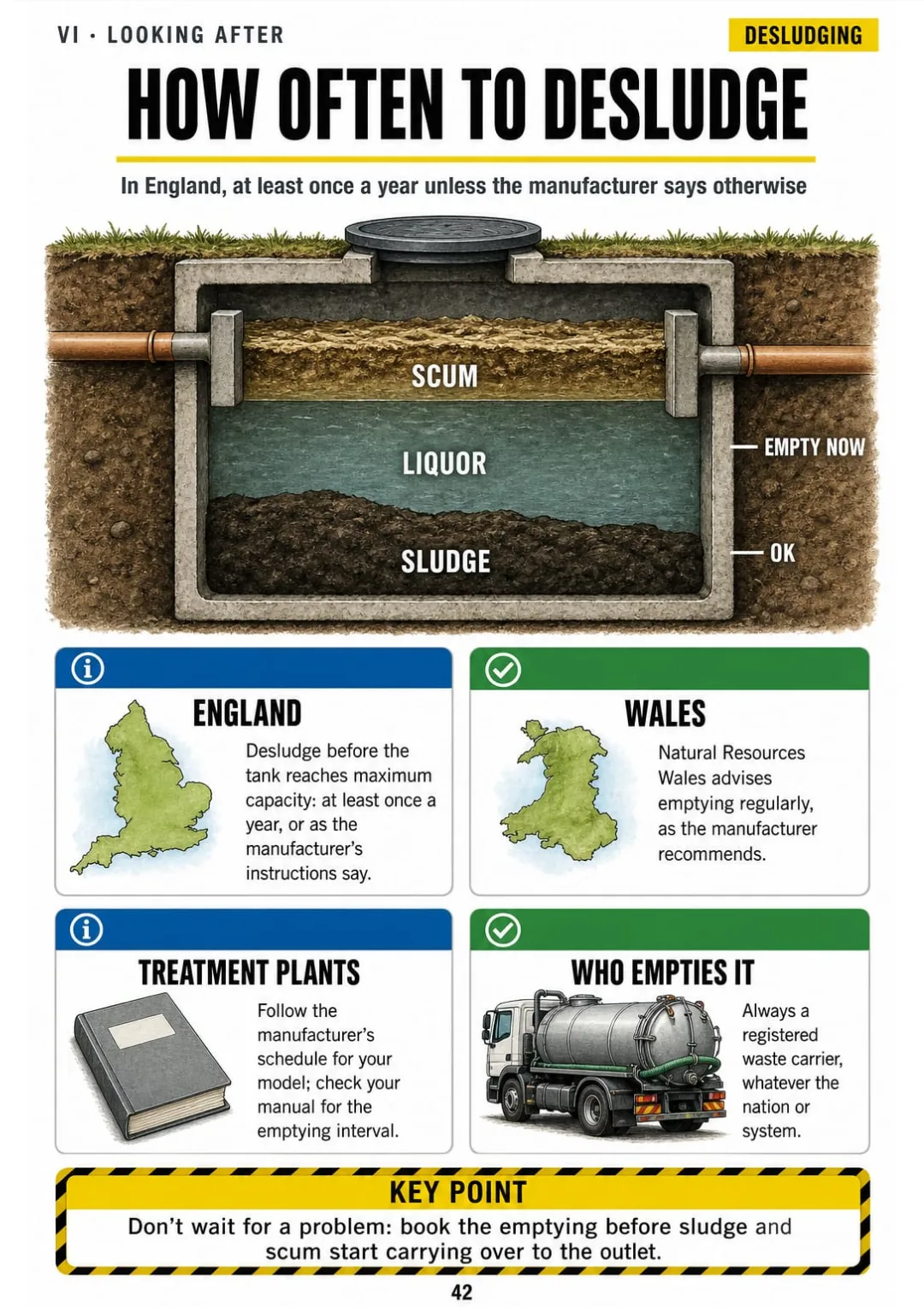
England: desludge at least yearly unless the manufacturer says otherwise; Wales: every 12–24 months.
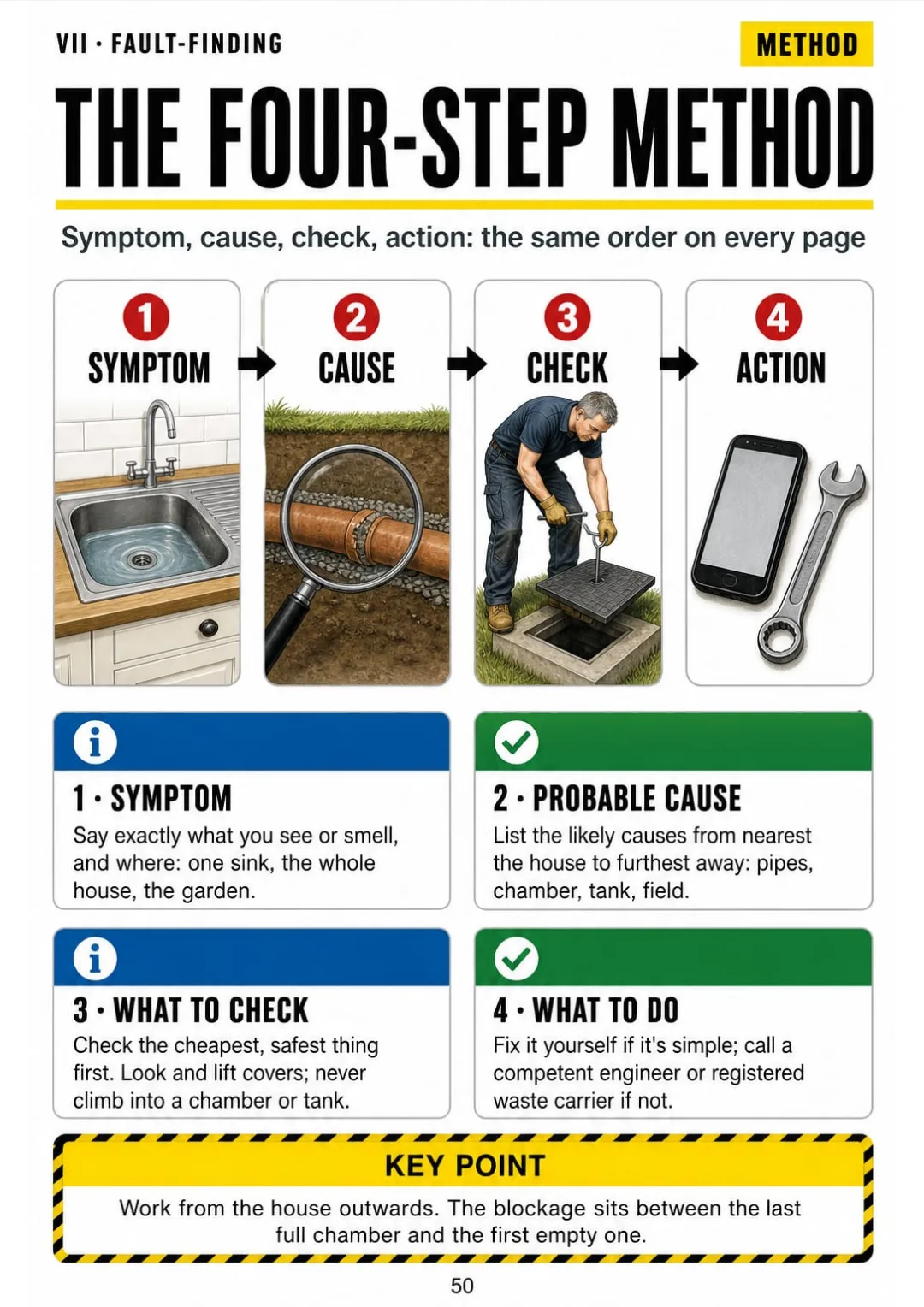
Symptom → probable cause → what to check → what to do: four boxes, every fault.
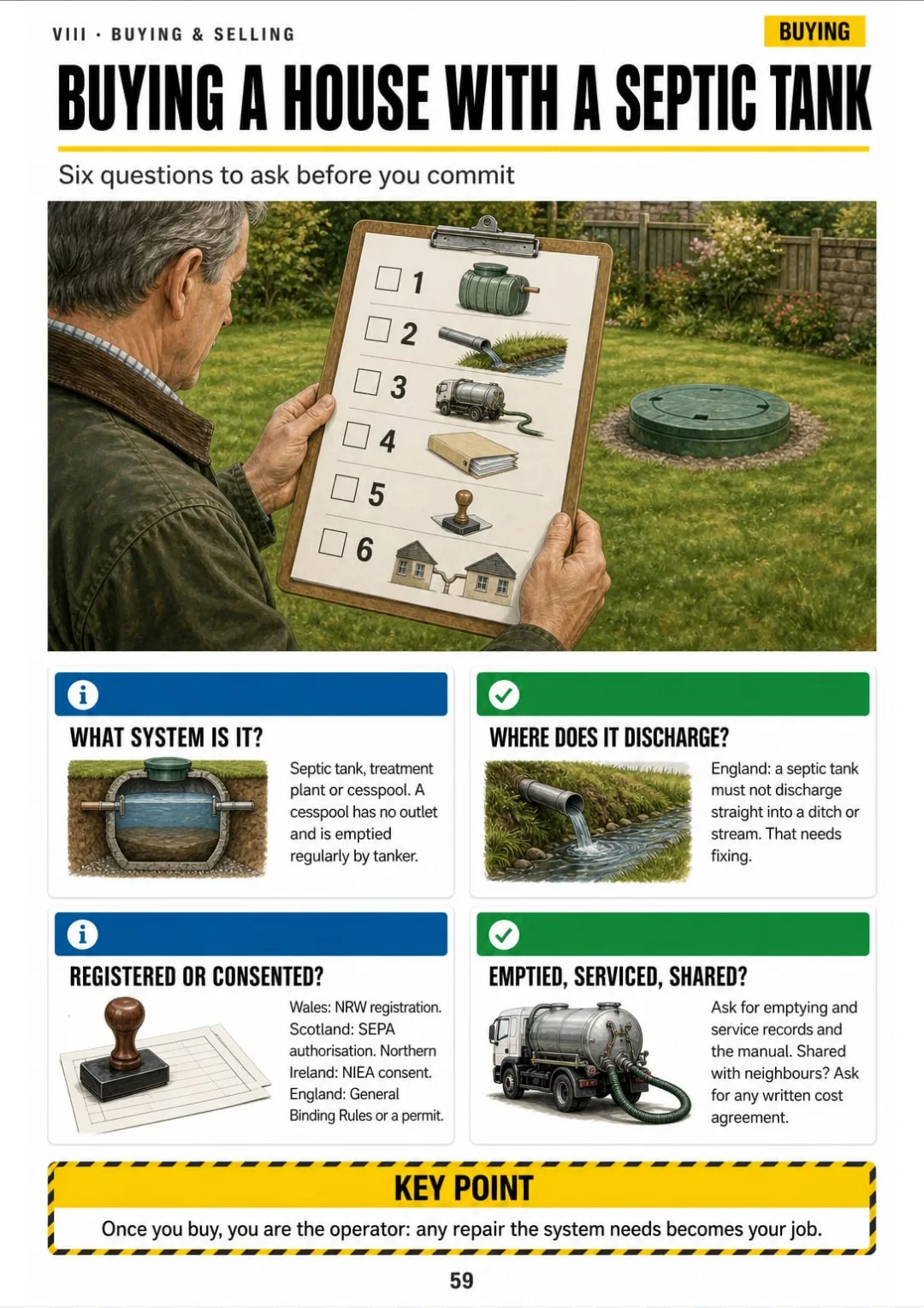
Before buying: system type, discharge point, emptying records, registration or consent, shared or not.

Take a Look at the 9 Parts and 65 Topics

What's Under Your Garden

pp. 5-11
  1. Off-mains drainage at a glance
  2. Septic tank, treatment plant or cesspit?
  3. How to identify the system you've got
  4. Where the pipes run
  5. Inspection chambers: your windows into the drain
  6. The words engineers use
  7. Who is responsible for what

Inside a Septic Tank

pp. 12-18
  1. The three layers: scum, liquor, sludge
  2. What bacteria do in the tank
  3. Inlet and outlet: the T-pieces and baffles
  4. Two-chamber and onion-shaped tanks
  5. How big does a tank need to be?
  6. Venting: why the tank needs to breathe
  7. What the effluent still contains

Sewage Treatment Plants

pp. 19-25
  1. A treatment plant step by step
  2. The blower and the diffusers
  3. Fixed film vs activated sludge vs SBR
  4. The control panel and the alarm
  5. Electricity and safety
  6. What a service visit covers
  7. Upgrading a septic tank to a treatment plant

Drainage Fields and Soakaways

pp. 26-33
  1. Drainage field, soakaway: what's the difference?
  2. The drainage field seen from below
  3. Trench layout and pipe falls
  4. The percolation test, drawn
  5. Reading your Vp result
  6. Sizing the drainage field
  7. Groundwater, clay and rock
  8. Signs a drainage field is failing

The Rules by Nation

pp. 34-41
  1. Four nations, four regulators
  2. England: the General Binding Rules
  3. England: septic tanks that drain to a ditch or stream
  4. Wales: registering your discharge
  5. Scotland: SEPA registration
  6. Northern Ireland: discharge consent
  7. Distances on the plot
  8. Building work that needs approval

Looking After Your System

pp. 42-49
  1. How often to desludge
  2. What happens when the tanker comes
  3. What can and can't go down the drain
  4. Water use and the tank
  5. Additives and 'bacteria boosters'
  6. Protecting the drainage field
  7. Your service log
  8. The seasonal check

Tracing a Fault in the Same Order

pp. 50-58
  1. The four-step method
  2. Slow drains and gurgling
  3. Smells near the house
  4. Smells in the garden
  5. Wet patches over the drainage field
  6. The tank is full to the brim
  7. Treatment plant alarm sounding
  8. Treatment plant effluent looks cloudy
  9. Roots, collapsed pipes and CCTV

Buying, Selling and Building Work

pp. 59-64
  1. Buying a house with a septic tank
  2. Selling: what to tell the buyer
  3. The drainage survey before purchase
  4. Shared systems with neighbours
  5. Extensions and extra bedrooms
  6. For groundworkers: setting out a new installation

Review and Checklists

pp. 65-69
  1. The whole system on one page
  2. The most frequent mistakes
  3. Fault-finding quick card
  4. Paperwork checklist
  5. When to call a professional

Who This Book Is For

You've got a tank you never chose

You see what's under your garden, what each part does and what to check first when something smells, gurgles or beeps.

You're buying or selling the house

You know which system it is, where it discharges, which records to keep and what the surveyor will ask about, before they ask.

You already do groundworks or drainage

The whole system drawn, from falls and inspection chambers to the drainage field and the rules nation by nation, to have to hand in the van.

Plus: 2 Free Books

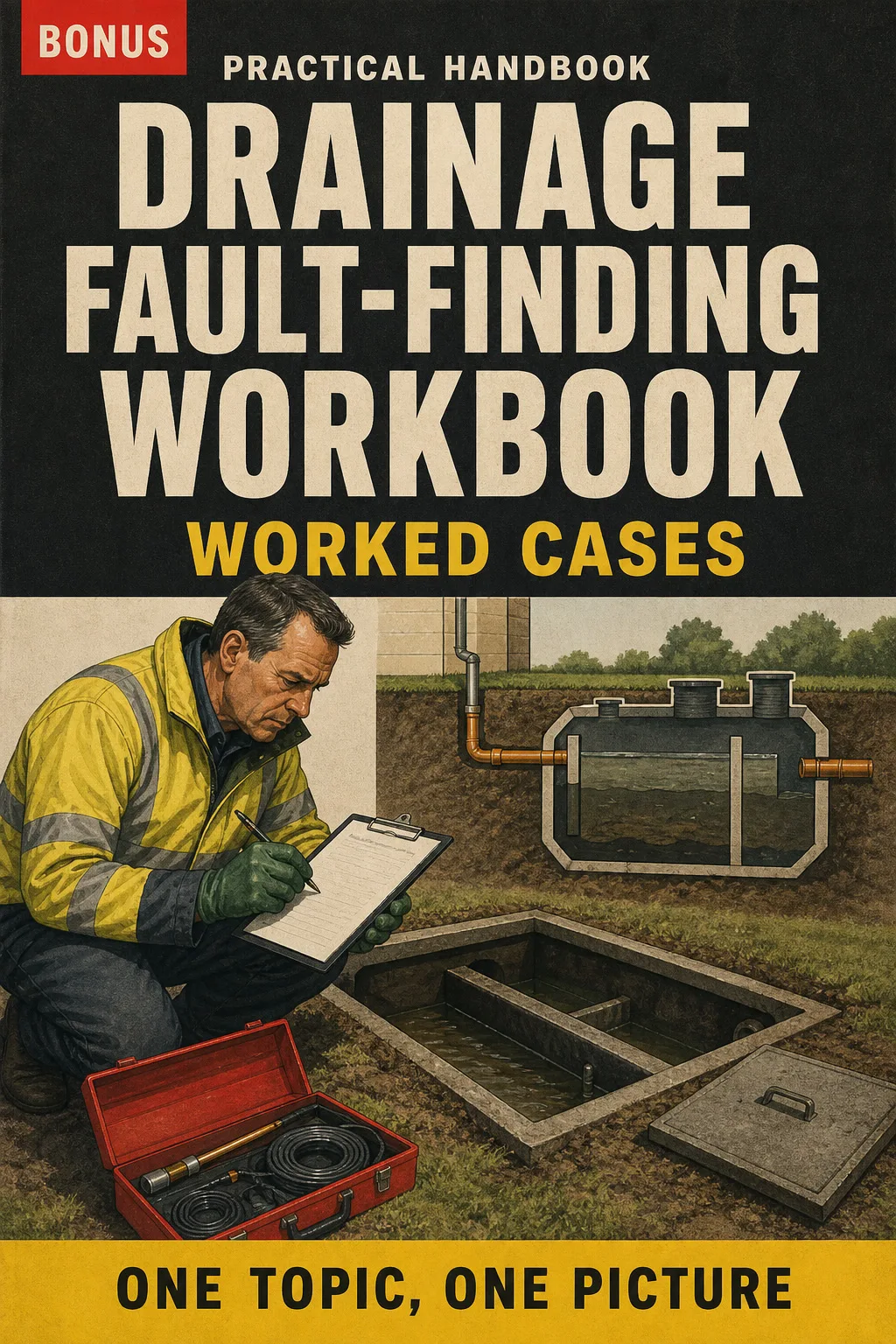
Drainage Fault-Finding Workbook: Worked Cases
BONUS 1

Drainage Fault-Finding Workbook: Worked Cases

Practise on real-life cases — smells, gurgling, wet patches, a sounding alarm — and work out the cause in the same order every time before you pick up a spade or the phone.

Common Septic Mistakes: Before & After
BONUS 2

Common Septic Mistakes: Before & After

See the most frequent mistakes side by side with the right way — wrong falls, wipes and bleach, skipped desludging — so you spot them on your own system or on site at a glance.

30-Day Guarantee

30-day guarantee: if a file doesn't open, if the content isn't what the product page describes, if you were charged twice or the email never arrived, write to us and we'll refund you in full. You pay once. No subscriptions.

Frequently Asked Questions

Is it for me if I've got a septic tank or treatment plant and nobody ever explained it?

Yes. It starts from what's under your garden and builds up to fault-finding. If you already do groundworks, the parts on drainage fields, falls and new installations go further. England, Wales, Scotland and Northern Ireland are each set out separately.

Where does the content come from?

The official guidance is free, and it's what counts for your property. This book doesn't replace it: it puts it in drawings, one topic per page, with the four nations side by side and one fault-finding order to follow. It's written with reference to Approved Document H, the General Binding Rules in England, guidance from Natural Resources Wales, SEPA and NIEA, and BS 6297 and BS EN 12566.

Is it official material?

No. It's an independent illustrated book, not affiliated with any regulator or standards body. For your own property, the current official guidance is what counts.

Does it replace a drainage engineer or building control?

No. It helps you understand your system and follow what they tell you. Installations, building work and anything inside the tank stay with a professional: never enter a tank.

Does it cover Scotland, Wales and Northern Ireland, or just England?

All four. The rules on discharge, registration and consent change by nation, so England, Wales, Scotland and Northern Ireland each have their own pages, with the regulator for each. Building regulations are set out separately. The worked cases in the bonus book are written for this book, not taken from any official inspection.

When and how does it arrive?

As a PDF by email, to the address you enter at checkout, together with the 2 bonus books.

Do I have to pay every month?

No. It's a one-off payment, with no subscription.

Can I have it on paper?

Yes. Print it at home or at a print shop and keep it in the van, or with your service log.

How does the refund work?

You have 30 days. We refund everything if the file won't open, if the book isn't what you see on this page, if you were charged twice or if the email doesn't arrive: just email us.

£19.99£57.99
Get the book · £19.99

This is a digital PDF book sent to your email: nothing is printed or shipped.