Study in Pictures🌐 English (United Kingdom)
OBD Fault Codes Illustrated

Digital book in PDF · read it on your phone or print it

OBD Fault Codes Illustrated

Fuel trims, the good lambda signal, P0420, misfires and the swap test, crank and cam sensors, P0128, diesel rail pressure and boost, DPF codes, circuit low and high. Each topic has its page: the drawing first, then what you need to remember.

  • 67 illustrated pages
  • English
  • 30-day guarantee
£19.99£57.99
Get the book · £19.99

Price shown for: United Kingdom. In other countries, the checkout shows the price that applies there.

About this book

What it is

Fuel trims, the good lambda signal, P0420, misfires and the swap test, crank and cam sensors, P0128, diesel rail pressure and boost, DPF codes, circuit low and high. Each topic has its page: the drawing first, then what you need to remember.

Who This Book Is For
  • You fix your own cars and the family's
  • A car's on the ramp with the light on
  • You've run a workshop for years
What it covers
  1. Reading a Code Properly
  2. Fuel Trims and Air Metering
  3. Lambda Sensors and the Catalyst
  4. Misfires, Ignition and Timing
  5. Cooling, EGR, EVAP and Idle
  6. Diesel Codes
  7. Circuit Codes and Wiring
  8. Fix, Prove It, Explain It
Language
English (United Kingdom)
Pages
67
Format
Digital book in PDF · read it on your phone or print it
Price
£19.99 (United Kingdom)
Delivery
This is a digital PDF book sent to your email: nothing is printed or shipped.
30-Day Guarantee
30-day guarantee: if a file doesn't open, if the content isn't what the product page describes, if you were charged twice or the email never arrived, write to us and we'll refund you in full.

Look Inside the Book

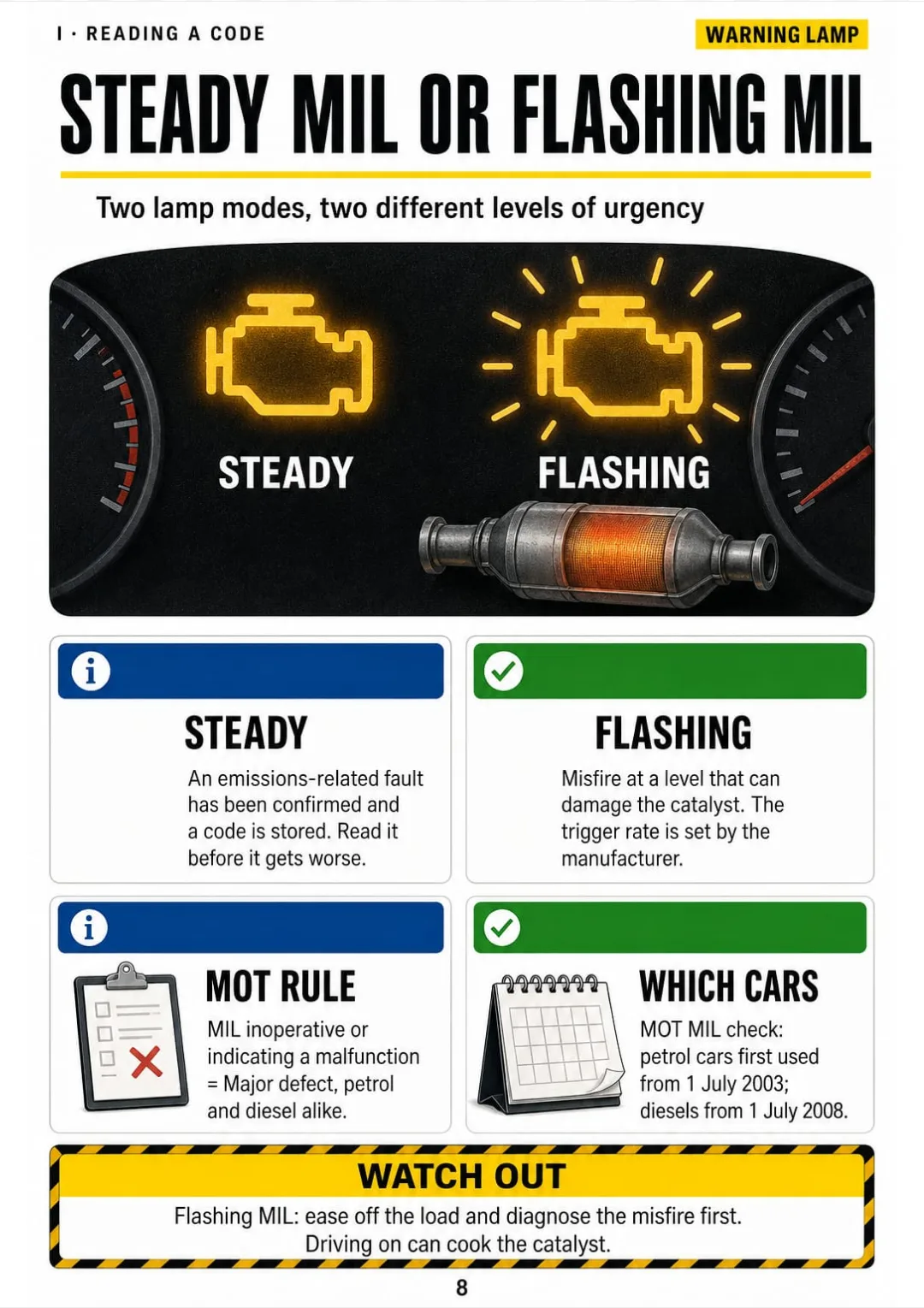
Steady = fault stored. Flashing = catalyst-damaging misfire. MIL on at the MOT = Major.
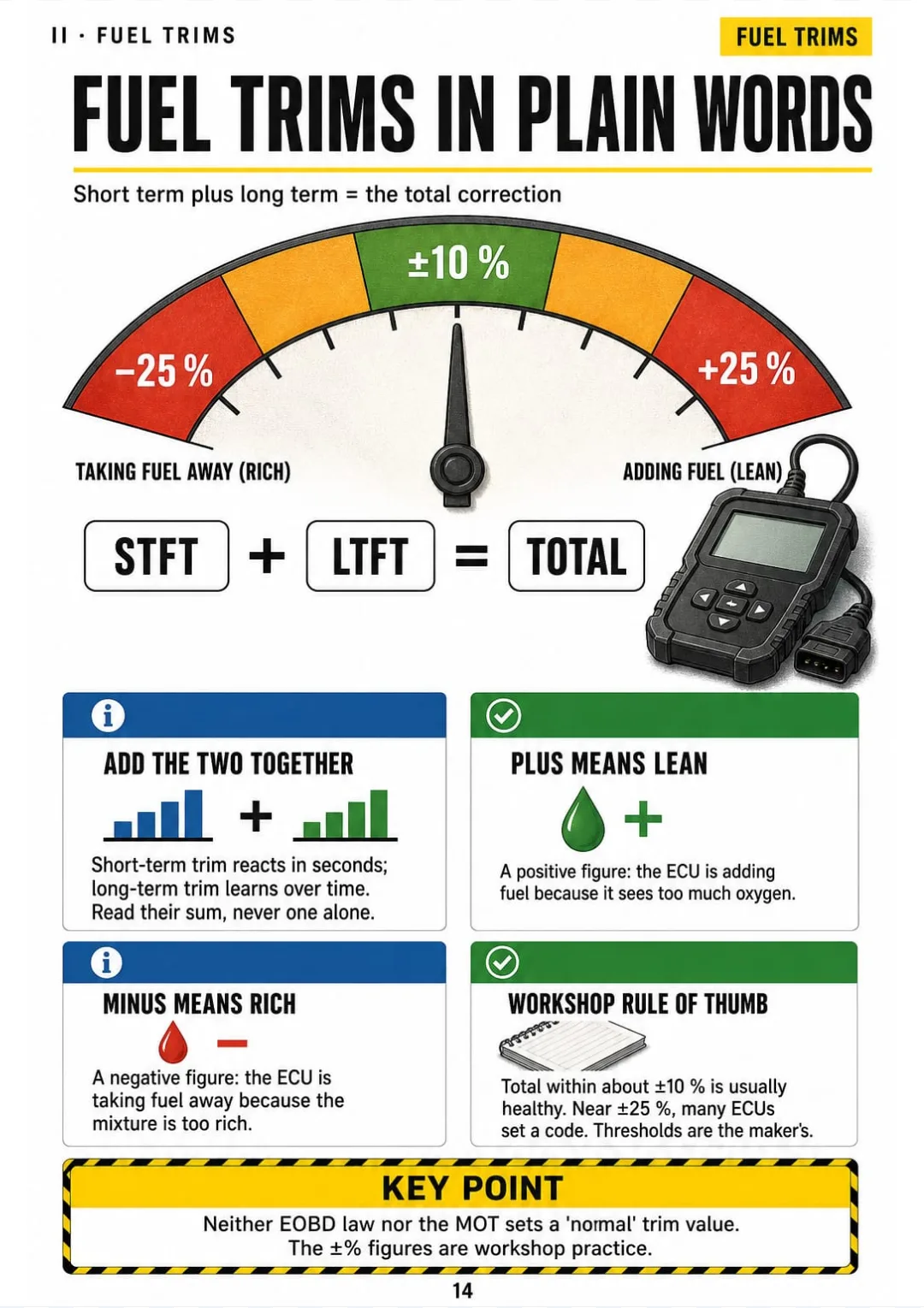
STFT + LTFT = total correction: plus is lean, minus is rich.
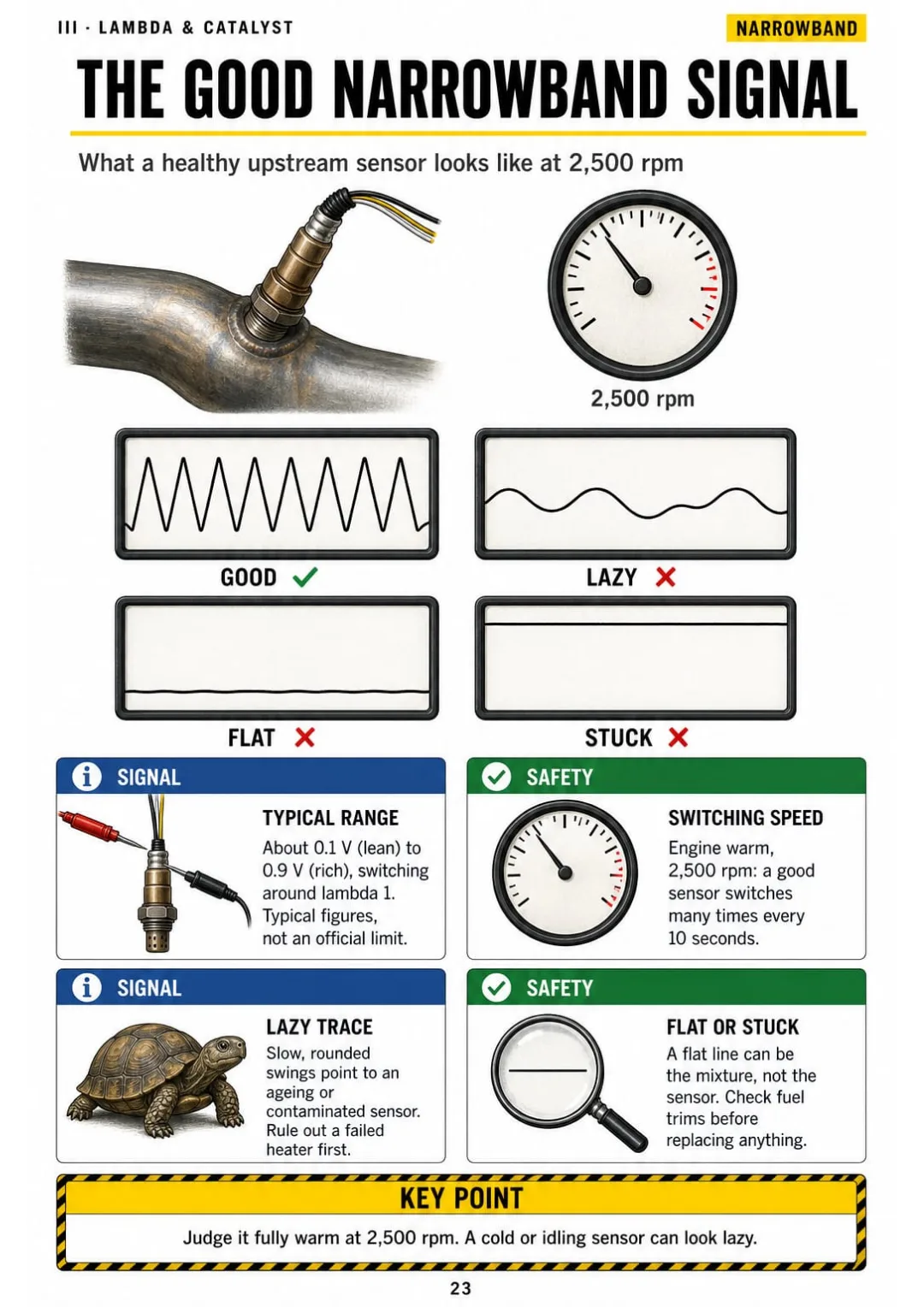
Good narrowband: 0.1–0.9 V, many switches every 10 seconds at 2,500 rpm
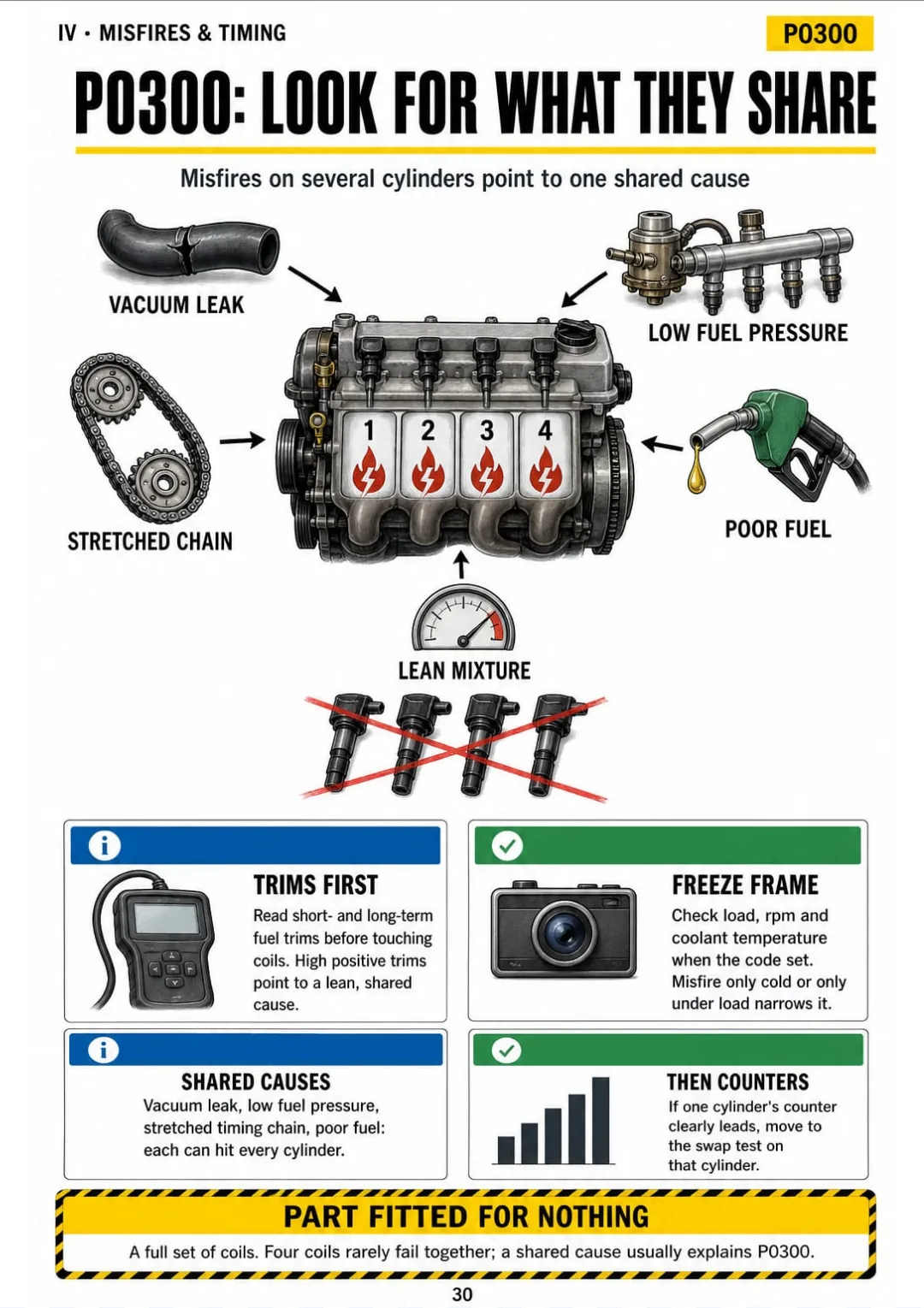
P0300: check fuel trims and shared causes before buying a set of coils
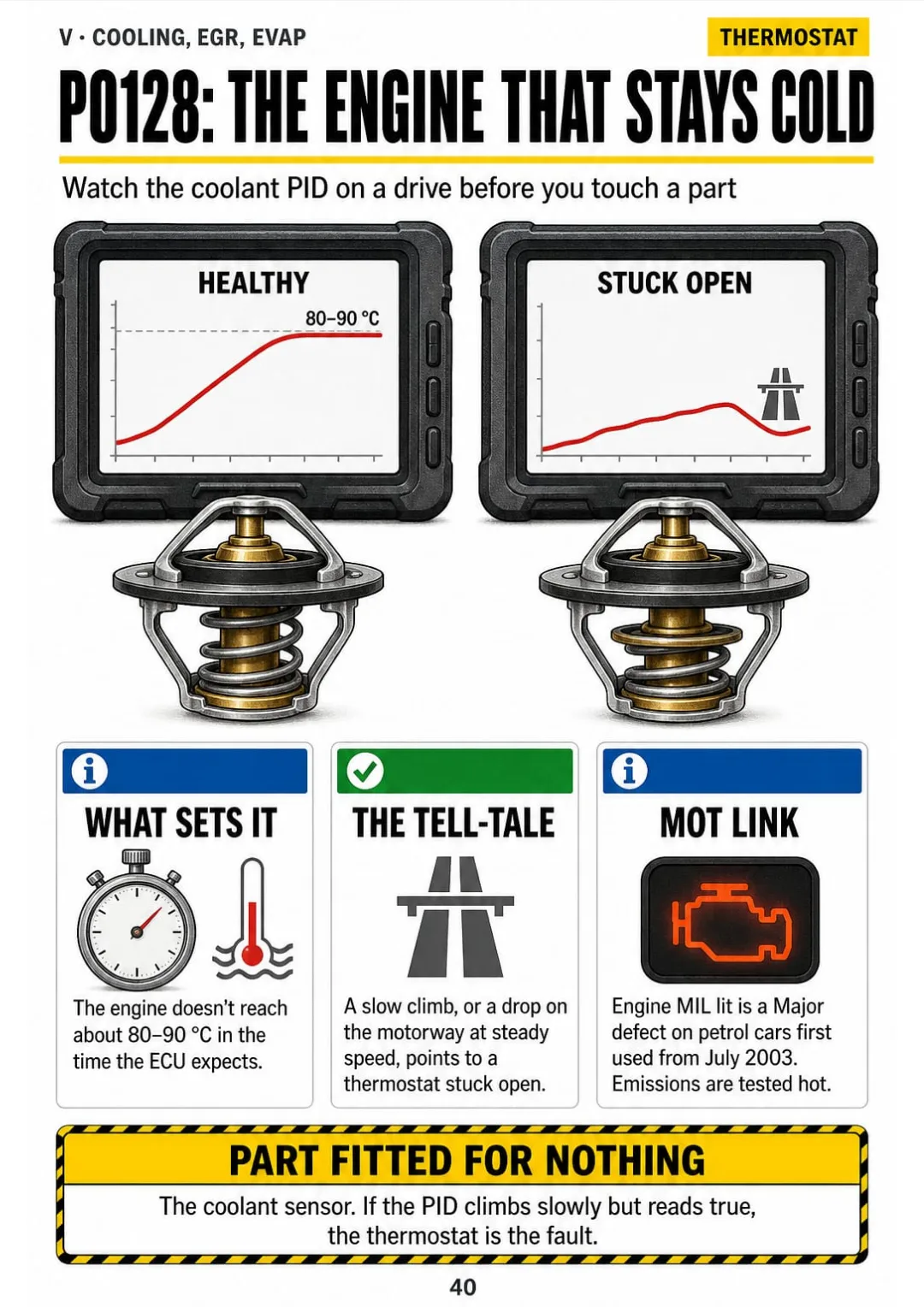
P0128: a slow climb or a motorway drop on the coolant PID means thermostat stuck open
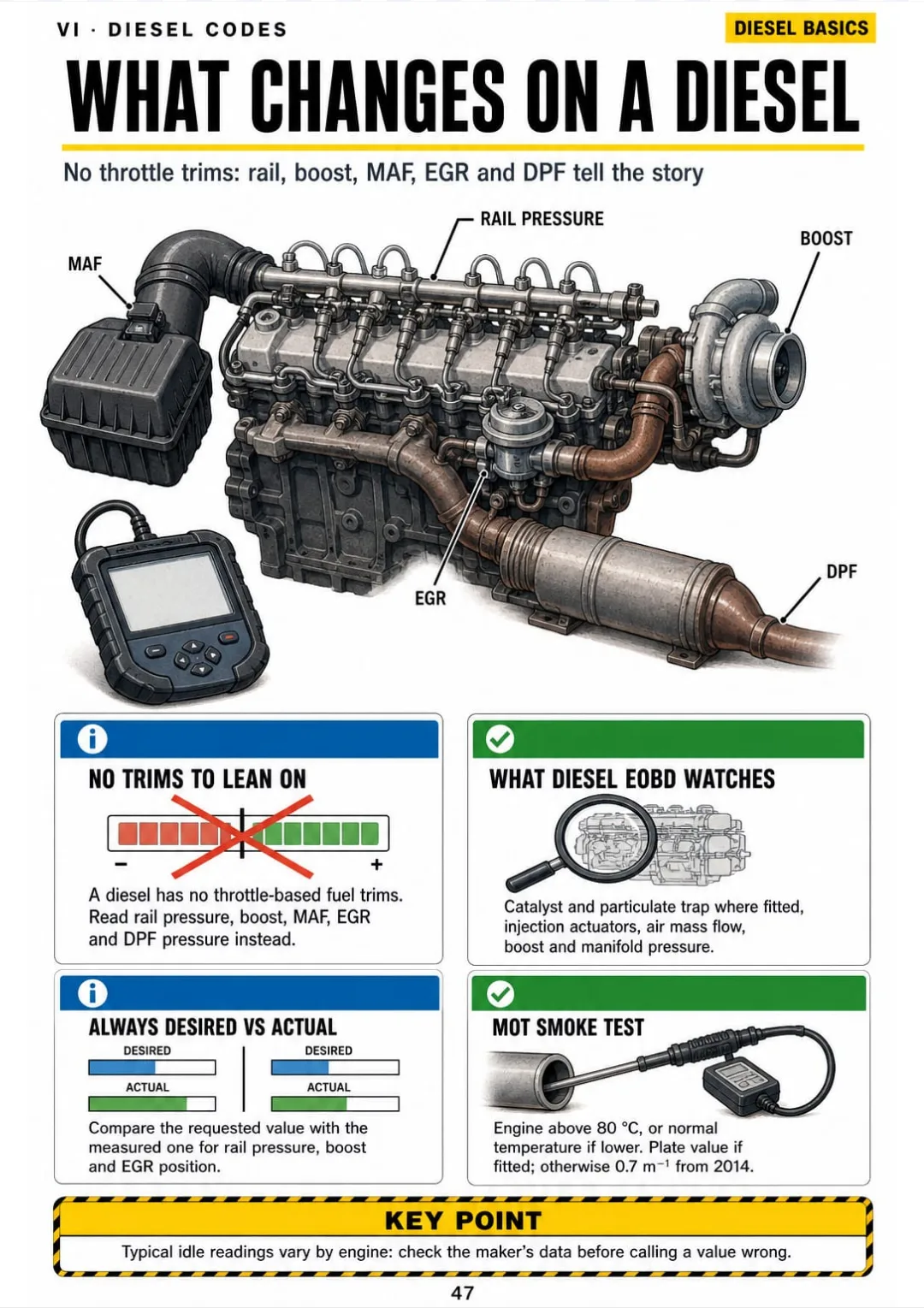
Diesel diagnosis: rail pressure, boost, MAF, EGR and DPF differential pressure
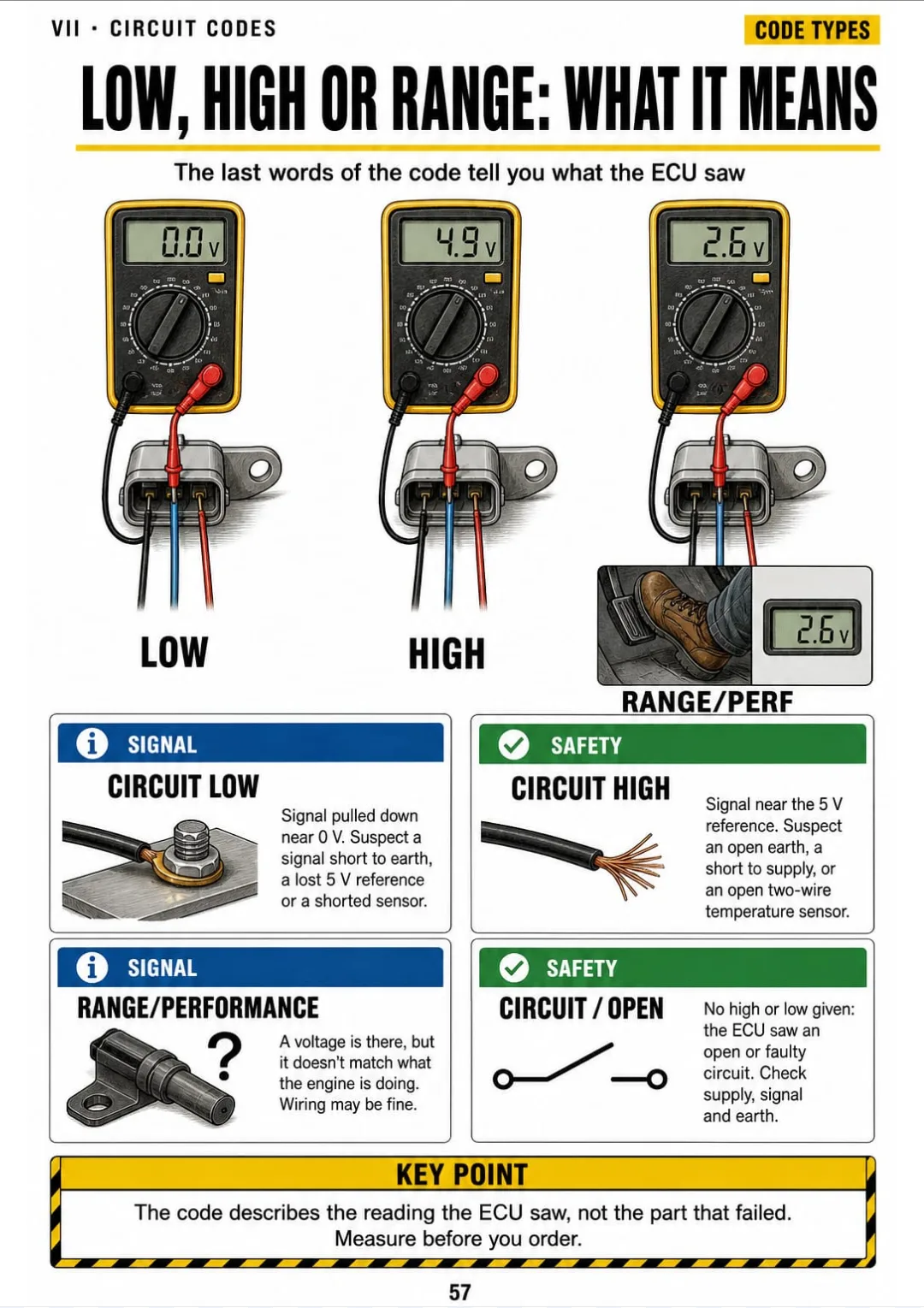
Circuit low ≈ 0 V, circuit high ≈ 5 V, range/performance = a signal that doesn't make sense
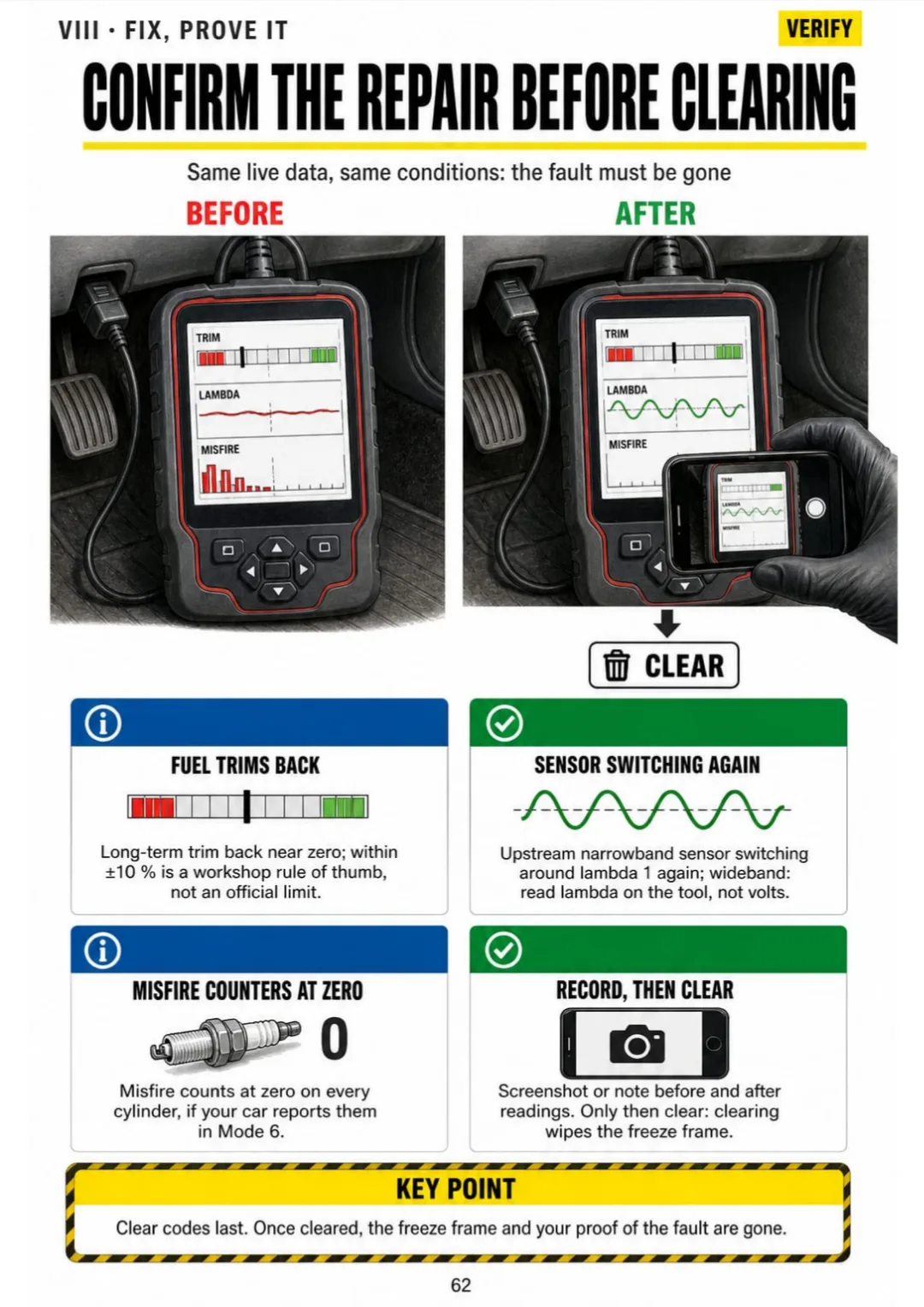
Before and after: trims, lambda switching and misfire counts checked before clearing codes

Take a Look at the 8 Parts and 63 Topics

Reading a Code Properly

pp. 5-13
  1. What EOBD Covers on UK Cars
  2. Anatomy of a Fault Code
  3. Generic or Manufacturer Code: How to Tell
  4. Steady MIL or Flashing MIL
  5. Pending, Confirmed and Permanent Codes
  6. Readiness Monitors After Clearing
  7. The 7-Step Method
  8. Freeze Frame: The Snapshot You Skip
  9. The Live Data PIDs Worth Watching

Fuel Trims and Air Metering

pp. 14-22
  1. Fuel Trims in Plain Words
  2. Idle vs 2,500 rpm: The Trim Test
  3. P0171: System Too Lean, Bank 1
  4. P0172: System Too Rich, Bank 1
  5. P0171 + P0174: Both Banks Lean
  6. P0101: MAF Range/Performance
  7. P0106: MAP Range/Performance
  8. P0112 / P0113: Intake Air Temperature Circuit
  9. Smoke Testing for Vacuum Leaks

Lambda Sensors and the Catalyst

pp. 23-29
  1. Narrowband Sensor: The Good Switching Signal
  2. Wideband Sensors: Read Lambda, Not Volts
  3. P0130–P0134: Upstream Sensor Circuit and Response
  4. P0135 / P0141: Lambda Heater Circuit
  5. The Downstream Sensor's Real Job
  6. P0420: Catalyst Efficiency Below Threshold
  7. Exhaust Leaks That Fake a Lean Code

Misfires, Ignition and Timing

pp. 30-39
  1. P0300: Random or Multiple Misfire
  2. P0301–P0306: The Swap Test
  3. Misfire Counters and Mode 6
  4. Coil-on-Plug Checks
  5. Reading a Spark Plug
  6. Injector Tests
  7. Compression and Leak-Down
  8. P0335: Crankshaft Position Sensor
  9. P0340: Camshaft Position Sensor
  10. P0016: Crank/Cam Correlation

Cooling, EGR, EVAP and Idle

pp. 40-46
  1. P0128: Coolant Below Thermostat Temperature
  2. P0117 / P0118: Coolant Sensor Circuit
  3. P0401: EGR Flow Insufficient (Petrol)
  4. P0455 / P0456: EVAP Large and Small Leaks
  5. P0443 / P0441: Purge Valve and Purge Flow
  6. P0505–P0507: Idle Control and High Idle
  7. P0562: System Voltage Low

Diesel Codes

pp. 47-56
  1. What Changes on a Diesel
  2. P0087: Rail Pressure Too Low
  3. P0088 / P0093: Pressure Too High and Fuel Leak
  4. P0299: Turbo Underboost
  5. P0234: Turbo Overboost
  6. P0401 on a Diesel: The Carboned EGR
  7. P2002 / P2463: DPF Efficiency and Soot Load
  8. P2452–P2454: DPF Pressure Sensor
  9. P0380 / P0670: Glow Plugs and Control Module
  10. SCR and AdBlue Codes: How to Recognise Them

Circuit Codes and Wiring

pp. 57-61
  1. Low Input, High Input, Circuit: What They Mean
  2. The Three-Wire Sensor: Supply, Signal, Earth
  3. Voltage Drop on Earths and Feeds
  4. Shared 5 V Reference: Several Codes at Once
  5. U0100 and Lost Communication Codes

Fix, Prove It, Explain It

pp. 62-67
  1. Confirming the Repair Before You Clear
  2. The Road Test That Proves the Fix
  3. Explaining the Fault to the Customer
  4. Ten Parts Fitted for Nothing
  5. Checklist Before You Order a Part
  6. Quick Index: Code → Page → First Test

Who This Book Is For

You fix your own cars and the family's

You've got the scan tool, now you get the test behind each code: what to measure, what a good reading looks like, before you buy anything.

A car's on the ramp with the light on

You open the code's page, check the freeze frame and run the first test in the right order, with the part people fit for nothing marked.

You've run a workshop for years

Live data, fuel trims and lambda signals drawn on one page each, printed and kept on the bench for the jobs that don't add up.

Plus: 2 Free Books

Freeze-Frame Case Workbook
BONUS 1

Freeze-Frame Case Workbook

Workshop-style cases with the code, the freeze frame and the live data: you decide what to test first, then check the answer on the next page.
Parts Fitted for Nothing: Quick Cards
BONUS 2

Parts Fitted for Nothing: Quick Cards

The most frequent misdiagnoses, code by code, on printable cards for the toolbox, so you check the cheap test before you order the part.

30-Day Guarantee

30-day guarantee: if a file doesn't open, if the content isn't what the product page describes, if you were charged twice or the email never arrived, write to us and we'll refund you in full. You pay once. No subscriptions.

Frequently Asked Questions

Is it for me if I've been on the tools for years and already have a scan tool?

Yes. It isn't a beginner's list of codes: it's the test that comes before the part, code by code. It covers generic powertrain codes valid on any make, petrol and diesel, in metric units, and shows how to recognise manufacturer-specific codes. A generic scan tool with live data and freeze frame is enough; the Mode 6 pages need a tool that reads it.

Where does the content come from?

Code definitions are checked against the generic powertrain code list in SAE J2012 / ISO 15031-6 (the EOBD list used on UK cars), and the MIL rules against the DVSA MOT inspection manual. Values are typical ranges: always check the manufacturer's data for the car in front of you.

Is it official material?

No. It's an independent illustrated book. It isn't published, approved or endorsed by any standards body, government agency, vehicle manufacturer or scan tool brand.

Does it replace training or the manufacturer's data?

No. It's a study and workshop reference that puts each code's test in order. It doesn't replace professional training, workshop manuals or safe working practice.

Is it all American, or does it work on diesels and European cars?

It's written for UK cars: EOBD, petrol and diesel, in metric units. Generic P0 codes mean the same on any make. For manufacturer codes it shows how to recognise them and when to go to the maker's data for that car.

When and how does it arrive?

As a PDF by email, to the address you enter at checkout, together with the 2 bonus books.

Do I have to pay every month?

No. It's a one-off payment, no subscription.

Can I have it on paper?

Yes. Print it at home or at a print shop, the whole book or just the pages you want on the bench.

How does the refund work?

You have 30 days. We refund everything if the file won't open, if the book isn't what you see on this page, if you were charged twice or if the email doesn't arrive: just email us.

£19.99£57.99
Get the book · £19.99

This is a digital PDF book sent to your email: nothing is printed or shipped.