Study in Pictures🌐 English (United Kingdom)
Motor Control Circuits Illustrated

Digital book in PDF · read it on your phone or print it

Motor Control Circuits Illustrated

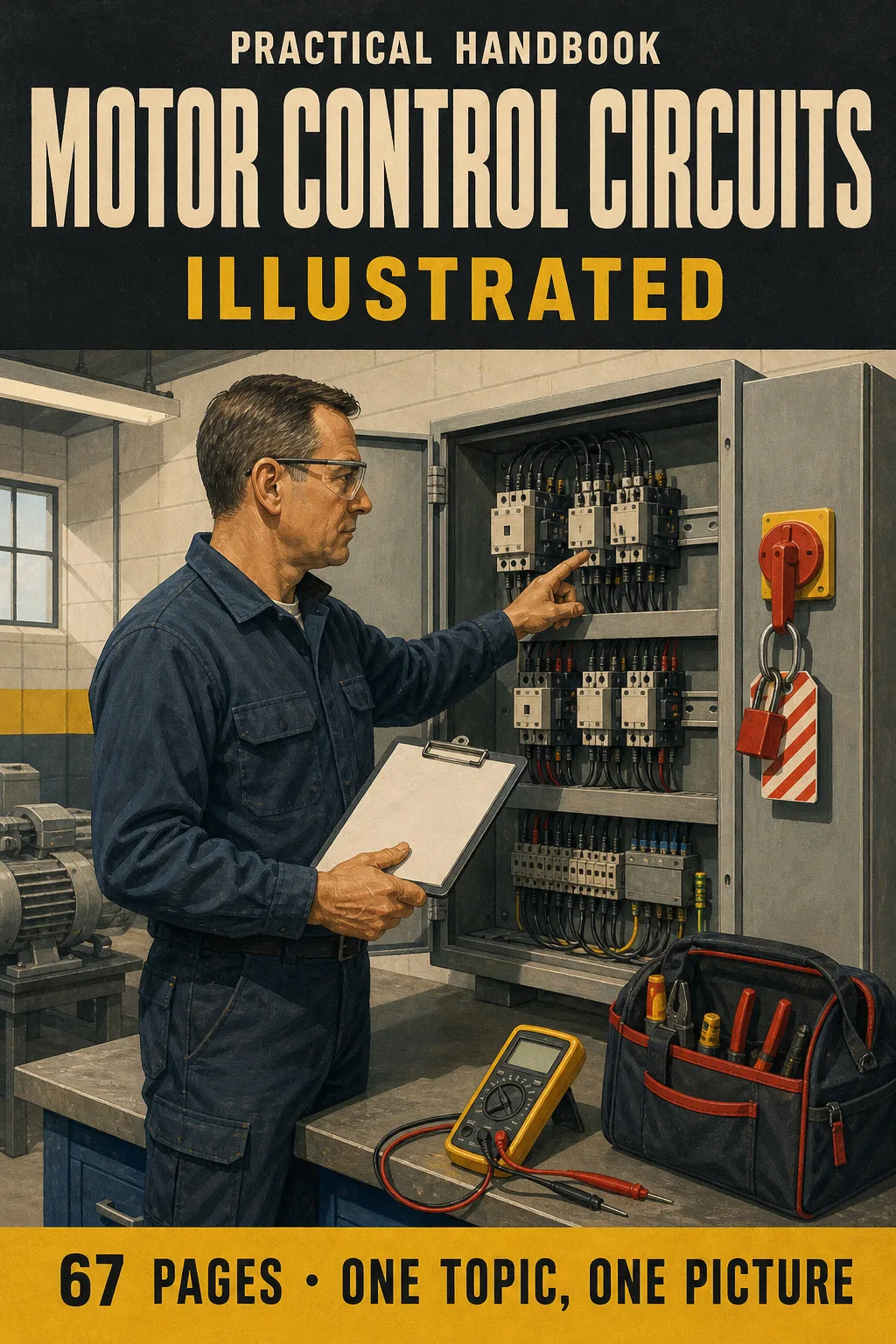
Contactors, overloads, push-button colours, DOL starters, reversing, star-delta, pump alternation, safe isolation and fault finding. Every topic has its own page: the drawing first, then what you need to remember.

  • 67 illustrated pages
  • English
  • 30-day guarantee
£19.99£57.99
Get the book · £19.99

Price shown for: United Kingdom. In other countries, the checkout shows the price that applies there.

About this book

What it is

Contactors, overloads, push-button colours, DOL starters, reversing, star-delta, pump alternation, safe isolation and fault finding. Every topic has its own page: the drawing first, then what you need to remember.

Who This Book Is For
  • You're learning motor control
  • You've got a panel job coming up
  • You already do motor work
What it covers
  1. Before the Drawing
  2. Symbols and Devices
  3. Reading Any Schematic
  4. Basic Circuits
  5. Reversing and Timing
  6. Star-Delta
  7. Pumps, Fans and Compressors
  8. Wiring, Testing and Fault Finding
  9. Practical Review
Language
English (United Kingdom)
Pages
67
Format
Digital book in PDF · read it on your phone or print it
Price
£19.99 (United Kingdom)
Delivery
This is a digital PDF book sent to your email: nothing is printed or shipped.
30-Day Guarantee
30-day guarantee: if a file doesn't open, if the content isn't what the product page describes, if you were charged twice or the email never arrived, write to us and we'll refund you in full.

Look Inside the Book

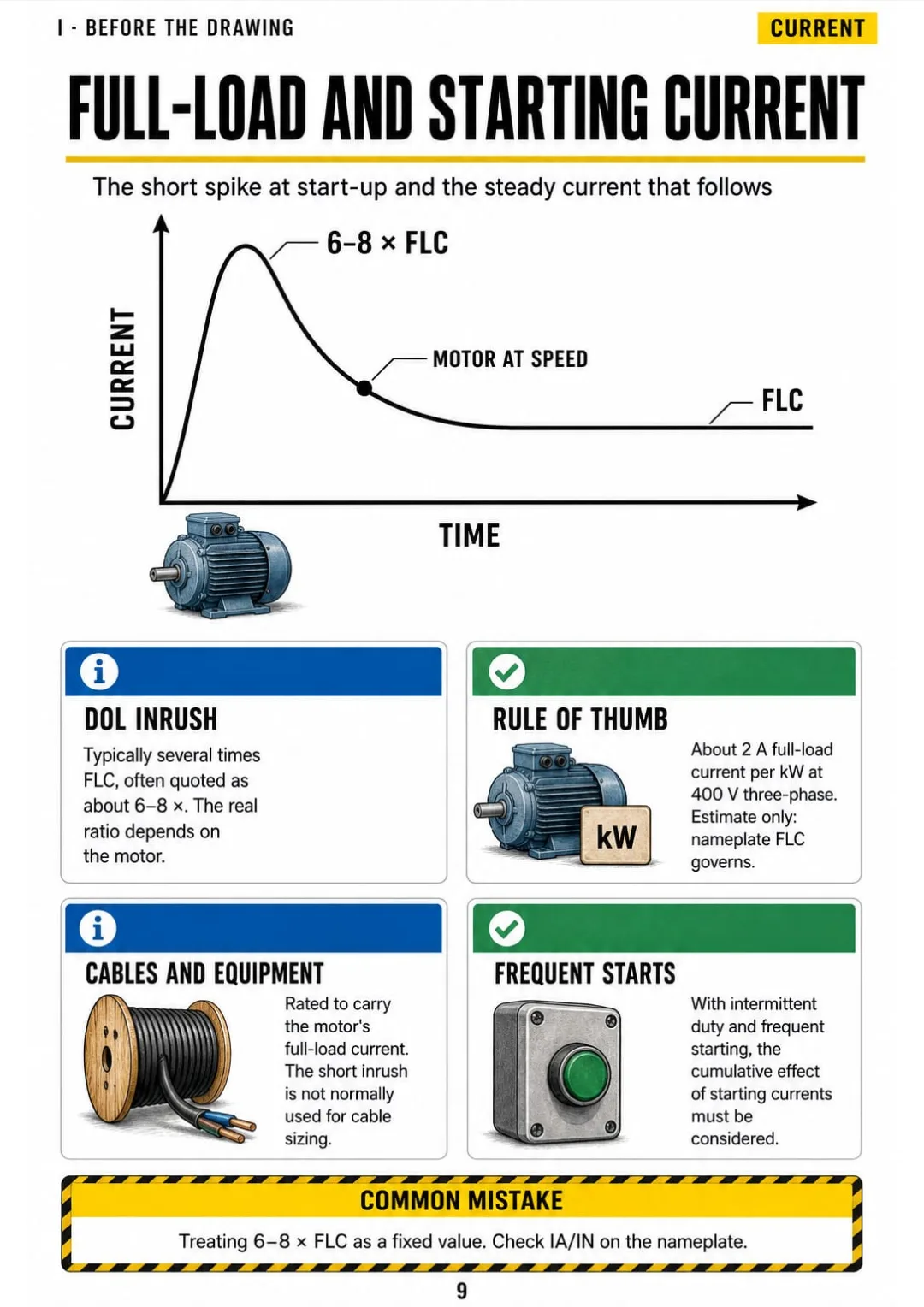
DOL inrush often about 6–8 × FLC · rule of thumb about 2 A per kW at 400 V.
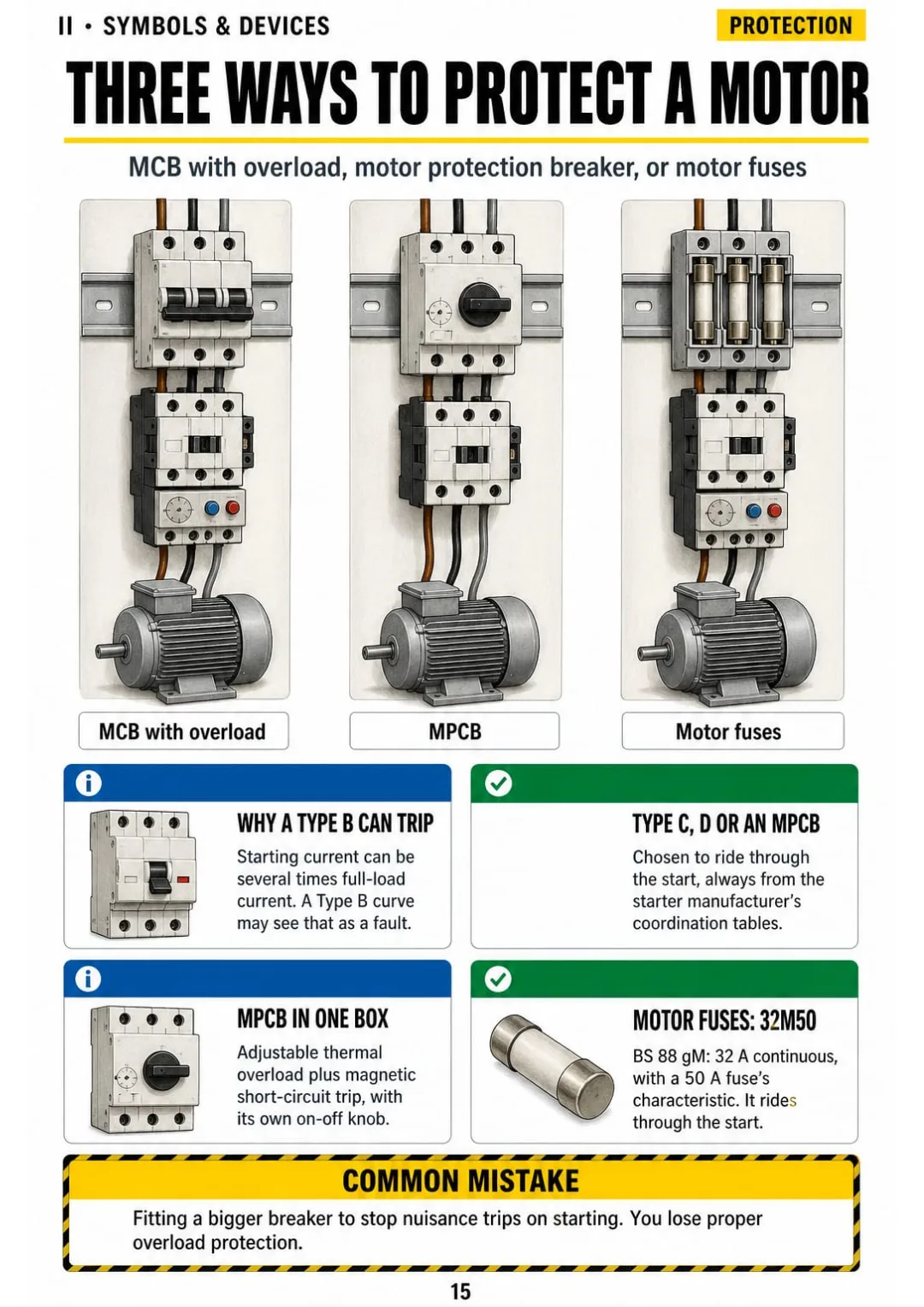
MCB plus overload, MPCB or gM fuses like 32M50: never just a bigger breaker
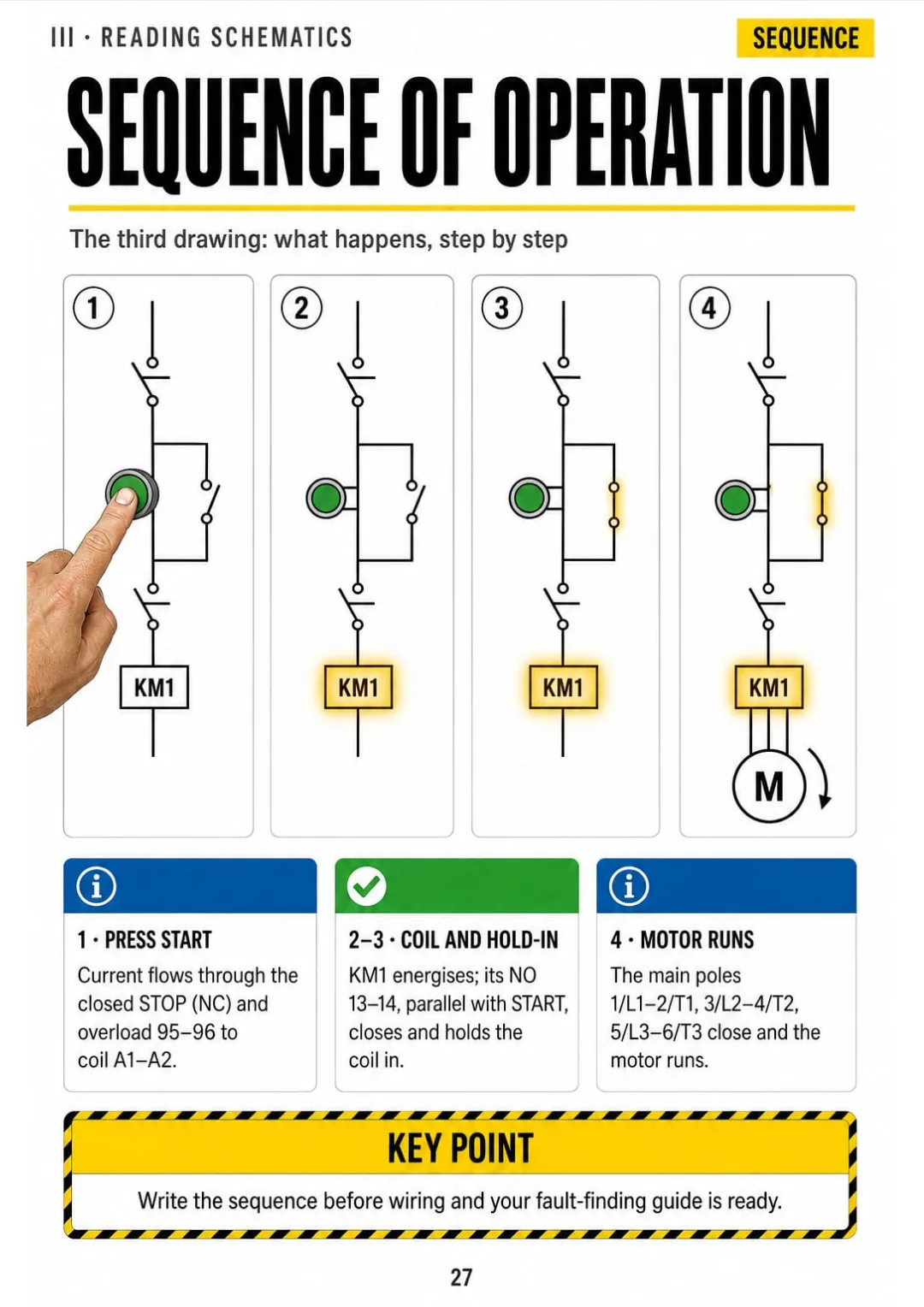
Press start → coil energises → hold-in closes → motor runs
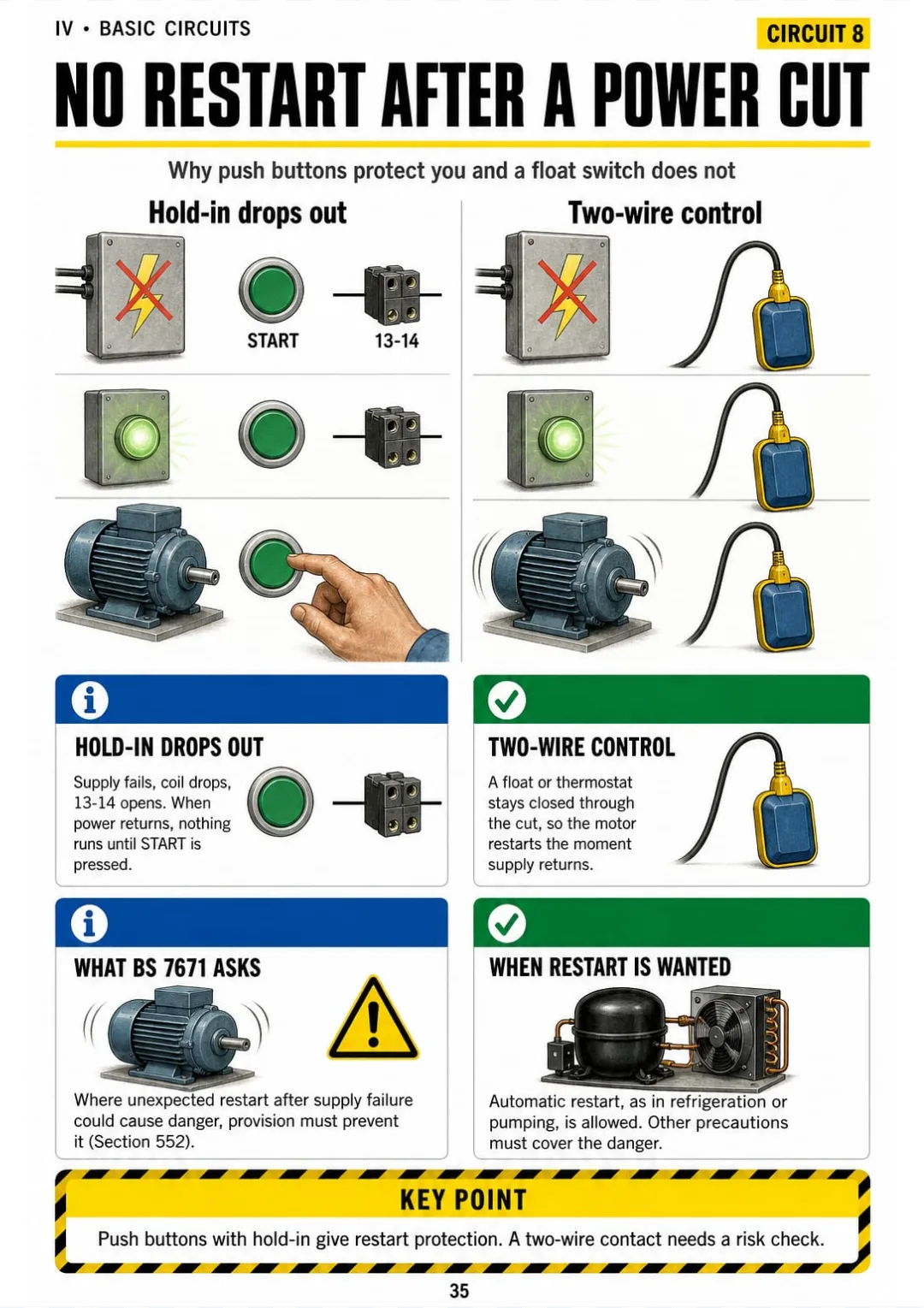
Hold-in contact prevents restart after supply failure; two-wire control restarts
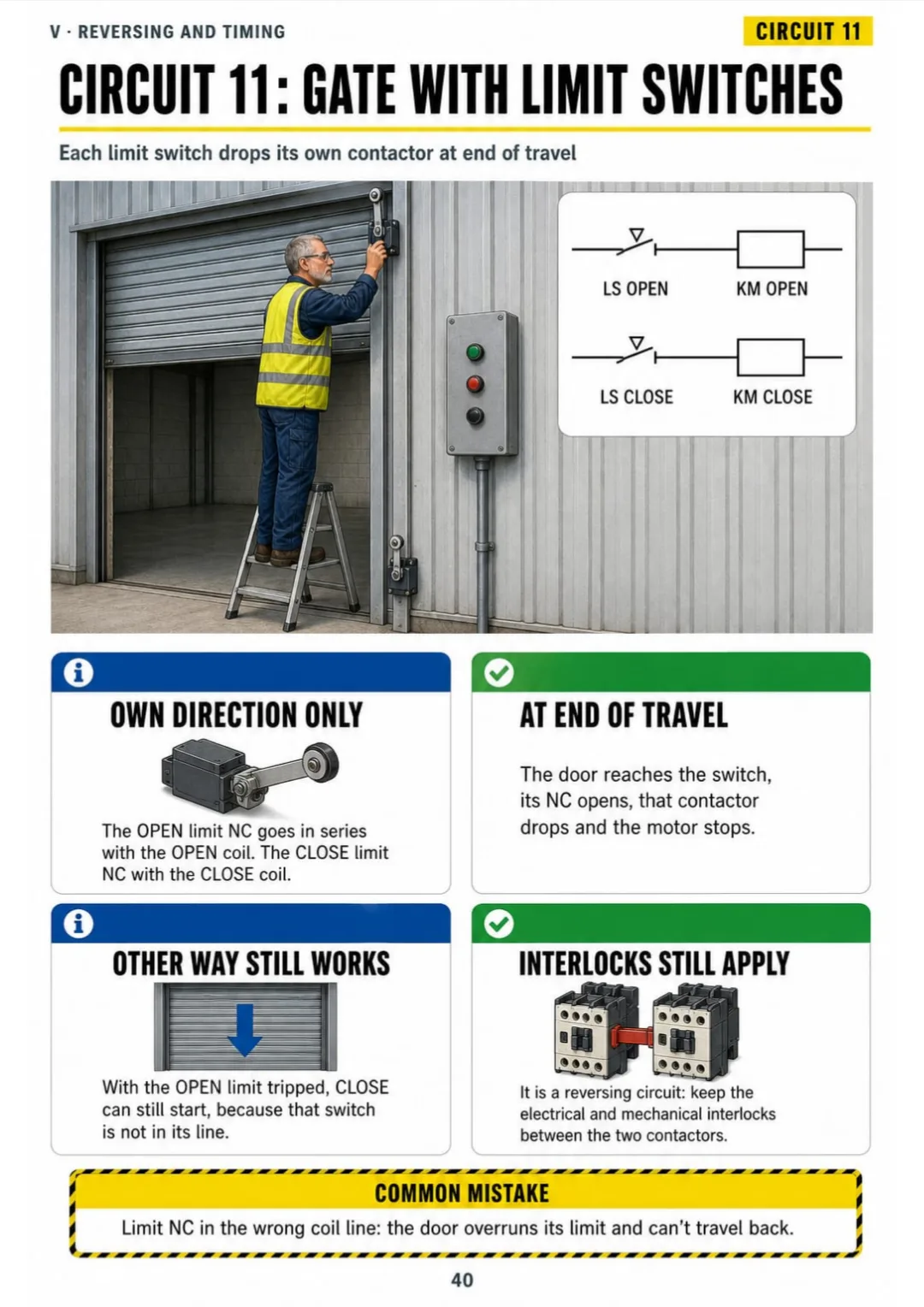
Circuit 11: each limit switch NC in series with its own direction's coil
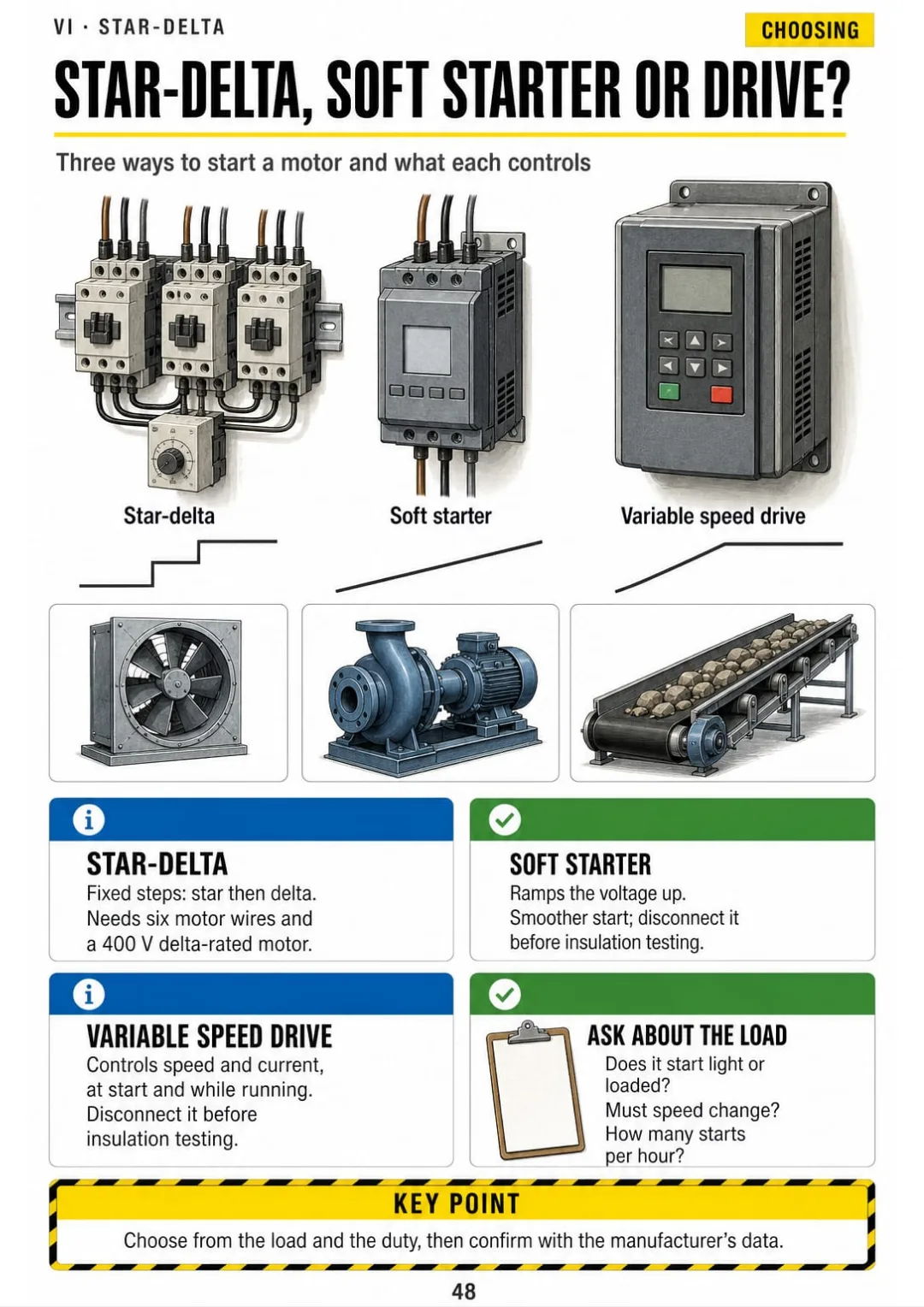
Star-delta: fixed steps · soft starter: voltage ramp · drive: speed and current
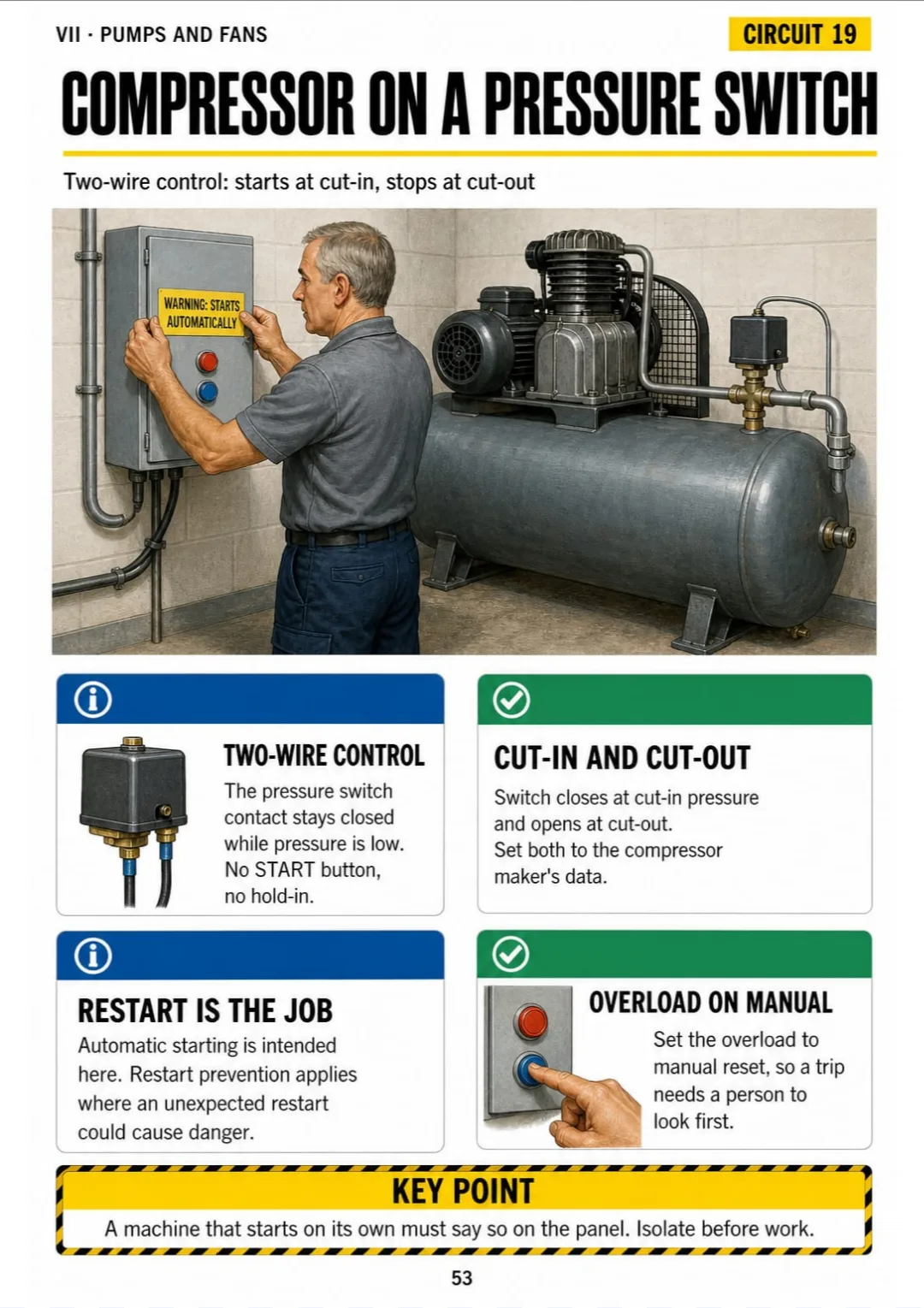
Compressor: two-wire pressure control, manual-reset overload and a 'starts automatically' label.
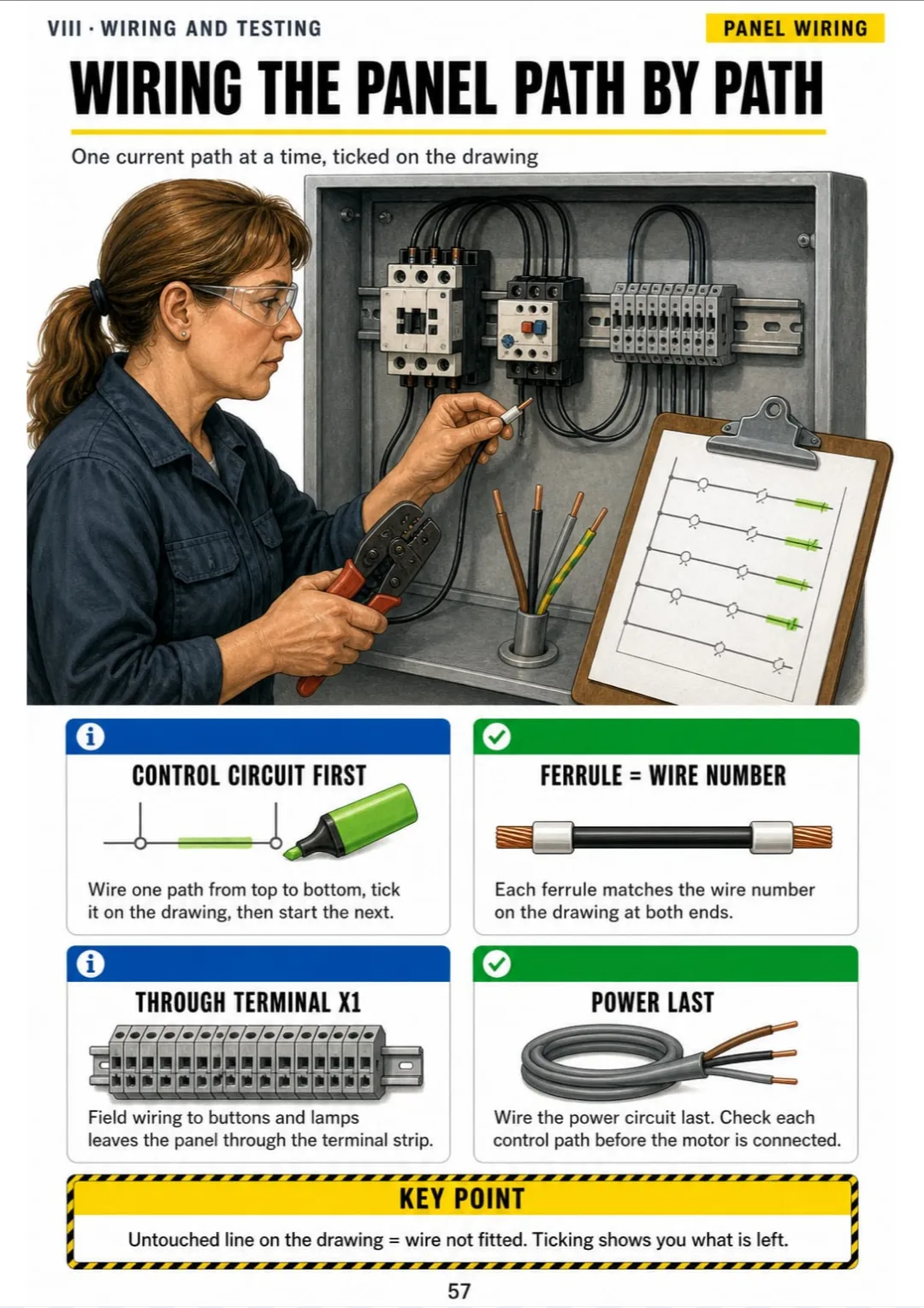
Control paths first, ticked one by one, ferrules matching the drawing, power circuit last

Take a Look at the 9 Parts and 63 Topics

Before the Drawing

pp. 5-10
  1. IEC, Not NEMA: Why Most Books Don't Match a UK Panel
  2. 400/230 V Three-Phase in One Picture
  3. Reading the Motor Nameplate
  4. Star and Delta in the Terminal Box
  5. Full-Load Current and Starting Current
  6. Power Circuit and Control Circuit Side by Side

Symbols and Devices

pp. 11-21
  1. Contacts: Normally Open and Normally Closed
  2. Terminal Numbers That Tell You What a Contact Is
  3. The Contactor
  4. The Thermal Overload Relay
  5. Motor Protection Circuit Breakers and Fuses
  6. The Isolator and Local Switching
  7. Push Buttons and Their Colours
  8. Indicator Lamps and What Each Colour Means
  9. Timers: On-Delay and Off-Delay
  10. The Control Supply: 230 V or a Transformer
  11. Device Letters on the Drawing

Reading Any Schematic

pp. 22-27
  1. The Five-Step Reading Order
  2. Current Paths and Column Numbers
  3. Cross-References Under Each Coil
  4. Wire Numbers and Terminal Strips
  5. Everything Is Drawn at Rest
  6. Sequence of Operation: The Third Drawing

Basic Circuits

pp. 28-35
  1. Circuit 1: DOL Start-Stop with Hold-In Contact
  2. Circuit 2: DOL with Run and Trip Lamps
  3. Circuit 3: Start and Stop from Two Places
  4. Circuit 4: Jog with a Selector Switch
  5. Circuit 5: Hand-Off-Auto
  6. Circuit 6: Single-Phase Motor on a Contactor
  7. Circuit 7: Emergency Stop Through a Safety Relay
  8. Circuit 8: No Restart After a Power Cut

Reversing and Timing

pp. 36-42
  1. Swapping Two Phases Reverses the Motor
  2. Circuit 9: Forward-Stop-Reverse
  3. Circuit 10: Direct Reversal
  4. Interlocks: Electrical and Mechanical
  5. Circuit 11: Gate or Shutter with Limit Switches
  6. Circuit 12: Timed Start with an On-Delay Timer
  7. Circuit 13: Extract Fan Run-On with an Off-Delay Timer

Star-Delta

pp. 43-48
  1. Why Star-Delta: A Third of the Current
  2. Circuit 14: Star-Delta Power Circuit
  3. Circuit 14: Star-Delta Control and Sequence
  4. Setting the Overload on a Star-Delta Starter
  5. Changeover Time and the Transition Spike
  6. Star-Delta, Soft Starter or Drive?

Pumps, Fans and Compressors

pp. 49-55
  1. Circuit 15: Tank Filling with Float Switches
  2. Circuit 16: Sump Emptying with Level Probes
  3. Circuit 17: Duty and Standby Pump Alternation
  4. Circuit 18: High-Level Alarm with Mute
  5. Circuit 19: Compressor on a Pressure Switch
  6. Circuit 20: Sequence Start for Two Motors
  7. Thermistor and Phase-Failure Relays

Wiring, Testing and Fault Finding

pp. 56-63
  1. Safe Isolation Before You Touch the Panel
  2. From Schematic to Panel: Wiring in Order
  3. Insulation Resistance on Motor Circuits
  4. Winding Resistance and Rotation Check
  5. Fault: The Contactor Chatters or Hums
  6. Fault: The Overload Keeps Tripping
  7. Fault: Nothing Happens When You Press Start
  8. Fault: The Motor Hums but Won't Turn

Practical Review

pp. 64-67
  1. Pre-Energising Checklist
  2. The Most Frequent Wiring Mistakes
  3. The Reading Order on One Page
  4. Handing Over the Job

Who This Book Is For

You're learning motor control

You get the symbols, the devices and the five-step reading order, one page each, before your first panel.

You've got a panel job coming up

You open the circuit you need, DOL, reversing or star-delta, and see the schematic, the wiring and the sequence.

You already do motor work

You keep the fault pages and the pre-energising checklist to hand, and check terminal numbers at a glance.

Plus: 2 Free Books

Schematic Reading Workbook: 30 Circuits to Trace
BONUS 1

Schematic Reading Workbook: 30 Circuits to Trace

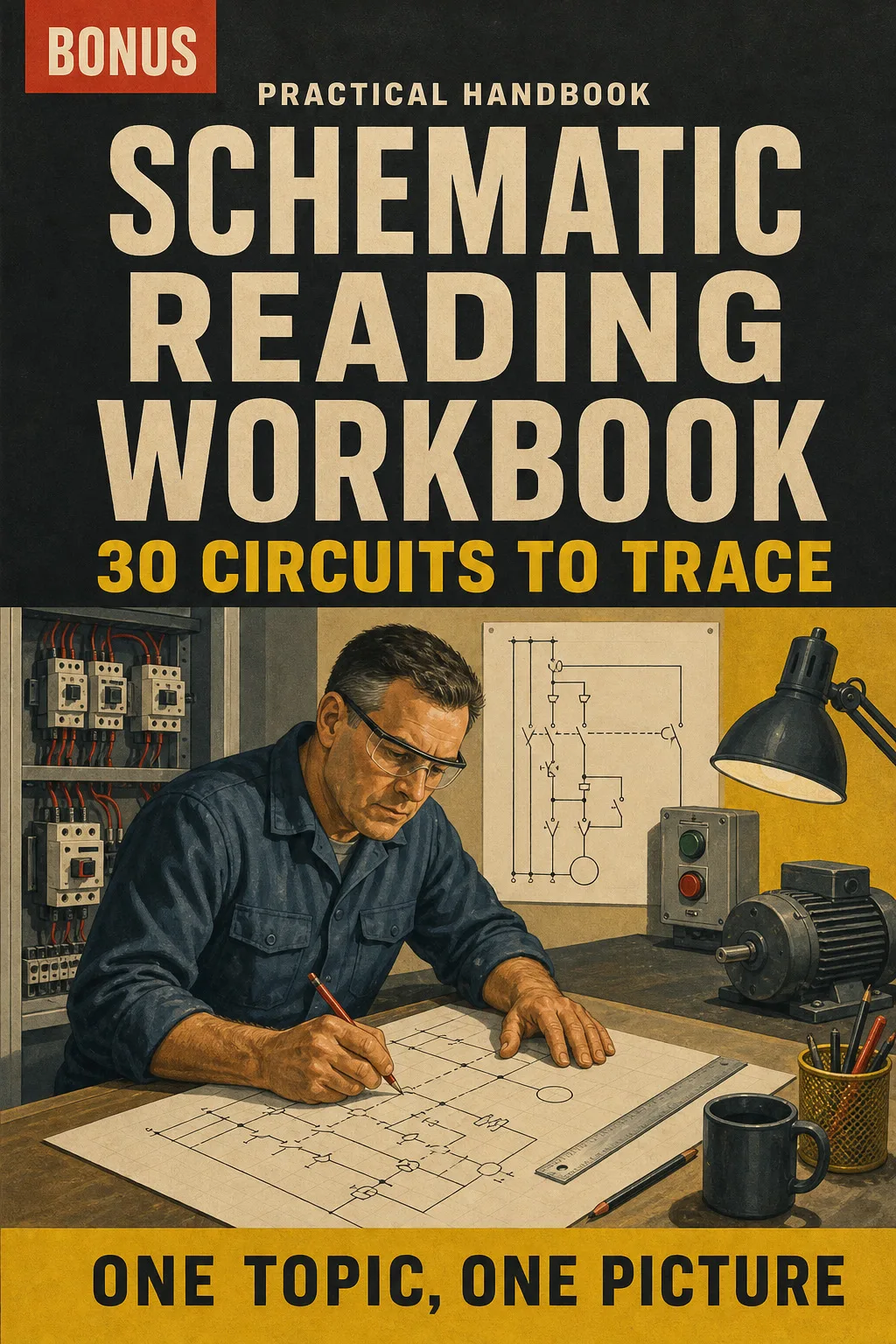
Trace 30 control schematics line by line and check your answer on the next page, until reading a new drawing becomes routine.
Motor Control Quick Cards: Symbols, Designations & Colours
BONUS 2

Motor Control Quick Cards: Symbols, Designations & Colours

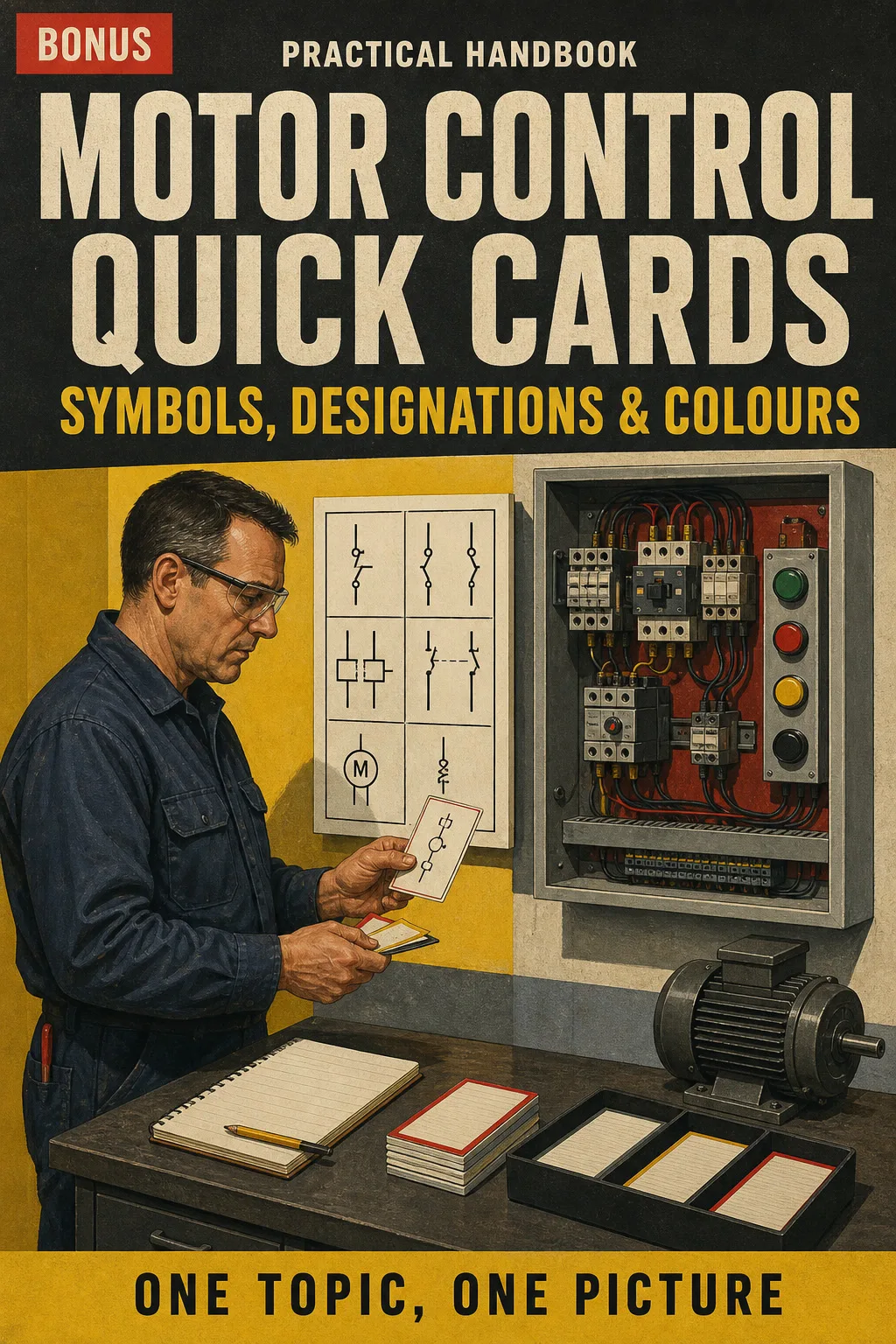
Every IEC symbol, device letter and push-button colour on printable cards to keep in the van and check at a glance on site.

30-Day Guarantee

30-day guarantee: if a file doesn't open, if the content isn't what the product page describes, if you were charged twice or the email never arrived, write to us and we'll refund you in full. You pay once. No subscriptions.

Frequently Asked Questions

Is it for me if I'm already an electrician but new to motor control?

Yes. It assumes you already do installation work to BS 7671 and starts from what's new in motor circuits: IEC symbols at 400/230 V, 50 Hz (no NEMA, no 480 V), contactors, overloads and the order to read a schematic.

Where does the content come from?

From BS 7671 (the edition in force when the book was checked, with its amendments), BS EN 60204-1, BS EN 60947-4-1, IEC 60617 symbols, BS EN 60445 terminal markings and HSE guidance GS38. Symbols, terminal numbers and the circuits themselves come from the IEC/EN standards, not from BS 7671. Everything is explained with our own drawings; no text or tables are reproduced from the standards.

Is this official material?

No. It's an independent illustrated guide, not affiliated with or endorsed by the IET, BSI, IEC or HSE.

Does it replace a course or training?

No. It's a drawn reference to understand and revise. It doesn't replace training, supervised work, the manufacturer's instructions or BS 7671 itself.

Are the practice circuits from an exam?

No. The 30 circuits in the workbook are written for this book. It isn't exam preparation and it doesn't come with a certificate or qualification: it's for reading and wiring real panels.

When and how do I get it?

As a PDF by email, to the address you enter at checkout.

Do I have to pay every month?

No. It's a one-off payment, with no subscription.

Can I have it on paper?

Yes. It's a PDF you can print at home or at a print shop and keep in the van.

How does the refund work?

You have 30 days. We refund everything if the file won't open, if the book isn't what you see on this page, if you were charged twice or if the email doesn't arrive: just email us.

£19.99£57.99
Get the book · £19.99

This is a digital PDF book sent to your email: nothing is printed or shipped.