Study in Pictures🌐 English (United Kingdom)
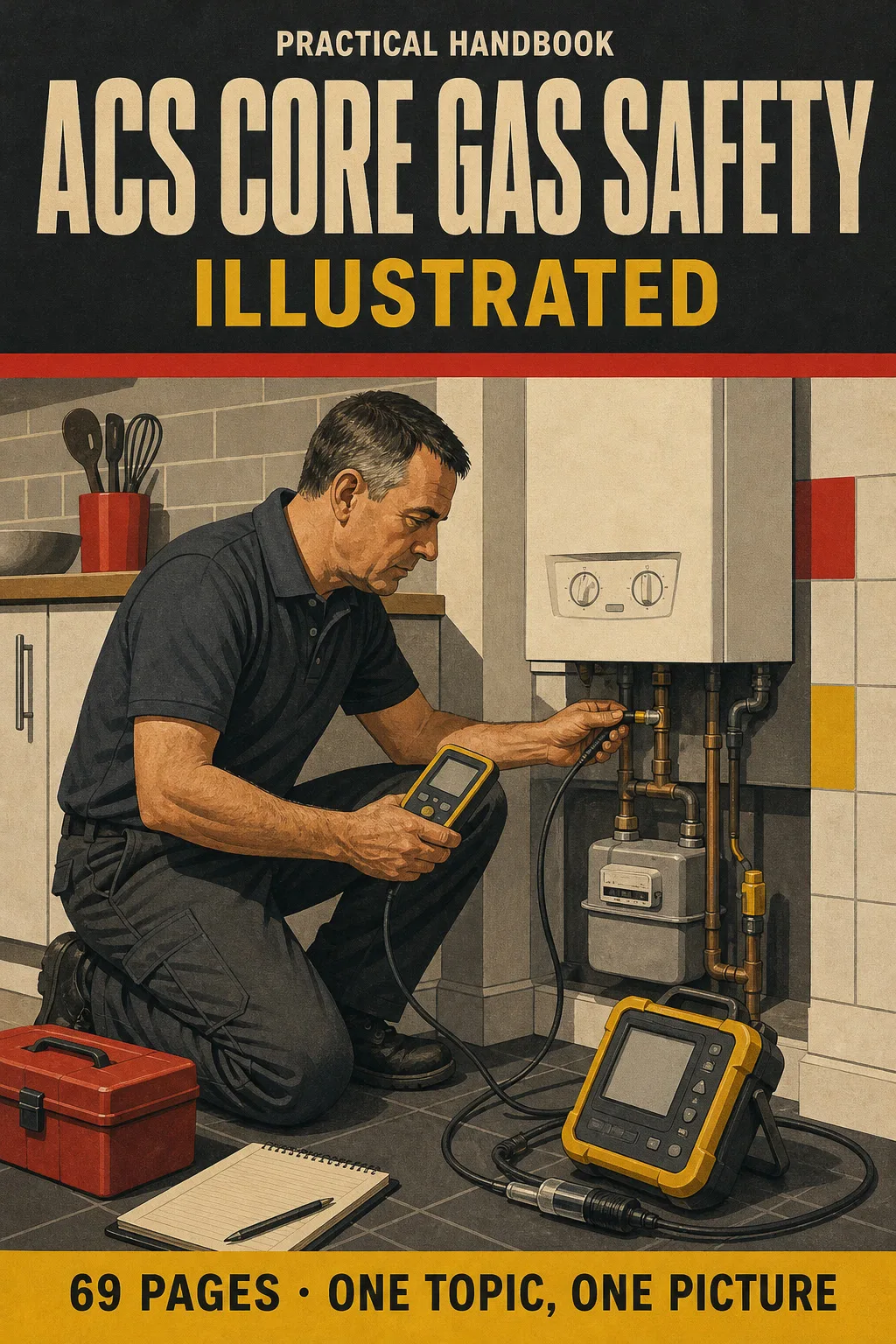
ACS Core Gas Safety Illustrated

Digital book in PDF · read it on your phone or print it

ACS Core Gas Safety Illustrated

For the ACS domestic natural gas core (CCN1), reassessment or initial: tightness testing and purging, working pressure, ventilation, flue types, spillage tests, the flue gas analyser, CO and ID vs AR. Every topic has its own page: the drawing first, then what you need to remember.

  • 69 illustrated pages
  • English
  • 30-day guarantee
£19.99£57.99
Get the book · £19.99

Price shown for: United Kingdom. In other countries, the checkout shows the price that applies there.

About this book

What it is

For the ACS domestic natural gas core (CCN1), reassessment or initial: tightness testing and purging, working pressure, ventilation, flue types, spillage tests, the flue gas analyser, CO and ID vs AR. Every topic has its own page: the drawing first, then what you need to remember.

Who This Book Is For
  • You're on managed learning
  • Your reassessment is weeks away
  • You're already on the tools
What it covers
  1. The law and your ACS
  2. Natural gas and combustion
  3. Meters, pressures and pipework
  4. Tightness testing and purging
  5. Ventilation
  6. Flues and spillage
  7. Combustion analysis and appliance checks
  8. Unsafe situations: ID, AR, NCS
  9. Before the assessment centre
Language
English (United Kingdom)
Pages
69
Format
Digital book in PDF · read it on your phone or print it
Price
£19.99 (United Kingdom)
Delivery
This is a digital PDF book sent to your email: nothing is printed or shipped.
30-Day Guarantee
30-day guarantee: if a file doesn't open, if the content isn't what the product page describes, if you were charged twice or the email never arrived, write to us and we'll refund you in full.

Look Inside the Book

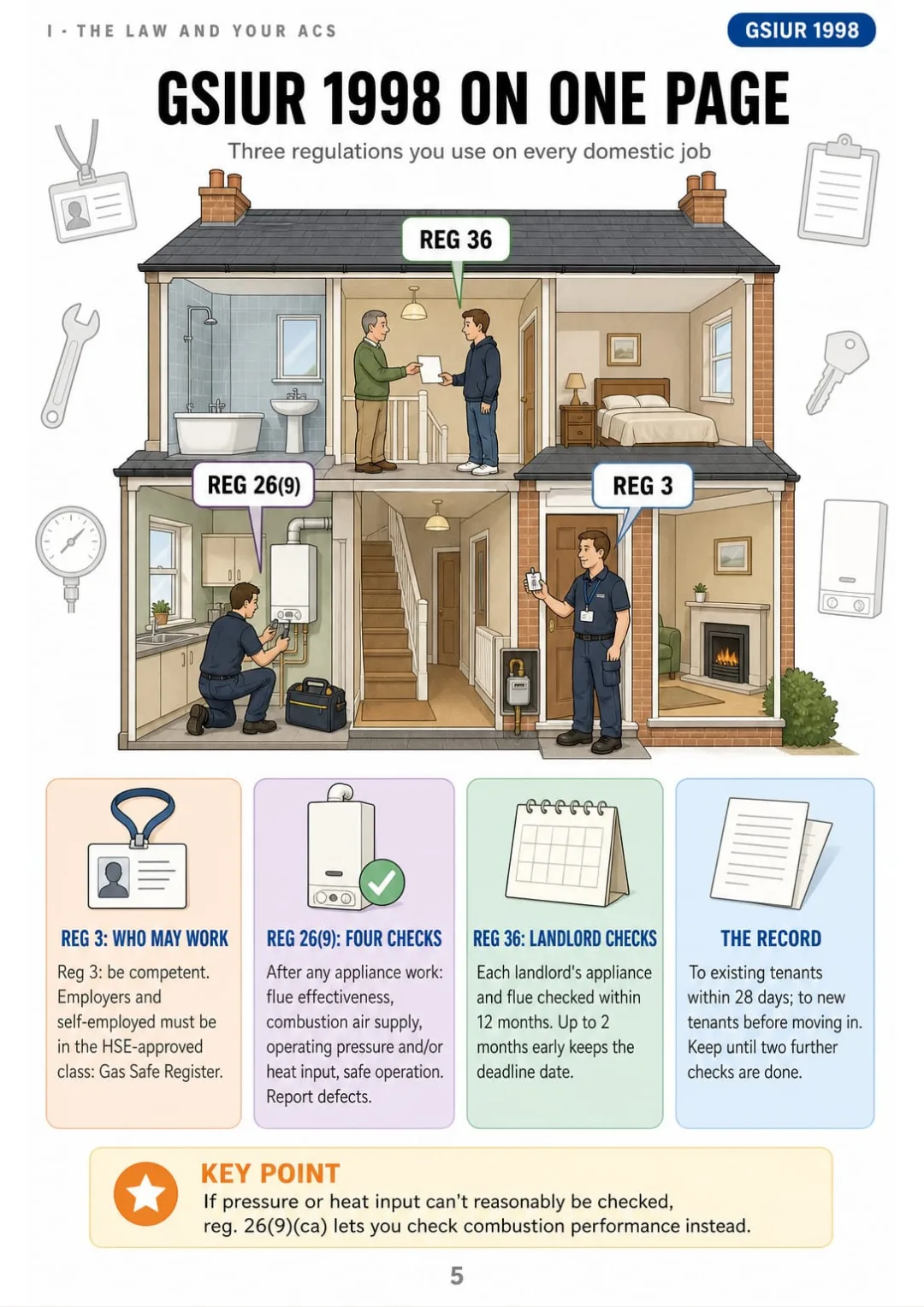
Reg 3, Reg 26(9) and Reg 36: the four post-work checks and the 12-month landlord record
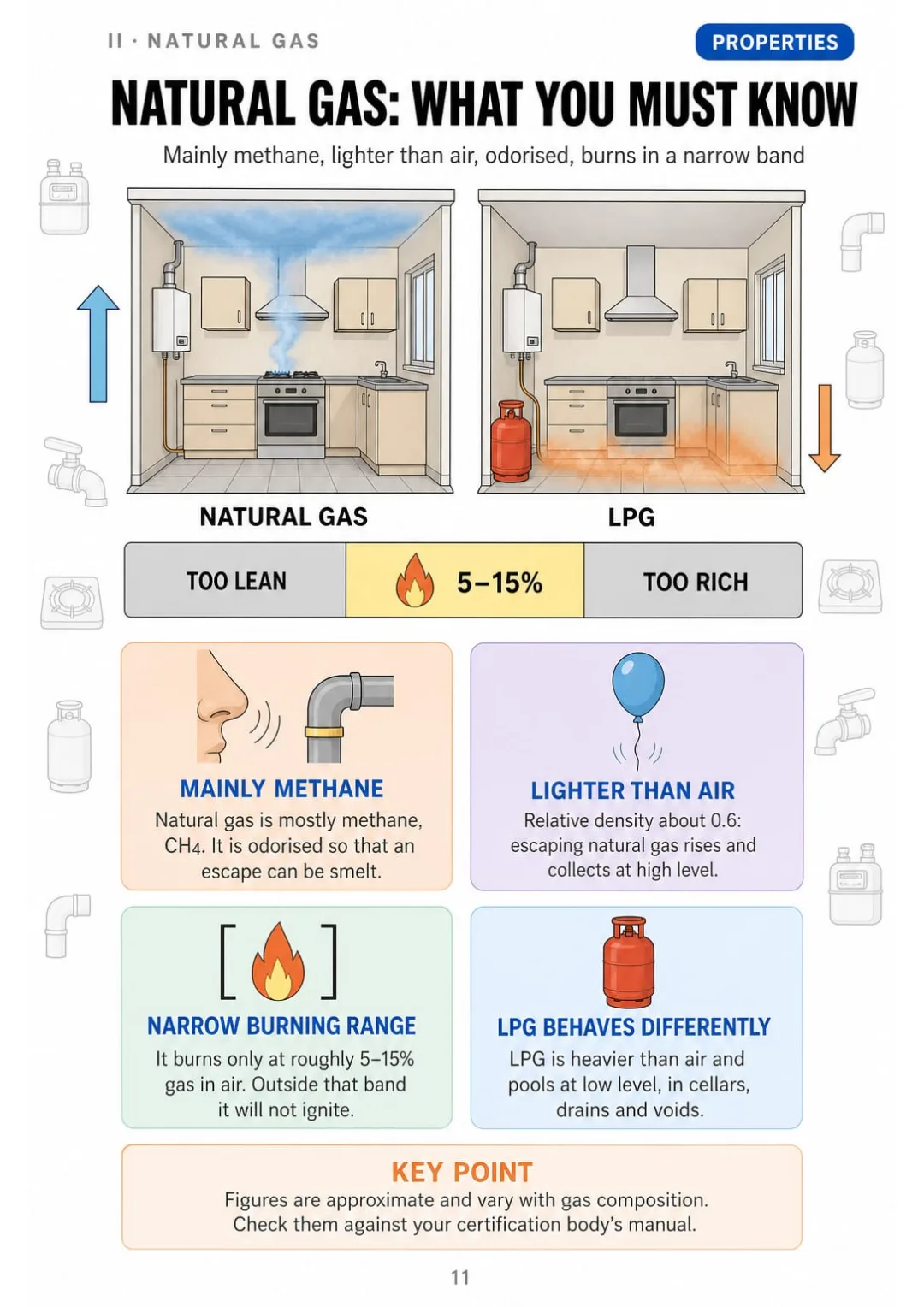
Natural gas: mainly methane, relative density about 0.6, burns at roughly 5–15% gas in air.
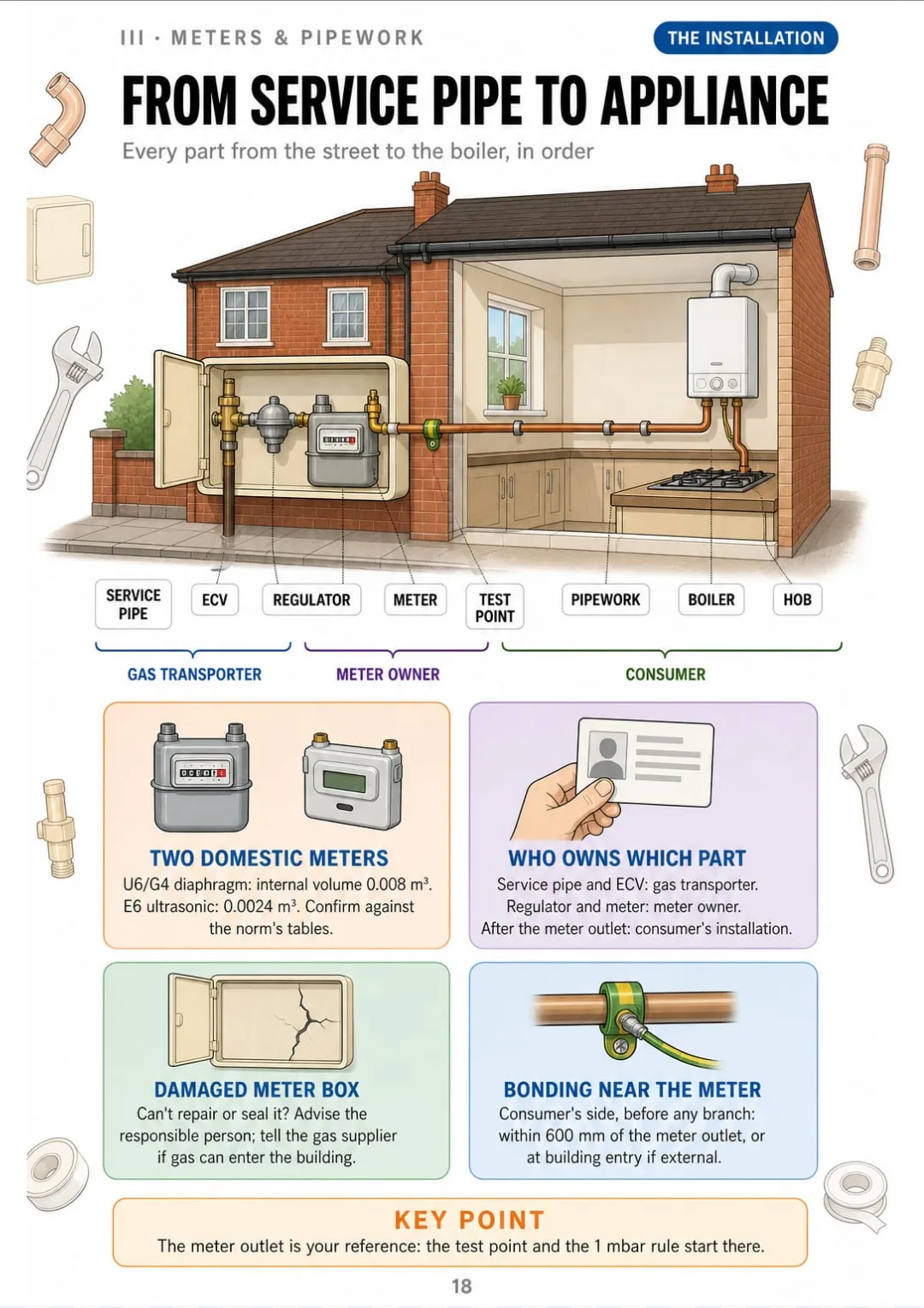
Service pipe, ECV, regulator, meter, test point, pipework: one labelled drawing, in order.
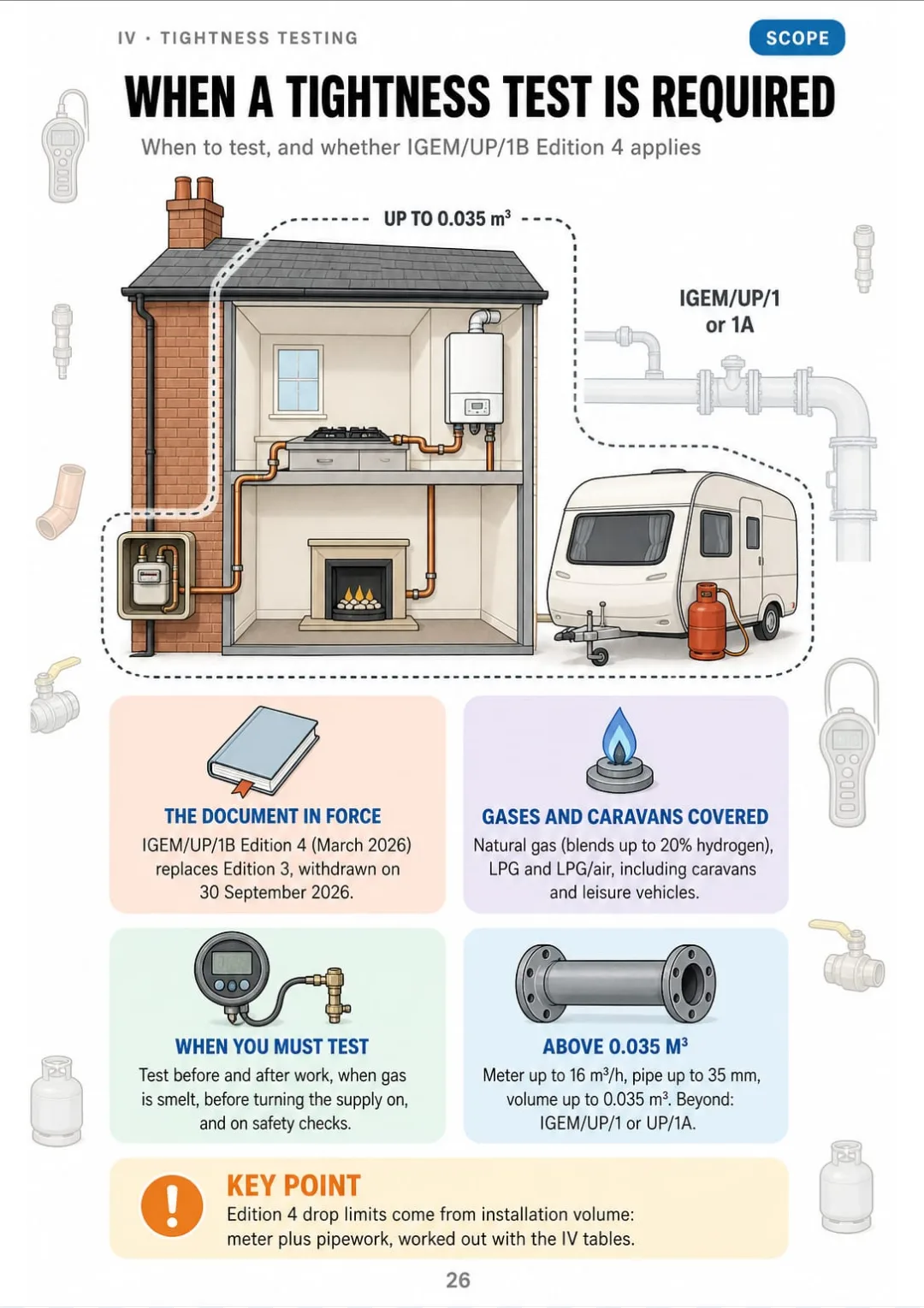
IGEM/UP/1B Ed. 4: natural gas, LPG, LPG/air and caravans, up to 0.035 m³
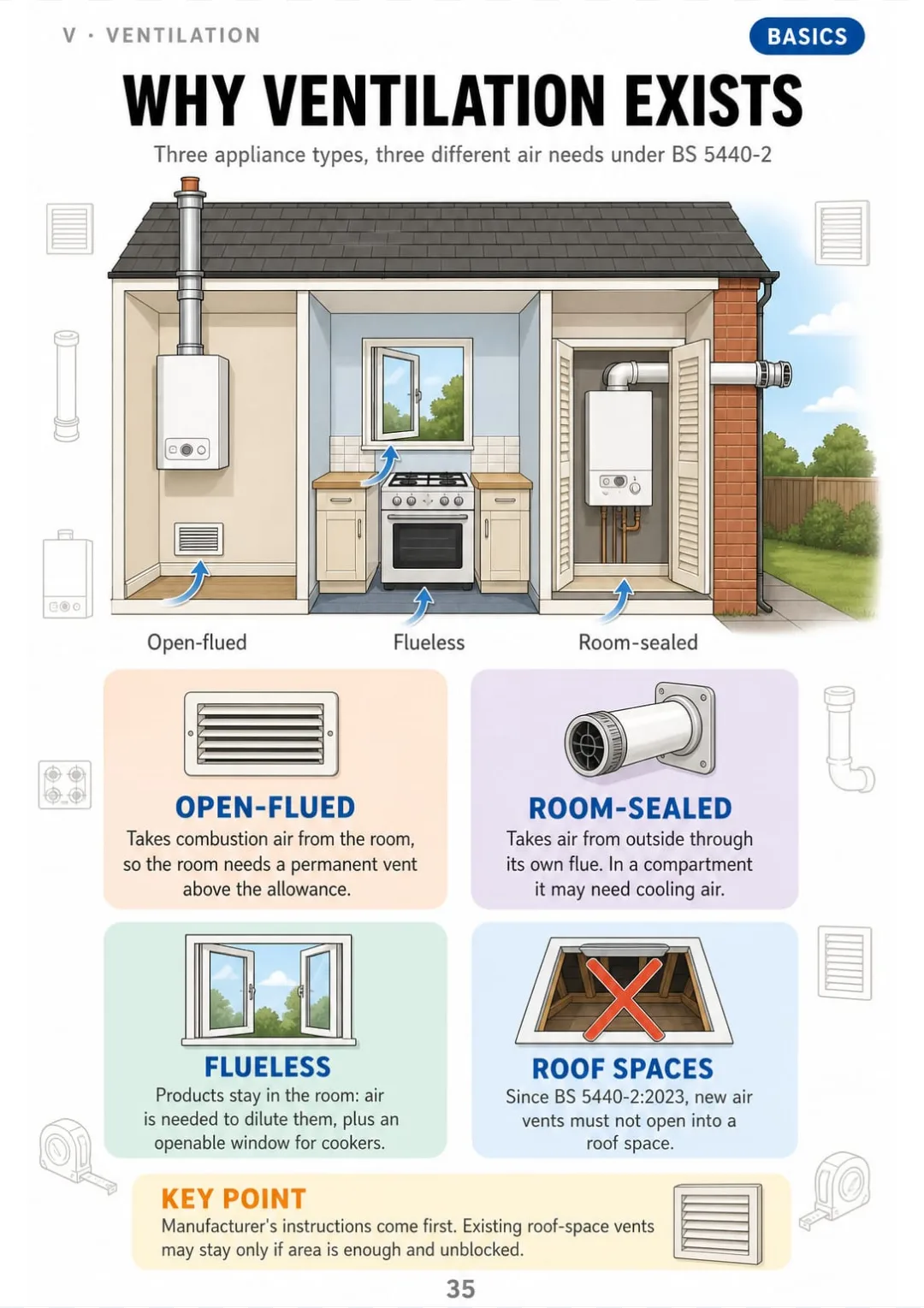
Open-flued, room-sealed and flueless: three air needs, one page
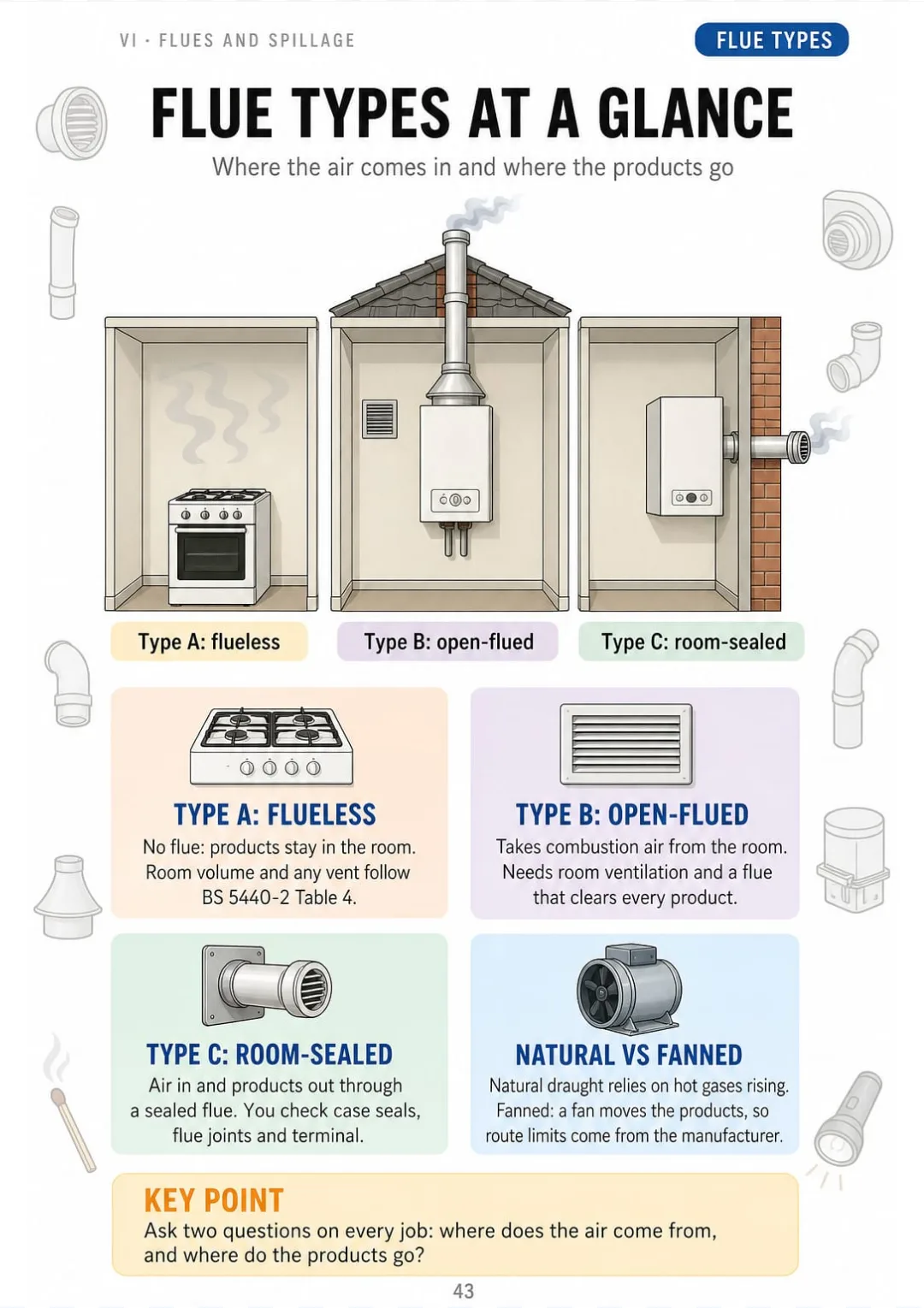
Type A flueless, Type B open-flued, Type C room-sealed: what each one asks you to check
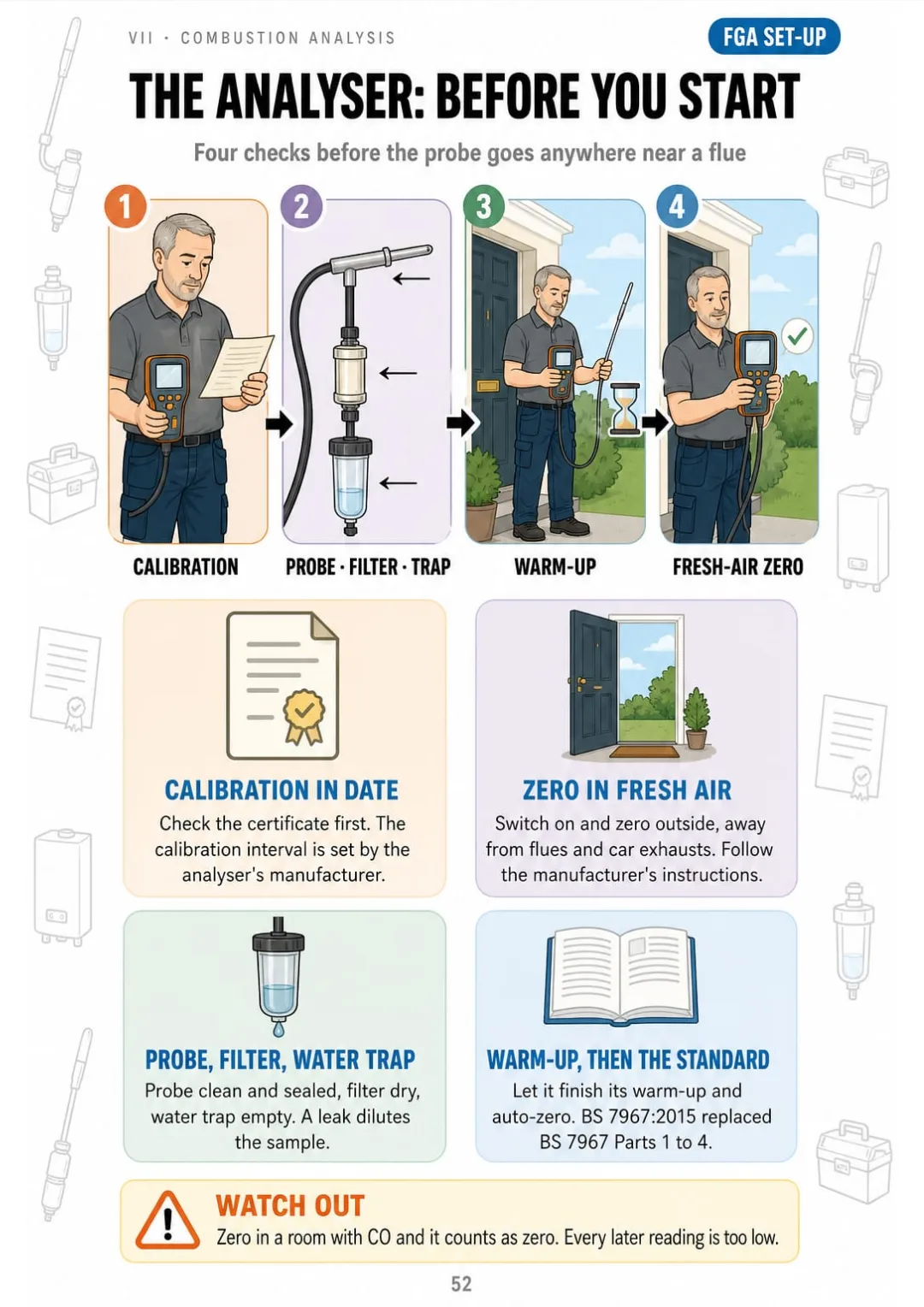
Calibration, probe and water trap, then switch on in fresh air for warm-up and zero: before every FGA job.
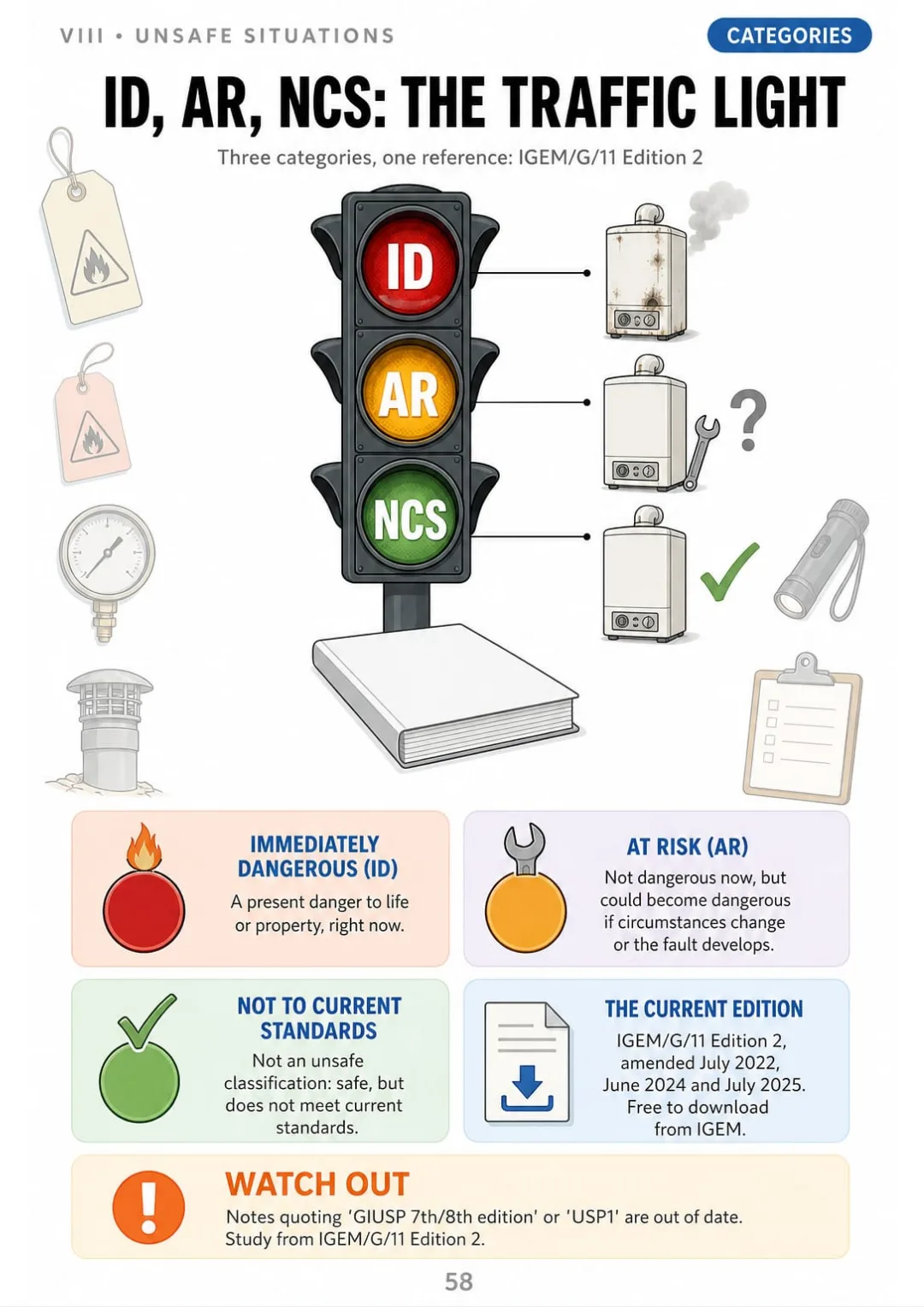
ID = danger now · AR = could become dangerous · NCS = safe but not to today's standards

Take a Look at the 9 Parts and 65 Topics

The law and your ACS

pp. 5-10
  1. GSIUR 1998 on one page
  2. Gas Safe Register, ACS and your certification body
  3. Initial ACS vs 5-yearly reassessment
  4. Which document answers which question
  5. Gas escapes: the first five actions
  6. RIDDOR and reporting gas incidents

Natural gas and combustion

pp. 11-17
  1. Natural gas properties you need
  2. The combustion triangle and air needed
  3. Complete vs incomplete combustion
  4. Carbon monoxide: how it harms
  5. Flame pictures: lifting, lighting back, yellow tipping
  6. CO alarms: where and when
  7. Gross and net heat input

Meters, pressures and pipework

pp. 18-25
  1. From the service pipe to the appliance
  2. The ECV: position, label and handle
  3. Standing vs working pressure
  4. The 1 mbar rule
  5. Gas rate by clocking the meter
  6. Pipe sizing from the tables
  7. Pipework rules: sleeves, clips and clearances
  8. Main bonding and the temporary continuity bond

Tightness testing and purging

pp. 26-34
  1. When a tightness test is required
  2. Gauge, test point and readability
  3. Step 1–2: preparation and let-by test
  4. Step 3–4: raise to 20 mbar and stabilise
  5. Step 5: the 2-minute test
  6. Reading the permissible-drop table
  7. Failed test: trace, repair, retest
  8. Purge volume calculated
  9. Purging safely, in order

Ventilation

pp. 35-42
  1. Why ventilation exists: air for combustion
  2. Open-flued in a room: the 5 cm² per kW rule
  3. Free area vs grille size
  4. Several appliances in one room
  5. Compartments: room-sealed appliance
  6. Compartments: open-flued appliance
  7. Flueless appliances: cookers and water heaters
  8. Extract fans and open-flued appliances

Flues and spillage

pp. 43-51
  1. Flue types at a glance
  2. How a natural draught flue works
  3. Visual inspection of a flue
  4. Flue flow test with a smoke pellet
  5. Spillage test on an open-flued boiler
  6. Spillage test on a gas fire
  7. Room-sealed terminal positions
  8. Room-sealed checks: seals and case
  9. Chimneys, liners and the open-flue terminal

Combustion analysis and appliance checks

pp. 52-57
  1. The flue gas analyser: before you start
  2. Reading O2, CO, CO2 and the ratio
  3. The FGA check in order (BS 7967)
  4. Room CO checks
  5. Burner pressure and heat input checks
  6. Safety devices you must test

Unsafe situations: ID, AR, NCS

pp. 58-64
  1. The three categories in one picture
  2. Immediately Dangerous: the action sequence
  3. At Risk: the action sequence
  4. Not to Current Standards: what you do
  5. ID or AR? Ten job scenarios
  6. Warning labels and the warning notice
  7. Refusals, landlords and RIDDOR

Before the assessment centre

pp. 65-69
  1. The tightness test and purge on one card
  2. Ventilation figures on one card
  3. Flues, spillage and FGA on one card
  4. Frequent mistakes in the practical
  5. The day before and the day itself

Who This Book Is For

You're on managed learning

Every core procedure on its own page, in the order you'll be assessed on it, to go with your portfolio and your mentor's jobs.

Your reassessment is weeks away

Five years of figures back in one place: tightness test, ventilation, flues, FGA and ID vs AR, to revise in the van or in the evening.

You're already on the tools

A printable reference for the checks you doubt on a job: which flue type, which test, ID or AR.

Plus: 2 Free Books

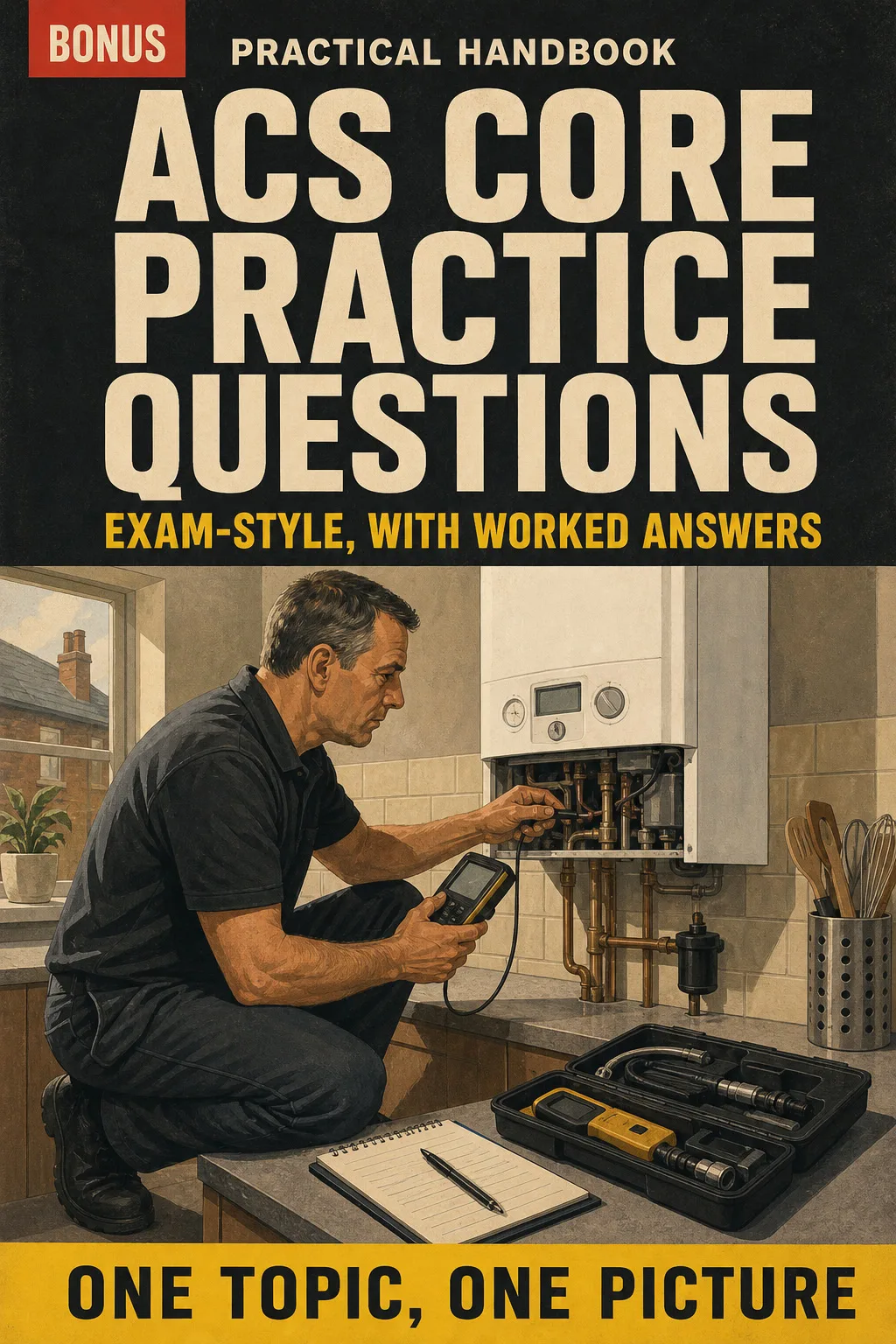
ACS Core Practice Questions: Exam-Style, with Worked Answers
BONUS 1

ACS Core Practice Questions: Exam-Style, with Worked Answers

Test yourself on every core topic before the assessment centre, and see the full working behind each answer, not just the letter.
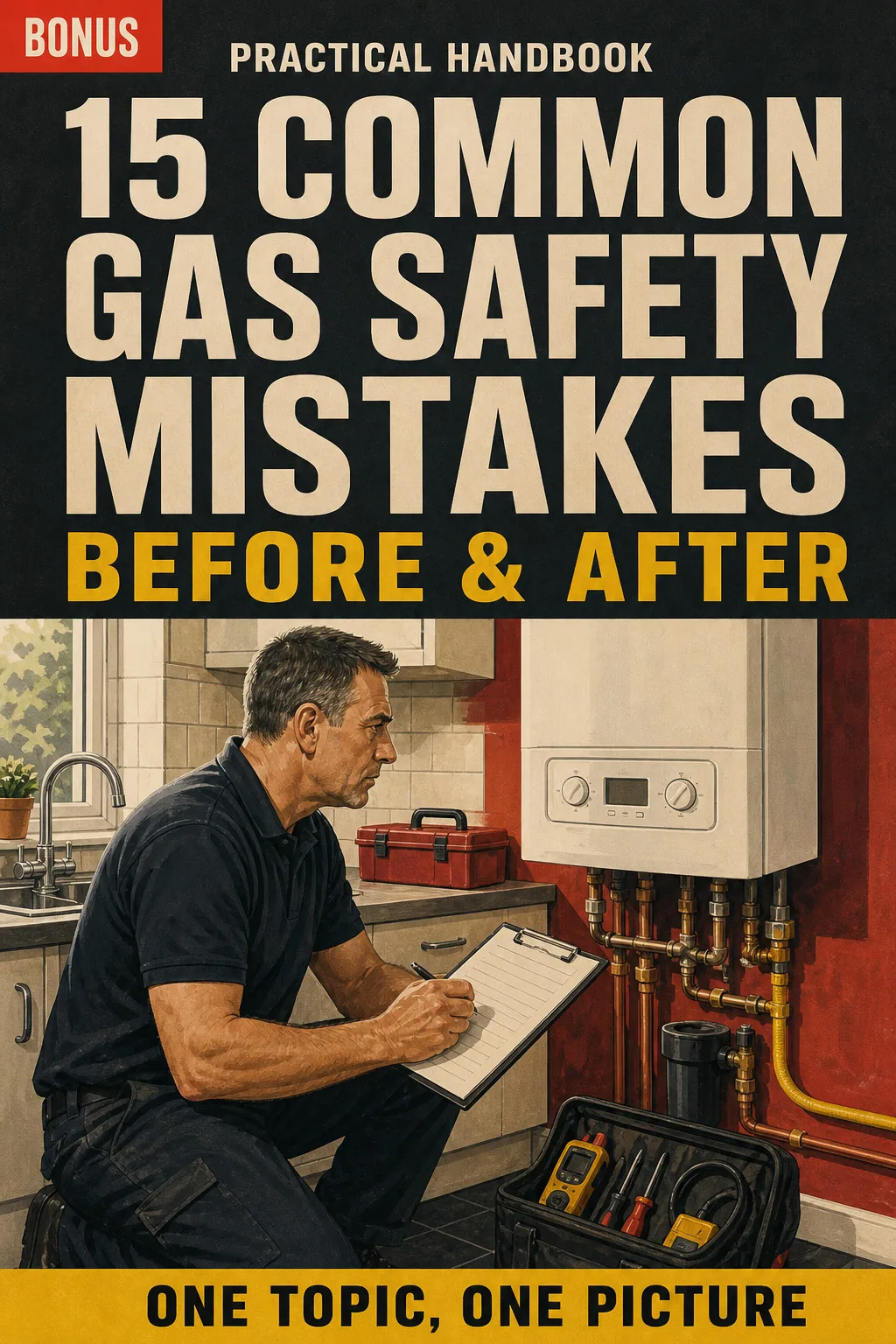
15 Common Gas Safety Mistakes: Before & After
BONUS 2

15 Common Gas Safety Mistakes: Before & After

The most frequent slips in testing, ventilation and flues drawn side by side with the correct way, so you spot them in seconds.

30-Day Guarantee

30-day guarantee: if a file doesn't open, if the content isn't what the product page describes, if you were charged twice or the email never arrived, write to us and we'll refund you in full. You pay once. No subscriptions.

Frequently Asked Questions

Is it for me if my 5-yearly ACS reassessment is coming up?

Yes. It follows the domestic natural gas core, CCN1, for the 5-yearly reassessment and for trainees heading to their initial ACS. It isn't a beginner's course: it puts the core procedures and figures back in order. It doesn't cover LPG or the appliance modules.

Where does the content come from?

From GSIUR 1998, IGEM/UP/1B, BS 6891, BS 5440-1 and -2, BS 7967 and the Gas Industry Unsafe Situations Procedure, checked against their current editions. Each page tells you which document it relies on.

Is it official material?

No. It's independent revision material, not published or endorsed by Gas Safe Register, IGEM, any certification body or assessment centre.

Does it replace my training or the assessment?

No. It doesn't replace training, managed learning, the ACS assessment or the standards themselves, and it doesn't qualify you to work on gas: by law, gas work must be done by a registered engineer.

Are the practice questions the ones in the assessment?

No. They're written for this book to test you on each core topic, with the full working behind every answer. They aren't official assessment questions.

When and how does it arrive?

The book and the 2 free books arrive as a PDF by email, to the address you enter at checkout.

I already have the training centre manuals. What does this add?

Your manuals explain each procedure in paragraphs. This book puts each one on its own page as a drawing, with the figures in one box and the steps in the order you carry them out. It's for the last weeks before the assessment, alongside your manuals, not instead of them.

Can I have it on paper?

Yes. The PDF prints on standard A4, so you can keep the pages you need in the van.

How does the refund work?

You have 30 days. We refund everything if the file won't open, if the book isn't what you see on this page, if you were charged twice or if the email doesn't arrive: just email us.

£19.99£57.99
Get the book · £19.99

This is a digital PDF book sent to your email: nothing is printed or shipped.

More books on this topic

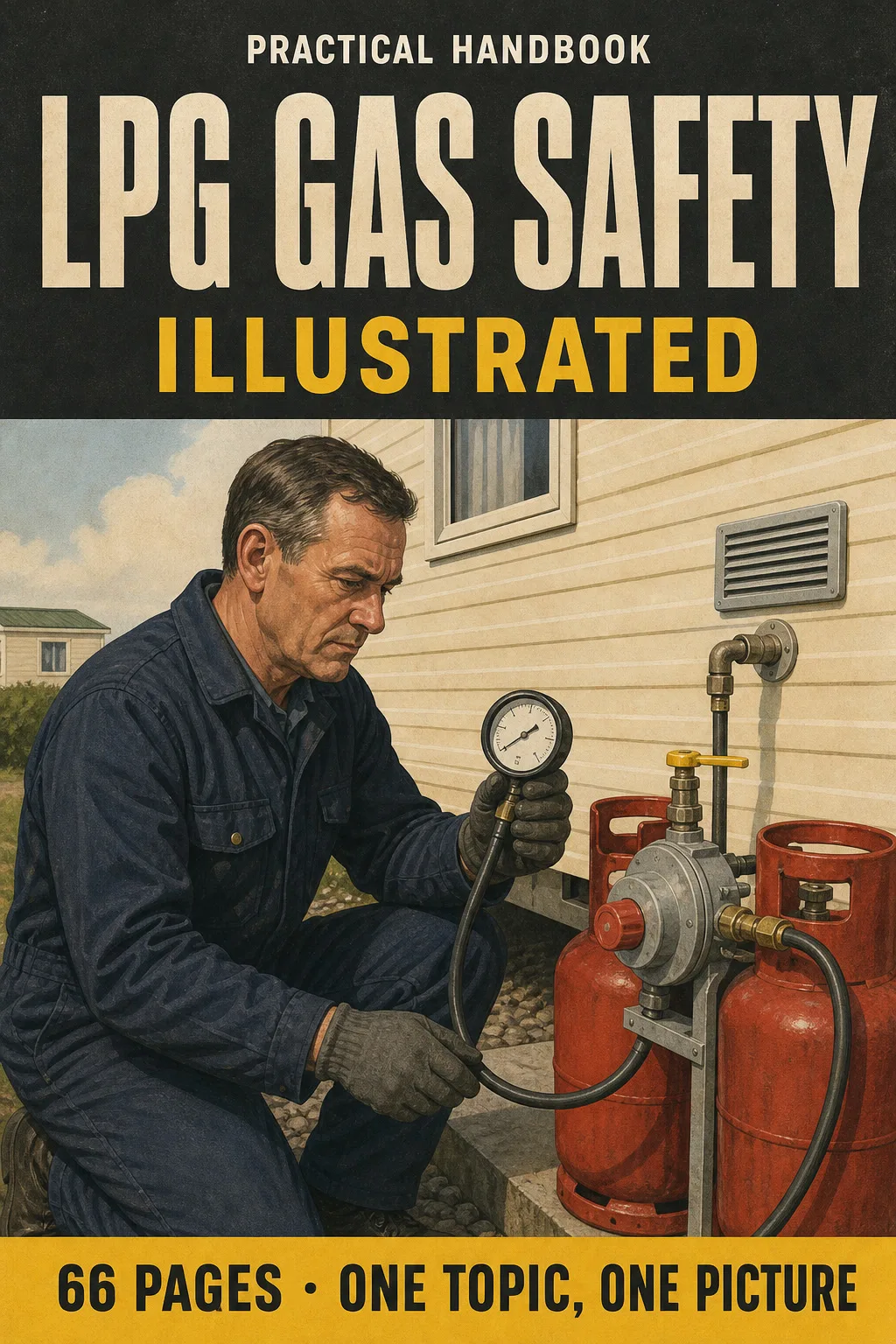
LPG Gas Safety Illustrated

An illustrated PDF for gas engineers revising LPG: properties compared with natural gas, cylinder and bulk tank siting…

From £19.99 £57.99

Wood Stove & Firewood Illustrated

Run your wood-burning stove properly and safely: how the air controls work, how to light top-down, how to season and…

From £19.99 £57.99