Study in Pictures🌐 English (United Kingdom)
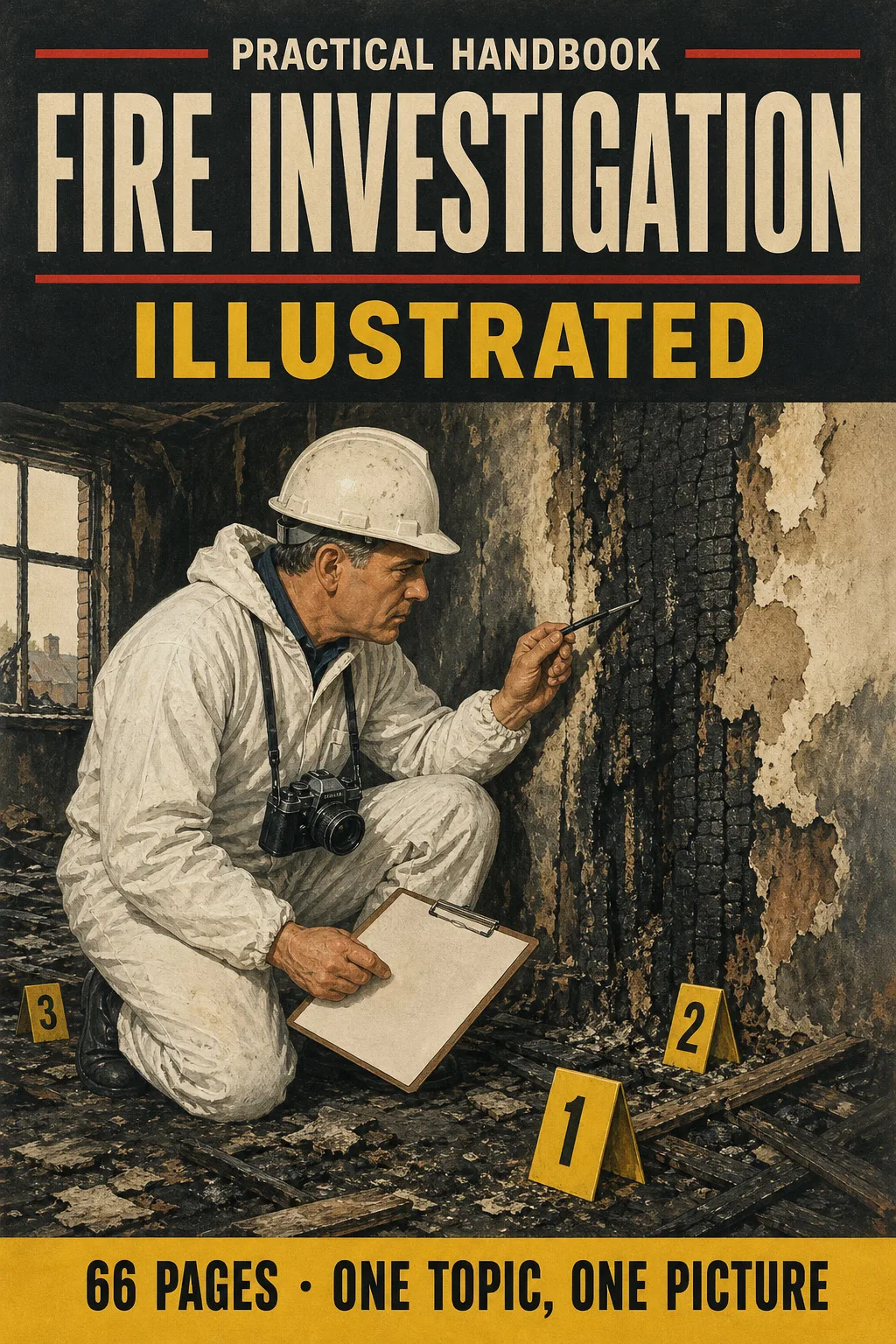
Fire Investigation Illustrated

Digital book in PDF · read it on your phone or print it

Fire Investigation Illustrated

Fire dynamics, flashover, burn patterns, char depth, arc mapping, ignition sources, sampling, exhibit continuity and the origin and cause report. Every topic has its own page: the drawing first, then what you need to remember.

  • 66 illustrated pages
  • English
  • 30-day guarantee
£19.99£57.99
Get the book · £19.99

Price shown for: United Kingdom. In other countries, the checkout shows the price that applies there.

About this book

What it is

Fire dynamics, flashover, burn patterns, char depth, arc mapping, ignition sources, sampling, exhibit continuity and the origin and cause report. Every topic has its own page: the drawing first, then what you need to remember.

Who This Book Is For
  • You've just moved into fire investigation
  • Your IFE exam is coming up
  • You already investigate fires or handle fire claims
What it covers
  1. The Investigator and the Method
  2. Fire Dynamics
  3. Safety and the Scene
  4. Reading Burn Patterns
  5. Area of Origin
  6. Ignition Sources
  7. Evidence and Documentation
  8. Hypothesis, Cause and the Report
  9. Exam and Final Review
Language
English (United Kingdom)
Pages
66
Format
Digital book in PDF · read it on your phone or print it
Price
£19.99 (United Kingdom)
Delivery
This is a digital PDF book sent to your email: nothing is printed or shipped.
30-Day Guarantee
30-day guarantee: if a file doesn't open, if the content isn't what the product page describes, if you were charged twice or the email never arrived, write to us and we'll refund you in full.

Look Inside the Book

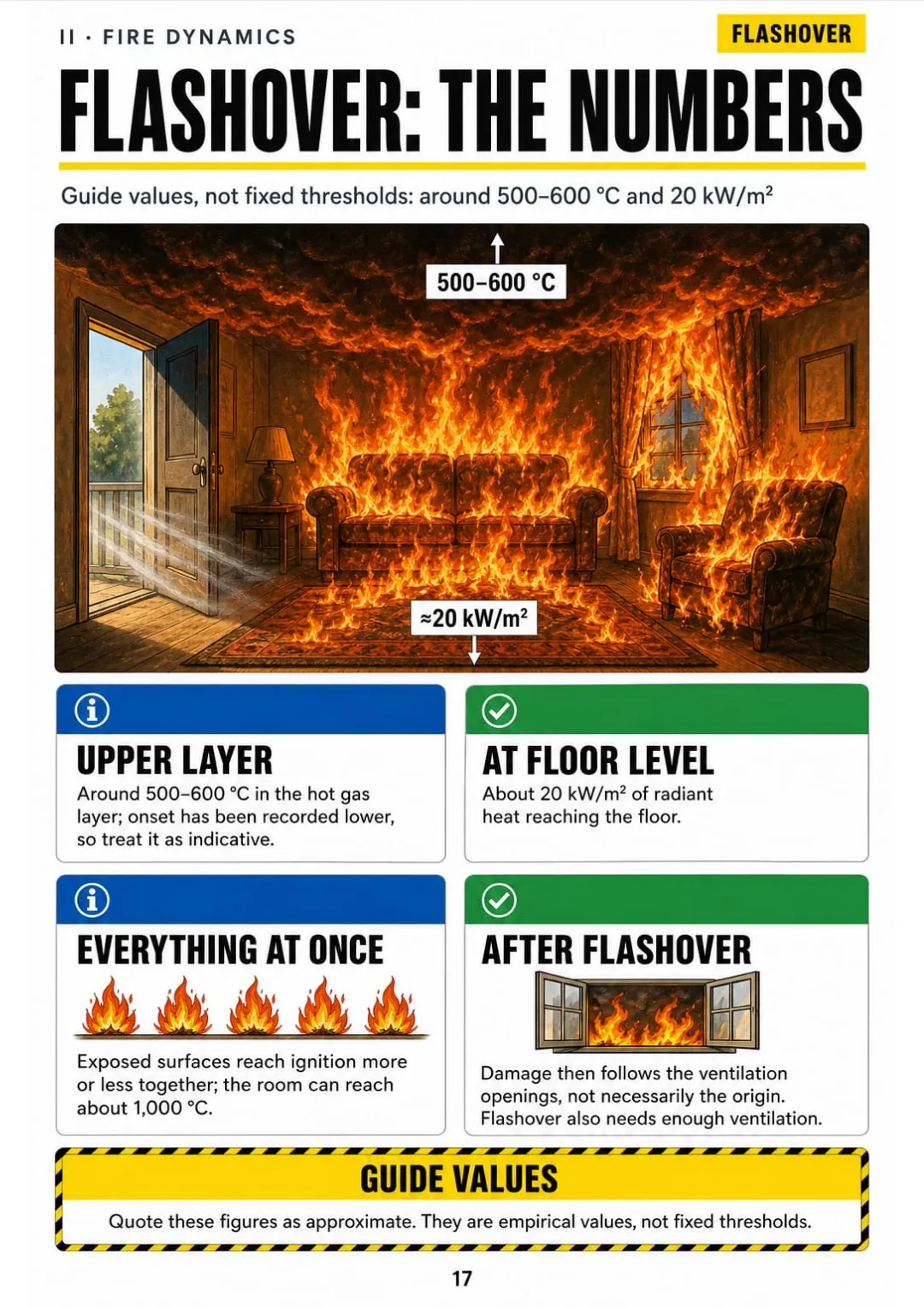
≈500–600 °C upper layer, ≈20 kW/m² at the floor: flashover guide values
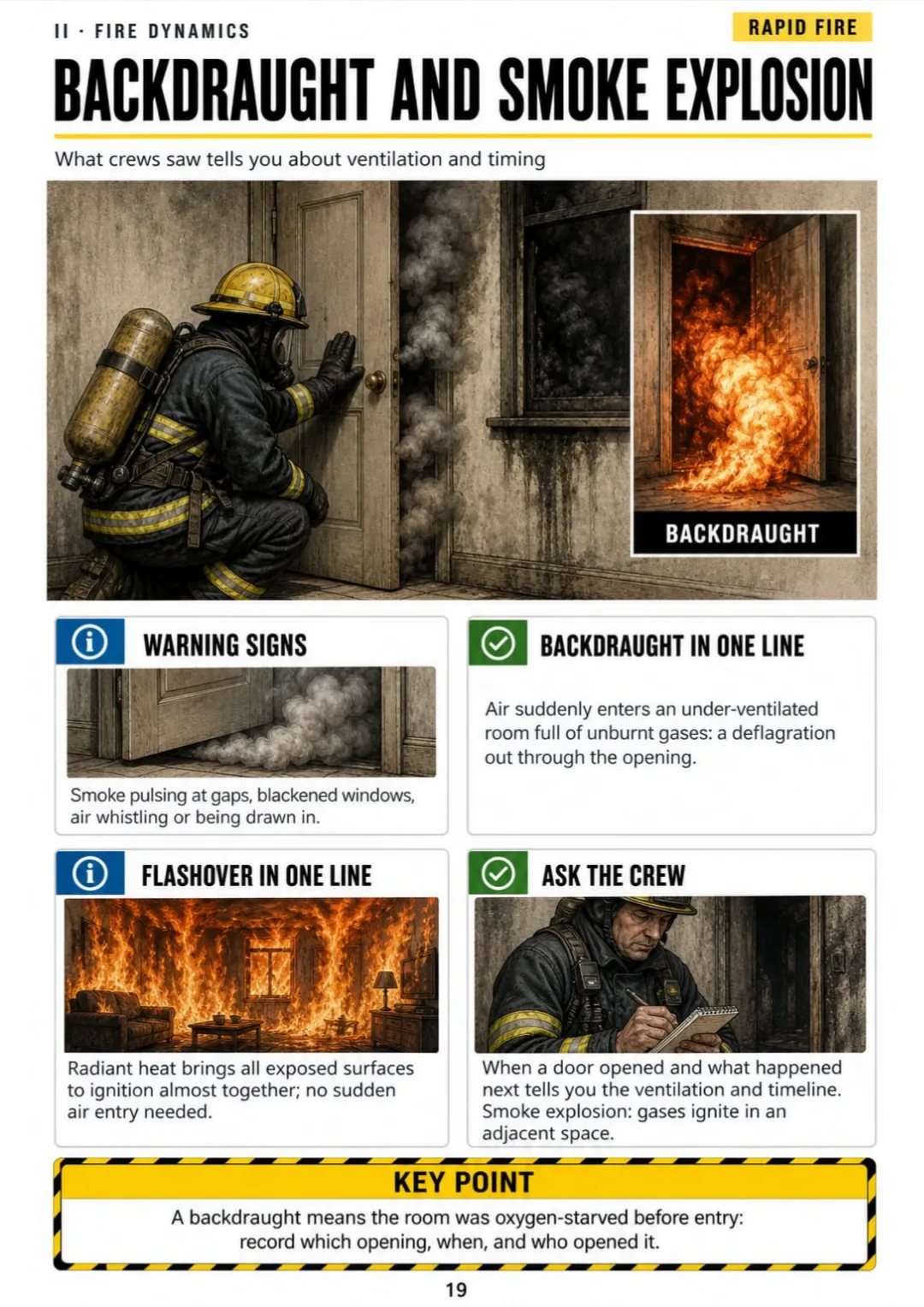
Pulsing smoke, black windows: backdraught signs and what they tell the investigator
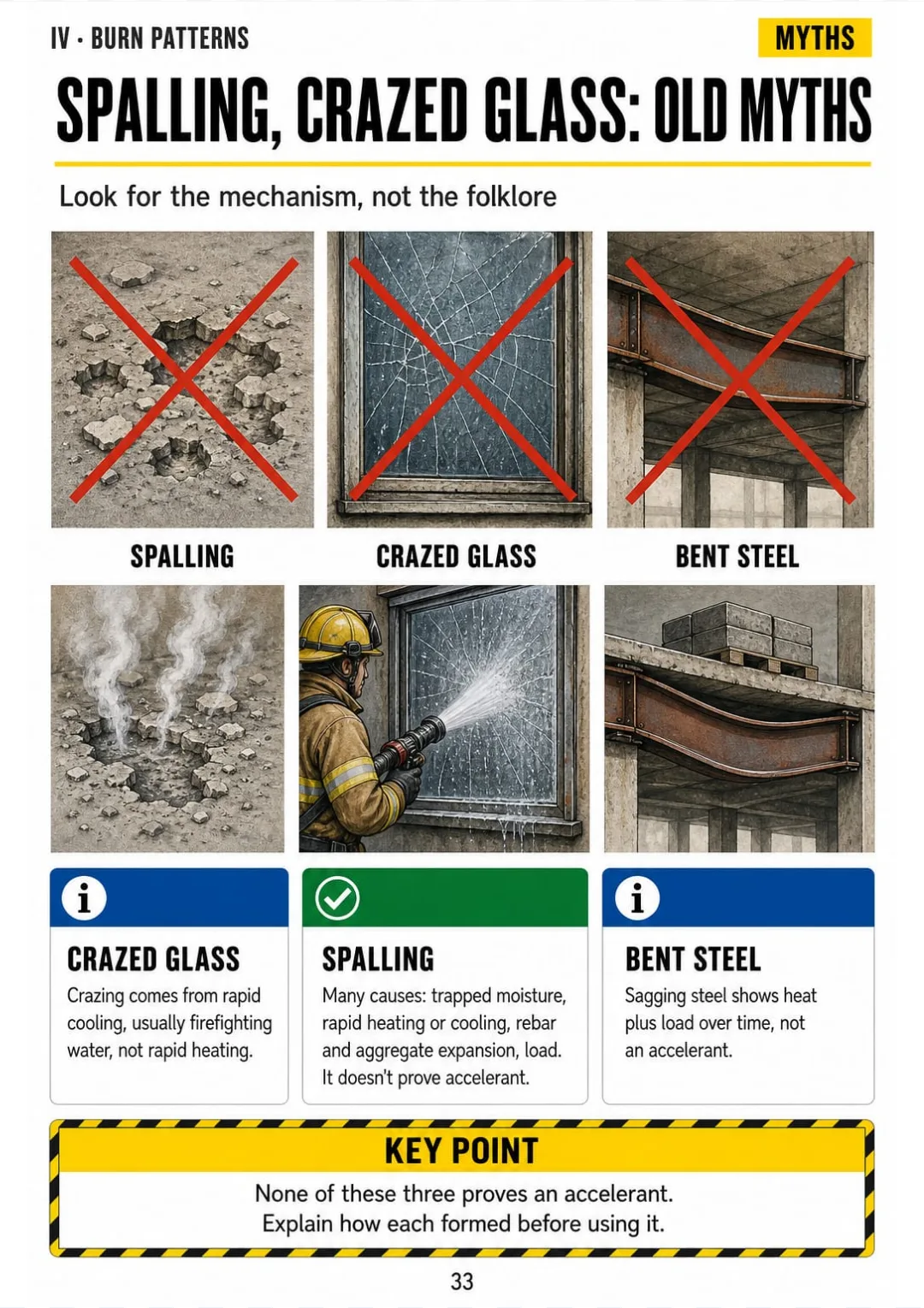
Crazing comes from cooling water; spalling has many causes; neither proves accelerant.
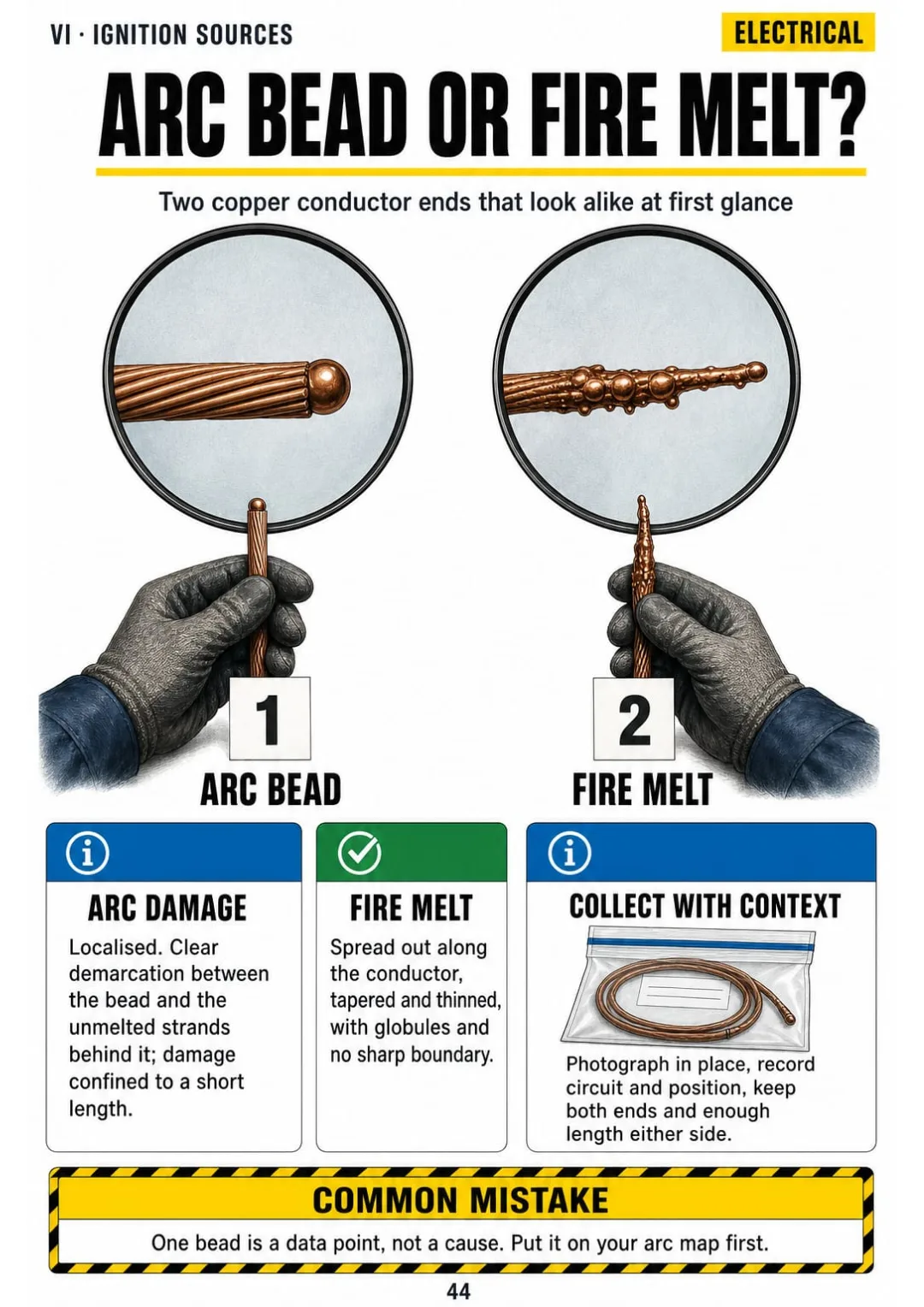
Arc bead: localised, sharp demarcation. Fire melt: spread out and tapered.
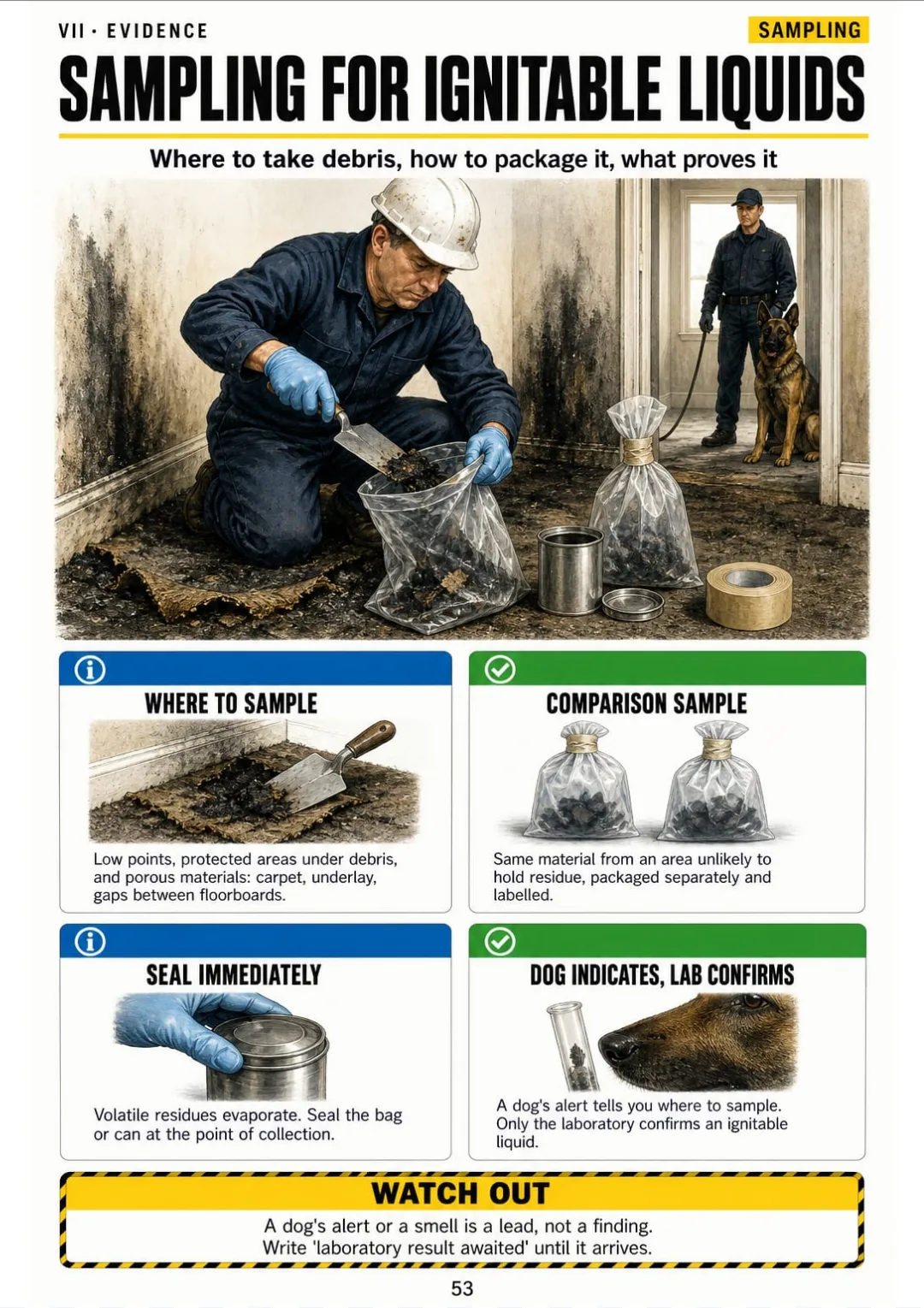
Low points, protected areas and porous materials, plus a comparison sample of the same material
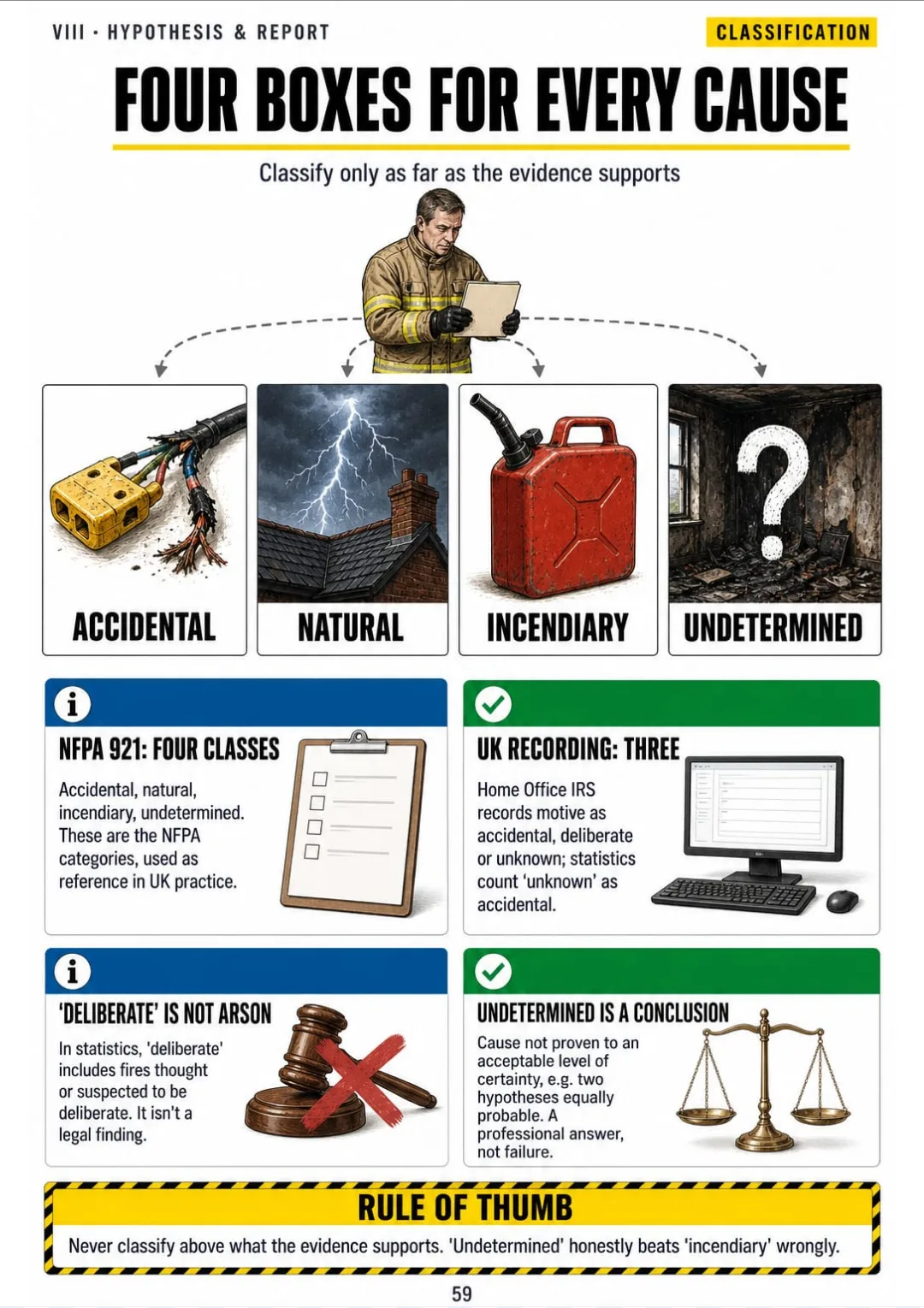
Accidental, natural, incendiary, undetermined (NFPA 921) vs accidental, deliberate, unknown (UK IRS).
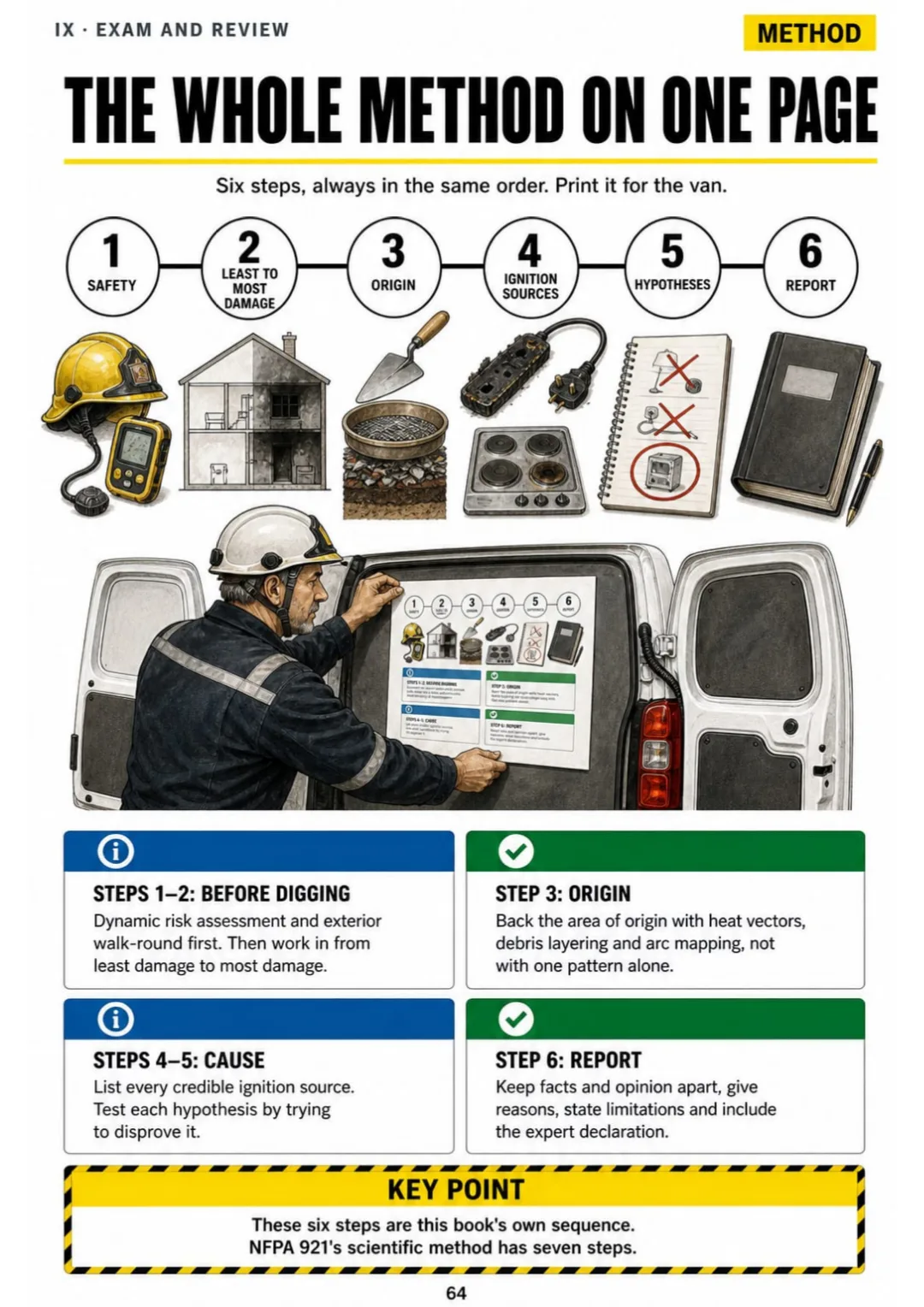
Safety → least to most damage → origin → ignition sources → hypotheses → report
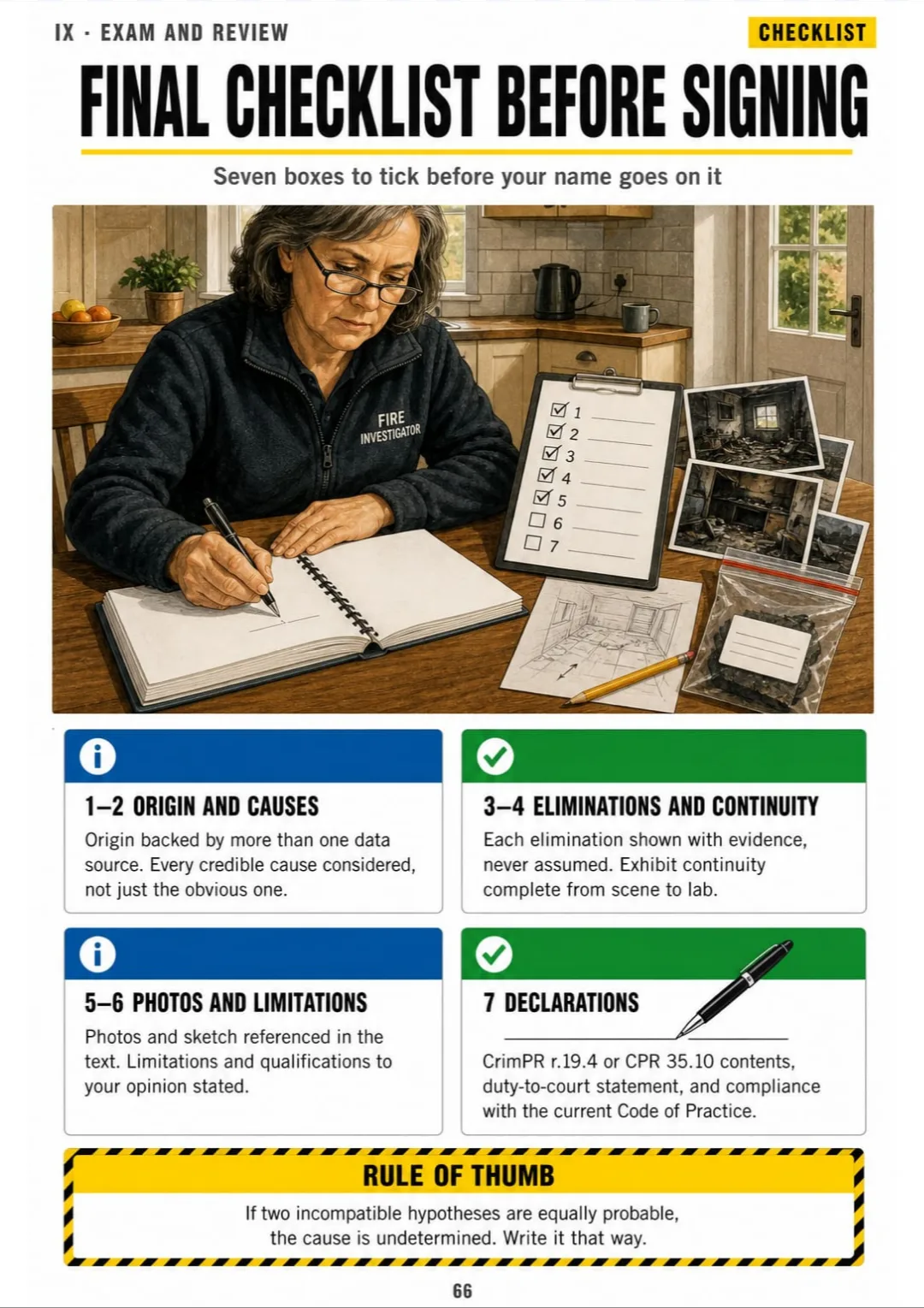
7 checks before signing: sources, causes, eliminations, continuity, photos, limitations, declaration

Take a Look at the 9 Parts and 62 Topics

The Investigator and the Method

pp. 5-10
  1. What a fire investigator actually has to answer
  2. Who investigates in the UK
  3. The method in 6 steps, always in the same order
  4. The scientific method applied to a fire
  5. Negative corpus: why 'nothing else found' is not a cause
  6. Expectation bias and how to protect your conclusions

Fire Dynamics

pp. 11-19
  1. Fire triangle and fire tetrahedron
  2. Three ways heat travels
  3. Ignition: piloted, auto-ignition and smouldering
  4. The fire plume and the ceiling jet
  5. The hot gas layer and the neutral plane
  6. The stages of a compartment fire on one timeline
  7. Flashover: the numbers to remember
  8. Fuel-controlled versus ventilation-controlled
  9. Backdraught and smoke explosion

Safety and the Scene

pp. 20-25
  1. Dynamic risk assessment before you step in
  2. Structural hazards: reading a building that may fall
  3. Contaminants, asbestos and PPE
  4. Scene security and cordons
  5. Information before entry: crews, occupiers, witnesses
  6. The exterior walk-round

Reading Burn Patterns

pp. 26-35
  1. From least to most damage
  2. The V pattern and what its angle tells you
  3. Inverted cone, hourglass and U patterns
  4. Clean burn: not the origin
  5. Protected areas and the furniture that moved
  6. Char depth: measuring, not guessing
  7. Calcination of plasterboard
  8. Spalling, crazed glass and other old myths
  9. Melted materials as a thermometer
  10. Pour-like patterns on the floor

Area of Origin

pp. 36-41
  1. Heat and flame vectors
  2. Debris layering: excavating like an archaeologist
  3. Arc mapping on the circuit
  4. Fire spread sequence
  5. Scene reconstruction
  6. When the origin cannot be found

Ignition Sources

pp. 42-50
  1. Fuel + ignition source + sequence
  2. The UK domestic electrical system
  3. Arc beads versus melting from fire
  4. Electrical appliances and extension leads
  5. Lithium-ion batteries and e-bikes
  6. Cooking and kitchen fires
  7. Smoking materials and naked flames
  8. Heating appliances and hot surfaces
  9. Deliberate fires: indicators, not proof

Evidence and Documentation

pp. 51-56
  1. Photographing the scene
  2. The scene sketch
  3. Sampling for ignitable liquid residues
  4. Exhibit labels and continuity
  5. Preventing contamination
  6. Fatal fires and the coroner

Hypothesis, Cause and the Report

pp. 57-62
  1. Building and testing hypotheses
  2. Ruling out an accidental cause, step by step
  3. Classifying the cause
  4. Structure of an origin and cause report
  5. The expert's duty to the court
  6. Giving evidence and facing cross-examination

Exam and Final Review

pp. 63-66
  1. IFE Level 3 vs Level 4: what each certificate covers
  2. The whole method on one page
  3. Numbers and terms to have to hand
  4. Final checklist before signing your report

Who This Book Is For

You've just moved into fire investigation

The method in six steps and every pattern drawn, so the course material finally has an order you can follow at a scene.

Your IFE exam is coming up

Revise one page at a time, test yourself with the practice questions and keep the numbers and terms page beside you.

You already investigate fires or handle fire claims

Print it, keep it in the van or on your desk, and check a pattern, a sampling point or the report structure before you sign.

Plus: 2 Free Books

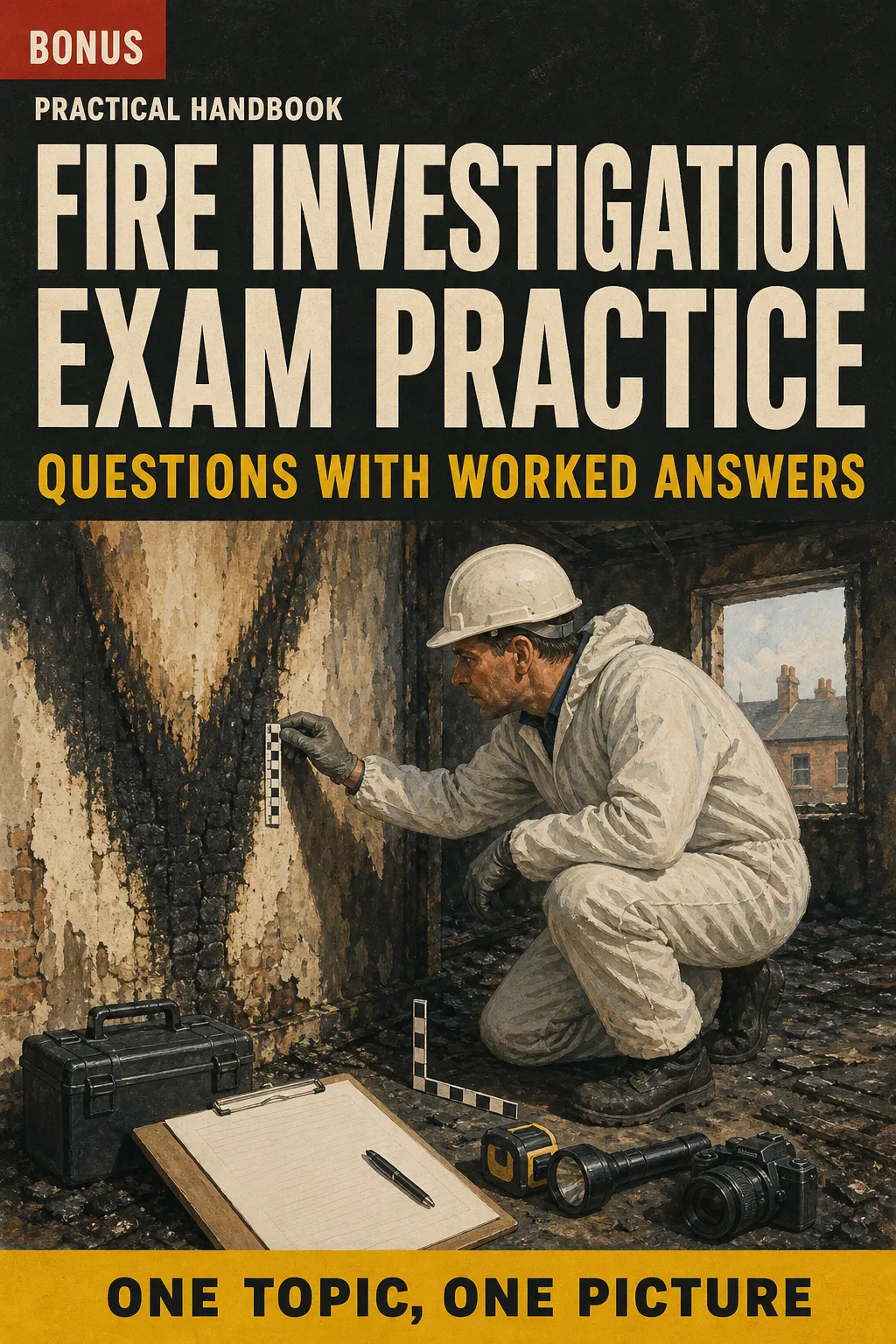
Fire Investigation Exam Practice: Questions with Worked Answers
BONUS 1

Fire Investigation Exam Practice: Questions with Worked Answers

Test yourself topic by topic with exam-style questions, and see why each answer is right, so you find your weak spots before the exam does.
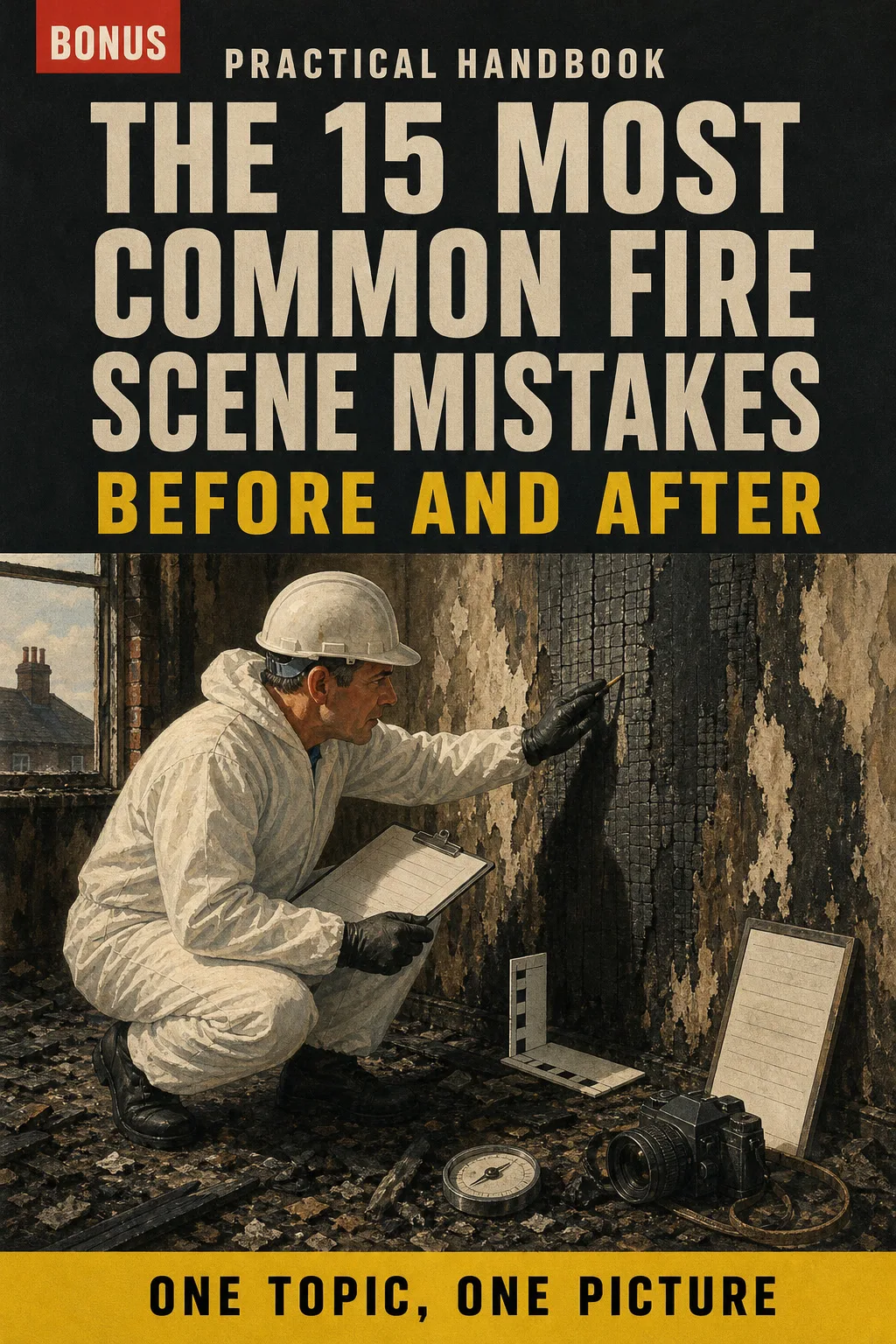
The 15 Most Common Fire Scene Mistakes: Before and After
BONUS 2

The 15 Most Common Fire Scene Mistakes: Before and After

See the errors investigators make most often (from reading clean burn as the origin to breaking continuity of evidence), each drawn wrong and then right.

30-Day Guarantee

30-day guarantee: if a file doesn't open, if the content isn't what the product page describes, if you were charged twice or the email never arrived, write to us and we'll refund you in full. You pay once. No subscriptions.

Frequently Asked Questions

Is it for me if I've been in the fire service for 20 years?

Yes. It isn't a beginner's book: it puts what you already know into one order, from least to most damage to the signed report, with UK practice throughout. It also works for loss adjusters and scene examiners.

Where does the content come from?

Written for UK practice, not a translated American book. It follows the topic areas of the IFE Level 3 and Level 4 Certificate in Fire Investigation, the Forensic Science Regulator's Code of Practice, the Fire and Rescue Services Act 2004, CrimPR Part 19 and CPR Part 35. NFPA 921 appears only where UK practice refers to it, such as the cause classes. Court rules cited are those of England and Wales: if you work in Scotland or Northern Ireland, check your own procedure. Every legal reference comes with its source, so you can look up the current version.

Is it official material?

No. It's an independent study book, not produced, endorsed or approved by the IFE, any Fire and Rescue Service, the police or the Forensic Science Regulator. It doesn't come with a certificate: the IFE certificate comes only from passing the IFE exam.

Does it replace the course or my training?

No. It doesn't replace your course, supervised scene work or your organisation's procedures. It helps you study and revise them in order.

Are the practice questions the ones in the exam?

No. They're written for this book, in exam style, to help you find your weak spots. They aren't official IFE questions.

When and how will I get it?

The book and the 2 free books arrive as a PDF by email, at the address you enter at checkout.

Do I have to pay every month?

No. It's a one-off payment, with no subscription.

Can I have it on paper?

Yes. The PDF is ready to print: print it at home or at a print shop and keep it in the van.

How does the refund work?

You have 30 days. We refund everything if the file won't open, if the book isn't what you see on this page, if you were charged twice or if the email doesn't arrive: just email us.

£19.99£57.99
Get the book · £19.99

This is a digital PDF book sent to your email: nothing is printed or shipped.

More books on this topic

Fire Service Exam Illustrated

Revise for your fire service promotion exam one topic per page, each one drawn: fire science, fire safety law…

From £19.99 £57.99

Level 3 Fire Exam Illustrated

The four Level 3 fire units — fire engineering science, fire operations, fire safety, management and administration —…

From £19.99 £57.99