Study in Pictures🌐 English (United Kingdom)
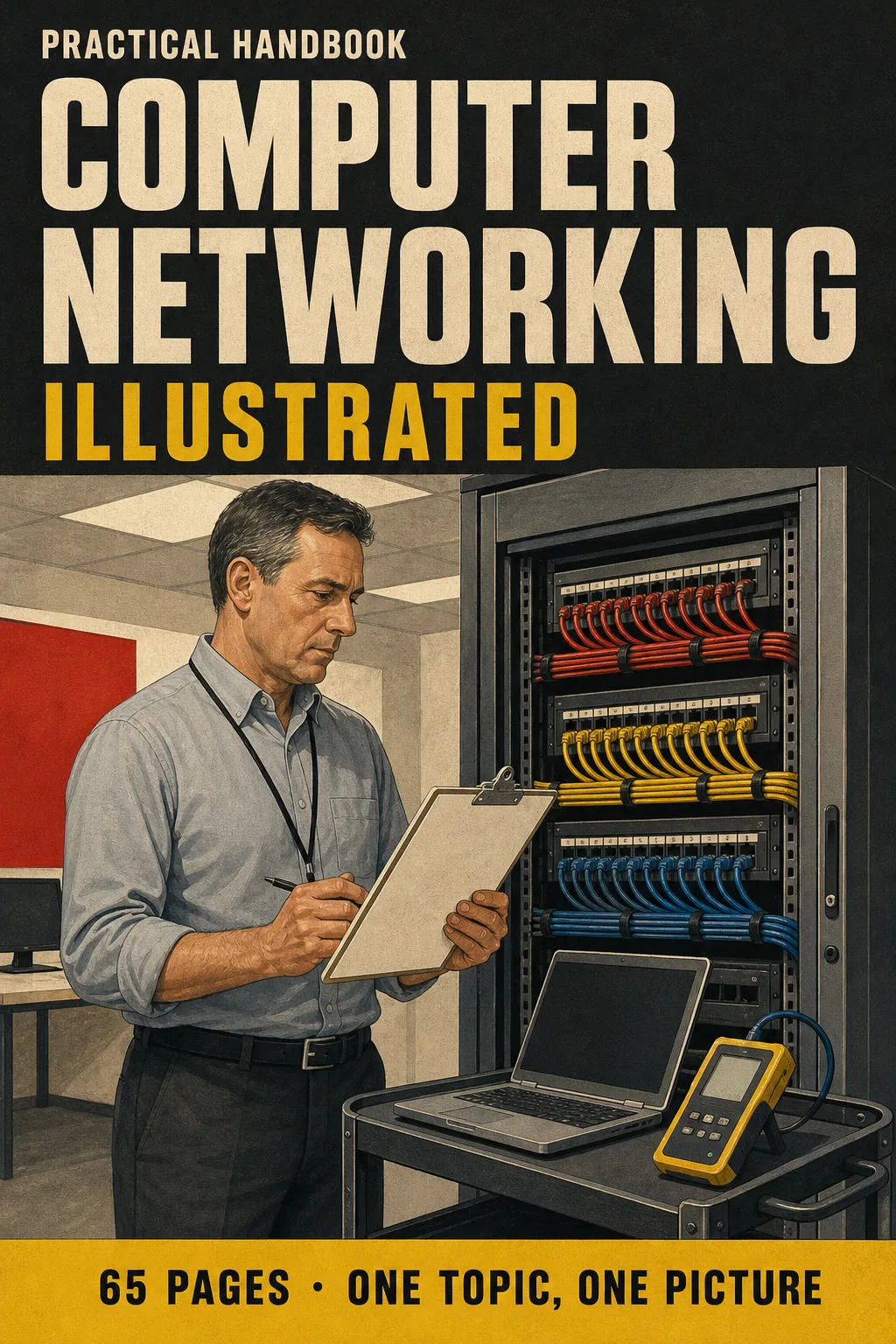
Computer Networking Illustrated

Digital book in PDF · read it on your phone or print it

Computer Networking Illustrated

The OSI model, IPv4 addresses, subnetting, ports, DHCP and DNS, switching, Wi-Fi, security and troubleshooting. Each topic has its own page: the drawing first, then what you need to remember.

  • 65 illustrated pages
  • English
  • 30-day guarantee
£19.99£57.99
Get the book · £19.99

Price shown for: United Kingdom. In other countries, the checkout shows the price that applies there.

About this book

What it is

The OSI model, IPv4 addresses, subnetting, ports, DHCP and DNS, switching, Wi-Fi, security and troubleshooting. Each topic has its own page: the drawing first, then what you need to remember.

Who This Book Is For
  • You're studying for Network+
  • Your exam date is booked
  • You already work on the service desk
What it covers
  1. The Map of a Network
  2. The OSI Model, Floor by Floor
  3. IP Addressing and Subnetting
  4. Ports, Protocols and Services
  5. Switching, Routing and Wireless
  6. Operations and Security
  7. Troubleshooting, Always in the Same Order
  8. Revision and Exam Day
Language
English (United Kingdom)
Pages
65
Format
Digital book in PDF · read it on your phone or print it
Price
£19.99 (United Kingdom)
Delivery
This is a digital PDF book sent to your email: nothing is printed or shipped.
30-Day Guarantee
30-day guarantee: if a file doesn't open, if the content isn't what the product page describes, if you were charged twice or the email never arrived, write to us and we'll refund you in full.

Look Inside the Book

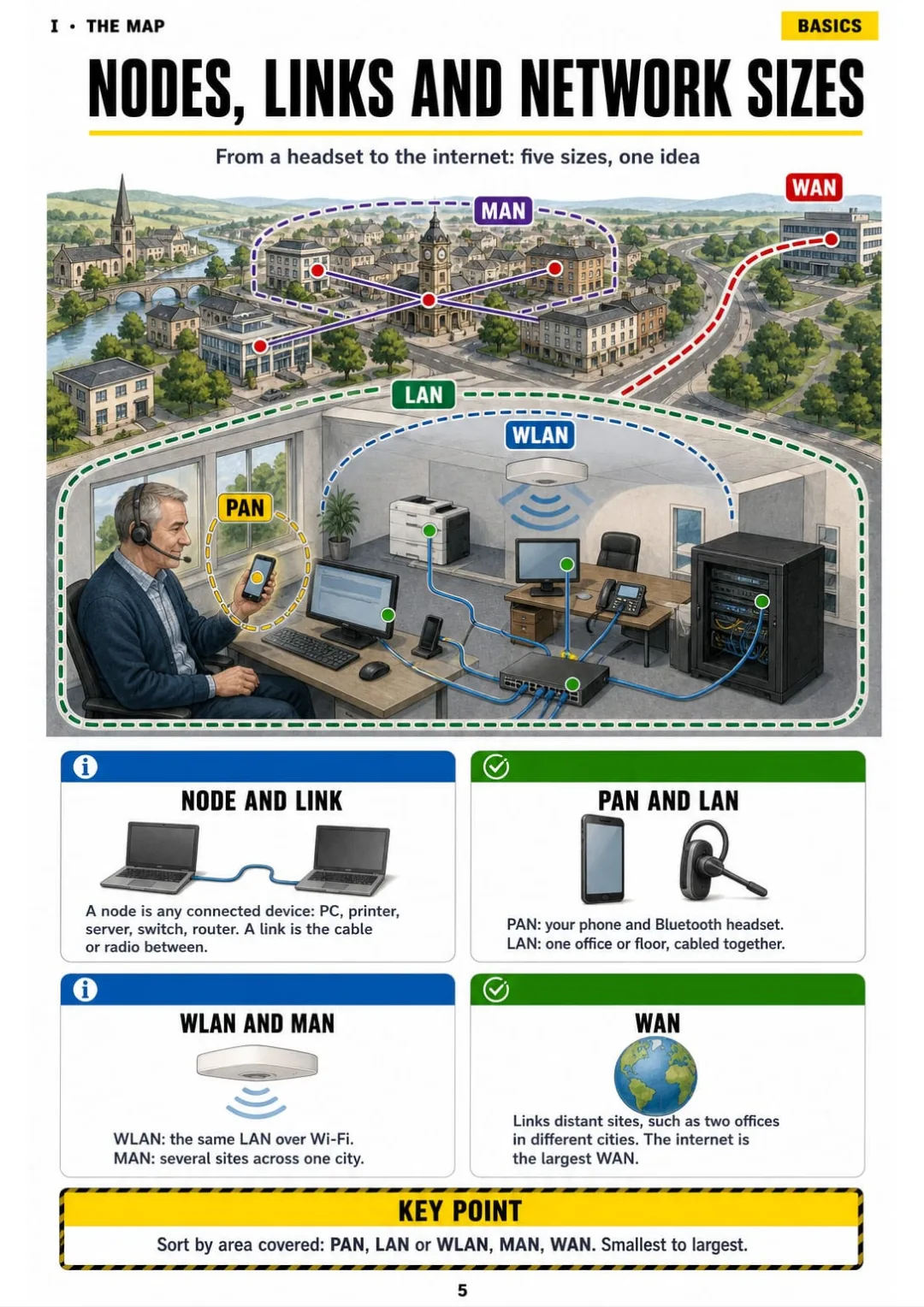
PAN, LAN, WLAN, MAN and WAN drawn on one town map, smallest to largest.
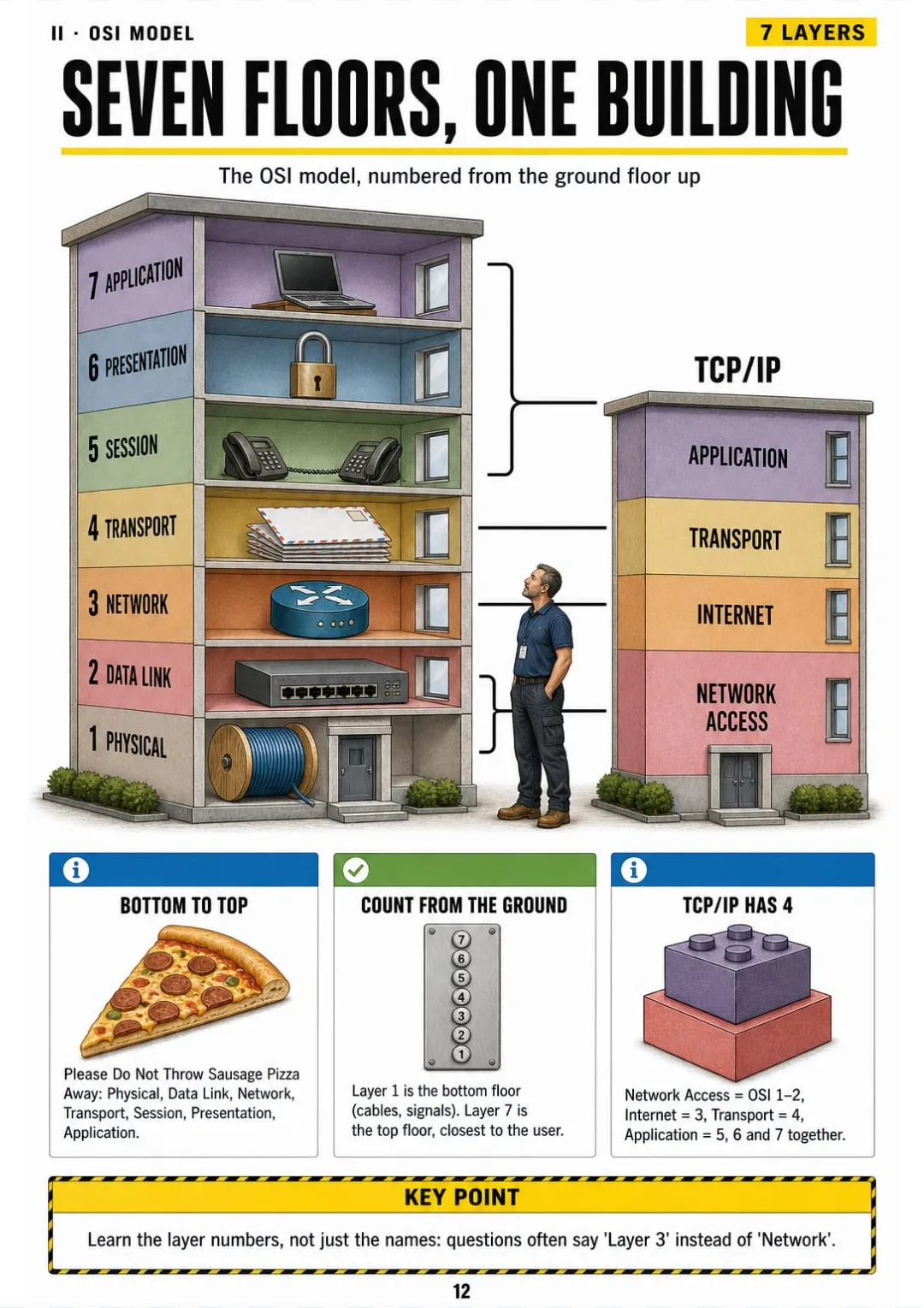
OSI layers 1 to 7, bottom to top, with the 4-layer TCP/IP model beside them
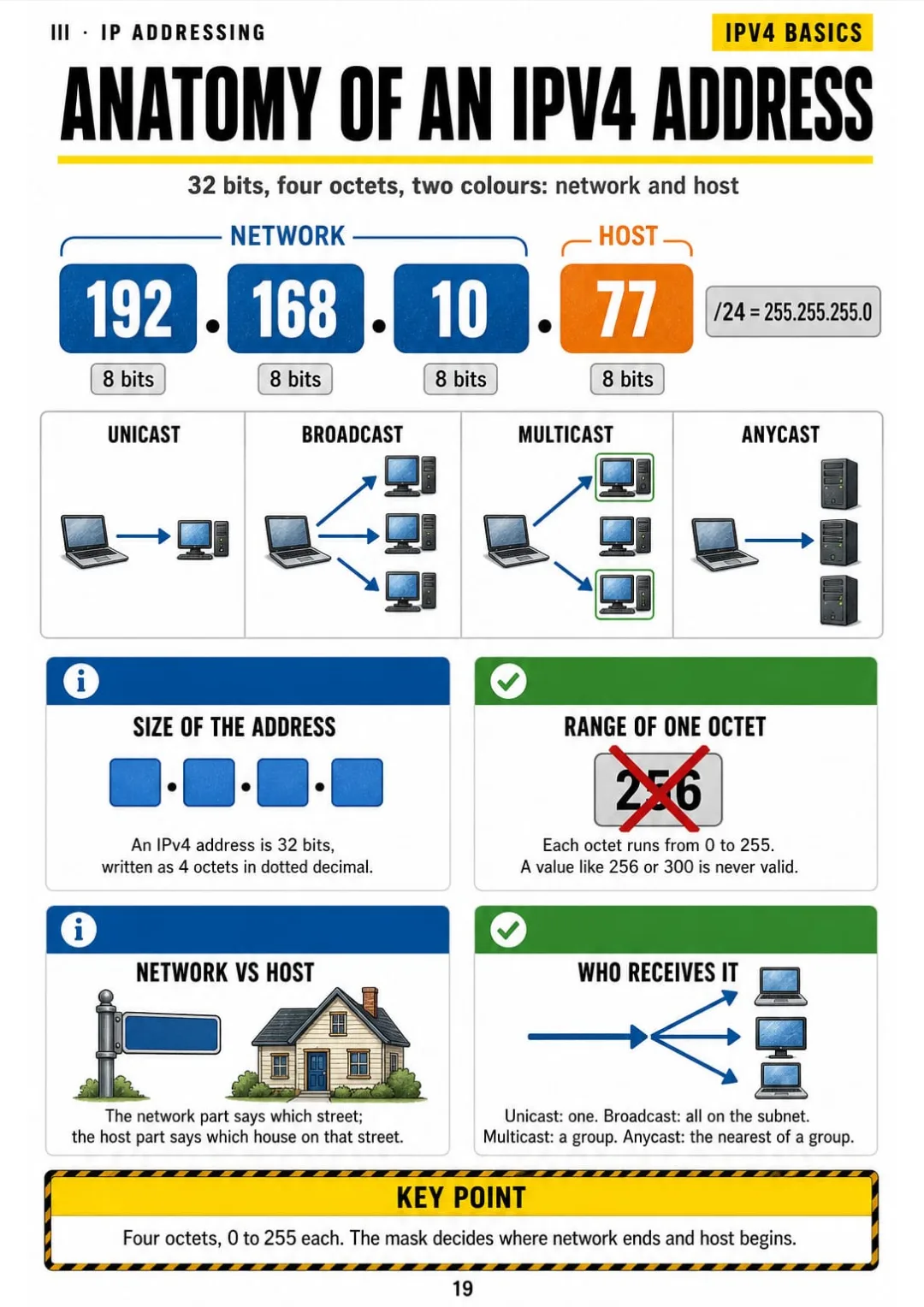
32 bits, 4 octets of 0–255, network in blue and host in orange
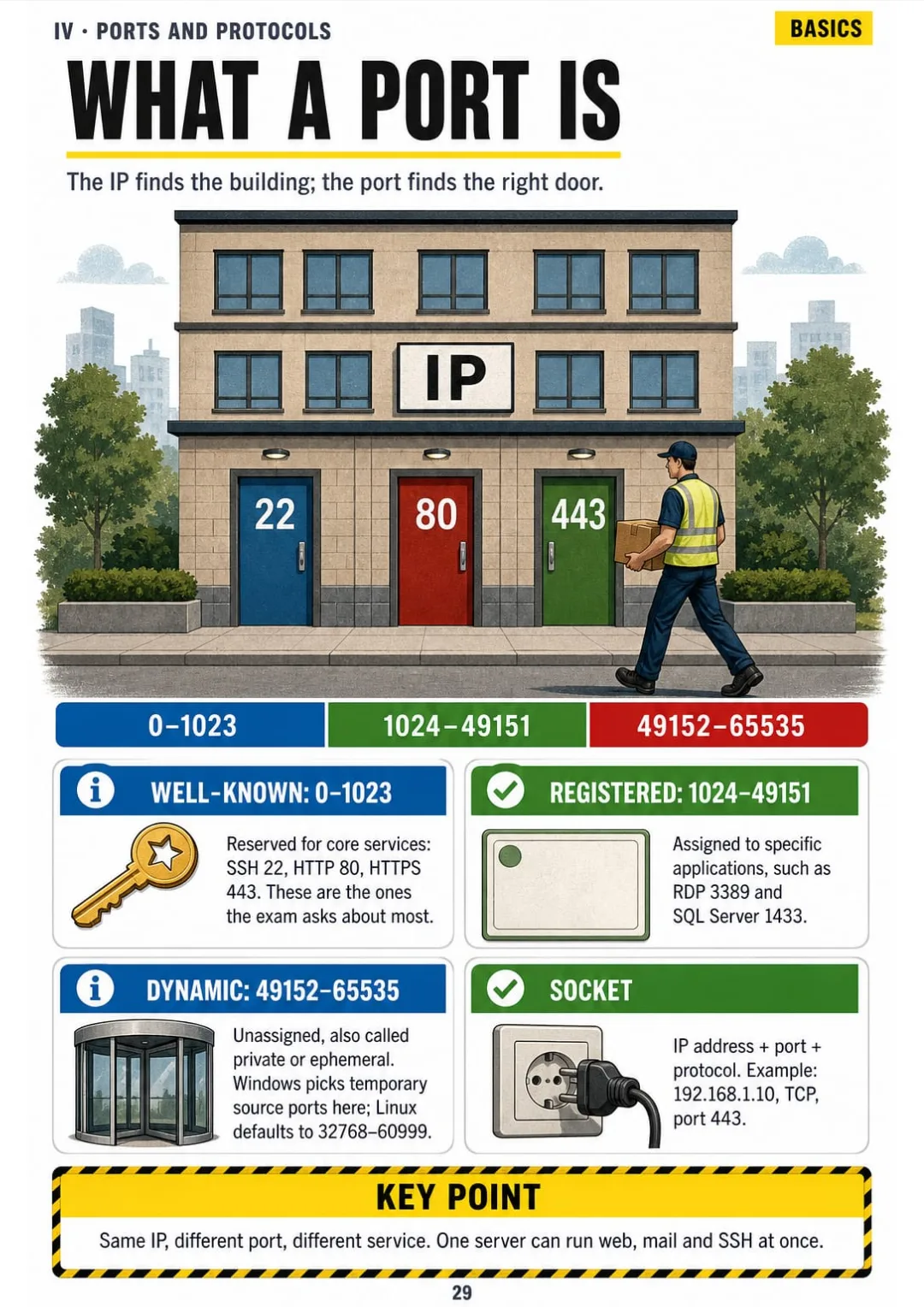
Port ranges: 0–1023 well-known, 1024–49151 registered, 49152–65535 dynamic.
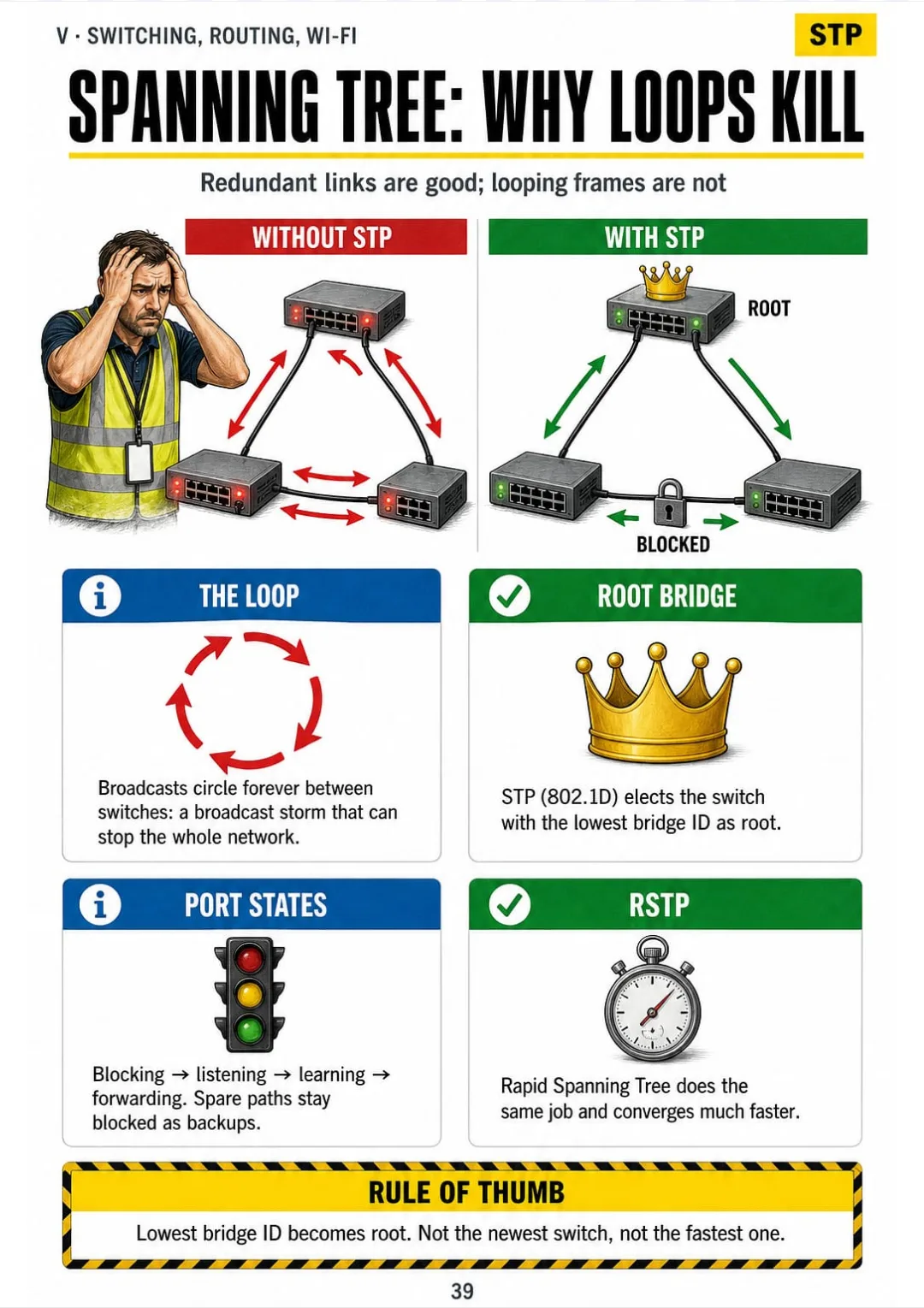
Loops cause broadcast storms; STP elects the lowest bridge ID as root and blocks spare paths.
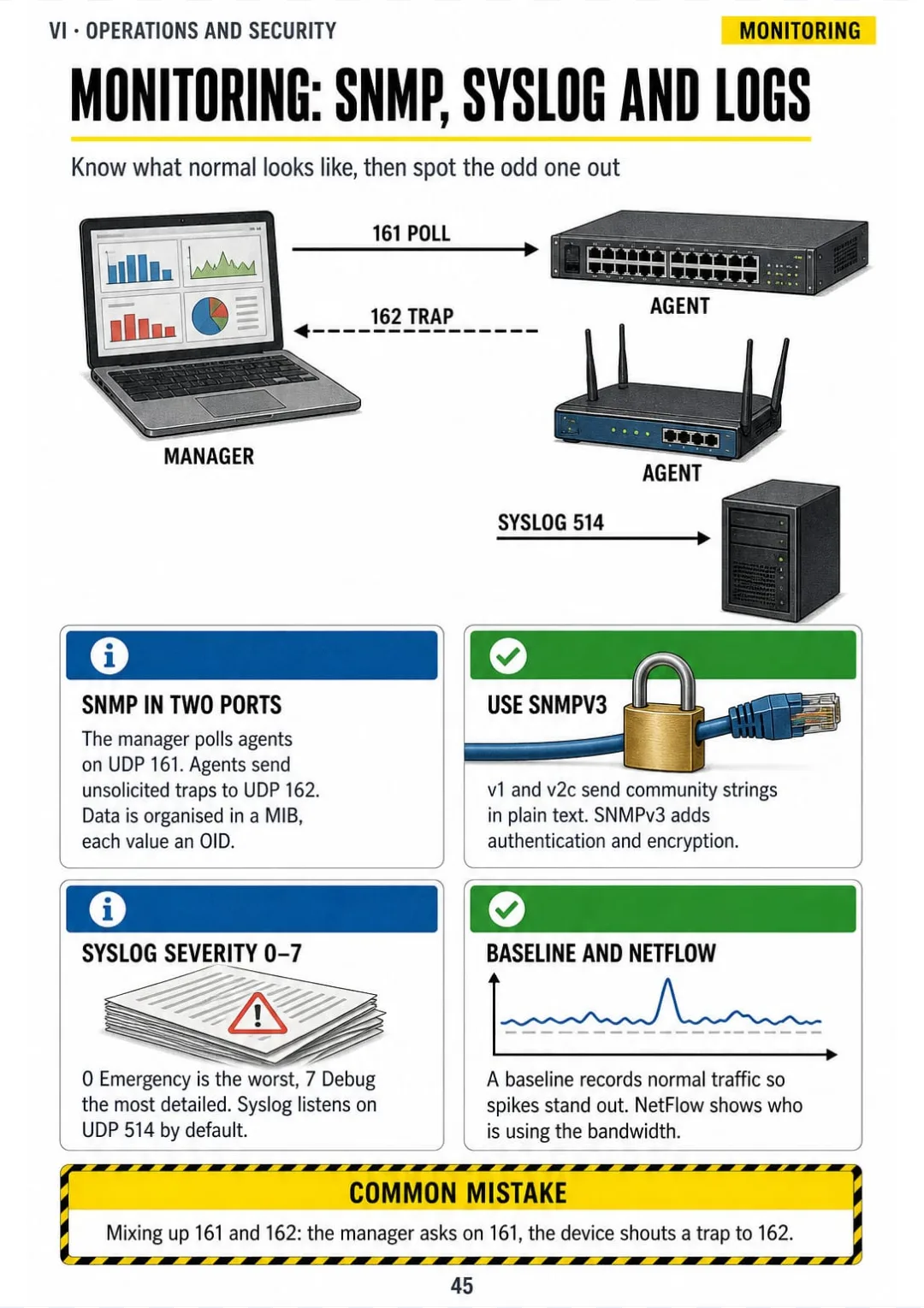
SNMP polls on UDP 161, traps on 162, syslog on 514 with severity 0 (Emergency) to 7 (Debug).
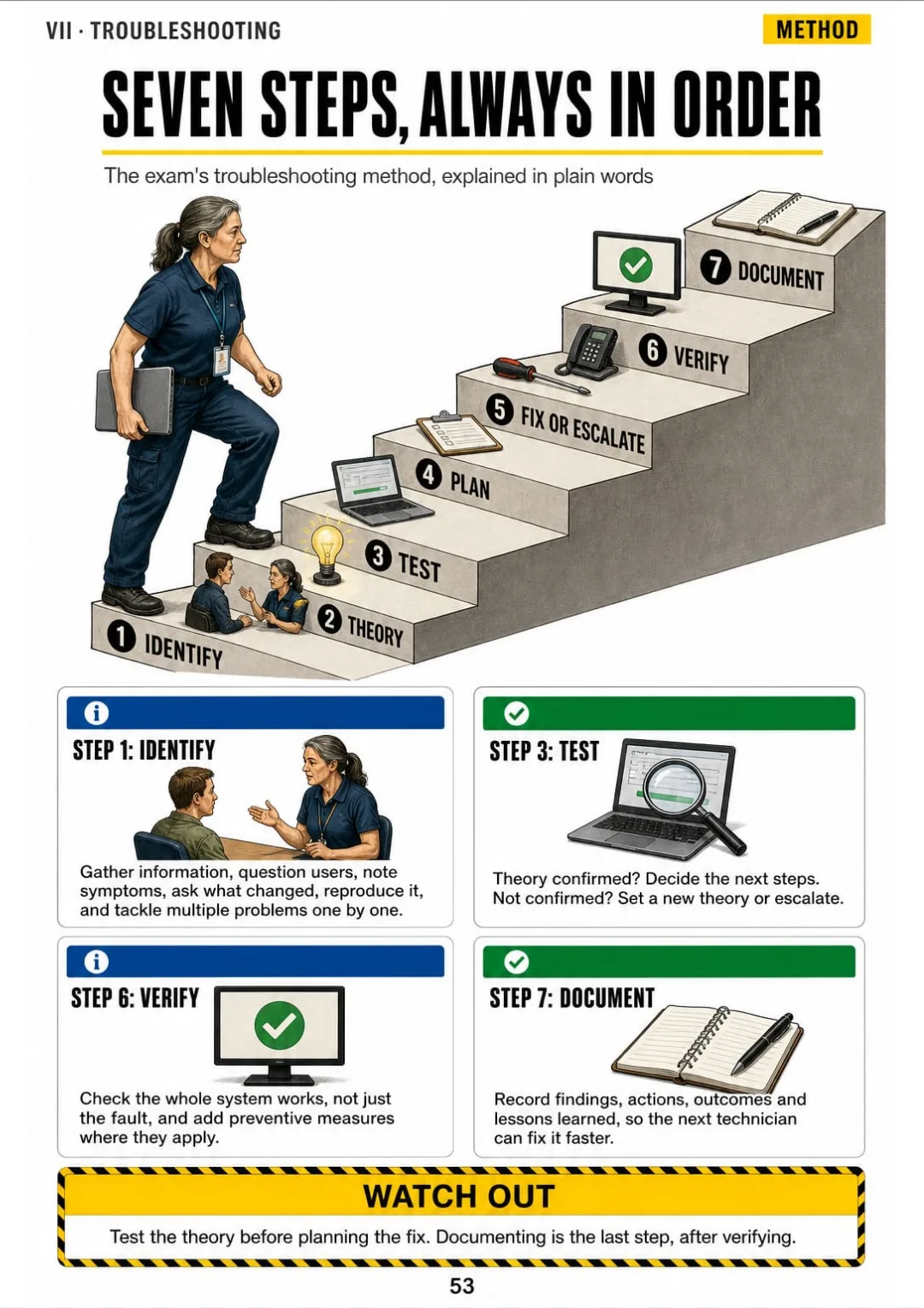
Identify, theory, test, plan, fix or escalate, verify, document: the seven steps on one staircase.
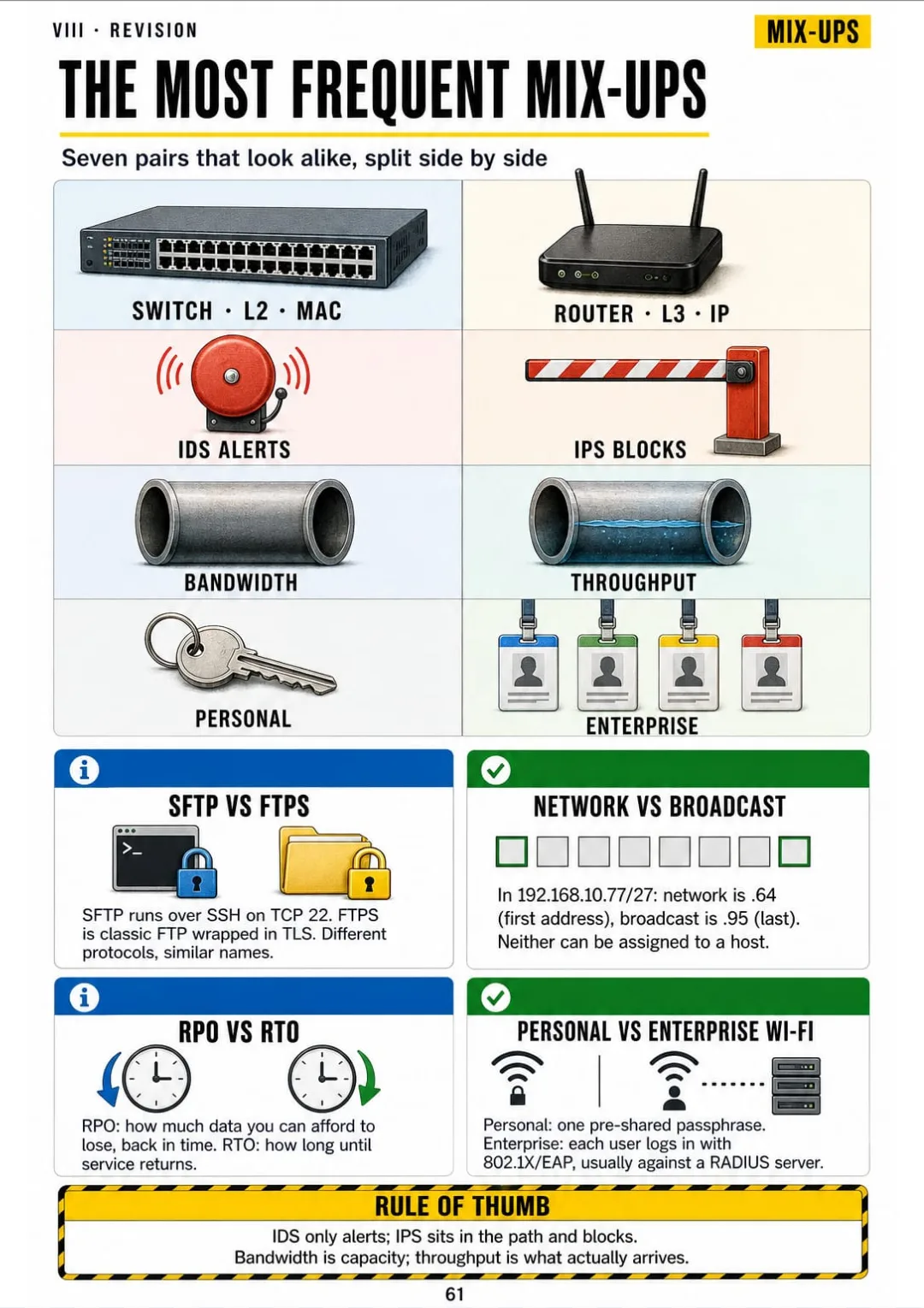
Switch vs router, IDS vs IPS, RPO vs RTO: the look-alikes split on one page

Take a Look at the 8 Parts and 61 Topics

The Map of a Network

pp. 5-11
  1. What a network is: nodes, links and sizes
  2. Topologies at a glance
  3. Copper cables: Cat5e, Cat6, Cat6a
  4. Fibre: single-mode vs multimode
  5. The devices and what each one does
  6. Bandwidth, throughput and latency
  7. Cloud and where the network lives

The OSI Model, Floor by Floor

pp. 12-18
  1. Seven floors, one building
  2. Encapsulation: data going down and up
  3. Layers 1 and 2: bits and MAC addresses
  4. Layer 3: IP addresses and routers
  5. Layer 4: TCP vs UDP
  6. Layers 5, 6 and 7 without the fog
  7. Which layer is it? The sorting page

IP Addressing and Subnetting

pp. 19-28
  1. Anatomy of an IPv4 address
  2. Binary in one row: 128 64 32 16 8 4 2 1
  3. Subnet masks and CIDR notation
  4. Private, public and special addresses
  5. NAT and PAT: many devices, one public address
  6. The subnetting method: block size first
  7. Worked example: 192.168.10.77/27
  8. How many hosts, how many subnets
  9. VLSM: the biggest subnet first
  10. IPv6 without panic

Ports, Protocols and Services

pp. 29-35
  1. What a port is
  2. Remote access and file transfer ports
  3. Web and email ports
  4. Infrastructure ports
  5. DHCP in four steps: DORA
  6. DNS: from a name to an address
  7. TCP or UDP? Protocol by protocol

Switching, Routing and Wireless

pp. 36-44
  1. How a switch learns MAC addresses
  2. ARP: finding the MAC behind an IP
  3. VLANs and trunks
  4. Spanning Tree: why loops kill a network
  5. Reading a routing table
  6. Static vs dynamic routing
  7. Wi-Fi standards by generation
  8. Channels: 1, 6 and 11
  9. Wireless security: Personal vs Enterprise

Operations and Security

pp. 45-52
  1. Monitoring: SNMP, syslog and logs
  2. Documentation and change management
  3. High availability and disaster recovery
  4. CIA triad and AAA
  5. Common attacks, drawn
  6. Defences on the switch
  7. Firewalls, ACLs and the screened subnet
  8. VPNs and zero trust

Troubleshooting, Always in the Same Order

pp. 53-60
  1. The seven-step troubleshooting method
  2. Bottom-up, top-down, divide and conquer
  3. Cable and physical faults
  4. Command-line tools in one page
  5. Reading ipconfig like a clue
  6. The 'no internet' ticket, step by step
  7. Slow or dropping Wi-Fi
  8. Switch and port problems

Revision and Exam Day

pp. 61-65
  1. The most frequent mix-ups
  2. All the ports on one page
  3. Subnetting cheat sheet
  4. How the exam works
  5. The night-before checklist

Who This Book Is For

You're studying for Network+

In the evenings and at weekends, one page per topic: you see the network as a map that builds up, from the cable to the router.

Your exam date is booked

Subnetting with the same steps every time, the ports on one page and the most frequent mix-ups split apart, ready for your final revision.

You already work on the service desk

A troubleshooting method in seven steps and ipconfig read like a clue, so you know where to look before you escalate a ticket.

Plus: 2 Free Books

Exam-Style Questions with Worked Answers
BONUS 1

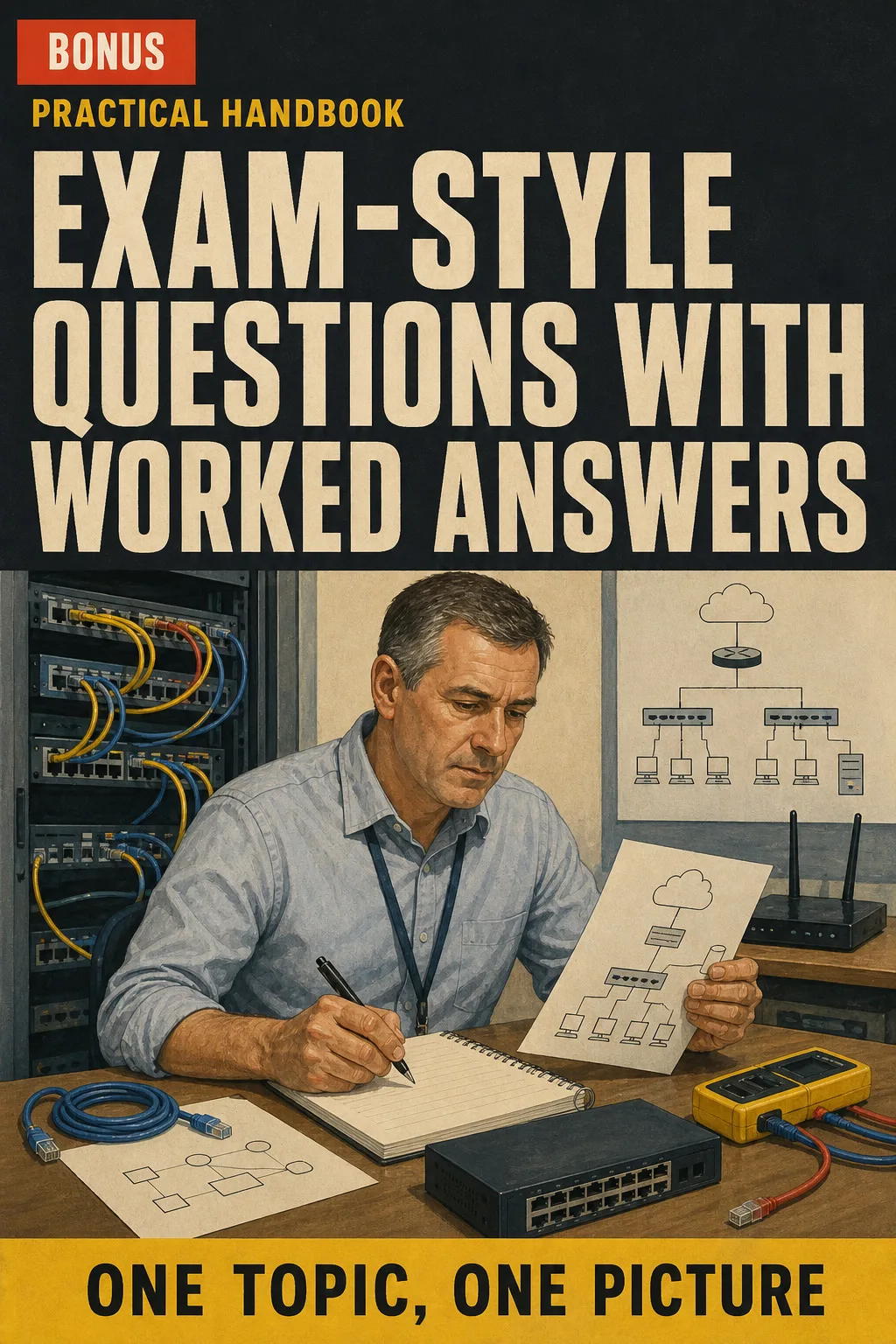
Exam-Style Questions with Worked Answers

Practise with multiple-choice and scenario questions in the style of the exam, and see in one line why each answer is right.
Ports, Protocols & Commands Quick Cards
BONUS 2

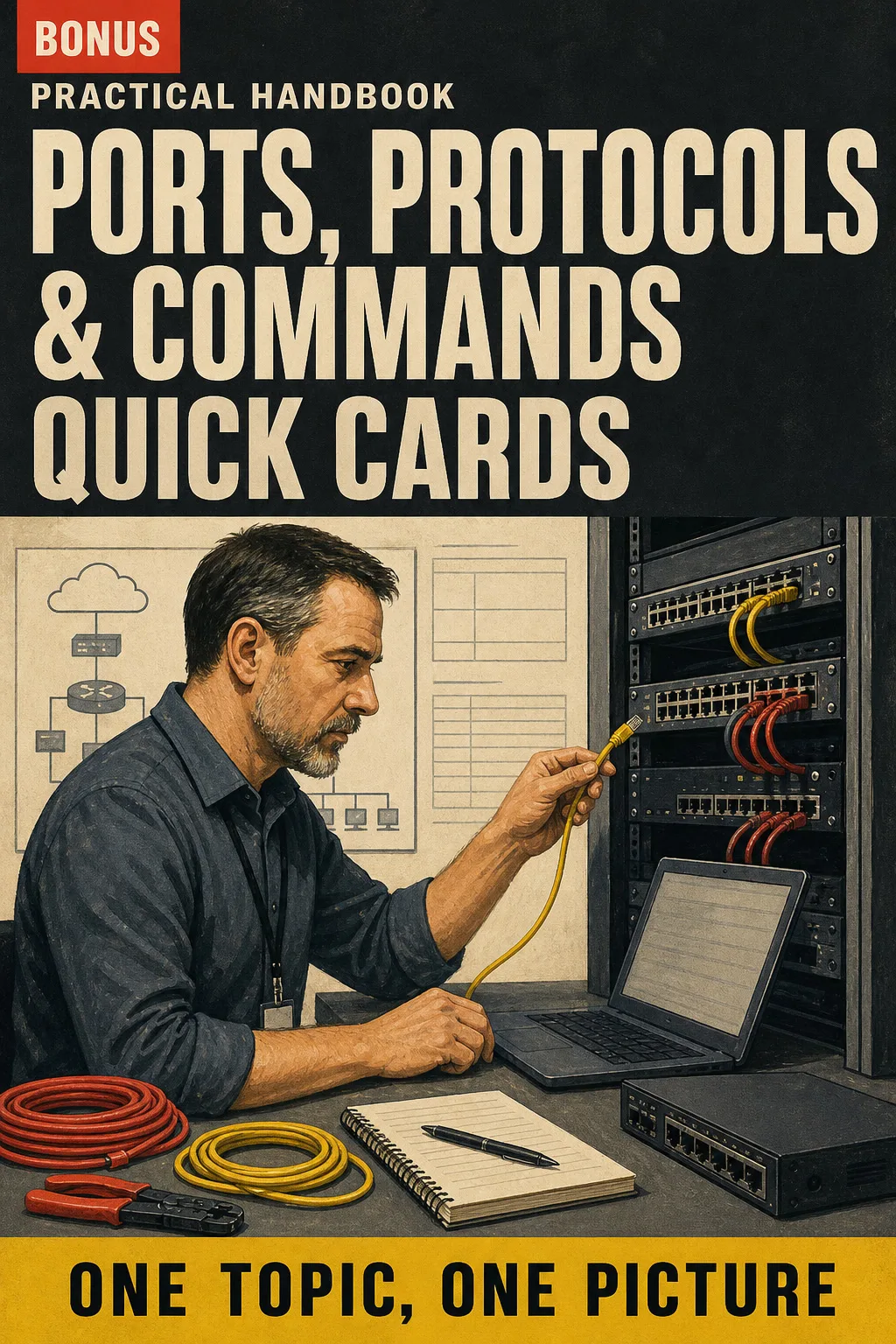
Ports, Protocols & Commands Quick Cards

The port numbers, protocols and command-line tools you need to recall, on printable cards for a ten-minute revision before bed.

30-Day Guarantee

30-day guarantee: if a file doesn't open, if the content isn't what the product page describes, if you were charged twice or the email never arrived, write to us and we'll refund you in full. You pay once. No subscriptions.

Frequently Asked Questions

Is it for me if I work on a help desk or I'm moving into IT from another career?

Yes. It starts from the basics, but it goes all the way to VLSM, IPv6, VLANs and trunks, Spanning Tree, zero trust and reading ipconfig on a real ticket. If you already work on the service desk, you can go straight to subnetting or the troubleshooting part.

Where does the content come from?

It follows the CompTIA Network+ N10-009 exam objectives published by CompTIA, not the older N10-008. Port numbers come from the IANA registry, and Wi-Fi and cabling details come from the IEEE 802 standards.

Is it official material?

No. It's an independent illustrated study book, not affiliated with or endorsed by CompTIA. It doesn't include an exam voucher or a certificate: you book and sit the Network+ exam separately.

Does it replace a course or a bootcamp?

No. Your course and your manual explain everything at length. This book is the page you open afterwards: one topic, one drawing, the numbers and steps in a box. It goes alongside your course and your labs, so you can revise a topic in a few minutes instead of rewatching a video.

Are the practice questions the real exam questions?

No. They're written for this book, in the style of the exam, and each one comes with a short explanation of the answer.

When and how will I get it?

The book and the 2 bonus books arrive as PDFs by email, sent to the address you enter at checkout.

Do I have to pay every month?

No. It's a one-off payment, with no subscription.

Can I have it on paper?

Yes. The PDF is ready to print at home or at a print shop, so you can keep it on your desk at work.

How does the refund work?

You have 30 days. We refund everything if the file won't open, if the book isn't what you see on this page, if you were charged twice or if the email doesn't arrive: just email us.

£19.99£57.99
Get the book · £19.99

This is a digital PDF book sent to your email: nothing is printed or shipped.