Study in Pictures🌐 English (United Kingdom)
Classic Motorcycle Engine Illustrated

Digital book in PDF · read it on your phone or print it

Classic Motorcycle Engine Illustrated

Recommissioning, valve clearances, points and timing, the slide carburettor, the wet clutch, chain slack and where home maintenance ends. Every job has its own page: first the drawing, then what you need to remember.

  • 67 illustrated pages
  • English
  • 30-day guarantee
£19.99£57.99
Get the book · £19.99

Price shown for: United Kingdom. In other countries, the checkout shows the price that applies there.

About this book

What it is

Recommissioning, valve clearances, points and timing, the slide carburettor, the wet clutch, chain slack and where home maintenance ends. Every job has its own page: first the drawing, then what you need to remember.

Who This Book Is For
  • You're getting to know your classic
  • Spring recommissioning is coming
  • You've serviced it yourself for years
What it covers
  1. Before You Pick Up a Spanner
  2. Waking a Laid-Up Classic
  3. Engine Top End
  4. Ignition: Points, Timing and Spark
  5. The Carburettor
  6. Clutch, Primary and Gearbox
  7. Final Drive and Chain
  8. When It Goes to a Machine Shop
  9. On the Bench: Review and Checklists
Language
English (United Kingdom)
Pages
67
Format
Digital book in PDF · read it on your phone or print it
Price
£19.99 (United Kingdom)
Delivery
This is a digital PDF book sent to your email: nothing is printed or shipped.
30-Day Guarantee
30-day guarantee: if a file doesn't open, if the content isn't what the product page describes, if you were charged twice or the email never arrived, write to us and we'll refund you in full.

Look Inside the Book

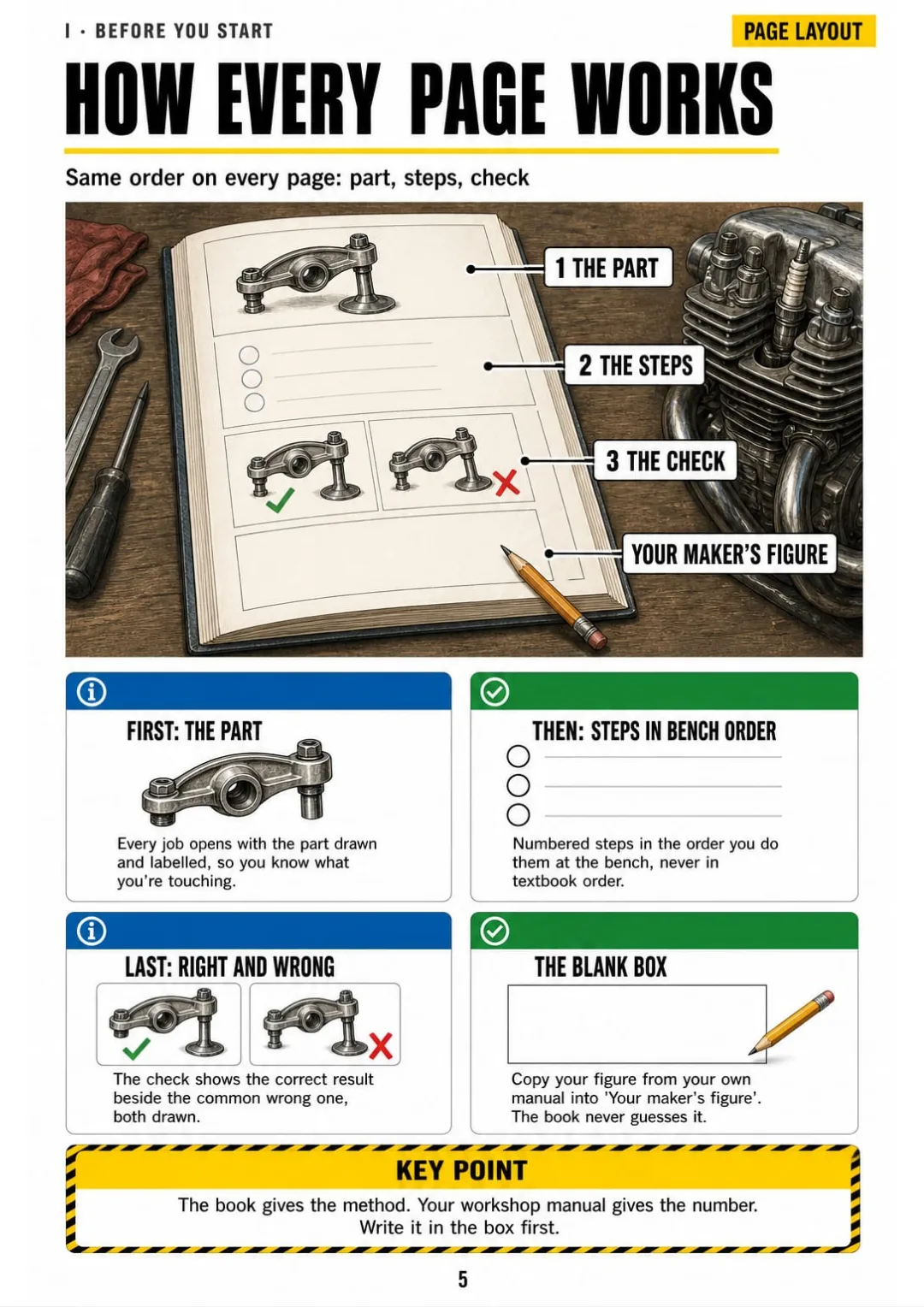
One job per page: part, numbered steps, check, and a box for your maker's figure
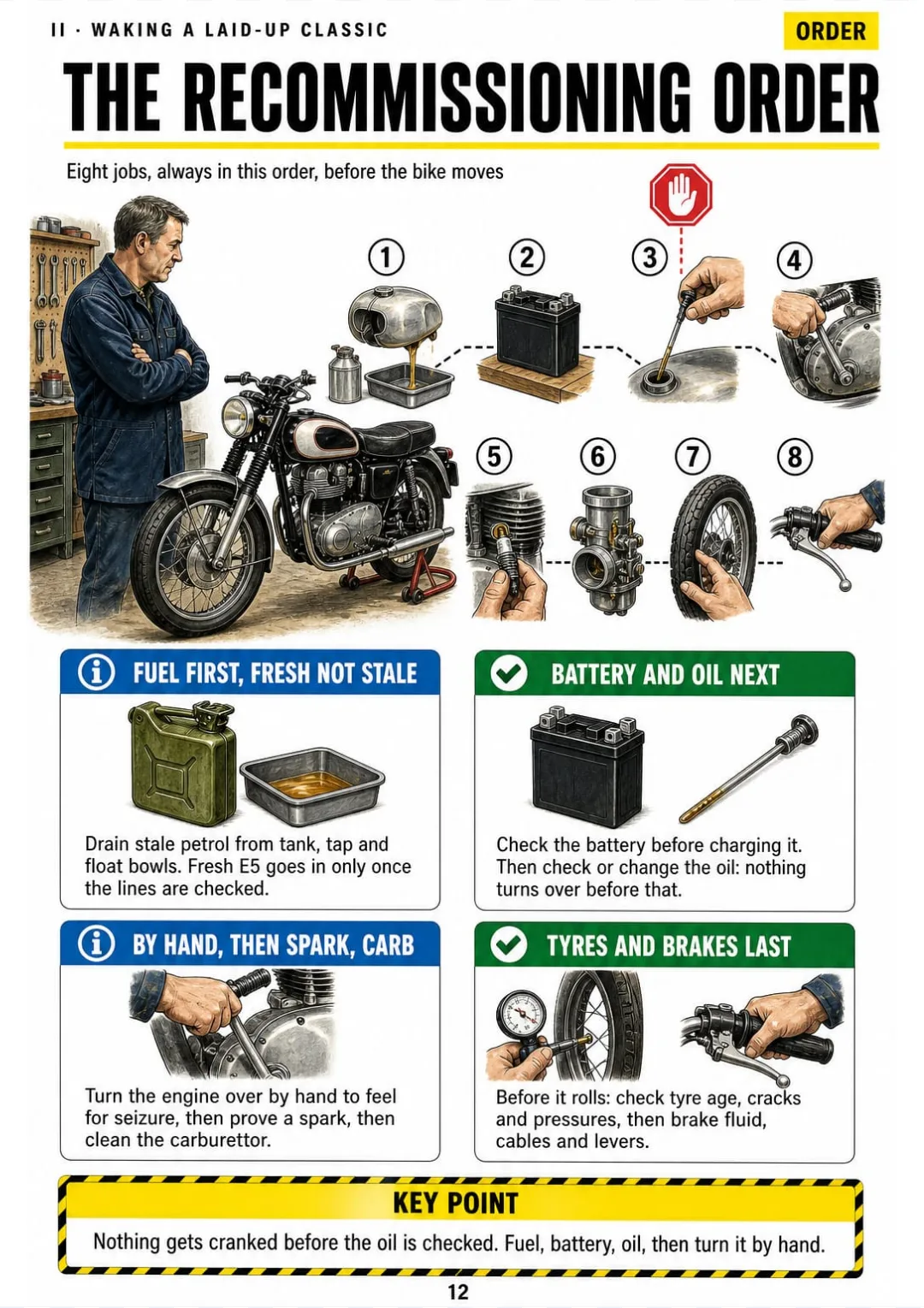
Fuel, battery, oil, by hand, spark, carb, tyres, brakes: the order that saves the engine.
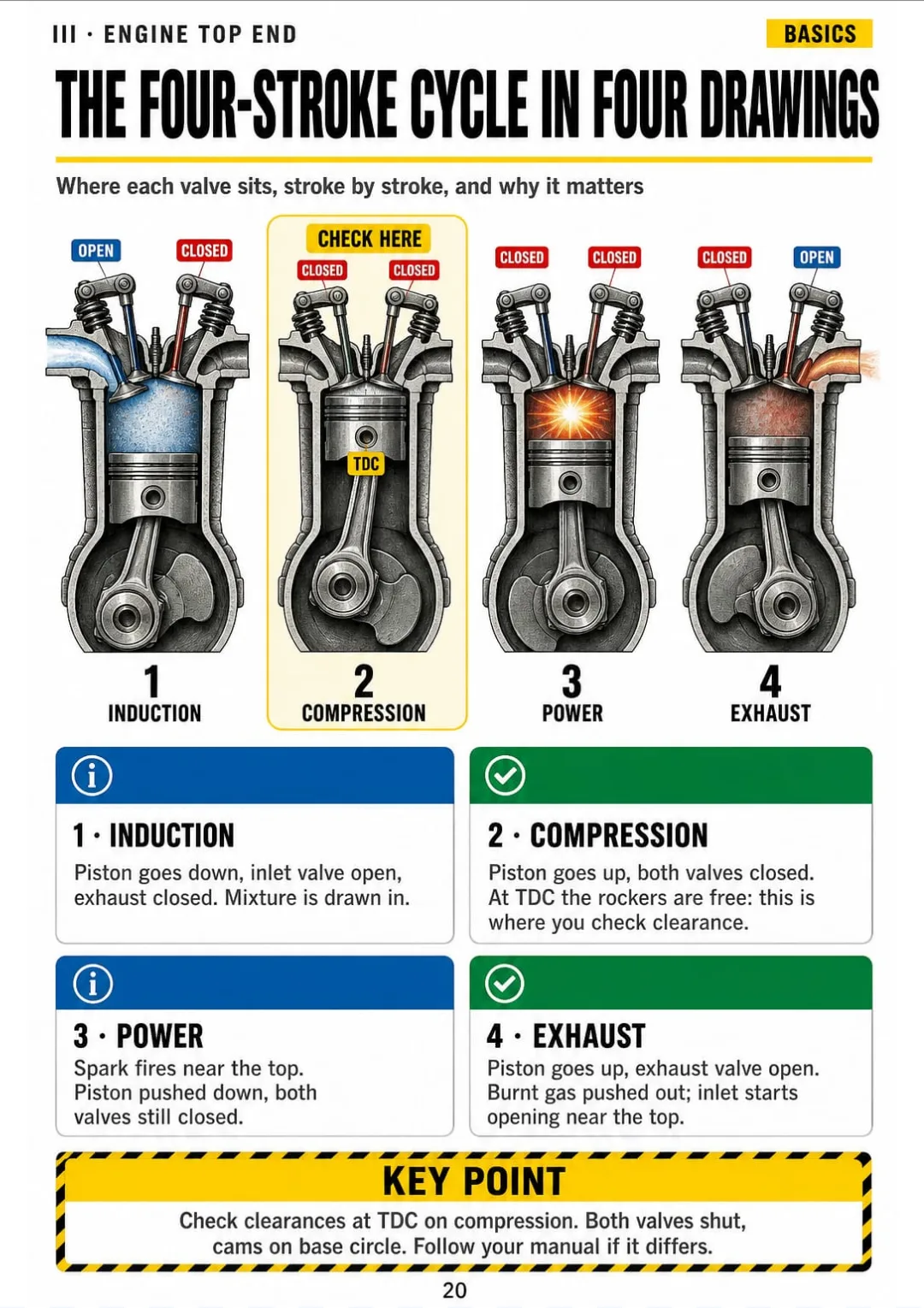
Induction, compression, power, exhaust: at TDC on compression both valves are shut and the rockers free.
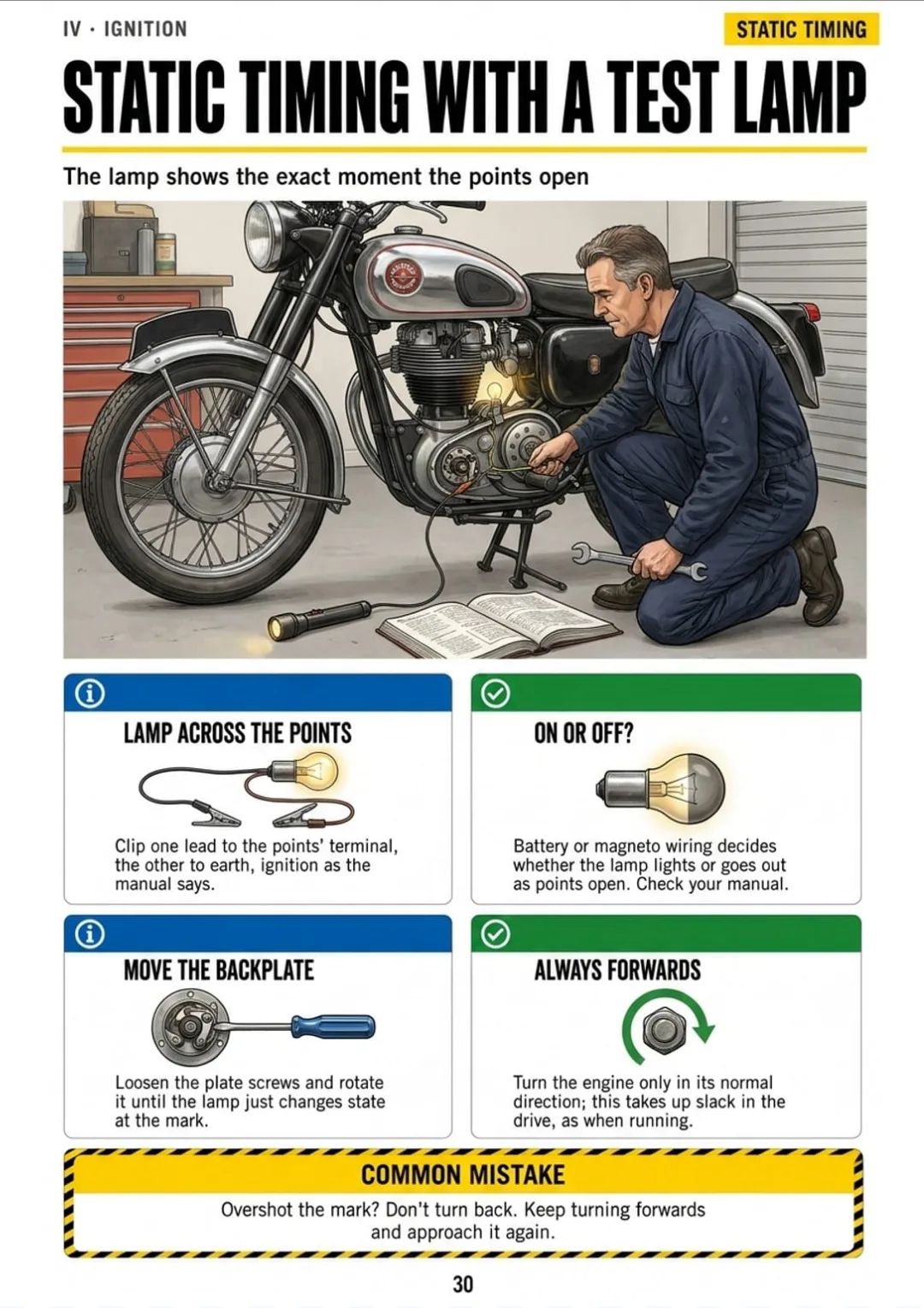
Lamp across the points, marks lined up, plate turned until the lamp just changes state.
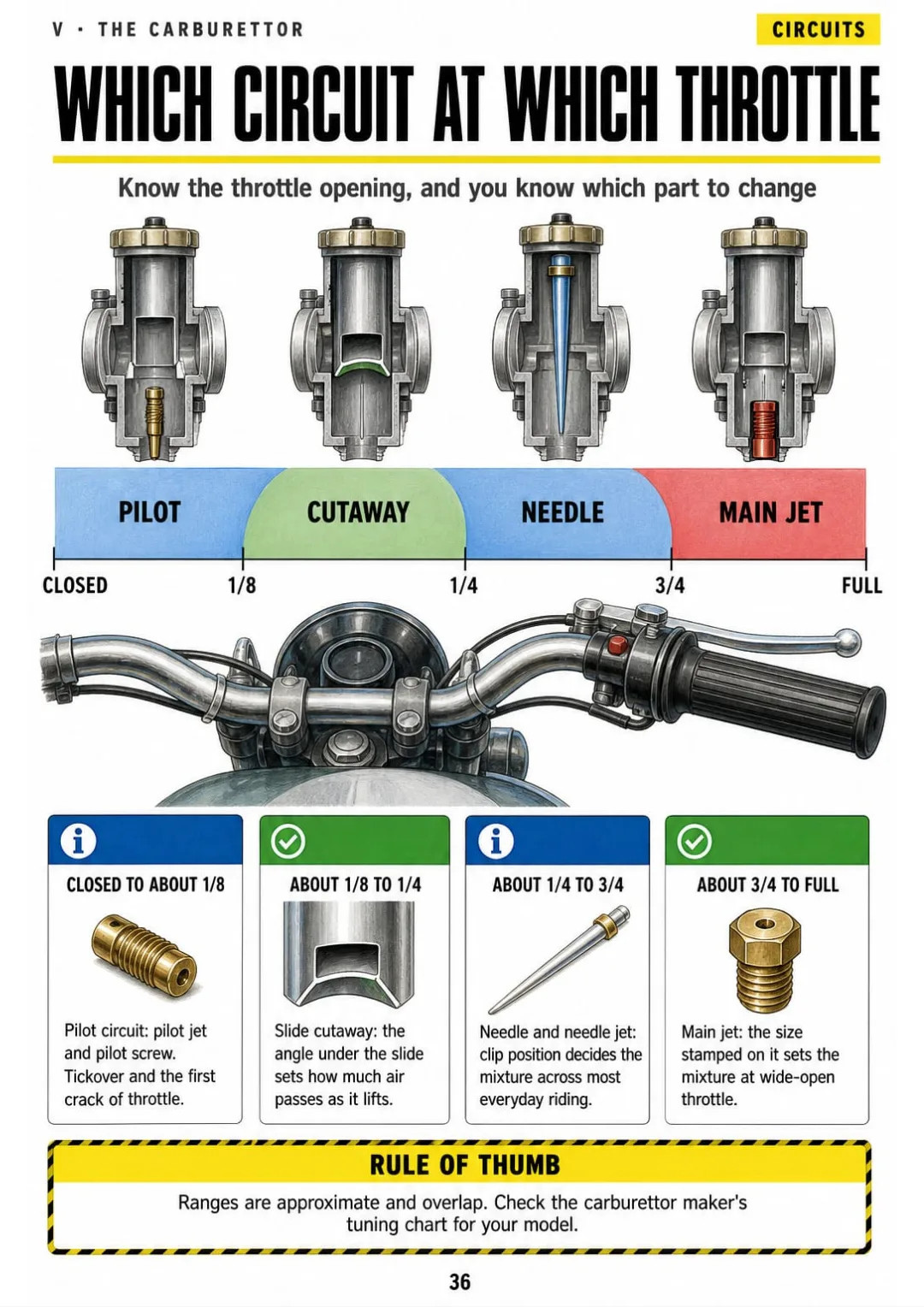
Pilot to about 1/8, cutaway to 1/4, needle to 3/4, main jet to full throttle.
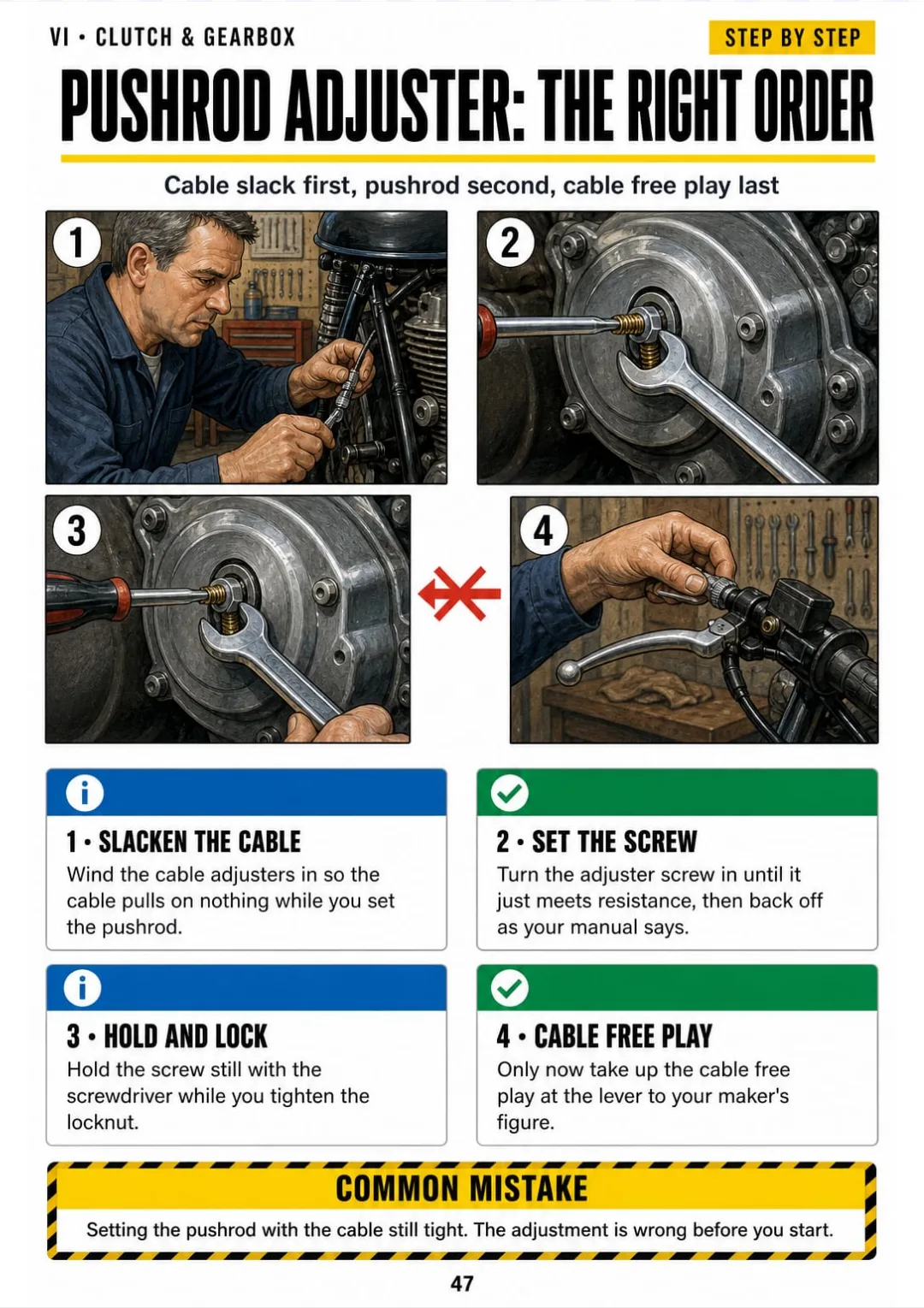
Four steps: slacken cable, set screw, lock it, then set cable free play.
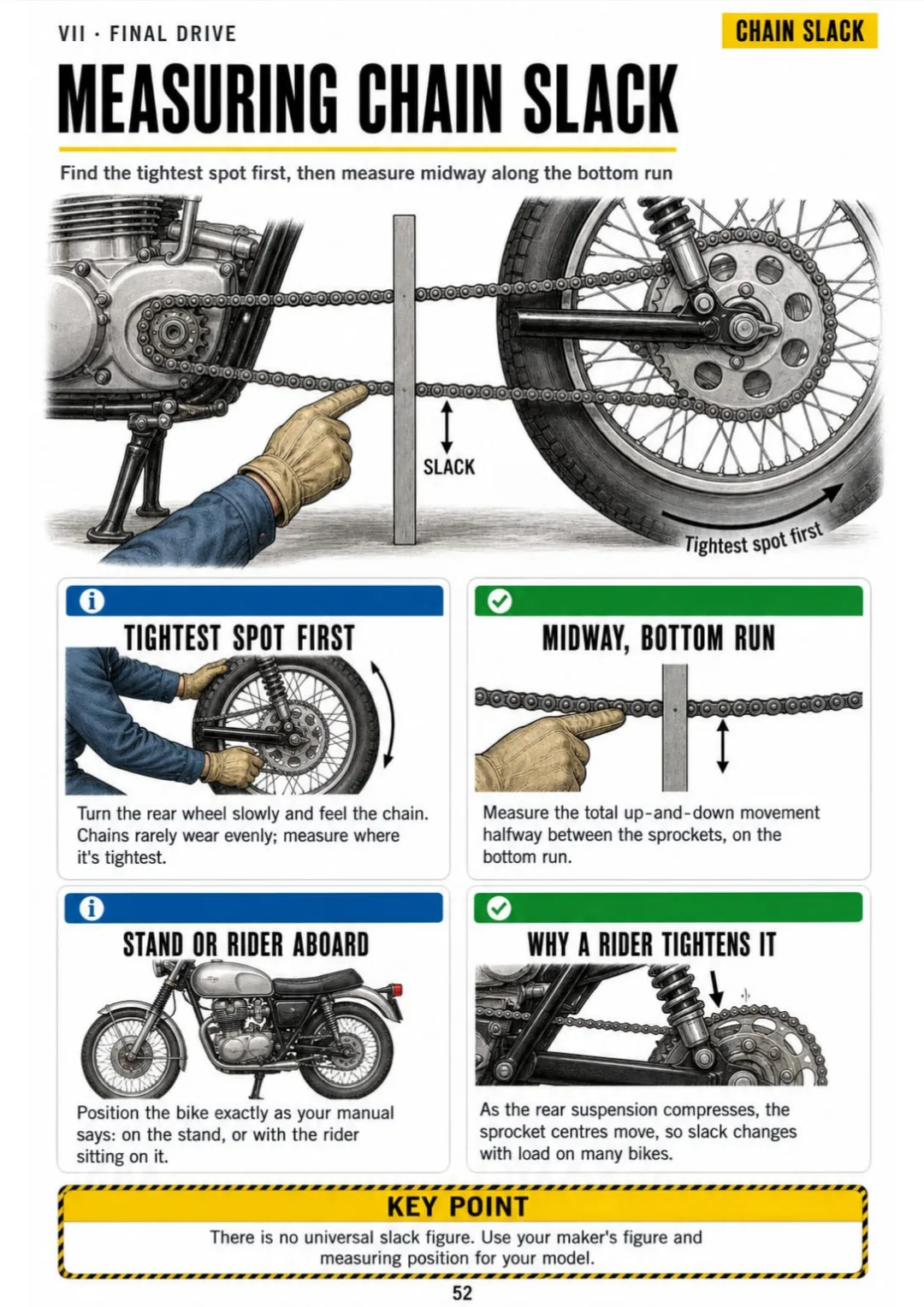
Chain slack: tightest spot, bottom run midpoint, your maker's figure in the box
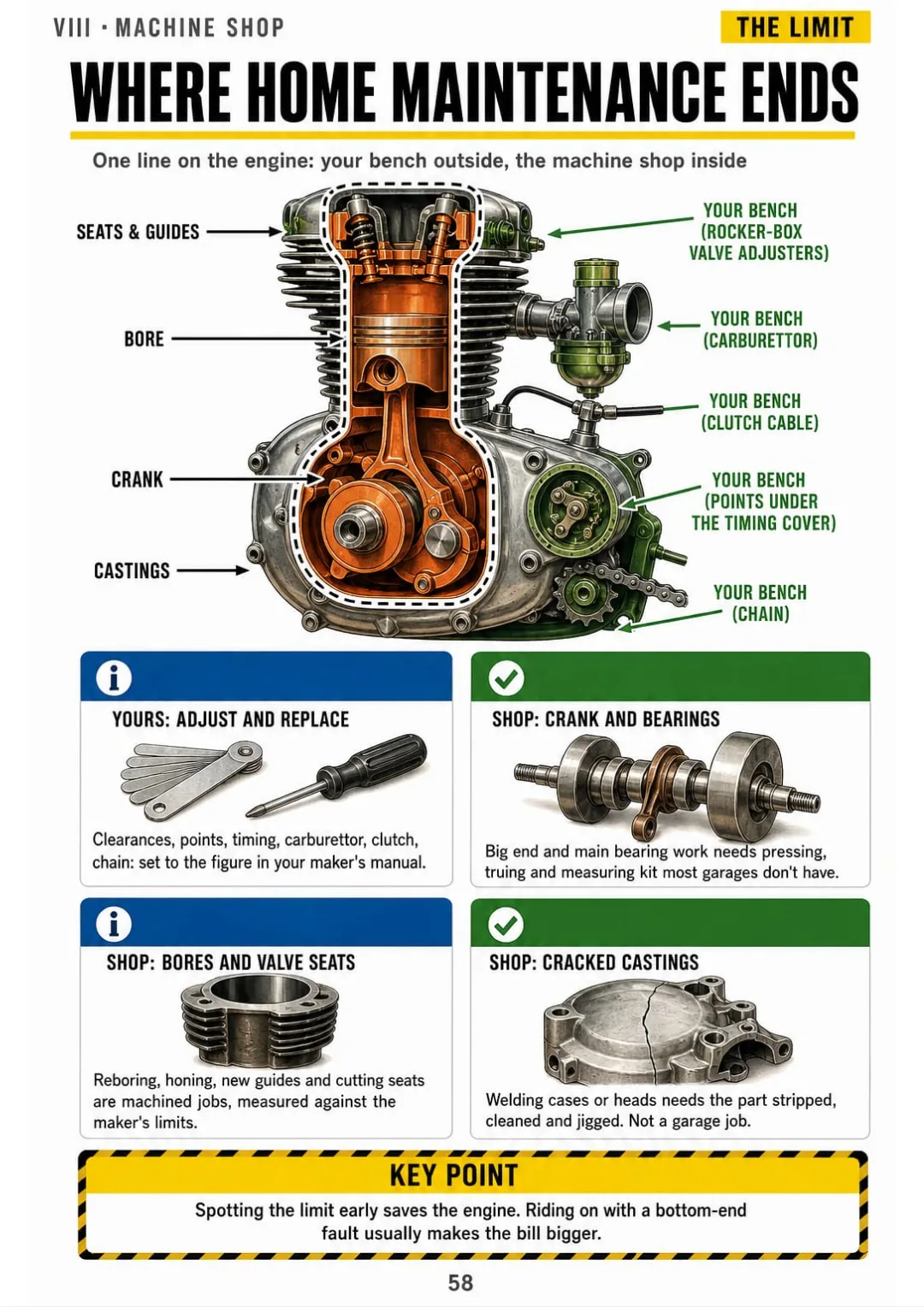
A dividing line on the engine: your jobs outside it, crank, bores, seats and castings inside

Take a Look at the 9 Parts and 63 Topics

Before You Pick Up a Spanner

pp. 5-11
  1. How Every Page Works
  2. Finding Your Maker's Figures
  3. Two-Stroke or Four-Stroke at a Glance
  4. British or Japanese Threads: Pick the Right Spanner
  5. The Bench Toolkit
  6. Safe in the Garage
  7. Photograph Before You Undo

Waking a Laid-Up Classic

pp. 12-19
  1. The Recommissioning Order
  2. Stale Petrol and E10
  3. Tank, Tap and Fuel Lines
  4. Battery: Read It Before You Charge It
  5. Turn It Over by Hand First
  6. Oil Change: Wet Sump or Dry Sump
  7. Tyres That Look Fine but Aren't
  8. Brake Fluid and Cables Before It Rolls

Engine Top End

pp. 20-27
  1. The Four-Stroke Cycle in Four Drawings
  2. Why Valve Clearance Matters
  3. Finding TDC on the Compression Stroke
  4. Measuring Clearance with a Feeler Gauge
  5. Adjusting: Screw, Locknut, Recheck
  6. Worked Example: A Twin's Valve Clearances
  7. Compression Test: Reading the Numbers
  8. Reading a Spark Plug

Ignition: Points, Timing and Spark

pp. 28-35
  1. The Points System, Labelled
  2. Setting the Points Gap
  3. Static Timing with a Test Lamp
  4. Worked Example: Timing a Single
  5. Strobe Timing at Full Advance
  6. The Condenser: Signs It's Failing
  7. No Spark: The Order of Checks
  8. Electronic Ignition Conversions: What Changes

The Carburettor

pp. 36-44
  1. Which Circuit Works at Which Throttle Opening
  2. Slide Carburettor Exploded and Labelled
  3. Strip and Clean in Order
  4. Float Height: A Worked Example
  5. Needle Clip Position
  6. Pilot Screw and Tickover
  7. Balancing Twin Carburettors
  8. Air Leaks: The Hidden Lean Mixture
  9. Rich or Lean? Read the Symptoms

Clutch, Primary and Gearbox

pp. 45-51
  1. How a Wet Multi-Plate Clutch Works
  2. Cable Free Play at the Lever
  3. Pushrod Adjuster: The Right Order
  4. Checking the Plates
  5. Slip or Drag: Which Is It?
  6. Primary Chain Tension
  7. Gearbox Oil Level and Grade

Final Drive and Chain

pp. 52-57
  1. Measuring Chain Slack
  2. Adjusting and Aligning the Rear Wheel
  3. Is the Chain Worn Out?
  4. Reading Sprocket Teeth
  5. Fitting the Spring Link the Right Way Round
  6. Cleaning and Lubricating the Chain

When It Goes to a Machine Shop

pp. 58-62
  1. Where Home Maintenance Ends
  2. Knocks and Rumbles from the Bottom End
  3. Blue Smoke: Rings or Guides?
  4. Stripped Threads and Cracked Castings
  5. What to Take to the Machine Shop

On the Bench: Review and Checklists

pp. 63-67
  1. Spring Recommissioning Checklist
  2. The Most Frequent Setting-Up Mistakes
  3. The First Ride Shakedown
  4. Your Monthly Routine in Ten Minutes
  5. Laying It Up for Winter

Who This Book Is For

You're getting to know your classic

Bought back the bike you had at nineteen, or inherited one? Each job is drawn in the order you do it, so you learn the engine one page at a time.

Spring recommissioning is coming

The bike's been laid up all winter. You follow the recommissioning order page by page and tick it off on the checklist before the first ride.

You've serviced it yourself for years

Oil and plugs are second nature. Now you set valves, points and the carb with a drawing in front of you, and you know which jobs belong to a machine shop.

Plus: 2 Free Books

Workshop Practice Book: Find-the-Fault Exercises
BONUS 1

Workshop Practice Book: Find-the-Fault Exercises

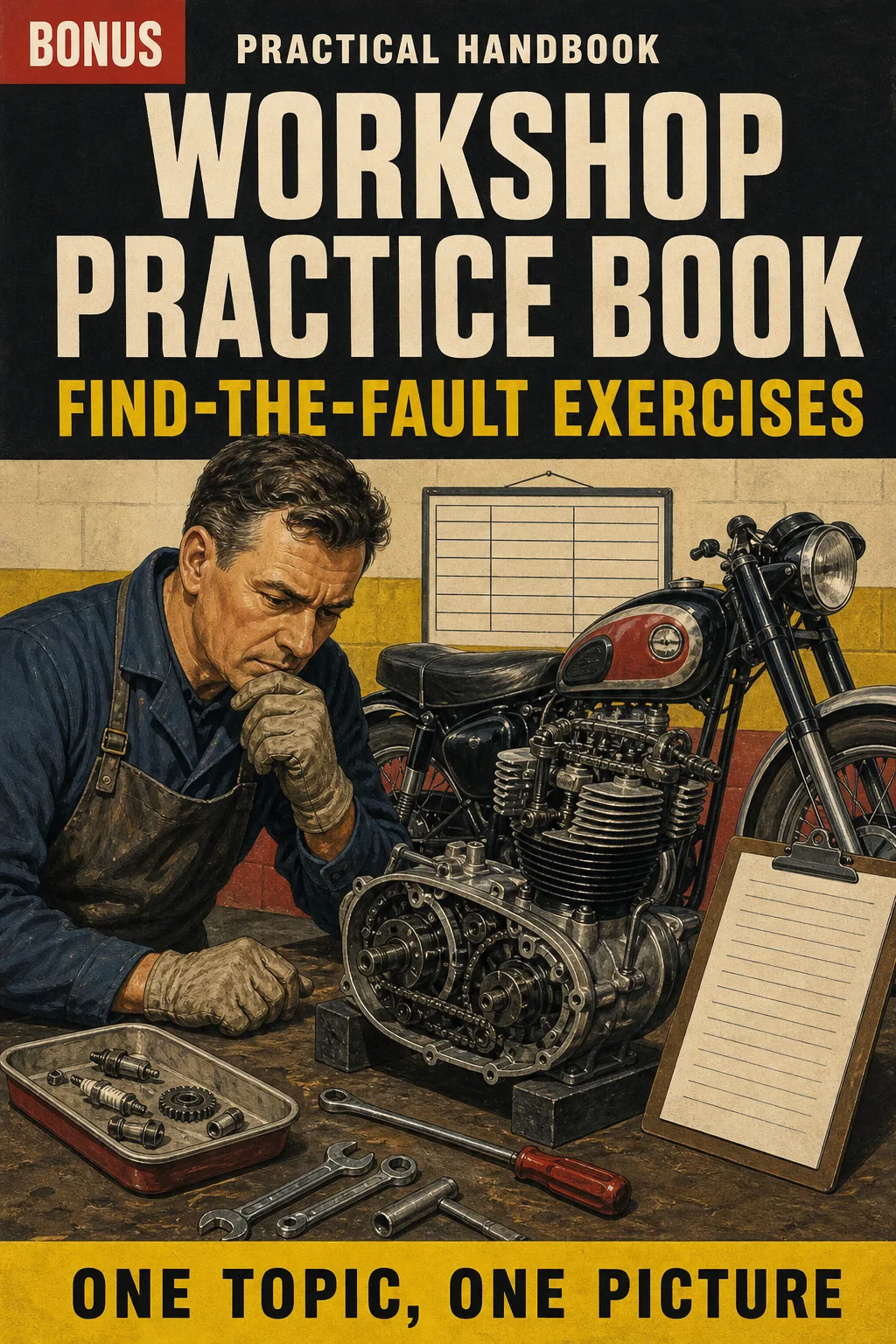
Drawn workshop scenarios (a plug, a feeler gauge reading, a sagging chain, a weeping gasket) where you spot what's wrong and check your answer, so the set-up steps stick before you pick up a spanner.

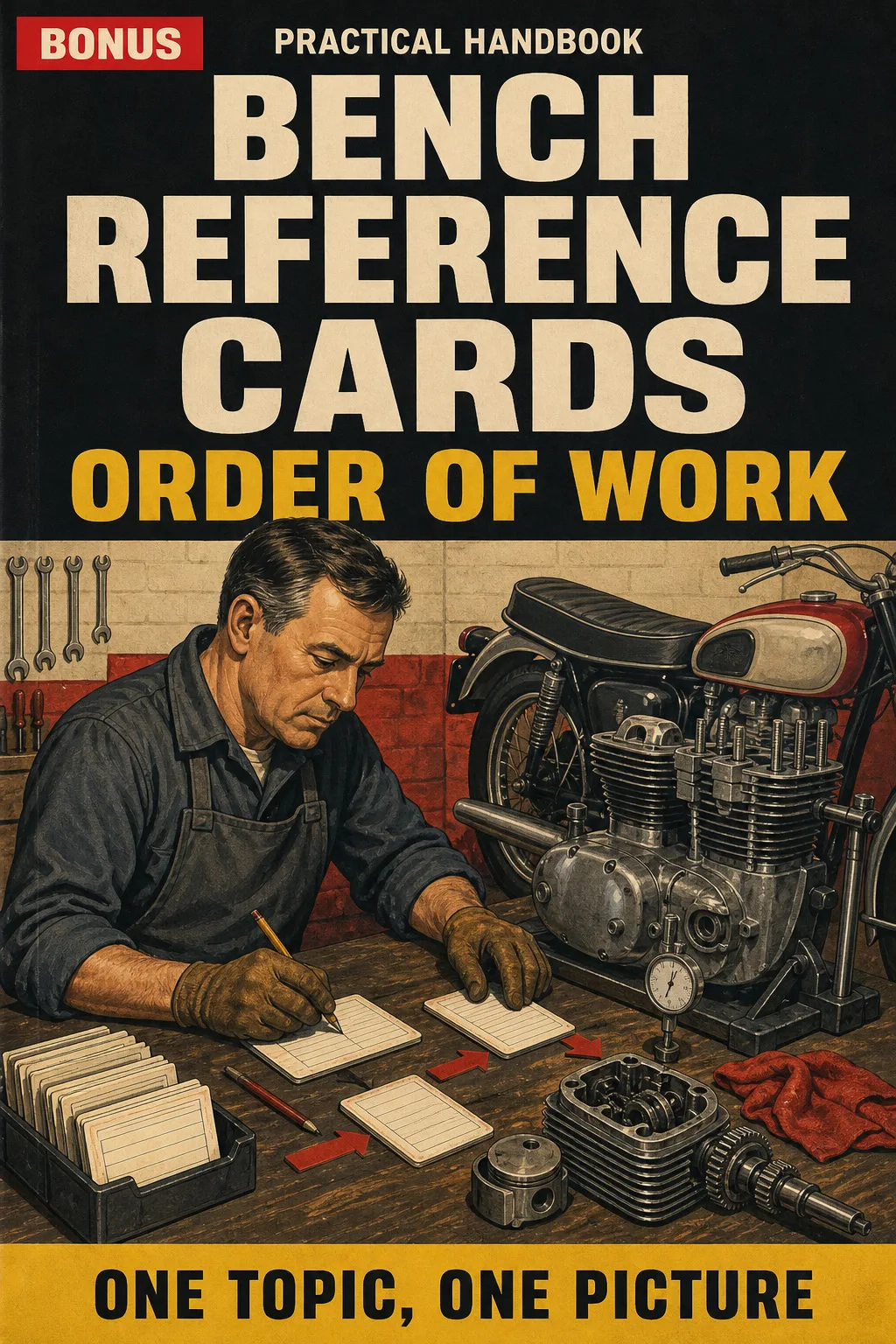
Bench Reference Cards: Order of Work
BONUS 2

Bench Reference Cards: Order of Work

Printable one-page cards for the bench with the order of work for each job and the most common mistakes before and after, so you can glance at them with oily hands instead of flicking through the book.

30-Day Guarantee

30-day guarantee: if a file doesn't open, if the content isn't what the product page describes, if you were charged twice or the email never arrived, write to us and we'll refund you in full. You pay once. No subscriptions.

Frequently Asked Questions

Is it for me if I've got a 1960s British twin or a 1970s Japanese bike?

Yes, if it's a four-stroke with slide carburettors and coil-and-points ignition, British or Japanese: the book doesn't name makes and draws each system as it works on both, with a page on British and Japanese threads. Part 1 explains what changes on a two-stroke, but the jobs are worked through on four-strokes. Magnetos and CV carburettors aren't covered step by step. Every figure comes from your maker's workshop manual.

Where does the content come from?

From standard workshop practice for classic engines. It works alongside your workshop manual, not instead of it: the book draws the job and the order to do it in, and your manual gives the figure (clearances, gaps, timing, float heights), which you write in the box on each page. Roadworthiness points follow the DVSA MOT inspection manual for motorcycles, useful even if your bike is MOT-exempt.

Is this official material?

No. It's an independent illustrated book, not affiliated with or endorsed by any manufacturer or by the DVSA.

Does it replace a mechanic or a proper course?

No. It's a bench book for owners who do their own maintenance. Crank, bores, valve seats and castings go to a machine shop, and if you're unsure about brakes or tyres, have them checked by a professional.

I've only ever changed the oil. Is it too advanced for me?

No. Each job starts from what you can see on the bike and goes step by step, in the order you do it. The find-the-fault exercises are written for this book, and the jobs for a machine shop are marked clearly.

When and how do I get it?

The book and the 2 free books come as PDFs by email, to the address you enter at checkout.

Do I have to pay every month?

No. It's a one-off payment.

Can I have it on paper?

Yes. It's a printable PDF: print it at home or at a print shop and keep the bench cards by the bike.

How does the refund work?

You have 30 days. We refund everything if the file won't open, if the book isn't what you see on this page, if you were charged twice or if the email doesn't arrive: just email us.

£19.99£57.99
Get the book · £19.99

This is a digital PDF book sent to your email: nothing is printed or shipped.