Study in Pictures🌐 English (United Kingdom)
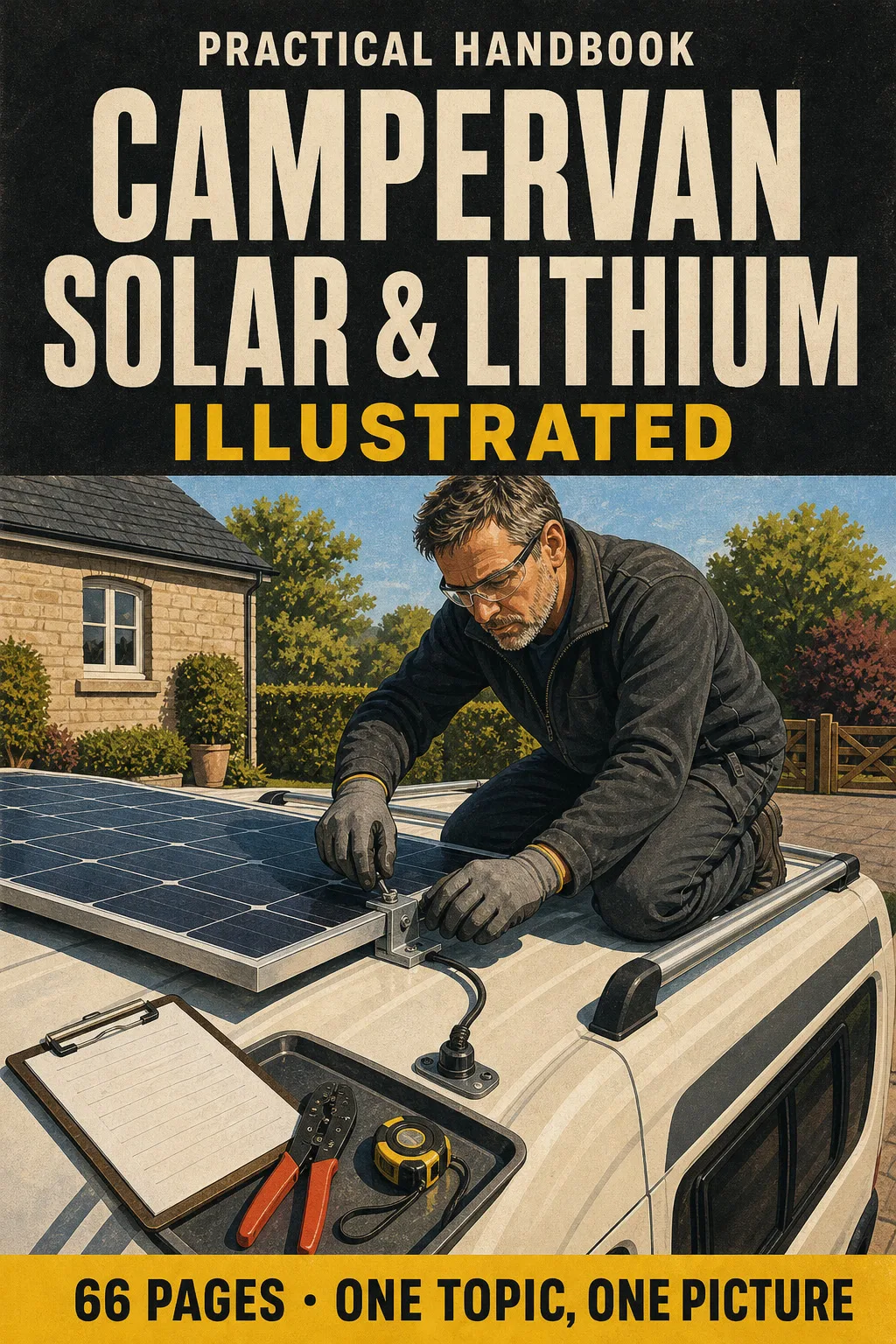
Campervan Solar & Lithium Illustrated

Digital book in PDF · read it on your phone or print it

Campervan Solar & Lithium Illustrated

Seven steps, always in this order: daily power use, panel watts, the lithium battery, charging (MPPT and DC-DC), fuses, cable size in mm² and fitting, down to a roof entry that doesn't leak. Every topic has its own page: the drawing first, then what you need to remember.

  • 66 illustrated pages
  • English
  • 30-day guarantee
£19.99£57.99
Get the book · £19.99

Price shown for: United Kingdom. In other countries, the checkout shows the price that applies there.

About this book

What it is

Seven steps, always in this order: daily power use, panel watts, the lithium battery, charging (MPPT and DC-DC), fuses, cable size in mm² and fitting, down to a roof entry that doesn't leak. Every topic has its own page: the drawing first, then what you need to remember.

Who This Book Is For
  • You're planning the build
  • Fitting day is coming
  • Your system's already in
What it covers
  1. The whole system on one page
  2. Step 1: work out your power use
  3. Step 2: solar panels
  4. Step 3: the lithium battery
  5. Step 4: charging
  6. Step 5: fuses and protection
  7. Step 6: cable
  8. Step 7: fitting it all
  9. Checks, records and common mistakes
Language
English (United Kingdom)
Pages
66
Format
Digital book in PDF · read it on your phone or print it
Price
£19.99 (United Kingdom)
Delivery
This is a digital PDF book sent to your email: nothing is printed or shipped.
30-Day Guarantee
30-day guarantee: if a file doesn't open, if the content isn't what the product page describes, if you were charged twice or the email never arrived, write to us and we'll refund you in full.

Look Inside the Book

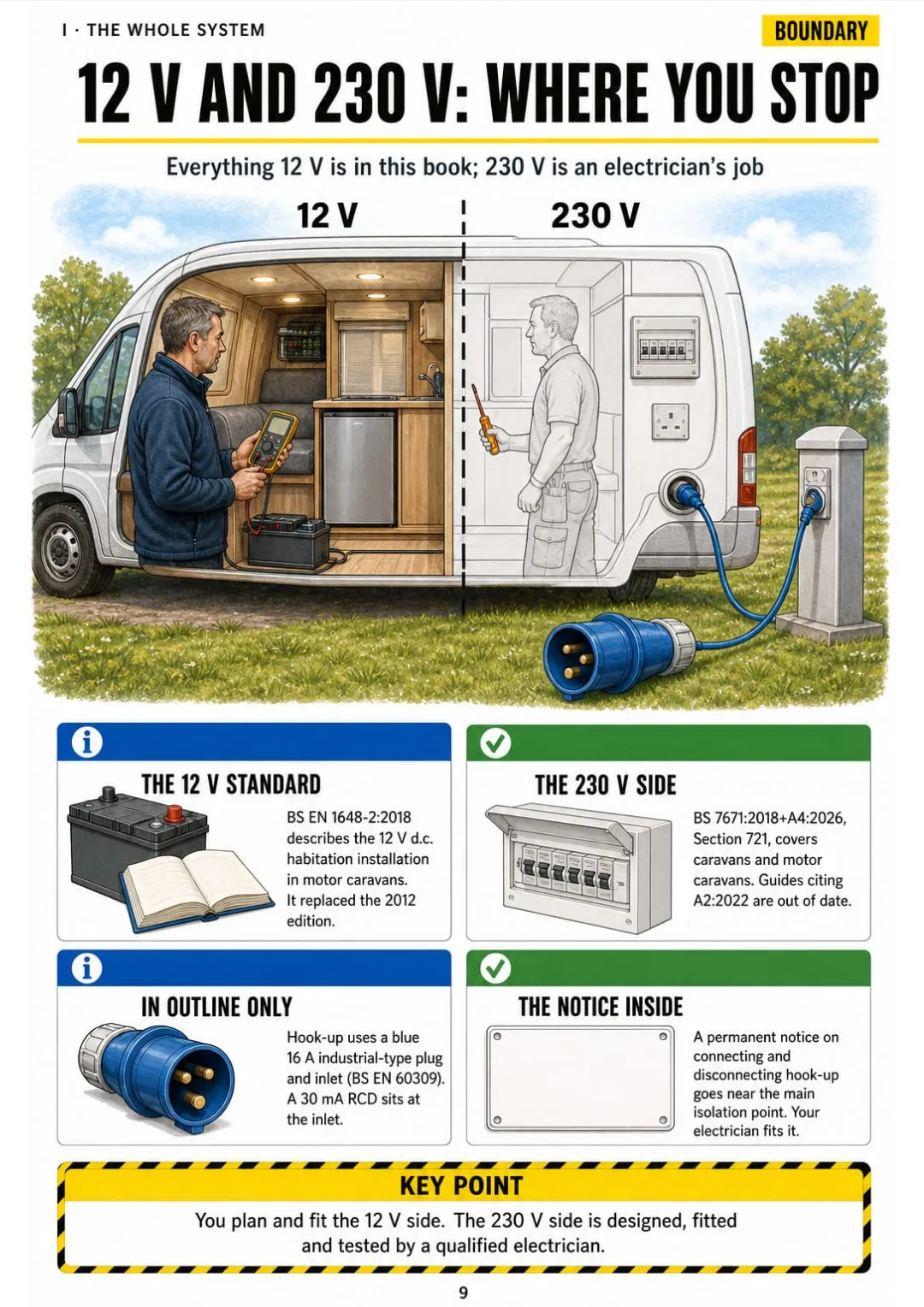
12 V side: BS EN 1648-2:2018 · 230 V side: BS 7671 Section 721, for an electrician
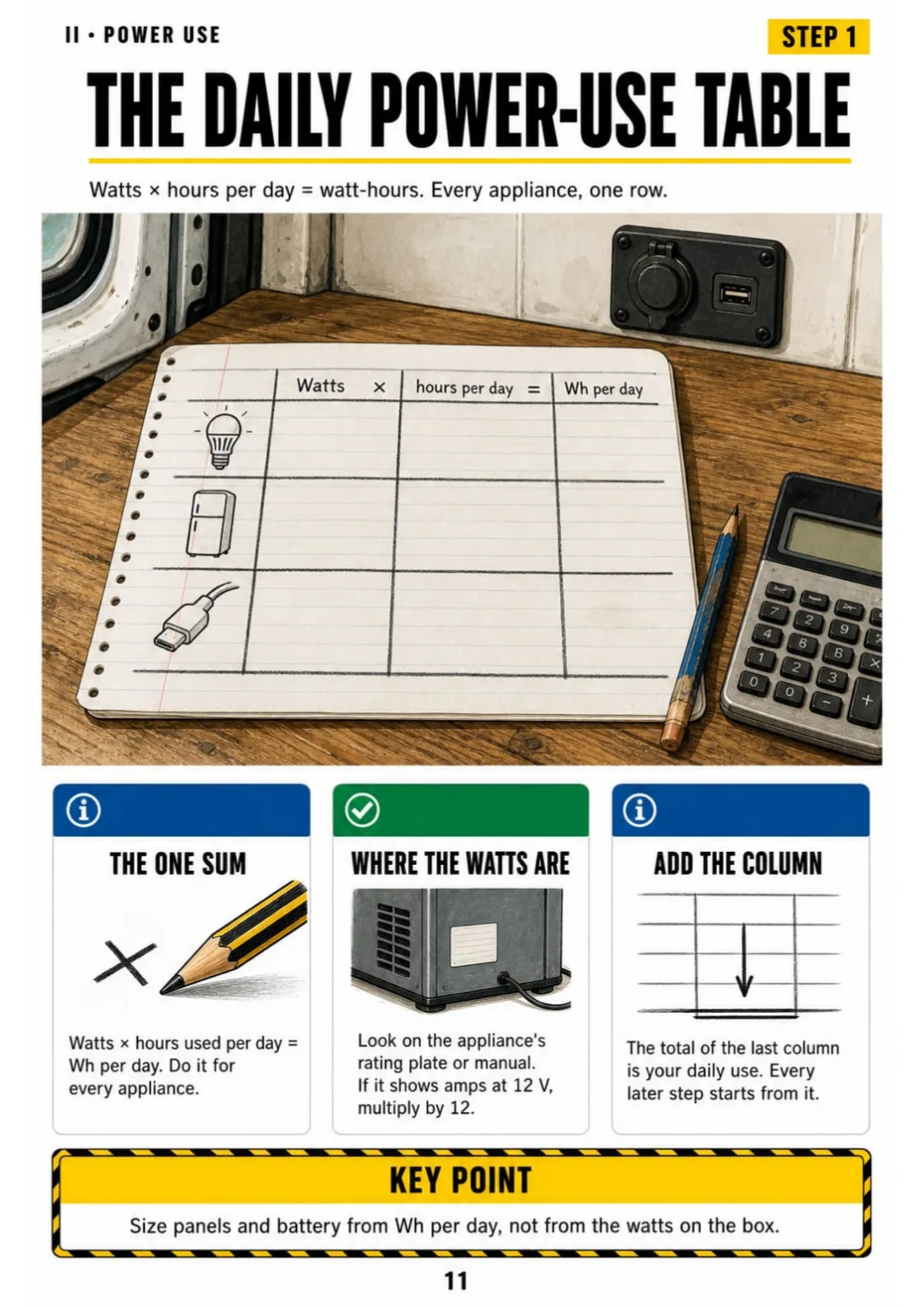
Watts × hours = Wh per day: the table every 12 V system starts from
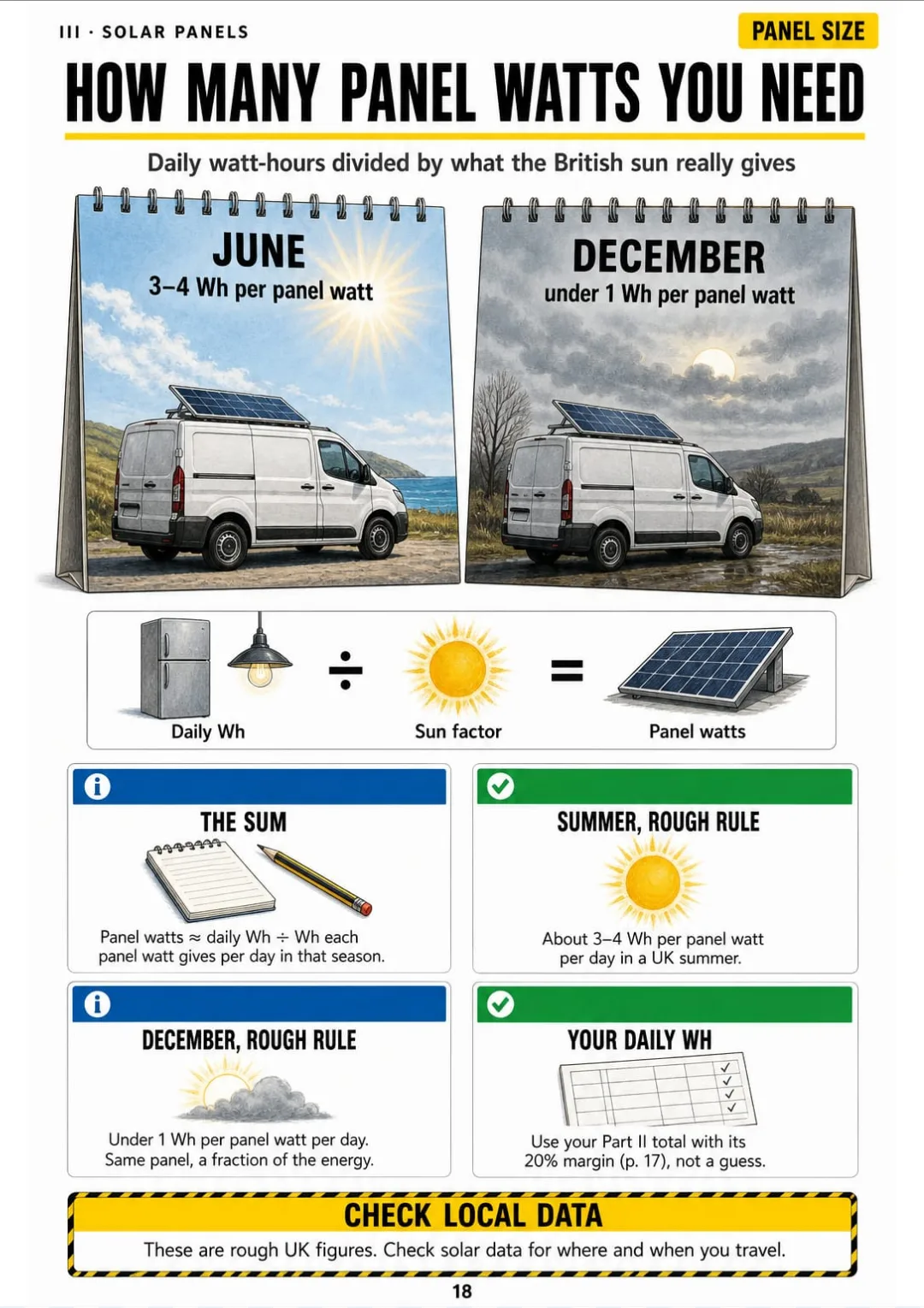
Rough UK rule: 3–4 Wh per panel watt a day in summer, under 1 in December.
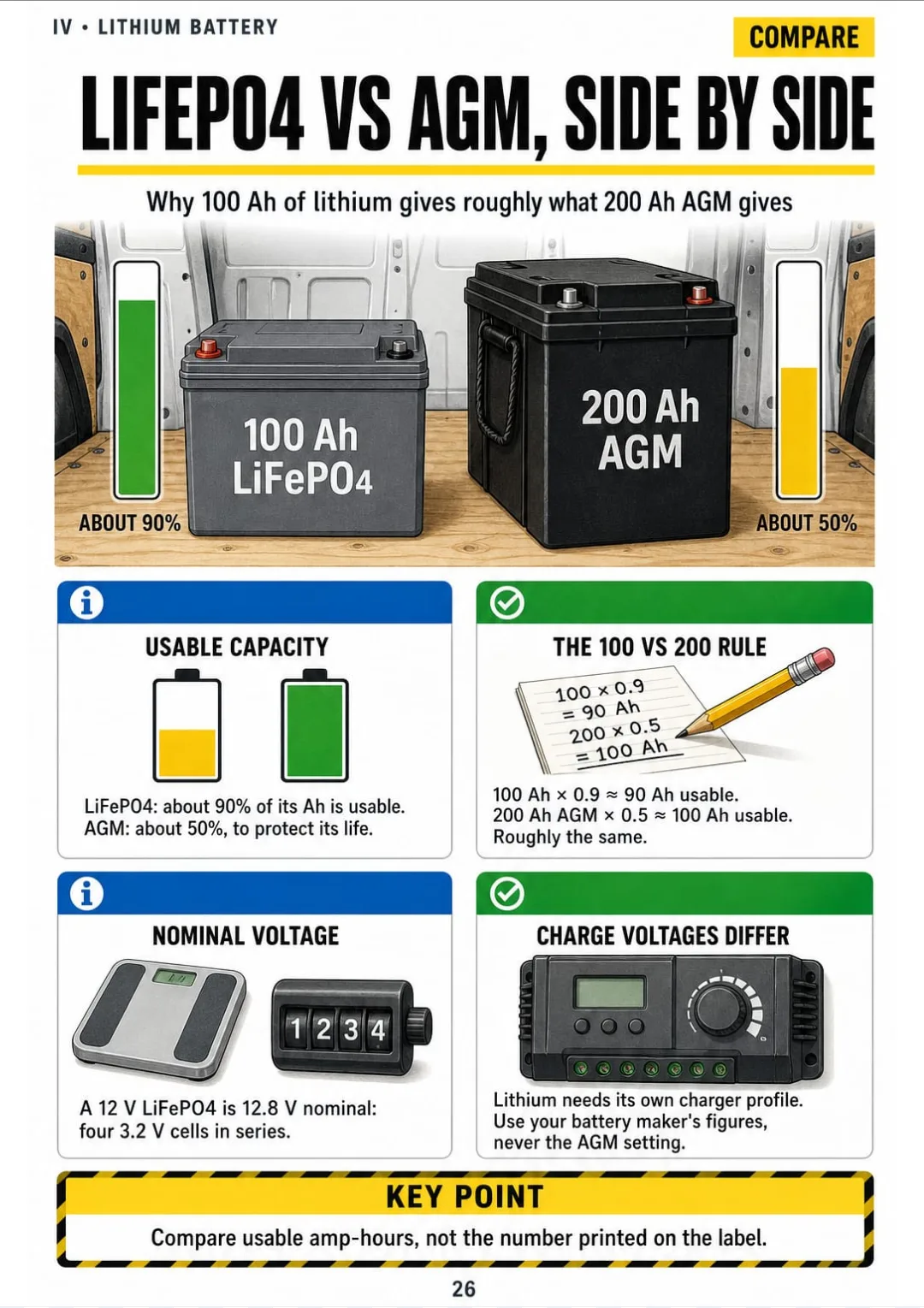
LiFePO4 about 90% usable vs AGM about 50%: 100 Ah ≈ 200 Ah AGM
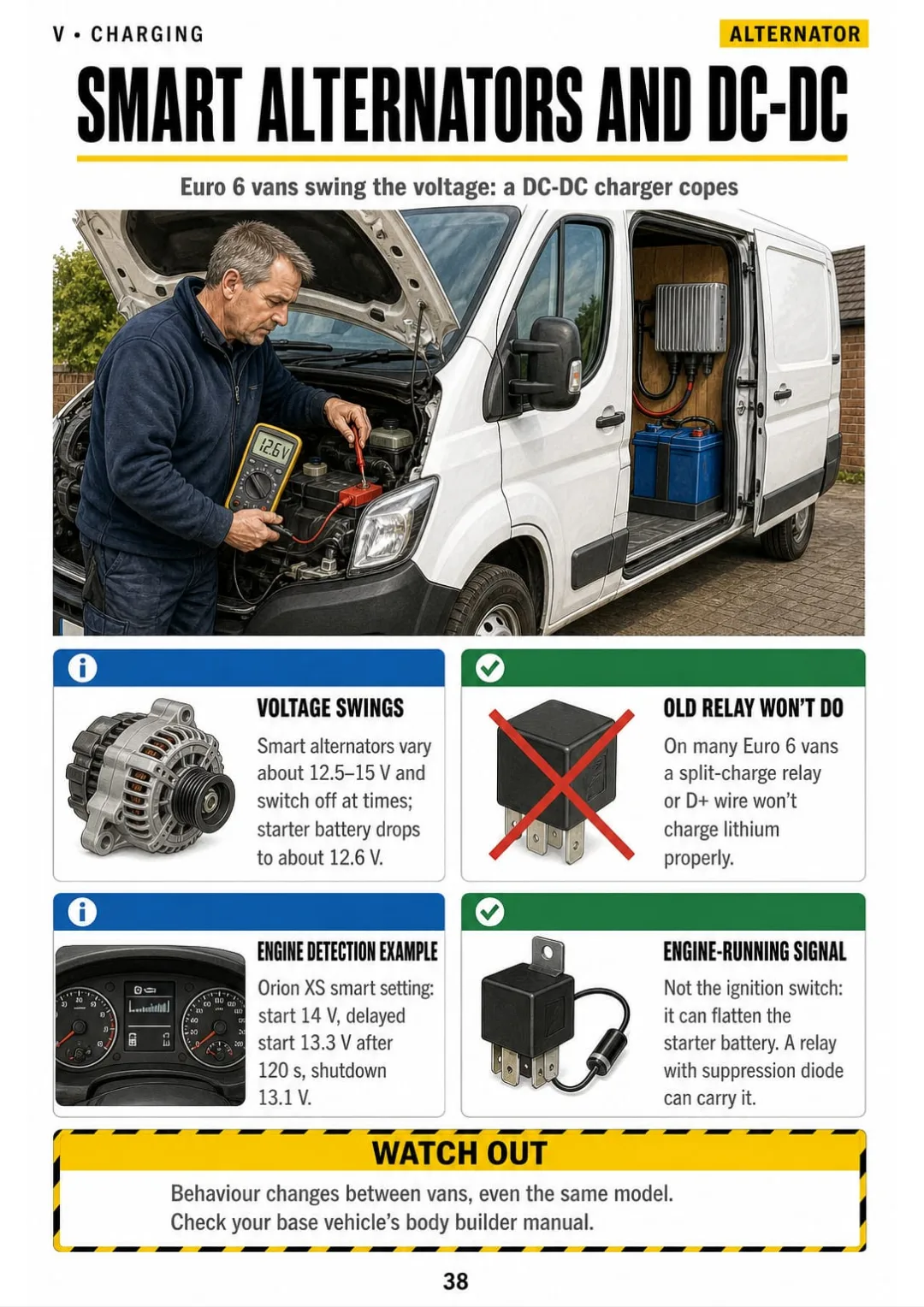
Smart alternators swing 12.5–15 V: the DC-DC charger detects the engine and charges lithium.
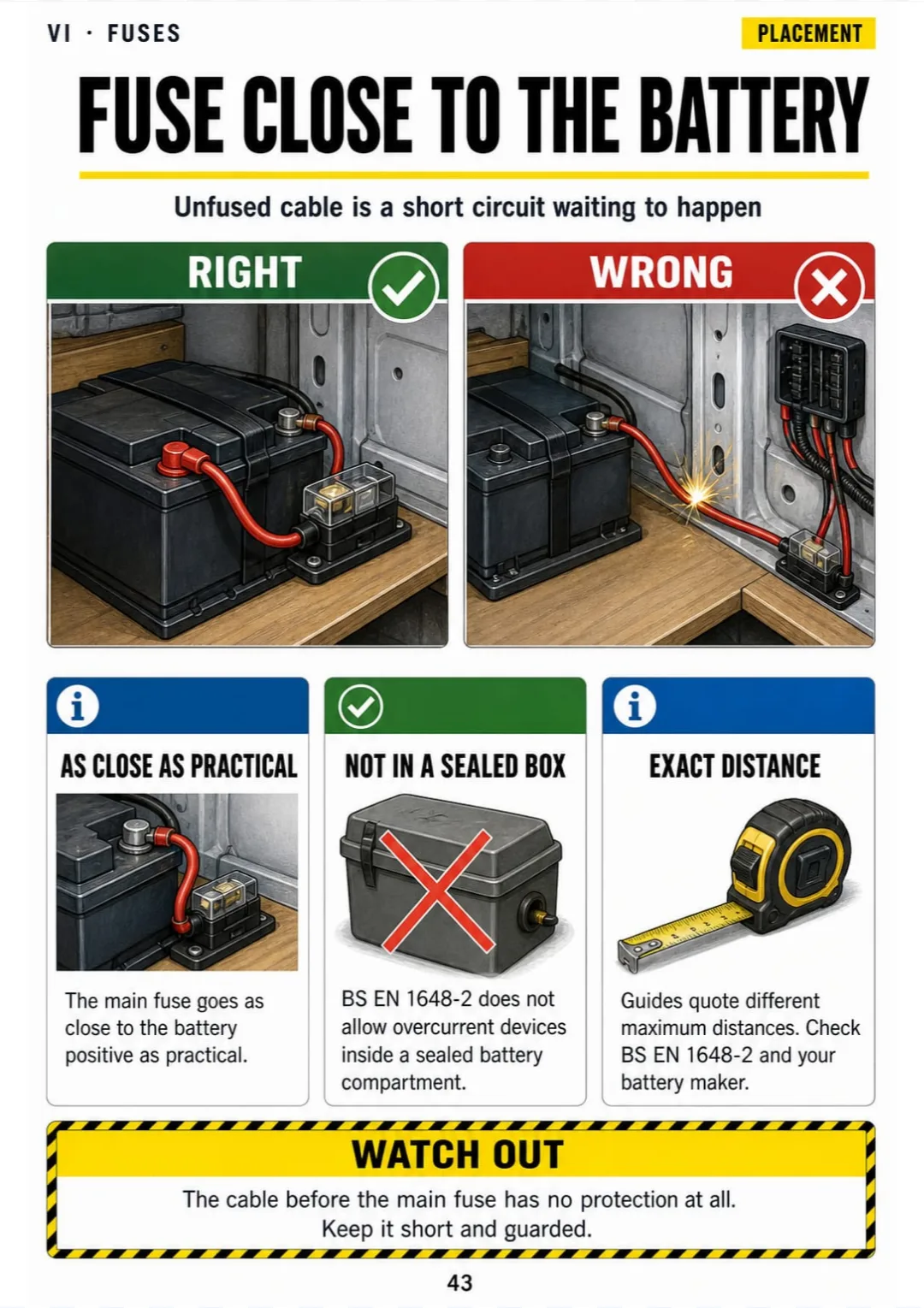
Main fuse beside the positive terminal, never inside a sealed battery box.
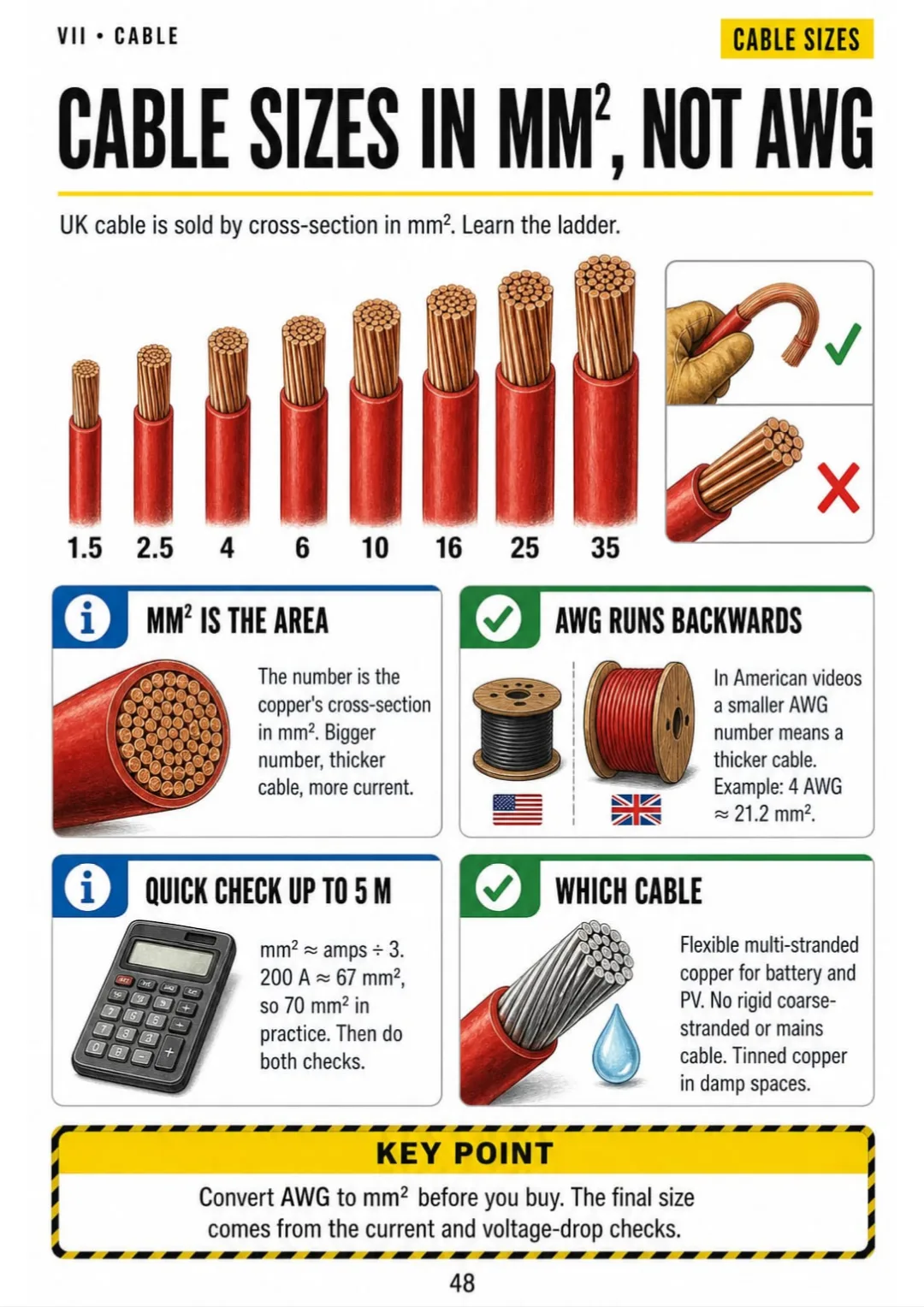
1.5 to 35 mm² in one row, plus the quick check: mm² ≈ amps ÷ 3 (up to 5 m)
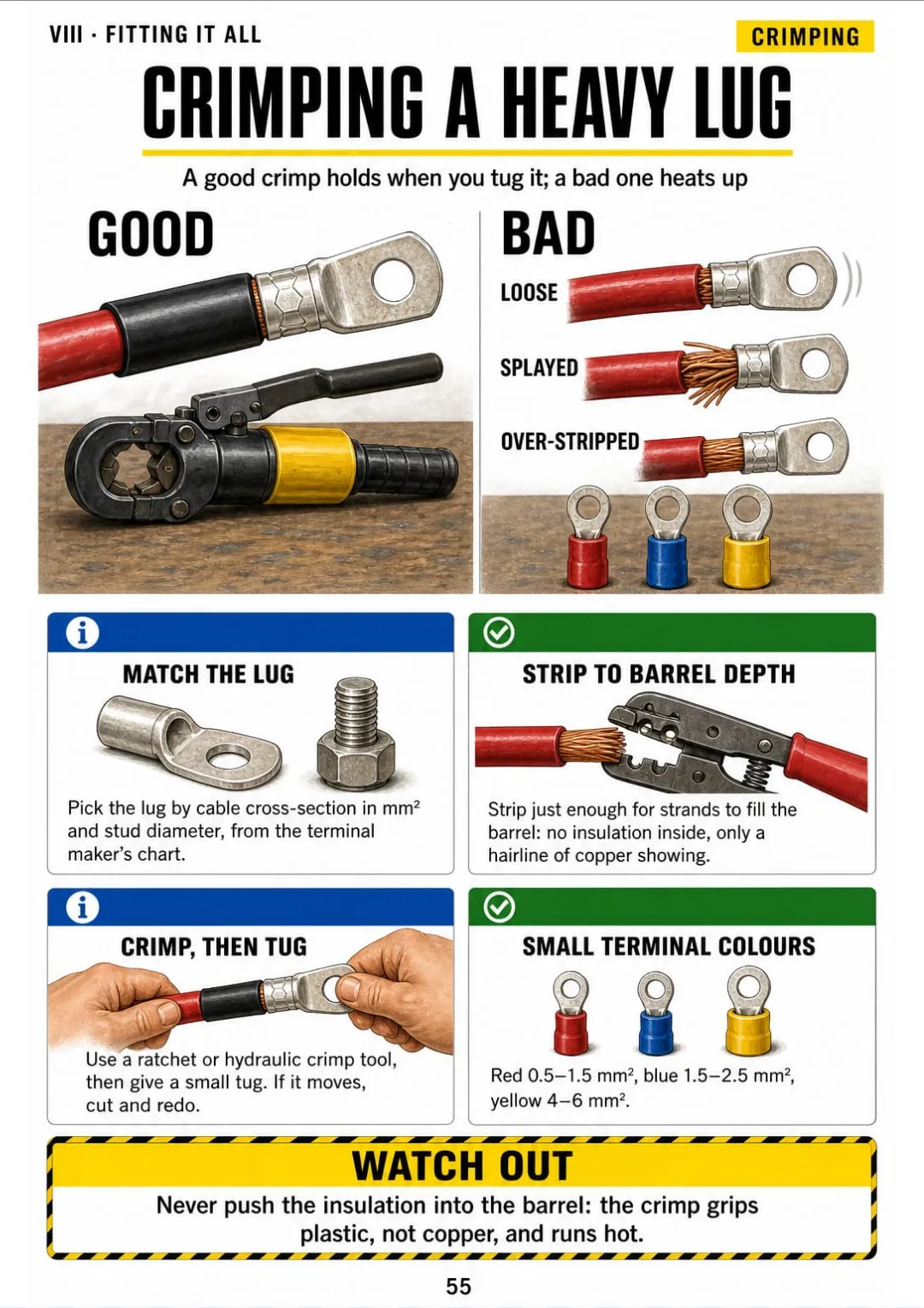
Good crimp vs loose, splayed and over-stripped, plus red, blue and yellow terminal sizes

Take a Look at the 9 Parts and 62 Topics

The whole system on one page

pp. 5-10
  1. Your van's 12 V system as a simple map
  2. The order that never changes
  3. Volts, amps, watts and amp-hours in one picture
  4. Leisure side vs vehicle side
  5. 12 V and 230 V: where your job stops
  6. The tools and parts list before you start

Step 1: work out your power use

pp. 11-17
  1. The daily power-use table
  2. The compressor fridge: your biggest load
  3. Diesel heater, water pump and lights
  4. Phones, laptops and USB
  5. Inverter loads: why a kettle changes everything
  6. Summer days vs winter days
  7. Worked example: a weekend van's daily total

Step 2: solar panels

pp. 18-25
  1. How many watts of panel you need
  2. Worked example: sizing the roof array
  3. Rigid, semi-flexible or portable
  4. Measuring your roof before you buy
  5. Series or parallel
  6. The cold-morning voltage check
  7. Reading a panel's label
  8. Panel cable and connectors

Step 3: the lithium battery

pp. 26-32
  1. LiFePO4 vs AGM in one drawing
  2. Sizing your battery in Ah
  3. What the BMS does and doesn't do
  4. Cold charging: the 0 °C rule
  5. Where the battery goes and how it's held
  6. Weight and your payload
  7. Two batteries in parallel

Step 4: charging

pp. 33-40
  1. Three ways the battery gets charged
  2. MPPT or PWM
  3. Sizing the MPPT controller
  4. MPPT settings for lithium
  5. Connect in this order
  6. Smart alternators and the DC-DC charger
  7. Sizing the DC-DC charger and its cables
  8. Hook-up and the mains charger, in outline

Step 5: fuses and protection

pp. 41-47
  1. A fuse protects the cable, not the gadget
  2. Every place a fuse goes
  3. Fuse close to the battery
  4. Fuse types and lithium's short-circuit current
  5. The main isolator switch
  6. The 12 V fuse box and circuit list
  7. The negative side: busbar and shunt

Step 6: cable

pp. 48-54
  1. Cable sizes in mm², not AWG
  2. Two checks: current and voltage drop
  3. The voltage-drop sum, worked
  4. How much drop to allow
  5. Inverter cables: the thick ones
  6. Colours, labels and routing
  7. Chassis negative or a dedicated return

Step 7: fitting it all

pp. 55-61
  1. Crimping a heavy lug, before and after
  2. Torque on terminals
  3. Mounting rigid panels on the roof
  4. A roof cable entry that doesn't leak
  5. Laying out the electrics locker
  6. Fitting the battery monitor
  7. First power-up, in order

Checks, records and common mistakes

pp. 62-66
  1. Your wiring record for the insurer
  2. Seasonal checks
  3. Fault-finding by symptom
  4. The most frequent mistakes, drawn
  5. Your system on one page: final checklist

Who This Book Is For

You're planning the build

Work out your daily Wh, panel watts and battery Ah on paper first, so you buy the right parts once.

Fitting day is coming

Every fuse position, cable size and connection order is drawn, so you fit it all in the same order and seal the roof properly.

Your system's already in

Check your MPPT settings, find faults by symptom and keep a tidy wiring record to show your insurer.

Plus: 2 Free Books

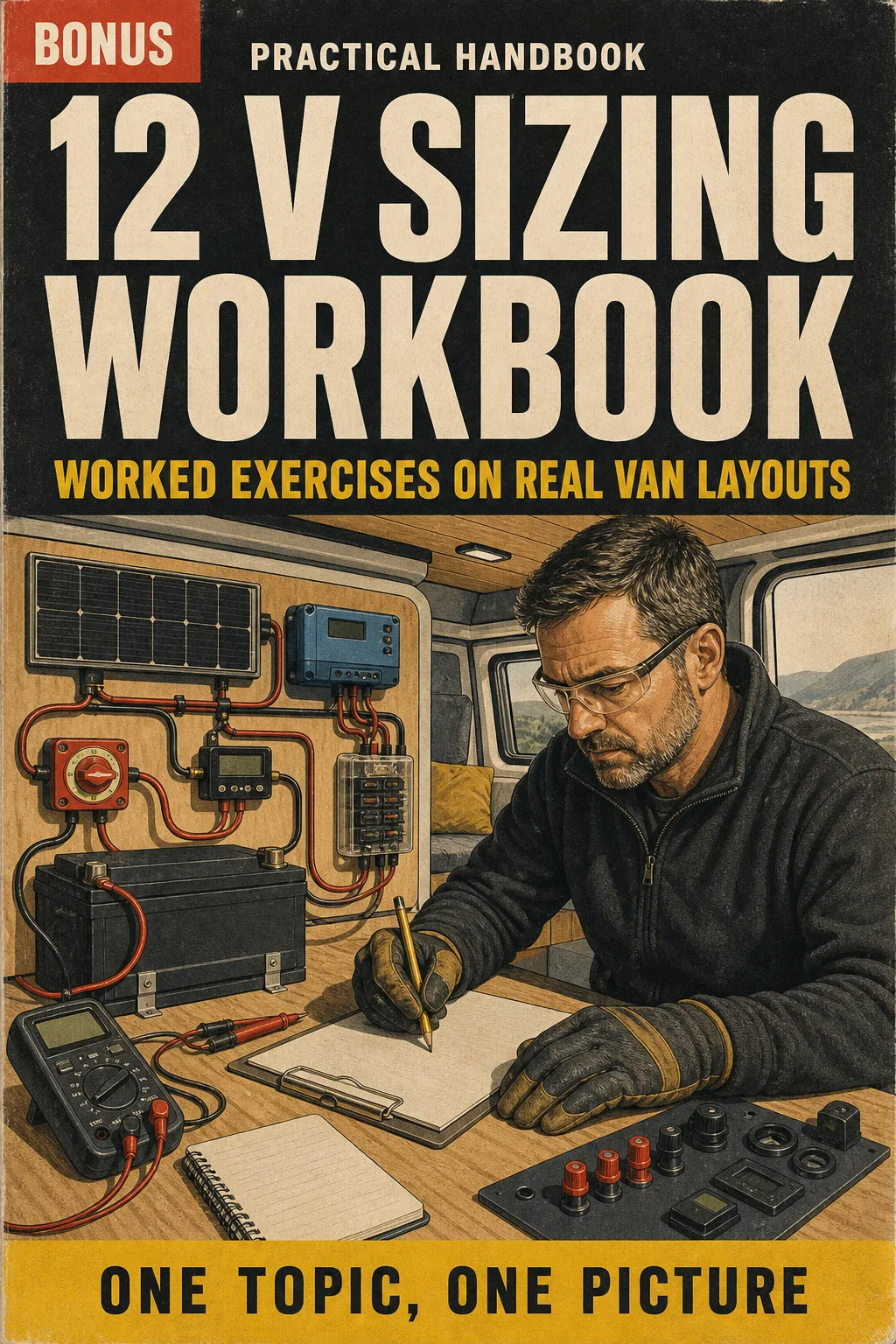
12 V Sizing Workbook: Worked Exercises on Real Van Layouts
BONUS 1

12 V Sizing Workbook: Worked Exercises on Real Van Layouts

Practise working out daily power use, solar watts, fuse ratings and cable sizes on real van layouts before you buy a single part, with every answer worked through step by step.
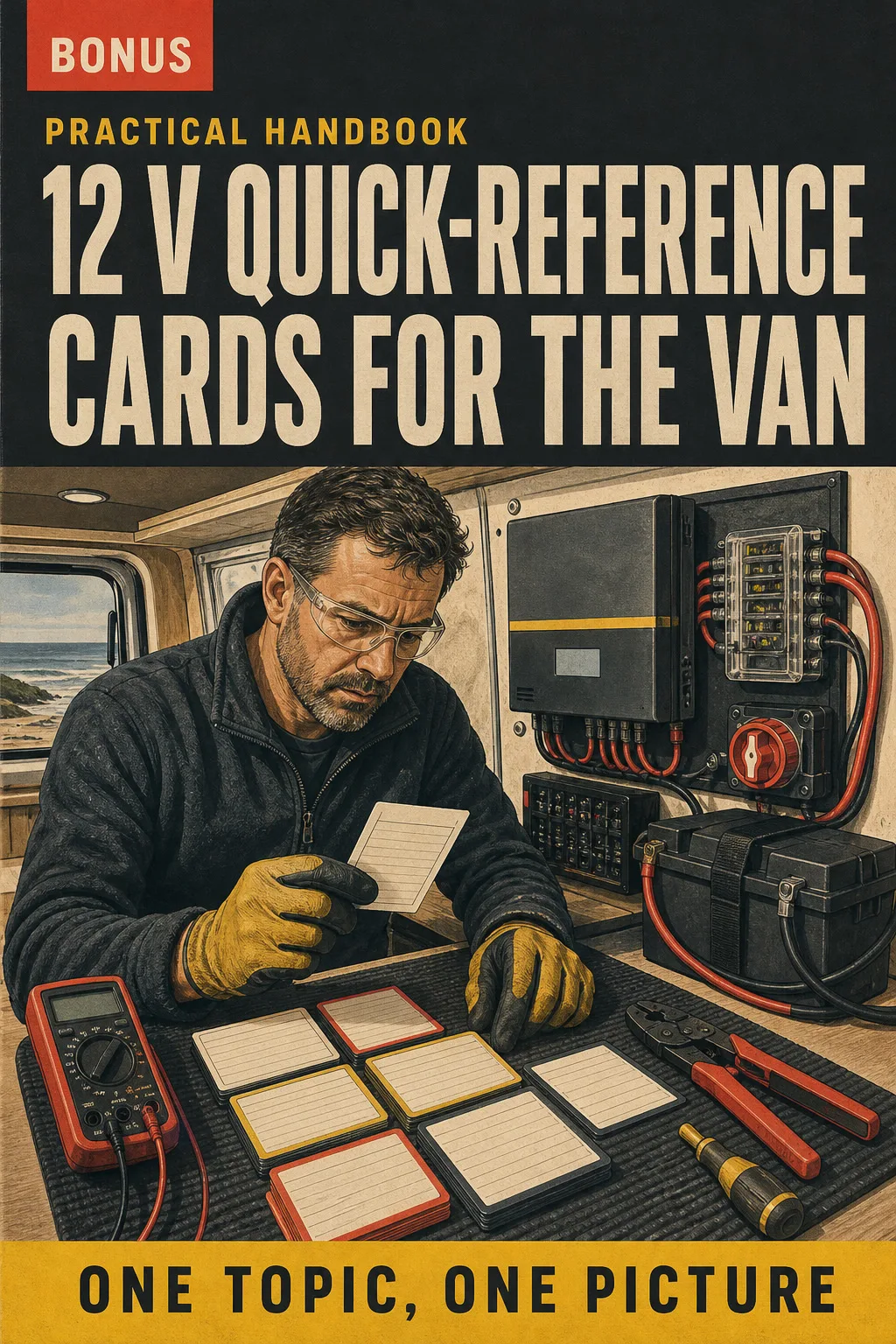
12 V Quick-Reference Cards for the Van
BONUS 2

12 V Quick-Reference Cards for the Van

The fuse positions, cable sizing steps, charger checks and seasonal checks on a few printable cards, so you've got what you need to hand in the van, at a glance.

30-Day Guarantee

30-day guarantee: if a file doesn't open, if the content isn't what the product page describes, if you were charged twice or the email never arrived, write to us and we'll refund you in full. You pay once. No subscriptions.

Frequently Asked Questions

Is it for me if I've never wired a 12 V system with lithium?

Yes. It starts with volts, amps and watts in one picture and assumes you're handy, not an electrician. It works for self-builds, converted vans and factory motorhomes, and isn't tied to one model.

Where does the content come from?

From BS EN 1648-2 for 12 V installations in motor caravans, BS 7671 Section 721 for the hook-up side (in outline), DVLA/DVSA guidance on weights, and the battery, charger, controller and panel manufacturers' instructions. Every threshold and setting is marked so you can check it against the current edition and your manufacturer's data.

Is it official material?

No. It's an independent illustrated guide. It isn't linked to or endorsed by any standards body, government agency or manufacturer.

Does it replace an electrician or a course?

No. It helps you plan and understand your 12 V leisure system. The 230 V hook-up side is shown in outline only and is a job for a qualified electrician. Insurers differ: tell yours about the changes before you travel and ask if they want the work checked. The book includes a wiring record page, so you can show what you fitted, where each fuse is and which cable sizes you used.

Are the workbook exercises taken from a course or test?

No. They're written for this book and based on example van layouts, with every answer worked through step by step.
When and how does it arrive?

As a PDF by email, sent to the address you enter at checkout. The two free books come the same way.

Do I have to pay every month?

No. It's a one-off payment. There's no subscription.

Can I have it on paper?

Yes. The PDF is ready to print at home or at a print shop, so you can keep it in the van.

How does the refund work?

You have 30 days. We refund everything if the file won't open, if the book isn't what you see on this page, if you were charged twice or if the email doesn't arrive: just email us.

£19.99£57.99
Get the book · £19.99

This is a digital PDF book sent to your email: nothing is printed or shipped.