Study in Pictures🌐 English (United Kingdom)
Bookkeeping Workbook Illustrated

Digital book in PDF · read it on your phone or print it

Bookkeeping Workbook Illustrated

Double entry, sales and purchases, the VAT return, the bank reconciliation, payroll, the trial balance, accruals and depreciation. Every topic has its own page: a drawing, a worked example line by line and an exercise with the full solution that you can print and do by hand.

  • 65 illustrated pages
  • English
  • 30-day guarantee
£19.99£57.99
Get the book · £19.99

Price shown for: United Kingdom. In other countries, the checkout shows the price that applies there.

About this book

What it is

Double entry, sales and purchases, the VAT return, the bank reconciliation, payroll, the trial balance, accruals and depreciation. Every topic has its own page: a drawing, a worked example line by line and an exercise with the full solution that you can print and do by hand.

Who This Book Is For
  • You're studying bookkeeping
  • You do your own books
  • You're starting out as a bookkeeper
What it covers
  1. Double entry from zero
  2. Sales and purchases
  3. VAT, the UK way
  4. Bank, cash and control
  5. Payroll
  6. The trial balance and corrections
  7. Year-end accounts
  8. Review and checklists
Language
English (United Kingdom)
Pages
65
Format
Digital book in PDF · read it on your phone or print it
Price
£19.99 (United Kingdom)
Delivery
This is a digital PDF book sent to your email: nothing is printed or shipped.
30-Day Guarantee
30-day guarantee: if a file doesn't open, if the content isn't what the product page describes, if you were charged twice or the email never arrived, write to us and we'll refund you in full.

Look Inside the Book

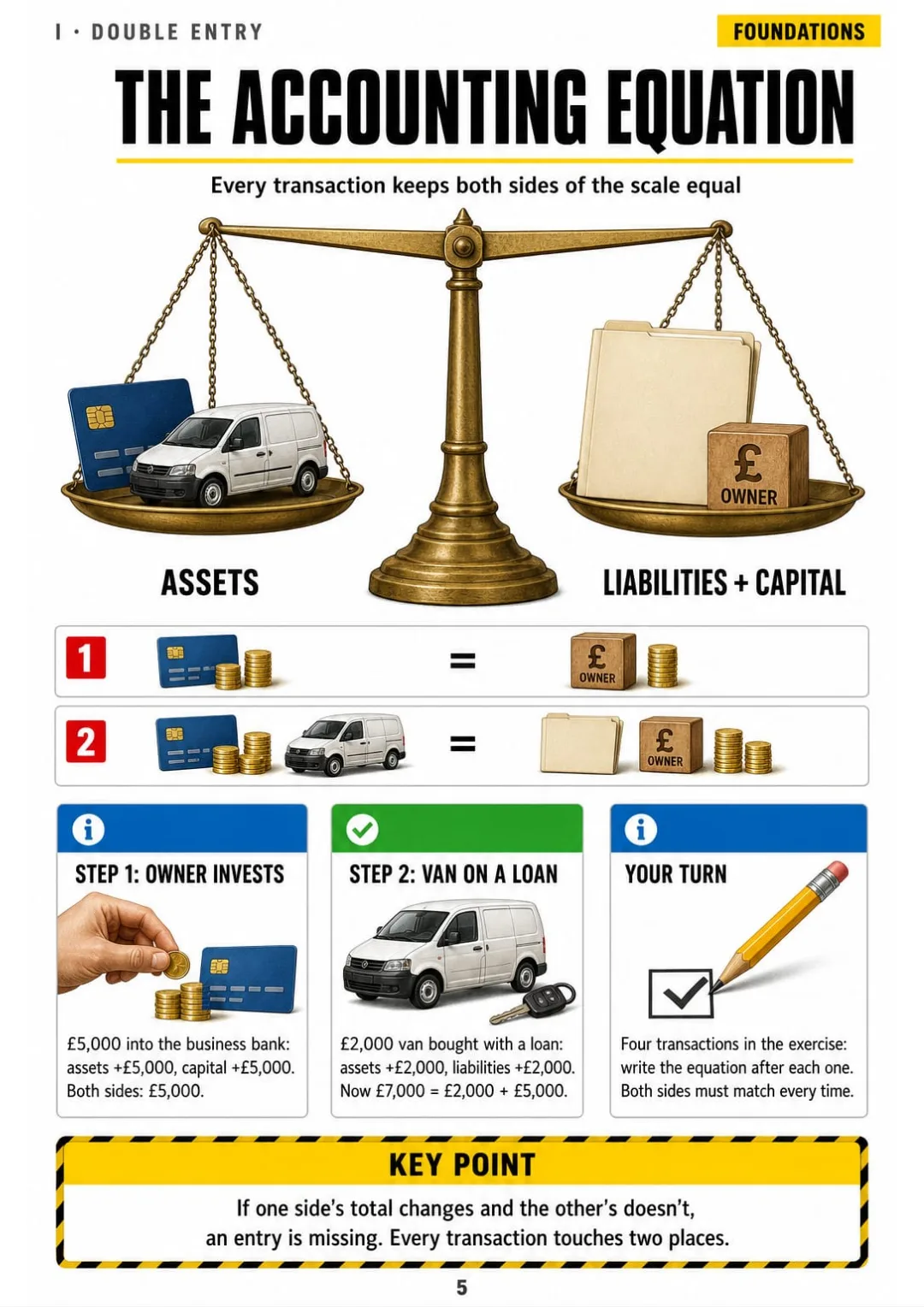
£5,000 in, £2,000 van on a loan: £7,000 = £2,000 + £5,000
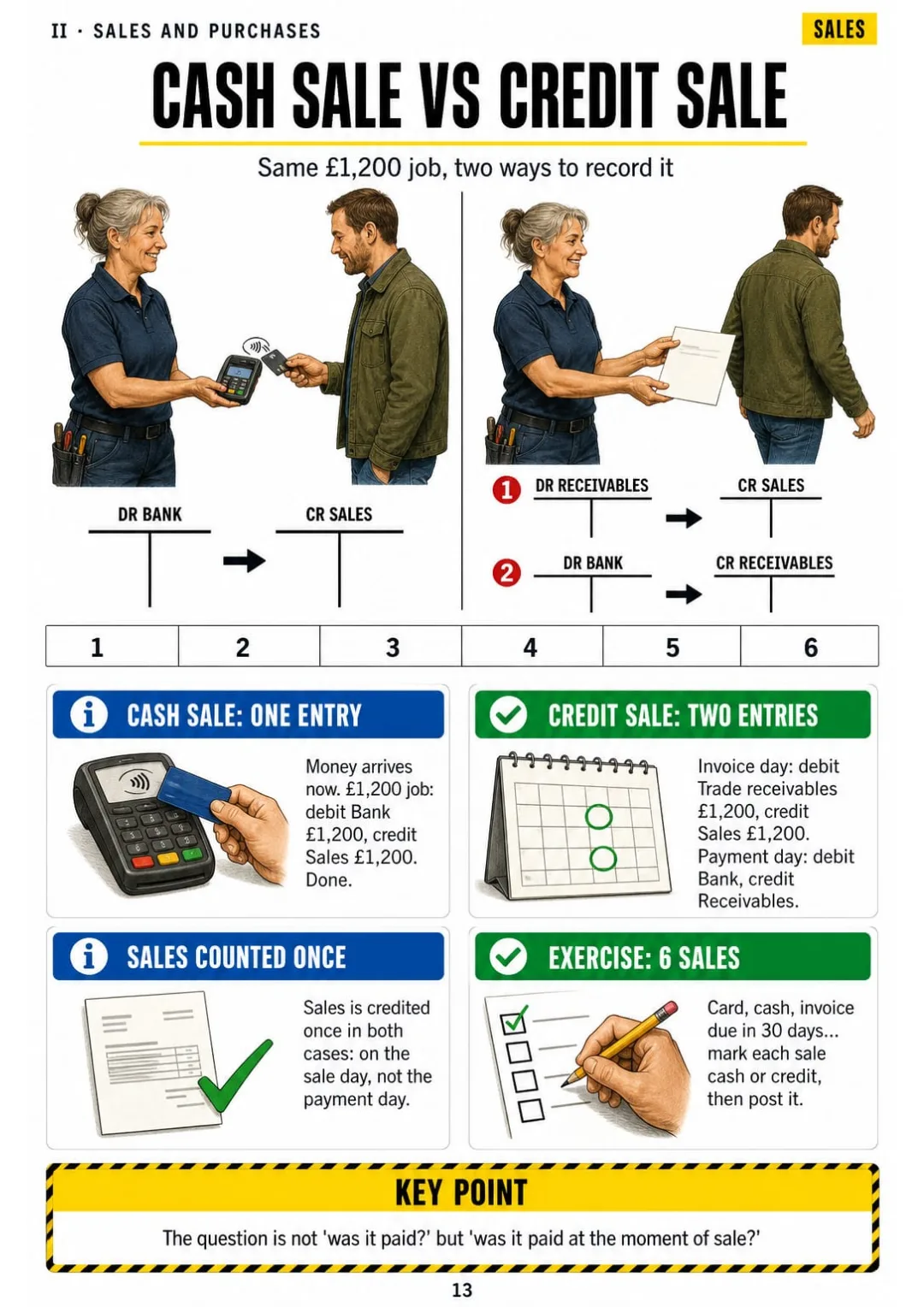
Cash sale: Dr Bank, Cr Sales. Credit sale: Dr Receivables, Cr Sales, then Dr Bank, Cr Receivables.
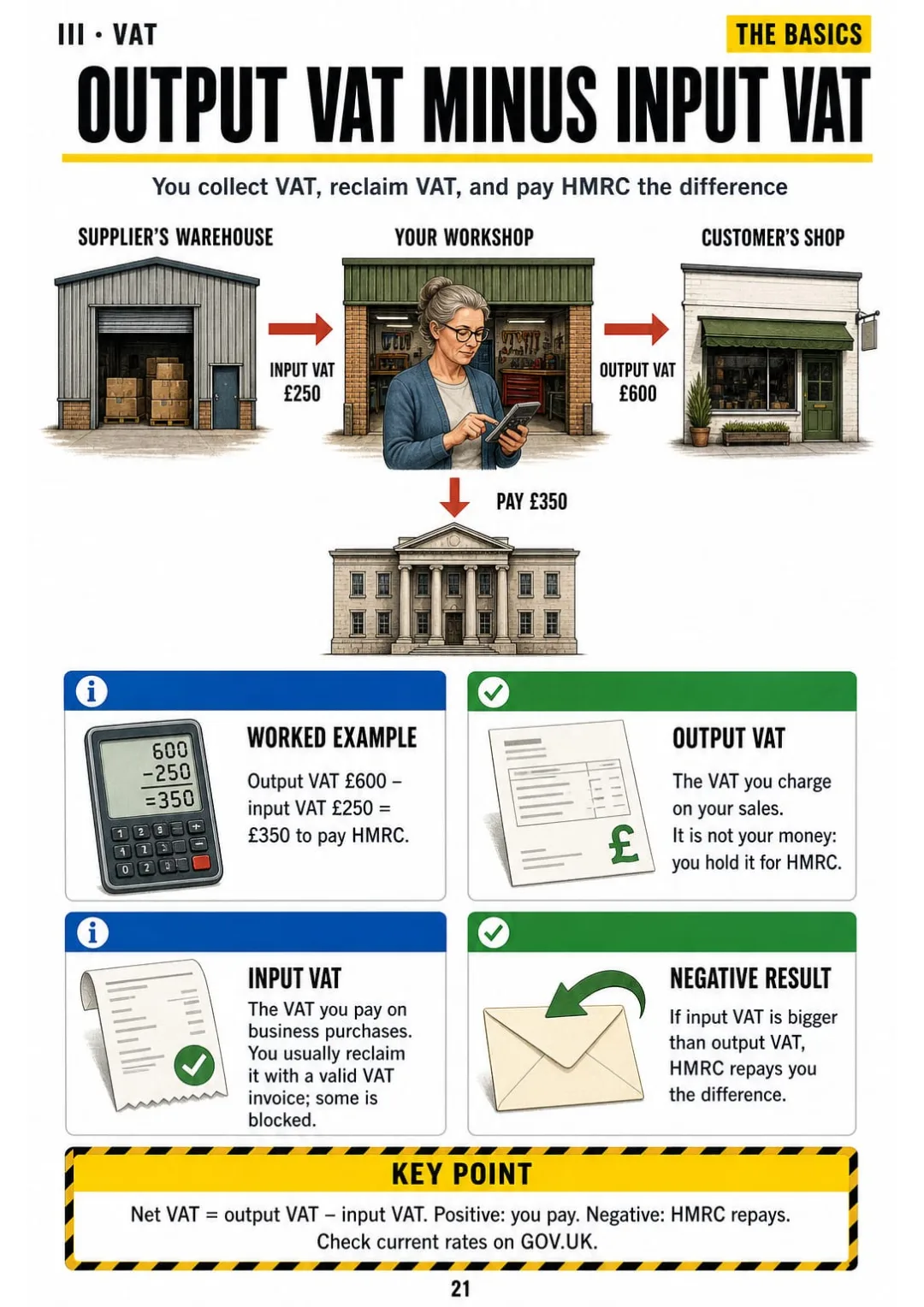
£600 output − £250 input = £350 to HMRC, drawn as one chain
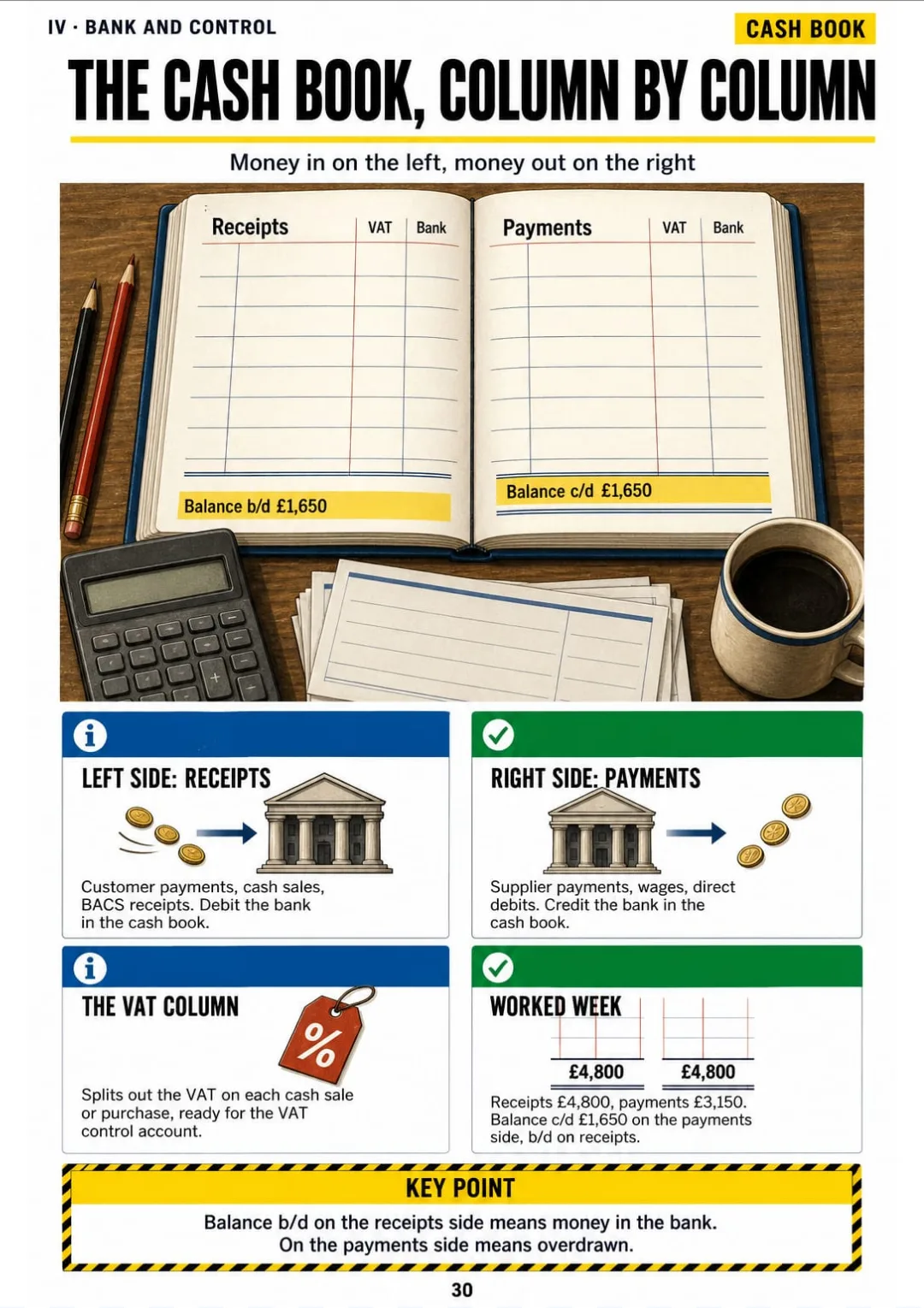
Receipts left, payments right: a week balanced off at £1,650 b/d.
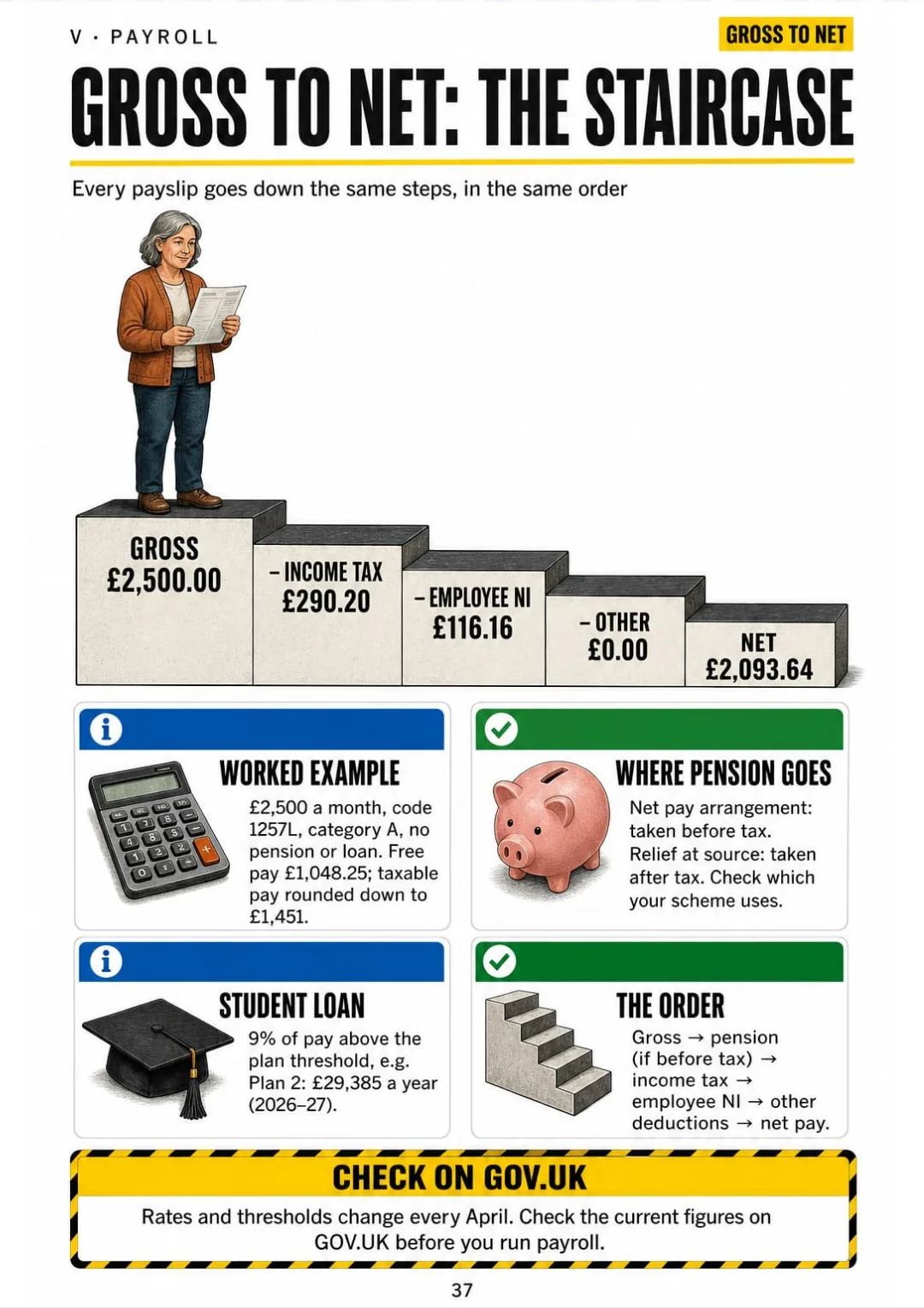
£2,500 gross − £290.20 tax − £116.16 NI = £2,093.64 net, drawn as a staircase
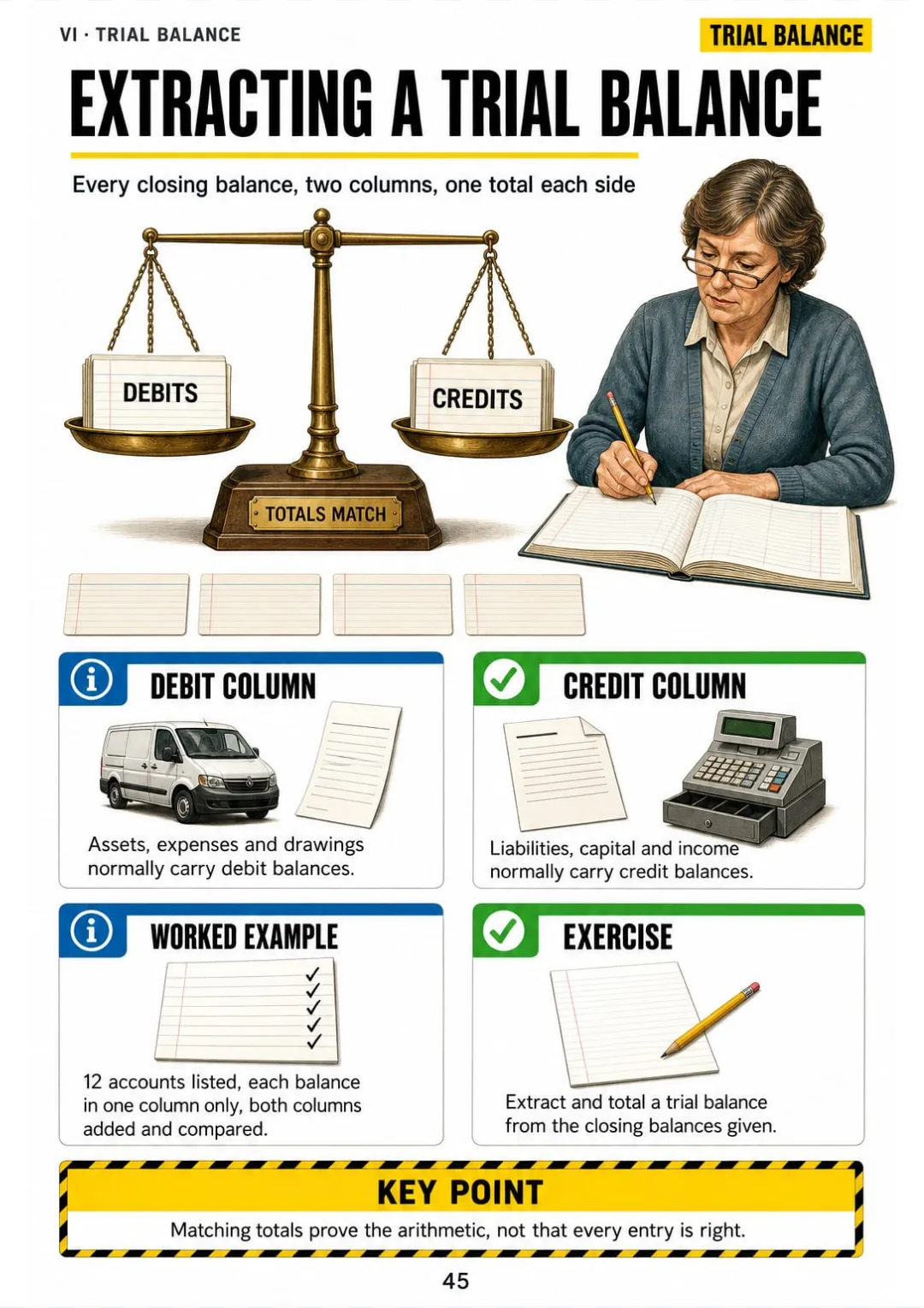
Debits on the left, credits on the right: drawn as a level scale, with a 12-account worked example.
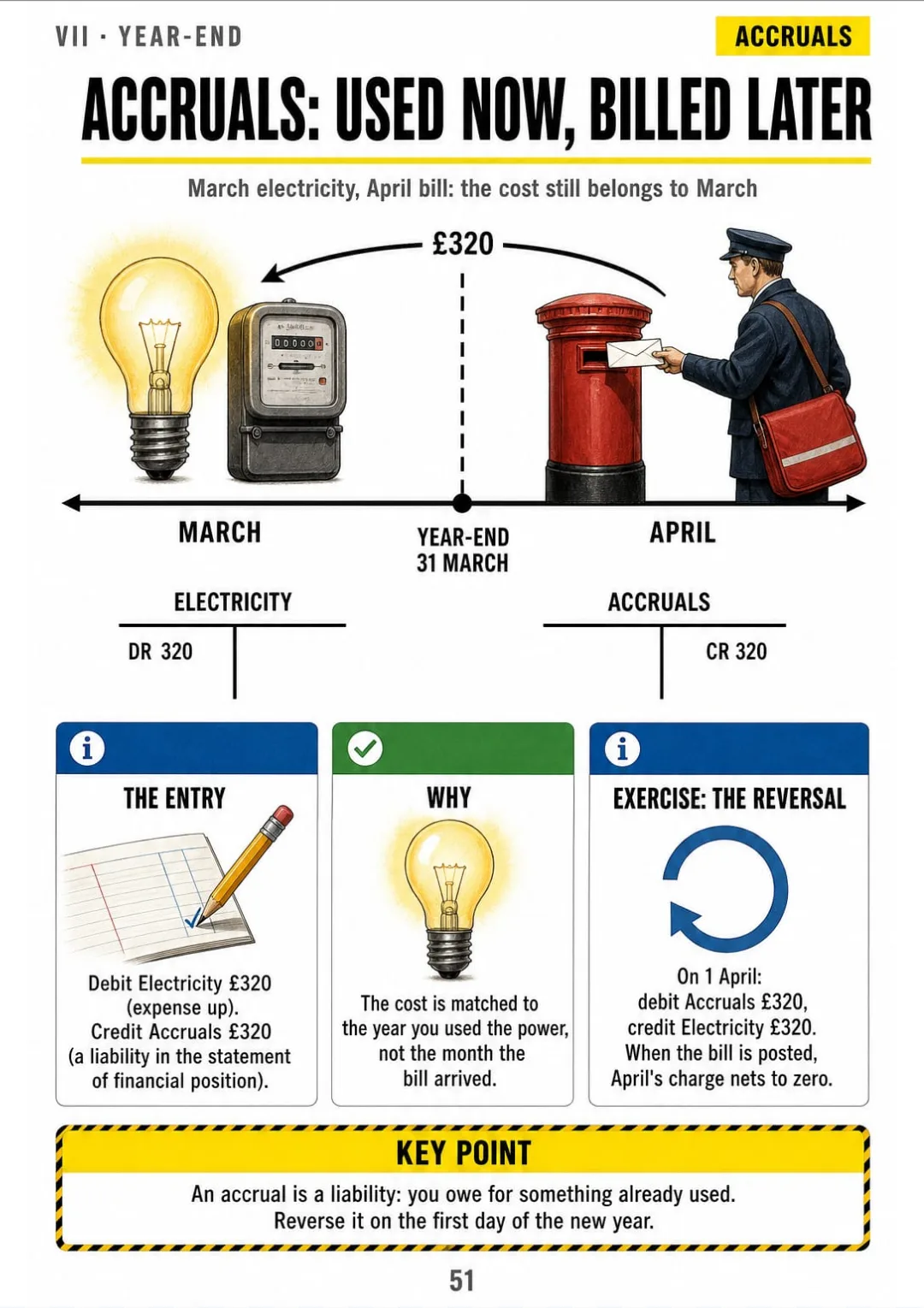
Accrual of £320: debit Electricity, credit Accruals, reversed on 1 April
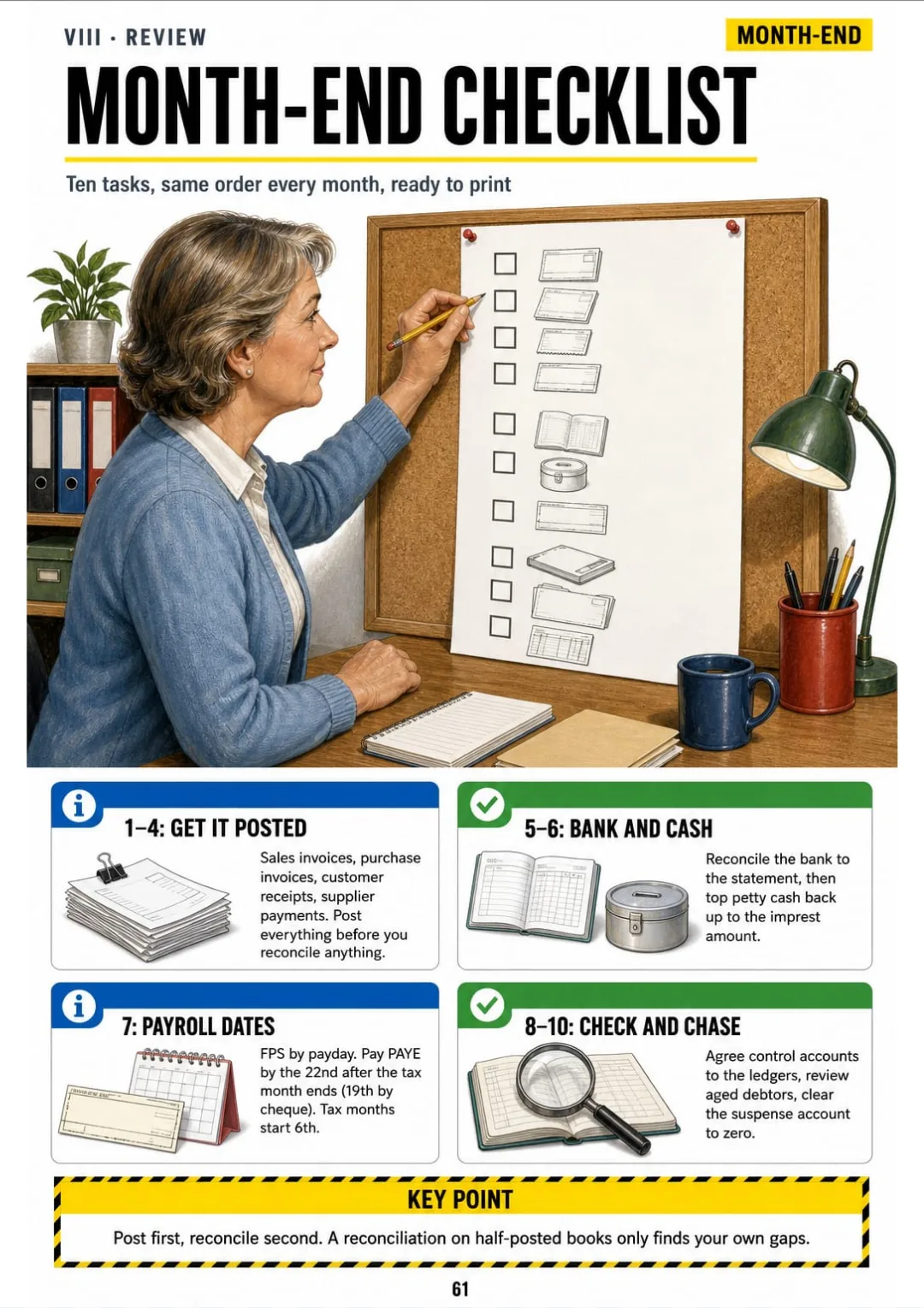
Month-end in 10 boxes: post, reconcile the bank, payroll by the 22nd, control accounts, aged debtors.

Take a Look at the 8 Parts and 61 Topics

Double entry from zero

pp. 5-12
  1. The accounting equation: assets = liabilities + capital
  2. DEAD CLIC: which side goes up
  3. The T-account: left is debit, right is credit
  4. Balancing off an account: balance c/d and b/d
  5. The 4-step posting method you use on every page
  6. Chart of accounts and nominal codes
  7. Source documents: what each piece of paper triggers
  8. Books of prime entry: where it is written first

Sales and purchases

pp. 13-20
  1. Cash sale vs credit sale
  2. The sales day book and sales ledger
  3. Recording a customer payment
  4. Credit purchases and the purchases day book
  5. Paying a supplier and the remittance advice
  6. Credit notes and returns
  7. Prompt payment discounts
  8. Capital vs revenue: asset or expense?

VAT, the UK way

pp. 21-29
  1. How VAT works: output VAT minus input VAT
  2. Standard, reduced, zero-rated and exempt
  3. Net, VAT and gross: the three figures
  4. Posting a sale with VAT
  5. Posting a purchase with VAT
  6. The VAT control account
  7. Filling in the VAT return, box by box
  8. VAT you can't reclaim
  9. Registration threshold, schemes and Making Tax Digital

Bank, cash and control

pp. 30-36
  1. The cash book: bank column by column
  2. Bank reconciliation in 4 steps
  3. Timing differences: uncleared lodgements and unpresented payments
  4. Bank-only items: charges, interest, direct debits
  5. Petty cash and the imprest system
  6. Control account reconciliation
  7. The suspense account: a temporary parking space

Payroll

pp. 37-44
  1. Gross to net: the order of deductions
  2. Reading a tax code: what 1257L means
  3. Income tax through PAYE
  4. Employee and employer National Insurance
  5. Workplace pension and auto-enrolment
  6. The payslip, line by line
  7. The payroll journal
  8. RTI and paying HMRC

The trial balance and corrections

pp. 45-50
  1. Extracting a trial balance
  2. Errors the trial balance won't show
  3. Errors that make it not agree
  4. Writing a journal entry
  5. Correcting errors through suspense
  6. Opening entries for a new business or new year

Year-end accounts

pp. 51-60
  1. Accruals: costs you used but haven't been billed for
  2. Prepayments: paid now, belongs to next year
  3. Accrued and deferred income
  4. Depreciation: straight line
  5. Depreciation: reducing balance
  6. Disposing of a fixed asset
  7. Irrecoverable debts and the allowance for doubtful debts
  8. Closing inventory
  9. From adjusted trial balance to final accounts
  10. Sole trader vs limited company at year-end

Review and checklists

pp. 61-65
  1. Month-end checklist
  2. Quarter-end and year-end checklist
  3. Which side? The one-page posting chart
  4. The most frequent bookkeeping mistakes
  5. UK terms vs the words in older or American books

Who This Book Is For

You're studying bookkeeping

Each topic from your course on one page, with a worked example and an exercise to do yourself, full solution included.

You do your own books

The VAT return, the bank reconciliation and year-end, drawn step by step, so you hand your accountant books that balance.

You're starting out as a bookkeeper

Practise every task here before your first client's books, and keep the posting chart and checklists to hand.

Plus: 2 Free Books

Bookkeeping Practice Tests: Mixed Transactions with Answers
BONUS 1

Bookkeeping Practice Tests: Mixed Transactions with Answers

Test yourself on real-style transactions in random order, so you know which side each one goes on without looking back at the chapter.
Common Bookkeeping Mistakes: Before and After
BONUS 2

Common Bookkeeping Mistakes: Before and After

The most frequent slips (wrong side, VAT on the wrong figure, missed accruals) shown wrong and then right, so you spot them in your own books.

30-Day Guarantee

30-day guarantee: if a file doesn't open, if the content isn't what the product page describes, if you were charged twice or the email never arrived, write to us and we'll refund you in full. You pay once. No subscriptions.

Frequently Asked Questions

Is it for me if I run a small business and do my own books?

Yes. It's written for sole traders, small company directors, adult students and new bookkeepers. It starts from the accounting equation and builds up one topic at a time, so it works whether you're rusty or have never practised. It covers the topics of introductory bookkeeping courses: double entry, VAT, control accounts, payroll and the trial balance. If you use the cash basis, the year-end pages help you follow the adjustments your accountant makes.

Where does the content come from?

From HMRC guidance on GOV.UK (VAT, PAYE, RTI, Making Tax Digital and record keeping), Companies House guidance on annual accounts and UK terminology in line with FRS 102 / FRS 105. It's written for the UK from the start, not adapted from an American book: pounds, the UK VAT return box by box, UK payslips, nominal codes and UK terms. The worked examples use the standard 20% VAT rate. Anything that changes each April (tax codes, National Insurance rates, thresholds) is flagged with where to find the current figure on GOV.UK, so the method doesn't go out of date.

Is this official material?

No. It's an independent illustrated workbook. It isn't produced, approved or endorsed by HMRC, Companies House or any professional body.

Does it replace a course or an accountant?

No. It's practice material to help you understand and do the tasks. It doesn't lead to a qualification or certificate, it isn't tax advice and it doesn't replace a recognised course or a qualified accountant.

Are the practice questions the real exam questions?

No. Every exercise and practice test is written for this book. They are not official questions from any exam.

I use accounting software. Is it still useful?

Yes. It doesn't teach any particular program: it shows the entries behind them, so you know what the software posts when you raise an invoice, record a payment or run payroll. It's a one-off payment, with no subscription.

Do I have to pay every month?

No. It's a one-off payment. No subscription.

Can I have it on paper?

Yes. It's a PDF you can print at home or at a print shop, and do the exercises by hand.

How does the refund work?

You have 30 days. We refund everything if the file won't open, if the book isn't what you see on this page, if you were charged twice or if the email doesn't arrive: just email us.

£19.99£57.99
Get the book · £19.99

This is a digital PDF book sent to your email: nothing is printed or shipped.