Study in Pictures๐ŸŒ English (United Kingdom)
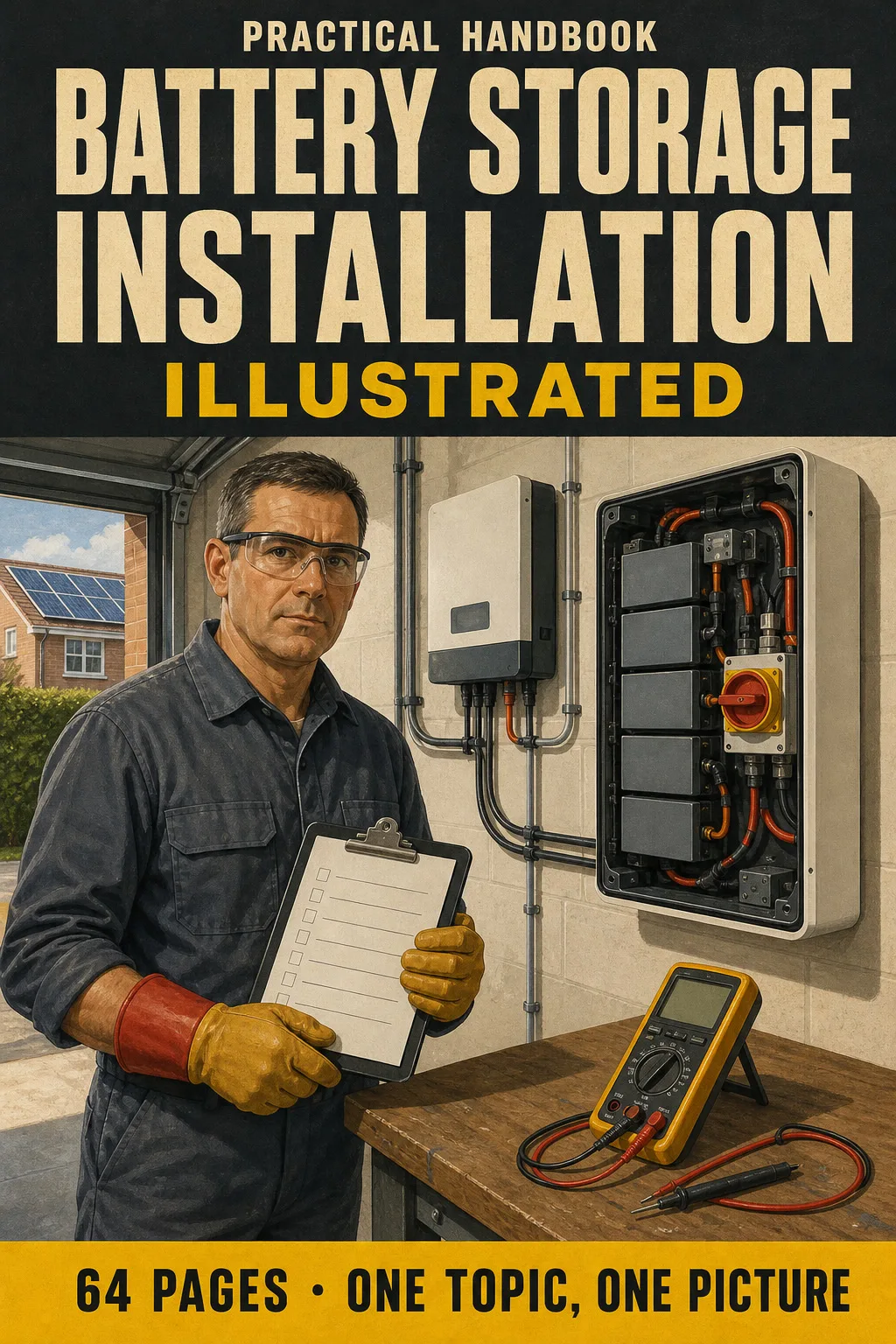
Battery Storage Installation Illustrated

Digital book in PDF ยท read it on your phone or print it

Battery Storage Installation Illustrated

AC and DC coupling, sizing in kWh, where the unit can go, protection and earthing, DC isolation, G98 and G99, commissioning and handover. Every topic has its own page: the drawing first, then what you need to remember.

  • 64 illustrated pages
  • English
  • 30-day guarantee
ยฃ19.99ยฃ57.99
Get the book ยท ยฃ19.99

Price shown for: United Kingdom. In other countries, the checkout shows the price that applies there.

About this book

What it is

AC and DC coupling, sizing in kWh, where the unit can go, protection and earthing, DC isolation, G98 and G99, commissioning and handover. Every topic has its own page: the drawing first, then what you need to remember.

Who This Book Is For
  • You're studying for the battery storage course
  • Your course date is close
  • You're already fitting batteries
What it covers
  1. How a home battery system works
  2. Survey and sizing
  3. Siting and fire safety
  4. Protection, cabling and earthing
  5. Isolation and labelling
  6. Notification and paperwork
  7. Commissioning and handover
  8. Revision and site checklists
Language
English (United Kingdom)
Pages
64
Format
Digital book in PDF ยท read it on your phone or print it
Price
ยฃ19.99 (United Kingdom)
Delivery
This is a digital PDF book sent to your email: nothing is printed or shipped.
30-Day Guarantee
30-day guarantee: if a file doesn't open, if the content isn't what the product page describes, if you were charged twice or the email never arrived, write to us and we'll refund you in full.

Look Inside the Book

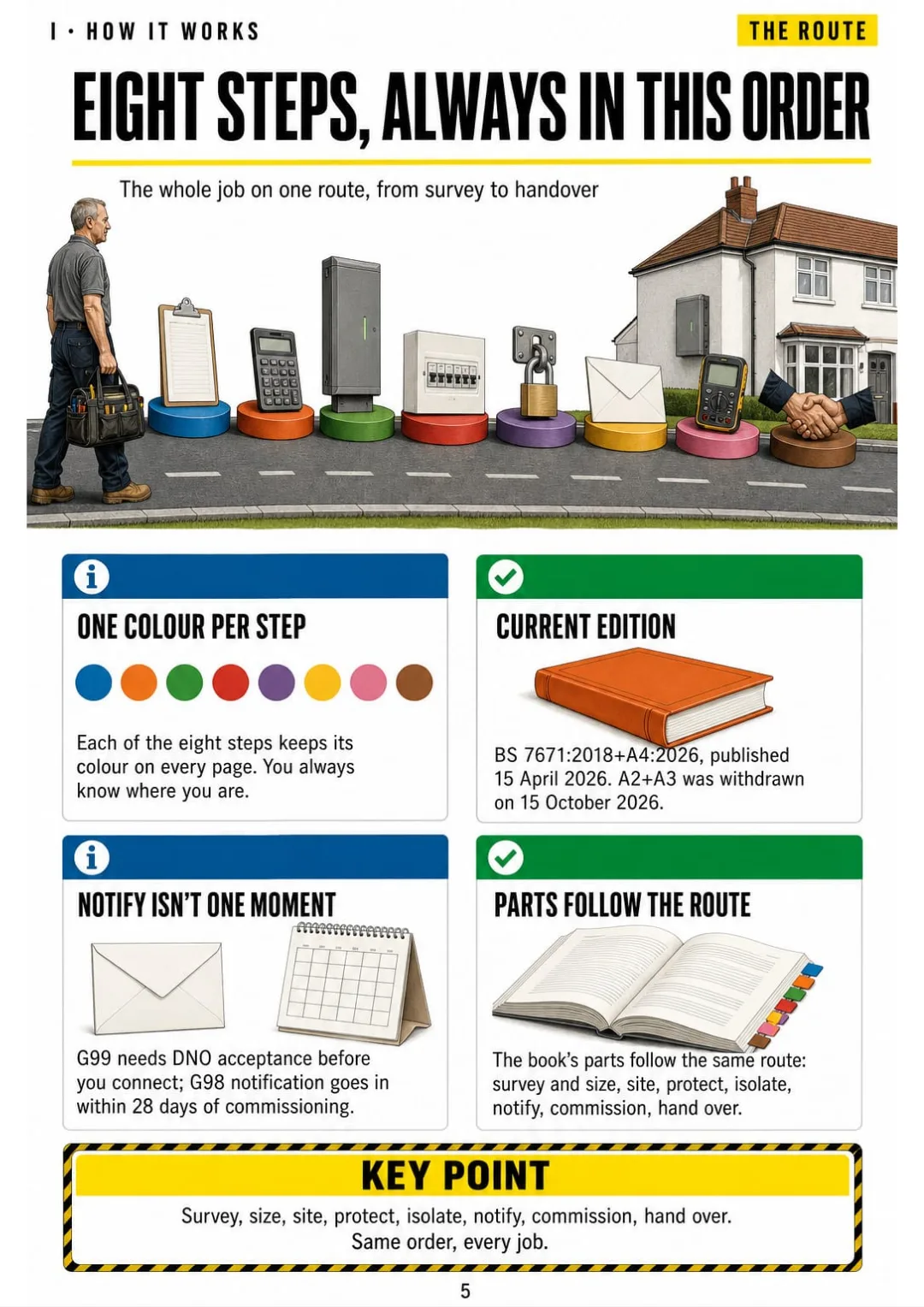
Survey โ†’ size โ†’ site โ†’ protect โ†’ isolate โ†’ notify โ†’ commission โ†’ hand over, to BS 7671:2018+A4:2026
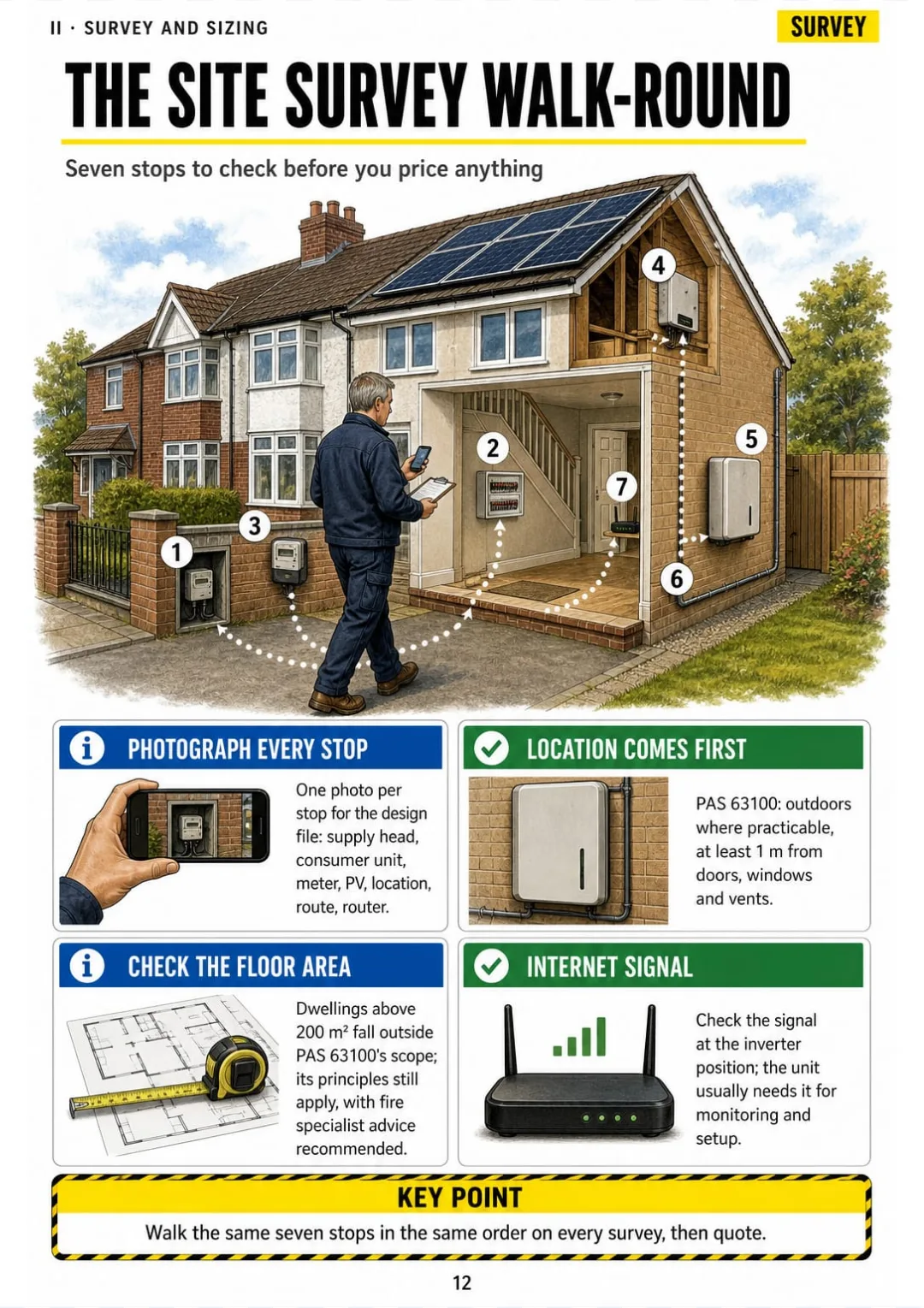
The survey walk-round: 7 numbered stops, one photo each for the design file
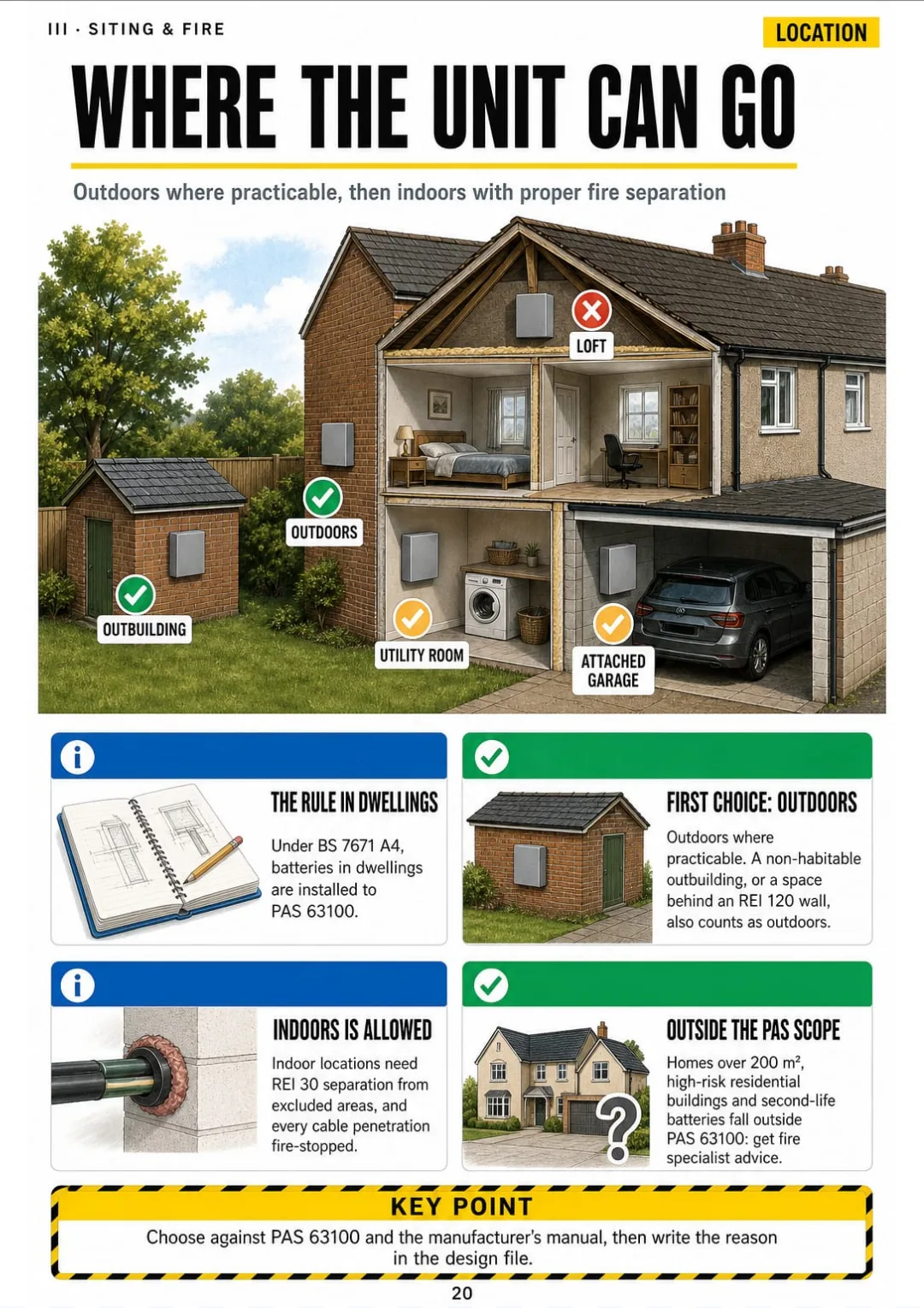
PAS 63100: outdoors where practicable; indoors needs REI 30 separation and fire-stopped penetrations.
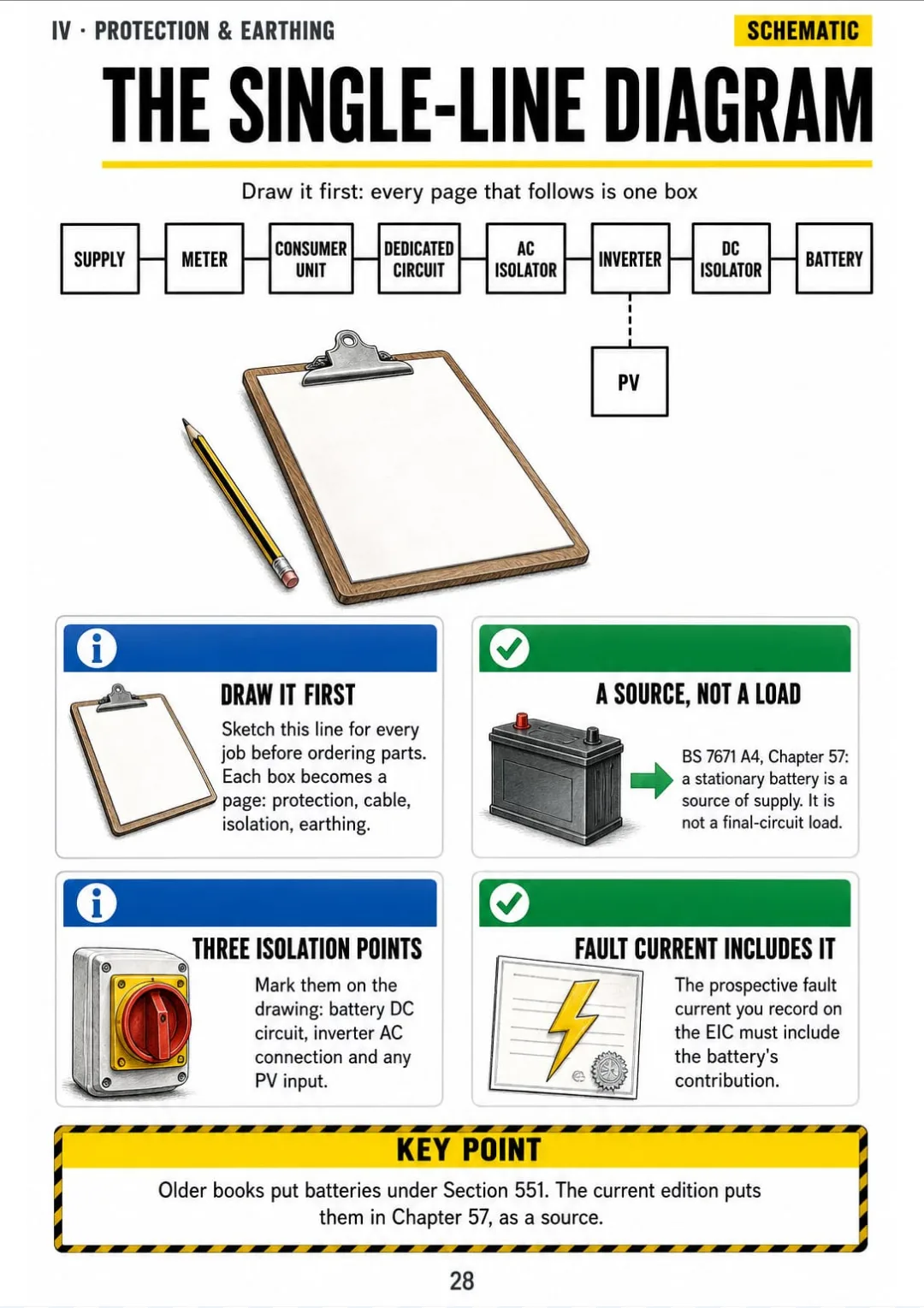
Supply, meter, consumer unit, AC isolator, inverter, DC isolator, battery: one line, drawn first.
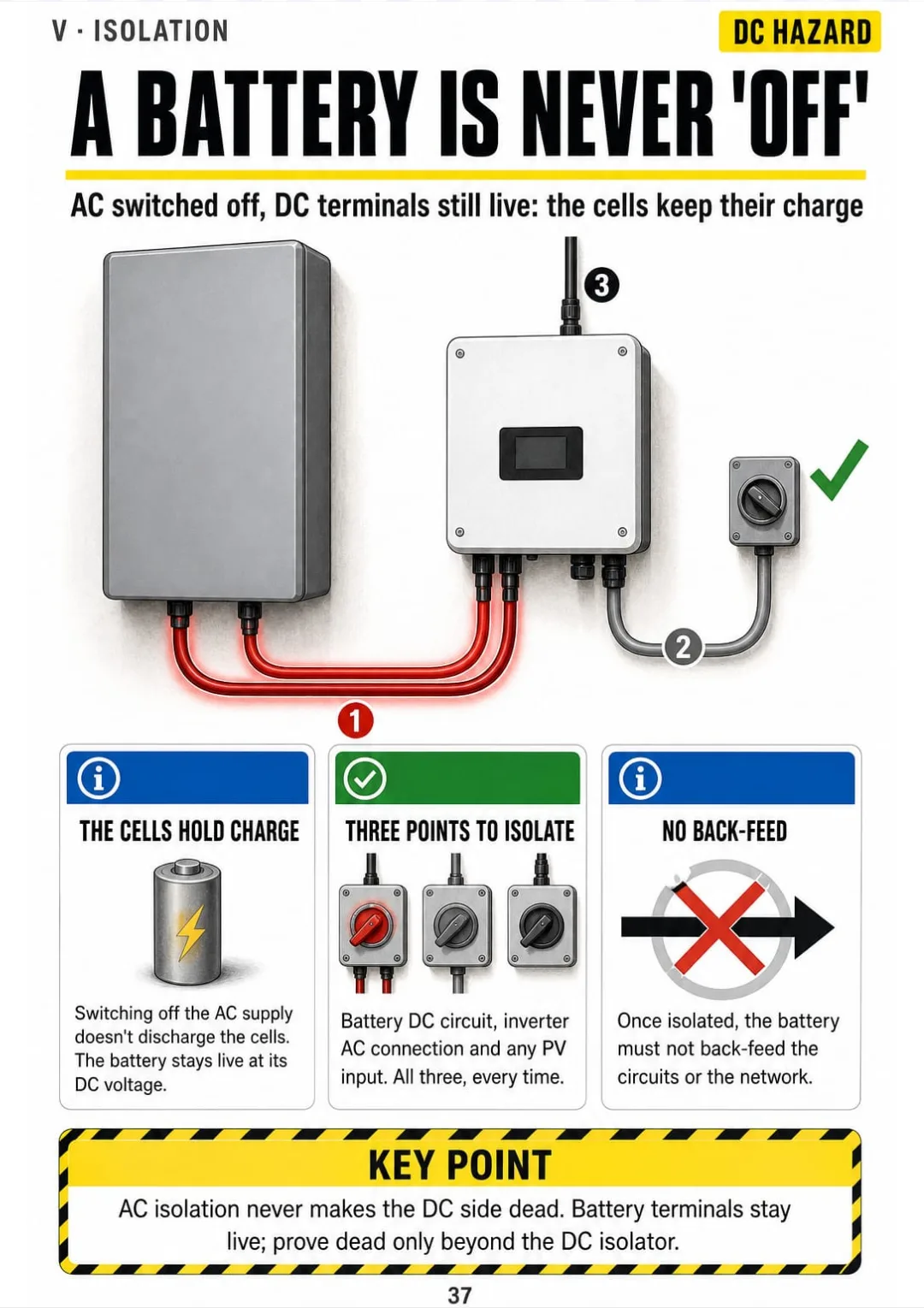
AC off, DC still live: isolation covers battery DC, inverter AC and any PV input.
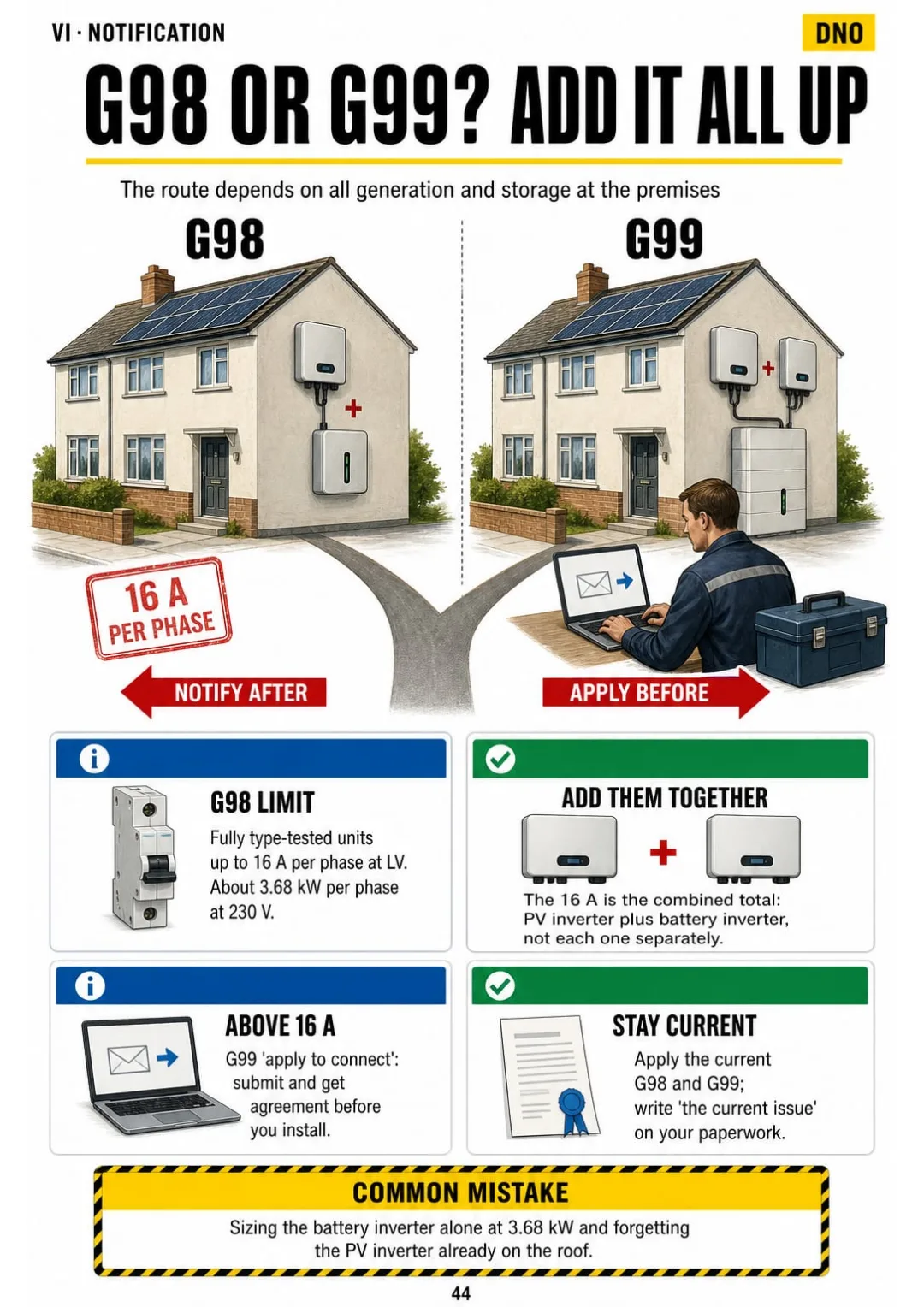
G98 up to 16 A per phase in total (โ‰ˆ3.68 kW at 230 V); above that, G99 before installing.
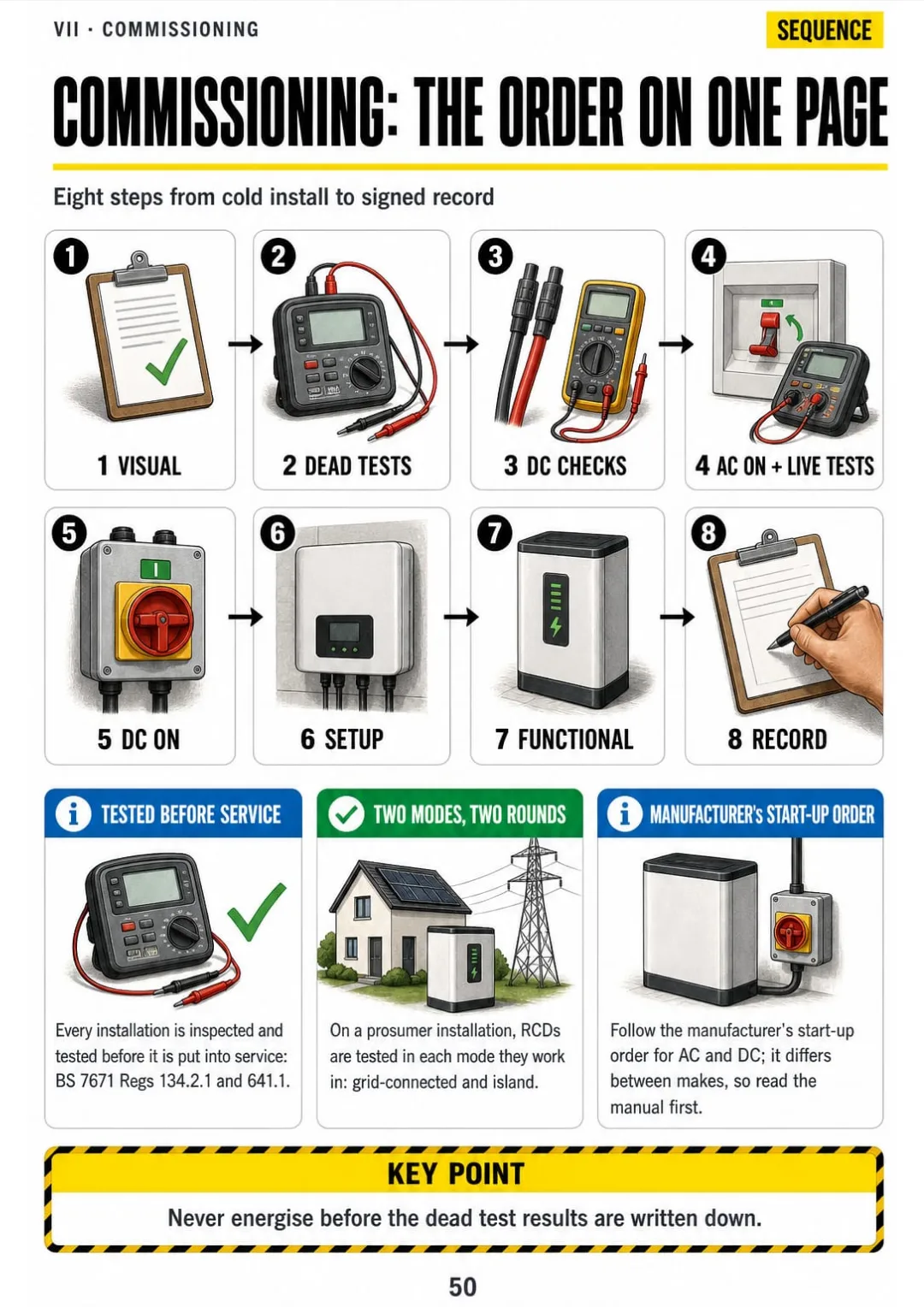
Visual โ†’ dead tests โ†’ DC checks โ†’ AC on + live tests โ†’ DC on โ†’ setup โ†’ functional โ†’ record.
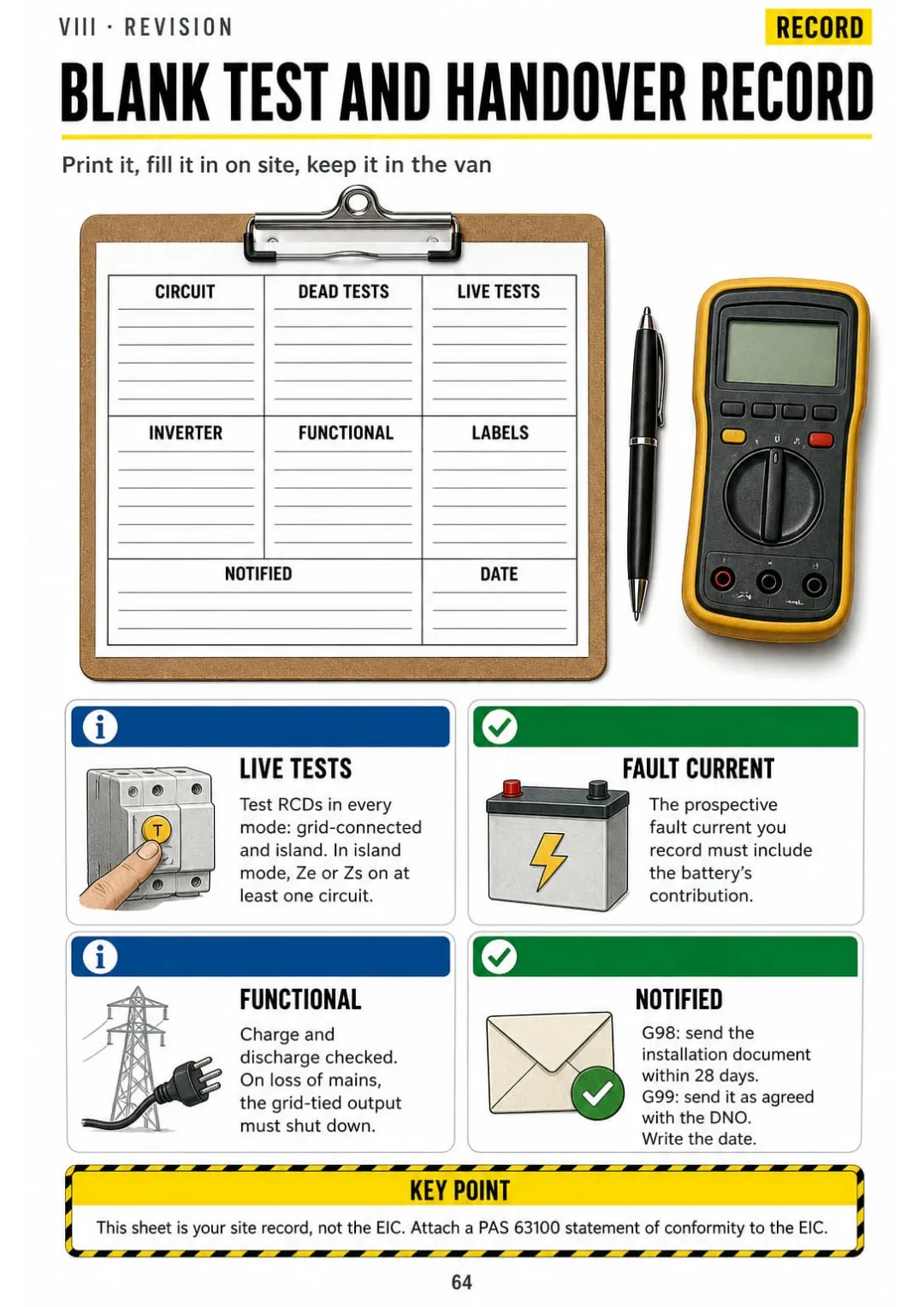
Circuit, dead and live tests, inverter, functional tests, labels and notification on one sheet.

Take a Look at the 8 Parts and 60 Topics

How a home battery system works

pp. 5-11
  1. The install sequence: eight steps, always in this order
  2. What's inside the box: cells, BMS, inverter
  3. AC-coupled vs DC-coupled, side by side
  4. Kilowatts vs kilowatt-hours
  5. Nominal vs usable capacity
  6. Battery chemistries you'll meet: LFP, NMC, lead-acid
  7. Low-voltage vs high-voltage battery stacks

Survey and sizing

pp. 12-19
  1. The site survey: what to look at before you quote
  2. Reading the supply: earthing system and main fuse
  3. Is the existing installation fit to connect to?
  4. The customer's daily use in kWh
  5. Sizing for solar surplus
  6. Sizing for time-of-use tariffs
  7. Inverter power: will it run the kettle and the oven at once?
  8. Backup, whole-house or no backup

Siting and fire safety

pp. 20-27
  1. Where the unit can go: the location decision
  2. Where it shouldn't go: escape routes, bedrooms, lofts
  3. The attached garage: what to avoid
  4. Heat detection in the battery room
  5. Wall, floor and fixing
  6. Clearances, temperature and ventilation
  7. Outdoor installs: IP rating, sun and flooding
  8. Access for the fire service and for you

Protection, cabling and earthing

pp. 28-36
  1. The single-line diagram of a battery install
  2. The dedicated AC circuit
  3. Bidirectional devices: power flows both ways
  4. RCD type for battery and inverter circuits
  5. DC cable: current, size and voltage drop
  6. DC overcurrent: fuses and breakers on the battery side
  7. Earthing in normal grid-tied mode
  8. Earthing in island (backup) mode
  9. Surge protection and the PV side

Isolation and labelling

pp. 37-43
  1. Why a battery is never 'off' at the terminals
  2. AC isolation: the steps
  3. DC isolation: the steps, numbered on the unit
  4. Safe isolation when PV is also connected
  5. Locking off and warning notices
  6. Dual-supply labels: where they go
  7. The system schematic on the wall

Notification and paperwork

pp. 44-49
  1. Telling the network operator: G98 or G99?
  2. G98: notify within 28 days
  3. G99 and export limitation
  4. Building Regulations notification in England and Wales
  5. Certificates: EIC and the battery-specific records
  6. Certification schemes and warranties

Commissioning and handover

pp. 50-57
  1. Commissioning sequence: the order on one page
  2. Visual inspection before power
  3. Dead tests on the new circuit
  4. Live tests: earth fault loop and RCD
  5. Inverter setup: grid code, CT clamp and modes
  6. Functional tests: charge, discharge, loss of mains
  7. Handover: what the customer needs to know
  8. The handover pack

Revision and site checklists

pp. 58-64
  1. The eight steps on one page
  2. Survey checklist
  3. Siting checklist
  4. Isolation card
  5. Most frequent mistakes: before and after
  6. Words you'll hear on the course
  7. Blank test and handover record

Who This Book Is For

You're studying for the battery storage course

Each topic of the course on one page, drawn, so you study at night or in the van and the order stays with you.

Your course date is close

The eight steps, the isolation card and the commissioning order on single pages to revise the week before, plus the practice questions to test yourself.

You're already fitting batteries

A print-out to keep in the van: where the unit can go, how to prove the DC side is dead and what to send the network operator.

Plus: 2 Free Books

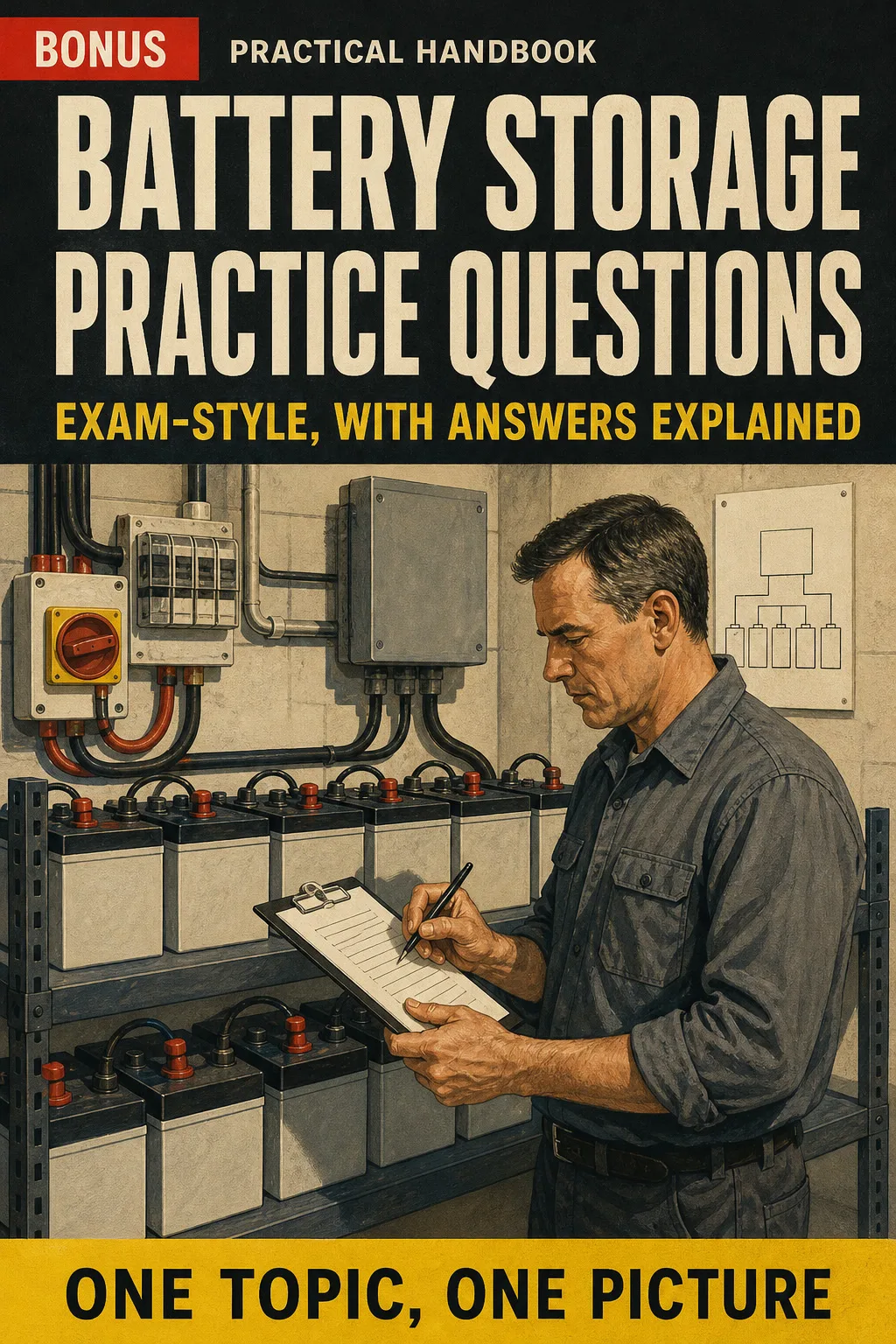
Battery Storage Practice Questions: Exam-Style, With Answers Explained
BONUS 1

Battery Storage Practice Questions: Exam-Style, With Answers Explained

Test yourself on sizing, siting, isolation and commissioning with exam-style questions, each answer explained with the page it comes from.
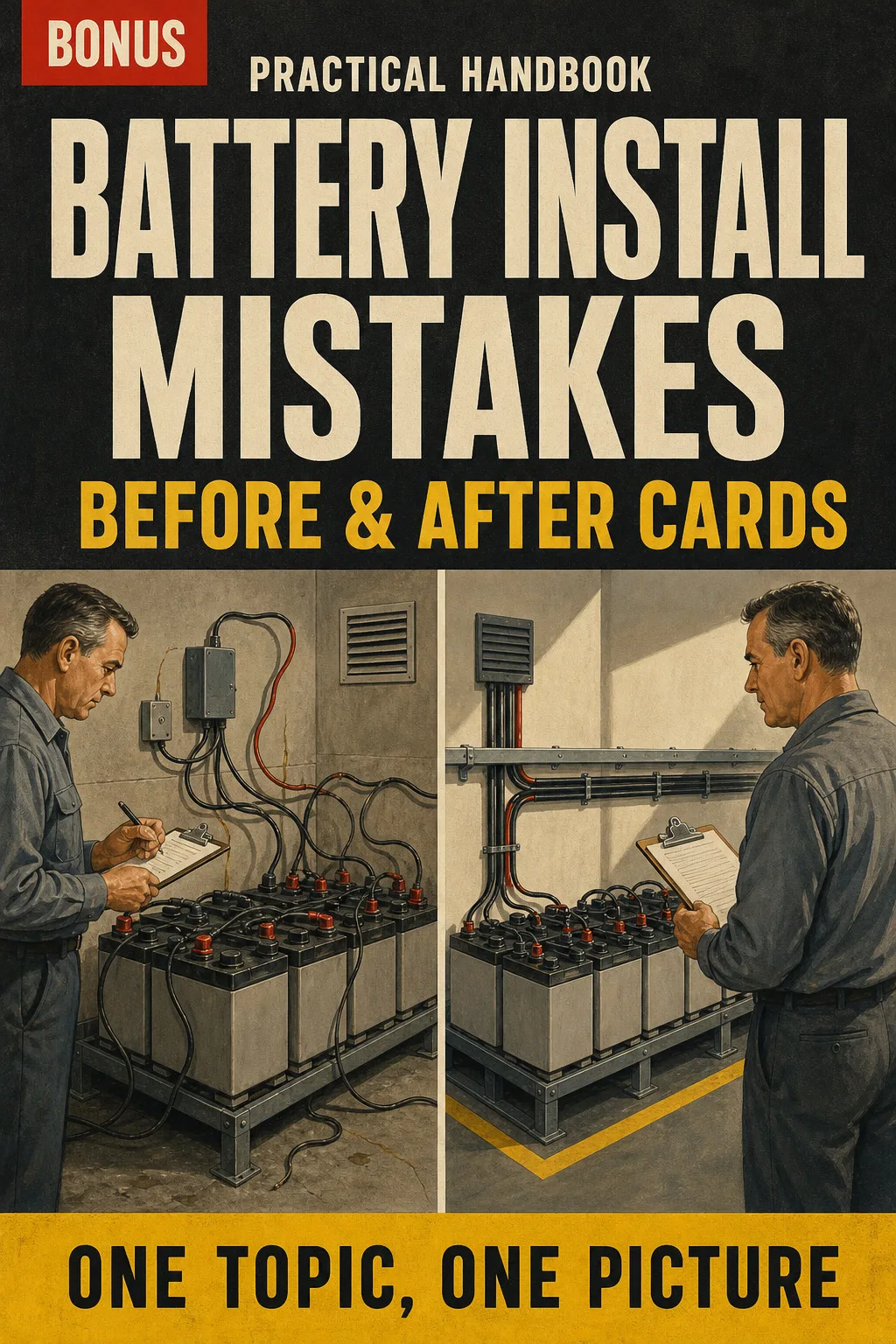
Battery Install Mistakes: Before & After Cards
BONUS 2

Battery Install Mistakes: Before & After Cards

The most common battery installation mistakes drawn side by side with the right way, so you can spot them on site at a glance.

30-Day Guarantee

30-day guarantee: if a file doesn't open, if the content isn't what the product page describes, if you were charged twice or the email never arrived, write to us and we'll refund you in full. You pay once. No subscriptions.

Frequently Asked Questions

Is it for me if I've been an electrician for years and I'm only now adding batteries?

Yes. It doesn't teach you how to wire a consumer unit: it draws what's new with batteries, on top of what you already know, from the survey to the handover.

Where does the content come from?

From BS 7671:2018 with Amendment 3 (2024), which added the chapter on stationary batteries, PAS 63100:2024 on siting and fire, the IET Code of Practice for Electrical Energy Storage Systems, ENA G98, G99 and G100, and MCS MIS 3012. It's UK-only: UK terms, units and notification rules, nothing American. The Building Regulations pages follow England and Wales; in Scotland and Northern Ireland, check your local route. Everything is explained with our own drawings, not copied from the standards.

Is it official material?

No. It's an independent illustrated study book. It isn't published, approved or endorsed by any standards body, network operator, scheme or awarding body, and it doesn't give you a certificate, a qualification or CPD hours: those come from your accredited course.

Does it replace the course or training?

No. It doesn't replace accredited training, the manufacturer's instructions or BS 7671 itself. It helps you understand and revise what you learn there.

Are the practice questions the ones from the exam?

No. They're written for this book, in exam style, and each answer is explained with the page it comes from.
When and how does it arrive?

The book and the 2 free books arrive as PDFs by email, at the address you enter when you pay.

Do I have to pay every month?

No. It's a one-off payment. No subscription.

Can I have it on paper?

Yes. It's a PDF you can print at home or at a print shop, whole or just the pages you want in the van.

How does the refund work?

You have 30 days. We refund everything if the file won't open, if the book isn't what you see on this page, if you were charged twice or if the email doesn't arrive: just email us.

ยฃ19.99ยฃ57.99
Get the book ยท ยฃ19.99

This is a digital PDF book sent to your email: nothing is printed or shipped.