Study in Pictures🌐 English (United Kingdom)
Amateur Radio Exam Illustrated

Digital book in PDF · read it on your phone or print it

Amateur Radio Exam Illustrated

Ohm's law, power, resonance, the superhet receiver, SWR, the half-wave dipole, the ionosphere, UK band plans and licence conditions. Each topic has its own page: the drawing first, then what you need to remember.

  • 66 illustrated pages
  • English
  • 30-day guarantee
£19.99£57.99
Get the book · £19.99

Price shown for: United Kingdom. In other countries, the checkout shows the price that applies there.

About this book

What it is

Ohm's law, power, resonance, the superhet receiver, SWR, the half-wave dipole, the ionosphere, UK band plans and licence conditions. Each topic has its own page: the drawing first, then what you need to remember.

Who This Book Is For
  • You're on the Foundation course
  • Your exam date is booked
  • You already hold a licence
What it covers
  1. The Licence Ladder
  2. Electricity You Can See
  3. Components and Circuits
  4. Transmitters and Receivers
  5. Feeders and Antennas
  6. Propagation
  7. Licence Conditions and Operating
  8. Safety and EMC
  9. Exam-Day Review
Language
English (United Kingdom)
Pages
66
Format
Digital book in PDF · read it on your phone or print it
Price
£19.99 (United Kingdom)
Delivery
This is a digital PDF book sent to your email: nothing is printed or shipped.
30-Day Guarantee
30-day guarantee: if a file doesn't open, if the content isn't what the product page describes, if you were charged twice or the email never arrived, write to us and we'll refund you in full.

Look Inside the Book

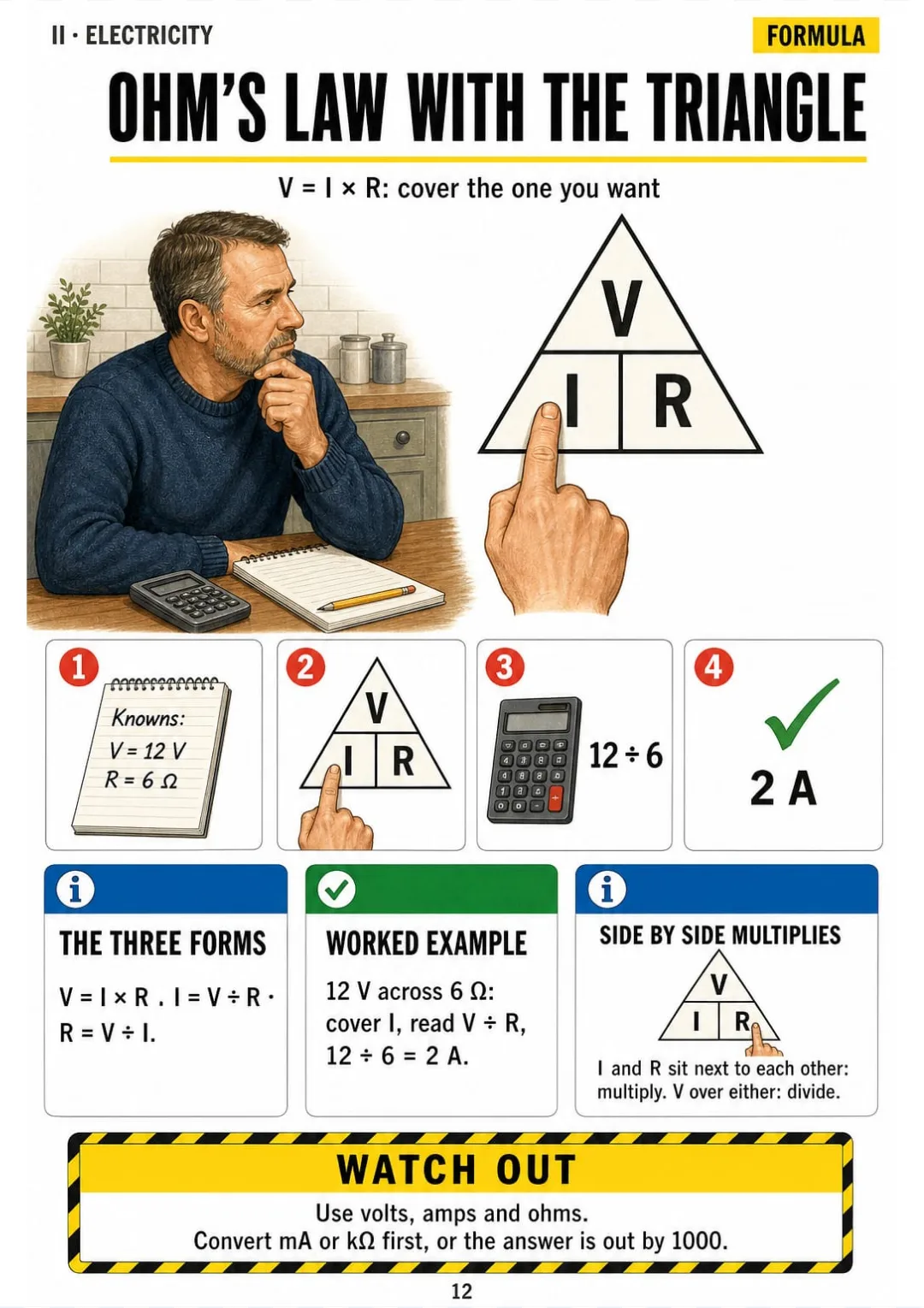
12 V across 6 Ω = 2 A, solved with the triangle in 4 steps.
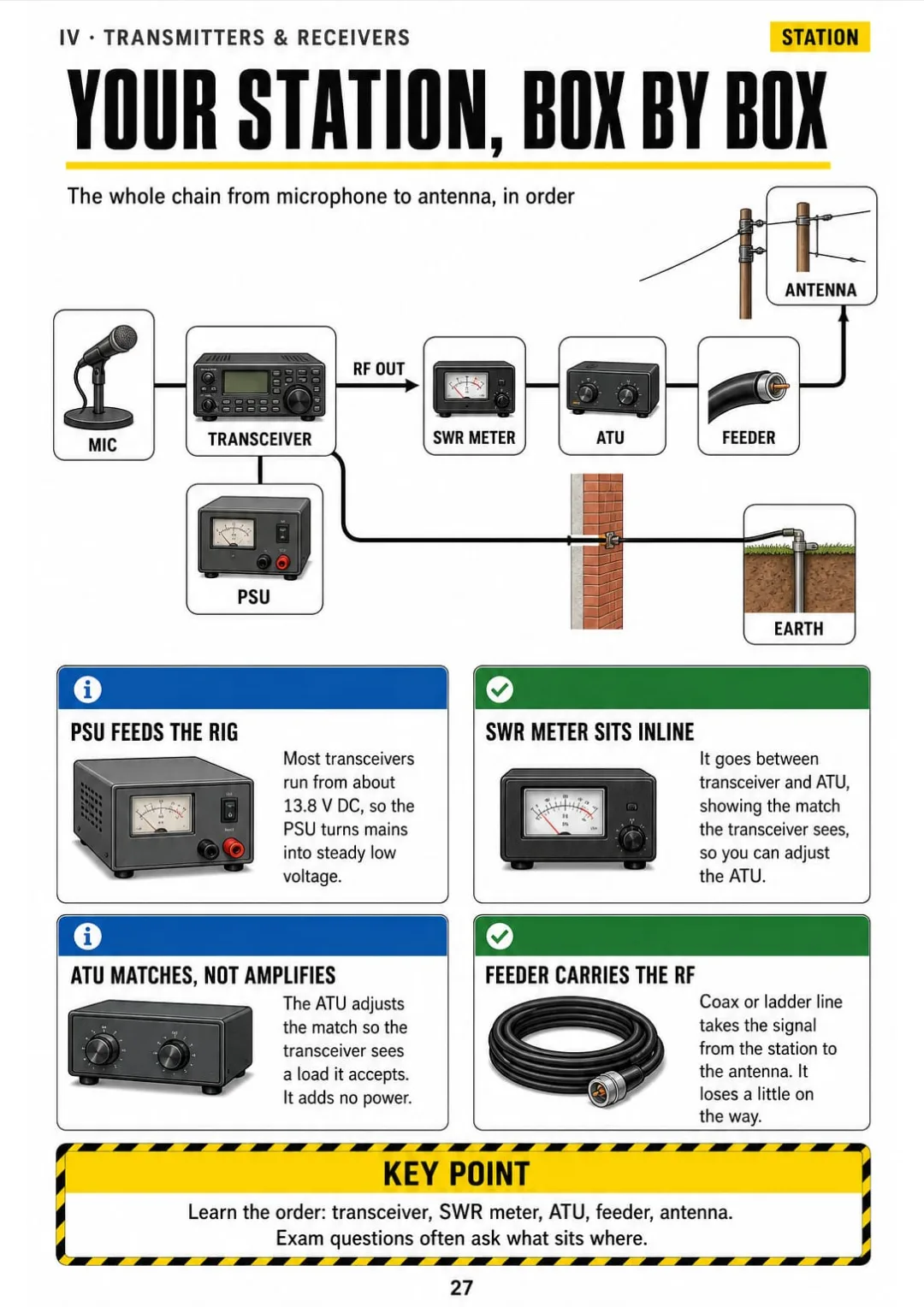
Mic → transceiver → SWR meter → ATU → feeder → antenna, with PSU and earth
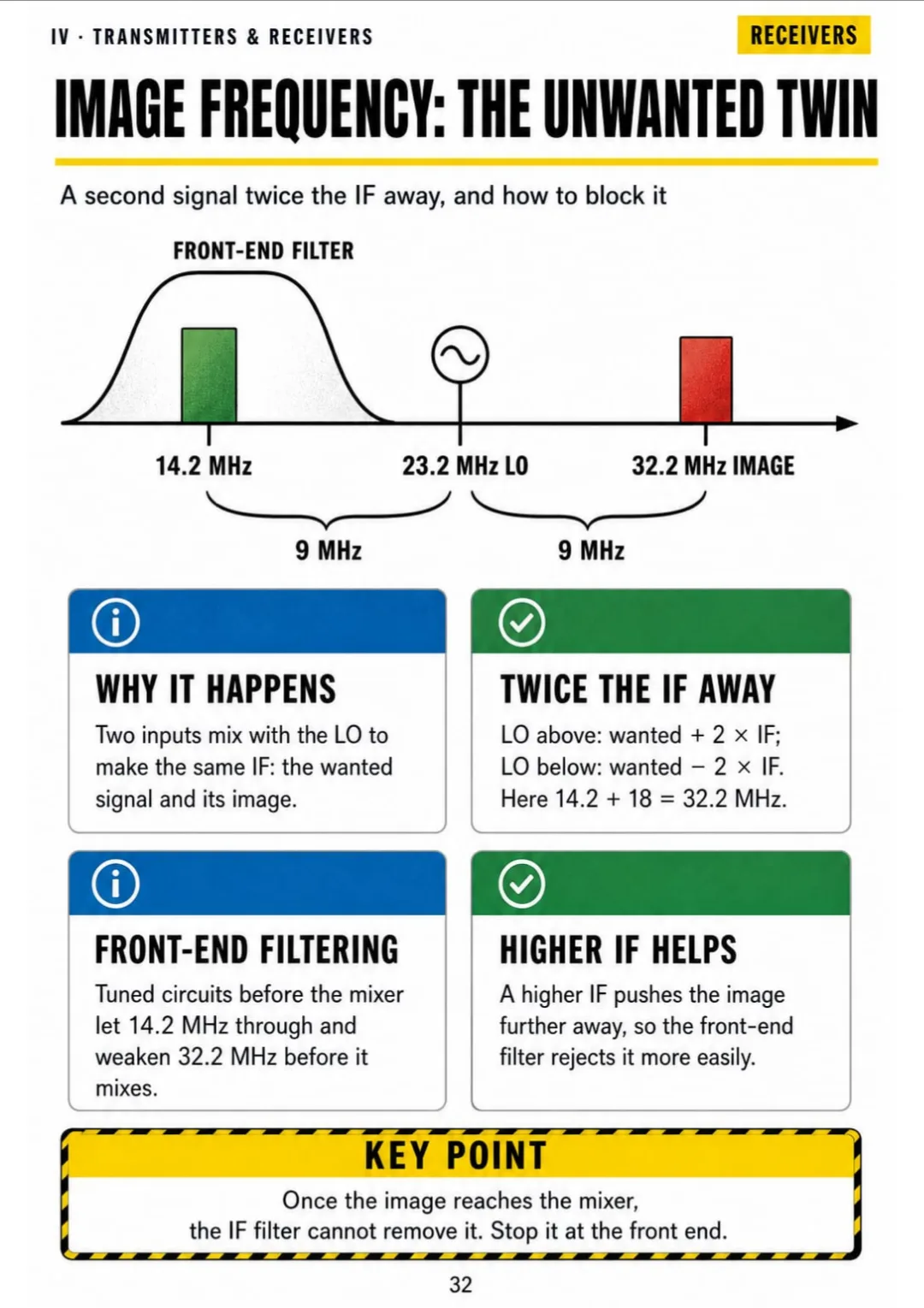
Image = wanted ± 2 × IF: 14.2 MHz with a 23.2 MHz LO hears 32.2 MHz
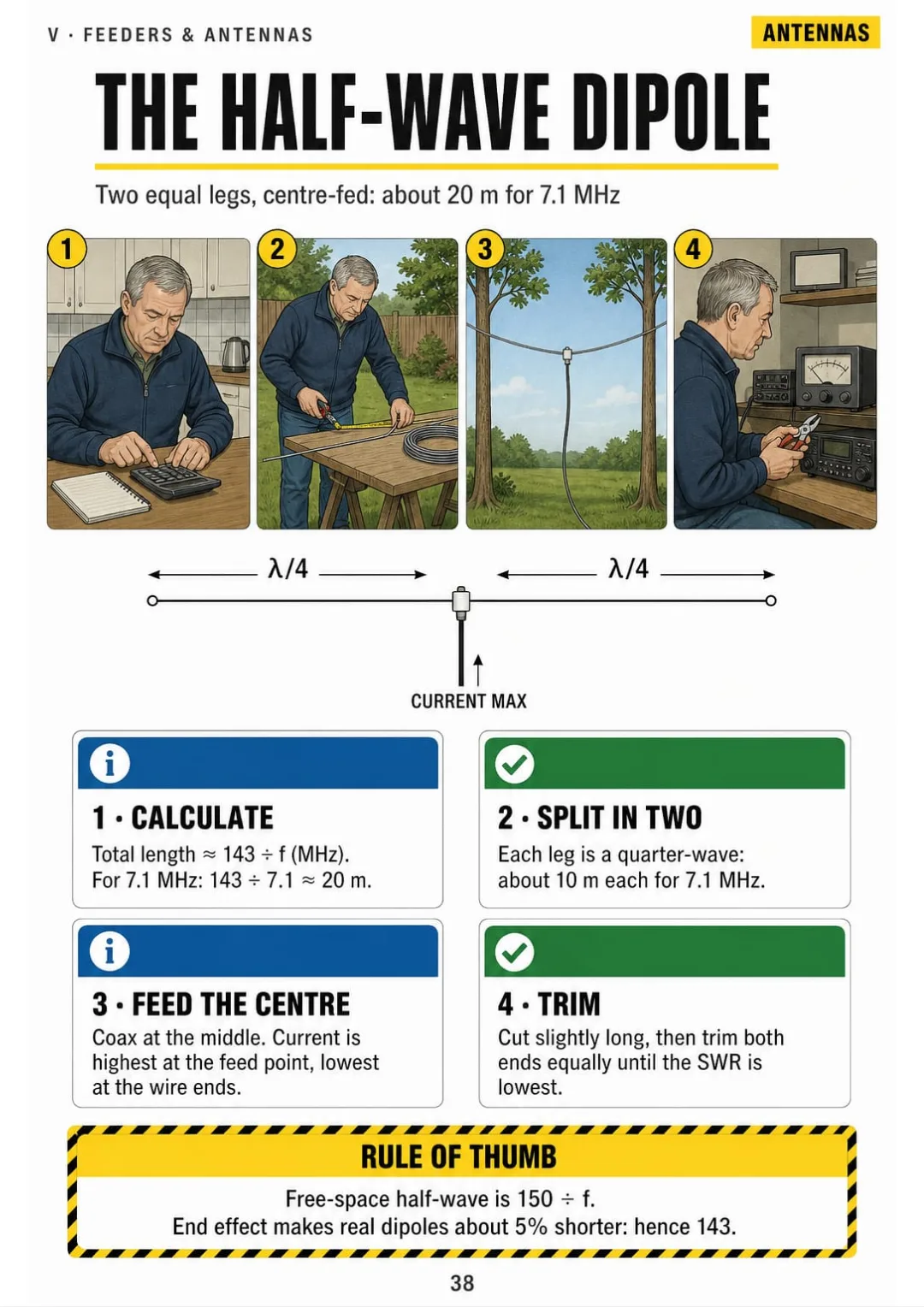
About 143 ÷ f (MHz): roughly 20 m total for 7.1 MHz
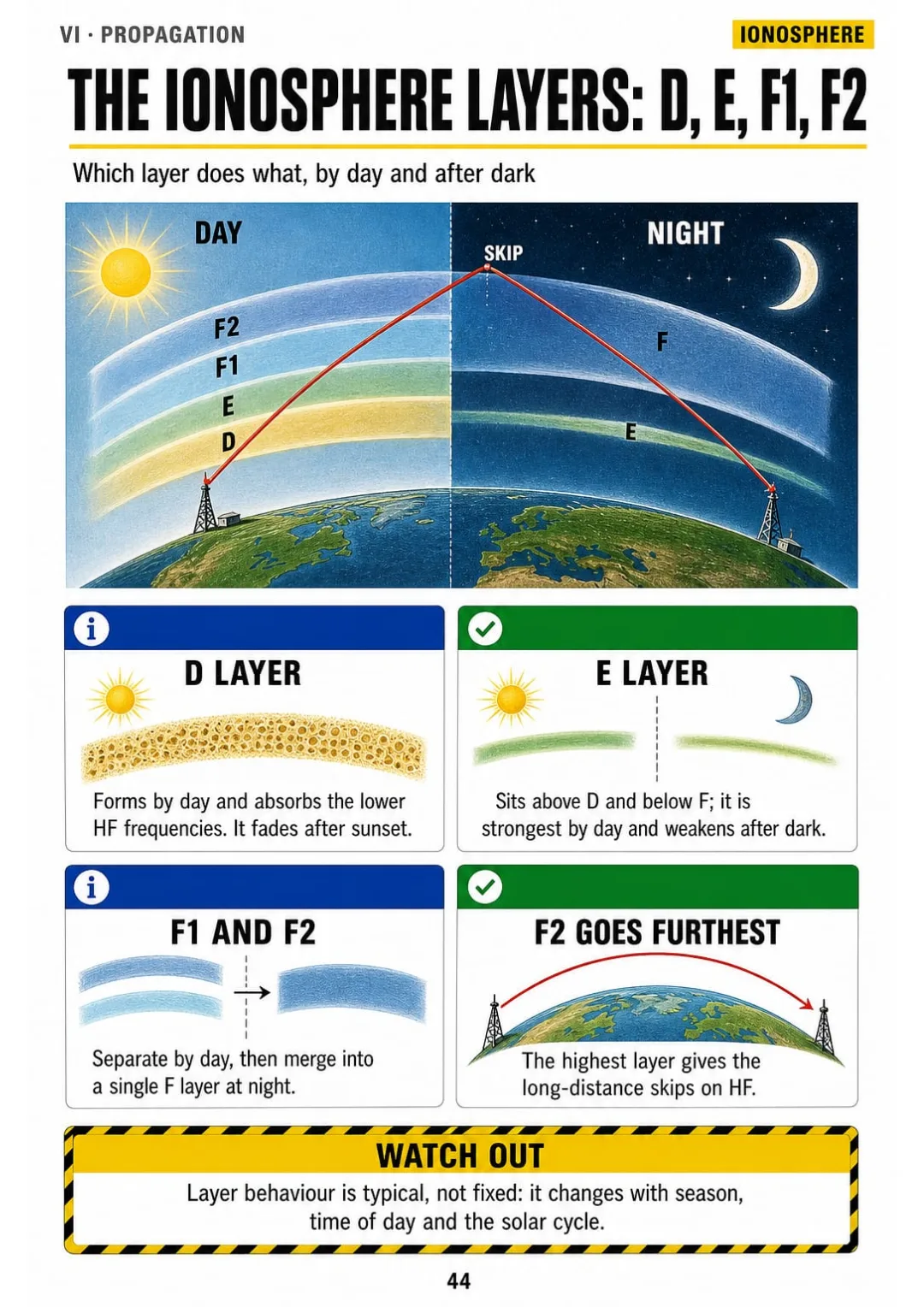
D absorbs low HF by day and fades at night; F1 and F2 merge into F after dark.
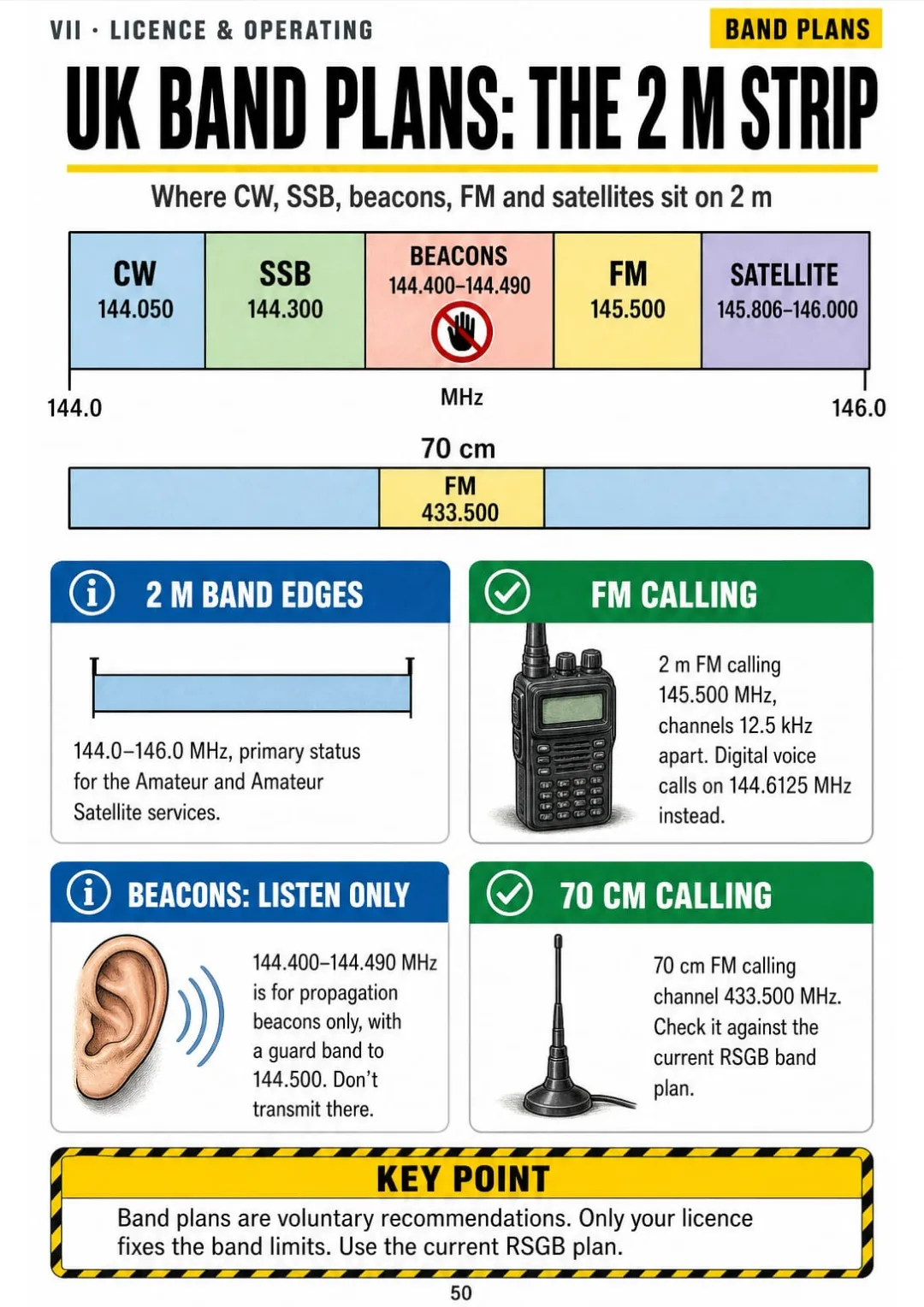
2 m: CW 144.050 · SSB 144.300 · beacons 144.400–144.490 · FM calling 145.500 MHz
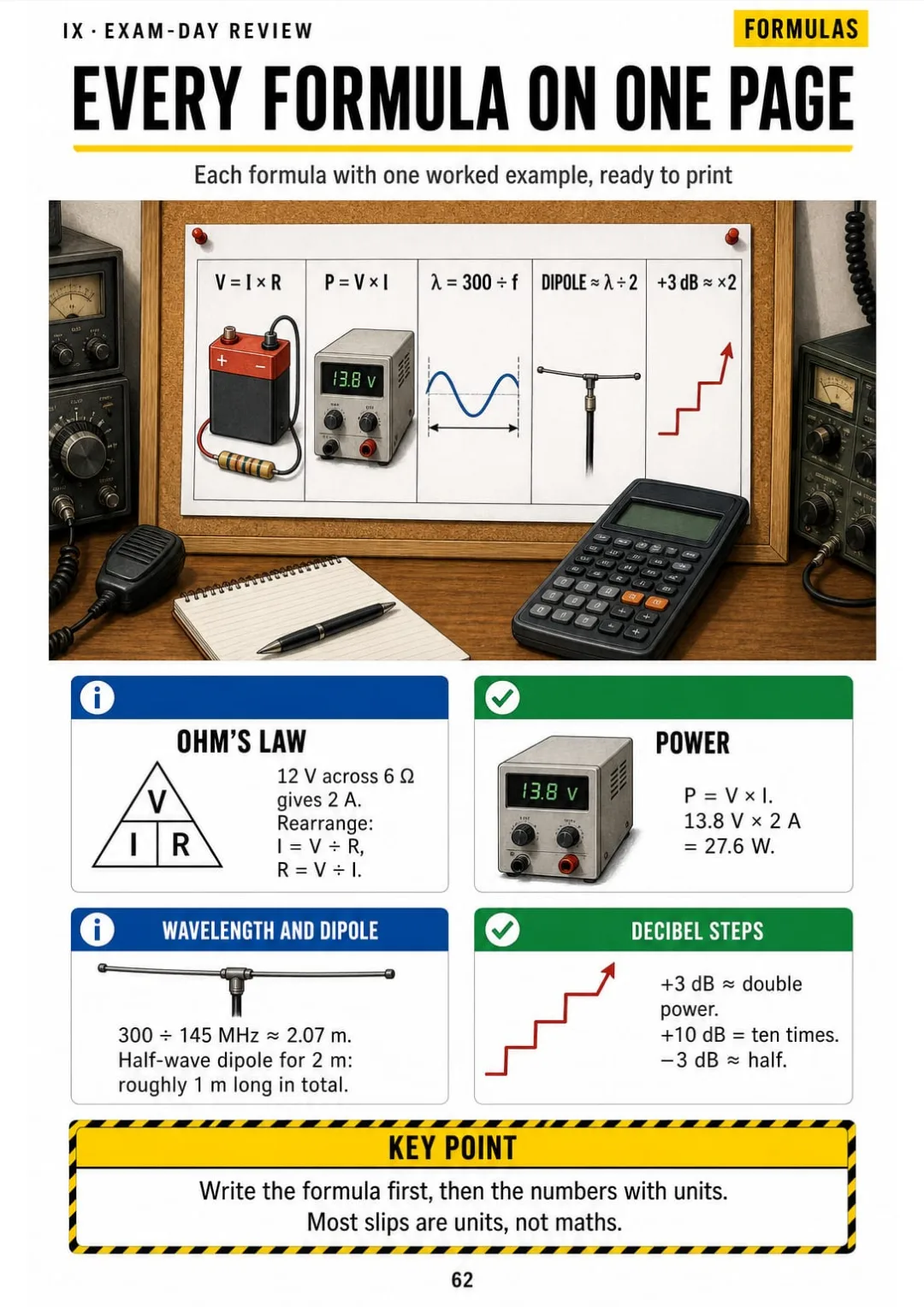
V = I × R, P = V × I, λ = 300 ÷ f, dipole ≈ λ ÷ 2, +3 dB ≈ ×2
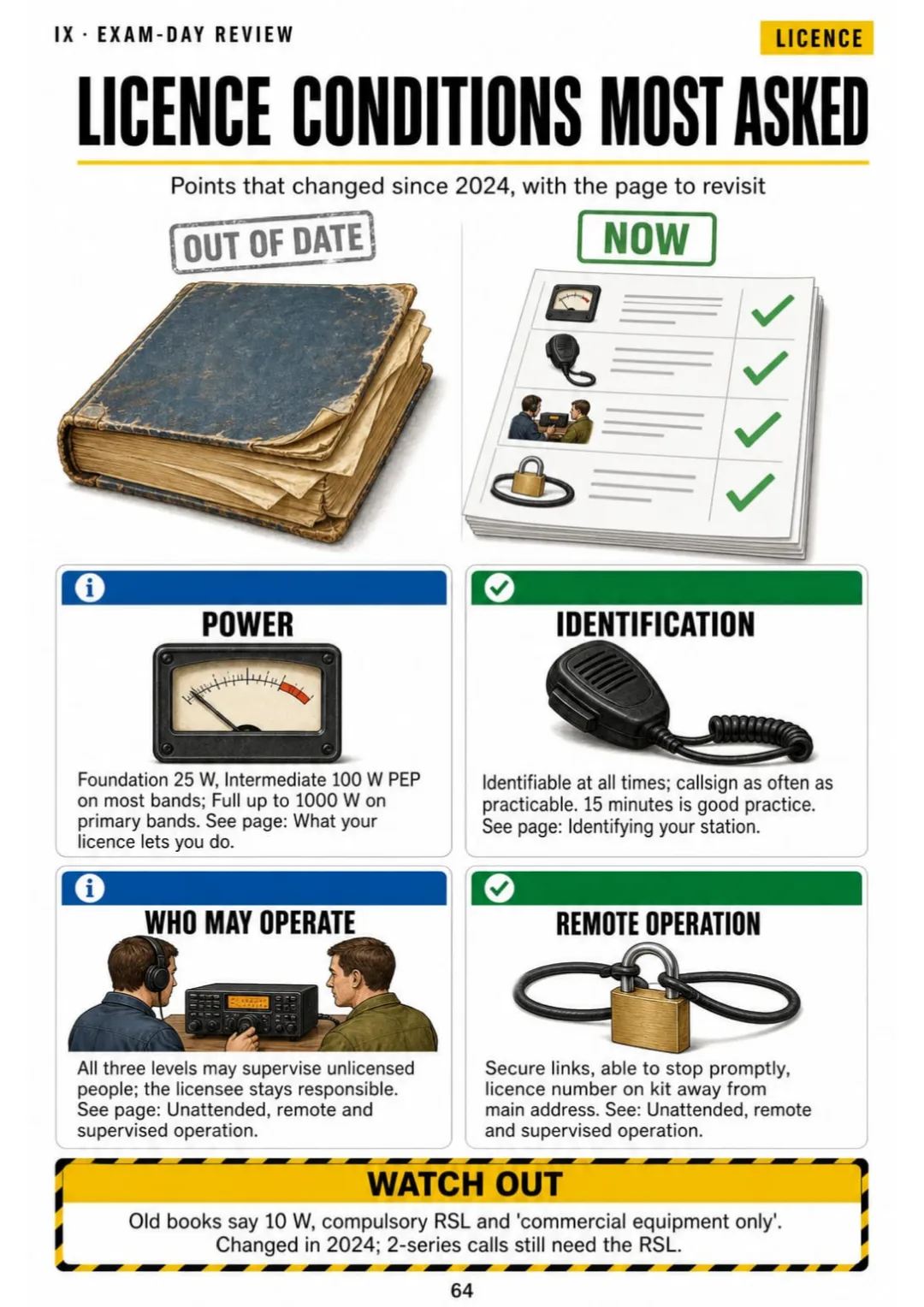
Since 21 Feb 2024: 25 W Foundation, 100 W Intermediate, 1000 W Full on primary bands

Take a Look at the 9 Parts and 62 Topics

The Licence Ladder

pp. 5-10
  1. Foundation, Intermediate, Full: three steps
  2. What the exam looks like
  3. How to read the syllabus
  4. Your callsign and what it tells others
  5. Units you'll meet on every page
  6. The 4-step method for every calculation

Electricity You Can See

pp. 11-18
  1. Voltage, current, resistance as water in a pipe
  2. Ohm's law with the triangle
  3. Power: watts from volts and amps
  4. Resistors in series and in parallel
  5. The resistor colour code
  6. DC and AC: the battery and the wave
  7. Frequency and wavelength
  8. Decibels without fear

Components and Circuits

pp. 19-26
  1. Capacitors: storing charge
  2. Inductors: the coil that resists change
  3. Tuned circuits and resonance
  4. Filters: low-pass, high-pass, band-pass
  5. Diodes and rectifying
  6. Transistors as switch and amplifier
  7. Transformers and turns ratio
  8. Power supplies and batteries

Transmitters and Receivers

pp. 27-34
  1. Your station as a block diagram
  2. Oscillators: where the signal is born
  3. Modulation: AM, FM and SSB
  4. CW and data modes
  5. The superhet receiver
  6. Image frequency and selectivity
  7. Transmitter stages and harmonics
  8. Transverters, repeaters and the offset

Feeders and Antennas

pp. 35-42
  1. Coax and ladder line
  2. SWR: what the meter is telling you
  3. The ATU and matching
  4. The half-wave dipole
  5. The quarter-wave vertical and its radials
  6. Beams and gain
  7. Polarisation
  8. Baluns and common-mode current

Propagation

pp. 43-48
  1. Ground wave and line of sight
  2. The ionosphere layers: D, E, F1, F2
  3. Skip distance and the dead zone
  4. MUF and choosing the band
  5. The sunspot cycle
  6. VHF surprises: tropo and Sporadic E

Licence Conditions and Operating

pp. 49-56
  1. What your licence lets you do
  2. UK band plans: the main bands
  3. Identifying your station
  4. Who you may talk to and what you may say
  5. Unattended, remote and supervised operation
  6. The phonetic alphabet
  7. Q codes and RST reports
  8. A first contact, start to finish

Safety and EMC

pp. 57-61
  1. Mains and electrical safety
  2. Antenna and mast safety
  3. RF exposure
  4. EMC: when your signal gets into the neighbour's TV
  5. Interference you receive

Exam-Day Review

pp. 62-66
  1. Every formula on one page
  2. Wavelength or frequency? The mix-up drawn
  3. Licence conditions most often asked
  4. How to read a multiple-choice question
  5. The night-before checklist

Who This Book Is For

You're on the Foundation course

Each evening's topic is one page you can look at again before the next club session. Callsigns, band plans and licence rules are all drawn.

Your exam date is booked

Part IX puts every formula and the licence conditions most often asked on a handful of pages, ready for the last week of revision.

You already hold a licence

If you're stepping up to Intermediate or Full, every calculation is solved in the same 4 steps. The book stays by the radio for a quick check.

Plus: 2 Free Books

Exam-Style Questions with Answers
BONUS 1

Exam-Style Questions with Answers

Practise with multiple-choice questions in the style of the real papers, each answer explained with the drawing from the page it comes from.
The 15 Most Common Mistakes, Before and After
BONUS 2

The 15 Most Common Mistakes, Before and After

See the slips candidates make most often, from mixing up wavelength and frequency to misreading licence conditions, and the right version next to each one.

30-Day Guarantee

30-day guarantee: if a file doesn't open, if the content isn't what the product page describes, if you were charged twice or the email never arrived, write to us and we'll refund you in full. You pay once. No subscriptions.

Frequently Asked Questions

Is it for me if I'm doing the Foundation course at my local club or online?

Yes. It follows the current UK Foundation, Intermediate and Full syllabus, with UK band plans and Ofcom's licence terms: it isn't an American book. Foundation topics start from zero, and the Intermediate and Full calculations (Ohm's law, power, decibels, dipole length, image frequency) are each solved in the same 4 steps. It works with a club course, an online course or self-study.

Where does the content come from?

From the current published syllabus for the UK Foundation, Intermediate and Full exams and from Ofcom's Amateur Radio Licence terms. Anything that can change, such as power limits or band plans, is marked so you can check it against the current version.

Is it official material?

No. It's an independent illustrated study guide. It isn't published, approved or endorsed by Ofcom, the RSGB or any exam body.

Does it replace the course?

No. It's a study aid to use alongside your course manual, your club and the official syllabus. What it adds: each topic on its own page with a drawing, so you can find it again in seconds before the next club session or the exam. It doesn't give you a licence or a certificate: for that you still sit the exam.

Are the practice questions the real exam questions?

No. The questions in the bonus book are written for this book, in the style of a multiple-choice paper. None of them come from an official question bank.

When and how does it arrive?

The book and the 2 bonus books come as PDFs by email, sent to the address you enter when you pay.

Do I have to pay every month?

No. It's a one-off payment with no subscription.

Can I have it on paper?

Yes. It's a PDF, so you can print it at home or at a print shop. Print the whole book or just the pages you want by the radio.

How does the refund work?

You have 30 days. We refund everything if the file won't open, if the book isn't what you see on this page, if you were charged twice or if the email doesn't arrive: just email us.

£19.99£57.99
Get the book · £19.99

This is a digital PDF book sent to your email: nothing is printed or shipped.