Study in Pictures🌐 English (United Kingdom)
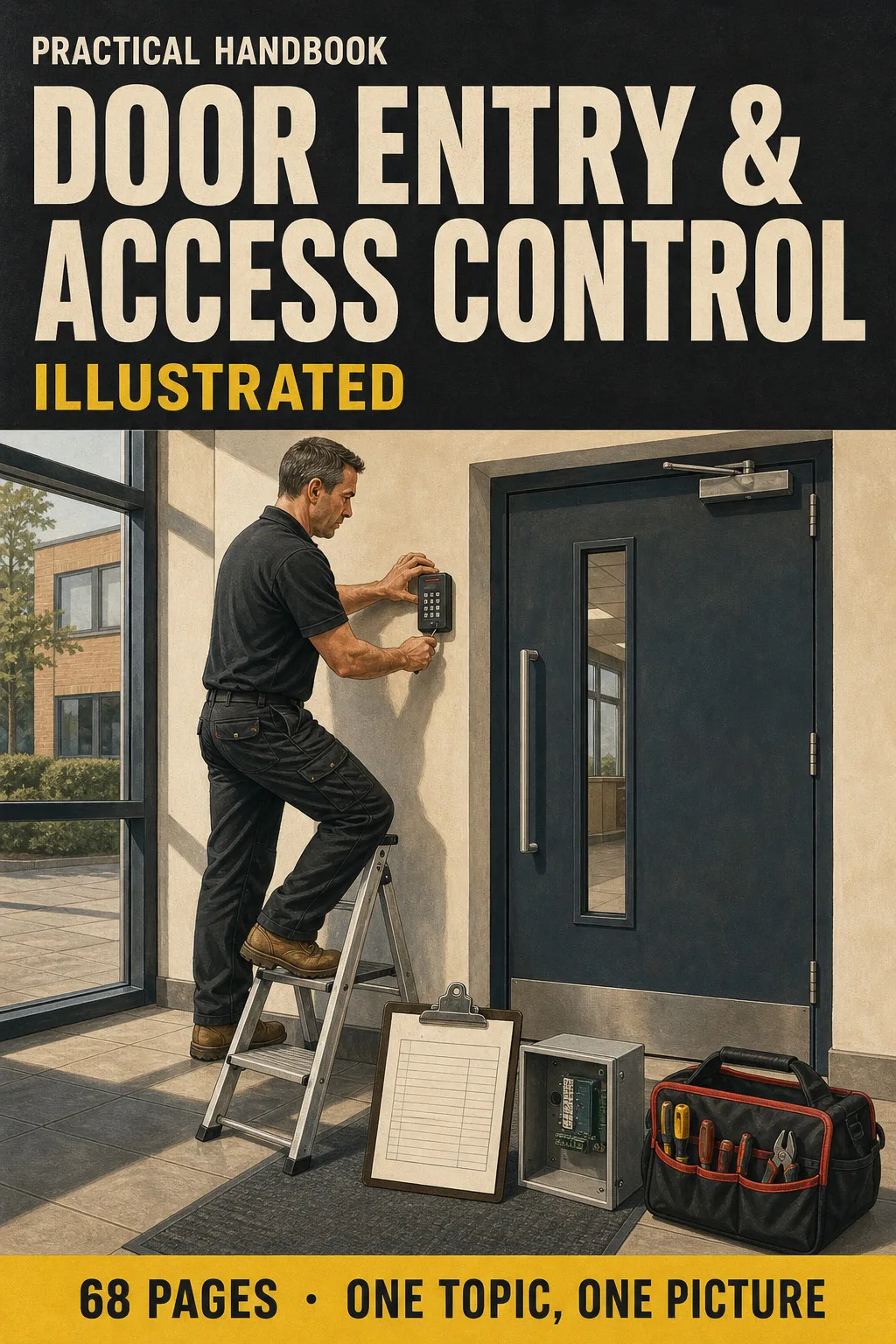
Door Entry & Access Control Illustrated

Digital book in PDF · read it on your phone or print it

Door Entry & Access Control Illustrated

Maglocks and strikes, fail-safe vs fail-secure, sizing the PSU, Wiegand and OSDP, door entry panels, wiring a door step by step, escape routes and the fire alarm link, commissioning and fault finding. Every topic has its own page: the drawing first, then what you need to remember.

  • 68 illustrated pages
  • English
  • 30-day guarantee
£19.99£57.99
Get the book · £19.99

Price shown for: United Kingdom. In other countries, the checkout shows the price that applies there.

About this book

What it is

Maglocks and strikes, fail-safe vs fail-secure, sizing the PSU, Wiegand and OSDP, door entry panels, wiring a door step by step, escape routes and the fire alarm link, commissioning and fault finding. Every topic has its own page: the drawing first, then what you need to remember.

Who This Book Is For
  • You're adding doors to your work
  • You've got a door job booked
  • You already fit and maintain doors
What it covers
  1. The Whole System at a Glance
  2. Locks and Door Hardware
  3. Power Supplies
  4. Readers, Credentials and Controllers
  5. Door Entry and Intercoms
  6. Wiring a Door Start to Finish
  7. Fire Safety, Escape and the Law
  8. Commissioning and Fault Finding
  9. Revision and Quick Checks
Language
English (United Kingdom)
Pages
68
Format
Digital book in PDF · read it on your phone or print it
Price
£19.99 (United Kingdom)
Delivery
This is a digital PDF book sent to your email: nothing is printed or shipped.
30-Day Guarantee
30-day guarantee: if a file doesn't open, if the content isn't what the product page describes, if you were charged twice or the email never arrived, write to us and we'll refund you in full.

Look Inside the Book

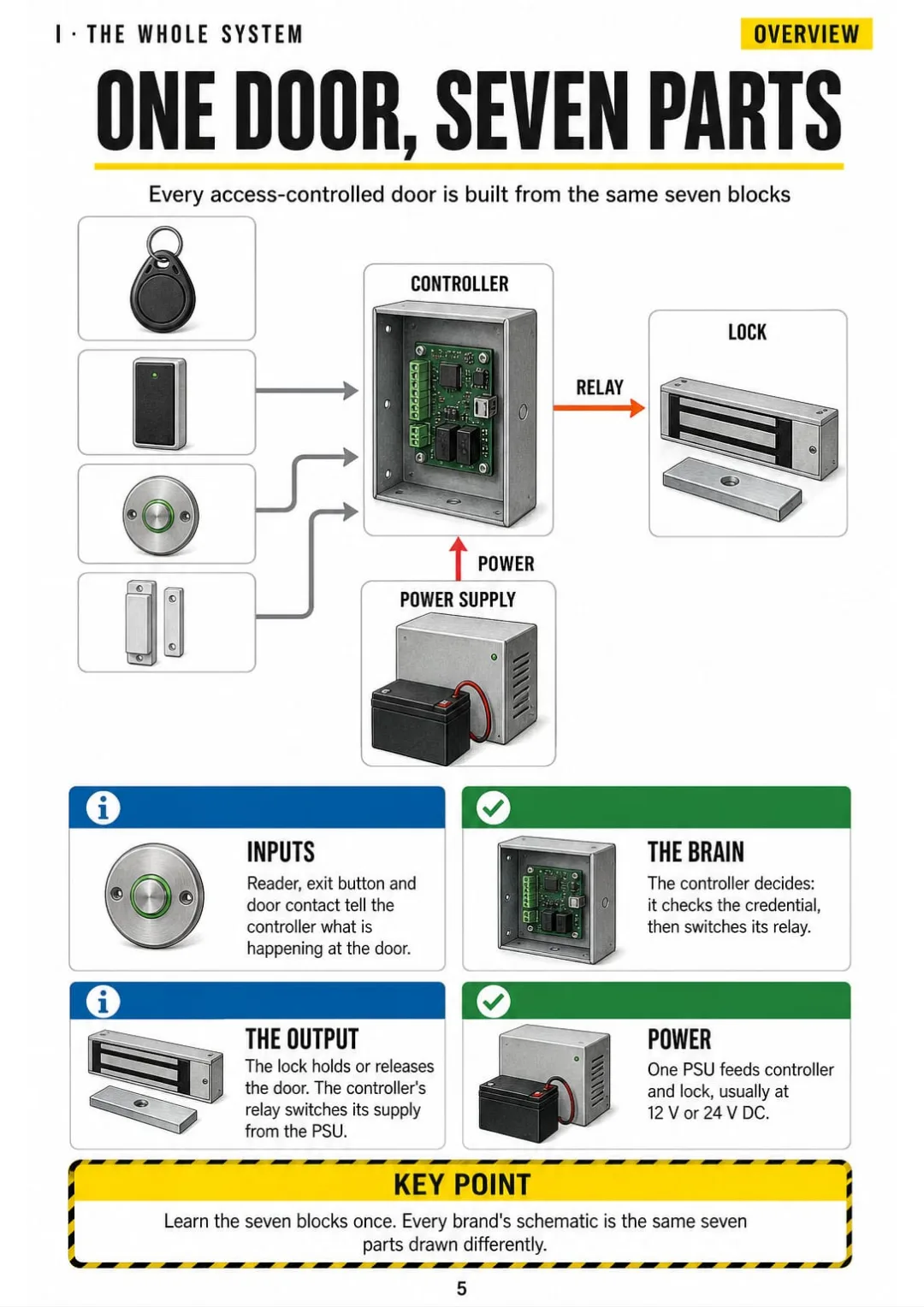
Credential, reader, controller, lock, PSU, exit button, door contact: one block diagram.
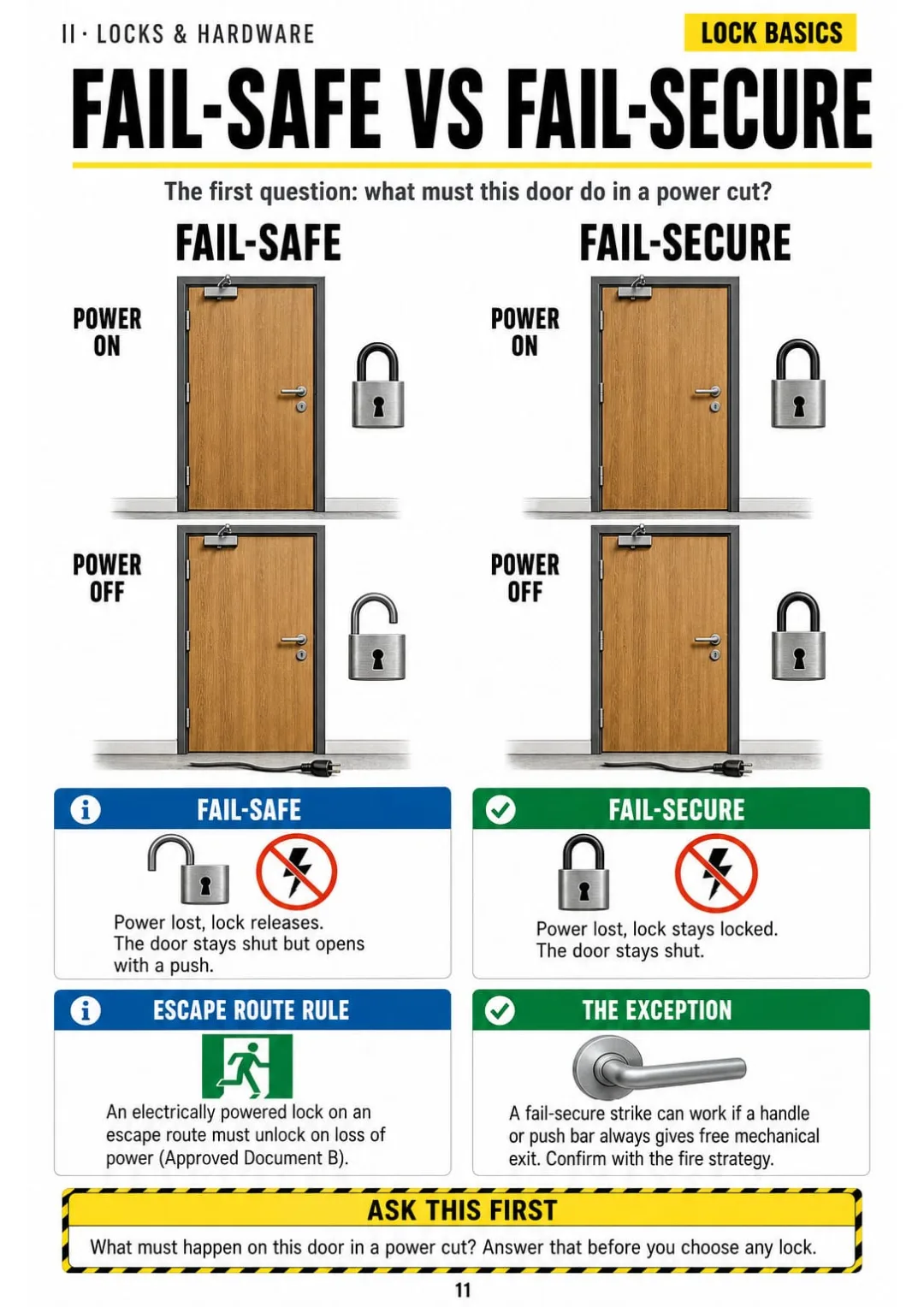
Same door, power on and off: fail-safe releases, fail-secure holds.
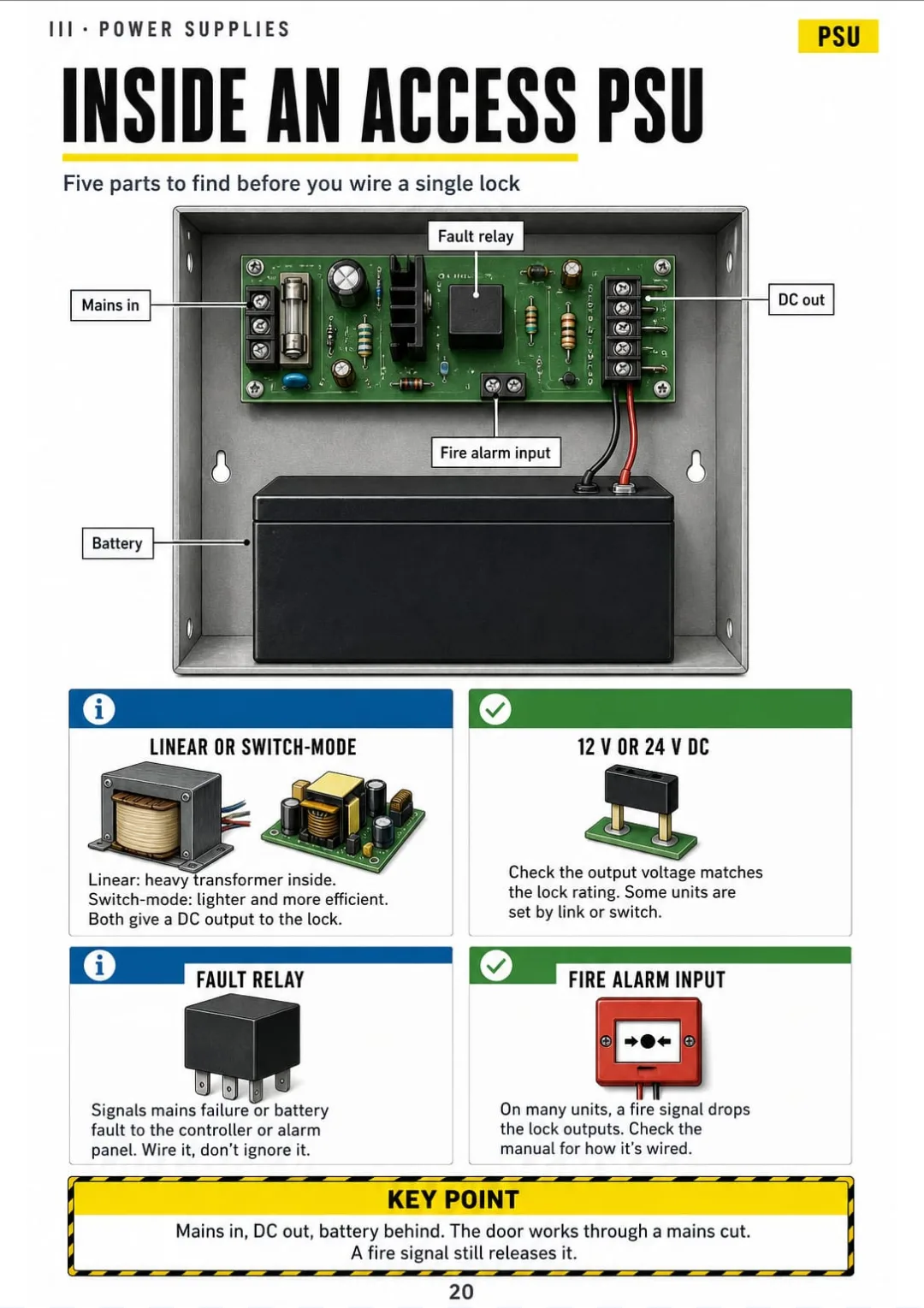
Mains input, fused outputs, battery, charger and fault relay, labelled on one open PSU.
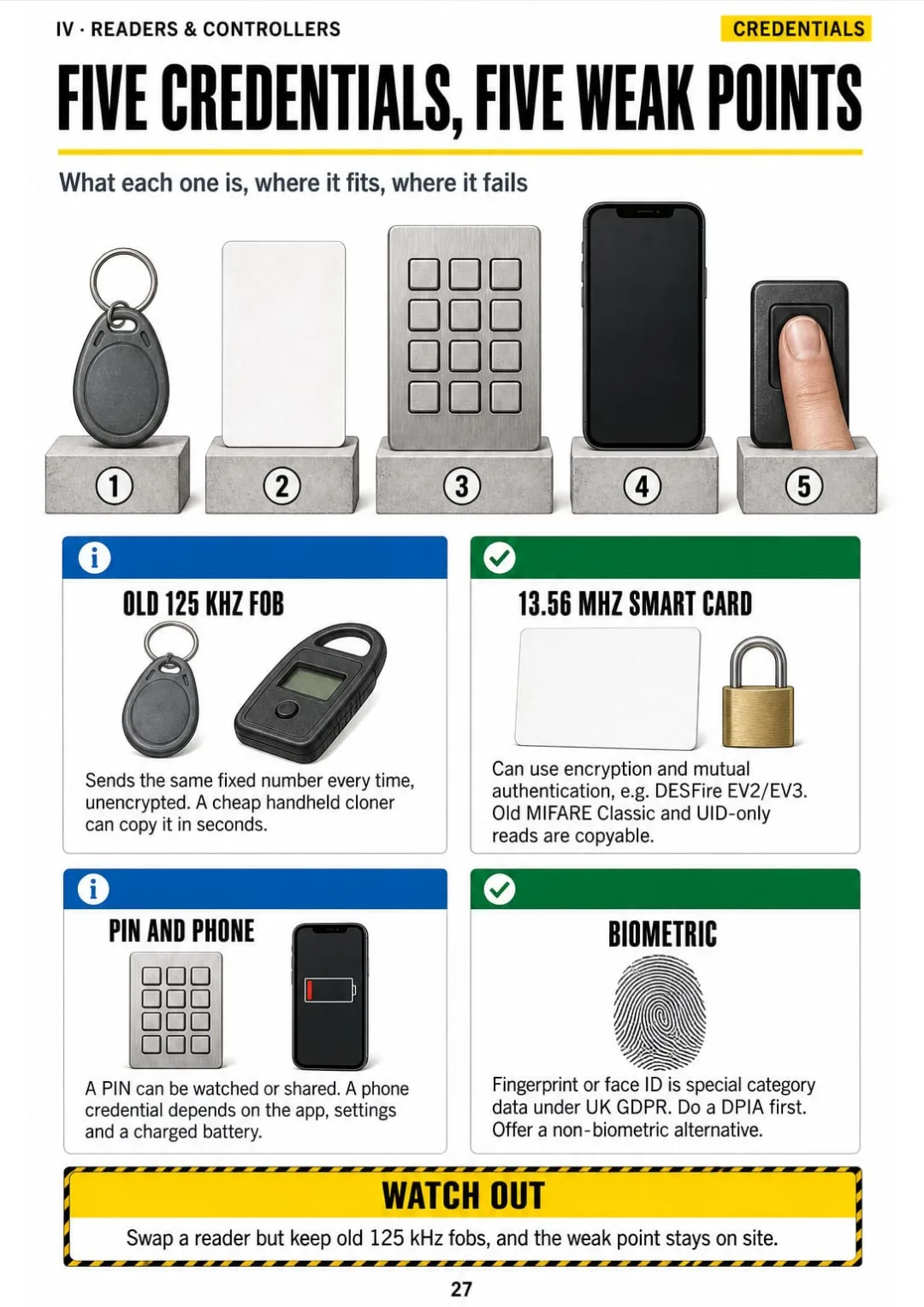
Fob, card, PIN, phone, biometric: 125 kHz vs 13.56 MHz and each weak point
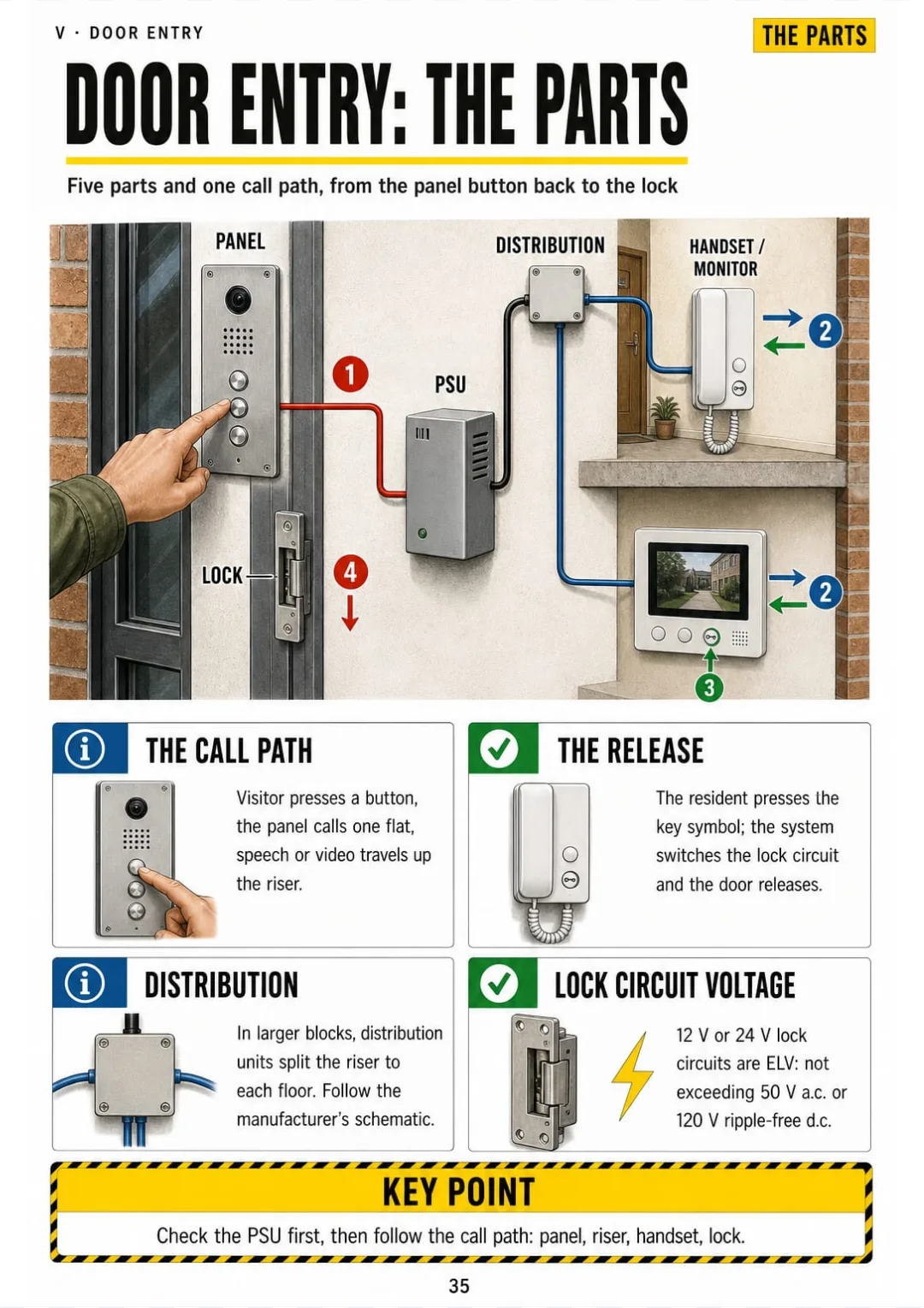
Panel, PSU, handset, monitor and lock: the call path in four numbered steps
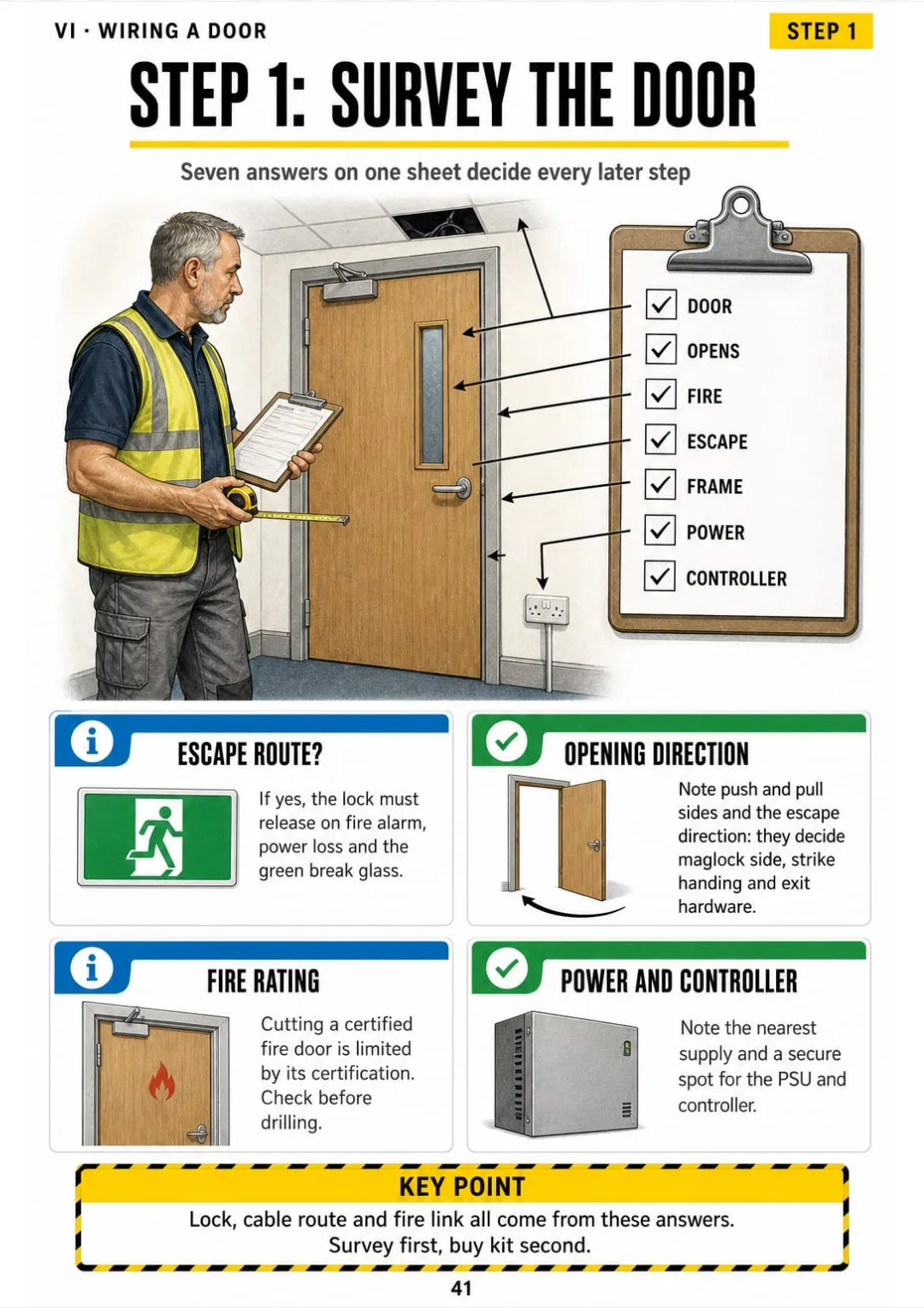
Door survey: material, swing, fire rating, escape route, frame, power, controller
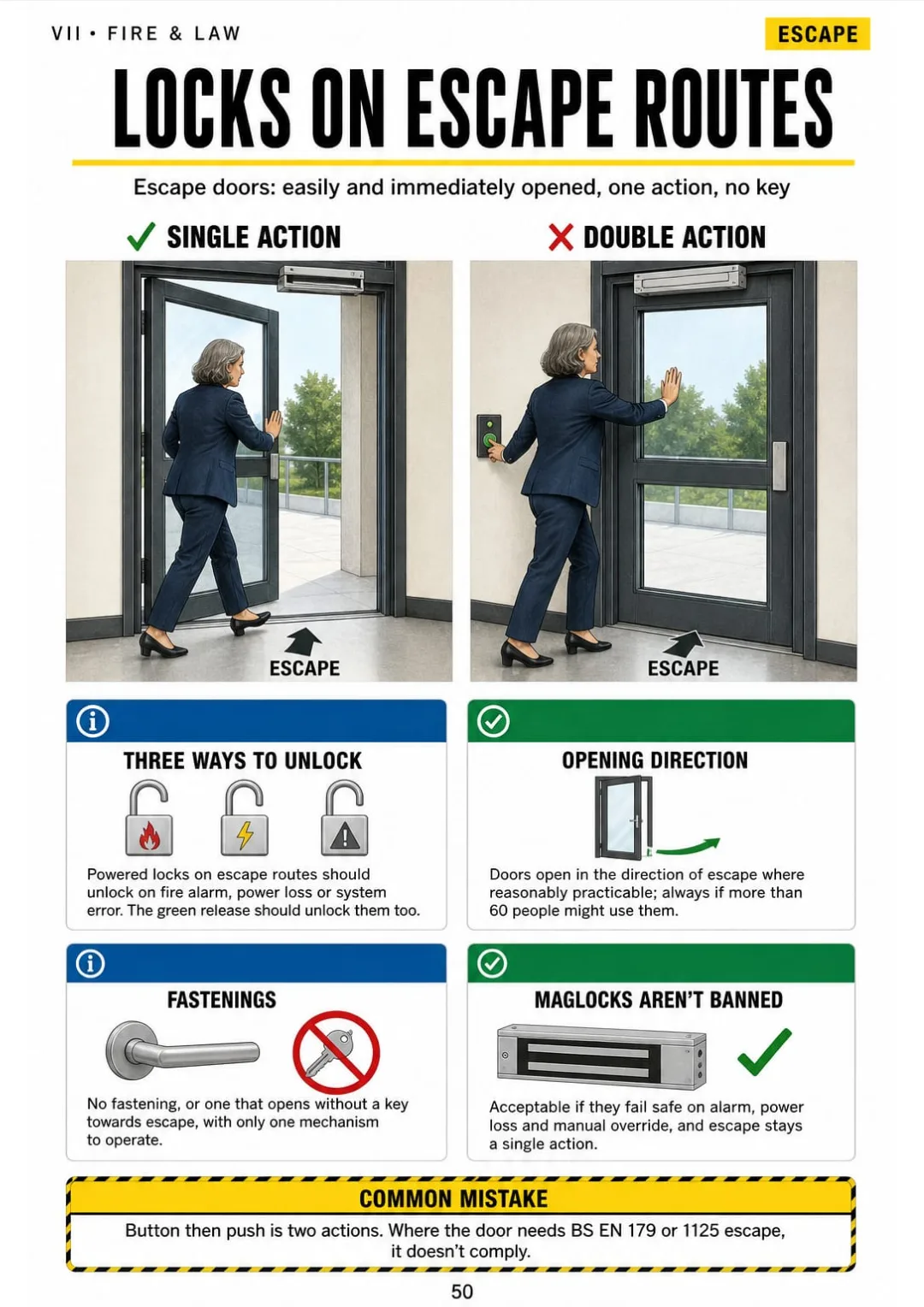
Maglock plus press-to-exit then push = two actions: not compliant where BS EN 179/1125 escape is required.
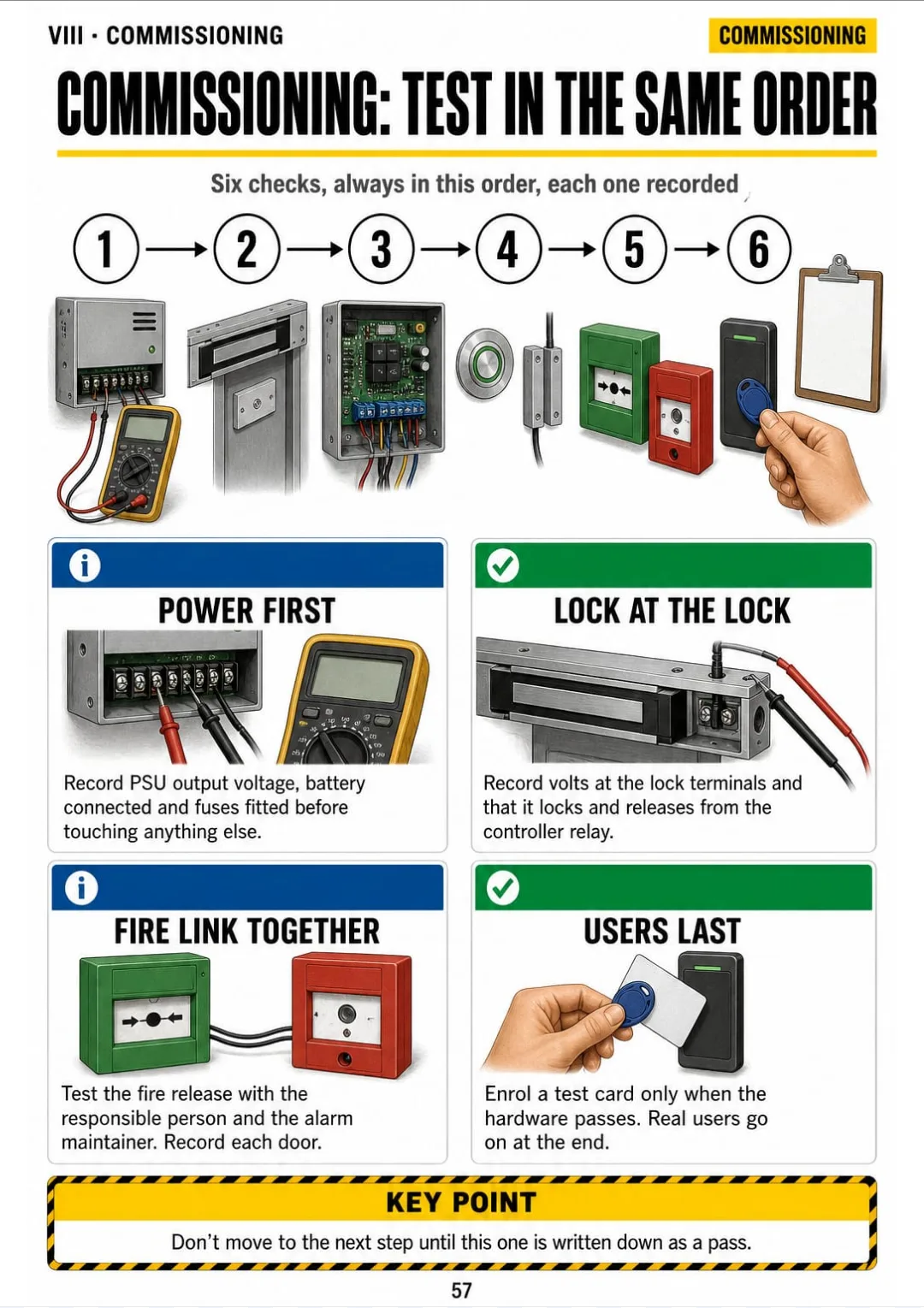
Power, lock, controller, inputs, fire link, users: six checks, always in that order.

Take a Look at the 9 Parts and 64 Topics

The Whole System at a Glance

pp. 5-10
  1. One Door, Seven Parts
  2. Door Entry vs Access Control
  3. Standalone, Networked or Cloud
  4. The Signal Path: In, Decide, Out
  5. Low Voltage, Mains and Where They Meet
  6. Reading a Manufacturer's Schematic

Locks and Door Hardware

pp. 11-19
  1. Fail-Safe vs Fail-Secure
  2. The Maglock
  3. Maglock Mounting: Brackets and Alignment
  4. The Electric Strike (Release)
  5. Shear Locks and Electric Bolts
  6. Motor Locks and Electric Mortice Locks
  7. Exit Hardware: Push Bars and Lever Handles
  8. Door Closers and Why the Door Must Close
  9. Choosing the Lock for the Door

Power Supplies

pp. 20-26
  1. Inside an Access PSU
  2. Adding Up the Load
  3. 12 V or 24 V: Same Lock, Half the Current
  4. Voltage Drop on the Lock Run
  5. Battery Standby: How Many Hours
  6. Back EMF: Diode and Varistor
  7. Fused Outputs and Supply Separation

Readers, Credentials and Controllers

pp. 27-34
  1. Credentials: Fob, Card, PIN, Phone, Biometric
  2. Wiegand: D0, D1 and Its Limits
  3. OSDP over RS-485
  4. Reader Positioning
  5. The Door Controller
  6. Relay Contacts: NO, NC and COM
  7. Door Contact and Request-to-Exit
  8. Access Levels, Schedules and Door Modes

Door Entry and Intercoms

pp. 35-40
  1. Audio and Video Door Entry: the Parts
  2. Multi-Wire vs 2-Wire Systems
  3. IP and SIP Door Entry
  4. GSM and 4G Intercoms
  5. Trade Buttons and Postal Access
  6. Upgrading an Old Door Entry System

Wiring a Door Start to Finish

pp. 41-49
  1. Step 1: Survey the Door
  2. Step 2: Plan the Cable Runs
  3. Step 3: Get Power and Data into the Door
  4. Segregation from Mains Cables
  5. Step 4: Fit and Wire the Lock
  6. Step 5: Fit and Wire the Reader
  7. Step 6: Exit Button and Door Contact
  8. Step 7: The Green Break Glass
  9. Step 8: Label, Tidy and Record

Fire Safety, Escape and the Law

pp. 50-56
  1. Locks on Escape Routes
  2. Linking to the Fire Alarm: BS 7273-4
  3. Fire Doors and What You Can Fit
  4. Accessible Doors
  5. Mains Work: What BS 7671 Covers
  6. User Data and UK GDPR
  7. Security Grading: BS EN 60839-11-1

Commissioning and Fault Finding

pp. 57-64
  1. Commissioning: Test in the Same Order
  2. Testing the Lock and the Fire Release
  3. Insulation Testing Without Damaging the Kit
  4. Fault-Finding Order: Power, Lock, Controller, Input
  5. Door Won't Release
  6. Door Won't Lock or Hold
  7. Reader Dead or Card Not Reading
  8. Handover to the Customer

Revision and Quick Checks

pp. 65-68
  1. Most Frequent Wiring Mistakes
  2. Most Frequent Survey and Hardware Mistakes
  3. The Door on One Page
  4. Pre-Handover Checklist

Who This Book Is For

You're adding doors to your work

The whole system in order, from the block diagram to the lock, before you take on your first access job.

You've got a door job booked

Survey, lock choice, PSU sizing and the wiring steps on the page, so you turn up knowing what to order and in which order to fit it.

You already fit and maintain doors

The fault-finding order and the escape-route pages to hand for call-outs, printed and kept in the van.

Plus: 2 Free Books

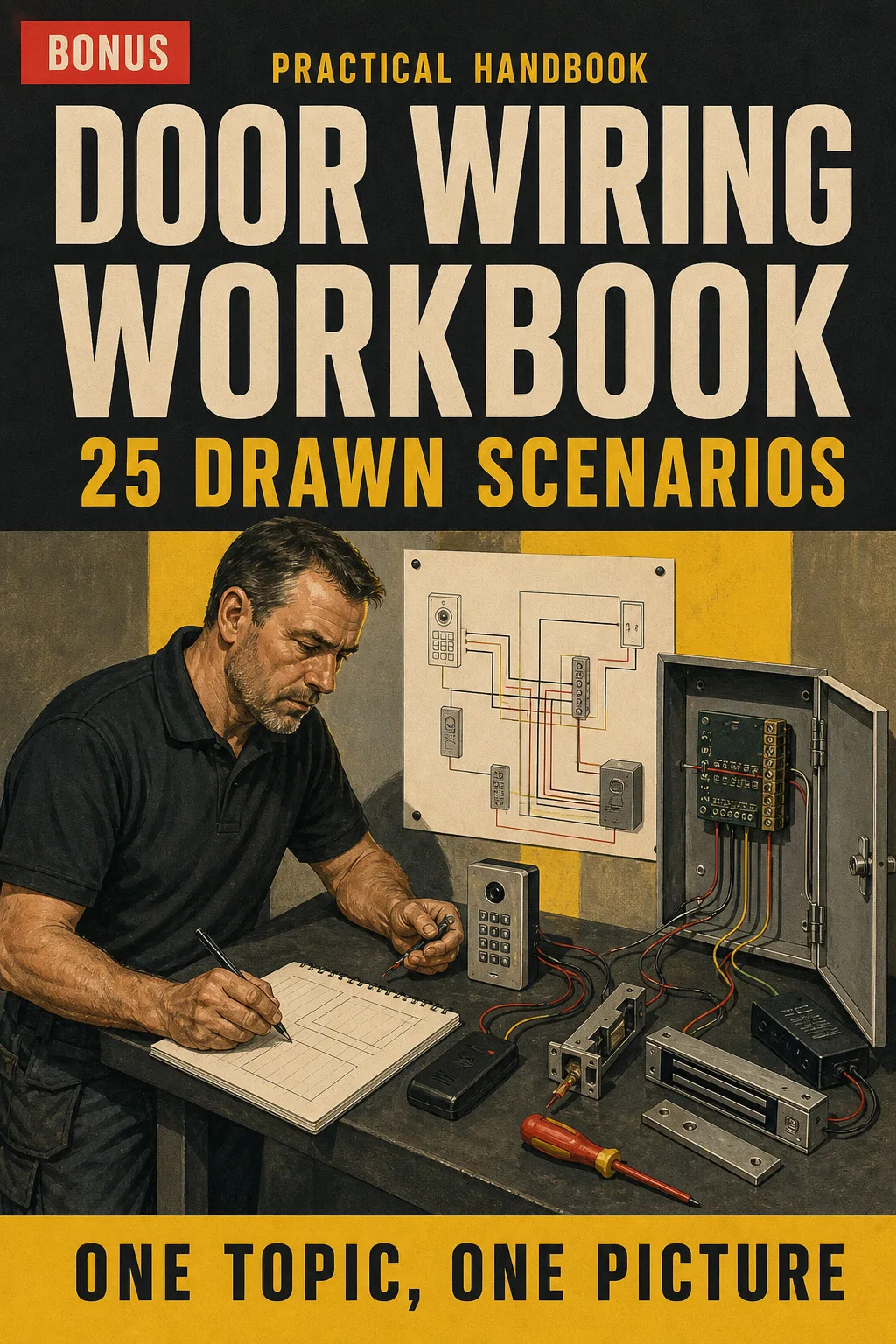
Door Wiring Workbook: 25 Drawn Scenarios
BONUS 1

Door Wiring Workbook: 25 Drawn Scenarios

Practise on real-style doors: choose the lock, size the power supply and trace the wiring, then check your answer against the drawing.
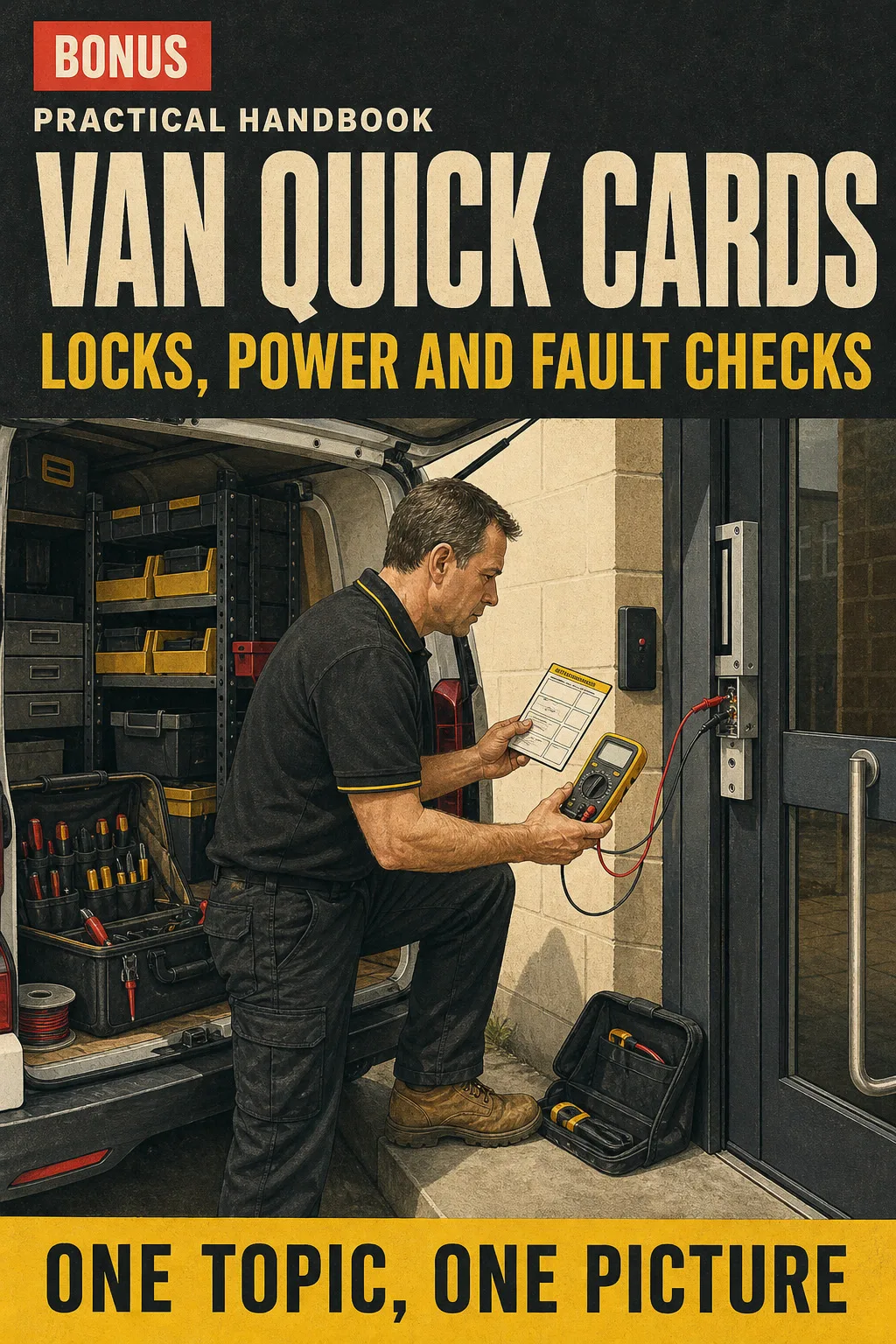
Van Quick Cards: Locks, Power and Fault Checks
BONUS 2

Van Quick Cards: Locks, Power and Fault Checks

Print them and keep them in the van: lock types, fail-safe vs fail-secure and the fault-check order, one card each, readable at a glance.

30-Day Guarantee

30-day guarantee: if a file doesn't open, if the content isn't what the product page describes, if you were charged twice or the email never arrived, write to us and we'll refund you in full. You pay once. No subscriptions.

Frequently Asked Questions

Is it for me if I'm already an electrician?

Yes. It assumes you know electrics and doesn't explain what a volt is. It puts the access side in order: locks, power, readers, wiring, escape rules and fault finding.

Where does the content come from?

It's checked against current UK guidance: BS 7671, BS 7273-4, BS EN 60839-11-1, BS EN 179, BS EN 1125 and BS EN 13637, and ICO guidance on UK GDPR. Fire and building rules follow the documents for England (Regulatory Reform (Fire Safety) Order 2005, Approved Documents B and M). Scotland, Wales and Northern Ireland have their own, so check them locally. It doesn't reproduce text or tables from any standard.

Is it official material?

No. It's an independent, brand-neutral illustrated guide, not linked to any manufacturer, standards body or trade scheme. Terminals are drawn generically (NO, NC, COM, 12 V and 24 V, D0/D1, OSDP A/B), so you can match them to any maker's schematic.

Does it replace training or the manufacturer's instructions?

No. It's a study and site reference, with no certificate or CPD hours. Always follow the kit's instructions. On escape routes and fire doors, the final design is set by the fire risk assessment and the person responsible for the building.

Are the practice scenarios from an exam?

No. The 25 scenarios in the workbook are written for this book. They aren't questions from any exam, course or certification.

When and how do I get it?

As a PDF by email, sent to the address you enter when you pay. The 2 free books come with it.

Do I have to pay every month?

No. It's a one-off payment.

Can I have it on paper?

Yes. It's a printable PDF: print the pages you need, or the whole book, and keep it in the van.

How does the refund work?

You have 30 days. We refund everything if the file won't open, if the book isn't what you see on this page, if you were charged twice or if the email doesn't arrive: just email us.

£19.99£57.99
Get the book · £19.99

This is a digital PDF book sent to your email: nothing is printed or shipped.