Study in Pictures🌐 English (Canada)
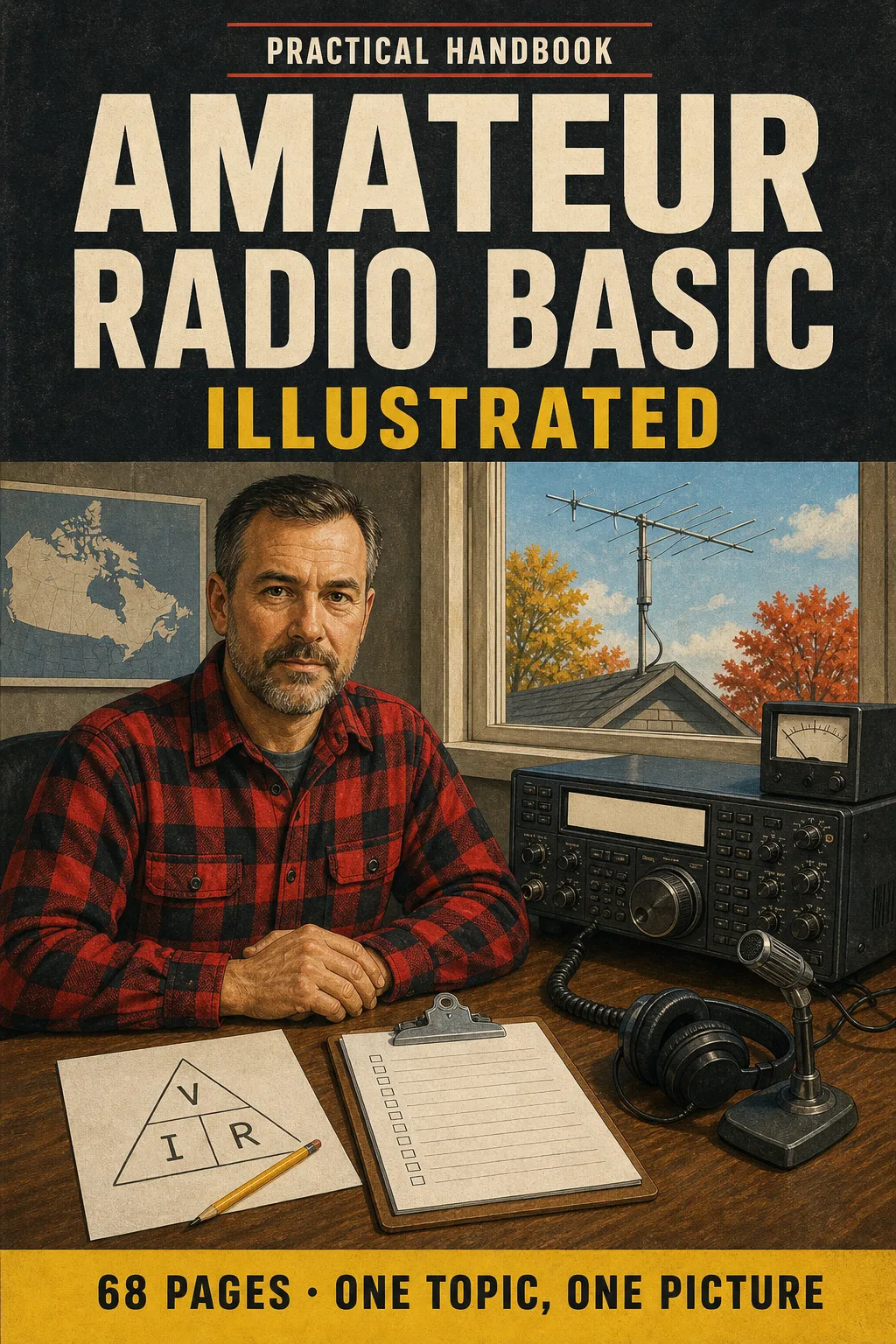
Amateur Radio Basic Illustrated

Digital book in PDF · read it on your phone or print it

Amateur Radio Basic Illustrated

Ohm's law, the resistor colour code, the superhet receiver, antennas and SWR, the ionosphere, Canada's bands, call signs and RF safety, one page each: the drawing first, then the numbers to remember, and every calculation worked in the same 4 steps.

  • 68 illustrated pages
  • English
  • 30-day guarantee
CA$ 34.99CA$ 79.99
Get the book · CA$ 34.99

Price shown for: Canada. In other countries, the checkout shows the price that applies there.

About this book

What it is

Ohm's law, the resistor colour code, the superhet receiver, antennas and SWR, the ionosphere, Canada's bands, call signs and RF safety, one page each: the drawing first, then the numbers to remember, and every calculation worked in the same 4 steps.

Who This Book Is For
  • You're starting the Basic
  • Your exam is coming up
  • You already have your call sign
What it covers
  1. The Exam and Your Certificate
  2. Electricity Without the Headache
  3. Components You Must Recognize
  4. Transmitters, Receivers and Modes
  5. Antennas and Feed Lines
  6. Propagation: Where the Signal Goes
  7. Canadian Rules and Operating Practice
  8. Safety and Interference
  9. Review Before the Exam
Language
English (Canada)
Pages
68
Format
Digital book in PDF · read it on your phone or print it
Price
CA$ 34.99 (Canada)
Delivery
This is a digital PDF book sent to your email: nothing is printed or shipped.
30-Day Guarantee
30-day guarantee: if a file doesn't open, if the content isn't what the product page describes, if you were charged twice or the email never arrived, write to us and we'll refund you in full.

Look Inside the Book

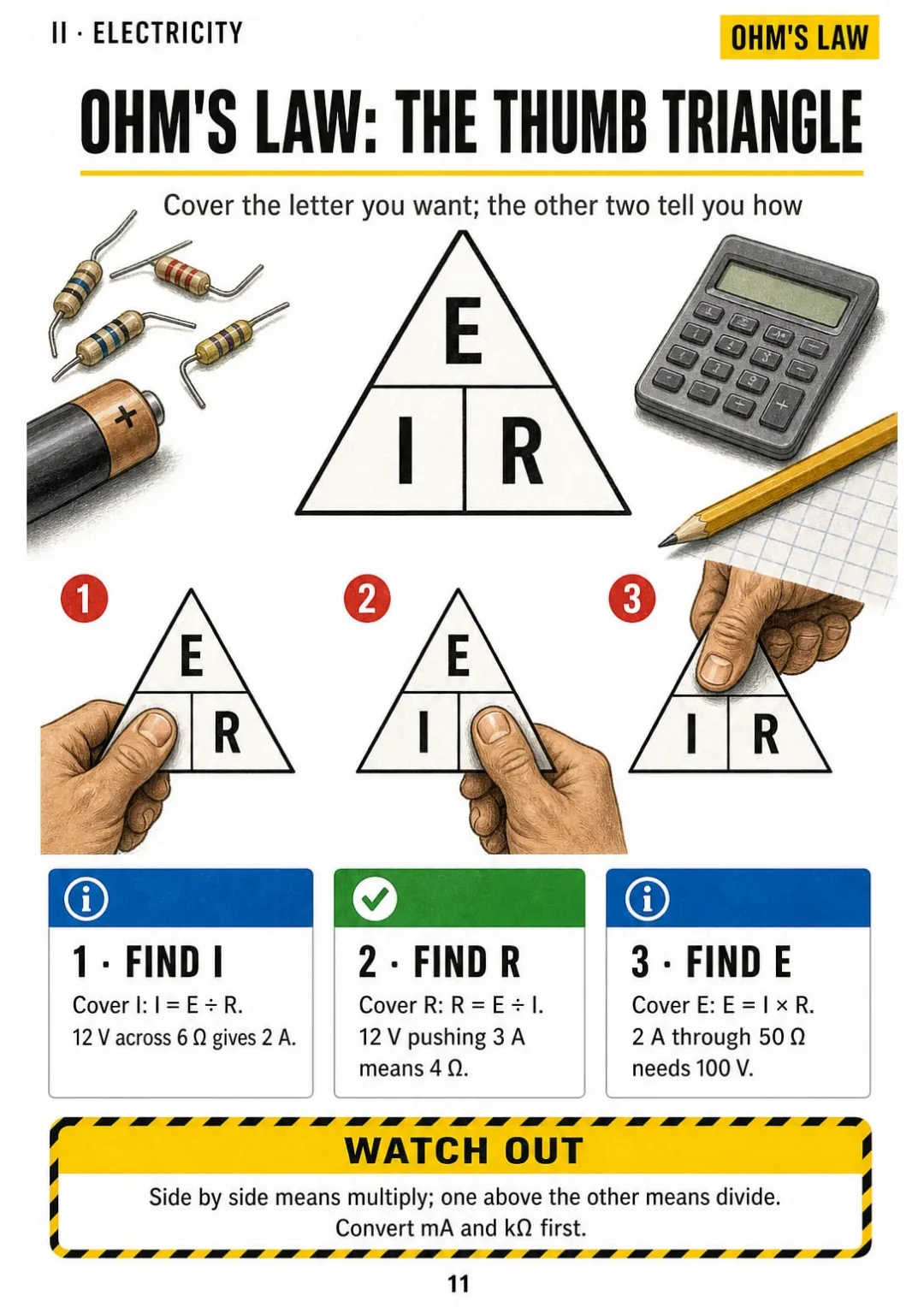
E = I × R: 12 V across 6 Ω gives 2 A
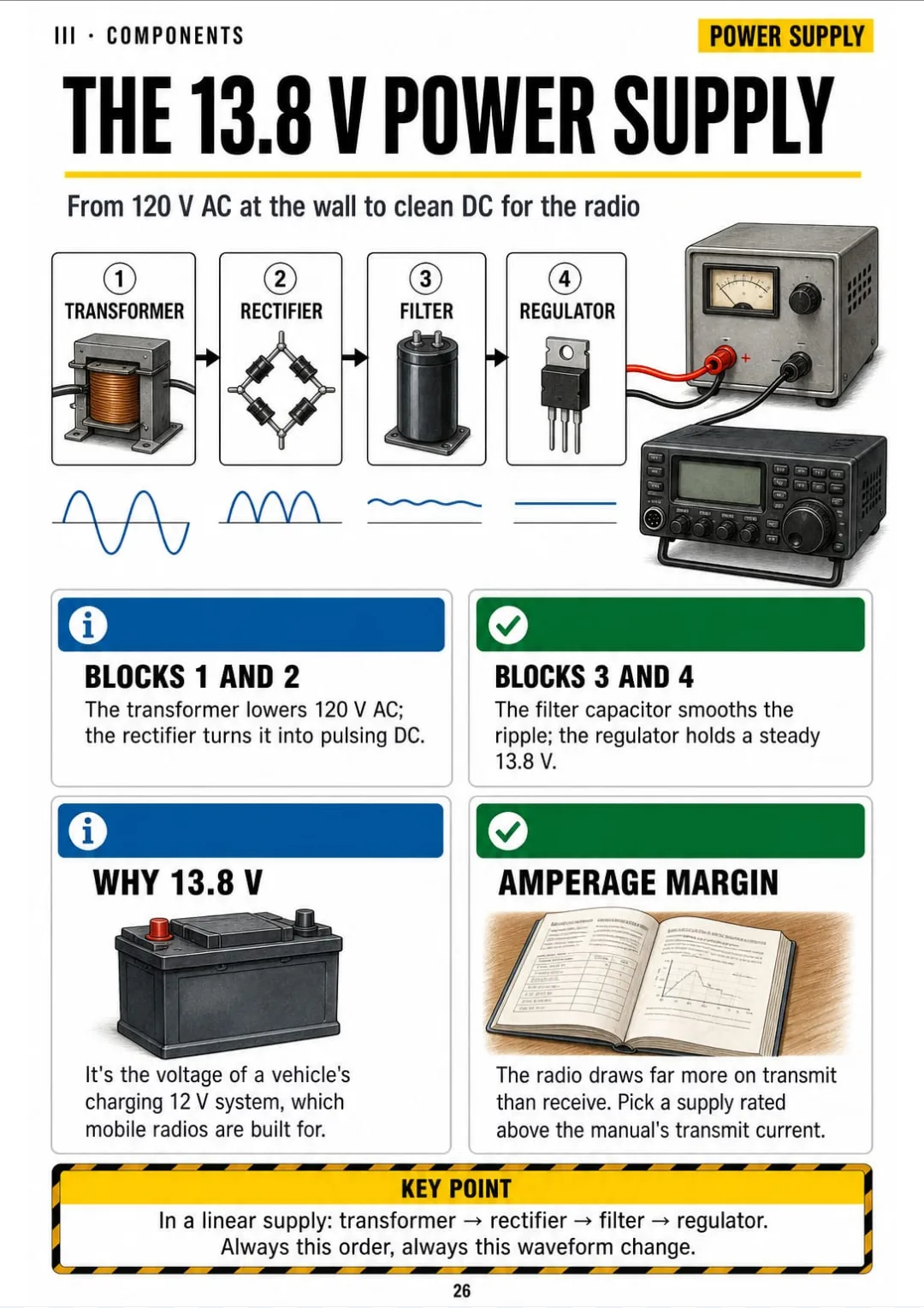
Transformer → rectifier → filter capacitor → regulator: 13.8 V DC out
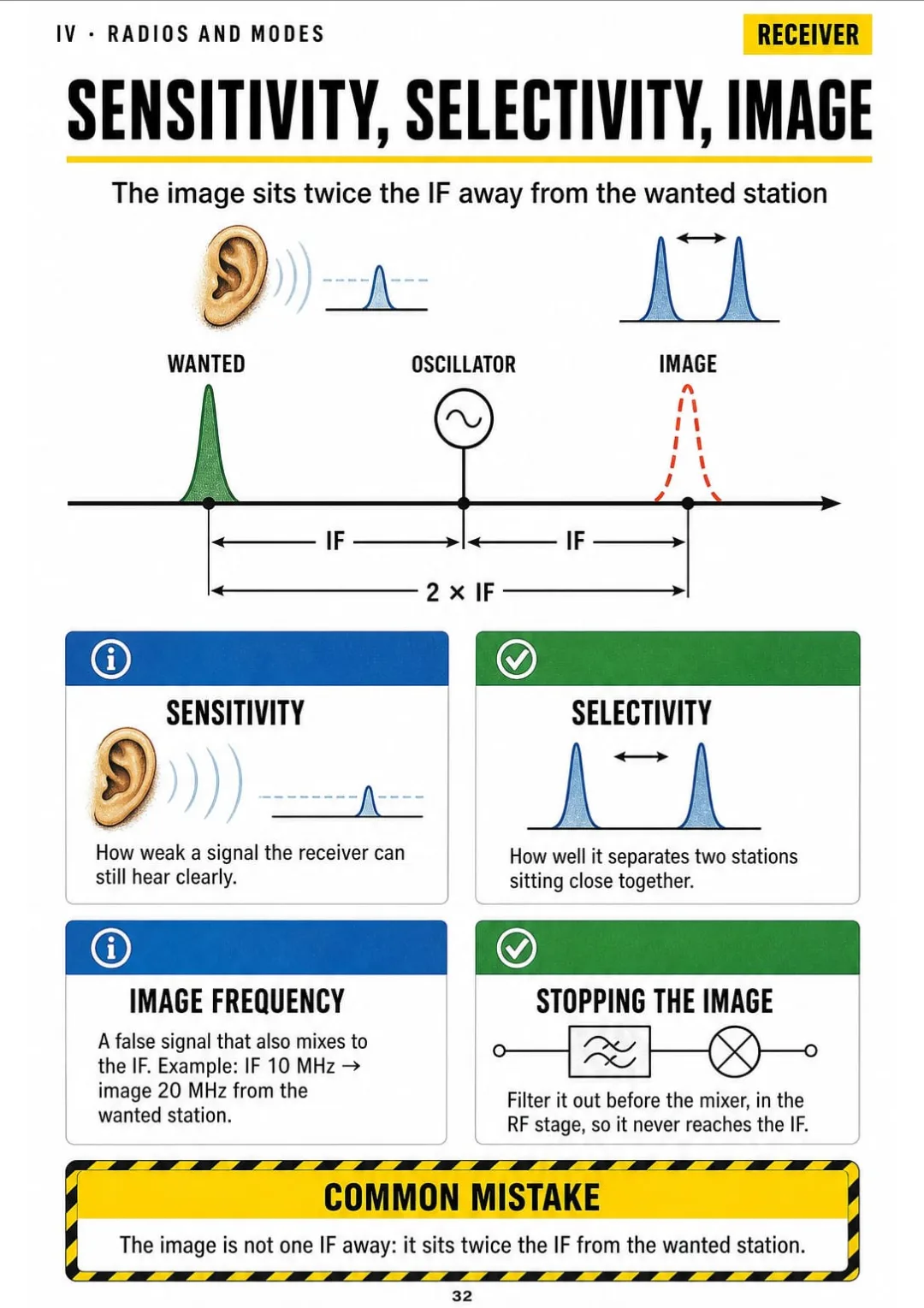
Image frequency = wanted station ± 2 × IF
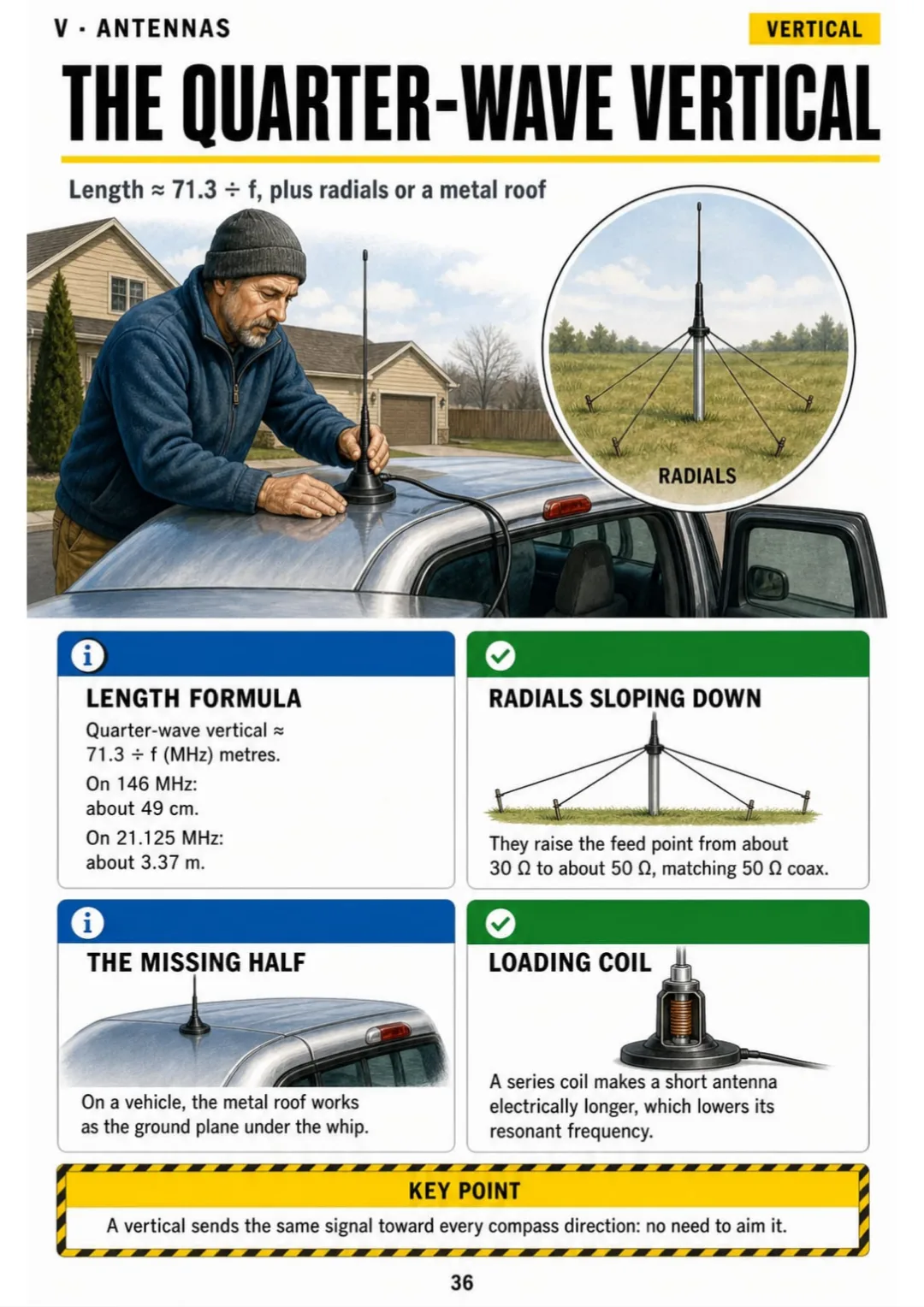
Quarter-wave vertical ≈ 71.3 ÷ f (MHz): about 49 cm on 2 m; sloping radials bring it to about 50 Ω
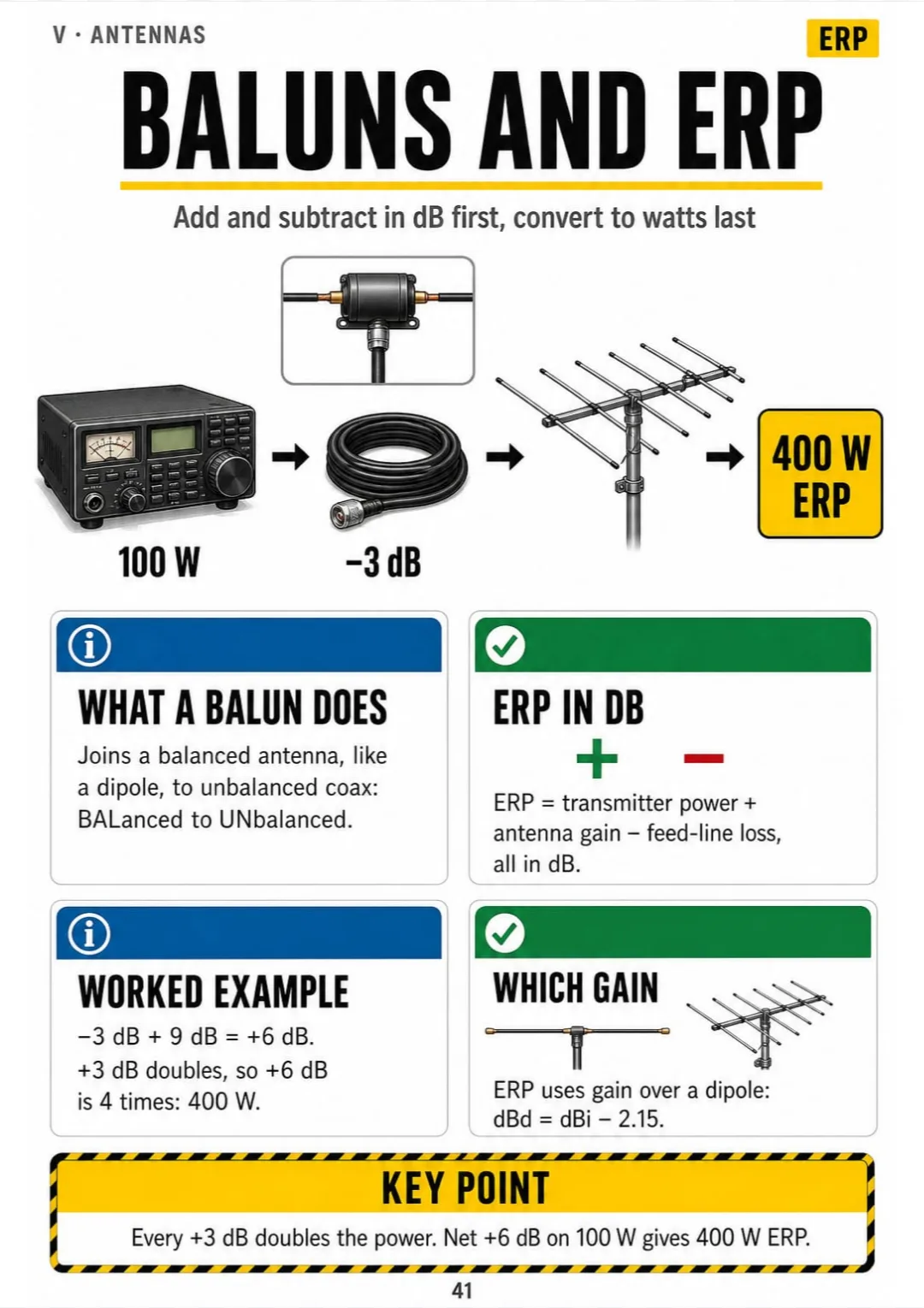
ERP = power + gain − line loss: 100 W, −3 dB, +9 dB = 400 W ERP
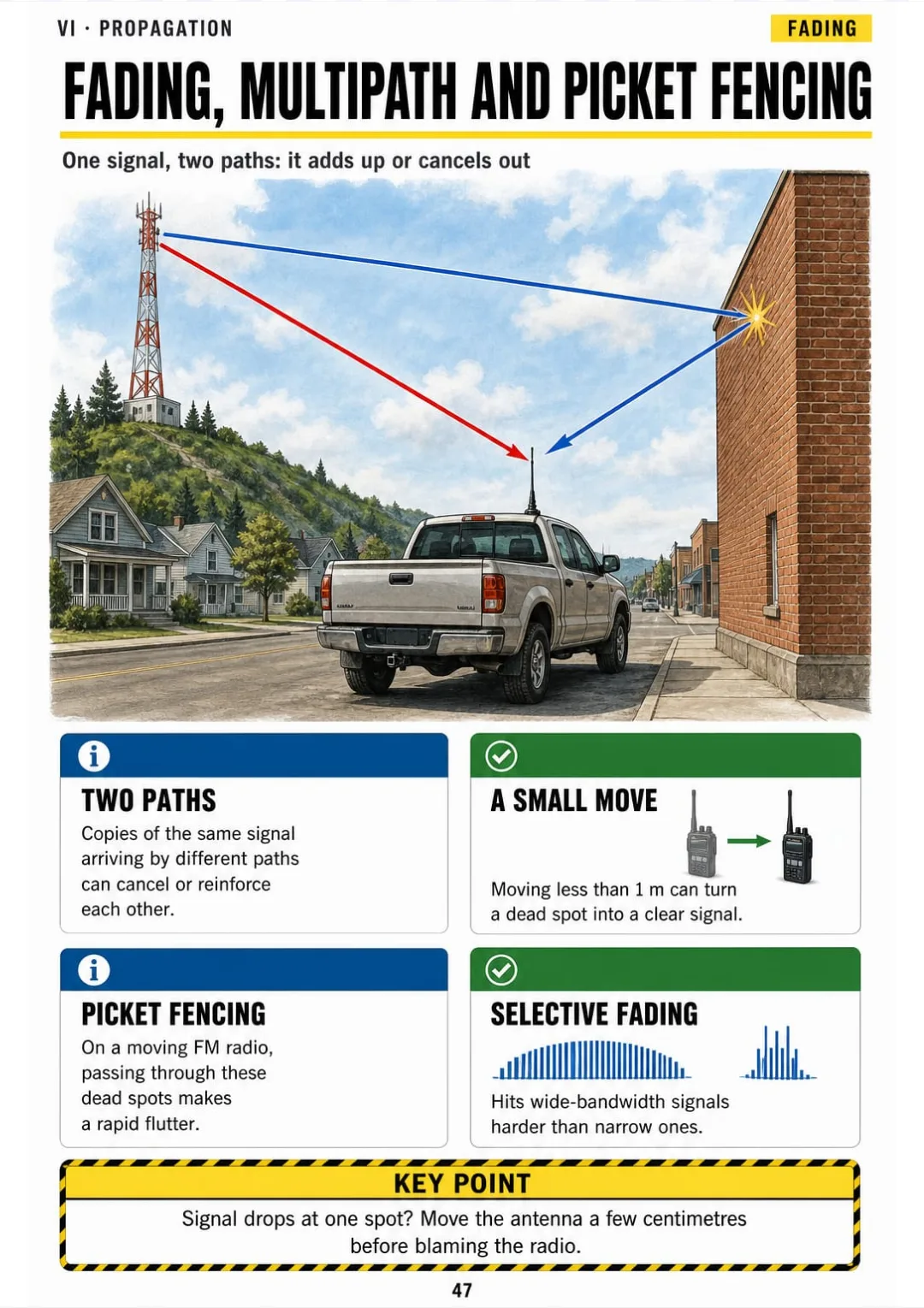
Two copies of one signal cancel or add up; moving less than 1 m can change that.
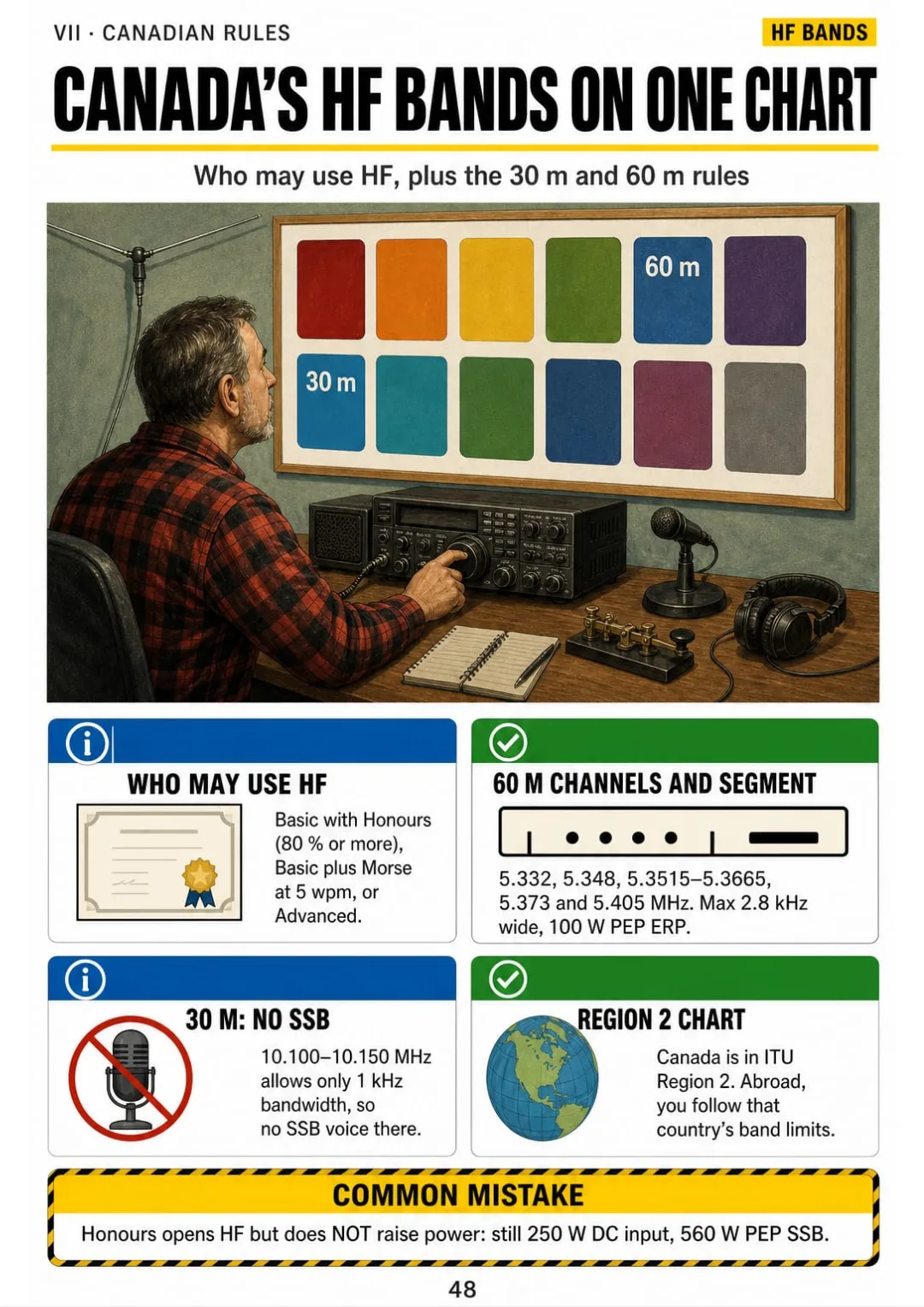
160 m to 10 m on one chart: HF needs Honours, Morse or Advanced
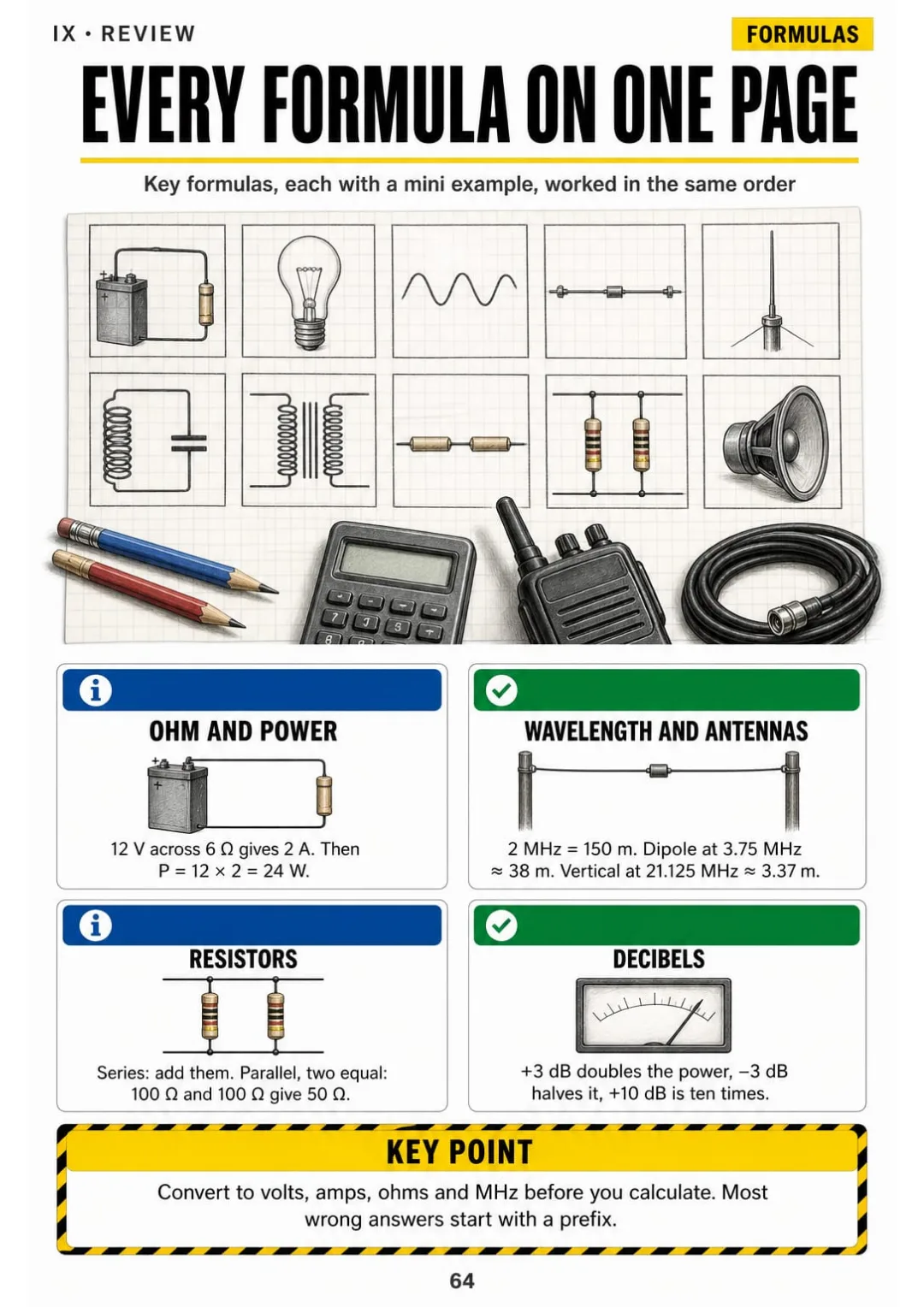
E = I × R, 300 ÷ f, 142.5 ÷ f, +3 dB: every formula with a mini example.

Take a Look at the 9 Parts and 64 Topics

The Exam and Your Certificate

pp. 5-9
  1. How the Basic exam works
  2. Basic, Basic with Honours, Advanced: what each one opens
  3. Your call sign: what the letters and the digit mean
  4. Power limits for Basic holders
  5. How to use this book: the 4-step order for every calculation

Electricity Without the Headache

pp. 10-18
  1. Volts, amps and ohms as water in a pipe
  2. Ohm's law: the triangle you cover with your thumb
  3. Power: watts are not volts
  4. Prefixes: milli, kilo, mega without mistakes
  5. Resistors in series and in parallel
  6. Batteries in series and in parallel
  7. AC and DC: cycles, hertz and the sine wave
  8. Decibels: double, half, ten times
  9. Meters: where the voltmeter and the ammeter go

Components You Must Recognize

pp. 19-26
  1. The resistor colour code
  2. Capacitors: block DC, pass AC
  3. Inductors: the coil that resists change
  4. Resonance: when a coil and a capacitor tune together
  5. Transformers: the turns ratio
  6. Diodes and rectifiers
  7. Transistors: switch and amplifier
  8. The 13.8 V power supply in four blocks

Transmitters, Receivers and Modes

pp. 27-33
  1. Your station in one drawing
  2. Modes and how wide they are
  3. SSB: upper or lower sideband
  4. FM: deviation and over-deviation
  5. The superheterodyne receiver, block by block
  6. Sensitivity, selectivity and the image frequency
  7. Digital modes and repeater links at a glance

Antennas and Feed Lines

pp. 34-41
  1. Frequency and wavelength: 300 divided by f
  2. The half-wave dipole, drawn to scale
  3. The quarter-wave vertical and its radials
  4. The Yagi: reflector, driven element, director
  5. Polarization: vertical or horizontal
  6. Coax and ladder line
  7. SWR: what it measures and what fixes it
  8. Baluns and effective radiated power

Propagation: Where the Signal Goes

pp. 42-47
  1. Ground wave, sky wave, line of sight
  2. The ionosphere at noon and at midnight
  3. Skip zone and maximum usable frequency
  4. The sunspot cycle
  5. VHF and UHF beyond the horizon
  6. Fading, multipath and picket fencing

Canadian Rules and Operating Practice

pp. 48-57
  1. HF bands in Canada, on one chart
  2. VHF and UHF bands for Basic
  3. What you may not transmit
  4. When to give your call sign
  5. Third-party traffic and contacts across the border
  6. The phonetic alphabet
  7. Q codes and the RST report
  8. Calling CQ and answering a call
  9. Repeaters: offset and tones
  10. Emergencies and distress

Safety and Interference

pp. 58-63
  1. RF exposure: distance, power and time
  2. Electrical safety in the shack
  3. Lightning and grounding
  4. Antennas and towers: who you need to check with
  5. Harmonics and the low-pass filter
  6. When the neighbour complains

Review Before the Exam

pp. 64-68
  1. Every formula on one page
  2. The numbers to have at your fingertips
  3. The most frequent mix-ups
  4. Exam day checklist
  5. After you pass: your first week on the air

Who This Book Is For

You're starting the Basic

You get the whole syllabus in one place and in order, with the electronics drawn so it makes sense from the first page.

Your exam is coming up

You review topic by topic, check the formula page and the numbers page, and go in knowing where each answer comes from.

You already have your call sign

You keep the band chart, the Q codes and the repeater page printed beside the radio for the questions that come up on the air.

Plus: 2 Free Books

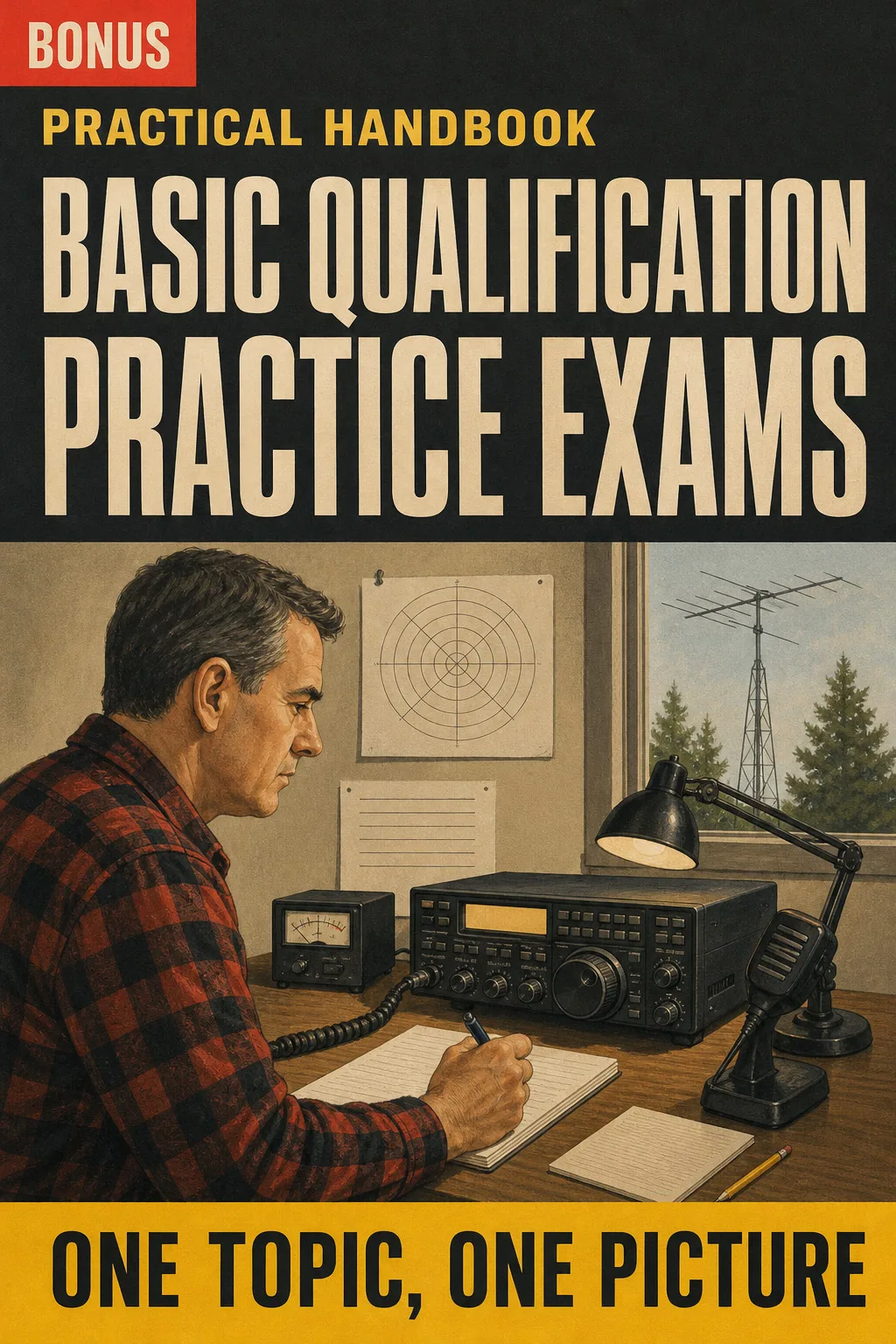
Basic Qualification Practice Exams
BONUS 1

Basic Qualification Practice Exams

Exam-style questions grouped by topic, each answer explained in one line with the page to go back to, so you practise the reasoning instead of memorizing letters.
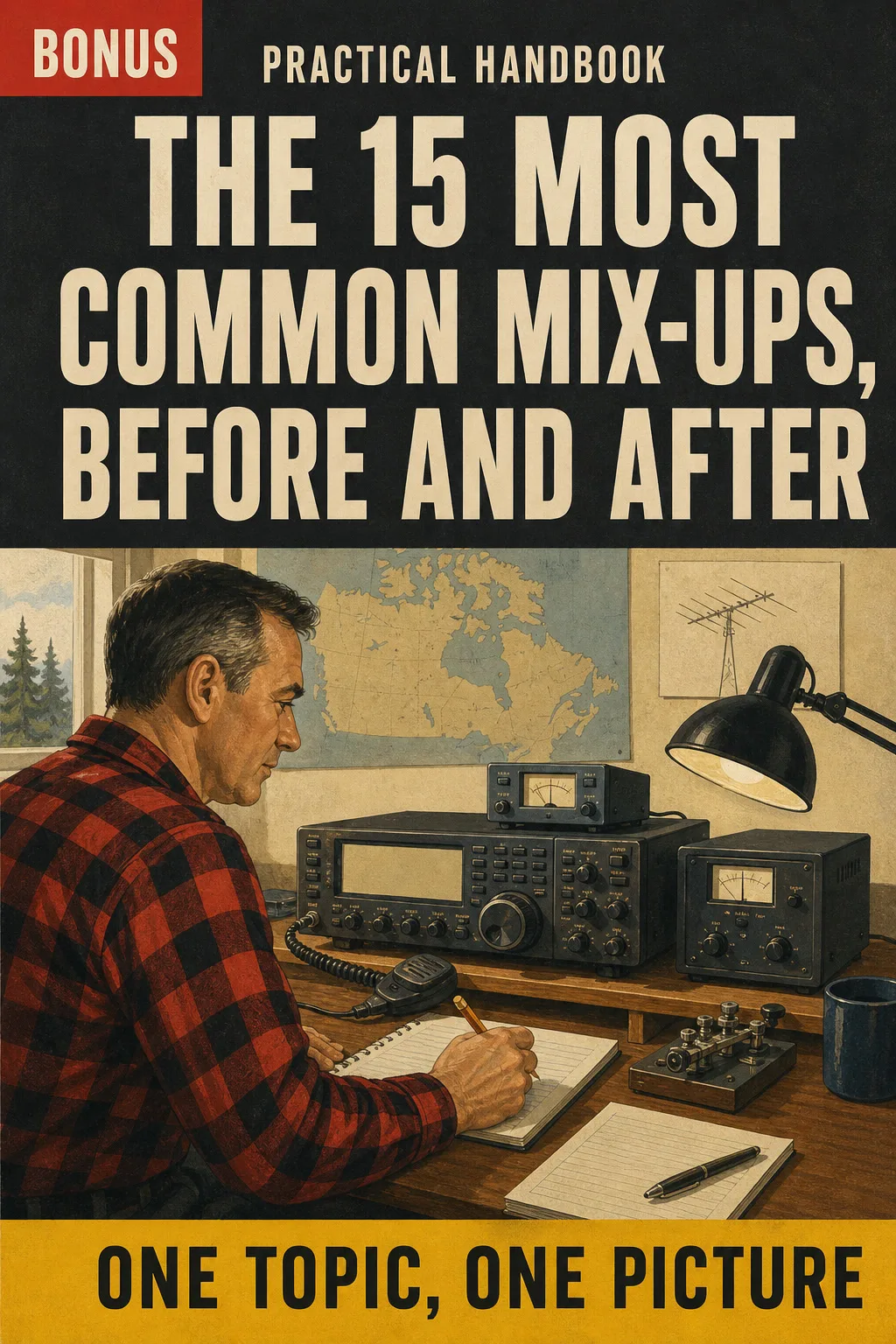
The 15 Most Common Mix-ups, Before and After
BONUS 2

The 15 Most Common Mix-ups, Before and After

Watts vs. volts, frequency vs. wavelength, when to give your call sign: each frequent mix-up shown wrong and right on one page, for a fast review the night before.

30-Day Guarantee

30-day guarantee: if a file doesn't open, if the content isn't what the product page describes, if you were charged twice or the email never arrived, write to us and we'll refund you in full. You pay once. No subscriptions.

Frequently Asked Questions

Is it for me if I've only used a scanner or GMRS and never studied electronics?

Yes. It starts with volts and amps as water in a pipe and builds up one page at a time. It also covers the full Basic syllabus, so it goes well past an introduction.

Where does the content come from?

It's checked against the current version of ISED's public Basic Qualification question bank and ISED's documents for the amateur service (RIC-3 and RBR-4). It's written for Canada, not adapted from a US book: Canadian bands, Canadian call signs and rules, metres and kilometres.

Is this official material?

No. It's an independent study book. ISED and accredited examiners don't publish, approve or endorse it.

Does it replace a course or a club class?

No. It's study material you can use on its own or alongside a course, a club or an accredited examiner. It doesn't give you a certificate or a call sign: those only come from passing the exam with an accredited examiner.

The question bank is public and free. Why buy a book?

The bank gives you the questions and the right letter, but not the why. The book draws the why: where the 2 × IF comes from, why 142.5 divided by f, which way a Yagi radiates. The practice exams are written for this book, in exam style, each with a one-line explanation and the page to go back to. None are copied from the official bank.

When and how do I get it?

The book and the 2 bonus books come as PDFs by email, sent to the address you enter at checkout.

Do I have to pay every month?

No. It's a one-time payment, with no subscription.

Can I have it on paper?

It comes as a PDF only: nothing is shipped. The PDF is made to print at home or at a print shop, so you can keep it on the bench or next to the radio.

How does the refund work?

You have 30 days. We refund everything if the file won't open, if the book isn't what you see on this page, if you were charged twice or if the email doesn't arrive: just email us.

CA$ 34.99CA$ 79.99
Get the book · CA$ 34.99

This is a digital PDF book sent to your email: nothing is printed or shipped.

More books on this topic

Amateur Radio Advanced Illustrated

The theory for Canada's Advanced amateur radio exam, one drawing per topic: Ohm's law, reactance, resonance, decibels…

From CA$ 34.99 CA$ 79.99