Study in Pictures🌐 English (Australia)
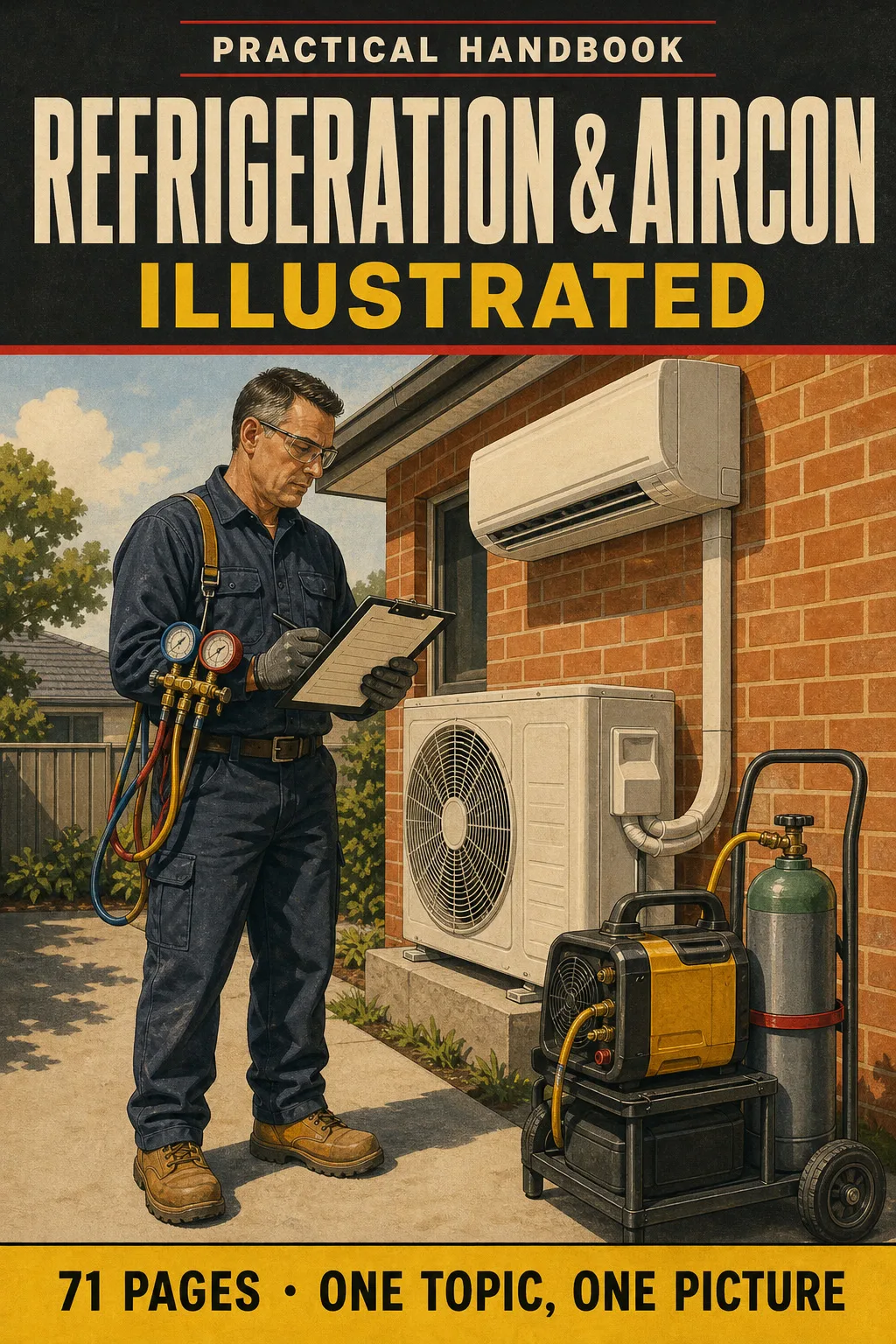
Refrigeration & Aircon Illustrated

Digital book in PDF · read it on your phone or print it

Refrigeration & Aircon Illustrated

The refrigerant cycle, safety classes, the gauge manifold, recovery, the nitrogen pressure test, evacuation, the decay test, charging and faults on the gauges. Each topic has its own page: the drawing first, then what you need to remember.

  • 71 illustrated pages
  • English
  • 30-day guarantee
A$ 39A$ 89
Get the book · A$ 39

Price shown for: Australia. In other countries, the checkout shows the price that applies there.

About this book

What it is

The refrigerant cycle, safety classes, the gauge manifold, recovery, the nitrogen pressure test, evacuation, the decay test, charging and faults on the gauges. Each topic has its own page: the drawing first, then what you need to remember.

Who This Book Is For
  • You're doing your Cert III
  • You're a sparky adding split systems
  • You already install splits
What it covers
  1. The cycle in 4 parts
  2. Refrigerants and safety
  3. The law and your licence
  4. Your tools
  5. Installing a split
  6. The 4 procedures, always in order
  7. Reading faults on the gauges
  8. Review and on-site checklist
Language
English (Australia)
Pages
71
Format
Digital book in PDF · read it on your phone or print it
Price
A$ 39 (Australia)
Delivery
This is a digital PDF book sent to your email: nothing is printed or shipped.
30-Day Guarantee
30-day guarantee: if a file doesn't open, if the content isn't what the product page describes, if you were charged twice or the email never arrived, write to us and we'll refund you in full.

Look Inside the Book

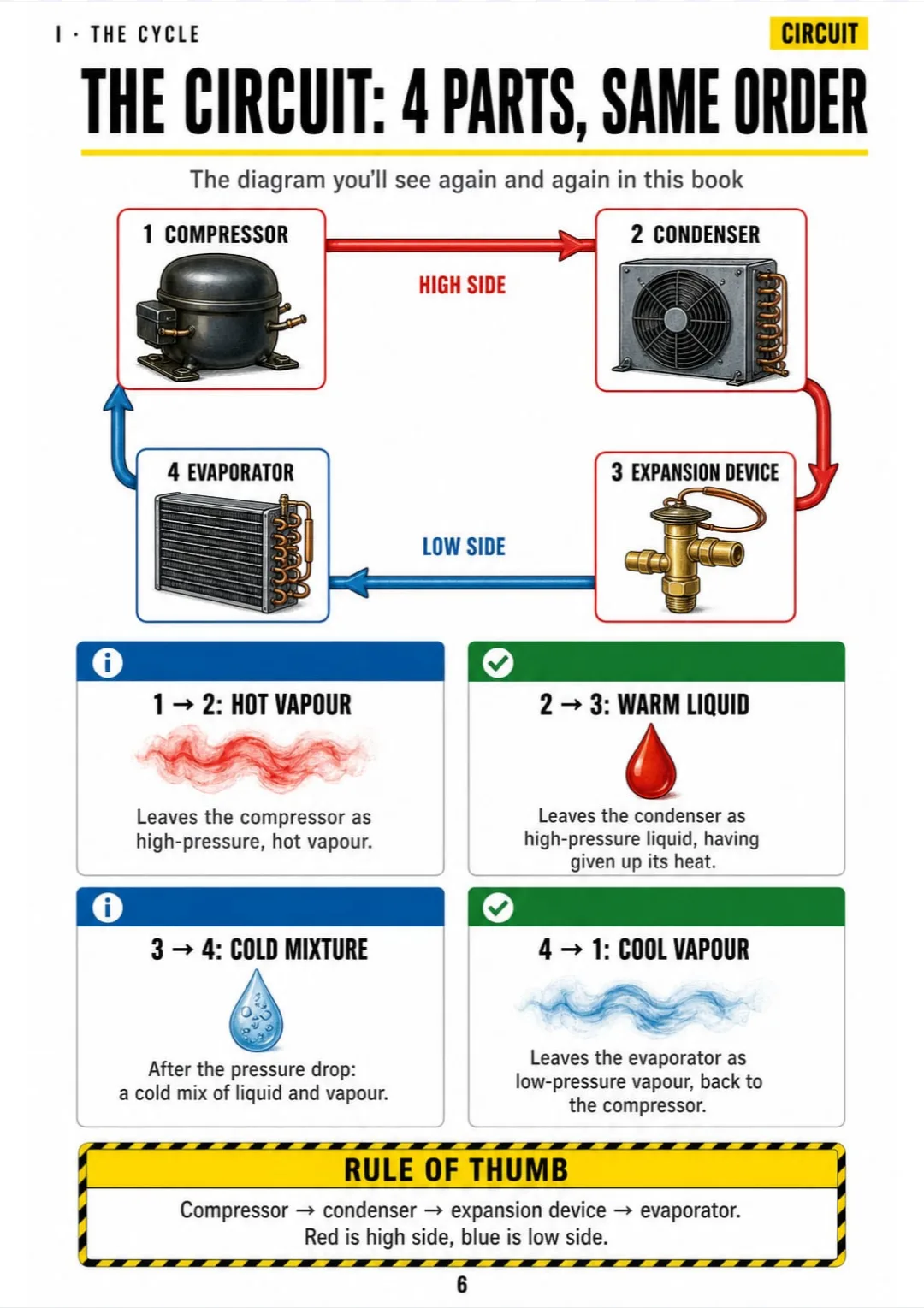
Compressor → condenser → expansion → evaporator: high side red, low side blue.
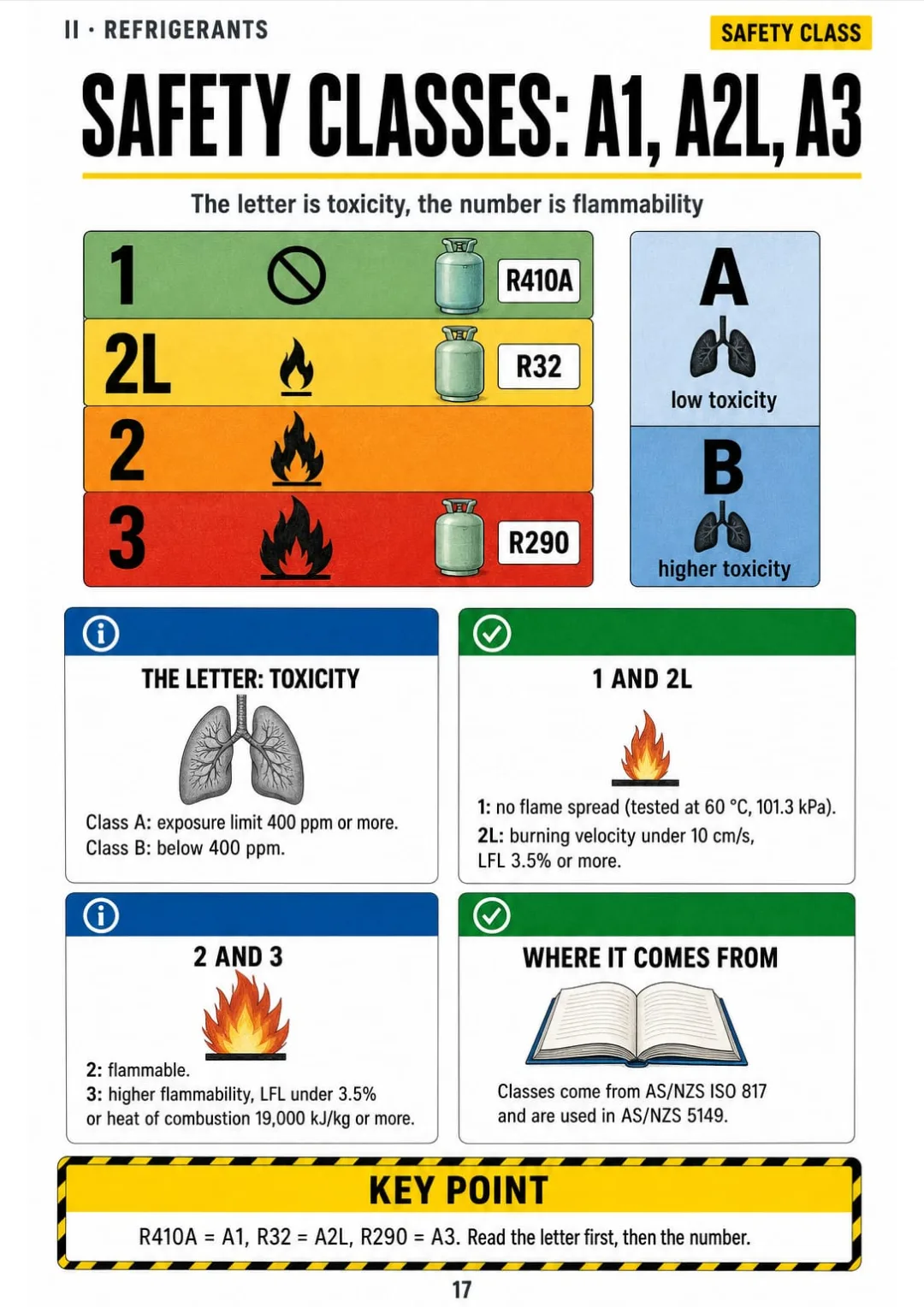
A = exposure limit ≥ 400 ppm; 1 no flame, 2L slow-burning, 3 highly flammable.
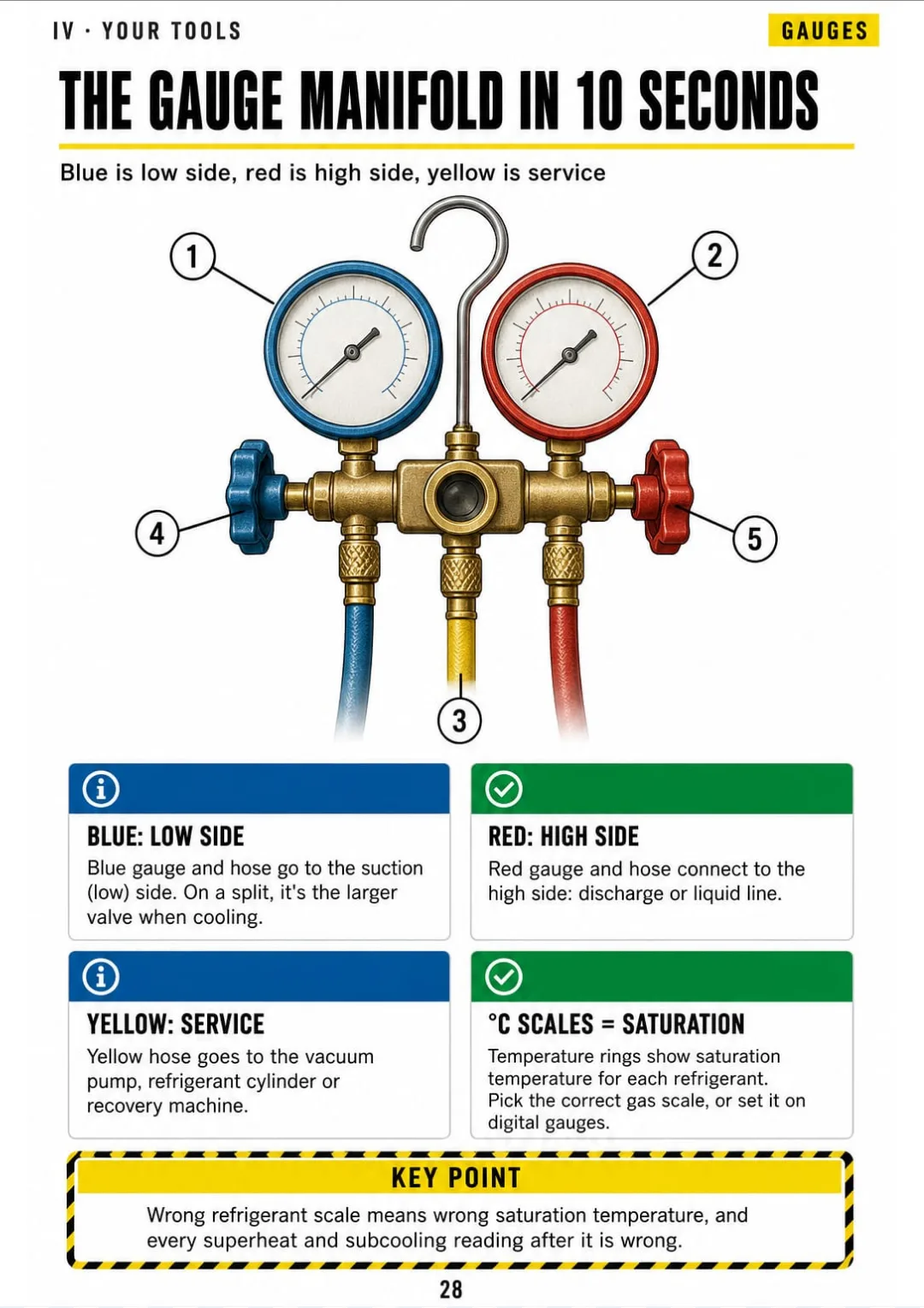
Blue = low side, red = high side, yellow = service hose, and the °C ring is saturation.
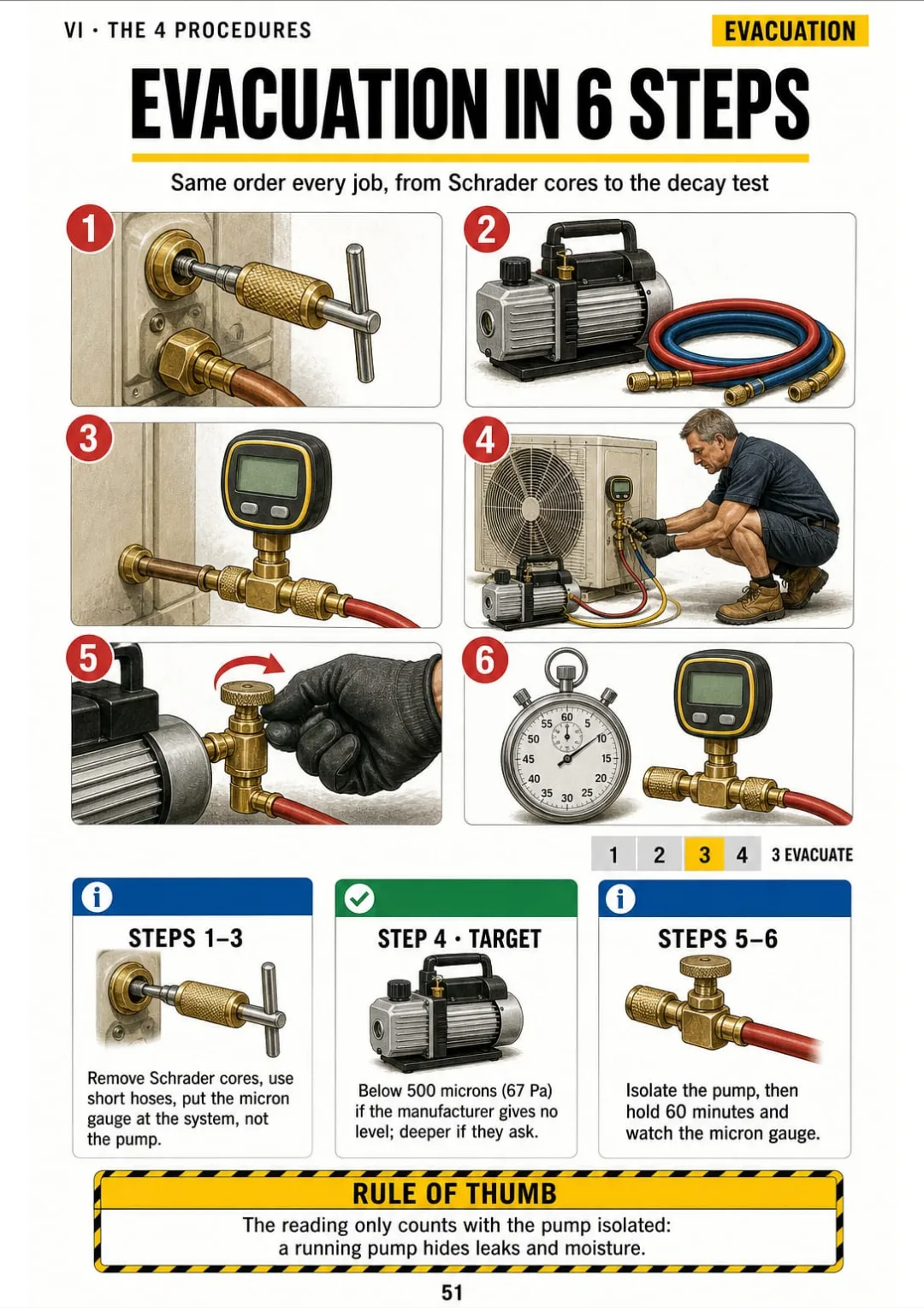
Cores out, short hoses, gauge at the system, under 500 microns, isolate, hold 60 minutes.
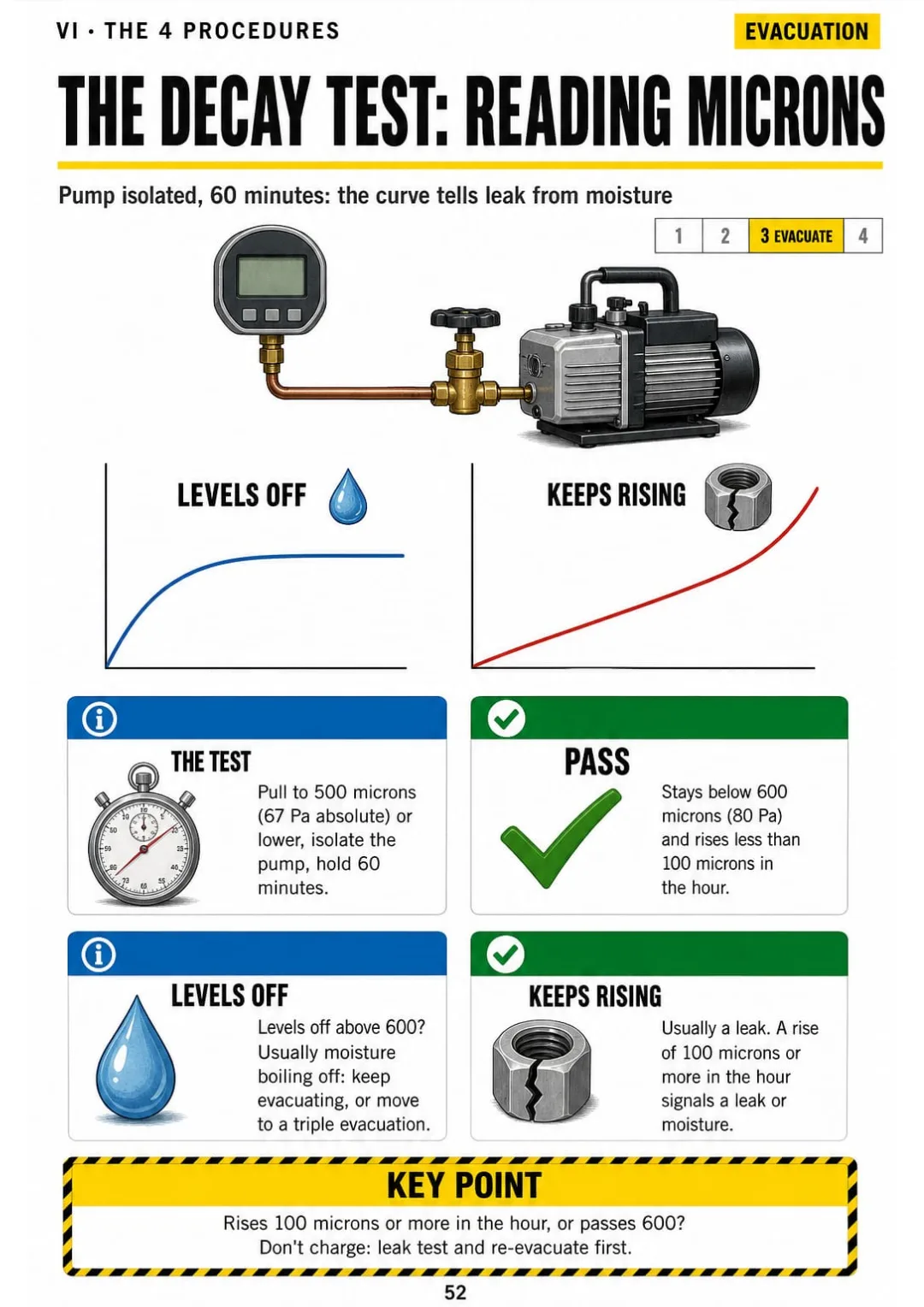
60-minute hold: under 600 microns and less than 100 microns of rise
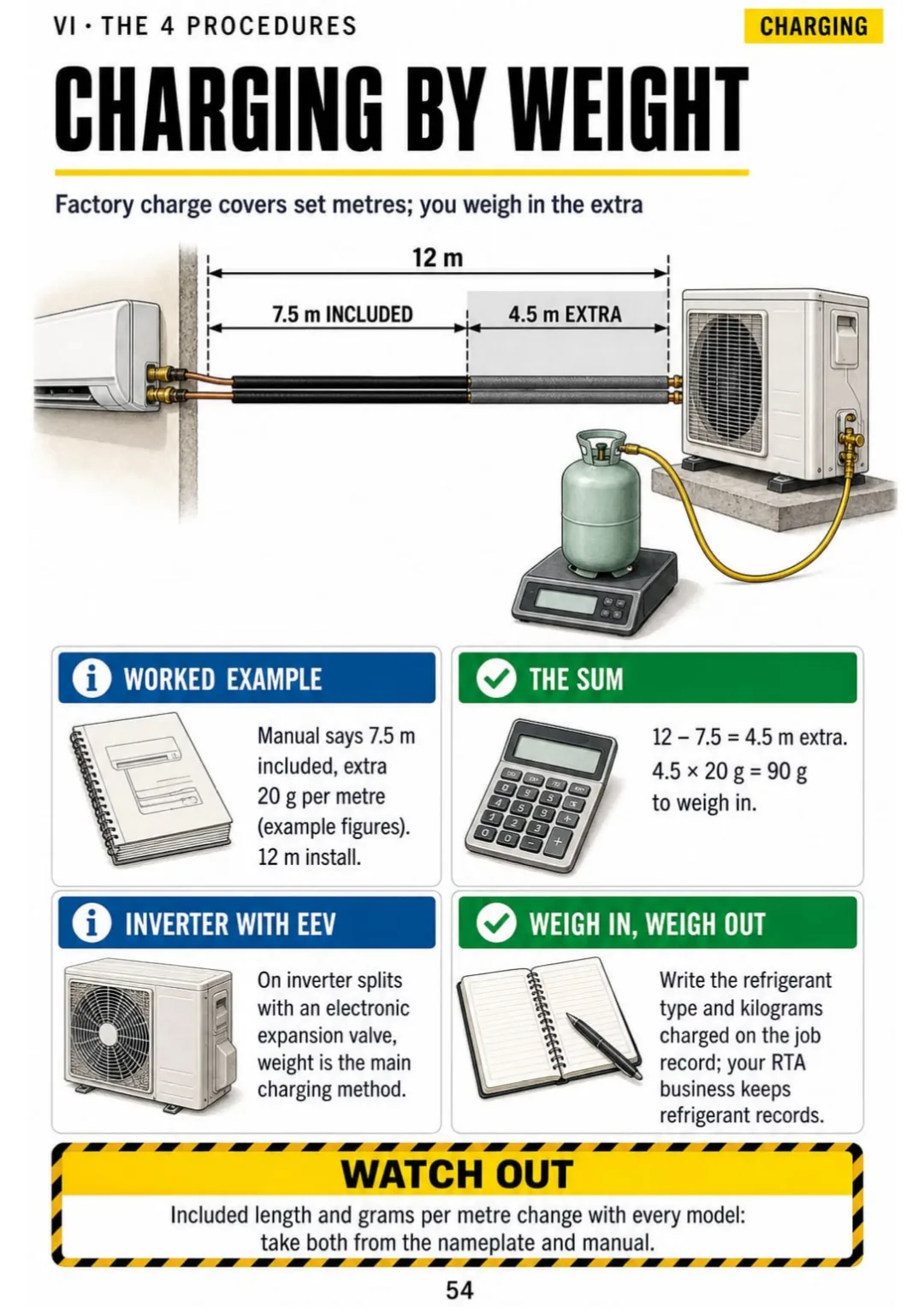
Extra metres × grams per metre from the manual = what goes on the scale
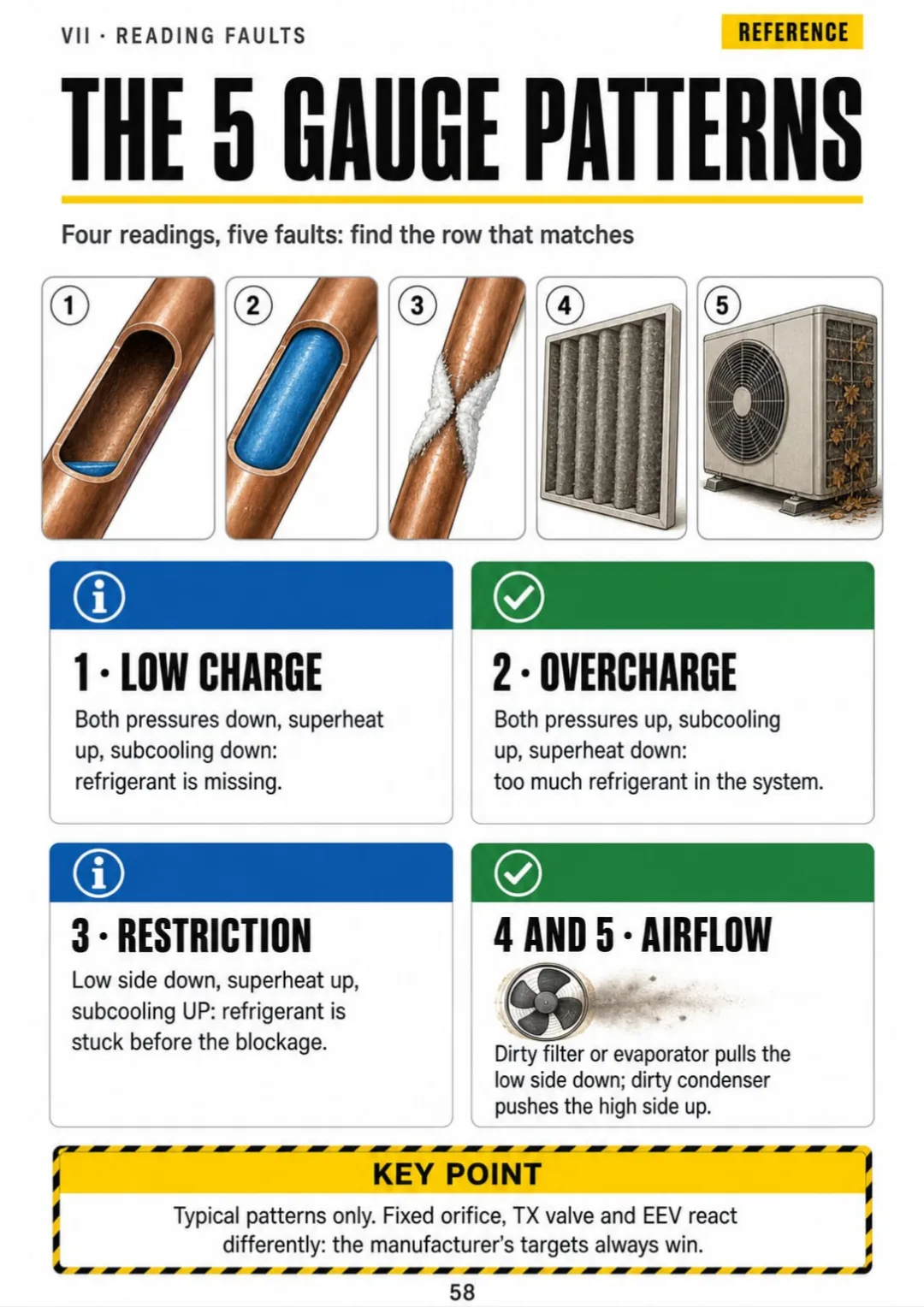
Low side, high side, superheat and subcooling for 5 faults, on one page
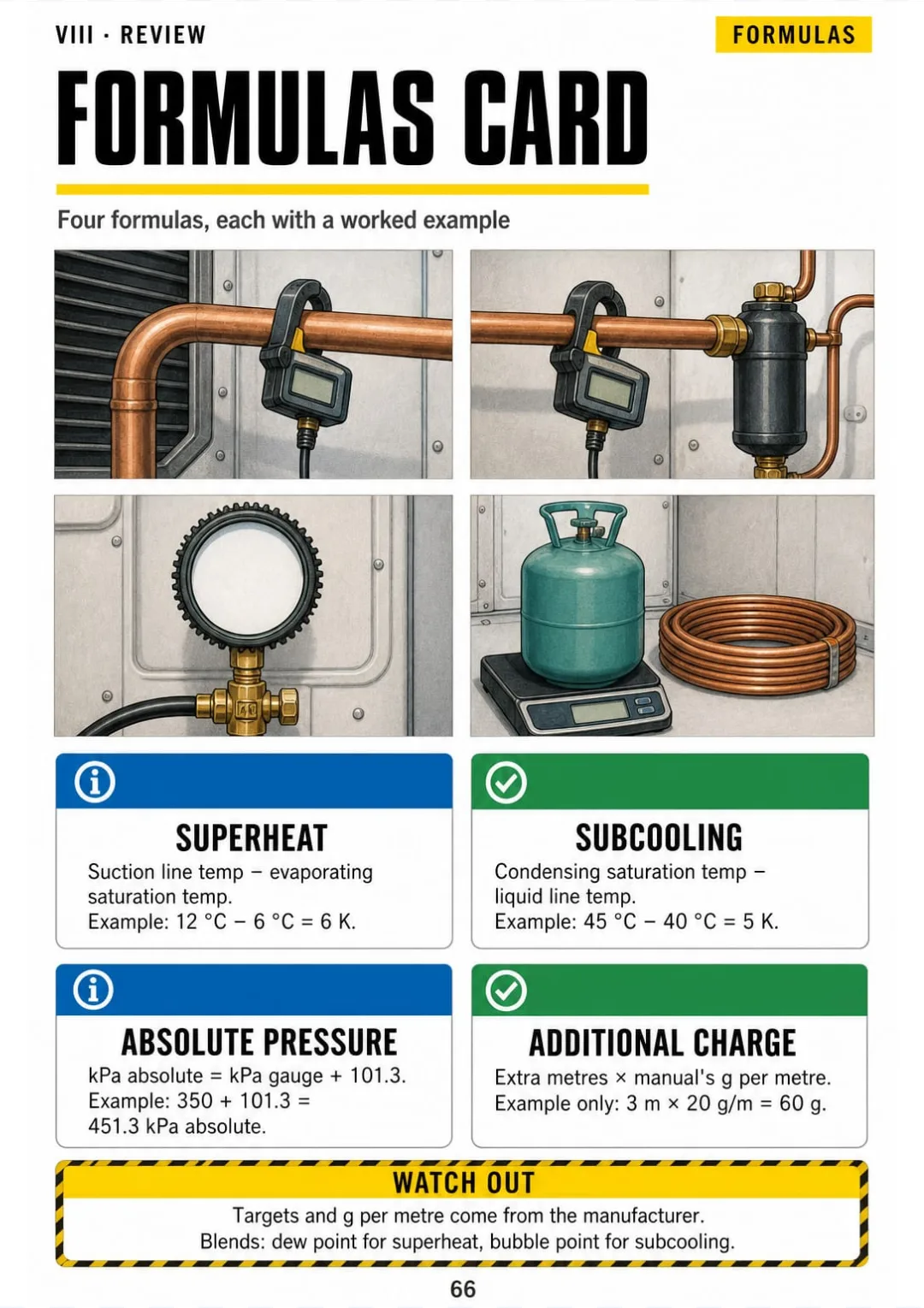
Superheat, subcooling, absolute pressure and extra charge: four formulas, four worked examples

Take a Look at the 8 Parts and 67 Topics

The cycle in 4 parts

pp. 5-14
  1. Heat only moves from hot to cold
  2. The circuit: 4 parts, always in the same order
  3. The compressor: the pump of the system
  4. The condenser: where the heat leaves
  5. The expansion device: the pressure drop
  6. The evaporator: where the heat comes in
  7. Pressure and temperature move together
  8. Gauge pressure vs absolute pressure
  9. Superheat and subcooling in one picture
  10. Heat pump mode: the reversing valve

Refrigerants and safety

pp. 15-21
  1. Ozone and global warming: ODP and GWP
  2. The refrigerants you'll meet on the job
  3. Safety classes: A1, A2L, A3
  4. Working with A2L gas like R32
  5. Blends and temperature glide
  6. Cylinders: refrigerant vs recovery
  7. PPE and the 3 real risks

The law and your licence

pp. 22-27
  1. Why venting is an offence
  2. Licence types at a glance
  3. Licence vs trading authorisation
  4. Electrical work: where your licence stops
  5. Records you must keep
  6. Returning recovered refrigerant

Your tools

pp. 28-35
  1. The gauge manifold, read in 10 seconds
  2. Hoses, valves and low-loss fittings
  3. Vacuum pump and micron gauge
  4. The recovery machine
  5. The charging scale
  6. Leak detectors: 4 ways to find a leak
  7. Nitrogen cylinder and regulator
  8. Pipe tools: cutter, bender, flaring tool

Installing a split

pp. 36-43
  1. Siting the indoor unit
  2. Siting the outdoor unit
  3. Pipe size and pipe length
  4. Bending copper without kinks
  5. Flaring in 5 steps
  6. Torque: tight enough, not too tight
  7. Brazing with a nitrogen purge
  8. Condensate drain and insulation

The 4 procedures, always in order

pp. 44-57
  1. The order that never changes
  2. Pump-down into the outdoor unit
  3. Recovery: vapour method step by step
  4. Recovery: liquid push-pull
  5. Pressure test with dry nitrogen
  6. The standing test: reading the drop
  7. Evacuation: why microns
  8. Evacuation in 6 steps
  9. The decay test: what the micron gauge tells you
  10. Triple evacuation
  11. Charging by weight
  12. Charging by superheat
  13. Charging by subcooling
  14. Liquid or vapour when charging?

Reading faults on the gauges

pp. 58-64
  1. The 5 gauge patterns
  2. Low charge
  3. Overcharge
  4. Restriction
  5. Airflow problems: dirty filter or coil
  6. Non-condensables in the system
  7. Decommissioning a split

Review and on-site checklist

pp. 65-71
  1. Units card: kPa, bar, psi, microns, °C
  2. Formulas card
  3. Job checklist: install
  4. Job checklist: service and repair
  5. The most frequent mistakes
  6. What the assessment usually asks
  7. Glossary in plain words

Who This Book Is For

You're doing your Cert III

Back to study after years away, you get the cycle and every procedure as a drawing, always in the same order, so the theory has something to hang on.

You're a sparky adding split systems

You know the electrical side. The book gives you the refrigerant side in order: recovery, nitrogen test, evacuation and charging, then the practice questions bonus book before your licence assessment.

You already install splits

You keep it printed in the ute: the decay test, the 5 gauge patterns and the formulas card, right there when you need them.

Plus: 2 Free Books

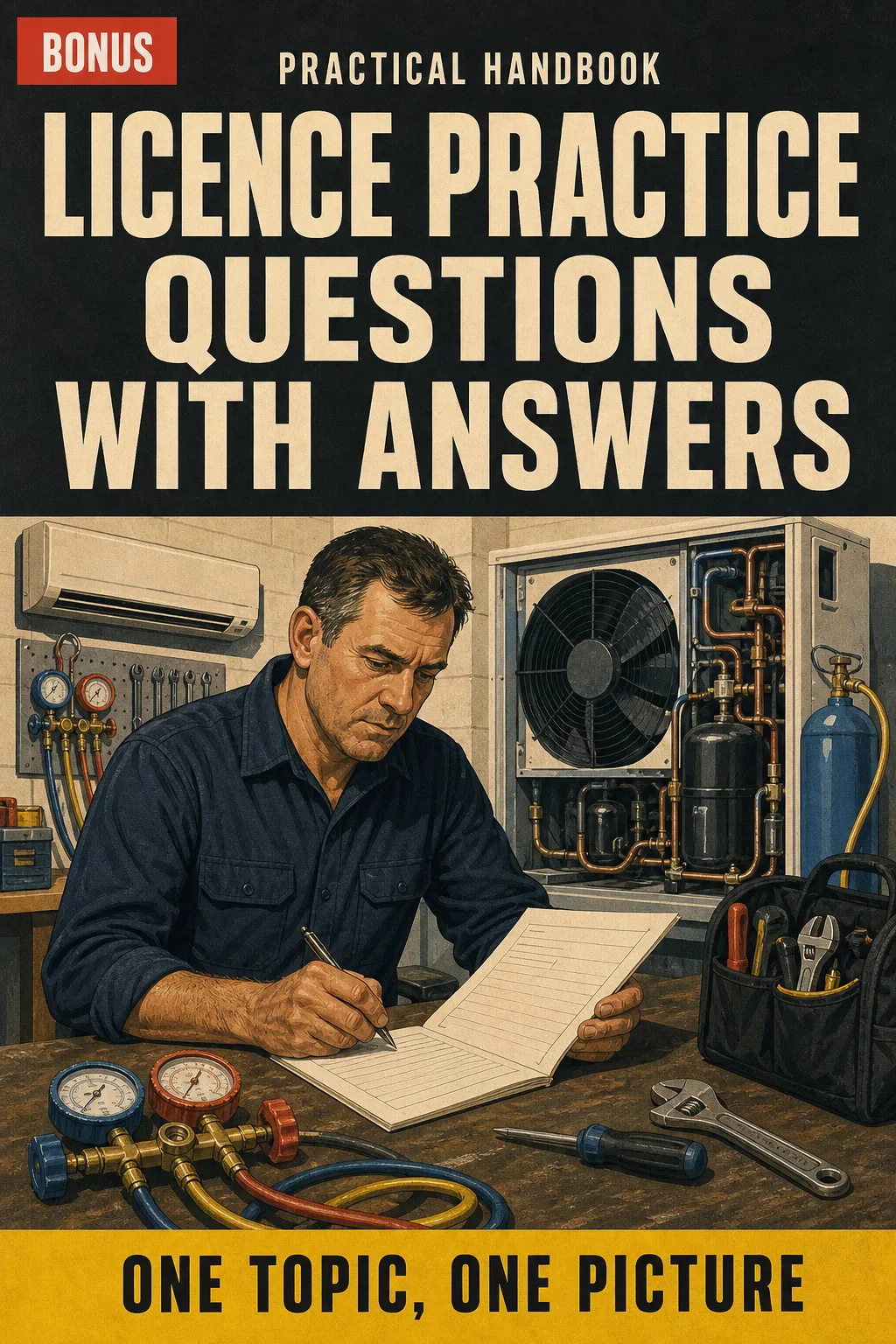
Licence Practice Questions with Answers
BONUS 1

Licence Practice Questions with Answers

Test yourself on the cycle, safety classes, recovery and charging with exam-style questions, each answer explained in one or two lines.
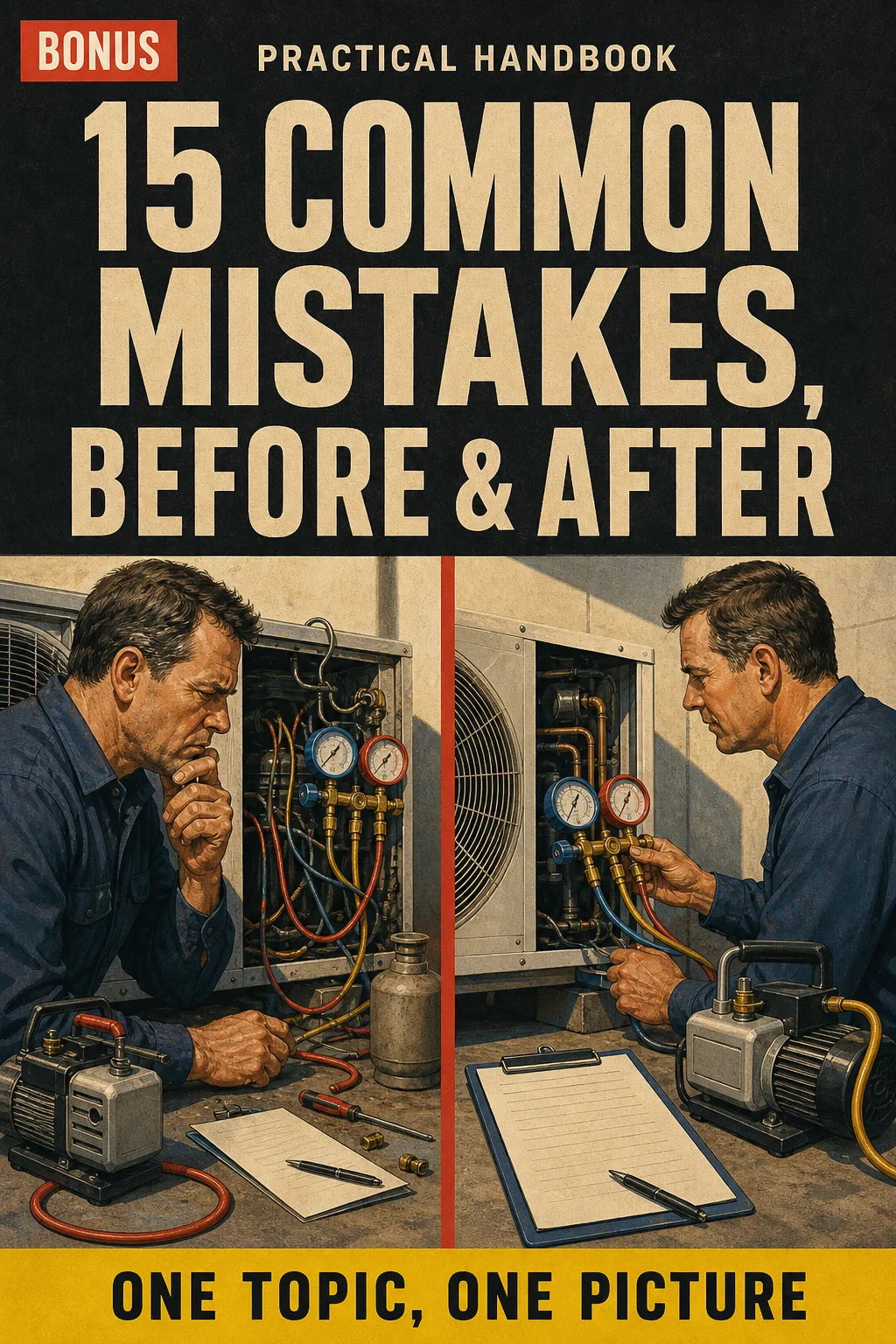
15 Common Mistakes, Before & After
BONUS 2

15 Common Mistakes, Before & After

See the slips techs make most often, from skipping the nitrogen purge to breaking vacuum too early, each drawn wrong and then right.

30-Day Guarantee

30-day guarantee: if a file doesn't open, if the content isn't what the product page describes, if you were charged twice or the email never arrived, write to us and we'll refund you in full. You pay once. No subscriptions.

Frequently Asked Questions

Is it for me if I already do the work and need the licence?

Yes. It isn't a beginner's book with the basics padded out: it puts what you already do in a fixed order, with the numbers in kPa, °C and microns, so you can explain it as well as do it. It covers split systems and the procedures behind the refrigerant handling licence; the licence types are explained in Part 3.

Where does the content come from?

It's checked against Australian sources: the Ozone Protection and Synthetic Greenhouse Gas Management Act and Regulations, the licensing rules of the Australian Refrigeration Council, the Refrigerant Handling Code of Practice and AS/NZS 5149. Metric units throughout, no psi or °F.

Is it official material?

No. It's independent illustrated study material. It isn't issued, approved or endorsed by any council, regulator or standards body.

Does it replace the course or my training?

No. The licence comes from your qualification and the application to the licensing body. The book helps you study and revise; it doesn't replace supervised training or the manufacturer's instructions.

Are the practice questions the ones from the assessment?

No. They're written for this book, in the style of the topics that are asked most, with each answer explained in a line or two.

When and how does it arrive?

As a PDF by email, to the address you enter at checkout. The 2 bonus books come the same way.

Do I have to pay every month?

No. It's a one-off payment. No subscription.

Can I have it on paper?

It isn't posted as a printed book: you get a PDF by email, made to print. Print the whole book or just the pages you want to keep in the ute.

How does the refund work?

You have 30 days. We refund everything if the file won't open, if the book isn't what you see on this page, if you were charged twice or if the email doesn't arrive: just email us.

A$ 39A$ 89
Get the book · A$ 39

This is a digital PDF book sent to your email: nothing is printed or shipped.