Study in Pictures🌐 English (Australia)
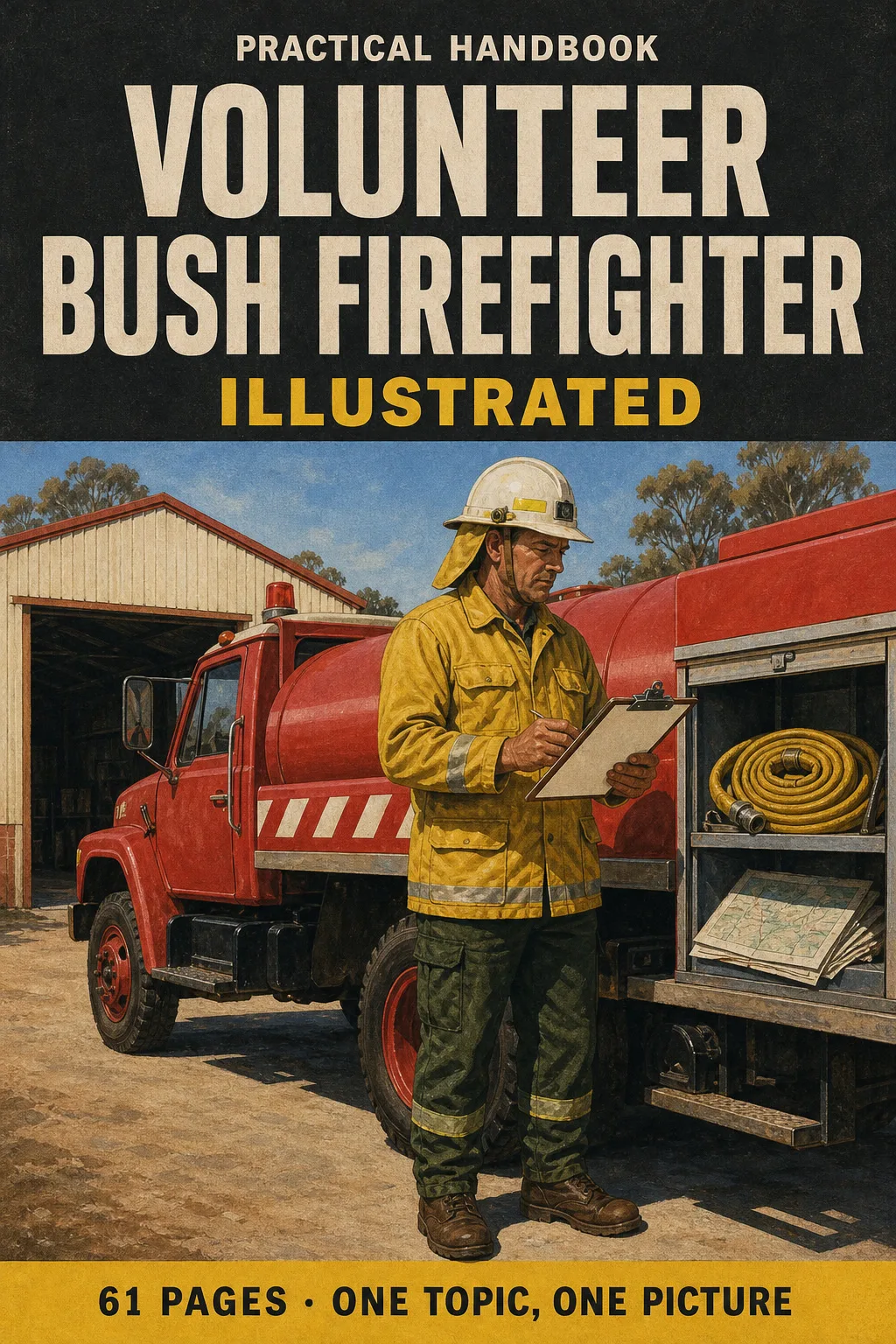
Volunteer Bush Firefighter Illustrated

Digital book in PDF · read it on your phone or print it

Volunteer Bush Firefighter Illustrated

Written for Australian volunteer brigades: fire behaviour, slope and wind changes, fire danger ratings, your PPC, starting the pump, couplings, LACES, radio calls, the burnover drill and mop-up. Every topic has its own page: the drawing first, then what you need to remember.

  • 61 illustrated pages
  • English
  • 30-day guarantee
A$ 39A$ 89
Get the book · A$ 39

Price shown for: Australia. In other countries, the checkout shows the price that applies there.

About this book

What it is

Written for Australian volunteer brigades: fire behaviour, slope and wind changes, fire danger ratings, your PPC, starting the pump, couplings, LACES, radio calls, the burnover drill and mop-up. Every topic has its own page: the drawing first, then what you need to remember.

Who This Book Is For
  • You've just joined the brigade
  • The fire season is weeks away
  • You've done a few seasons
What it covers
  1. How Bushfire Behaves
  2. Fire Danger and Your Day
  3. Your Kit and Your Body
  4. The Tanker
  5. Hoses, Pumps and Water
  6. Working as a Crew
  7. Radio and Messages
  8. Hazards, Burnover and Mop-up
  9. Before the Season: Review
Language
English (Australia)
Pages
61
Format
Digital book in PDF · read it on your phone or print it
Price
A$ 39 (Australia)
Delivery
This is a digital PDF book sent to your email: nothing is printed or shipped.
30-Day Guarantee
30-day guarantee: if a file doesn't open, if the content isn't what the product page describes, if you were charged twice or the email never arrived, write to us and we'll refund you in full.

Look Inside the Book

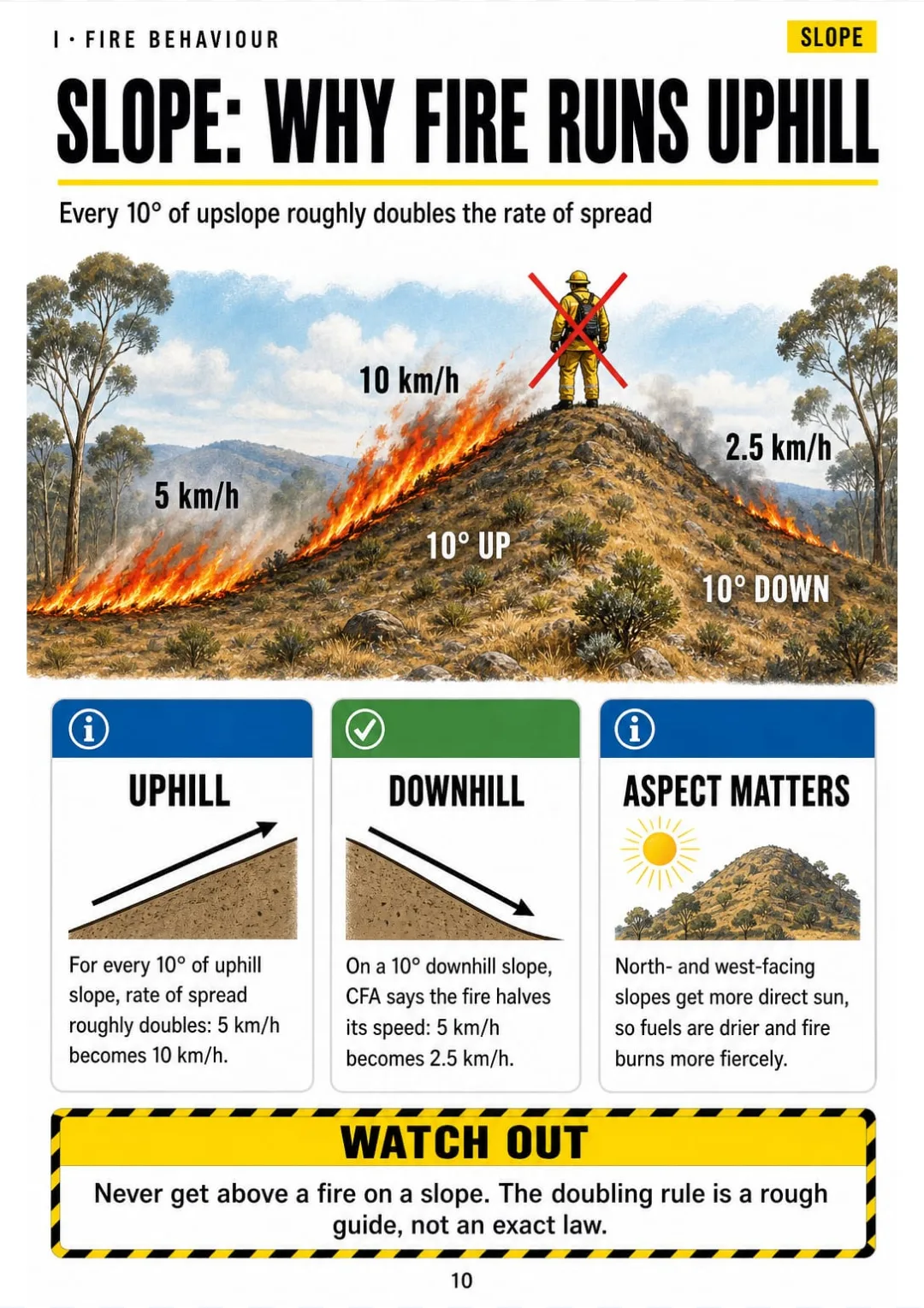
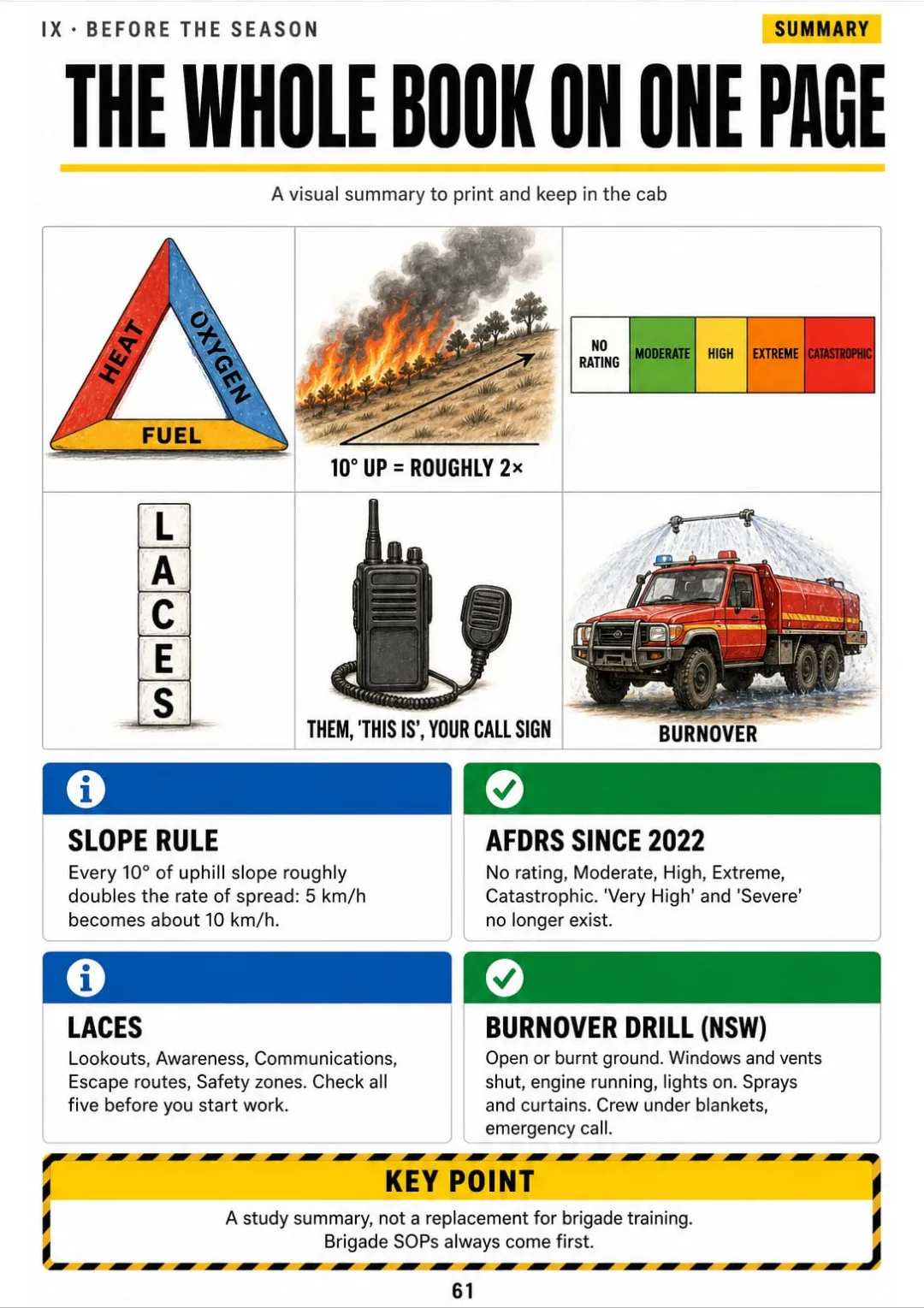
5 km/h on the flat, about 10 km/h on a 10° upslope.
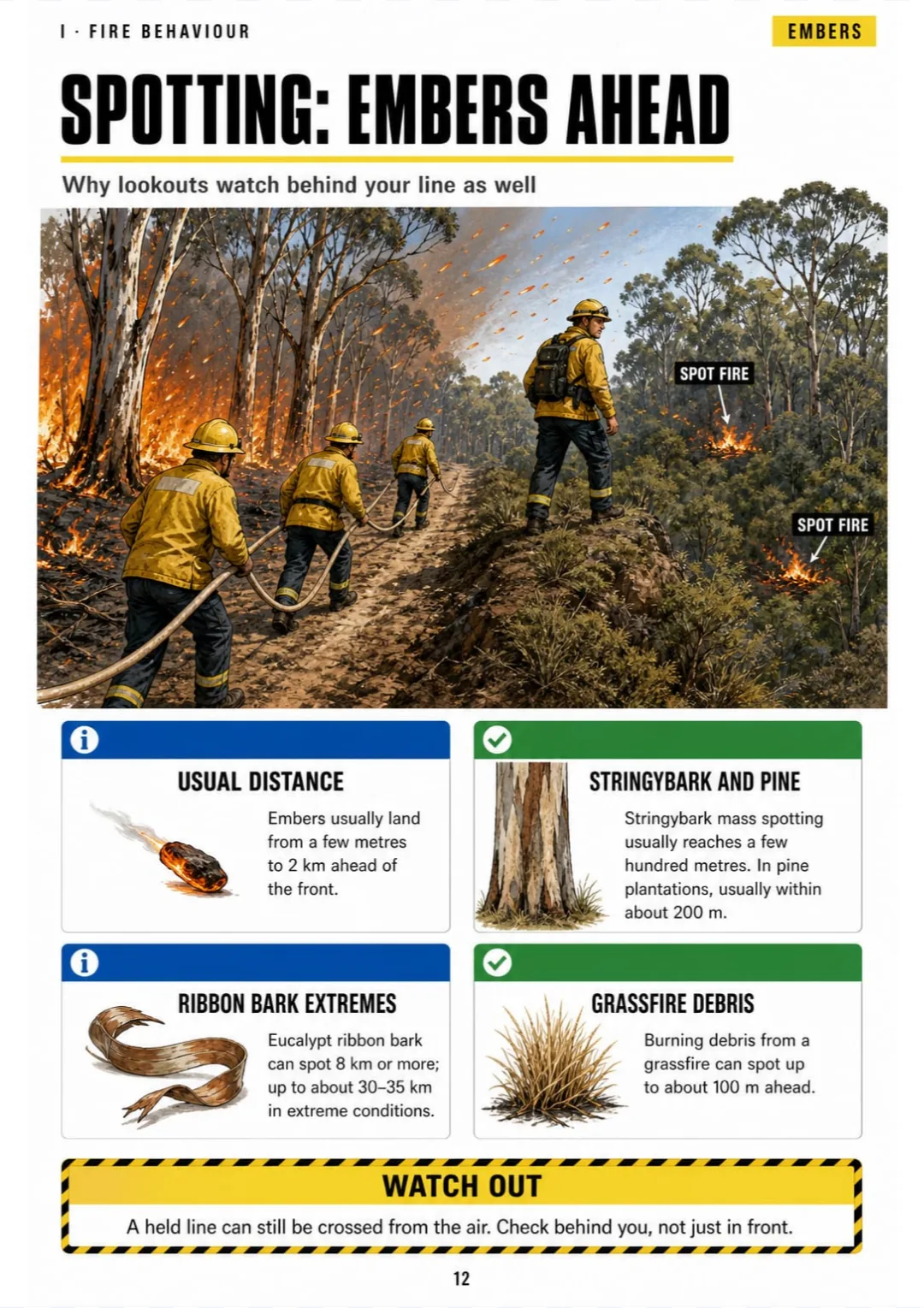
Embers usually land from a few metres to 2 km ahead of the front.
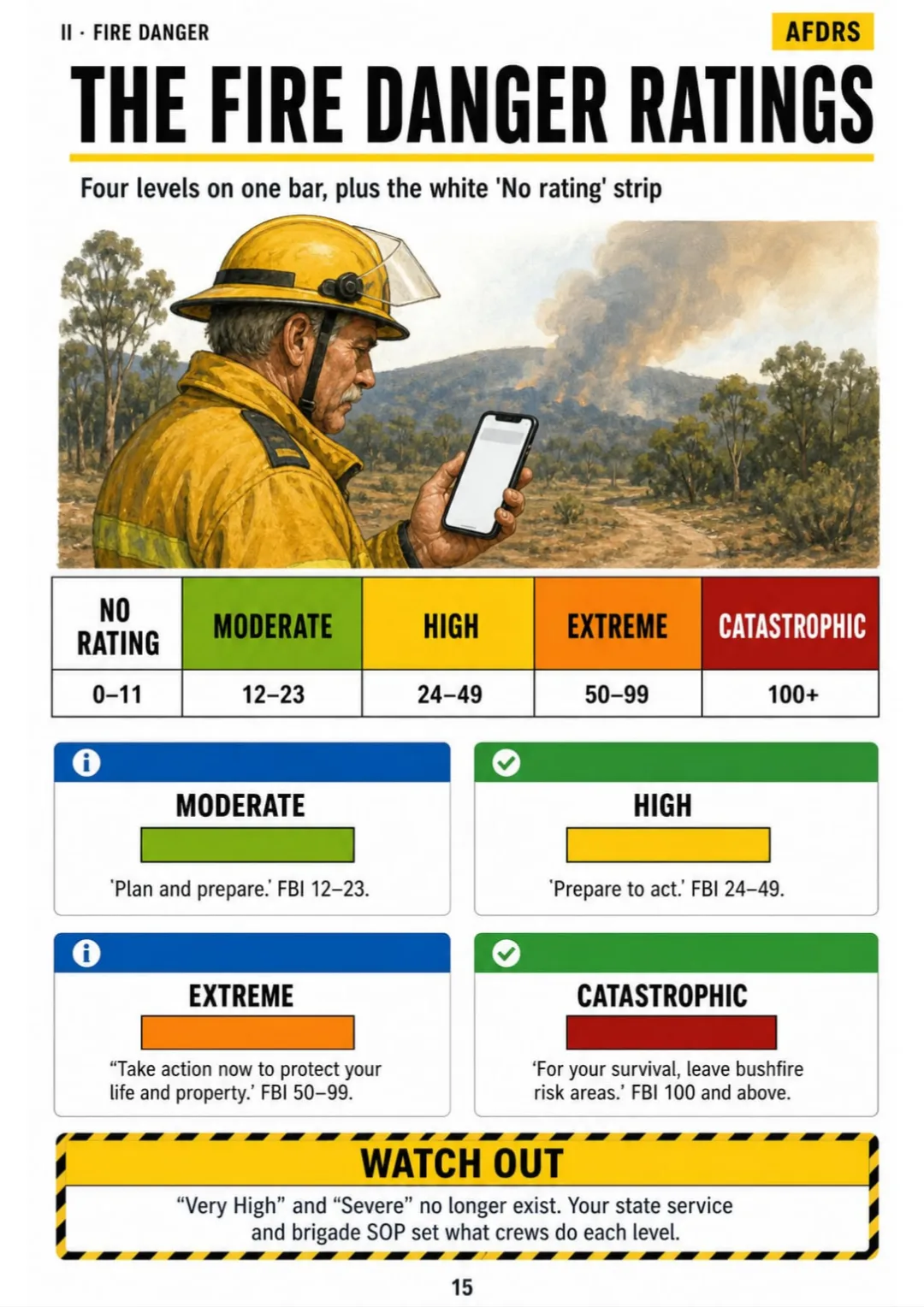
AFDRS since 1 September 2022: Moderate, High, Extreme, Catastrophic, plus 'No rating'.
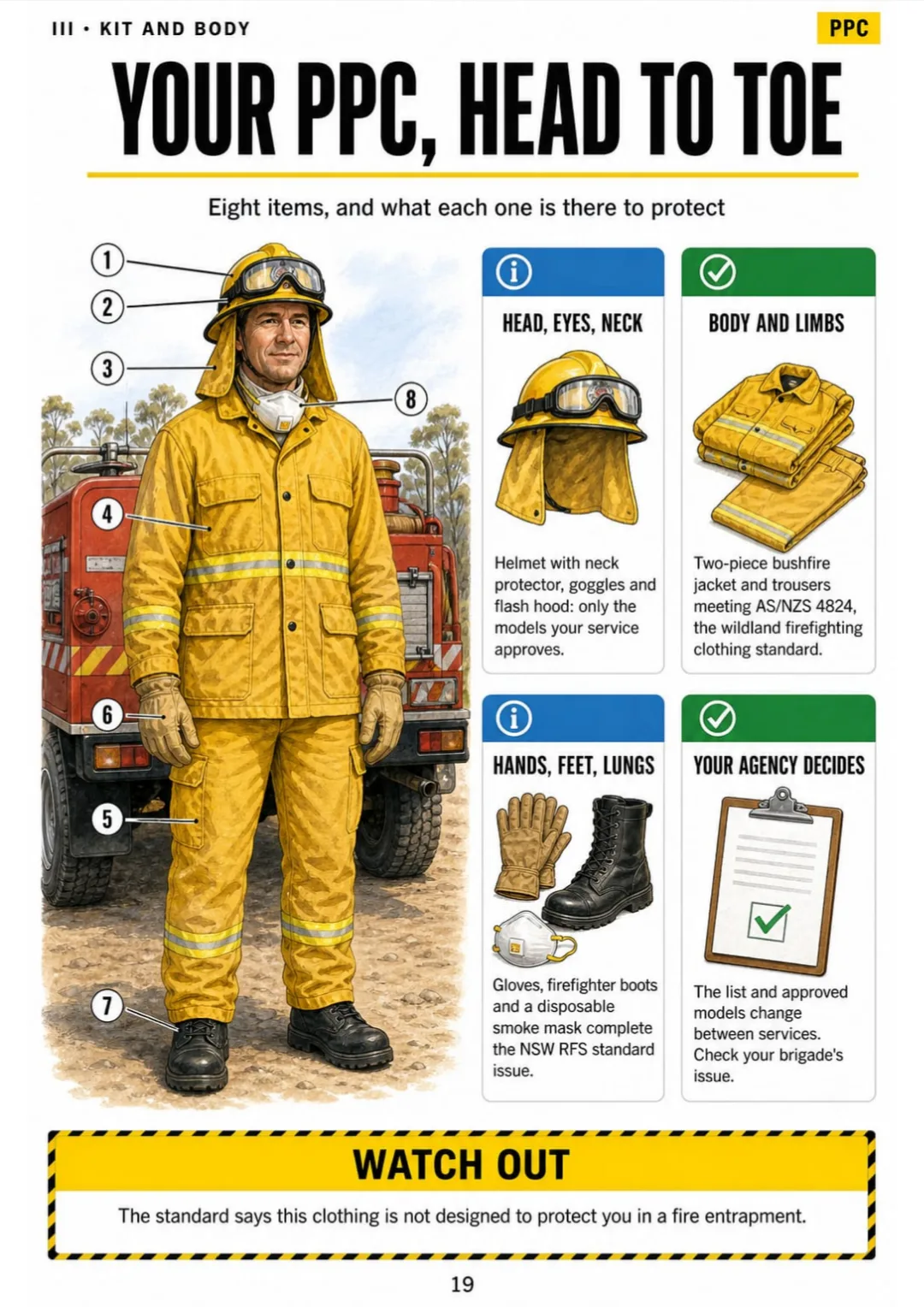
Helmet, goggles, flash hood, jacket, trousers, gloves, boots, P2 mask: the bushfire PPC set, labelled.
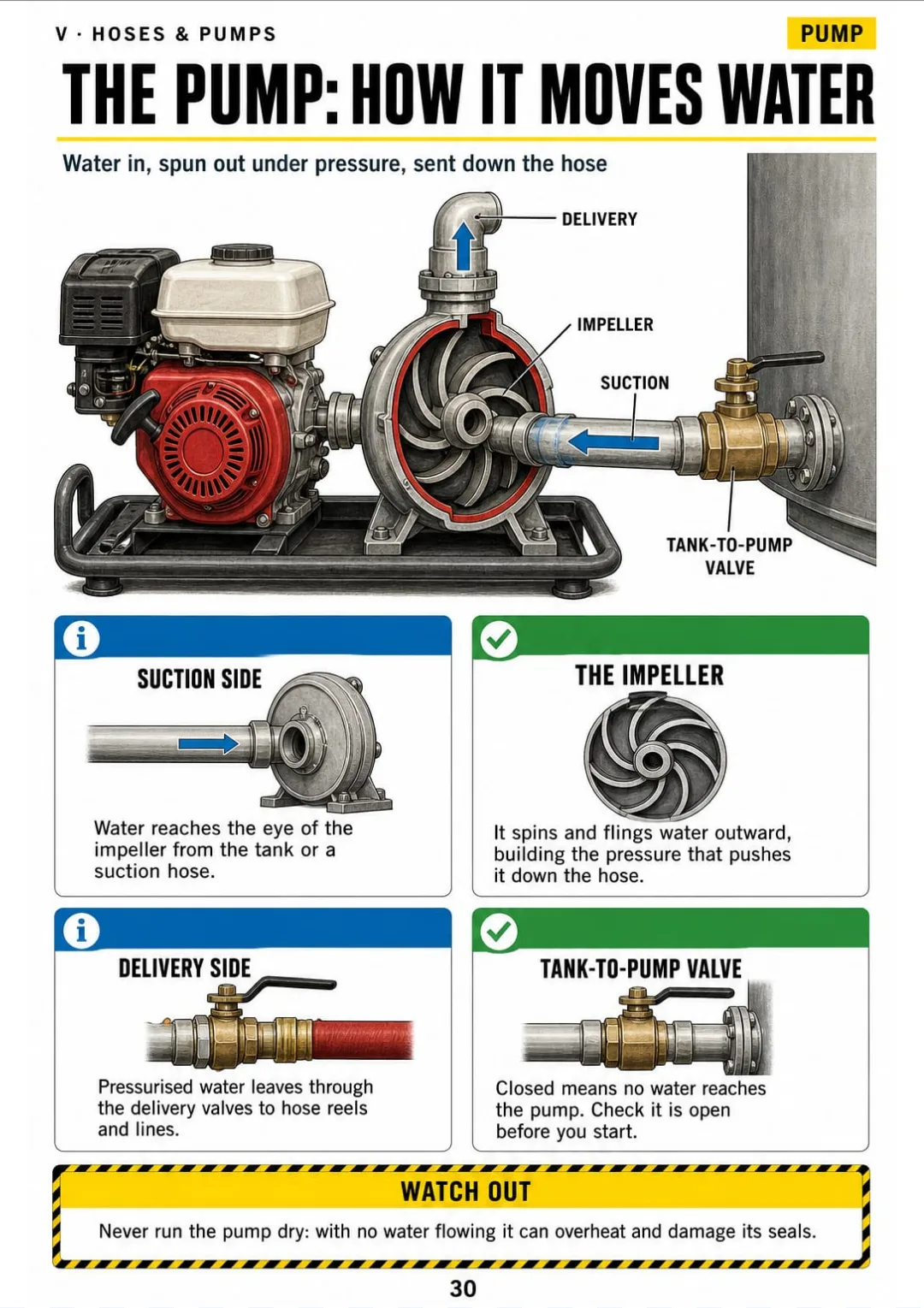
Cut-away pump: suction, impeller, delivery and the tank-to-pump valve, labelled in one drawing
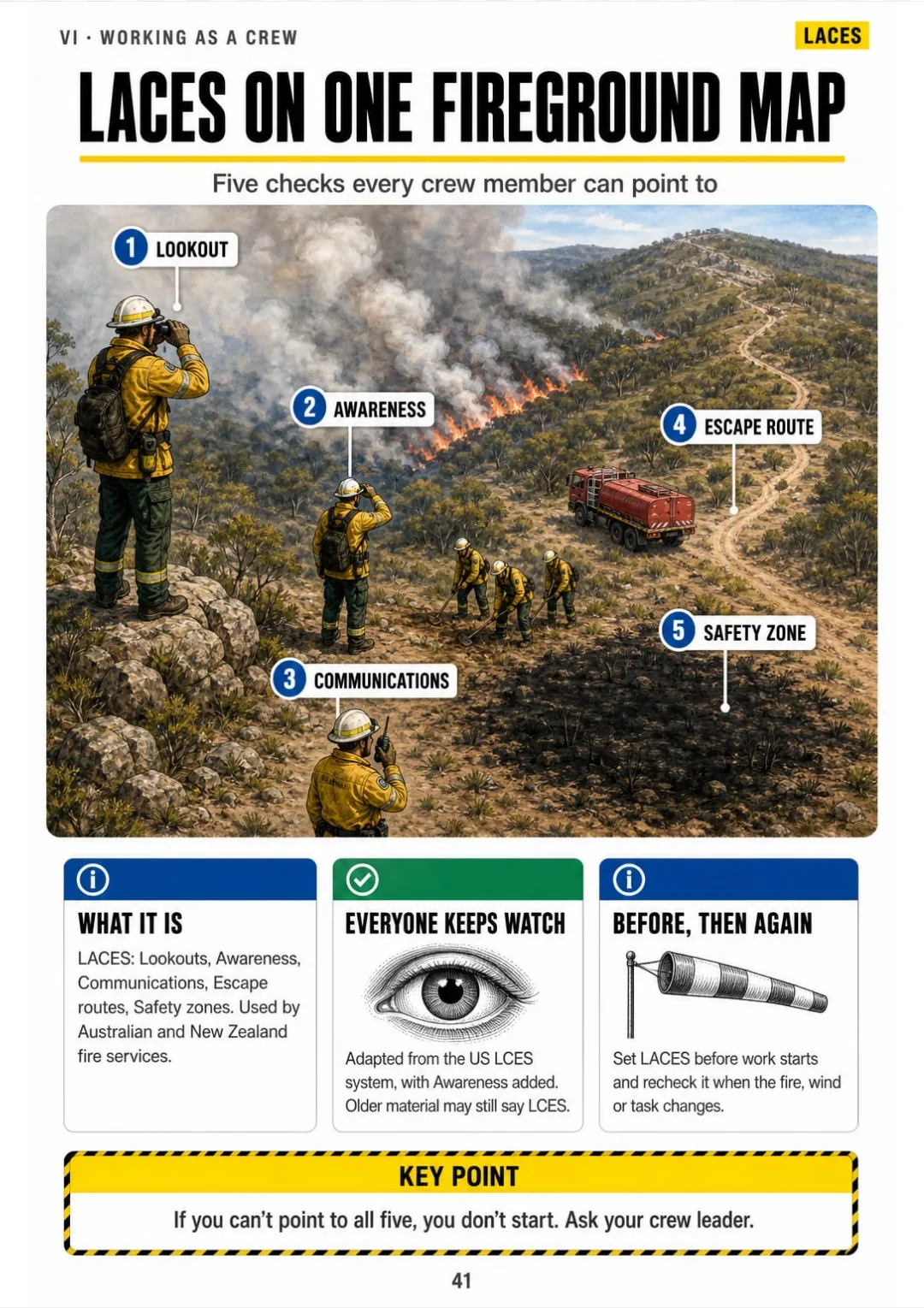
LACES: Lookouts, Awareness, Communications, Escape routes, Safety zones
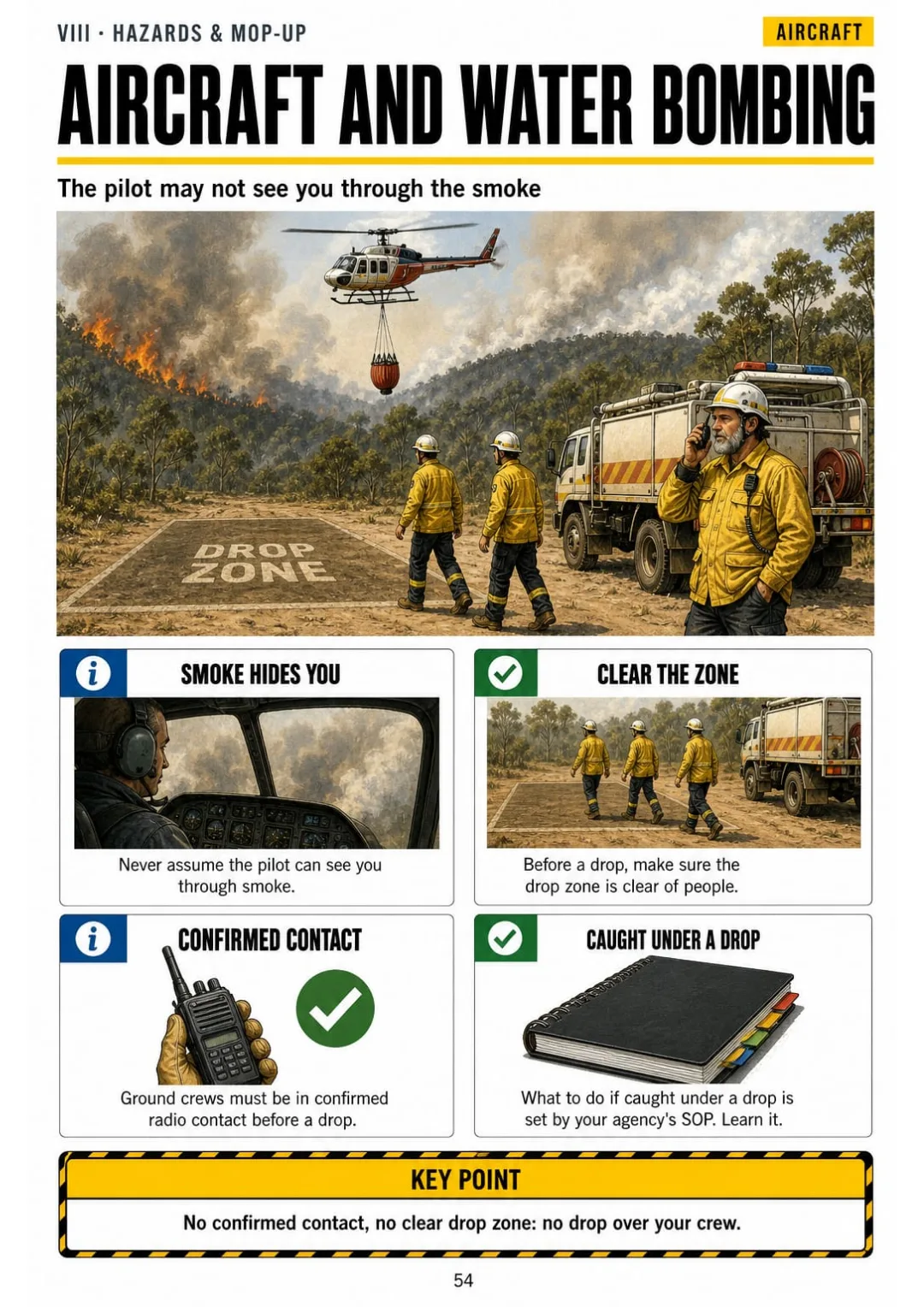
Before any drop: drop zone clear and ground crews in confirmed contact.
The book on one page: 10° uphill roughly doubles spread, 4 ratings plus No rating, LACES, burnover drill

Take a Look at the 9 Parts and 57 Topics

How Bushfire Behaves

pp. 5-14
  1. The fire triangle: heat, fuel, oxygen
  2. How heat travels: radiation, convection, conduction
  3. Fuel: fine, heavy and how much
  4. Fuel layers: surface, near-surface, elevated, bark, canopy
  5. Weather: temperature, humidity, wind
  6. Slope: why fire runs uphill
  7. The parts of a fire
  8. Spotting: embers ahead of the front
  9. The wind change: the flank becomes the head
  10. Grass fire vs forest fire

Fire Danger and Your Day

pp. 15-18
  1. The fire danger ratings: what each level means for you
  2. Total fire bans and the declared fire season
  3. Reading the day: morning, afternoon, evening
  4. Signs the fire is about to change

Your Kit and Your Body

pp. 19-23
  1. Personal protective clothing, head to toe
  2. Wearing PPC properly
  3. Water, heat and fatigue
  4. Smoke and your lungs
  5. Fit for the line: telling your crew leader

The Tanker

pp. 24-29
  1. Tanker categories at a glance
  2. Lockers and gear: where everything lives
  3. The pre-start check, in order
  4. The crew protection system
  5. Riding and moving safely
  6. Parking the tanker on the fireground

Hoses, Pumps and Water

pp. 30-37
  1. The pump: how it moves water
  2. Starting the pump, step by step
  3. Hose sizes and what each is for
  4. Couplings and connecting hose
  5. Branches and nozzles: jet, spray, fog
  6. Making water last
  7. Drafting and refilling
  8. Hose handling: laying out and making up

Working as a Crew

pp. 38-46
  1. Who's who: the crew and the chain of command
  2. Your role as a crew member
  3. The briefing: what you should hear
  4. LACES before you start work
  5. Escape routes and safety zones
  6. Anchor points and the direct attack
  7. Indirect attack, containment lines and back-burning
  8. Hand tools: rake hoe, McLeod, axe, drip torch
  9. Handover at the end of a shift

Radio and Messages

pp. 47-51
  1. Fireground radio basics
  2. How to make a radio call
  3. Plain language and the phonetic alphabet
  4. The situation report
  5. Emergency and priority calls

Hazards, Burnover and Mop-up

pp. 52-58
  1. Trees: the hazard you can't hear coming
  2. Power lines and electricity
  3. Aircraft and water bombing
  4. Vehicle burnover: the drill
  5. Burnover on foot
  6. Mop-up: blacking out the edge
  7. Patrol and the fire that comes back

Before the Season: Review

pp. 59-61
  1. The 15 most common mistakes on the fireground
  2. Your one-page pre-season checklist
  3. The whole book on one page

Who This Book Is For

You've just joined the brigade

Basic training covered a lot, fast. Here the tanker, the pump and your role in the crew get a page each, so it all settles in order.

The fire season is weeks away

You go over the pre-start check, LACES and the burnover drill at a glance, always in the same order.

You've done a few seasons

Print it and keep it in the cab to check the radio call format or the pump layout before you roll out, or to brief new members one page at a time.

Plus: 2 Free Books

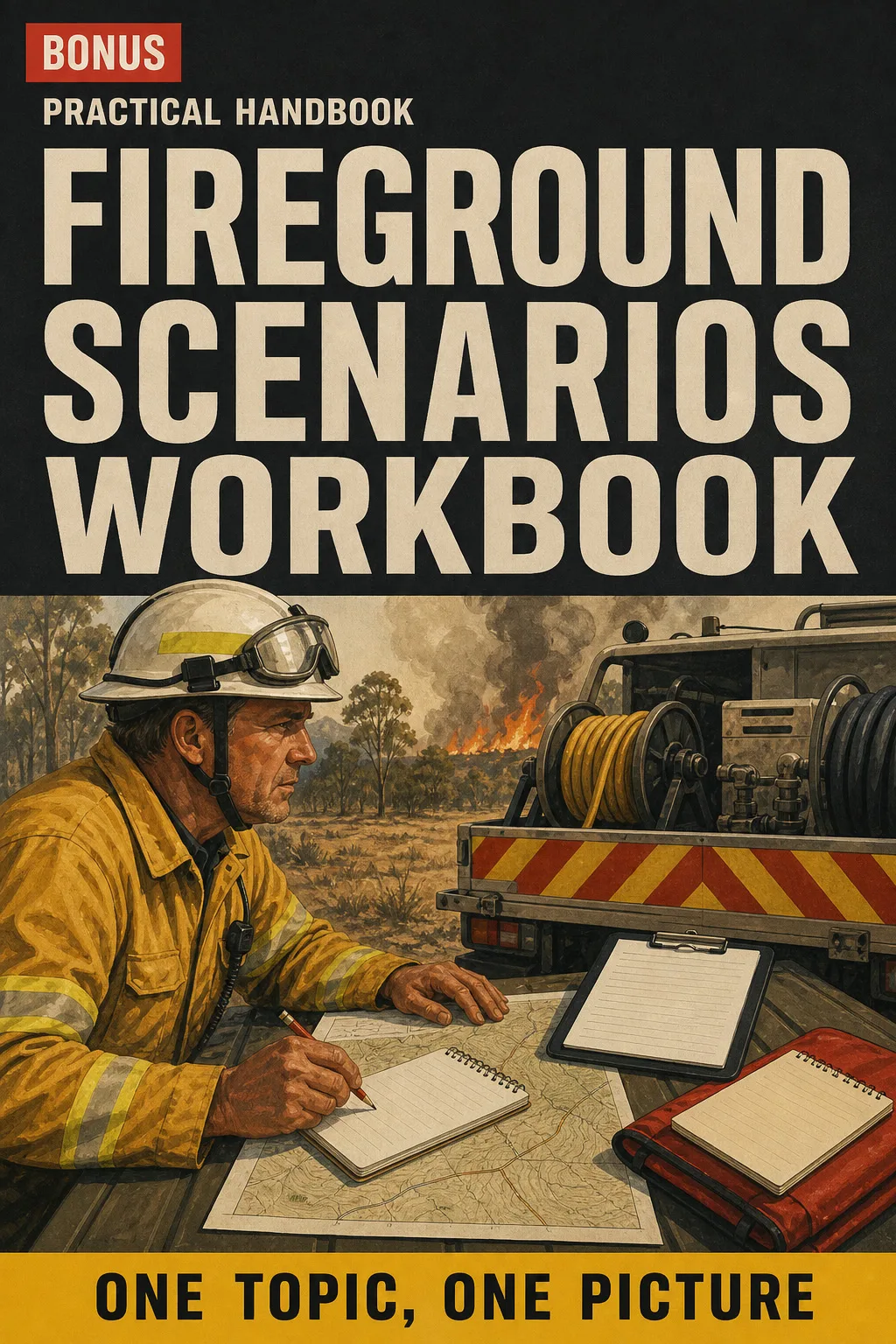
Fireground Scenarios Workbook
BONUS 1

Fireground Scenarios Workbook

Practise the decisions before the season: a drawn map, a wind change, a slope, and you work out the escape route, the safety zone and the radio call, with answers explained.
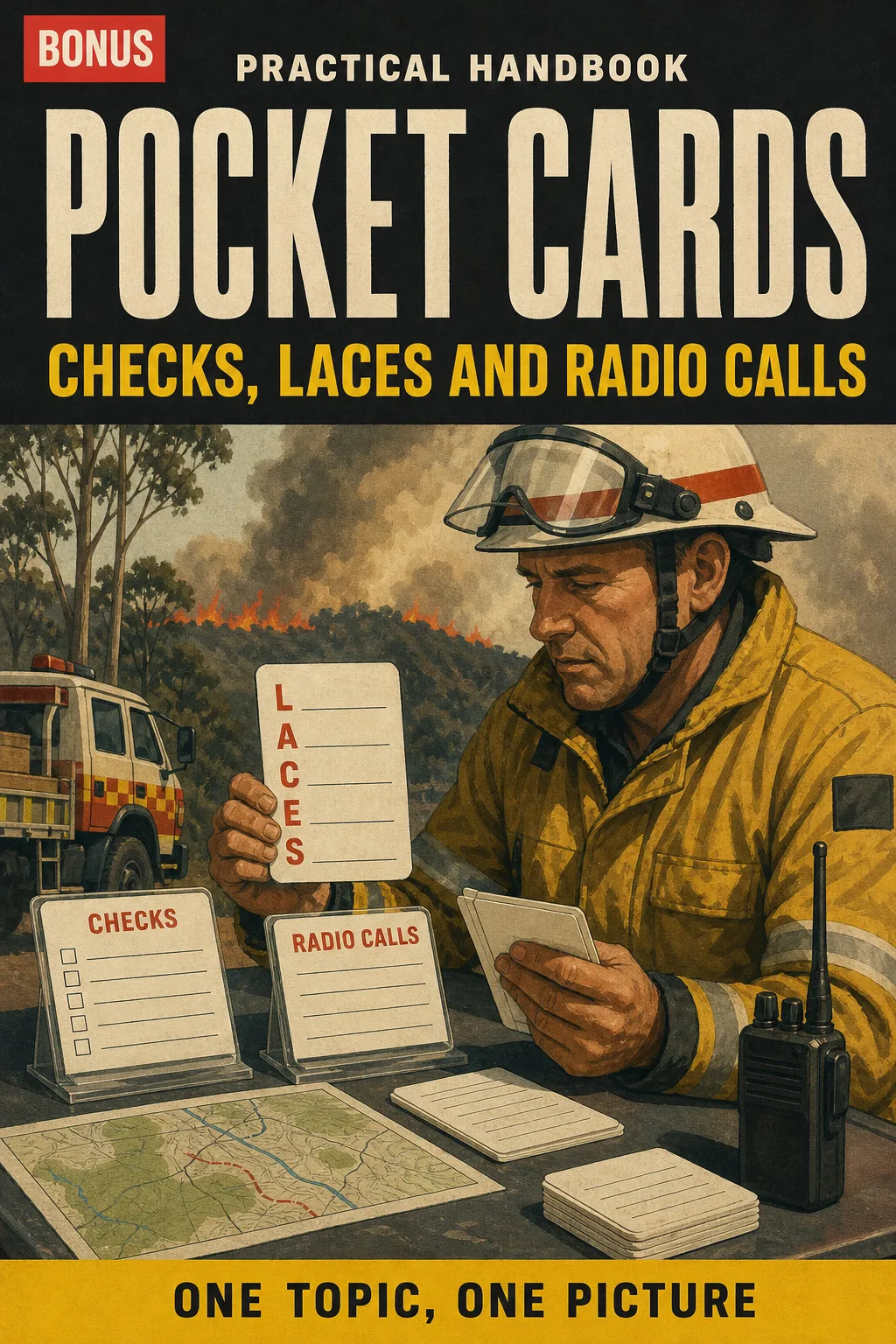
Pocket Cards: Checks, LACES and Radio Calls
BONUS 2

Pocket Cards: Checks, LACES and Radio Calls

The pre-start check, the LACES steps, the radio message template and the 15 most common mistakes on printable cards you can keep in the cab.

30-Day Guarantee

30-day guarantee: if a file doesn't open, if the content isn't what the product page describes, if you were charged twice or the email never arrived, write to us and we'll refund you in full. You pay once. No subscriptions.

Frequently Asked Questions

Is it for me if I've only just joined my brigade?

Yes, wherever your brigade is: NSW, Vic, SA, WA, Qld or Tas. It follows what's shared across Australia (the fire danger ratings, LACES, fire behaviour, the burnover drill), in metric units. Where your state names a tanker or a radio call differently, your brigade's SOPs come first. It starts with the fire triangle and builds up to crew work; if you've done a few seasons, it works as a refresher that goes in order.

Does it work in my state, and where does the content come from?

It's checked against current Australian guidance: the Australian Fire Danger Rating System, AFAC doctrine and the training material published by the state and territory fire services. It covers what's common to every state. Where your service does it differently, like tanker layouts or radio call signs, your brigade's SOPs come first.

Is it official material?

No. It's an independent study book. No fire agency issued, approved or endorsed it. Your brigade's SOPs always come first.

Does it replace brigade training?

No. It backs up the training and the hands-on drills you do with your brigade. It doesn't give you a qualification or count towards any brigade assessment. Back-burning is planned and led by the crew leader only.

Are the practice scenarios the ones from brigade assessments?

No. The scenarios in the workbook were written for this book. They aren't taken from any agency assessment.

When and how does it arrive?

As a PDF by email, sent to the address you enter at checkout. The 2 bonus books come with it.

Do I have to pay every month?

No. You pay once.

Can I have it on paper?

Yes. It's a PDF, so you can print it at home or at a print shop and keep it in the cab.

How does the refund work?

You have 30 days. We refund everything if the file won't open, if the book isn't what you see on this page, if you were charged twice or if the email doesn't arrive: just email us.

A$ 39A$ 89
Get the book · A$ 39

This is a digital PDF book sent to your email: nothing is printed or shipped.